❌

Reading view

Breaking the Ice: Origins of Carbon Oxides on Uranian Moons

Uranus close-up

For decades, astronomers have tried to decipher the source of carbon oxides on Uranus’s largest moons from ground-based telescopes. A recent study has leveraged JWST spectroscopy and laboratory experiments to identify carbon oxides and their origins for Ariel, Umbriel, Titania, and Oberon.

Unknown Origins of Carbon Oxide Enrichment

Forty years ago, the Voyager 2 spacecraft flew past Uranus and its twenty-seven moons, sending back prized portraits of the planet’s large and tidally locked satellites Miranda, Ariel, Umbriel, Titania, and Oberon. These images revealed extensive valleys, smooth plains, deep canyons, and possible icy volcanic (cryovolcanic) activity across the surfaces of the icy moons — the telltale signs of intense geologic activity. While Voyager 2 could take spectacular pictures, the spacecraft was not capable of identifying the molecules and materials making up these active surfaces.

Six largest moons of Uranus

Voyager 2 images of Uranus’s six largest moons. Click to enlarge. [NASA / JPL-Caltech / Ted Stryk; CC BY-NC-ND 4.0]

In the decades that followed, astronomers have used ground-based near-infrared spectroscopy of these moons to investigate their chemical compositions. These observations have detected weak carbon dioxide and hints of carbon monoxide ice features on the moons with clear spatial trends across the moons’ surfaces, but the origins of these carbon oxides remain unknown. There are two potential explanations for the presence of these molecules: 1) carbon oxides are native to the Uranus system, present from formation, or 2) they formed via radiolysis, in which charged particles trapped in Uranus’s magnetic field interact with water ice and carbon-bearing molecules on the moons’ surfaces.

Ground-based detections are limited due to contamination from Earth’s atmosphere as well as the overall weakness of the carbon dioxide spectral features, thus space-based near-infrared observations of the Uranian moons are necessary to better constrain the carbon oxides on the satellites. Luckily, JWST’s Near-Infrared Spectrograph (NIRSpec) now offers astronomers unimpeded access the moons’ carbon oxide spectral features.

Chemical Clues from Space and in the Lab

In 2024, a study acquired NIRSpec observations of Uranus’s moon Ariel, revealing prominent carbon dioxide features and confirming the presence of carbon monoxide ice hinted at by ground-based studies. Expanding on these observations to include Umbriel, Titania, and Oberon alongside Ariel, Richard J. Cartwright (Johns Hopkins University) and collaborators obtained JWST NIRSpec spectroscopy of Uranus’s four largest moons in hopes of disentangling the origin story of their carbon oxides.

Leading and trailing diagram

Diagram illustrating the leading and trailing sides of a moon orbiting Uranus. Click to enlarge. [AAS Nova/Kerry Hensley]

In addition to the JWST spectra, Cartwright and team performed laboratory experiments measuring the spectral properties of carbon dioxide ice over a range of very low temperatures (tens of kelvin). These experiments provided a better understanding of the spectral properties and nature of carbon dioxide on the surfaces of the Uranian moons. Comparing the JWST spectra with the laboratory spectra, the authors found that Ariel, Umbriel, Titania, and Oberon exhibit a variety of spectral features resulting from carbon dioxide ice, carbon monoxide ice, and other carbon-bearing molecules. The presence of these molecules varies between the leading and trailing hemispheres of the moons, these variations appearing strongest in Ariel and Umbriel. The carbon dioxide and carbon monoxide spectral features are stronger on the trailing hemispheres, decreasing with increasing distance from Uranus for all four moons.
spectral ratios

Spectral ratios of the trailing and leading hemispheres for each moon, labeling spectral features of multiple carbon-bearing molecules. Click to enlarge. [Cartwright et al 2026]

Carbon Oxide Origins

What does this mean for the origins of the carbon oxides on the Uranian moons? Spectral features of carbonate minerals and the widespread presence of carbon dioxide throughout the Uranus system suggest that these compounds exist natively. On the other hand, the concentration of carbon oxide features on the trailing hemispheres supports radiolytic production as these hemispheres are bombarded with more ionizing particles from Uranus’s magnetosphere.

Based on these results, the authors have postulated that both origin scenarios, native presence and radiolysis, are required to fully explain the presence of carbon oxides. Future laboratory studies and JWST observations will continue to reveal the nature and composition of bodies in the Uranus system, furthering our understanding of our solar system siblings.

Citation

“Tracing the Source of Carbon Oxides on the Large Moons of Uranus,” Richard J. Cartwright et al 2026 Planet. Sci. J. 7 199. doi:10.3847/PSJ/ae8818

The post Breaking the Ice: Origins of Carbon Oxides on Uranian Moons appeared first on AAS Nova.

  •  

Sept. 9, 1892: Edward Emerson Barnard sees Amalthea

When Edward Emerson Barnard peered through the 36-inch refractor at Lick Observatory on Sept. 9, 1892, and spotted Amalthea, it marked the first discovery of a moon of Jupiter in 280 years. Galileo had discovered the four largest jovian moons – Io, Europa, Ganymede, and Callisto – in 1610. Though this fifth moon was closerContinue reading "Sept. 9, 1892: Edward Emerson Barnard sees Amalthea"

The post Sept. 9, 1892: Edward Emerson Barnard sees Amalthea appeared first on Astronomy Magazine.

  •  

Aug. 17, 1877: Asaph Hall discovers Phobos

Astronomer Asaph Hall met Angeline Stickney at New York Central College in 1855. Two years his elder, she instructed him in geometry and German, and was reputedly so strong a mathematician that Hall and his classmate made a game of trying to stump her, yet never could. The pair were married the following year. ForContinue reading "Aug. 17, 1877: Asaph Hall discovers Phobos"

The post Aug. 17, 1877: Asaph Hall discovers Phobos appeared first on Astronomy Magazine.

  •  

Aug. 11, 1877: Asaph Hall discovers Deimos

After spending the 1850s at Harvard Observatory calculating orbits, Asaph Hall became an assistant at the U.S. Naval Observatory at Washington, D.C., in 1862. He was quickly promoted, and by 1873 had not only held several scientific discussions with Abraham Lincoln during the president’s visits to the observatory, but had also been put in chargeContinue reading "Aug. 11, 1877: Asaph Hall discovers Deimos"

The post Aug. 11, 1877: Asaph Hall discovers Deimos appeared first on Astronomy Magazine.

  •  

Assessing Biosignatures Beyond Abiotic Signs on Ocean Worlds

In the relentless quest to uncover signs of life beyond Earth, scientists have turned their gaze towards the mysterious realms of ocean worlds—icy moons like Enceladus, Europa, and Titan. These celestial bodies harbor vast, hidden oceans beneath their frozen crusts, creating environments that could potentially support life. Yet, the challenge remains daunting: distinguishing genuine biological signatures from complex abiotic processes that could mimic these signals. A groundbreaking study recently published in Nature Astronomy proposes a sophisticated quantitative framework designed to rigorously evaluate these abiotic baselines on ocean worlds, shedding new light on how future life detection missions might navigate this delicate terrain.

Ocean worlds have captivated astrobiologists not merely because they contain liquid water, a fundamental criterion for habitability, but also because they offer diverse chemical environments where life as we know it might exist. However, confirming the presence of life requires more than spotting chemicals commonly associated with biology; it demands a nuanced understanding of how non-biological processes could generate similar signals, muddying the interpretative waters. The novel framework developed by Higgins, Chen, Warr, and colleagues provides an unprecedented approach to dissect this ambiguity, employing Enceladus as a primary example to demonstrate its utility.

At the heart of the study lies the challenge of interpreting isotopic measurements, particularly of methane (CH₄) and carbon dioxide (CO₂), molecules widely regarded as potential biosignatures due to their roles in Earth’s carbon cycle. The study scrutinizes the isotopic ratios of these molecules, expressed as δ¹³C values, which reflect the ratio of carbon-13 to carbon-12 isotopes. Traditionally, biological processes tend to prefer lighter isotopes, leading to distinctive fractionation patterns. However, the researchers highlight that uncertainties inherent in abiotic chemistry within Enceladus’ ocean and vent systems can produce isotopic signatures overlapping with those produced by biological activity, thereby defying straightforward interpretation.

The implication is profound: future missions that might measure δ¹³C in carbon-bearing molecules emanating from Enceladus’ plumes could misinterpret data, either falsely declaring a biosignature or overlooking subtle hints of life concealed beneath abiotic noise. The framework thus urges caution against over-reliance on isotopic biosignatures without a comprehensive assessment of the abiotic baseline. This is a pivotal insight that recalibrates how missions might prioritize scientific instruments and analytical strategies aboard orbiters or landers.

Complementing isotopic analysis, the study explores amino acid chirality as an alternative biosignature. Chirality, the “handedness” of molecules, is a hallmark of terrestrial biology, as living organisms almost exclusively synthesize left-handed amino acids. Nevertheless, the researchers caution that abiotic synthesis of amino acids on ocean worlds, influenced by factors such as radiation, mineral surfaces, and catalytic processes, could yield racemic mixtures or even chiral excesses unrelated to life. This ambiguity necessitates robust characterization of abiotic organic chemistry before interpreting chirality as a definitive biosignature in extraterrestrial contexts.

Another layer of complexity arises from the physical and geological attributes of the ocean worlds themselves. The study emphasizes that factors like internal temperature gradients, rheology (the deformation behavior of the icy shell and underlying materials), and lithology (rock types beneath the ocean) significantly influence abiotic chemical pathways. Understanding these properties with finer precision could narrow the range of isotopic and chemical signatures attributable to non-biological processes, thereby enhancing the confidence in detecting life.

Central to reducing the abiotic baseline uncertainty is the challenge of constraining the internal temperatures of ocean worlds. The framework points out that if internal temperatures can be pinpointed within a range of about 10 to 100 degrees Celsius, models of abiotic chemistry become markedly more predictive. Doing so would help delineate which molecular signals likely stem from hydrothermal activity and mineral interactions rather than biogenic outputs. This underscores the vital role of geophysical observations, such as gravity mapping, heat flux measurements, and ice shell thickness determinations, in complementing chemical analyses.

Transport timescales within the ocean and the overlying ice shell also feature as critical parameters. The timeframe over which molecules or small organic compounds travel from the ocean floor to the surface can alter their chemical and isotopic signatures dramatically. For instance, longer transport times may lead to isotopic exchanges or degradation processes that obscure the original biosignature signal. Hence, understanding ocean circulation patterns and ice shell permeability is integral to accurately interpreting any detected anomaly.

Expanding beyond Enceladus, the framework’s holistic approach is applicable to other ocean worlds such as Europa and Titan, each with their distinct environments and chemical contexts. On Europa, for example, the ocean’s interaction with a silicate seafloor and potential radiolysis-driven chemistry creates a different abiotic baseline compared to Enceladus. Titan’s complex organic-rich atmosphere and potential subsurface oceans add further layers of chemical diversity. The framework enables tailoring of life detection strategies and biosignature interpretations to these distinct habitats.

The study’s methodology can also inform future mission design, influencing instrument selection, sampling strategies, and data interpretation pipelines. By anticipating where abiotic ambiguity is most pronounced, mission planners can prioritize measurements that either better constrain abiotic baselines or provide multiple independent biosignature lines of evidence. This may include coupling isotopic data with mineralogical, geophysical, and molecular chirality information to build a more integrated and less ambiguous picture of habitability.

Furthermore, the framework embodies a precautionary principle against false positives and false negatives. Past and ongoing searches for life beyond Earth have grappled with ambiguous signals, from Viking’s methyl chloride controversy on Mars to debates over methane on the Red Planet. The ocean worlds’ complex chemistry and challenging environments elevate this problem, making a rigorous, quantitative approach like that offered by Higgins et al. indispensable in the life detection toolkit.

Importantly, this work illustrates the multidisciplinarity essential in astrobiology. Geochemistry, planetary science, biology, and physics converge to piece together the puzzle of extraterrestrial biosignatures. The framework’s integrated perspective exemplifies the collaborative spirit needed to interpret subtle clues from distant worlds and avoid the pitfalls of isolated or oversimplified analyses.

Looking ahead, technological advancements in both remote sensing and in situ exploration promise to enhance constraints on ocean world environments, thereby sharpening the framework’s applicability. For instance, sophisticated flyby missions or landers equipped with mass spectrometers, isotopic analyzers, and chiral detection capabilities may provide richer datasets. Simultaneously, laboratory simulations and terrestrial analog studies will refine models of abiotic chemistry and kinetics under relevant conditions.

The impact of this research extends beyond ocean worlds to the broader quest for life in the cosmos. The principles of robustly addressing abiotic baselines and embracing interdisciplinary data fusion can guide biosignature evaluation on exoplanets and other planetary bodies where life’s chemical fingerprints, if present, might be similarly elusive or confounded by non-biological processes.

In conclusion, the study spearheaded by Higgins and colleagues fundamentally reshapes our approach to biosignature interpretation on ocean worlds. By proposing a quantitative, comprehensive framework that weighs biosignature potential against carefully characterized abiotic backgrounds, it sets a new standard for rigor in the search for extraterrestrial life. As humanity’s exploration of the Solar System’s ocean realms advances, this framework will be pivotal in ensuring that claims of discovering life are grounded in unambiguous, scientifically defensible evidence.


Subject of Research: Evaluation of biosignature potential versus abiotic baselines on ocean worlds in the Solar System.

Article Title: A framework for evaluating biosignature potential against the abiotic baseline on ocean worlds.

Article References:
Higgins, P.M., Chen, W., Warr, O. et al. A framework for evaluating biosignature potential against the abiotic baseline on ocean worlds. Nat Astron (2026). https://doi.org/10.1038/s41550-026-02893-8

DOI: https://doi.org/10.1038/s41550-026-02893-8

  •  

Hunting for Exomoons Around a Lonely Planet

illustration of an exoplanet and exomoon around a star

Editor’s Note: Astrobites is a graduate-student-run organization that digests astrophysical literature for undergraduate students. As part of the partnership between the AAS and astrobites, we occasionally repost astrobites content here at AAS Nova. We hope you enjoy this post from astrobites; the original can be viewed at astrobites.org.

Title: A Deep Search for Exomoons Around WISE 0855 with JWST
Authors: Mikayla J. Wilson et al.
First Author’s Institution: University of California, Santa Cruz
Status: Published in AJ

The “Moon”-umental Question

The solar system hosts hundreds of moons, ranging from volcanic worlds like Io around Jupiter, to icy objects like Enceladus around Saturn, to captured objects like Neptune’s retrograde moon Triton. Moons are essential to our model of how the solar system formed and also offer some of the best chances we have for finding life beyond Earth.

Astronomers also expect exomoons, or moons orbiting planets outside the solar system, to be abundant around other giant exoplanets. But how common are exomoons? How do they compare to the moons in our solar system?

In order to begin answering those questions, we must first detect an exomoon, which has proved difficult despite decades of searching by astronomers. Fortunately, JWST presents a new opportunity to uncover the exomoon population by looking at lonely free-floating planets as they drift through space.

Why Free-Floating Planets?

One proposed method for searching for exomoons is by looking for their transits in front of their host planets, characterized by the dips in brightness of the planet as the moon passes in front, blocking the planet’s light. Looking for exomoon transits around planets orbiting stars is quite difficult, as the bright starlight can easily drown out the small signals of exomoon transits. Free-floating planets solve this issue by removing the star entirely, increasing our sensitivity to such detections. (See this bite for a good review.)

The authors of today’s article directed the exomoon hunt towards the free-floating WISE J085510.83-071442.5 (or WISE 0855). It has the prestige of being the coldest known brown dwarf (250–285K) while also sitting at a relatively low mass (3–10 Jupiter masses). Notably, it is also one of our closest neighbors at a distance of only 7.4 light-years, making it ideal for high-precision observations despite its faintness. Even though brown dwarfs are technically distinct from planets, the authors opt to refer to companions around WISE 0855 as moons given WISE 0855’s “planetary-mass” status. (It’s complicated…)

Repurposing JWST Data… for Moons!

The JWST observations used in this study contain 11 hours of near-infrared (2.87–5.27 microns) time-series spectra originally intended to study water clouds and weather on WISE 0855. Time-series brightness monitoring can also be used for transit searches, which the authors take advantage of.

One complication is that WISE 0855 is variable, meaning its intrinsic brightness changes over time. Variability is likely driven by clouds and other dynamic processes within its atmosphere. So how do the authors distinguish between a passing moon and a turbulent atmosphere? The key idea is that variability is wavelength dependent, meaning that the brightness of WISE 0855 will fluctuate differently depending on the observed wavelength. In contrast, transits are “gray,” meaning that the same amount of light is blocked at all wavelengths, producing a consistent feature across the entire spectrum.

Finding Moons with Statistics!

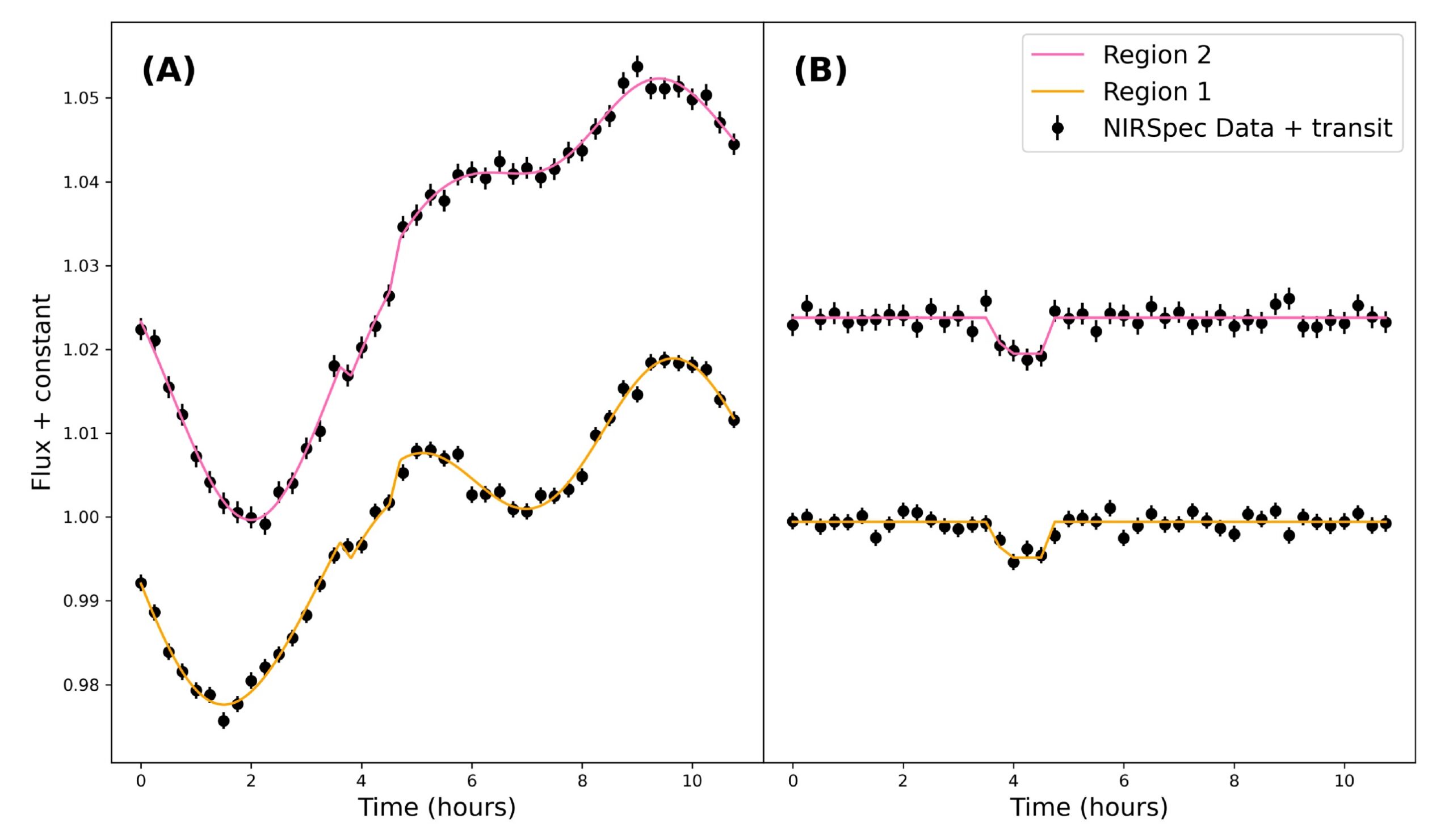
The authors apply this idea and pick out two wavelength regions of WISE 0855’s spectrum that contain two distinct variability patterns, which should both contain an identical moon transit signal (if present). They then generate a light curve (how brightness changes over time) for these two regions (see Fig. 1).

WISE 0855 light curves

Figure 1: (A) Light curves from two selected wavelength regions of WISE 0855’s spectrum with injected transit signals. Also plotted is the best-fit Gaussian processes + transit model for the two light curves. (B) Light curve data after subtracting the Gaussian processes portion of the best-fit model, revealing the example injected transit signals. [Wilson et al. 2025]

To appropriately model the variability, the authors employ Gaussian processes, a flexible tool that can model complex, quasi-periodic signals like atmospheric variability. They compare fits from two types of models:
  • Gaussian processes–only model: Assumes that all observed variability is intrinsic to the planet itself
  • Gaussian processes + transit model: Includes a simple trapezoidal exomoon transit signal that is simultaneously fit in both light curves

Using Bayesian evidence (a measure of how well each model explains the data), they determined which model was favored. So, what do they find?

The Bad News and the Good News

Based on Bayesian evidence, the authors conclude that there are no statistically significant detections of exomoons in the data. The results suggest very weak evidence for a ~0.53-Earth-radius moon at a wide separation from WISE 0855 — an unlikely scenario given that transit probability decreases at greater separations (and therefore longer orbital periods).

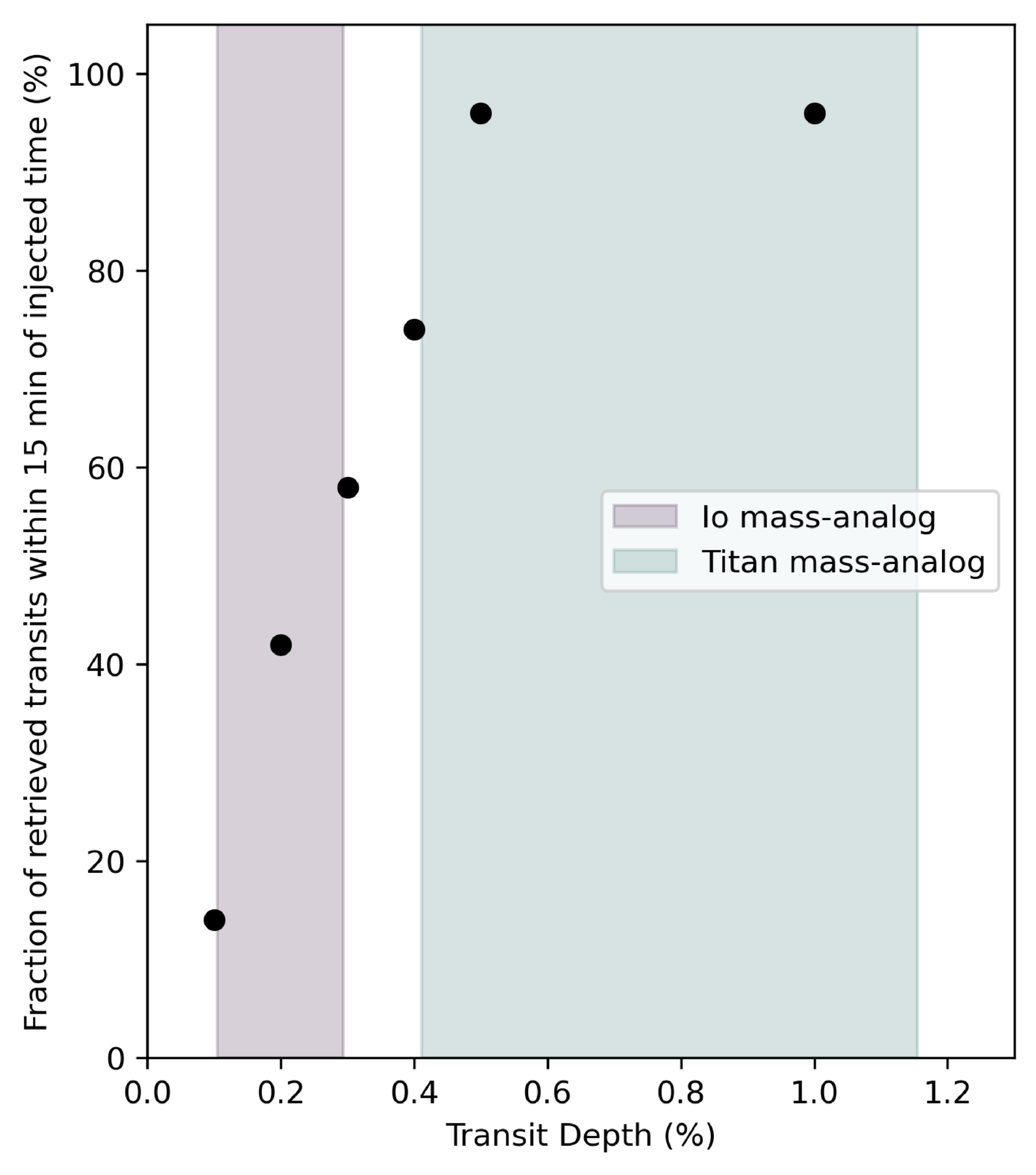
Yet, the study goes further: What kinds of moons is JWST able to detect, if any? To answer this, the authors performed injection and recovery tests, where they injected artificial transit signals of varying depths (exomoon sizes) into the data and tested how well their models were able to recover them (results shown in Fig. 2). They find that JWST is capable of detecting 96% of transits with depths ≥0.5%, equivalent to a Titan-like moon. Smaller Io-like moons were also detectable more than half of the time. This means that if a Titan analog had actually transited during these observations, we would almost certainly have seen it!

plot of successful detections of injected transit signals

Figure 2: Results showing the number of successful detections for the transit injection and recovery tests. Fifty transit injections are done for transit depths of 1%, 0.5%, 0.4%, 0.3%, 0.2%, and 0.1%. The transit depths represent different exomoon sizes, with the shaded regions representing Io-like and Titan-like moons. [Wilson et al. 2025]

JWST will continue to gather more time-series data of free-floating planets, brown dwarfs, and directly imaged exoplanets, each providing a new opportunity to help us better understand the moon population outside of our solar system. We’re still waiting for the first confirmed exomoon, but when that transit finally happens, we know that JWST will be ready.

Original astrobite edited by Kelsie Taylor.

About the author, Jared Bull:

I am a 2nd-year PhD student at Johns Hopkins University. I study brown dwarf variability and am interested in using time-series observations to uncover dynamic processes within their atmospheres. In my free time I like to read, cook, and do astrophotography.

The post Hunting for Exomoons Around a Lonely Planet appeared first on AAS Nova.

  •  

Finding Avatar’s Pandora: Exomoons with Astrometry

Illustration of a giant planet with a large moon orbiting a distant star

Editor’s Note: Astrobites is a graduate-student-run organization that digests astrophysical literature for undergraduate students. As part of the partnership between the AAS and astrobites, we occasionally repost astrobites content here at AAS Nova. We hope you enjoy this post from astrobites; the original can be viewed at astrobites.org.

Title: Astrometric Methods for Detecting Exomoons Orbiting Imaged Exoplanets: Prospects for Detecting Moons Orbiting a Giant Planet in α Centauri A’s Habitable Zone
Authors: Kevin Wagner et al.
First Author’s Institution: University of Arizona
Status: Published in ApJL

Six of the eight planets in our solar system host at least one moon; the innermost planets Mercury and Venus are the exceptions. The origins of these moons are widely studied and hotly debated. Earth’s very own moon seems to have formed in the aftermath of a collision between the young Earth and another protoplanet. Mars seems to have captured two asteroids as its moons, Phobos and Deimos, a process thought to have produced many of the irregular satellites orbiting the gas giants as well. Using our solar system as a model, the presence of moons seems like a natural outcome of planet formation.

Why then don’t we observe exomoons, moons orbiting any of the ~6,000 known exoplanets? Well, the largest moon in our solar system, Ganymede, is 2.5% as massive as Earth and has 40% of the radius, making it marginally larger than Mercury but still less massive. You might have heard how difficult it is to find Earth-like exoplanets, and finding exomoons is even harder. A few exomoon candidates have been announced via microlensing and transits, but the authors of today’s article investigate whether a different technique, astrometry, could help find moons.

Astrometry involves precisely tracking the positions of objects like stars or planets on the sky. In a simple star–planet system, the star and planet trace out ellipses around their shared center of mass. With a moon present, there is an additional deviation, as the planet wobbles to and fro due to the gravitational tug of the moon. The authors of today’s article check whether moons can be detected by tracking such wobbles exhibited by directly imaged planets.

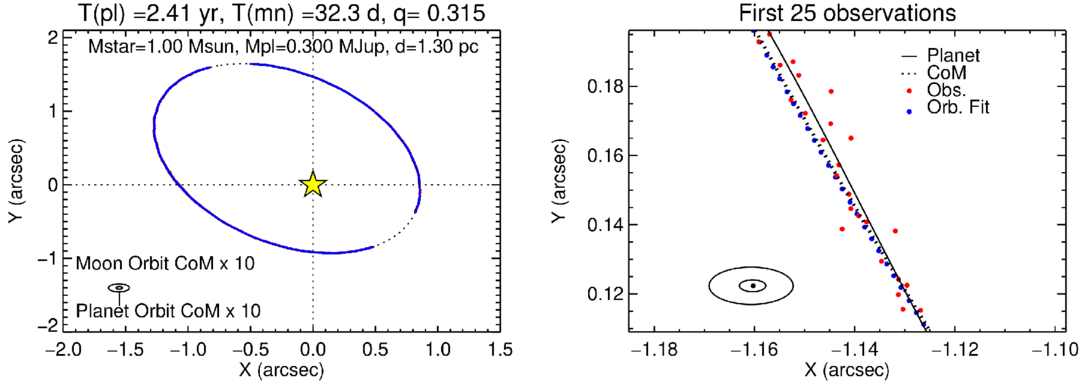
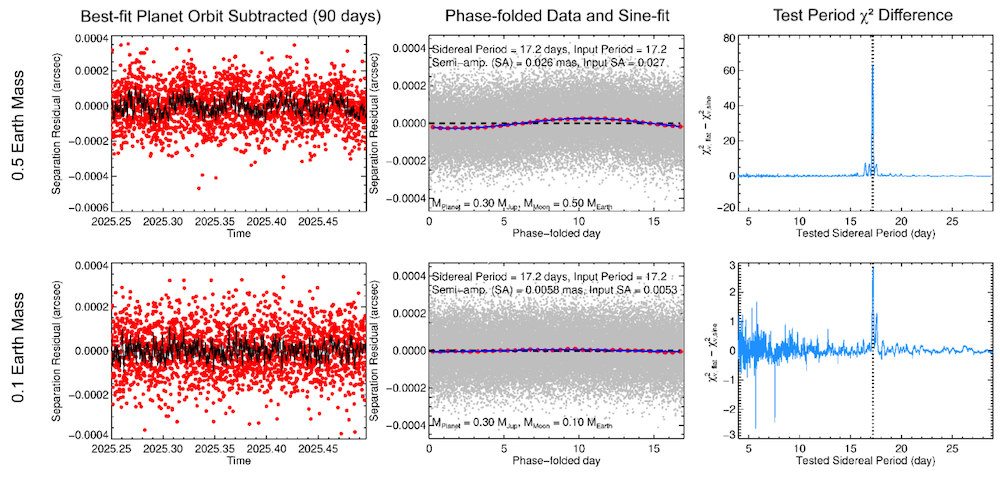
To start, the authors consider whether any known planets are promising targets for astrometric moon searches. There just so happens to be a giant planet candidate in Alpha Centauri, and if there were a massive moon orbiting this large planet around this nearby star, it would be as good as it gets. The authors simulate orbits of this system (a Saturn-like planet in a 1.8 au orbit around a Sun-like star at a distance of 4.2 light-years) with a 30-Earth-mass moon injected. They simulate observing such a system with a space-based 6.5-meter telescope (similar to the planned Habitable Worlds Observatory) with realistic noise over a 3-year observing campaign. The simulated and modeled orbits are shown in Figure 1. After the authors subtract the best-fit planet orbit, they are left with what is shown in Figure 2, where a clear periodic perturbation from the moon as it orbits is visible.

plots of the hypothetical orbit of a moon in the Alpha Centauri system

Figure 1: Left: The zoomed-out orbit of the hypothetical Alpha Centauri star–planet–moon system. The blue curve shows the Keplerian orbital fit. Right: The zoomed-in orbit. The red points are the simulated observations, showing deviations caused by the moon. [Wagner et al. 2025]

plot showing deviations in position of the planet’s orbit over time

Figure 2: Left: Deviations in position of the planet’s orbit over time. The red points show the simulated observations, and the black curve shows the data smoothed. Right: Zoom-in showing the moon’s effect on the planet’s motion. [Adapted from Wagner et al. 2025]

The authors then repeat this procedure with more realistically sized moons and a more optimistic observing campaign (5-year baseline, 1-hour observing cadence, precision of 0.1 milliarcsecond) looking at the Alpha Centauri giant planet candidate. They use the difference in the chi-squared (χ2) test statistic to determine whether the presence of a moon is statistically preferred. Figure 3 shows the moon-induced deviations for two different moon masses and the resulting χ2 difference. Using their χ2 difference threshold of ~5, the lowest-mass detectable moon is ~0.2 Earth mass. This is much more massive than the Moon, which is around 1% of Earth’s mass. The authors additionally vary the moon’s orbital period and find that periods of 4–30 days are detectable.
plot of periodic position deviations caused by a moon

Figure 3: Left: Moon-induced planet position deviations over the first 90 observing days. Middle: Deviations from the entire 5-year observing baseline folded around the best-fit moon orbital period. Right: χ2 difference as a function of period, showing a peak in the signal at the moon’s orbital period. [Adapted from Wagner et al. 2025]

The authors continue to consider more specific observing scenarios: a 39-meter ground-based telescope (similar to the planned European Extremely Large Telescope) and a 3-meter space telescope built specifically to find moons. They find that the ground-based telescope observing once per day could detect an Earth-mass moon around a Saturn-like planet over a 5-year observing campaign. The dedicated space telescope observing once per hour could make the same detection observing over 5 years. While detecting moons astrometrically is neither easy nor fast, it may be feasible to start finding moons around planets orbiting nearby stars in the coming decades.

All of this is great news for fans of the hit movie (and still the highest-grossing movie of all time) Avatar, which features a habitable exomoon in the Alpha Centauri system. Searching for moons will help us understand their properties and formation, probe whether our solar system is unique, and even look for life on rocky moons orbiting gas giants in the habitable zones of their stars.

Original astrobite edited by Ryan White.

About the author, Kylee Carden:

I am a PhD student at Johns Hopkins University, where I am an observer of planets outside the solar system. I’m interested in dynamics, disks, demographics, the Roman Space Telescope. I am a huge fan of my cat Piccadilly, cycling, and visiting underappreciated tourist sites.

The post Finding Avatar’s Pandora: Exomoons with Astrometry appeared first on AAS Nova.

  •  

A Close Look at an Ancient Moon

A photograph of a heavily cratered moon on a black background.

By piecing together observations from dozens of radio telescopes in Chile, planetary scientists recently completed the first-ever map of Callisto’s emission at millimeter wavelengths.

Old and Cold

In striking contrast to Io’s frenzied volcanism and Europa’s cracking ice shell, Jupiter’s moon Callisto is much quieter and colder than its Galilean siblings. Though a liquid water ocean hypothetically sloshes beneath its frigid surface, it’d be hard to infer that just by looking at the moon. Callisto’s terrain is ancient, static, and bears the scars of the millennia of exposure to space. There are no volcanoes, plate tectonics, or any other features to disturb what researchers call “evolved ruins” of the numerous craters. These have names like Valhalla, Asgard, and Lofn, since Callisto’s geologic features are named after settings and characters in Norse mythology to further reinforce their freezing existence.

This never-reset canvas makes Callisto an ideal laboratory for studying the long-term effects of asteroid impacts, dust accumulation from nearby natural satellites, and other processes that modify a planetary surface over time. One way to infer the composition and structure of the first few meters of material is to observe the way the temperature changes over the course of a day. For example, ice and rock respond differently to temperature changes; similarly, small-grains of either material warm up and cool down at different speeds than their larger-grain counterparts.

An image of a purple-orange blob against a black background.

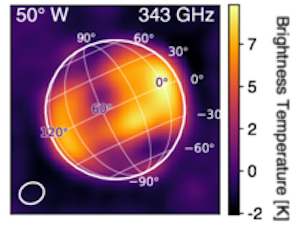
The residuals from one of ALMA’s observations of Callisto. [Adapted from Camarca et al. 2025]

In theory, planetary scientists can measure the temperature of a moon by noting how bright each patch of its surface appears in millimeter-wavelength observations. However, this is easier said than done, as only a handful of telescopes are capable of seeing Callisto as anything more than a fuzzy blob at those wavelengths. Back in 2016–2017, planetary scientists used the Atacama Large Millimeter/submillimeter Array (ALMA), a radio interferometer in Chile, to attempt the challenging feat of making a map of Callisto’s surface.

Mapping from Afar

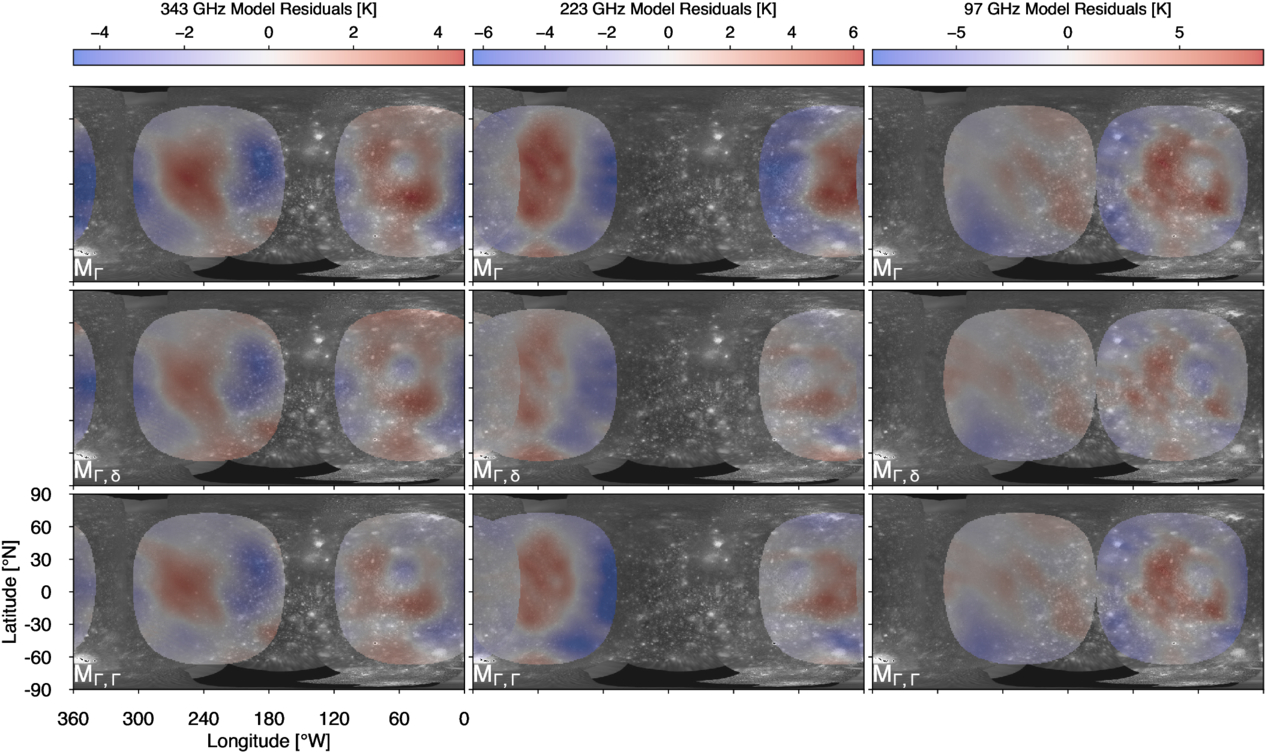
A team led by Maria Camarca, California Institute of Technology, just finished churning through all of the data and assembling their map of Callisto’s temperature residuals. Though the final spatial resolution was at best a few hundred kilometers, meaning a comparable map of Earth would blur all of New England together, this represents the most detailed thermal map of Callisto yet. The map was detailed enough to easily spot the largest craters, and several impact craters including Valhalla stood out as being 3–5K colder than all of the surrounding terrain. The team spotted another anomalously cold region that coincides with the location of maximum carbon dioxide gas density recently seen with JWST.

A multi-panel figure of a black and white surface beneath transparent red and blue blobs.

A map of Callisto’s thermal emission (red/blue) overlaid atop visible images of the surface collected by spacecraft. Click to enlarge. [Camarca et al. 2025]

The team also found that their data could not be explained by a simple model for Callisto’s surface that assumed one dominant material and structure. Instead, their images were better explained by more complex simulations that use two different thermal inertias. Though they are not sure yet why this may be, it is clear that Callisto, often overlooked compared to its flashier siblings, is a complex world worthy of further study. Luckily, the upcoming Jupiter Icy Moons Explorer mission and ALMA’s Wideband Sensitivity Upgrade will bring new knowledge of Callisto’s ancient surface.

Citation

“A Multifrequency Global View of Callisto’s Thermal Properties from ALMA,” Maria Camarca et al 2025 Planet. Sci. J. 6 183. doi:10.3847/PSJ/ade7ee

The post A Close Look at an Ancient Moon appeared first on AAS Nova.

  •  
❌