❌

Reading view

We are all managers now

Career paths for software developers have always been a touch problematic. 

Early on, you started out as a junior developer, and maybe there were ladder rungs that got you raises until you became a senior developer. But there was typically a ceiling to that, leaving you with little choice but to move into a management position if you wanted to continue to advance and make more money.

On top of that, promoting developers to be managers is often less than optimal for the company or the developer in the long run. Many of the qualities that make a good developer don’t always translate into being a good people manager. And certainly, many software developers want to continue to write code and not have to worry about the bureaucracy and paperwork that often comes with management. Plus, it hardly seems optimal to take your best coders and tell them to stop coding. 

The industry dealt with this by creating technical positions such as “Architect” and “Staff Developer” and “Chief Scientist.” That works well, but then these positions often lead to doing less programming and attending more meetings.

No matter what the title or role, the simple fact of the matter is that the more senior you get, the more you’ll be dealing with other people. “Tech Leads” have to supervise the work of other developers. Maybe you aren’t responsible for managing their careers or writing their performance evaluations, but you are responsible for making sure their code is up to snuff.

You’re the boss

It will come as no surprise that agentic coding changes this entire dynamic.

We don’t write much code anymore. And we are all too aware that coding agents aren’t perfect. Like humans, they make bad decisions, write bugs, and do things they weren’t asked to do. They need clear instructions, wise guidance, and the right working environment. You need to keep an eye on your agents to make sure they are on track and headed in the right direction. 

One might even say that you need to, ahem, “manage” your coding agents. 

And in that sense, we are all managers now. “A coding agent is most useful when you treat it more like an employee than an autocomplete tool,” says Jim Bourke, founder and CEO of Zide Software, producer of a development tool that treats developers more like managers than coders. “It needs a clear assignment, the right context, a safe place to work, checkpoints, and a way to evaluate the result.”

How you deal with coding agents isn’t all that different from how you would deal with a real live developer. You have an array of choices to make about who/what will write the code, what they will be building, and when their work can be called finished. You have to guide them, give them clear instructions, review their code, and decide when that code is ready to be checked in. 

Career twists and turns

All of that should sound pretty familiar to managers and individual contributors alike. In fact, one might argue that this is the job now — managing coding agents. Even the most junior of developers will be managing a “developer” in the future.

What does that mean for the career path of a person who manages coding agents all day? I hate to say it, but I don’t know and I don’t think anyone can say for sure. The set of skills required to successfully lead a “team of coding agents” compared to those needed to manage a team of real live people overlap, but they are not congruent. 

It may be that managing coding agents is an innate talent, leading to some junior developers suddenly outproducing seniors. Or maybe it will be a skill that needs to be carefully nurtured and grown under the mentorship of an experienced manager. It’s hard to say. And how the career ladder will look going forward, and exactly what skills will be rewarded, are questions I don’t think we can answer right now.

Everything is so new and changing so fast that it’s all a blur at this point. 

Wherever we may be headed, I don’t envy the person who will have to rewrite all those job descriptions.

  •  

Tech layoffs: A 2026 timeline

Among a range of factors leading to a wave of tech sector layoffs in 2026 is the rapid rise of artificial intelligence and automation. Companies are reconfiguring their workforces to leverage AI for increased efficiency and reduced operating costs. This realignment and reduction is implemented even by companies reporting strong financial performance.

But it’s not just AI leading to workforce cuts. Complementing this technological shift are ongoing economic uncertainty, inflation, and higher interest rates, compounded by a chip shortage and rising energy costs. This mix is driving companies to cut costs and streamline operations for increased efficiency.

According to data compiled by Layoffs.fyi, an online tracker that keep tabs on job losses in the technology sector, 123,941 tech employees were laid off at 269 companies in 2025. The site also reports that 71,981 government employees were laid off by DOGE alone, with 182,528 total federal workers laid off.

Here is a list — to be updated regularly — of some of the most prominent technology layoffs the industry has experienced recently.

Notable tech layoffs in 2026

  • Oracle (again)
  • Monday.com
  • Microsoft
  • Meta
  • Cisco
  • Cloudflare
  • Oracle
  • Atlassian
  • Salesforce
  • Amazon
  • Ericsson

Sept. 15, 2026: Oracle forecasts 33% increase in restructuring costs as new round of layoffs hits

Oracle began a new round of layoffs this week, sending early-morning termination emails to staff for the second time in six months. Oracle has made no public statement confirming the latest round of job cuts, but in a regulatory filing days earlier the company said it had set aside a further $700 million for restructuring charges, bringing the total charges this year to roughly $2.8 billion.

July 22, 2026: Monday.com cuts 20% of its workforce to restructure for the AI era

The company says the decision to cut 620 jobs isn’t about margins, but about creating a flatter organization built around AI agents, autonomous teams, and deeper customer engagement.

July 6, 2026: Microsoft cuts 4,800 jobs, primarily in sales and Xbox teams

As the company trims thousands of jobs, it’s also investing in embedded engineering teams and AI infrastructure. The layoffs come several weeks after the company offered 8,750 US employees voluntary retirement buyouts.

June 5, 2026: Tech industry cut 38,242 jobs in May, worst since 2024

AI was blamed for 40% of the job cuts in May, up from 7% in January, according to research by employment placement company Challenger, Gray & Christmas.

May 20, 2026: Meta cuts 8,000 jobs, around 10% of workforce

The cuts are expected to expected to hit Meta’s engineering and product teams the hardest, arriving as Meta pivots toward AI to boost efficiency across its organization, according to Yahoo Tech.

May 13, 2026: Cisco to cut nearly 4,000 jobs despite strong growth in AI, enterprise networking

Despite reporting positive financial news — including record third-quarter revenue of $15.8 billion, a 12% year-over-year increase — Cisco said it will eliminate almost 4,000 jobs.

May 7, 2026: Cloudflare to cut 1,100 jobs in AI-focused restructuring

About 20% of Cloudflare’s global workforce will be culled as the company pivots for the agentic AI era, Reuters reported.

April 1, 2026: Oracle to cut up to 30,000 jobs globally, putting enterprise support and roadmaps at risk

Oracle began laying off employees on March 31 in what could be the largest workforce reduction in the company’s history. Employees received termination emails at 6 a.m. local time with immediate system lockouts and no prior warning. (Note: in June, CNBC put the final layoff tally at 21,000.)

March 12, 2026: Atlassian cuts 1,600 jobs to fund AI and enterprise expansion

Atlassian will reduce its global workforce by approximately 10%, eliminating around 1,600 roles, as the collaboration software maker redirects capital toward artificial intelligence development and enterprise sales.

March 11, 2026: Tech layoffs surpass 45,000 in early 2026

A recent analysis by RationalFX found 45,363 job cuts globally so far this year—with roughly 68% or more than 30,000 occurring in the U.S. — highlighting ongoing workforce cuts even as many tech companies report strong revenue growth.

Feb. 10, 2026: Salesforce lays off staffers as executive leadership churn continues

Salesforce has reduced close to 1,000 roles earlier this month across teams, including marketing, product management, data analytics, and its Agentforce AI unit, Business Insider reported, quoting employees familiar with the matter.

Jan. 23, 2026: Amazon layoffs expected to disproportionately hit AWS and tech talent

As the market slows down, AWS and other Amazon units are preparing for another round of layoffs, which is expected to overwhelmingly impact tech talent. An email from HR leader Beth Galetti on Jan. 28 confirmed 16,000 job cuts.

Jan. 15, 2026: Ericsson plans to shed 1,600 jobs in Sweden

 Ericsson lans to cut some 1,600 jobs in Sweden, the telecommunications equipment maker said doubling down on recent cost-saving measures that have helped it weather a prolonged downturn in telecoms spending, Reuters reports.

Jan. 13, 2026: Meta plans to cut around 10% of employees in Reality Labs business

Meta plans to cut around 10% of the employees in its Reality Labs division who work on products including the metaverse, according to three people with knowledge of the discussions, according to The New York Times.

Layoffs in 2025

  • Cisco
  • Oracle
  • Windsurf
  • Intel
  • Microsoft
  • Crowdstrike
  • HPE
  • Autodesk
  • HPE
  • CISA
  • Workday
  • Salesforce
  • Meta

Global tech-sector layoffs surpass 244,000 in 2025

Economic uncertainty, elevated interest rates, and AI adoption have driven workforce reductions across tech companies worldwide, according to a RationalFX report.

October 28, 2025: Amazon to cut 14,000 jobs across company

Amazon will reduce its overall workforce by 14,000, cutting layers of management across the company and hiring in some areas to support its “biggest bets”.

August 18, 2025: Cisco and Oracle to cut hundreds of Bay Area jobs

Tech companies Cisco and Oracle are cutting hundreds of jobs across the Bay Area. Cisco will eliminate 221 positions at its Milpitas and San Francisco offices, effective Oct. 13. Oracle is reducing 101 positions in Santa Clara on the same date 

August 5, 2025: 3 weeks after acquiring Windsurf, Cognition offers staff the exit door

Cognition, the AI coding startup that acquired rival company Windsurf three weeks ago, laid off 30 employees last week and is offering buyouts to the roughly 200 remaining employees on the team, reports The Information.

July 25, 2025, Intel to lay off 22% of workforce, CEO Tan signals ‘no more blank checks’

Intel will reduce its workforce to 75,000 employees by the end of 2025 as new CEO Lip-Bu Tan implements sweeping changes designed to transform the struggling chipmaker

July 8, 2025, Intel layoffs begin: Chipmaker is cutting many thousands of jobs

Intel has begun laying off employees across the company. CEO Lip-Bu Tan told workers back in April to expect major layoffs at Intel in the coming months as the chipmaker slashes costs and overhauls its organization after years of technical setbacks and falling sales.

July 2, 2025: Microsoft will cut 9,000 workers

Microsoft will lay off about 9,000 employees, a source familiar with the workforce cut told CNBC.  The cuts will reportedly affect less than 4% of Microsoft’s global workforce and will impact different teams, geographies and levels of experience. This is the latest in a string of cuts the tech giant has made this year.

June 17, 2025: Intel looks to factory layoffs to return to profitability

Intel will lay off up to 20% of its manufacturing sector employees starting in July, according to media reports, as the company looks for options as it seeks a return to profitability. The cuts reportedly will be made around the world, but some of the layoffs will be closer to home, according to a report in The Oregonian citing an internal company memo from Intel manufacturing Vice President Naga Chandrasekaran.

May 7, 2025: CrowdStrike to lay off 5% of staff

CrowdStrike announced a plan to cut about 500 roles, roughly 5% of its workforce, to streamline operations and reduce costs. The cybersecurity company will incur about $36 million to $53 million in charges related to the layoffs

March 6, 2025: HPE cuts 2,500 jobs, remains committed to Juniper buy

CEO Antonio Neri told Wall Street analysts that HPE would begin implementing a cost-cutting program involving layoffs of about 2,500 employees over the next 18 months. HPE employs about 61,000 people worldwide.

Feb. 27, 2025: Autodesk to lay off 9% of workforce

Software maker Autodesk is laying off 1,350 staff. With the rise of subscription and multi-year contracts billed annually, and self-service enablement, it finds it needs fewer sales staff, CEO Andrew Anagnost said in a message to employees. And with its cloud, platform, and AI products proving most profitable, it’s concentrating its staff and investments there.

Feb. 27, 2025: HP to lay off 2,000 more

As part of an ongoing restructuring, HP plans to lay off up to another 2,000 workers. In recent weeks, the company has tried — unsuccessfully — to do away with telephone support staff by forcing callers to wait for at least 15 minutes if they refuse to use self-service support resources online. The company swiftly backtracked, but wider job cuts are still on.

Feb. 21, 2025: CISA lays off 130

Government employees get laid off too: In this case, 130 workers at the US Cybersecurity and Infrastructure Security Agency are being shown the door as a result of a DOGE decision. Cybersecurity experts are concerned that the cuts will harm the international collaborations that CISA has fostered, quite apart from their concerns about the security of the DOGE layoff process itself.

Feb. 5, 2025: Workday lays off 1,750

As it moves to invest more in AI and international growth, Workday is laying off 8.5% of its workforce and disposing of unused office space. Some analysts fear the cutbacks will affect the company’s customer service — unless AI can pick up the slack.

Feb. 4, 2025: Salesforce lays off over 1,000

At the same time as it’s hiring sales staff for its new artificial intelligence products, Salesforce is laying off over 1,000 workers across the company, according to Bloomberg. As of June, 2024, the company had over 72,000 employees, according to its website. Salesforce did not comment on the report. In 2024 the company reportedly laid off around 1,000 staff too, in two waves: January and July.

Jan. 14, 2025: Meta will lay off 5% of workforce

Mark Zuckerberg told Meta employees he intended to “move out the low performers faster” in an internal memo reported by Bloomberg. The memo announced that the company will lay off 5% of its staff, or around 3,600 staff, beginning Feb. 10. The company had already reduced its headcount by 5% in 2024 through natural attrition, the memo said. Among those leaving the company will be staff previously responsible for fact checking of posts on its social media platforms in the US, as the company begins relying on its users to police content.

Tech layoffs in 2024

  • Equinix
  • AMD
  • Freshworks
  • Cisco
  • General Motors
  • Intel
  • OpenText
  • Microsoft
  • AWS
  • Dell

Nov. 26, 2024: Equinix to cut 3% of staff

Despite intense demand for its data center capacity, Equinix is planning to lay off 3% of its workforce, or around 400 employees. The announcement followed the appointment of Adaire Fox-Martin to replace Charles Meyers as CEO and the departures of two other senior executives, CIO Milind Wagle and CISO Michael Montoya.

Nov. 13, 2024: AMD to cut 4% of workforce

AMD will lay off around 1,000 employees as it pivots towards developing AI-focused chips, it said. The move came as a surprise to staff, as the company also reported strong quarterly earnings.

Nov. 7, 2024: Freshworks lays off 660

Enterprise software vendor Freshworks laid off around 660 staff, or around 13% of its headcount, despite reporting increased revenue and profits in its fourth fiscal quarter. The company described the layoffs as a realignment of its global workforce.

Sept. 17, 2024: Cisco lays off 6,000

After laying off around 4,200 staff in February, Cisco is at it again, laying off another 6,000 or around 7% of its workforce. Among the divisions affected were its threat intelligence unit, Talos Security.

Aug. 20, 2024: General Motors lays off 1,000 software staff

More than 1,000 software and services staff are on the way out at General Motors, signalling that it could be rethinking its digital transformation strategy. In an internal memo, the company said that it was moving resources to its highest-priority work and flattening hierarchies.

August 1, 2024: Intel removes 15,000 roles

Intel plans to cut its workforce by around 15% to reduce costs after a disastrous second quarter. Revenue for the three months to June 29 stagnated at around $12.8 billion, but net income fell 85% to $83 million, prompting CEO Pat Gelsinger to bring forward a company-wide meeting in order to announce that 15,000 staff would lose their jobs. “This is an incredibly hard day for Intel as we are making some of the most consequential changes in our company’s history,” Gelsinger wrote in an email to staff, continuing: “Our revenues have not grown as expected — and we’ve yet to fully benefit from powerful trends, like AI. Our costs are too high, our margins are too low. We need bolder actions to address both — particularly given our financial results and outlook for the second half of 2024, which is tougher than previously expected.”

July 4, 2024: OpenText to lay off 1,200

OpenText said it will lay off 1,200 staff, or about 1.7% of its workforce, in a bid to save around $100 million annually. It plans to hire new sales and engineering staff in other areas in 2025, it said.

June 4, 2024: Microsoft lays off staff in Azure division

Microsoft laid off staff in several teams supporting its cloud services, including Azure for Operations and Mission Engineering. The company didn’t say exactly how many staff were leaving.

April 4, 2024: Amazon downsizes AWS in a fresh cost-cutting round

Amazon announced hundreds of layoffs in the sales and marketing teams of its AWS cloud services division — and also in the technology development teams for its physical retail stores, as it stepped back from efforts to generalize the “Just Walk Out” technology built for its Amazon Fresh grocery stores.

April 1, 2024: Dell acknowledges 13,000 job cuts

Dell Technologies’ latest 10K filing with the US Securities and Exchange Commission disclosed that the company had laid off 13,000 employees over the course of the 2023 fiscal year; it characterized the layoffs and other reorganizational moves as cost-cutting measures. “These actions resulted in a reduction in our overall headcount,” the company said. A comparison to the previous year’s 10K filing, performed by The Register, found that Dell employed 133,000 people at that point, compared to 120,000 as of February 2024. Dell announced layoffs of 6,650 staffers on Feb. 6, but it is unclear whether those cuts were reflected in the numbers from this year’s 10K statement.

See news of earlier layoffs.

  •  

Ask me anything: Kiefer Vermeulen – ‘We had to figure everything out on a shoestring budget and on a really challenging timescale’

Kiefer Vermeulen studied applied physics at Delft University of Technology in the Netherlands, where he did his master’s thesis at its QuTech research institute on the topological properties of Majorana quantum bits. He is now head of research at Delft Circuits, where he leads a team of quantum engineers developing the cabling and wiring needed for quantum-based devices.

What skills do you use every day in your job?

When I was at QuTech, I’d work on qubit systems using equipment that was sometimes worth several hundreds of millions of dollars. It’s now very different at Delft Circuits, which is a start-up company, where I have to get by with budgets that may be as little as few hundred dollars. So I need to take problems and condense them down into manageable work packages. After being a junior and then senior researcher at the company, I now lead a team of eight fantastic scientists and one of the most important skills for me is talking. I don’t just mean chatting – but really trying to figure out a problem by talking and listening to different stakeholders.

It’s vital to be able to communicate what might be a very niche understanding of a specific field to a wider audience

If you’re in academia and want to go into industry, it’s vital to be able to communicate what might be a very niche understanding of a specific field to a wider audience. If you can do that, then you can solve problems, which is what being in industry is all about.

What do you like best and least about your job?

I really like innovation. For anyone in industry, the aim is to make money, which means developing and selling products. At Delft Circuits, we make cryogenic cabling for quantum computing, but none of that technology previously existed. We had to do it all ourselves – figuring everything out on a shoestring budget and on a really challenging timescale. That to me is super exciting especially when you’re doing something for the first time ever. As for the least favourite part of the job, raising money – whether it’s to build a lab or a factory – is tough. I’m currently in Denver, I was in Taiwan a few weeks ago, I’ve got three or four meetings coming up elsewhere in the next few weeks because the speed at which you need to do things might even outpace the money you can get for selling the things you have. I also don’t like the sheer amount of e-mails I have to deal with. When I started at Delft Circuits, there were just four members of staff. But now we’re so much bigger, I might get 50 or 100 e-mails a day. I guess I could speed things up by feeding them all into AI but I can’t really do that as a lot of work is confidential.

What do you know today that you wish you knew when you were starting out in your career?

I wish I’d known how important communication is, whether that’s getting your ideas across – or understanding those of other people – and really being able to frame your expertise and explain it to potentially non-technical people. Trust is important too because in start-up companies you all need to rely on each other and work through problems together so that things come to fruition. I also wish I’d known to talk a bit less – and let the other person in a conversation come up with the answers that might be different to your own. When I started out, I always wanted to answer problems quickly – in fact, I had to do that because it was expected of me. But as I’ve started managing and leading teams, I’ve learned to give others the opportunity to go through the same type of brain puzzles and thinking that I went through myself.

The post Ask me anything: Kiefer Vermeulen – ‘We had to figure everything out on a shoestring budget and on a really challenging timescale’ appeared first on Physics World.

  •  

Can you futureproof your career by choosing an AI-resistant degree?

Humans will have to compete with AI-powered virtual employees in the near future. Here are our tips for the last human holdouts

Futureproofing your career with an AI-resistant degree is a tough ask, says Charlie Ball, an expert on graduate employment for Jisc, the UK’s higher education digital, data and technology agency.

“What you’re trying to do is futureproof a 45-year career in a time of rapid technological change – and that’s really quite hard to do. What’s likely is that jobs that hinge a lot on human, face-to-face interaction are unlikely to be replaced.”

Continue reading...

© Photograph: sturti/Getty Images

© Photograph: sturti/Getty Images

© Photograph: sturti/Getty Images

  •  

No, AI is not killing jobs for everyone, studies say

A slew of recent studies indicate that AI isn’t dramatically displacing workers. At the same time, there were no indicators that the fast-moving technology is creating a lot of jobs, even as AI skills remain in high demand.

Stanford University researchers in an August study found that any AI-related job declines were concentrated among young workers aged 22–25. But for older and more experienced workers that wasn’t the case.

“Claims of economy-wide AI-driven job losses are not visible in payroll data through June 2026,” the researchers said, citing ADP payroll information. Stanford partnered with ADP to conduct the research.

The decline for young workers is more often related to the automation of some work tasks by AI, as opposed to its use to complement work. In contrast, AI is more often used by experienced workers to augment what they do. 

According to the Stanford report, workers between 22 and 25 and employed in jobs highly exposed to disruption by AI are falling behind their older counterparts. Their employment levels in June were about 19% below the same age group in less-exposed occupations. That’s compared to where they would be if both groups had kept pace with each other.

“Experienced workers show no comparable gap,” the researchers said, adding that “this is consistent with recent reports of a worsening job market for entry-level workers.”

Employment of younger workers in AI-exposed jobs fell about 11% from late 2022, while the same age group in less-exposed jobs actually grew about 10%. “For older age groups, we find much less marked differences in employment growth across AI exposure quintiles,” the researchers said.

Stanford, which created a lab last year to study AI’s impact amid heightened fears of the technology’s economic effects, said its numbers were based on available indicators.

AI’s adverse impact on young workers has been well documented, with many of them laid off in the initial wave of AI automation. AI has also suppressed wages for entry-level workers.

AI was cited for 116,175 job cuts in 2026, but that number is declining. The technology  was blamed for 3,462 cuts in August, according to data from Challenger, Gray and Christmas.

It’s the “lowest monthly total since December 2025 when 142 cuts were attributed to AI,” the company wrote in a blog entry. The research firm also noted aggressive hiring plans for companies in 2027.

AI is adding value to companies in different ways, and humans are an important part of that process, said Michael Chui, a senior fellow at QuantumBlack, AI at McKinsey. “The night shift is real now,” he said. “People are sending off their agents to write code and checking in the morning.”

MIT late last year established an AI labor index to determine how agents are affecting the workforce. The school’s Project Iceberg looks at how the coordination and interaction with agentic AI changes how work is done.

Despite the disruptions, demand for AI-related talent continues to rise, tech industry consortium CompTIA said last week. About 320,000 job listings in August required AI-related capabilities, a 4.5% increase from July.

AI-related hiring is outperforming the broader tech market, with demand for AI skills up 96% year-over-year, said Kye Mitchell, head of Experis North America, which is part of ManpowerGroup.

“We’re seeing real growth…in marketing management and project management roles, suggesting employers are looking beyond the people building AI to the people applying it,” Mitchell said.

More broadly, the US economy added 162,000 jobs in August, according to US Department of Labor figures released last week. CompTIA noted that tech employment across all sectors rose by 86,000 workers in August.

But within the tech sector, 14,700 positions were cut, CompTIA said.

  •  

Suddenly I’m a Go developer

I guess I’m a Go developer now.

My first programming language was BASIC. My seventh-grade math teacher, Mr. Schulte, taught BASIC to us on Fridays. He gave us programming assignments for homework during the week. Some of us loved it so much we stayed after school to play games and create extra programs, including our own crude, text-based adventure games. I remember hearing a story about a crazy new language called Pascal that didn’t have line numbers. How in the world would that work?

Years later I became a Pascal programmer — an ardent one. So ardent, in fact, that I would argue for hours with Visual Basic developers on CompuServe, AOL, and Usenet, telling them how Turbo Pascal, and then Delphi, was clearly a superior language. I was completely self-taught — if you count all the help that others gave me as teaching myself. I wrote shareware, became pretty competent, and eventually started helping others. 

People would tell me I should branch out and learn other languages — C++ or C#. But I wanted to be a master of one instead of a jack of all trades. Besides, we were all Windows developers and there was no better tool for writing Windows applications than Delphi. It became a point of pride for me, and I would stick up for Delphi and its company Borland no matter what. It got so bad that my friends would tease me, calling me “Baghdad Nick” after the famously optimistic Iraqi foreign minister during the Iraq War. 

Delphi by day

Looking back, I was foolish. I did become a pretty good Object Pascal programmer, but I would have benefited from learning JavaScript or a functional language. I did eventually learn TypeScript and a bit of C#. (I guess I was following Anders Hejlsberg around…) 

But if you were to ask me to this day what kind of code I write, I’d say I’m a Delphi developer. Indeed, that is my day job. I understand Delphi deeply, knowing all the nuances and insider tricks to making the language my own.

But over the course of a day or two, I’m now a Go developer, too. 

If coding all day isn’t enough, I have taken on a side project for a friend. I’ve been writing Delphi code for him for a while, but now he wants to shift gears. He has asked me to build a cross-platform application for his company written in Go and Wails Version 3. Now, I’m no Go expert. In fact, I only have a passing familiarity with the language. I can decipher what is going on, but I’m far from understanding the intricacies of what makes Go tick.

But that doesn’t really matter anymore, does it?

Claude bootcamp

I asked Claude to give me a tutorial on Go and Wails. It did a great job, quickly bringing me up to speed on the basics. (How cool is it that you can so easily turn a struct into a JSON object?) I described what I wanted, and asked for recommendations for libraries. The project uses Go for the “back end” and React on the “front end.” (I use the quotes because those “ends” are actually all built into a single binary.) 

In about an hour I came to understand the architecture and got a basic application up and running. I told Claude what I wanted, and it obliged. I described the basic data structures and objects needed, and Claude wrote them quite elegantly. I didn’t actually write a line of code, but there the project was, in all its glory. Go, TypeScript, and HTML. 

Claude managed the Git repository and even created a nice little CI/CD pipeline for me, building binaries for Mac, Linux, and Windows, all in one step.   

I went from being basically ignorant of the Go language to having a moderately sophisticated application in a day.

The thing is, I’m still not that good at Go. Not that good at all. But I’m a Go programmer nonetheless. Maybe next weekend I’ll become a Python programmer.

  •  

Finding careers in STEM and the weirdness of AI

This episode of the Physics World Weekly podcast features two conversations. The first is with career consultant Alaina G Levine who gives advice on how to build a “unicorn career” in science, technology, engineering, and mathematics. Our second guest is the optics and artificial-intelligence researcher Janelle Shane who writes extensively about the absurd, and often hilarious, side of AI.

Levine’s latest book is called Create Your Unicorn Career and Shane writes about artificial intelligence on her blog  AI Weirdness.

This podcast is supported by American Elements, the world’s leading manufacturer of engineered and advanced materials. The company’s ability to scale laboratory breakthroughs to industrial production has contributed to many of the most significant technological advancements since 1990 – including LED lighting, smartphones, and electric vehicles.


The post Finding careers in STEM and the weirdness of AI appeared first on Physics World.

  •  

From student to scientist – how to build a career with physics

Whether it’s cosmology, quantum mechanics or particle theory, most of us go into physics because we’re fascinated by the universe and its mysteries – and not because of the career options it might lead to. In fact, by the time you’re at university, you’re so snowed under with lectures, labs, coursework and tutorials – not to mention having fun – that there’s almost no time to think about what to do after graduating.

It doesn’t help either that most university staff are only familiar with careers in research, and so aren’t the best career mentors for physics students exploring the many options outside academia. That’s why Physics World has published countless careers articles over the years looking at what physicists do after they graduate – not just in research but also in industry, finance, teaching, IT and engineering. Each year we also gather many of these into our annual Physics World Careers guide – which includes a directory of employers seeking physics graduates.

But when the time comes to look for a job or plan your next steps, you won’t want to plough through every guide we’ve published. So to help you through the maze of options, this article brings together all our tips, information and help in one place. In today’s tough job market, a physics degree is an absolutely fantastic thing to have, giving you a deep technical knowledge and an ability to think rigorously. But before even starting to apply for jobs or courses, you first need to sit down and think hard about what it is that makes you happy and fulfilled in life.

Stop and think

As Crystal Bailey from the American Physical Society advised in a 2025 Physics World Live discussion “Not sure what to do with your physics degree? Our expert panel give their careers advice”, first ask yourself what it is you want for your career and your life. Do you prefer theoretical questions or practical problems? Do you like working alone or with people? Do you want a good work–life balance, a flexible schedule or just to make pots of money? “You need to understand what will be a good match for you,” she advises.

We suggest you do this kind of self-reflection long before you expect to graduate – don’t leave it to the last minute when you’re short of time. It also helps to make an audit of all the “soft skills” you have as a physicist, of which there are 16 different kinds. From being able to manage your time, knowing how to communicate or sort out conflict, these attributes are just as important to employers as your technical prowess.

Young man looking at a collection of sticky notes on a noteboard
Think for a minute Before even starting to apply for jobs, first reflect on what it is you want from life. (Courtesy: iStock/Layla Bird)

The “hard” skills you gained while studying – such as knowing how to solve a differential equation or line up mirrors on an optics bench – are easy to provide evidence for, from the modules you took, or the lab work you did. But the other more nuanced and practical skills – such as presenting in front of your peers, writing reports or keeping to deadlines – are just as crucial.

While you’re still at university, it also helps to take advantage of the huge amount of talented people you’re surrounded by – or as Katie Perry, a physicist who works at the Daphne Jackson Trust, once put it, “network like crazy”. Scientific meetings, talks and conferences are a great place to do this, where our tip is to devise an “elevator pitch” – a short and pithy statement of who you are. If someone asks you about yourself, you can then confidently reel off a few well-considered words.

Networking doesn’t necessarily come easy so if you find it awkward, you just need to get out there and practise. As science communicator Claire Malone believes, networking doesn’t have to be scary and something that only super confident people excel at. Learn to ask questions, be a good listener, take an interest in other people – and remember to ask for their business card so you can contact them later.

And our final piece of advice before even brushing up your CV or creating a LinkedIn page is to get a sense of the current job market for physics. It always goes through ups and downs, with the rise of artificial intelligence (AI) causing huge uncertainty right now. But overall there are some constant characteristics to the physics jobs market, as you can find out in a 2023 Institute of Physics report, which is packed with information about the UK physics jobs market by size, location and salary.

From reflection to action

So now you’ve done all that self-reflection, analysed the job market, audited your soft skills, and had a go at networking, it’s time to start applying for things to do after you graduate.

A number of you might be considering a PhD and, if so, we have some specific advice just for you (see “The PhD pathway” box below). But more than half of today’s graduates move into the private sector and pursue industry careers instead. If that’s your target, plan ahead by spending a summer interning at a company and try to find the right mentor for you. It’s also a good idea to do some extracurricular activities beyond your core academic aims, which will help you develop a range of transferable skills that can help you switch into a different area beyond physics.

The PhD pathway

Cartoon illustration of academia, with books, pens, coffee, caps and gowns and students
(Courtesy: iStock/elenabs)

For graduates who choose to remain in academia, and have found a PhD position, resilience and critical thinking are key skills to have. While it can be exciting and fulfilling to do your own research for the first time, completing a PhD is challenging. Most people have tough moments during a PhD, but people don’t often share their difficulties and it’s easy to think you’re the only one struggling.

Creativity is the backbone of scientific success so, if you’re doing a PhD, take the time to have a break and let new ideas come to light. Things can go wrong – from funding cuts to global pandemics – and it’s important to make sure that you value your mental health and don’t burn out. If you are one of the many neurodivergent people in science, it’s a good idea to ensure you have the accommodations necessary for success, and to embrace your diversity and the unique perspective you bring to your work.

Once you have completed all your research and gathered your data, the final step is to write your thesis – which can be a particularly stressful task, so its important to find different ways to motivate yourself and complete that final hurdle. Even if you don’t stay in academia, a PhD will teach you a lot about how to get ahead under your own steam and complete a major piece of work on your own.

A degree in physics opens doors into many different fields, from nuclear energy to quantum and beyond (see “Across the physics careers spectrum” box below). You might also be keen to use your physics skills in a more lateral way, whether in scientific patent law or science communication. You may choose to be an entrepreneur and set up your own business or decide to teach future generations of physicists. Remember, if your original plan doesn’t pan out as you imagined, it’s never too late to take a risk and make a change even at a later stage of your career.

Across the physics careers spectrum

Six images illustrating renewable energy, quantitative finance, a chessboard, the human circulatory system, quantum computing and nuclear fission
Take your pick From medical physics to green energy, and everything in between; your physics degree offers you many options. (Top row: Shutterstock/hrui; iStock/peshkov; Shutterstock/shaneinsweden. Bottom row: Shutterstock/Yevhen Vitte; iStock/chayanan; iStock/Peter Hermes Furian)

Green energy and sustainability: Physics graduates are ideally placed to tackle the world’s environmental challenges, with their technical knowledge and problem-solving skills. You can find out more about the physicists who are doing their bit to build a greener, more sustainable future in the field of decarbonizing energy sources.

Quantitative finance: With strong mathematical and analytic skills, physicists are a great fit for the financial world, and are often in high demand in quantitative finance in particular. Meet five physicists who pivoted to a career in finance, and explore what physics skills they use day to day.

Intelligence and cyber security: If a challenging but rewarding career is what you are looking for, you may want to consider a role in security. Here you can find out more about the careers of two leaders from GCHQ – the UK’s intelligence, security and cyber agency – with a background in physics.

Medical physics: Medical physicists have a wide variety of roles across academia and industry. From clinical research and medical imaging to computational simulations and testing new scanners, many job options for medical physicists around the world are included here.

Quantum: The quantum sector is thriving and there are numerous roles across the four main pillars of quantum computing; quantum simulation; quantum communication; and quantum sensing and metrology. From industry to academia, government and policy, and education;  there are many ways to join the revolution.

Nuclear energy: With the push away from fossil fuels, there is a shortage of skills in the nuclear power sector. Here we speak to six physicists working across the nuclear energy industry – from design and construction, to safety and waste and beyond – highlighting how a background in physics can open many doors in this expanding sector.

The overall picture for all of you graduating with a degree in physics is positive. Physicists all over the world are keen to help solve some of humanity’s biggest challenges and help further our understanding of the universe at large. We hope that all of the resources above – alongside the annual Physics World Careers guide, the Physics World Jobs Hub and the Physics World LinkedIn page – will give you the headstart you need in planning your path and building a fulfilling career.

The post From student to scientist – how to build a career with physics appeared first on Physics World.

  •  

Honor Powrie: 10 things I wish I’d known (or done better) when I started my career

When I went to university, I didn’t know what kind of career I wanted to pursue. I’d originally applied to study geophysics, but after a few weeks realized mineral exploitation wasn’t my thing and quickly switched to maths. Then, at the end of my first year, I had a range of degree options open to me and, whilst I preferred (and was better at) maths, I just didn’t feel it was my best choice for a career.

So I decided to switch again, this time to physics. During my degree, a few friends and I joined the Student Industrial Society (now known as the Bright Future Society). It gave us the chance to visit a range of companies – from micro-breweries and wine importers to TV studios, nuclear-power stations and semiconductor manufacturers. We also went to Llanwern steelworks in South Wales, where a closing session with a British Steel careers advisor really shook me up.

A feisty Yorkshireman, he started off by directly asking each of us what we planned to do after university. We were all put on the spot and our answers, which were embarrassingly unsure, failed to impress him. The advisor firmly suggested that if we didn’t know what our plans were by now, we had better find out before it was too late. For me, it was a wake-up call and when I got back to campus, I went straight to the careers office and started applying for summer student placements.

To my amazement, and despite my lack of experience, I was offered several positions and decided to take a summer job in Malvern at the Royal Signals and Radar Establishment, which is now part of the private defence-technology firm QinetiQ. Somehow, I managed to find something useful to work on and after 12 weeks had done enough to be as included as co-author on a peer-reviewed publication.

Summerlove sensation

After the placement, I continued with my physics degree, but began to feel something about physics wasn’t quite right for me. Whilst I loved the classical side of the subject and the real-world applications, I struggled with the less visible aspects, such as quantum and nuclear. So after a final-year project investigating the aerodynamics of cars – and finding myself more interested in my housemate’s mechanical engineering course – I wondered if I might be better suited to a career in engineering.

On the back of this growing interest, I applied to do a PhD in high-speed aerodynamics at the University of Southampton. My final-year project – coupled with my grounding in physics and the fact that I had a journal publication to my name – must have impressed my future supervisor, who picked me for the project. I had a great time on my PhD, which proved I loved engineering – particularly aerospace.

After four years in research, I realized an academic career wasn’t for me. But my PhD proved handy as it led to me getting a job with a small business called Stewart Hughes Ltd, which built vibration-monitoring equipment for use on mechanical machines. The company was looking for people with an academic background whose presence could help secure US government research funding. It turned out to be a sound strategy, as the firm built up a significant track record in winning high-value government grants.

My advice to you

These days I work a lot with interns and science or engineering students, who often ask me about my career path. As you can see, it wasn’t straightforward – and I believe a lot of people struggle making choices early in their careers. It’s easy to think you need to have everything mapped out in advance, which is rarely how things pan out. With that in mind, here are a few tips if you are starting out on your own career journey.

Top 10 tips

1 Even if you’re not sure what’s right for you – just try things out. Visiting industrial sites or attending topical lectures is great, even if it doesn’t lead to any work experience.

2 Be honest about what you like and don’t like – and don’t be afraid to change direction if things don’t feel right.

3 Be prepared to stretch yourself to find out more. Go outside your comfort zone.

4 Remember your degree subject may not be the most important thing unless you’re aiming for a career needing specific vocational training to get in. It’s far more important to study a subject you enjoy.

5 Get yourself a mentor who can be a constant in your career. They don’t have to be more senior to you; they could be a peer or someone more junior (i.e. a “reverse mentor”).

6 It’s fine if you enjoy doing lots of different things – but it doesn’t mean you have to do them all at once.

7 Being happy in what you do is more important than ultimate career goals.

8 Career opportunities don’t arise exactly when you’d like them to so be prepared to jump in or try different options if they pop up. A lateral move can be just as effective.

9 Don’t be afraid to nominate yourself for awards and prizes. An award will look good on your CV and there are a surprising number of opportunities.

10 Network and use your friends’ and peers’ experience.

Doing the rounds

One interesting bit of advice was once given to me on a career session led by a senior human-resources executive who works for a global corporation. The exec told us how he’d been having a golf lesson and was about to hit the ball down the fairway when the coach stopped him and asked where he was aiming. After explaining he was hoping to land the ball on the green, the coach shot back: “Yes…but where exactly on the green?”

Set your goal, do your best to reach it, and don’t worry too much about potential pitfalls.

Obviously the exec said he wanted to get a hole in one, but he was also trying to avoid the bunker and the long grass. The coach went on to explain that golfers should aim at the target and not be distracted by obstacles. Stay focused and the ball will land at or near the target. The exec saw this as the perfect analogy for one’s career: set your goal, do your best to reach it, and don’t worry too much about potential pitfalls.

Now that’s easier said than done – in fact, my career journey has not been the epitome of this advice. There have been bumps and detours along the way, which haven’t necessarily been through lack of focus, but because it took me time to discover what I really wanted to do. To stretch the golf analogy to breaking point, my first green might have not been great, but I’ve certainly had fun making it round the course.

The post Honor Powrie: 10 things I wish I’d known (or done better) when I started my career appeared first on Physics World.

  •  

Careers at the frontier of space technology

Multinational missions Ariane 6 is the latest rocket in a long history of launchers – demonstrating the power of multinational co-operation for more than five decades. More than 3000 staff are working at ESA to implement space missions for exploring the universe, protecting our planet or serving our daily life. (Courtesy: ESA)

The European Space Agency (ESA) is globally recognized for its iconic space missions that push the boundaries of science and technology, whether it’s a rendezvous with a comet, landing a probe on Saturn’s giant moon Titan or mapping the stars of the Milky Way in unprecedented detail. But ESA does so much more than these headline-grabbing scientific and exploratory endeavours.

“Space is no longer solely a playground for curious minds,” says Eric Wille, ESA Head of the Opto-Electronics Section. “It’s really important for our everyday life too.” In fact, modern society relies on space technologies.

Project management The ESA Optical Ground Station in Tenerife is used to develop laser technologies for high-speed data links or quantum communication. The laser beam projects a guide star to control an adaptive optics system that improves the beam quality of the optical communication link. It is one of several ESA laboratories managed by Eric Wille and the opto-electronics section for testing optical systems for space. (Courtesy: ESA)

Satellite-based environmental monitoring, weather forecasting and global navigation are obvious examples, but there are many other important applications. For instance, the global financial system could not function without atomic clocks aboard satellites time-stamping millions of stock trades and digital payments every second. Similarly, when natural disasters strike, satellite networks become essential lifelines: mapping floods, tracking wildfires and helping with the co-ordination of emergency response efforts on the ground.

Fulfilling all of these roles and ESA’s bold space ambitions – from seeking answers to big questions about the universe to watching over our precious planet – requires a highly dedicated, technically proficient and multi-skilled workforce made up of scientists, engineers and various other professionals.

Diverse and challenging work

When Wille joined ESA as an optical systems engineer in 2009 after completing his PhD in experimental quantum optics, it was the sheer diversity of challenging work that attracted him. “Working in an international space agency, you’re partly a researcher, partly a project manager, partly also someone with ambassadorial skills,” he says. “That mixture is really something which I found at that time very attractive and I still like today, very much.”

Charlotte Pachot also craved a technically challenging role after her master in optics. She found it at Thales Alenia Space in France as a space engineer working on optical instruments. But after a few years, her interactions with ESA staff through joint projects convinced her to join the Agency as an optical engineer. She is now Lead Payload Engineer for the Laser Interferometer Space Antenna (LISA) mission, intended for launch in 2035, which will be the first gravitational wave detector in space.

Both Wille and Pachot have found that the technically challenging work at ESA is particularly satisfying because it has real-world impact. The first 10 years of Wille’s ESA career were largely spent on Athena (Advanced Telescope for High ENergy Astrophysics; now renamed NewAthena), a powerful X-ray observatory set to launch in the late 2030s that will provide fresh eyes on a wide range of hot and energetic processes in the universe.

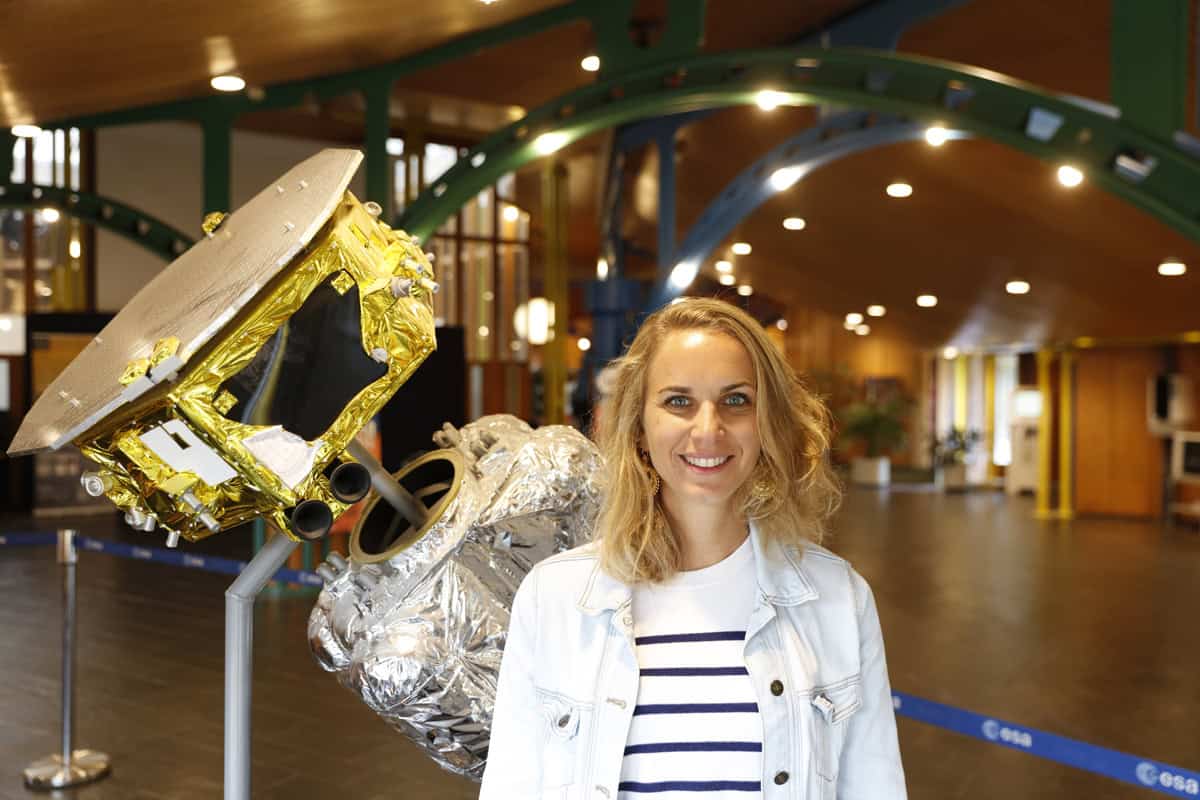
Charlotte Pachot is overseeing the LISA optical bench assembly. Next to her is a model of LISA Pathfinder that tested critical technologies in space in 2016. (Courtesy: ESA)

In this role, Wille and the ESA team collaborated with an industrial consortium led by Dutch measuring instrument supplier cosine to develop a completely new type of optics, called silicon pore optics. Using techniques perfected by the semiconductor industry, cosine bonded and stacked many silicon plates on top of each other. By shaping the plates, a lightweight mirror to focus X-rays was created; in fact, 10 times lighter than the ones flying on current X-ray missions XMM-Newton and the Chandra X-ray Observatory.

Like Athena, LISA will also provide fresh eyes on cosmic events, but through the unique prism of gravitational waves. This will be achieved through a completely new approach involving a triangle of three satellites spaced 2.5 million kilometres apart.

Understandably, LISA calls for a unique optical bench, which Pachot is managing from design to manufacturing and testing. She sees her role as being like that of a conductor of an orchestra: a lot of her time is spent co-ordinating team members and partners, while also helping to solve technical, budget and schedule problems. For Pachot, tackling these daily friction points is part and parcel of working on real-world big science. “The instruments are very complex technically, very challenging, but they are also real pieces of hardware as part of a real project,” she says.

International community

As Wille and Pachot’s stories show, ESA selects talent from different career stages.  The Agency offers several programmes that support students, graduates and experienced professionals in finding the right role for their profile and interests.

Device testing Lasers are used in many different space applications. Igniting launchers, high-speed optical communication, LIDARs for atmospheric measurements or for measuring gravity waves with LISA. The opto-electronics laboratory at ESTEC is frequently used to characterize the lifetime and performance of high-power diode lasers. (Courtesy: ESA)

For example, university students can benefit from ESA Academy sponsorship, such as participating in hands-on projects or training sessions. They can also join ESA as interns. Graduates can apply to ESA’s Graduate Trainee Programmes where they can gain experience on actual ESA projects and develop technical and professional skills. And for those currently in industry with less than three years’ experience, the Junior Professional Programme allows them to join ESA as staff members for four years and benefit from tailored learning and development opportunities to prepare them for a long-term position.

Whichever pathway they take, once new recruits get started in their first role, an excellent employment package – including competitive salary and pension scheme, hybrid working and flexible hours, and professional development training opportunities – comes as standard.

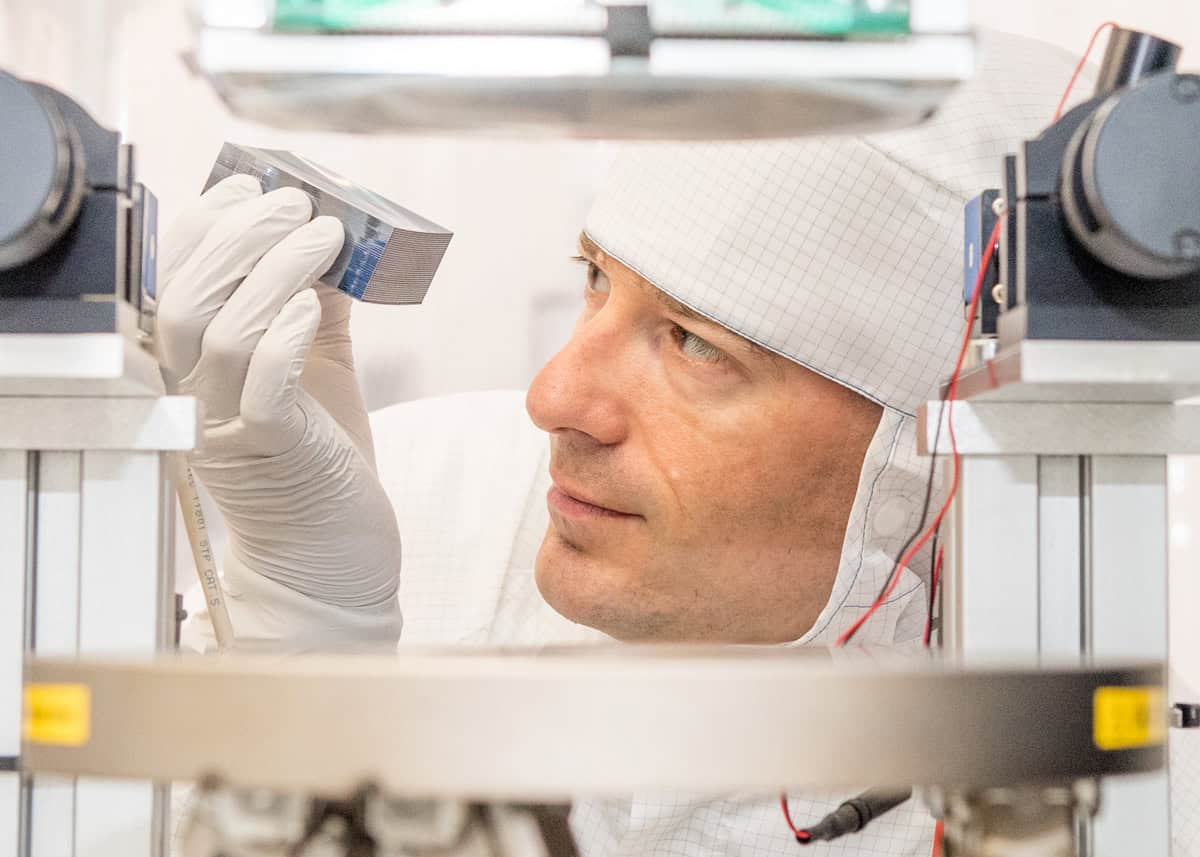
Eric Wille inspecting a new X-ray mirror using stacked silicon plates. The mirror was assembled using an automated stacking robot partially visible in the foreground. (Courtesy: ESA)

What sets ESA apart is the multicultural work environment. Team members might come from any of ESA’s 23 Member States and nine further Cooperating States and Associate Members.  And recruits can be based in more than nine locations in seven countries (France, Germany, the Netherlands, Italy, Belgium, Spain and the UK). This makes for a melting pot of cultures.

“There’s a very lively expat community,” says Wille. “At the European Space Research and Technology Centre (ESTEC) and other big sites, it’s like a small Europe.”  This cultural diversity is of course intentional. “The problems we have to solve require teamwork,” says Pachot. “And this is made easier at ESA because we all see problems in a different way depending on our culture.”

Working life at ESA

Want to learn more about working at ESA? Take a look at life at ESA and what ESA offers. Quickly find out which programme could be the best fit for you by following the pathways to ESA on this flowchart.

The post Careers at the frontier of space technology appeared first on Physics World.

  •  

MacVoices #26215: Catching Up with Adam Christianson at Macstock 2026

In a conversation at Macstock 2026, Adam Christianson reflects on retiring the MacCast, joining Mac Geek Gab, and starting the Debut Film Podcast with his daughter. He also explains how his views on AI have evolved, how ChatGPT and Claude support his programming work, why human oversight remains essential, and what AI may mean for […]

💾

  •  

What we lose when every engineer can do everything

Four months ago, a front-end engineer on my team looking to make upgrades to a product or feature would have filed a ticket and waited for the infrastructure group to unblock them. They might have lost a day, sometimes a week. Today, that same engineer makes changes themselves. The code is occasionally brittle, but it works, and the end result ships in a fraction of the time it used to take.

That small story is unfolding inside nearly every engineering organization right now. While some celebrate the sudden fact that one person can do the work of five, others are focused entirely on tech industry layoffs. Both perspectives skip the question I find more interesting: What happens to mastery when every engineer can suddenly do everything?

For two decades, we have described strong engineers as T-shaped. The horizontal bar represents breadth, which is a working familiarity across many areas. The vertical bar represents depth, the real command of one domain earned over years. Agent tooling has stretched that horizontal bar wider than ever before. My concern is the vertical bar, which is quietly getting shorter.

Consider what is now possible in a single quarter. With the right agent harness, one engineer can stand up a billing system, a data connector framework, regional and organizational tenancy infrastructure, or a consumption-based pricing implementation. The pull requests pass review. The tests are green. All looks good. But green tests cannot tell you if the person who shipped that work understood why the system needs redundancy in one specific place, where its failure modes are hiding, or which trade-offs the model made silently on their behalf. The pattern recognition that comes from watching systems fail over many years is suddenly weighted differently than it was even 12 months ago. Our industry has not caught up to that shift.

When the interview stops measuring judgment

The first place this surfaces is hiring, a trend that should concern anyone who has built a team. Traditional coding interviews were always an imperfect proxy for engineering judgment, but agent tooling completely obliterates them. If a candidate can produce a working solution in 20 minutes that would have taken two hours a year ago, the exercise no longer measures technical competence. It just measures how well a coder can prompt an agent.

At Thread AI, we have responded by widening what we look at when we interview job candidates. Our process moves across coding exercises, problem decomposition, system architecture, and behavioral components, with the weighting shifting by role. We allow AI assistance only in specific sections because our engineers still need to be able to operate without it. Some of our work happens in secure environments where you cannot lean on an agent to debug for you. What we’re really testing for now is judgment under ambiguity — the ability to notice when an agent’s output is confidently wrong — and the depth to predict where a system will break before it breaks.

Hiring teams that fail to make this shift will fill their rosters with false positives. They will hire people who interview like experts but struggle the first time a system behaves in a way the model did not anticipate. Ultimately, these companies will miss out on top-tier talent, and they won’t discover the misstep until it’s too late.

Confusing velocity with understanding

That brings me to a larger risk: the rise of false expertise as a category of its own. Historically, the reasoning has gone, “I built a proof of concept, therefore I am an expert.” I have watched versions of this appear in technical leadership, in investment decisions, and in policy conversations about AI. It travels well because the artifact looks real. A working demo is highly persuasive, even when the person behind it only half-understands how it functions.

The problem is bigger than one false expert shipping one bad product; an organization can absorb that. The real risk is a generation of consequential decisions being made by people who have confused velocity with understanding. You can already see the cultural scaffolding being built around this with the celebration of the “idea guy,” and the sudden fashion for invoking “taste” as a substitute for knowing how a system actually works. Those of us shaping tooling, hiring norms, and regulations have a narrow window to set better defaults before this pattern hardens into the way the industry operates.

Depth and breadth, held together

This is the path we’ve been walking at Thread AI since before the latest wave of tooling arrived.

To ground this in a specific example: I have spent 15 years building complex systems. I worked at Goldman Sachs through the financial crisis and the early Dodd-Frank infrastructure, moved critical payment systems into the cloud at The New York Times when that ground was still new, and built the system of record for model training and evaluation at Palantir across highly regulated environments in defense, health, and finance. This experience is the superpower that lets me course-correct an agent when it produces confident-but-wrong output.

I felt this sharply not long ago while scoping consumption-based pricing in a single quarter. The agents did an enormous amount of the heavy lifting, and at some point, I realized that my largest contributions to the effort were knowing where the system would fail and steering around it before we got there. I have also seen how organizations have built large teams around efforts like these in the past. Someone earlier in their career or relying purely on AI guidance would not have had that instinct to draw on. That is the part the public conversation keeps missing.

Every engineer at Thread AI, regardless of seniority, is expected to be a builder at heart. Our people own outcomes across compute, data, and the organizational and identity primitives that hold the product together, all without the traditional product-manager and project-manager scaffolding around them. Our model works only because the people in those seats have the depth to know what they do not know, and the breadth to fill the gaps with agents. They use the tooling instead of being used by it.

AI doesn’t replace deep understanding

The core issue facing organizations today is not whether AI will replace engineers. That question has been answered dozens of times this year with varying degrees of nuance, and it has stopped being interesting. The more useful question for anyone running a company is whether we are protecting the people who understand our systems deeply enough to recognize when the machines are wrong.

In our company, the answers have been to move toward explicit end-to-end ownership, and to hire for depth and breadth together rather than treating them as a trade-off. Layoffs dominate the headlines because they are an easy narrative, but they describe a symptom rather than the actual choice in front of us. The real choice is whether we let breadth quietly stand in for mastery, or whether we build organizations that keep human judgment in the loop on purpose.

In an era when software can be generated faster than it can be understood, the companies that hold onto what is human, verifiable, and deeply understood will be the ones still standing when the brittle parts give way.

—

New Tech Forum provides a venue for technology leaders—including vendors and other outside contributors—to explore and discuss emerging enterprise technology in unprecedented depth and breadth. The selection is subjective, based on our pick of the technologies we believe to be important and of greatest interest to InfoWorld readers. InfoWorld does not accept marketing collateral for publication and reserves the right to edit all contributed content. Send all inquiries to doug_dineley@foundryco.com.

  •  

Tech sector adds jobs, defies overall US job market decline

While the number of US jobs declined by 23,000 in July, employment in the tech sector rebounded as the AI revolution continues to gain steam.

The national unemployment numbers were reported Friday by the US Bureau of Labor Statistics. At the same time, research firms said July was a good month for IT hiring compared to June.

According to CompTIA, which analyzed the BLS data, tech sector jobs rose in July by 3,700. In June, the IT sector had lost 900 jobs.

Companies last month hired in the cloud, hosting, information processing, data, and semiconductor manufacturing sectors, CompTIA said in a statement. 

“We’re entering a labor market where opportunity is increasingly concentrated around specific skills, industries, and investments,” said Ger Doyle, regional president of North America at ManpowerGroup, a labor consulting firm.

For example, data center hiring was up 39% in July compared to the same period last year, Doyle said. Not surprisingly, the data-center growth has been fueled by AI infrastructure needs and demand for hardware. That has helped increase the number of jobs in ancillary sectors such as transportation.

July hiring data showed heavy truck driver demand, which surged by 181% from June, Doyle said.

According to the BLS data, employment went up by 2.4% in the “computing infrastructure providers, data processing, web hosting, and related services” sectors, which is listed under the information sector.

Jobs in the “computer and electronic product manufacturing” sector — which is bunched under manufacturing — rose by 2.9% from June to July.

But bad news continued for the telecommunications sector, where the number of jobs declined by 1.5% from June to July. That continued a downward slide in recent years.

Overall job layoffs slowed in July, with 33,429 cuts announced; that’s down from 45,849 cuts announced in June, and the lowest since July 2024, according to data from Challenger, Gray and Christmas.

“Hiring has also increased over last year by 25%, so while AI is shifting the labor market, it is not dismantling it,” said Andy Challenger, chief revenue officer for Challenger, Gray & Christmas.

The tech sector announced 9,867 cuts in July, bringing the year-to-date total to 149,023 so far in 2026, according to Challenger figures.

Tech sector hiring and job losses vary as organizations use different measurement techniques to gauge the overall hiring environment. 

The top-line US unemployment rate declined to 4.1% from 4.2%, in part because of  workers leaving the workforce or not looking for jobs, indicating a slow labor market.

Still, hiring demand exists across the US, despite declining labor force participation and longer job searches, Doyle said.

Because technology underpins many of the changes occurring across sectors such as healthcare and services, employers are rethinking hiring.  “That’s why the labor market many workers are experiencing doesn’t always match the one described by the headline numbers,” Doyle said.

ADP’s National Employment report said only 44,000 jobs were added to private payrolls in July, with choppiness across sectors.

But demand for AI skills continues to rise, according to research firms that track growth by analyzing job listings. CompTIA noted that about 14,000 new job listings in July sought AI and machine learning skills.

It’s not clear how the ongoing AI boom may be hurting or helping human jobs. Many recent job cuts have been attributed to AI, though some companies have been accused of using the technology as a rationale for cuts they made for other reasons.

A recent OECD report said that even manual jobs once thought immune to AI are at risk of being taken over by robots. The OECD report said creative jobs — typically management, arts, and social work — will be least threatened by AI.

There are also increasing indications that successful AI deployments will require humans in the loop. For example, more consulting firms are using forward-deployed engineers (FDEs) to implement agentic AI. And smaller consultancy firms are finding more productivity by automating mundane work with AI and spending more time meeting client requirements.

  •  

What we lose when every engineer can do everything

Four months ago, a front-end engineer on my team looking to make upgrades to a product or feature would have filed a ticket and waited for the infrastructure group to unblock them. They might have lost a day, sometimes a week. Today, that same engineer makes changes themselves. The code is occasionally brittle, but it works, and the end result ships in a fraction of the time it used to take.

That small story is unfolding inside nearly every engineering organization right now. While some celebrate the sudden fact that one person can do the work of five, others are focused entirely on tech industry layoffs. Both perspectives skip the question I find more interesting: What happens to mastery when every engineer can suddenly do everything?

For two decades, we have described strong engineers as T-shaped. The horizontal bar represents breadth, which is a working familiarity across many areas. The vertical bar represents depth, the real command of one domain earned over years. Agent tooling has stretched that horizontal bar wider than ever before. My concern is the vertical bar, which is quietly getting shorter.

Consider what is now possible in a single quarter. With the right agent harness, one engineer can stand up a billing system, a data connector framework, regional and organizational tenancy infrastructure, or a consumption-based pricing implementation. The pull requests pass review. The tests are green. All looks good. But green tests cannot tell you if the person who shipped that work understood why the system needs redundancy in one specific place, where its failure modes are hiding, or which trade-offs the model made silently on their behalf. The pattern recognition that comes from watching systems fail over many years is suddenly weighted differently than it was even 12 months ago. Our industry has not caught up to that shift.

When the interview stops measuring judgment

The first place this surfaces is hiring, a trend that should concern anyone who has built a team. Traditional coding interviews were always an imperfect proxy for engineering judgment, but agent tooling completely obliterates them. If a candidate can produce a working solution in 20 minutes that would have taken two hours a year ago, the exercise no longer measures technical competence. It just measures how well a coder can prompt an agent.

At Thread AI, we have responded by widening what we look at when we interview job candidates. Our process moves across coding exercises, problem decomposition, system architecture, and behavioral components, with the weighting shifting by role. We allow AI assistance only in specific sections because our engineers still need to be able to operate without it. Some of our work happens in secure environments where you cannot lean on an agent to debug for you. What we’re really testing for now is judgment under ambiguity — the ability to notice when an agent’s output is confidently wrong — and the depth to predict where a system will break before it breaks.

Hiring teams that fail to make this shift will fill their rosters with false positives. They will hire people who interview like experts but struggle the first time a system behaves in a way the model did not anticipate. Ultimately, these companies will miss out on top-tier talent, and they won’t discover the misstep until it’s too late.

Confusing velocity with understanding

That brings me to a larger risk: the rise of false expertise as a category of its own. Historically, the reasoning has gone, “I built a proof of concept, therefore I am an expert.” I have watched versions of this appear in technical leadership, in investment decisions, and in policy conversations about AI. It travels well because the artifact looks real. A working demo is highly persuasive, even when the person behind it only half-understands how it functions.

The problem is bigger than one false expert shipping one bad product; an organization can absorb that. The real risk is a generation of consequential decisions being made by people who have confused velocity with understanding. You can already see the cultural scaffolding being built around this with the celebration of the “idea guy,” and the sudden fashion for invoking “taste” as a substitute for knowing how a system actually works. Those of us shaping tooling, hiring norms, and regulations have a narrow window to set better defaults before this pattern hardens into the way the industry operates.

Depth and breadth, held together

This is the path we’ve been walking at Thread AI since before the latest wave of tooling arrived.

To ground this in a specific example: I have spent 15 years building complex systems. I worked at Goldman Sachs through the financial crisis and the early Dodd-Frank infrastructure, moved critical payment systems into the cloud at The New York Times when that ground was still new, and built the system of record for model training and evaluation at Palantir across highly regulated environments in defense, health, and finance. This experience is the superpower that lets me course-correct an agent when it produces confident-but-wrong output.

I felt this sharply not long ago while scoping consumption-based pricing in a single quarter. The agents did an enormous amount of the heavy lifting, and at some point, I realized that my largest contributions to the effort were knowing where the system would fail and steering around it before we got there. I have also seen how organizations have built large teams around efforts like these in the past. Someone earlier in their career or relying purely on AI guidance would not have had that instinct to draw on. That is the part the public conversation keeps missing.

Every engineer at Thread AI, regardless of seniority, is expected to be a builder at heart. Our people own outcomes across compute, data, and the organizational and identity primitives that hold the product together, all without the traditional product-manager and project-manager scaffolding around them. Our model works only because the people in those seats have the depth to know what they do not know, and the breadth to fill the gaps with agents. They use the tooling instead of being used by it.

AI doesn’t replace deep understanding

The core issue facing organizations today is not whether AI will replace engineers. That question has been answered dozens of times this year with varying degrees of nuance, and it has stopped being interesting. The more useful question for anyone running a company is whether we are protecting the people who understand our systems deeply enough to recognize when the machines are wrong.

In our company, the answers have been to move toward explicit end-to-end ownership, and to hire for depth and breadth together rather than treating them as a trade-off. Layoffs dominate the headlines because they are an easy narrative, but they describe a symptom rather than the actual choice in front of us. The real choice is whether we let breadth quietly stand in for mastery, or whether we build organizations that keep human judgment in the loop on purpose.

In an era when software can be generated faster than it can be understood, the companies that hold onto what is human, verifiable, and deeply understood will be the ones still standing when the brittle parts give way.

—

New Tech Forum provides a venue for technology leaders—including vendors and other outside contributors—to explore and discuss emerging enterprise technology in unprecedented depth and breadth. The selection is subjective, based on our pick of the technologies we believe to be important and of greatest interest to InfoWorld readers. InfoWorld does not accept marketing collateral for publication and reserves the right to edit all contributed content. Send all inquiries to doug_dineley@foundryco.com.

  •  

Three concepts cloud architects overlook

After two decades of cloud architecture consulting, I see an unchanging pattern in enterprise deployments. Organizations approach me with unexpectedly high cloud bills, operational chaos, and architectures that look good on paper but cause headaches in production. The common thread is almost always the same. Fundamental concepts that should be foundational to any cloud deployment are treated as optional or ignored altogether.

I’m not talking about exotic requirements, bleeding-edge technologies, or vendor-specific best practices. Basic engineering principles are somehow getting lost amid the excitement of cloud adoption. I wish I could say it’s rare, but after working with organizations across industries and geographies for years, I can confirm that missing these fundamentals is more common than most people realize. The results are predictable. Bills grow faster than business value, architectures require constant firefighting, and teams are stretched too thin to optimize anything.

The good news? You don’t have to start over, but you do have to go back to basics. Here are three concepts most cloud architects overlook that will make your architecture dramatically more valuable and efficient.

Identifying common ground

When deploying heterogeneous architecture, especially in multicloud environments, organizations must aggressively reduce silos. This means establishing common control planes for security, governance, and operations. You won’t get there by relying on whatever proprietary technology each cloud provider offers out of the box. Each provider wants you locked into their way of managing things. That is fine for simple deployments, but when you are running across multiple clouds and on-premises systems, proprietary control planes introduce redundancy, complexity, and cost.

You need a single control layer that spans your entire environment. Instead of managing 10 different security solutions from 10 different providers, you have one. Instead of separate identity management systems for each cloud, you need one that works everywhere. This eliminates the need to change security parameters in five different consoles, maintain five different skill sets for five different operational models, and reconcile five different governance frameworks. The common control plane ties everything together.

This might sound hard, but it’s not as bad as you think. (I will cover the specific patterns in a future article.) The real issue is that most architects have never been trained to think this way. They were taught to select the best services from each provider rather than abstract away the differences. This fundamental gap costs organizations real money every single day.

Cost observability and optimization

Most architects treat cost visibility and optimization as afterthoughts, things that can be bolted on after the architecture is in place. That backward approach shows up in the results. Without cost observability and optimization baked into your architecture from day one, you cannot understand where your money is going, where waste is accumulating, or where you should make changes to align expenses with delivered value.

The more complex and heterogeneous your environment, the more critical this becomes. You need a unified cost observability layer that spans public and private clouds and your own infrastructure. This is about building a layer that aggregates cost data from everywhere, provides a single source of truth for spending, and delivers the insights needed to actively optimize. Without this, you are flying blind, making decisions based on incomplete data and discovering problems only after the invoice arrives.

Too many organizations fail to gain control of their cloud spending because their billing data is scattered across multiple consoles, with no way to correlate usage across providers. They cannot see which teams, projects, or services are driving costs. They miss opportunities to right-size, consolidate, or eliminate waste. You cannot improve what you cannot measure. Without a common cost observability and optimization layer built into your architecture, you will never achieve the efficiency the cloud was supposed to deliver.

Consider the human element

Here is an uncomfortable truth most architects do not want to discuss: The more complex your architecture is, the broader the range of skills you will need to keep it running. Complexity requires expertise, and expertise requires hiring, training, and retention. If your architecture demands 15 different skill sets to operate, you’d better have a plan for finding and retaining the people with those skills.

I have seen beautifully designed architectures fail because the organization could not meet hiring requirements. They compromised by hiring underqualified individuals, which led to operational failures, security gaps, and mounting technical debt. The architecture itself was sound. The human infrastructure around it was not. This is a solvable problem. It starts with acknowledging that you are not designing for yourself. You are designing for the team that will inherit this system after you have moved on to your next assignment or promotion.

The solution isn’t just simplifying architecture, though that should be a goal. The key is to consider human factors in your design. What skills are required? How can you find and train people? What cultural changes are necessary for effective operation? These questions are essential; ignoring them risks failure.

The simple bottom line

I understand why most cloud architects miss these basic principles. No single course or book brings all of this together in one place. Cloud architecture has become a collection of best practices, vendor recommendations, and conference talking points, rather than a disciplined engineering discipline focused on business value.

As a result, architectures end up optimized in the wrong places, if they are optimized at all. They are expensive to run, difficult to secure, and nearly impossible to operate at scale without constant intervention. The cloud promises efficiency, yet we are not delivering it because we have lost sight of the fundamentals.

It’s time to go back to basics. Commonality, human factors, and cost observability and optimization are the three things that separate architectures that create value from those that create cost. Incorporate these concepts into your architecture and you’ll get ahead of most production systems in use today.

  •  

Word wave puzzle no.7

Here’s how the game works:

    1. Enter a word guess – in this game the word has six letters.
    2. After submitting your guess, each letter in the guessed word is coloured to provide feedback:
      • Green: The letter is correct and is in the correct position in the target word.
      • Yellow: The letter is correct but is in the wrong position in the target word.
      • Grey: The letter is not in the target word at all.
    3. Using this colour feedback, refine your next guess.
    4. Continue guessing until you correctly identify the hidden word(s) or run out of attempts.

If you want a clue to the answer, read the article here.

Fancy some more? Check out our puzzles page.

The post Word wave puzzle no.7 appeared first on Physics World.

  •  

Ask me anything: Kristian Dominek Barajas – ‘I’m able to take a really complicated problem and give it my best guess’

Kristian Dominek Barajas is head of quantum theory at the UK-based quantum computing company Oxford Ionics, which merged with the US firm IonQ in 2025. Barajas got his PhD – which was focused on developing analytic methods for high-accuracy models of driven quantum systems beyond the rotating-wave approximation – at the University of California Los Angeles, US, via the American Physical Society’s Bridge Program. The programme provides pathways into research for qualified students who might not otherwise continue their physics education. He now serves as chair of the APS Committee on Minorities (2025–2026), where he helps shape national initiatives that support physicists from historically marginalized backgrounds – particularly people of colour, LGBTQIA+ physicists, and physicists with disabilities.

What skills do you use every day in your job?

Because I’m relatively new to the field, I often have to break difficult questions down into simpler ideas before I can grapple with them. That has trained me to take a really complicated problem and give it my best guess, and that first-pass intuition often gets me surprisingly close to the full solution.

The other thing I’d highlight is leadership skills. I come from an untraditional background – it took me a long time to do my undergraduate degree, and afterwards I worked in a lot of different jobs, including working at a pet store, where I was training to become a team lead. When I went to grad school, I applied through the APS Bridge Program, which is great, and it gave me an opportunity to get into research. But again, my path wasn’t traditional: I did soft condensed matter physics for four years, and then my advisor passed away unexpectedly, so I switched fields to trapped ions because I needed to graduate. I had no background in quantum physics at that point, so it was quite a transition.

Experiences like this added up. By the time I joined Oxford Ionics right before the merger with IonQ, even though I was the “greenest” person in my team in terms of being new to the field, I had the most leadership experience. That meant I went from being an entry-level quantum theorist to a senior quantum theorist in two or three months. A month and a half later, I became the atomic, molecular and optical (AMO) theory manager. The experience I’d gained made it easy to set priorities and get people to go in the correct direction.

What do you like best and least about your job?

My least favourite part of the job is that I don’t get to read much new research. The job is so fast-paced and there’s so many things happening every day that getting the chance to sit down and read an article is quite rare. I use AI tools to help me find and keep up with new research. Part of my workflow involves asking AI to identify relevant papers and give me an initial sense of what I need to know. I still skim the papers themselves as much as I can, but I don’t get the chance as often as I’d like to pick up a manuscript and spend a whole day working through it like I did in academia.

We also don’t always have the time to write papers about what we’re doing. It’s not that we aren’t allowed to – in fact, we’re encouraged to pursue that if we want to do it – but finding time is challenging.

I’m constantly getting to do new and interesting physics, and I absolutely love that about my job

The upside is that the pace at which I get to do research far, far outweighs what I experienced in academia. What we accomplish on our team in four to six weeks is comparable to the amount we would do in six months in academia. It is absurd how fast we get to move. I’m constantly getting to do new and interesting physics, and I absolutely love that about my job.

What do you know now that you wish you’d known at the start of your career?

I wish I’d known that feelings of imposter syndrome don’t always have to be something to fear. For me, they can also be a reminder that there is still so much more to learn, and that can be exciting. That’s why I was so excited for the opportunity to earn my PhD in physics: it gave me the chance to keep learning. Now, whenever that old imposter feeling comes up, I try to see it as an opportunity to learn rather than a reason to hold myself back. I wish I had embraced that earlier in my career and not been so afraid to try things.

The post Ask me anything: Kristian Dominek Barajas – ‘I’m able to take a really complicated problem and give it my best guess’ appeared first on Physics World.

  •  

A trip down shareware lane

I hope you’ll indulge me this week as I take a break from my usual rantings about agentic coding and meander down memory lane.

I learned to code BASIC in the mid-1970s at my progressive junior high school. In math class. We took Fridays to learn about line numbers, loops, statements, and the amazing GOSUB, which was as close as we got to a function call. It strikes me that it was pretty early in the whole tech world to be teaching seventh graders to program, and I feel lucky.

Coding faded into the background for me through high school, but soon afterward the arrival of Windows 3.0 and modems made writing software fun again. You could even earn a little profit. CompuServe, AOL, and bulletin board systems (BBS) created a market for shareware.

I bought a copy of Turbo Pascal for Windows 1.0 from Borland and a copy of Mastering Turbo Pascal 6 by the great Tom Swan, and I learned the Pascal syntax. I remember being delighted to discover that Swan had also written a book specifically for Turbo Pascal for Windows, and I devoured that too. 

In search of SYSBACK

I soon came up with an idea for a shareware project — System Backup. Any of you who can remember back to the DOS and Windows 3.x days will remember that there were four files — AUTOEXEC.BAT, CONFIG.SYS, WIN.INI, and SYSTEM.INI — that were crucial to one’s setup. You’ll also remember that it wasn’t uncommon to twiddle with these files to eke out an extra measure of performance from the system. Backing those files up was critical to the tweaking, so I wrote SYSBACK.EXE to do the job quickly and easily. 

Windows 3.1 introduced the amazing feature of *.wav files — sound through your tinny PC speaker! That led me to write WAVSHELL.EXE, which listed all your sound files and made them easy to play.

I guess I didn’t have much faith in the value of my shareware because I released it into the wild of the pre-internet shareware market for a measly $2. People soon started sending me checks in the mail — my address was in the About Box, with a plea to pay for the software. Soon I added a licensing scheme and a “nag screen” that would go away if the user entered a valid license key. I actually made a bit of money.

Eventually both programs became unnecessary as Windows grew more functional, and I abandoned things. I’m sure all that code is on a hard drive in a landfill somewhere. 

But that doesn’t mean that SYSBACK and WAVSHELL don’t live on!

Last week, on a whim, I went searching to see if I could find any remnants of my glory days. Although it took a while, I was delighted to discover that both programs had clung to life in the dark crevices of the internet. 

I found WAVSHELL.ZIP and SYSBACK.ZIP and downloaded them. Sure enough, there were the files — the 16-bit Windows executables, along with the accompanying READMEs formatted for Windows Write, the simple word processor that came with Windows 3.1.

Return to Windows 3.1

So, what to do? Naturally I fired up Claude and asked how to get all this running. It suggested I give Oracle VirtualBox a try. At first I tried an open-source DOS version, but soon ran into conflict with memory managers and Windows. Tweaking CONFIG.SYS like the old days didn’t seem to make a difference.

This led to downloading a set of *.img files of MS-DOS 6.22. I mounted the first disk in the A: drive of the virtual machine. (For you youngsters, the A: drive was a floppy disk — maybe you remember those?) I had to do a virtual version of the old disk shuffle for the three floppies, and then do the same to install Windows. Everything installed and ran like clockwork, and soon enough, Windows 3.1 was up and running. 

Then, of course, I had to figure out how to get the files from my modern system to this ancient OS. This led me to WinImage, a shareware program (!) that builds floppy disk images for you. I built an image, copied the files onto the “disk,” and mounted it in the A: drive in the VirtualBox machine. I copied the files to the virtual hard drive, and behold!

System Backup and Wave Shell

Foundry

There they are, in all their glory. I have to say, it was quite a thrill. And they actually work!

Anyway, it was fun to remember all those halcyon days of CompuServe, 2400 BAUD modems, and getting checks from strangers in the mail. It seems strange to me that 35 years from now, some software developer will be writing a column about the deep dark past when people used to actually write code, argue about what programming languages were best, and, who knows, even had to type things out by hand.

  •  

Surviving AI: Navigating workload creep, AI slop, and the new tech career playbook

After more than 30 years the cybersecurity field, Keith Jones recently realized that his role had changed, from being a single contributor to manager of a fairly large team. And this team was getting a lot accomplished — tasks that used to take up a huge chunk of his workday.

No, his company hadn’t hired a group of new employees to work under him. He simply accelerated his use of artificial intelligence tools. Now, instead of grinding through a lot of basic tasks, that work is done for him while he focuses on bigger-picture work.

“It really feels like I have a team behind the scenes, but what I have is Claude [Anthropic’s AI tool],” says Jones, who currently works as a cybersecurity researcher. “I’ve been thinking for the last several months about how much differently I work now than I did a year ago, when I would sit and write all the low-level stuff before I could get to the 10% of the good stuff I really wanted to focus on. Now I can sit back and say, ‘Give me three different ways to solve this problem.’”

width="1024" height="678" sizes="auto, (max-width: 1024px) 100vw, 1024px">

Keith Jones, cybersecurity researcher

Keith Jones

Most people working in the technology field, like Jones, have had to figure out how best to work with AI. The technology has come on strong, with many companies making its use mandatory and actively evaluating whether employees are faster and more efficient because of it. And while it is boosting productivity and taking over the burden of repetitive, manual tasks, it’s also creating a new level of stress and a dizzying kind of mental exhaustion.

So what can tech workers do about the heavier mental load that comes with using AI, on top of escalating worries about the safety of their own jobs? AI users and industry analysts say there are specific ways to ease some of those burdens and prepare for a changing job market.

Combating the slop factor

When it comes to working with LLM tools, a well-known issue is dealing with AI workslop and hallucinations. The slop is AI-generated output that is low-quality, buzzword-heavy, and generic. It also can refer to bloated, boilerplate code. Hallucinations are inaccurate or completely made-up results. AI routinely offers this messy or incorrect information with total confidence, giving users a false sense of security.

Using this bad data can lead to anything from minor software bugs to severe liabilities. “Don’t believe the machine is infallible,” says Craig Shue, computer science professor and department head at Worcester Polytechnic Institute (WPI). “That’s when bugs will start working in. There’s a lot of misinformation on the internet, and that could be what the LLM is grabbing and using.”

width="1024" height="674" sizes="auto, (max-width: 1024px) 100vw, 1024px">

Craig Shue, computer science professor and department head at Worcester Polytechnic Institute 

WPI

Here are ways to combat the problem:

  • Make AI show its work: Ask it to cite its sources or explain its reasoning. Example prompt: Explain the logic and show the steps before writing the code.
  • Give the AI a source of truth: Instead of letting the AI search the internet for information, give it the exact source material (reports, transcripts, data sheets) to base its output on, telling it to use only the information provided.
  • Validate. Validate. Validate: Never let AI publish code directly to the main project without first reviewing and running it locally. Similarly, never take AI output and simply move it on to the next person in the project. Every single AI output needs review.
  • Don’t be fooled by confidence: As with managing a human, question the output. When you’re busy or tired, it’s easy to just go with the results it gives you. Don’t. Always analyze and question it.

Taking on AI-driven workload creep

Let’s face it: The great promise of AI is that it will take over repetitive, manual tasks, which will save you an incredible amount of time. What isn’t talked about as much is that it also can create a new workload — one that can be exhausting in a whole new way.

“Is AI saving people time? The short answer is yes,” says J.P. Gownder, vice president and principal analyst with Forrester Research. “But people also are being overwhelmed with overproduced things. Everyone wants to look busy and they’re producing more, but not necessarily better. Managers have to push back on that or it’s not really saving you time.”

In a multi-year study by Upwork, the largest online freelance marketplace, 77% of employees reported that AI had increased their workload. The report noted that a boost in productivity comes with a “significant emotional and relational cost,” with 88% of workers who saw the highest productivity gains also feeling burned out. And IDC’s Future of Work 2026 survey reported that 24% of IT workers report increased workload as a top AI concern.

Here are ways to combat the problem:

  • Keep it short: Part of the prompt — always — should be to tell any AI tool to be concise.
  • Build an anti-slop culture: Don’t simply accept and pass on workslop. It’s insulting for a co-worker to have to deal with pages of largely useless information.
  • Filter the noise: When everyone on a team starts using AI, the volume of Slack messages, long-form memos, and data reports skyrockets. Don’t treat it all with equal importance. Practice radical prioritization.
  • Manage the transcript deluge: Stop wading through 40-page meeting transcripts that bury action items. Instead, prompt the system to produce a concise summary focused strictly on deliverables or status updates.
  • Reduce the AI blast radius: When asked to fix a bug, AI tools often rewrite hundreds of lines of unrelated code, multiplying your code review time. Prevent this by instructing the tool to isolate its changes only to the specific function or file in question.

Managing the AI mental tax

Using AI often necessitates a different kind of mental processing, changing what had been the natural pacing of your day and dramatically increasing context switching. Instead of simply building and testing, someone might be jumping back and forth between auditing, fact-checking, prompting, and re-prompting. To manage strain and protect your focus, new strategies are needed.

Published this past March in the Harvard Business Review, a study by Boston Consulting Group and the University of California, Riverside, surveyed 1,500 workers and coined the term “AI brain fry.” The researchers found that juggling multiple AI tools causes decision fatigue and increases errors.

How to combat the problem:

  • Work in batches: Continuously reviewing AI output as it comes in can quickly lead to mental burnout. Dedicate blocks of time throughout your day to interact with your AI tools.
  • Create analog islands: Your brain needs time to decompress, and that means taking a break from digital processing… and from screen time in general. Make time in your day to step away from screens, such as taking a 15-minute walk or reading a book instead of watching a video online.
  • Know when to step in: Instead of endlessly tweaking prompts to get a perfect result, it is often faster and less mentally taxing to manually write or refactor the final 20% yourself.
  • Create base prompts: Writing custom prompts that include everything from guardrails to tone instructions for every new project quickly drains your mental energy. Instead, build two or three reusable system prompts, such as one for refactoring legacy code and another for drafting API docs, and use them as templates.

Proving your human value in a new job market

With companies regularly using AI-based applicant tracking systems to filter resumes, and AI actively shifting job responsibilities and skills requirements, the strategy for how you apply for roles and handle interviews is changing.

Leo Freitas, an analyst and research manager at IDC Research, says it’s critical for job applicants to show potential employers what they can do that machines cannot. “You need demonstrable achievements,” he adds. “It’s good to show highly human skills.”

width="1024" height="683" sizes="auto, (max-width: 1024px) 100vw, 1024px">

Leo Freitas, analyst and research manager at IDC

IDC

How to combat the problem:

For your resume:

  • Mirror their language: Use the exact language from the job description. Traditional applicant tracking systems rely heavily on structured information and keyword matching, says Teresa Hill, founder and leader of Anchor GTM, a growth marketing consultancy. That means if a posting says “product marketing manager,” don’t just write “PMM.” Write both.
  • Keep it simple: Use standard section headers, like “Experience” and “Education.” Creative alternatives and formatting can confuse parsers.
  • Avoid AI writing: Use AI to help structure your thinking, then edit until the copy sounds natural and authentically human.
  • Swap responsibilities for metrics: To stand out, especially with AI scanners, tie as many bullet points as possible from your work to business outcomes.

For the interview:

  • So, how do you use AI? Every interviewer eventually asks some version of this question. The best answers focus on judgment vs. simply name-dropping tools. Explain what you automate, what you never automate, and why.
  • Show that you’re a gatekeeper: AI tools can generate code or copy instantly, but they also introduce errors. To stand out, show that you know how to audit, verify, and safeguard quality.
  • Focus on learning: Don’t emphasize your expertise with a specific AI tool. Focus on being someone who is adaptable and learns quickly, Hill says. 
  • What sets you apart from a machine: Show, don’t tell. Give work examples that demonstrate that you know how to be creative, collaborative, and problem solve. Show metrics whenever possible.
  • Demonstrate that you know the limits: Make it clear that you know when to use AI and what not to let it touch without heavy review. 
width="1024" height="576" sizes="auto, (max-width: 1024px) 100vw, 1024px">

Teresa Hill, founder and leader of Anchor GTM

Teresa Hill

Future-proofing your career in a shifting tech market

The anxiety echoing through the tech industry is tangible as companies reallocate corporate capital toward automation. While both Gownder and Freitas emphasize that there is far more fear than actual AI-driven layoffs, the shift in corporate spending is undeniably stoking job insecurity.

“There’s this apocalyptical view that AI will take everyone’s job in a few years,” says Freitas. “I don’t see that happening, but many things will change in the nature of how we work. I don’t think the world is going to end tomorrow. But it’s always good to do a self-assessment and look at whether AI can do what you’re doing now.”

How to combat the problem:

  • Use this technology to your advantage: Approach AI as a new tool, not a replacement. Use it to make yourself better and faster at your job. “I look at AI like it’s another new tool, and I’m going to learn it like I’ve learned any other tool,” says Jones.
  • Don’t bury your head in the sand: Take a look at what you do and consider if it could be done by AI.If your role is highly automatable, think about switching to a more advanced position or to a role, like security, that more clearly needs a human in the loop.
  • Take ownership of your career: Expand your knowledge and skills. Find courses and certifications (many are free online) and take advantage of employers’ training programs.
  • Work with the business side: Make sure you understand the business — its long-term goals, competitive market, and jargon. Be the bridge between the technical and business sides of the company, giving presentations and solving business problems with technology.
  • Highlight your in-house expertise: When you have institutional knowledge, make sure you are openly using it to benefit the business. Your knowledge can be your key differentiator.
  • Push the business forward: Think about the next app or customer-facing system that will propel the business forward. Be the one who is advancing the company with tech.
  • Continue to adapt: Don’t get stuck in your anxiety. Keep being curious and working your learning muscles. 

More on AI in the workplace:

  •  

From galaxies to groceries: how Sarah Bridle made the switch from cosmology to food

What happens when a cosmologist points their tools at the dinner plate instead of the night sky? One person who has done just that is Sarah Bridle, who studied natural sciences at the University of Cambridge in the UK and then stayed on to do a PhD in cosmology, graduating in 2000. Having spent two decades mapping dark matter and building large collaborations around open data, Bridle is now chair in food, climate and society at the University of York, applying that same quantitative, physics based mindset to food.

Food manufacturing is a huge sector: in the UK, it employs 400,000 people and contributes £28bn to the economy. Physics underpins much in the field – everything from productivity, food safety and food security to health and nutrition, waste reduction and environmental impact. Bridle talks to Gleb Yakubov, a food physicist at the University of Leeds, about what inspired their switch from cosmology to food physics and tips for those looking to follow suit. Yakubov is a committee member of the food physics group of the Institute of Physics (IOP), which bridges industry and academia, raises the profile of physics in food, and represents the community to policymakers.

What attracted you to food physics?

It began when I heard that the late David MacKay, who was working at the University of Cambridge, was ill. He worked on error-correction codes, education and artificial intelligence, before pivoting to sustainability and became chief scientific adviser to the UK energy department. I started thinking hard about why we do what we do, and what would happen without him doing the fantastic work he led on energy and climate.

I began watching his talks and learning about climate change – something I hadn’t really engaged with while immersed in astrophysics. In one of his penultimate presentations, he highlighted food as having huge potential to influence climate change through diets and how we produce food. From that moment on I wanted to understand this area – it was compelling, timely and I got obsessed.

You’ve called land use the “dark matter” of climate solutions – what do you mean by this?

Most people aren’t aware that food is responsible for up to a third of global greenhouse gas emissions and, in the UK, about 70% of land is used for agriculture. Many climate solutions involve land – forests for sequestration, biofuels, solar – and people often say “we can’t spare land, we need it for food”. But the way we use land for food can be extremely inefficient, which blocks those climate solutions. That’s a huge, underappreciated lever. 

When you started working in food, what surprised you most?

As a data geek, I expected it to be all about technical solutions but what surprised me was how dominant social and cultural factors are too. You see versions of the so-called “Jevons paradox”: introduce an efficient technology and people just use more of it, cancelling the gains. Unless, that is, you pair it with social and cultural change. Food systems aren’t just complicated; they’re a complex mix of people, incentives, norms and feedback loops.

How did you shift that approach, given that people don’t always behave rationally?

I don’t think people are random; they just use different decision criteria than many models assume. For example, if you raise the price of meat to reduce consumption, some people may see it as more of a luxury and desire it more. You can get perverse responses unless you understand the social context. On top of that, my recent work looks at the potential for civil unrest and even societal collapse – uncertainties we wouldn’t have anticipated five years ago. It pushes us to combine quantitative modelling with deeper social insight.

Can you share an example where astrophysics tools didn’t work in a food context?

Early on I tried to repurpose multispectral satellite-imaging techniques to detect blackgrass in UK wheat fields. Blackgrass is a serious weed that hits yields and this felt like a neat transfer – I’d been analysing astronomical imaging, so why not fields? But it turned out to be too difficult with satellite data alone. Variables like soil moisture, rockiness and other field conditions confounded the signals. That experience nudged me away from a pure imaging approach toward broader system modelling – and, later, back to data with more contextual integration.

Tell us about your “future food calculator”?

About five years ago we started building a quantitative model of the food system to compare interventions on a common footing: on-farm practices such as fertiliser, irrigation, crop management; consumer dietary shifts; and land-use choices. We turned it into a web-based dashboard inspired by MacKay’s energy calculator. Users can move sliders, explore UK production and consumption, greenhouse gas emissions, self-sufficiency and land use, and ask, “Do these choices get us to net zero, and with what trade-offs?”

How do you handle the “people” side – demographics and messaging – in such models and outreach?

You have to meet people where they are. Older generations, on average, are more focused on health than climate. Children and younger people tend to feel invincible about health but are very concerned about climate. If you’re trying to encourage dietary change, those differences matter for messaging and for assumptions in models.

What have you learned about information versus behaviour change?

From obesity research we know that giving people information often doesn’t change behaviour. But it does increase receptiveness to policy. You couldn’t have a sugary drinks tax without enough people accepting that sugary drinks contribute to type 2 diabetes and put pressure on the National Health Service.

I think the same is true for climate and food: we need systemic changes that make sustainable choices easy by default, and public understanding helps make those changes legitimate. Reformulation and choice architecture are good examples – you can reduce beef content in a lasagne by adding pulses, or put low-impact options first in canteens. Many people won’t even notice, but outcomes improve.

While space has an intrinsic “wow” factor, how do you create that for the food industry?

For many people there’s a complete disconnect between food and how it’s produced. Experience helps more than pictures so community garden projects, for example, let people see how hard it is to grow food and how weather drives yields. That fosters respect for food, reduces waste, increases interest in the natural world and builds practical resilience.

Agriculture and wind farms in close proximity
Balancing act Food production is responsible for up to a third of global greenhouse gas emissions. (Courtesy: iStock/Stephen Meese)

You’ve also advised on environmental labelling – what should a good label do?

People already face a lot of labels, and shopping may not be when they’re most receptive. Studies show labels don’t shift individual purchasing as much as you might expect. But labels do change production. In pilot programmes, adding climate labels led operators to change what they offered once they saw the differences. In Canada, when authorities announced a tighter threshold for “red” sugar labels, manufacturers reformulated to avoid red. So the big impact is upstream – on what gets produced.

What’s inside the “digital twin” of UK food you’re building and what can it tell policymakers?

We take UK production and consumption, feed use and losses, and then we test interventions and see how they affect greenhouse-gas emissions and self-sufficiency. An example is soil carbon management practices such as how to reduce tillage – the mechanical manipulation of soil to prepare seedbeds – manage crop residues and control weeds. Another is dietary and consumer preference shifts, such as reducing red meat consumption. The twin helps interrogate trade-offs and unintended consequences, and assess whether a bundle of changes can hit net-zero targets while maintaining resilience.

Herbicides like glyphosate illustrate those trade-offs. How do you manage that complexity?

Exactly. No-till – an agricultural technique that plants crops without disturbing the soil through traditional ploughing or tilling – can reduce emissions but may increase reliance on herbicides if weed pressure rises. The point is to quantify those interactions at the system level and compare pathways transparently, rather than assuming any single intervention is universally better in isolation.

How do the field’s data practices compare with astrophysics – and what would you change tomorrow?

Food physics feels like astrophysics did 20–30 years ago. In astrophysics today everybody codes, collaborations are large and data and code are open. When we released Python code on GitHub for food-system models and invited contributions, basically no-one engaged because the skills weren’t there. Many models live in Excel rather than in transparent, version-controlled code.

We need standards, shared datasets, open code and co-ordinated efforts

Sarah Bridle

Even at the policy interface there are gaps: you might get a major report with spreadsheets but not the underlying code or assumptions, which we then have to reverse-engineer. With a problem as urgent as climate change, that level of opacity isn’t defensible. We need standards, shared datasets, open code and co-ordinated efforts.

What advice do you have for physicists or mathematicians who want to follow in your footsteps?

Quantitative modelling, open-source practices and Python-based tooling are highly sought after right now. Help build transparent models and shared datasets, and join or create collaborative efforts that mirror modern astrophysics consortia. Also, find your people. The best advice I got was to “adopt your own mentors”. I worked with a career coach and asked people for 30-minute calls. Many were lukewarm, but a few were transformative and became long-term collaborators. It was painful but made all the difference.

What is a concrete step someone could take now?

One is to bring open-science habits to food-system work: publish code and assumptions, contribute quantitative skills to cross-disciplinary teams, help build shared datasets and reproducible models, and translate findings into accessible tools – like interactive calculators – for policymakers and the public.

What motivates you now?

My motivation is about doing what I can to help with the crisis we’re walking into. It’s a way to channel worries about the future into practical improvements.

Looking a decade ahead, what would success look like for the UK food system?

Success would mean that UK production and consumption are aligned with net-zero targets and that land is used more efficiently so other climate solutions can scale. Through product reformulation and choice, I hope we can make low-impact diets easy by default. I also hope that self-sufficiency and resilience improve – and that open, quantitative modelling with transparent code and assumptions is embedded in policymaking.

The post From galaxies to groceries: how Sarah Bridle made the switch from cosmology to food appeared first on Physics World.

  •  
❌