Could we find alien technology embedded in moon dust?
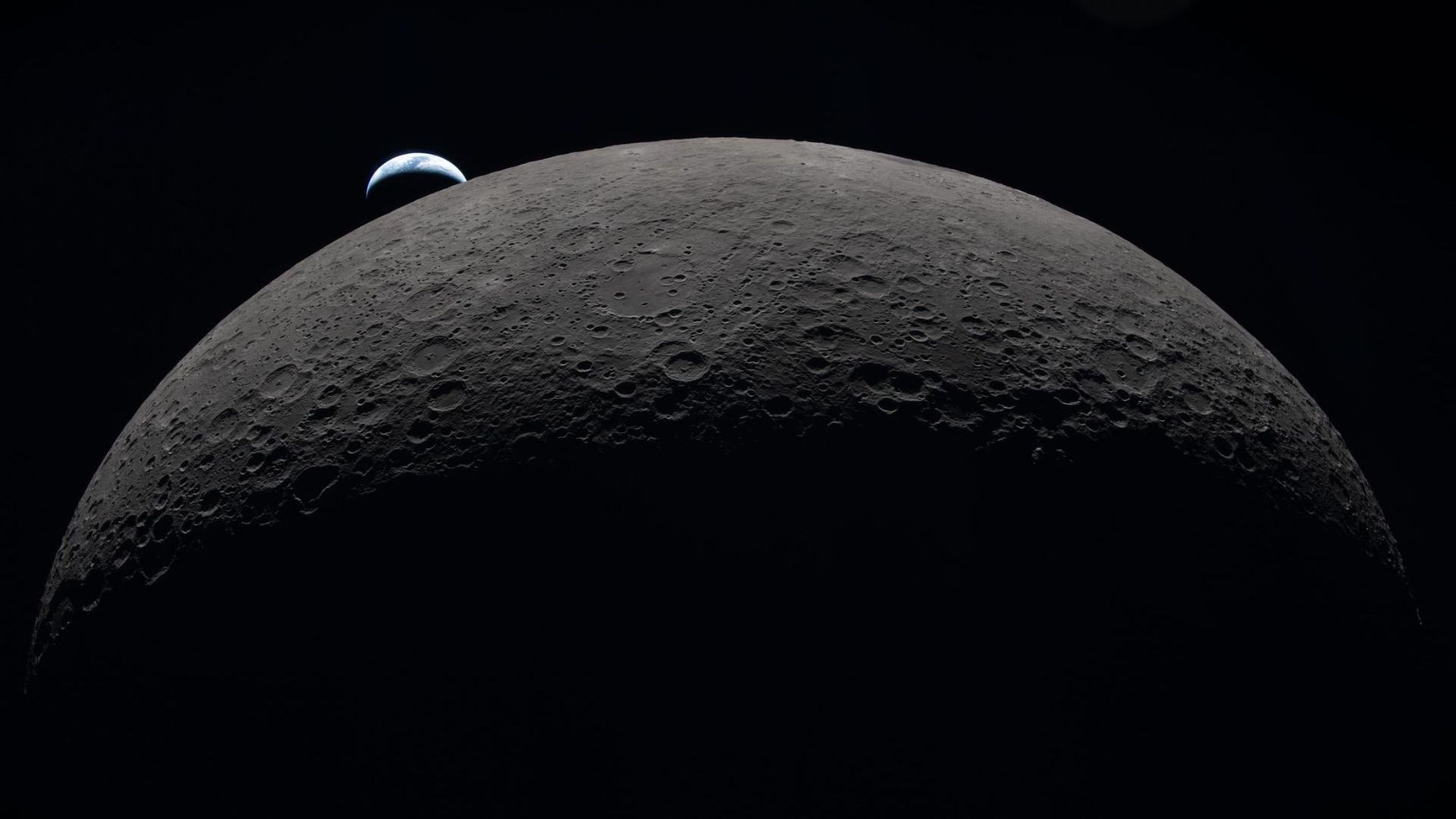
The bold idea, not yet peer-reviewed, suggests checking out the lunar surface for "microscopic technosignatures." The SETI Institute — or the Search for Extraterrestrial Intelligence Institute — describes these technosignatures as "tiny engineered particles" that may have come from interstellar space before settling on the moon.
The institute recently highlighted a paper on the topic, published on arxiv in August, and added the research is undergoing peer review for consideration in the International Journal of Astrobiology. The study is led by SETI Institute Affiliate Scientist Lewis Pinault.
"The moon has been quietly accumulating material from space for billions of years, much of it likely billions of years older than the moon itself," said Pinault in a statement. "We're asking whether that ancient collection might contain microscopic traces of technologies that existed long before humans ever looked up at the sky."
Even if no aliens turn out to be there, the search could help advance models of how dust goes through interstellar space, as well as effects on lunar geology or impact science, the institute added.
"The study reports no evidence of extraterrestrial technology," the institute added in the statement. "Instead, it demonstrates that searching for these microscopic technosignatures is now scientifically testable."
That's in large part because the NASA-led Artemis program, which will ultimately bring astronauts to the moon, as well as China's Chang'e robotic series, would provide opportunities to return samples, the institute said. (China is also eyeing bringing its taikonauts to the moon by 2030.)
SETI is best known for looking for artificial radio signatures in space that may have come from extraterrestrials. This new study, the institute added, is focusing more on past alien communities that may have preserved their knowledge in "durable particles," even if the communities are no longer in existence.
The study examines how these particles could (in theory) move from star to star, stay viable over long distances and periods, embed themselves in the lunar surface and then — if humans could find them — use AI-assisted imaging, materials analysis and microscopy to take a closer look, among other techniques.
Helping in that search is the environment of the moon itself, which — compared with Earth, at least — has slow-moving geology. As the institute points out, the surface has no flowing water or substantial atmosphere like our planet does. What's more, the moon has picked up dust in its environment for about four billion years (from not long after the solar system was formed 4.5 billion years ago), presenting a potential archive of dust in the solar system and interstellar space.
"The researchers argue that if advanced civilizations produce durable microscopic debris — whether intentionally or as a byproduct of space exploration or large-scale engineering — a tiny fraction of those particles could eventually become embedded in the lunar regolith," the institute stated.
The goal is to start these studies with about 35 cubic feet (one cubic meter) of lunar regolith, which is maybe the equivalent size of a fridge. Researchers would try out a series of careful investigations using multiple tools to "begin placing meaningful limits on the amount of durable artificial material produced by technological civilizations over the history of the Milky Way."
And as mentioned, even if this small sample doesn't turn up technosignatures, the researchers say the work is still important. It's another way to search for "extraterrestrial artifacts," to look at various aspects of solar system science, and to try out newer tools for examining moon samples that weren't available in the Apollo years.
"This is a novel addition to the search methodologies applied to seeking evidence of technology as a proxy for life and intelligence beyond our solar system and we are excited at the prospect of bringing this to fruition," stated Bill Diamond, SETI Institute president and CEO.
Whatever they are and from where, UFOs, now known as Unidentified Anomalous Phenomena or UAP, are the subject of serious scrutiny at the highest levels of the U.S. government.
In June 2026, the White House established a new UAP Science Advisory Council in coordination with the Pentagon's All Domain Anomaly Resolution Office, the Office of the Director of National Intelligence and the FBI Deep diving into the UAP landscape is Avi Loeb, noted Harvard astrophysicist. He is also director of the Galileo Project at Harvard, which aims to search for signs of extraterrestrial activity here on Earth. As the council chair, Loeb said the goal of this group is to advise the U.S. government on how to resolve the nature of UAP.
Members of the UAP Science Advisory Council recently gathered at a private meeting, held on Aug. 31 at the Office of the Director of National Intelligence, Loeb told Space.com. "I cannot disclose the contents but I will say that the U.S. government is sincere in its efforts to understand UAP based on the scientific method of data collection," Loeb said.
Council membership
One of the council's members is Ben Lamm, co-founder and CEO of Colossal Biosciences. As a serial technology entrepreneur, he's no stranger to diving into complex challenges. Colossal is advancing the use of genome editing technology to "de-extinct" previously lost species such as the Wooly Mammoth.
Working along with the council's group of scientists and experts, Lamm is bullish about bringing clarity to a long-standing investigation and wonder of UAP.
"I've been fascinated by this topic for a long time, so having the opportunity to help examine the evidence firsthand and contribute to a serious scientific effort is incredibly exciting," Lamm told Space.com.
"Our mission is straightforward," Lamm added. "This is not about belief, it is about evidence. We want to apply rigorous scientific methods to both historical UAP records and new observations, collecting and analyzing data that meets today's scientific standards," he said.
Lamm said that the expectation is to bring transparency and accountability to the field by objectively evaluating credible evidence and sharing findings openly with the scientific community and the public.
"It's time to search for answers around the science because they could reshape our understanding of the world and, potentially, become one of the most significant discoveries in human history," said Lamm.
Ben Lamm at SXSW London 2025 on June 03, 2025 in London, England. (Image credit: Lorne Thomson/Redferns/Getty Images)
New polling data
Meanwhile, and serving as a backdrop to studying UAP, is a new Gallup poll, conducted in July. That poll found that about half of Americans, 49 percent, think all Unidentified Flying Object (UFO) sightings can be explained by human activity on Earth or natural phenomena.
The poll also found 37 percent believe at least some UFOs have been alien spacecraft visiting Earth from other planets or galaxies while another 13 percent do not have an opinion.
Interestingly, rather than becoming increasingly convinced that some sightings have been alien spacecraft, the percentage of Americans who are unsure has grown, from 7% in 2019 to 13% in 2026 the Gallup poll found.
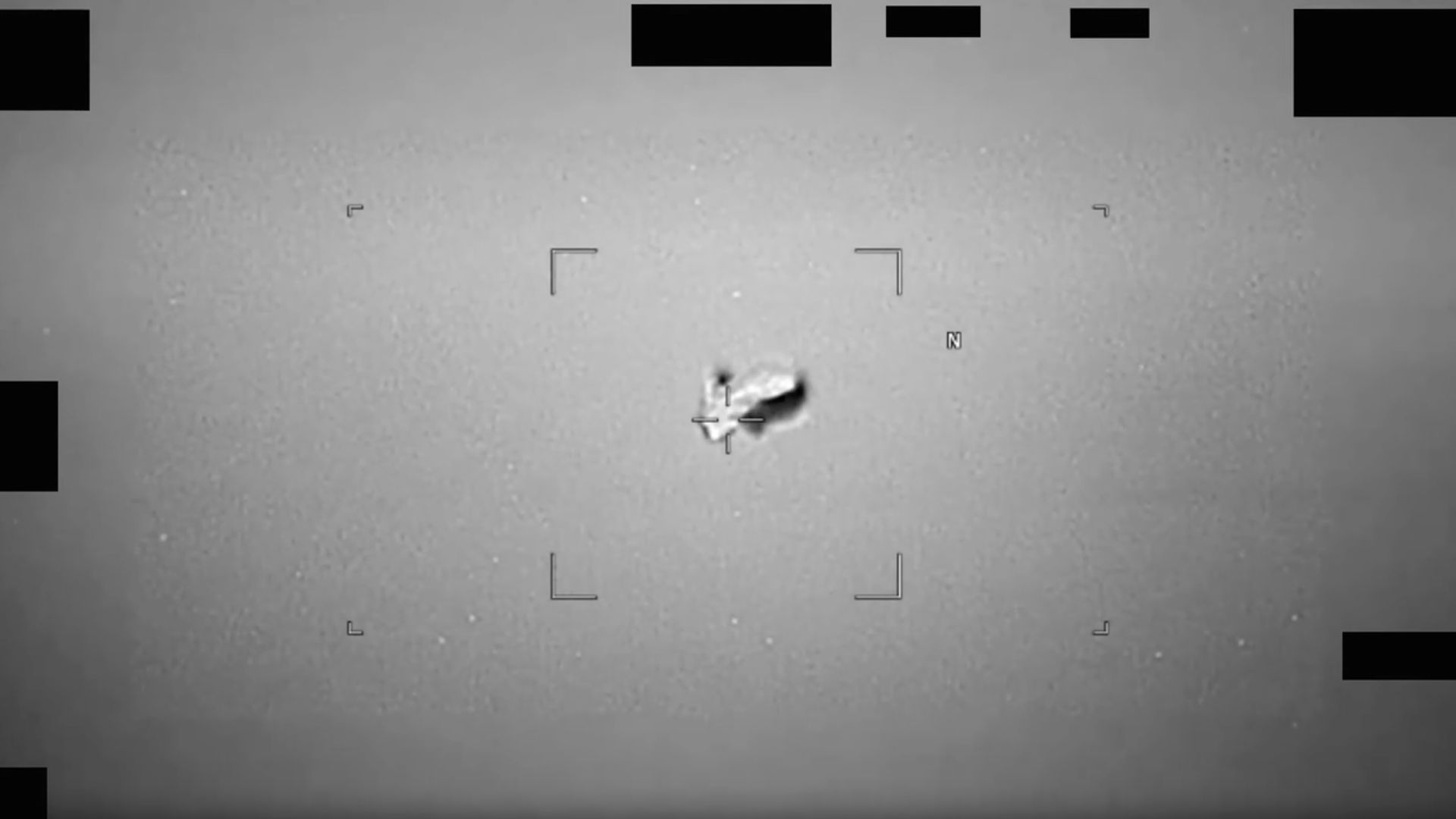
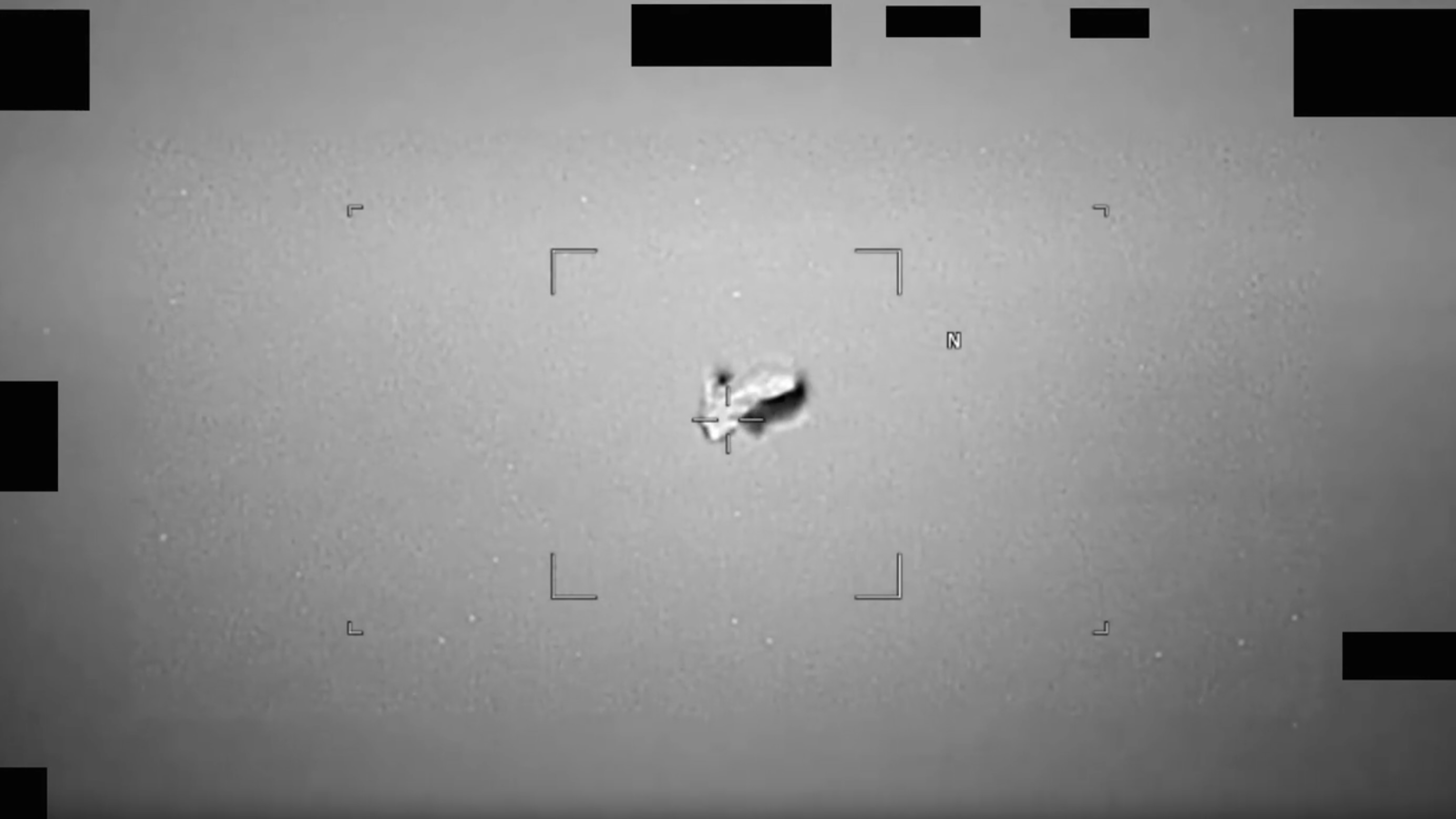
A "football-shaped" UAP (unidentified anomalous phenomenon) observed by an infrared sensor on a U.S. military platform in 2024. The Pentagon released this observation on May 8, 2026. (Image credit: U.S. Deparment of War)
The new poll also notes that a majority say the U.S. government is withholding UFO information. Seventy-eight percent of Americans say the U.S. government knows more about UFOs than it is telling the public, higher than the 68 percent and 71 percent who said so in 2019 and 1996, respectively.
In August 2026, the UAP Science Advisory Council announced their support for the Trump administration to provide legal assurances, including immunity where necessary, for current or former government employees and military personnel to share information with the council "regarding alleged technology from a non-human origin and help guide the council's scientific evaluation."
A rocky planet orbiting in the habitable zone of a sun-like star may look like a perfect place for life to thrive — but not if it's too small to hold onto its atmosphere.
So, we may wonder: How much smaller Earth could be and still have its delightfully breathable atmosphere? How small could an exoplanet be to sustain life as we know it?
With these questions in mind, University of California Riverside planetary scientist Michelle Hill and her colleagues recently simulated what happens to the atmospheres of different sizes of rocky worlds. The worlds tested were similar to Earth and orbited in the habitable zones around sun-like stars. It turns out for a world to maintain an atmosphere long enough for life to gain a foothold (a few billion years at minimum), it needs to be at least as big as Mars.
Narrowing down the search for life
The habitable zone — the area around a star where temperatures are right for liquid water to exist on a planet's surface — is prime real estate in the hunt for alien life. It's also a tough neighborhood for exoplanet atmospheres, because the closer a planet is to a star, the more ways in which radiation and stellar wind will try to strip away an atmosphere.
This is why Hill and her colleagues recently simulated how long it would take rocky, Earth-like planets of various sizes, in the habitable zone of a star like our sun, to lose their atmospheres. In other words, how much smaller could Earth, or a similar planet, be and still keep an atmosphere?
The answer turns out to be that an atmosphere-sustaining planet needs to be about 80% as wide as Earth, but could technically be as small as 60%. This offers astrobiologists a clue about which planets to focus on in the search for habitable worlds and signs of alien life.
"The plethora of exoplanets creates an interesting challenge in the search for potentially habitable planets," wrote Hill and her colleagues. "Of the many targets in the habitable zones of their star, which are the best candidates for follow-up observations with the aim of detecting biosignatures?" In other words, astrobiologists now have almost too many planets to choose from and not enough telescope time to search them all. So, it's time to narrow the search.
One way to do that is to figure out which planets are most likely to be habitable — and for life as we know it, that habitability means having an atmosphere.
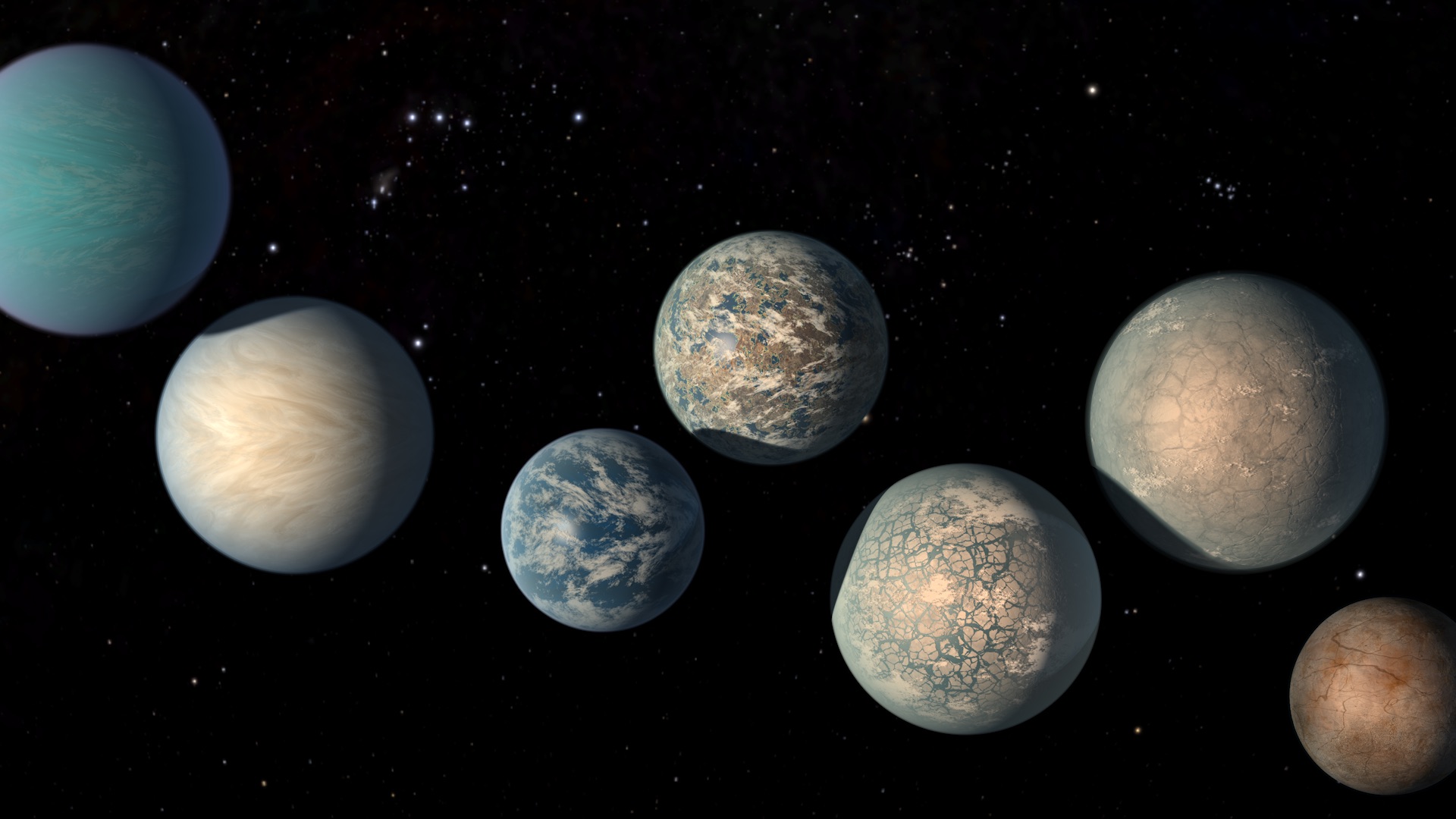
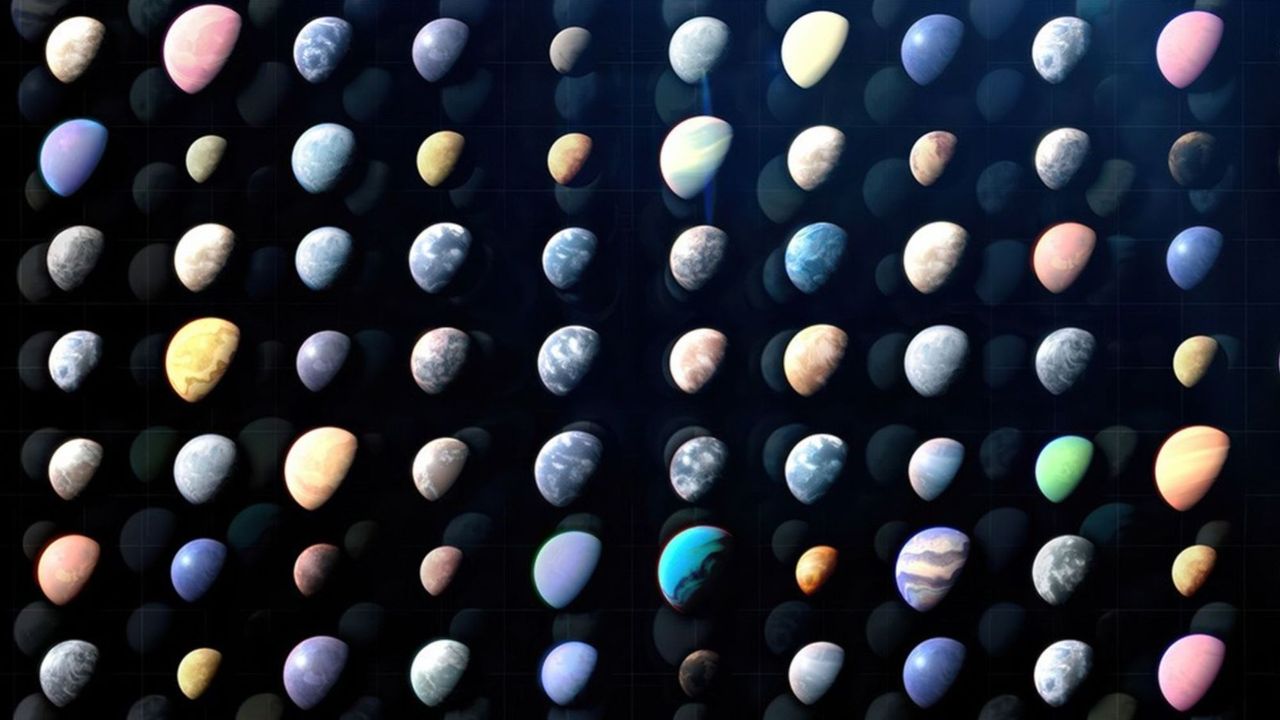
New exoplanets, like those orbiting TRAPPIST-1, are being discovered with staggering frequency. (Image credit: NASA's Goddard Space Flight Center)
Modeling atmospheres — and volcanoes
Hill and her colleagues' "Smaller Than Earth Habitability Model" simulates the fate of atmospheres around digital versions of Earth. Some of the simulated worlds are exactly like ours but smaller, with the same chemical makeup and the same proportions of core, mantle and crust. Others have slightly different amounts of carbon, larger or smaller cores, or different starting temperatures. The model traces what happens to these worlds over a few billion years, based on two things: how quickly stellar wind and radiation strip away gas from the planet's atmosphere and how quickly volcanoes pump out gas (mostly carbon dioxide) to replace it.
The model is how the team realized a scaled-down version of Earth needs to be at least 80% as wide as true Earth (0.8 Earth radii) to maintain an atmosphere in the long run. Smaller planets tend to lose gas faster than volcanic eruptions can replace it.
That's because smaller planets have less gravity and weaker magnetic fields with which to hold onto their thin envelopes of gas. They also don't usually release enough gas from within to make up for the loss. Their mantles — the churning layer of magma beneath the crust — tend to release less volcanic gas over time, and their upper layers cool and harden much faster. The latter process cuts off volcanic eruptions much earlier in a planet's lifespan.
Smaller planets clinging onto atmospheres
By changing some of Earth's parameters, the team managed to get planets as small as 0.6 Earth radii to maintain a stable atmosphere. Carbon was the key: planets with more carbon in their mantles tend to release more carbon dioxide gas in eruptions, and that turns out to be the biggest factor (other than size) in whether a planet keeps its atmosphere.
"Carbon dioxide is a heavy molecule," Hill and her colleagues wrote, "which can make it a difficult molecule to lose. We focus on a pure carbon dioxide atmosphere as a best-case scenario for atmospheric retention." Of course, that's only a best-case scenario for some relatively simple forms of life, so your astrobiological mileage may vary.
It took tons more carbon than Earth contains to make a significant difference to the fate of a planet's atmosphere — but because it's theoretically possible for a planet to form with that much carbon in its makeup, that's useful knowledge. Planets with relatively smaller cores, and therefore relatively thicker mantles, also had better luck on the atmospheric retention front. Starting with a larger supply of radioactive elements, which decay and release heat into the surrounding rock, helped keep the mantle molten and the volcanic gases churning skyward.
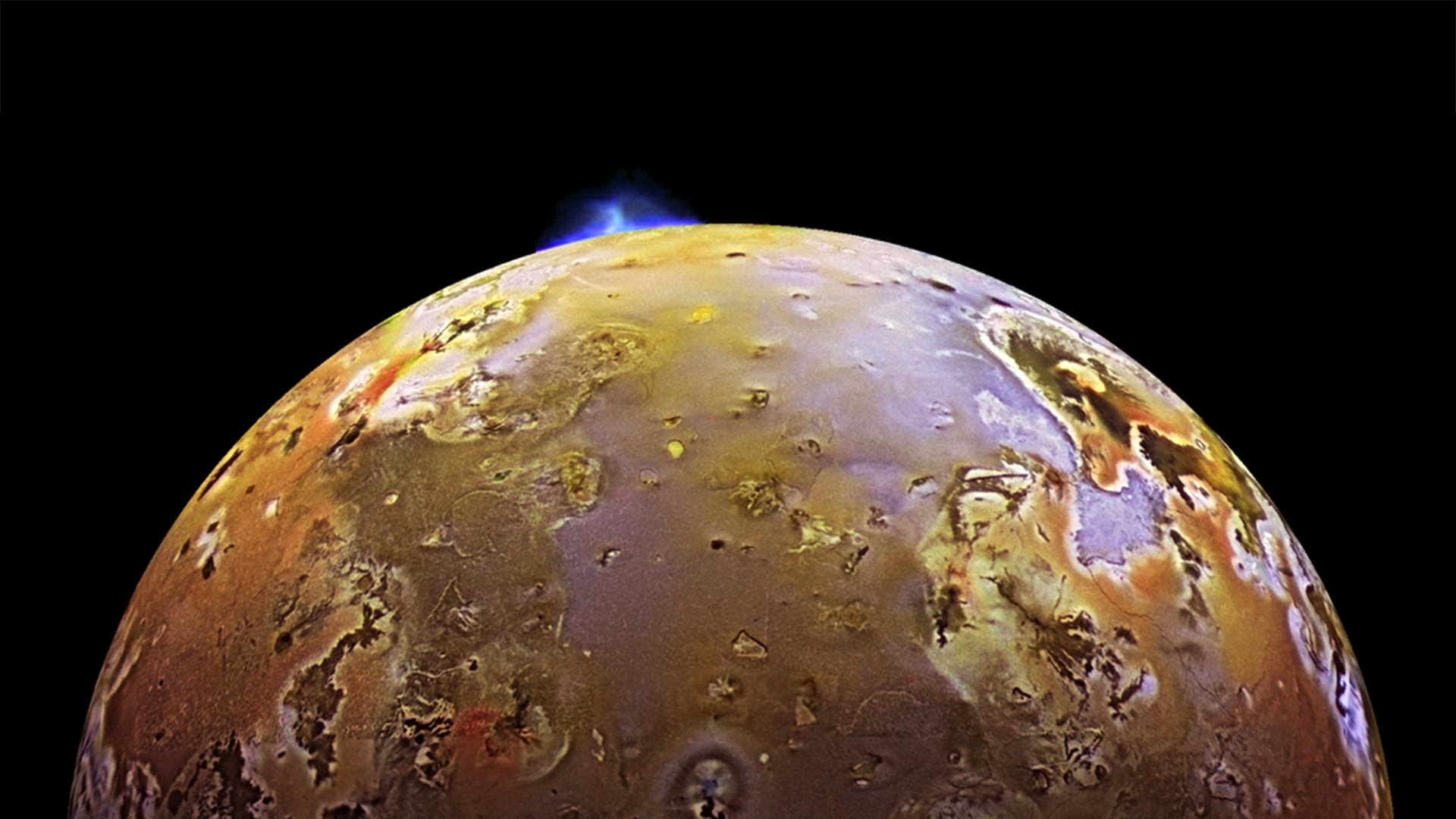
Space volcanoes are widespread. For instance, Jupiter's moon Io has a pizza-like surface covered in volcanoes. (Image credit: NASA)
Starting with a cooler mantle also helps — which sounds surprising. You'd think a hotter mantle would be more likely to spew volcanic gases into the atmosphere. Yet, a cooler mantle takes longer to start erupting in earnest, which means the planet gets to hold onto its reservoir of gases until its star is older and more settled.
Newborn stars are prone to violent bursts of radiation and plasma, which would sweep away the volcanic gas as fast as it erupted. With a cooler mantle and later eruptions, the planet gets to keep more of the erupted gas.
A second chance for airless worlds
There's still hope of life for smaller worlds.
Even planets that lose their initial atmospheres entirely — instead of gradually replacing them with things like carbon dioxide and methane — might have a second chance to build a new atmosphere.
Hill and her colleagues suggest that one way for a planet to regain its lost atmosphere could be comet and asteroid impacts, which might deliver volatile elements like hydrogen, oxygen and carbon. These elements can combine to form all sorts of atmospheric gases.
Such impacts could be especially helpful if they happen later in the star system's life, like after the star is past its youthful phase of intense flares.
"While smaller planets face greater challenges in retaining atmospheres, our model suggests that they can develop atmospheres under the right conditions," wrote Hill and her colleagues, so, "even those that initially lose their atmospheres should not be immediately discounted as potentially habitable worlds."
What's next?
Future simulations using the Smaller Than Earth Habitability Model could study worlds around smaller, cooler stars called red dwarfs — stars like TRAPPIST-1, which is home to at least seven rocky planets, with three of them in the habitable zone. These stars make up about 75% of the stars in our galaxy, and their relatively dim light makes it easier for telescopes like the James Webb Space Telescope (JWST) to capture images of starlight filtering through the atmospheres of planets that pass between Earth and their host stars.
Hill and her colleagues also hope to explore what happens to atmospheres around tidally-locked planets, or planets where tidal forces keep the interior hot and seismically active, similar to Jupiter's moon Io.
The researchers behind the historic discovery, which they are calling “a major milestone in the search for life on other planets,” said the detection of an atmosphere on an Earth-like rocky exoplanet offers the strongest evidence to date that worlds with similar compositions and temperatures to Earth that are also capable of supporting life could exist beyond our solar system.
Models Predicted First Earth-like Rocky Habitable Zone Exoplanet Atmosphere
In a statement announcing the detection of an atmosphere around a habitable-zone rocky exoplanet, the discovery was motivated by theoretical predictions suggesting that LHS 1140 b may contain an atmosphere. The planet was even more tantalizing because its orbit around its host red dwarf star allows for liquid water on its surface, a key ingredient for life as we know it.
Although thousands of exoplanets have been confirmed since 1995, including habitable-zone rocky worlds similar in size and composition to Earth, the team notes that determining whether any of these potential Earth analogs maintain an atmosphere. Like water, an atmosphere is considered a likely necessity for life to emerge.
“An atmosphere is essential for a planet to support life as we know it,” explained Collin Cherubim, the lead author of a study detailing the findings, who recently earned his Ph.D. in Earth and Planetary Sciences from Harvard University.
Robin Wordsworth, the Gordon McKay Professor of Environmental Science and Engineering and Professor of Earth and Planetary Sciences at Harvard, said that as recently as twenty years ago, astronomers still didn’t know if other, terrestrial-type planets “even existed.” However, he explained, they quickly found that this type of planet was common, including some orbiting within their star’s habitable zone.
“The next question was whether any of them had managed to keep an atmosphere,” the professor added.
Infrared Observations Confirm Historic First
Before performing any direct observations, the team used computer models to predict what they might find on LHS 1140 b. As noted, those models predicted an upper atmosphere rich in helium. The models also suggested that the atmospheric helium was slowly escaping into space.
To test the model’s predictions, Cherubim and colleagues gained access to the Warm Infrared Echelle (WINERED) Spectrograph on the Magellan Observatory in Chile. The team noted that this powerful telescope allowed them to observe an alignment of LHS 1140 b and another planet transiting its star “on the same night.”
When analyzing the data, the team found that one of the planets appeared to lack any measurable atmosphere. However, as their models had predicted, helium was actively escaping from LHS 1140 b. The finding confirmed that this rocky exoplanet orbiting within its star’s habitable zone was actively maintaining an atmosphere.
David Charbonneau, the head of the Harvard Department of Astronomy and an astronomer at the Center for Astrophysics | Harvard & Smithsonian, and Cherubim’s co-advisor with Wordsworth, was initially skeptical because the entire concept was based on a mathematical prediction of a phenomenon astronomers had never witnessed directly. However, Professor Charbonneau ended up praising the student’s determination and follow-through, which led to the historic detection.
“Collin analyzed the planets we knew about and predicted that this one would have a helium atmosphere,” Charbonneau said. “Then he organized telescope time, got the data, and the detection was statistically rock solid.”
“Hopefully it’s just the First of Many More Observations to Come”
When discussing the implications of the findings, Cherubim noted that “this is the first time anyone has found an atmosphere on a rocky planet in the habitable zone of another star.” Professor Wordsworth agreed, once again noting that until now, planets in these categories with atmospheres had been purely theoretical.
“Now we know at least one has,” the professor said.
The data also suggest that LHS 1140 b’s atmosphere has likely survived for more than three billion years, roughly three-quarters of Earth’s existence. This durability makes LHS 1140 b an excellent candidate for future exoplanet atmosphere studies.
More broadly, the team said that using ground-based observatories to search for escaping gases, such as the helium detected leaving LHS 1140 b, “may become an important tool for studying atmospheres on rocky exoplanets.” They also note the potential value of atmospheric detection for astrobiologists searching for signs of life in the cosmos.
As for Cherubim, he plans on following up his historic discovery with a more detailed analysis of the planet’s atmospheric composition. He also said he would like to investigate the possible presence of surface oceans or other planetary characteristics typically associated with habitability and life. The entire team also said they would like to use Cherubim’s model to search for similar Earth-like, habitable-zone rocky exoplanets.
“This has been a model validation, and hopefully it’s just the first of many more observations to come,” Cherubim said.
Christopher Plain is a Science Fiction and Fantasy novelist and Head Science Writer at The Debrief. Follow and connect with him on X, learn about his books at plainfiction.com, or email him directly at christopher@thedebrief.org.
Harvard astrophysicist Avi Loeb has been appointed as the head of a new White House group to study unidentified anomalous phenomena or UAP, a new catch-all term for UFOs that might appear not just in the air but also in space or underwater. Loeb says the group is focused on evidence, instrumentation, data analysis and collection standards.
Loeb co-founded and leads the Galileo Project, designed to bring the search for extraterrestrial technological signatures of extraterrestrial technological civilizations "from accidental or anecdotal observations and legends to the mainstream of transparent, validated and systematic scientific research."
As chair of the just-formed UAP Science Advisory Council, Loeb has built a team of researchers that he describes as "an amazing A-team of exceptional scientists and experts."
Members of the group come from a wide range of disciplines from data science and instrumentation to biology, oceanography, anthropology and psychology.
The council's stated purpose is to help government agencies study the nature of UAP through rigorous scientific methods, with an emphasis on collecting and analyzing higher-quality data rather than relitigating older material that cannot be independently verified.
Meet the team
But first things first.
What is the current membership makeup of Loeb's Council? It's quite a mix of talent to undertake a new look at UAP:
Liberty Capito is a professor of practice in data science at the Olin Business School at the Washington University in St. Louis.
Carol Cleland is a professor in the Department of Philosophy at the University of Colorado Boulder.
Richard Cloete is a computer scientist at Harvard University and a member of Loeb's Galileo Project.
Omer Eldadi is in the department of psychology at Reichman University, Herzliya, Israel.
Tim Gallaudet is a retired Navy admiral and oceanographer.
Robin Hanson is an associate professor of economics at George Mason University statistics and economics.
Ross Howard is producer of John Michael Godier's Event Horizon podcast that explores the technosignatures of alien technology. He is also with the Sol Foundation aimed at addressing the UAP issue and preparing society for its social implications.
Kevin Knuth is a professor of physics at the University at Albany.
Ravi Kopparapu is a NASA Goddard Space Flight Center expert having research interests in extrasolar planet habitability, atmosphere modeling and characterization.
Ben Lamm is the co-founder and CEO Of Colossal Biosciences, the world's first de-extinction company.
Jacob Haqq Misra, of Blue Marble Space, is a meteorology and astrobiology specialist.
Devesh Nandal is a Swiss National Science Foundation postdoctoral fellow at the Center for Astrophysics at Harvard and Smithsonian.
Garry Nolan is professor in the Department of Pathology at Stanford University School of Medicine and is executive director of the board of the Sol Foundation.
Michael Shermer is the founding publisher of Skeptic magazine and an educator on critical thinking.
Peter Skafish is a sociocultural anthropologist and secretary of the Sol Foundation.
Matthew Szydagis is an associate professor in the Department of Physics at the University at Albany.
Jennice Vilhauer is a clinical psychologist with expertise in quantitative psychology and the psychological dimensions of potential disclosure.
Data-driven, physics-based
Space.com reached out to several of the UAP Council members to get their personal views on this new study approach.
"I expect the council and myself to follow methods and techniques deeply rooted in the scientific principles," said Devesh Nandal.
"The UAP Science council in particular is focused on a data-driven and physics-based approach on the topic of UAP," said Nandal. "We approach this topic with the same rigor we apply in our respective scientific fields and we hope to provide an unbiased analysis on this topic."
Nandal said his role is to help with quantitative data analysis and apply his expertise in astrophysics to help the council decipher the origin of UAPs.
A "football-shaped" UAP (unidentified anomalous phenomenon) observed by an infrared sensor on a U.S. military platform in 2024. The Pentagon released this observation on May 8, 2026. (Image credit: U.S. Deparment of War)
"My first and foremost passion is in stellar astrophysics where I study the life and death of massive and supermassive stars," Nandal said. "I also find the anomalous nature of UAP sightings to be quite intriguing, and whether these events are of terrestrial or extraterrestrial origin, I am excited to apply my understanding of physics to decipher their true nature," he said.
If such events can be explained using known principles, "that's excellent," Nandal advised, as this gives him a chance to test the laws of physics to explain a phenomenon that is captivating fellow humans.
"If such events are beyond our current understanding, I see this as a brilliant opportunity to learn all that I can about the Universe and share my findings with everyone," Nandal concluded.
Public trust in science
Council memberLiberty Capito said she's honored to be a part of the study group.
"Avi is one of the most brilliant scientists of our time and what he has put together, is what I believe to be a blueprint for re-establishing the public's trust in science by having people with vastly different views, beliefs and science on it," Capito said.
From Council member, Robin Hanson: "It's an honor to be invited, and it's a great cause. I worried at first if we could find much useful to do, but it seems that we do have some promising ideas."
Another member of the UAP Council is Carol Cleland, a professor in the Department of Philosophy at the University of Colorado Boulder. She is a Search for Extraterrestrial Intelligence Institute Affiliate and a member of CU Boulder's Center for Astrobiology.
"I anticipate having a council of outside experts will pressure the government to be more open about releasing information and allowing members of the council to interview UAP witnesses," Cleland told Space.com.
Potential positive
Identifying the unidentified deserves a high priority within the U.S. government and the scientific community, explains Loeb.
Nevertheless, for organizations that also continue to diligently sort out what's behind unidentified flying objects (UFOs) in the past and the current UAP tag line, they are taking a cautiously optimistic attitude.
"The involvement of serious, independent scientists is a potential positive development, and the government requires that for any thorough and credible investigation of UAP," said Mark Rodeghier, president and scientific director of the J. Allen Hynek Center for UFO Studies since 1986.
The key issue is not the credentials of the people involved, Rodeghier said, but the structure they are working within.
"If the Council lacks a clear mandate, access to relevant data, a collaborative relationship with those actually grappling with the UAP problem in the government, and then a path for public reporting, its practical value may be quite limited," Rodeghier told Space.com.
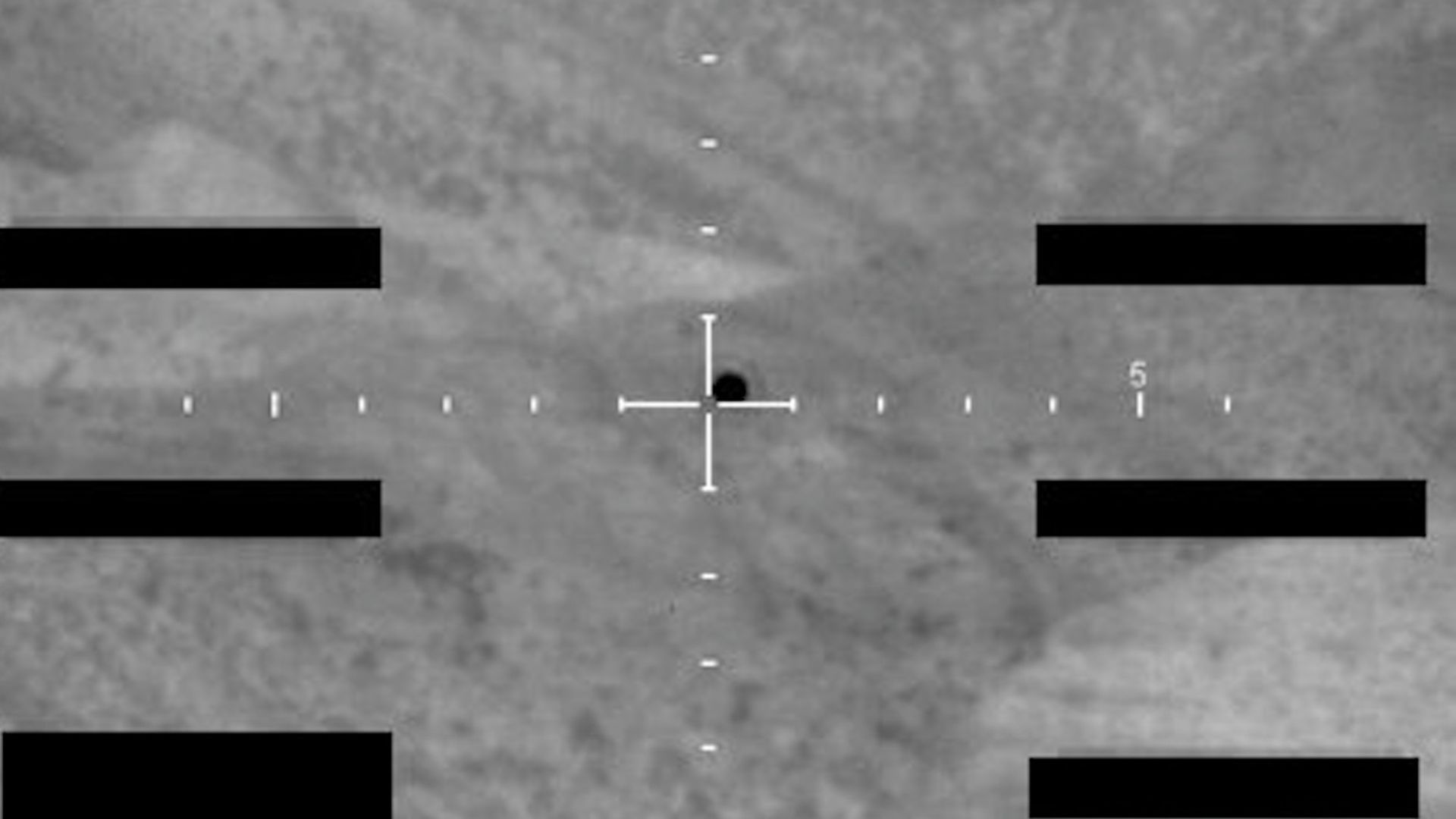
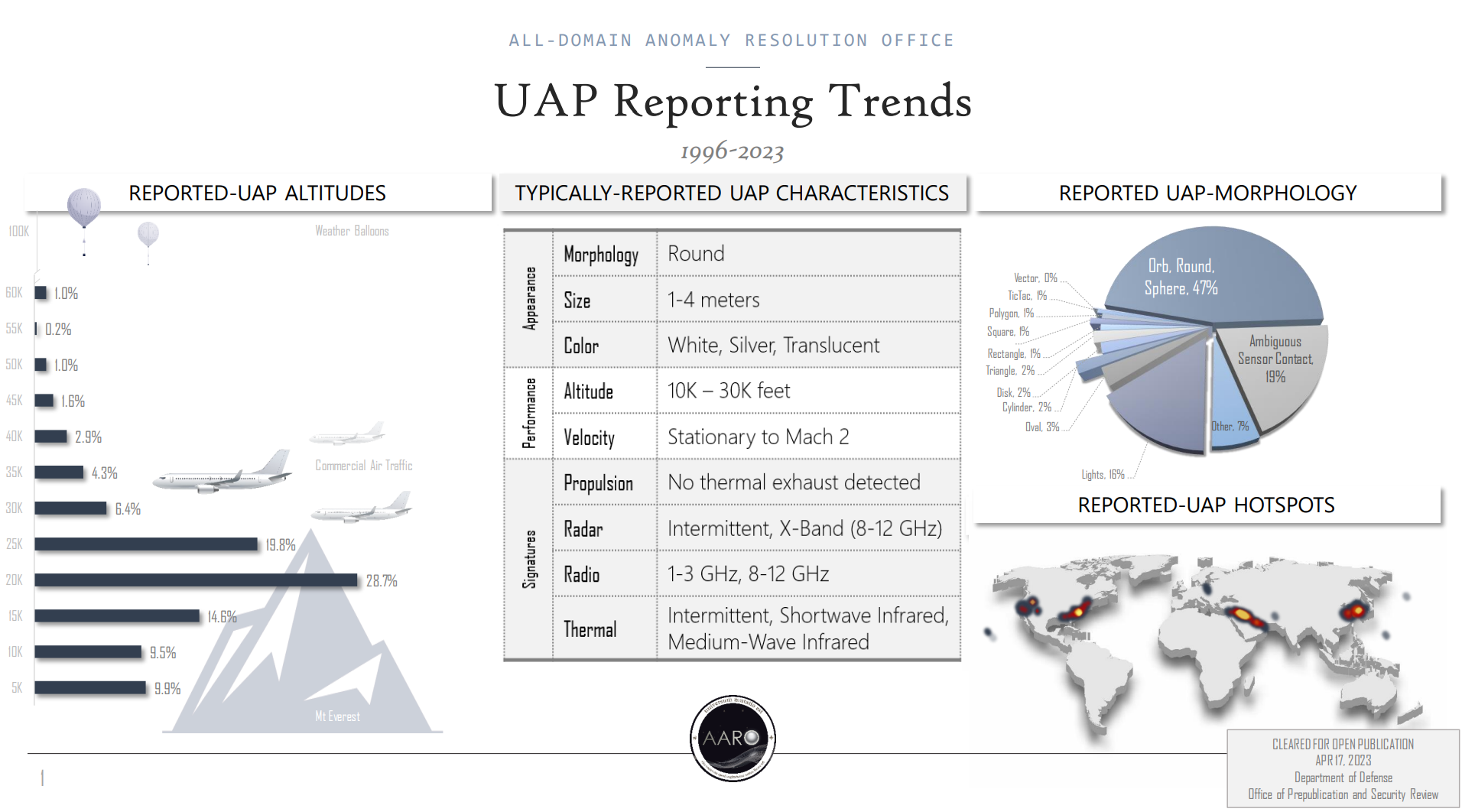
A slide released by the Pentagon's All-Domain Anomaly Resolution Office (AARO) in 2023 detailing trends in UAP reports. (Image credit: U.S. Dept. of Defense/AARO)
Wait and see
Robert Powell, an executive board member of the Scientific Coalition for UAP Studies, said he's adopting a "wait and see" attitude regarding the UAP Council at this point in time.
"Since the UAP Council seems to have the ear of some in Congress," Powell told Space.com, "I hope that they will spend some of their time advocating that Congress appropriate funding specific to the study of UAP through the National Science Foundation."
In SCU board meetings, Powell added, they are a strong proponent of making funding available to the scientific community and academia.
"We never know from where a breakthrough may occur in the study of UAP," Powell said, "and the more scientists involved from all areas of research, the better."
A new planetary habitability model could make the search for aliens more efficient by quickly identifying rocky worlds unlikely to sustain the atmospheres needed for life as we know it.
The software, called the Smaller Than Earth Habitability Model (STEHM), allows astronomers to screen exoplanets before committing valuable telescope time to detailed observations. Developed by researchers at Stanford University, the model assesses whether a rocky planet can build and retain an atmosphere over billions of years — a prerequisite for life as we know it, according to a statement from the university.
Astronomers searching for life beyond Earth face a daunting challenge: thousands of exoplanets have already been discovered, and billions more are thought to exist throughout the Milky Way — roughly one for every star in the galaxy. As powerful new telescopes come online, researchers increasingly need ways to identify which worlds are worth closer study.
"The only way that we're going to ever find out if there are signatures of life out there is by observing the atmosphere of these planets," Michelle Hill, lead author of the study who developed STEHM, said in the statement.
Traditionally, scientists have focused on whether a planet lies within its star's habitable zone, the region where temperatures may allow liquid water to exist on the surface. But location alone does not guarantee habitability. A planet without a substantial atmosphere may be unable to maintain stable temperatures, shield itself from radiation or support surface water, the researchers said.
STEHM adds a second layer to this assessment by estimating whether small rocky planets can generate and retain atmospheres over geologic timescales. The model links a planet's size to its ability to hold onto atmospheric gases, helping identify a lower size threshold for potentially habitable worlds.
To build STEHM, Hill used the ExoPlex planetary simulation code to model six rocky worlds ranging from half Earth's size to Earth-size, testing how planetary structure, volcanic activity, internal heat and stellar radiation affect atmospheric survival. The model was validated using Venus and Mars, correctly reproducing Venus's thick carbon dioxide atmosphere and Mars's long-term atmospheric loss.
The results suggest that rocky planets at least 80% the size of Earth can retain atmospheres for 10 billion years or more when orbiting within habitable zones around sun-like stars. Smaller planets generally lose their atmospheres more quickly, though worlds around 70% of Earth's size may still be habitable under favorable conditions. Atmospheric longevity also depends strongly on initial carbon content and heat-producing elements that drive volcanic activity, allowing STEHM to serve as a size-based filter for identifying the most promising habitable worlds.
"Maybe there's life on other planets under the ground, but we are never going to be able to see it because we can't send something to those exoplanets," Hill said in the statement. "The best chance we've got is looking for signs of life by analyzing atmospheres from afar."
By narrowing the field of candidates, STEHM could help astronomers focus on the most promising planets for life while avoiding wasting resources on unlikely targets. The approach may be especially useful as next-generation missions, such as the European Space Agency's PLATO space telescope, expand the catalog of rocky exoplanets around nearby stars. Researchers hope the model will help prioritize which of these planets merit follow-up observations.
STEHM not only addresses where life beyond Earth could occur, but when it might, by modeling whether exoplanets can actually hold onto atmospheres over geologic timescales — a key prerequisite for life to take hold in the first place.
"Maybe the answer to why we haven't found any life yet is that we're so early in the grand scheme of what has been created through the lives and deaths of stars," Hill said in the statement. "Maybe we're one of the first."
Their findings were published June 4 in the Planetary Science Journal.
A new study analyzed how NASA's Habitable Worlds Observatory might be able to confidently spot biosignatures in the atmosphere of a distant ancient Earth.
As Steven Spielberg's alien conspiracy thriller "Disclosure Day" heads to theaters, Space.com talks to the astronomer who has led efforts to make sure any real alien detection will not be kept a secret.
Scientists failed to find radio signals emanating from the interstellar comet 3I/ATLAS, further bolstering its status as a natural object, not one made by aliens.

 Login