❌

Reading view

What happens when driverless cars break the law? 

Driverless cars, once a distant techno-optimist’s dream, are making their way into more cities, racking up miles and attracting a loyal fan base. They’re also increasingly racking up tickets and driving in ways that would land a human driver in hot water. 

During July Fourth celebrations this year, several Waymo autonomous robotaxis operating near San Francisco’s Golden Gate Bridge reportedly hit technical trouble that led to at least one vehicle driving over an exploding firework with two passengers inside. The riders (who luckily escaped harm) said they smelled smoke coming out of the vehicle and promptly bolted at the next intersection.

A couple of months earlier, a California driver claimed a pair of Waymos cut her off and blocked her from moving forward for nearly 50 minutes, causing a traffic pile-up and frantic 911 call. Halfway across the country, as many as five Waymos in Austin blocked police and emergency crews responding to an active shooting that left four people dead and a dozen injured. 

“The question is not if this is going to turn into a deadly situation for someone, but when,” Austin City Council member Paige Ellis said at a meeting following that incident.  

Human drivers in any of these situations would likely face a confrontation with police and the real possibility of a citation—or worse. But that calculus changes when there’s no one behind the wheel. Across the country, cities and states are still figuring out how to sanction a driverless vehicle that breaks the law, even as the well-financed companies operating them rack up thousands of dollars in parking tickets with seemingly few consequences.

To call the situation a work in progress is an understatement. Many localities that allow these vehicles on public roads still lack clear legal mechanisms for issuing moving violations. Where laws do exist, enforcement remains light-handed. Experts in autonomous vehicle (AV) policy tell Popular Science that this seemingly basic question, “what happens when a driverless car breaks the law?”, is still surprisingly complicated to answer.

“In principle, AVs are licensed drivers and someone owns and operates them,” University of Southern California Gould School of Law professor Gregory Keating tells Popular Science. “They should be treated like any other licensed driver.”

Despite spending years studying this very issue, Keating says the path forward remains hazy. 

“In practice, I don’t know what’s going on,” he adds. 

Driverless cars are racking up parking tickets

Cars breaking laws, whether driven by humans or algorithms, fall broadly into two categories: traffic violations and moving violations. Anyone who’s gotten a parking ticket is familiar with the former, and increasingly, so are driverless cars. In 2024, Waymo, by far the most common robotaxi operating today, accrued over 589 parking tickets in San Francisco and $65,065 in fines, according to The Washington Post. The Post reported another 75 tickets further south in Los Angeles. In Austin, where the company more recently started commercial operations, Waymo has reportedly received 20 parking-related citations as of June 23. Zoox, another robotaxi firm backed by Amazon, also received a citation for parking in a tow-away zone. 

[Related: Why are ‘driverless’ cars still hitting things?]

Cops issuing those tickets basically approach it the same way as they would a car with a human driver. Matthew Raifman, autonomous vehicle and traffic lead at UC Berkeley’s SafeTREC, tells Popular Science that in these cases, it’s the vehicle, not any individual behind the wheel, that’s on the hook–the same as it would be for a human-driven car. Parking tickets already work this way: If you borrow a friend’s car and get a ticket, it’s the car’s registered owner who pays, not the friend who parked it. Since an AV’s registered owner is the company that operates it, that same logic extends easily to driverless cars. A traffic cop who comes across an empty, illegally parked driverless car can simply print a ticket and place it on the windshield. At the end of the day, perhaps after picking up more passengers, the AV returns to a depot where a human employee collects the ticket and sends it up the chain for payment. 

How cops are supposed to arrest a car with no driver 

Ticketing driverless cars for more serious moving violations gets more complicated. Most municipalities still don’t have clear mechanisms for citing these vehicles when they block traffic, make illegal U-turns, or commit other mistakes that would normally lead to tense conversations with police. The core issue is confusion over who is held responsible when no human is actually making the mistake.

If a police officer observes an AV committing a moving violation, they generally flash their lights to signal the vehicle to pull over. Robotaxis are programmed to use their onboard sensors to detect police flashers, though some vehicles have struggled to do so in the past. If the AV pulls over, the officer must determine who the rogue car belongs to. Today, with only a handful of robotaxi firms operating, that detective work is pretty simple. But it could get much trickier in the near future as more AV companies enter the market, or if individuals begin owning and operating their own autonomous vehicles.

“Just because robotaxis are dominant right now doesn’t mean that robo taxis will dominate in the future,” University of South Carolina law professor and AV policy expert Bryant Walker Smith tells Popular Science. “We could have one company that develops the automated driving system, another company that puts it on a vehicle, another company that buys the vehicles.” 

A clear example of how this confusion can play out occurred late last year in Northern California. San Bruno police, conducting a DUI operation, say they spotted a driverless Waymo make an illegal U-turn in front of them. Officers pulled the wayward Waymo over and contacted a human representative through the car’s speakers to report a “glitch.” But because there was nobody behind the wheel, no ticket or citation was issued the way it would have been if a human driver were involved.

“Since there was no human driver, a ticket couldn’t be issued (our citation books don’t have a box for ‘robot’),” a San Bruno Police Department Facebook post explained following the incident reads.

“That’s right… no driver, no hands, no clue.”

“I’ve been in a Waymo but, being a mere passenger, I’ve never poked around in the glove compartment to see if they carry their ‘papers’ around approximately the way that human beings do,” Keating says. 

Worries about AVs breaking the law aren’t hypothetical. A recent CNN analysis of federal government records and social media footage found hundreds of driverless cars running red lights, driving into oncoming traffic, ignoring emergency road closures, and executing other potentially dangerous maneuvers. Around that same time, Waymo temporarily pulled its vehicles from highways following reports from the National Highway Traffic Safety Administration (NHTSA) of at least 13 instances where they drove into active construction zones. The company has since started resuming highway routes. 

Waymo and independent supporters of AV rollouts generally have repeatedly claimed that, even when taking these issues into account, autonomous systems get into fewer crashes and drive safer than humans. Recent research lends credence to that argument in certain cases, but AVs are still limited in where and how they can operate. 

“No technology is perfect, but while human drivers can only learn from their individual experiences, Waymo takes community feedback and applies those safety learnings to our entire fleet,” a Waymo spokesperson told CNN in June.

A new type of ‘ticket’ for autonomous vehicles 

Regulators hope some creative new legislation can help clear up the confusion. California enacted a law allowing police to issue a “notice of noncompliance” to AVs. The whole point of these notices, and why they mark an important step forward, is to create an official record for when an AV makes a mistake, Raifman notes. Those notices are then updated in the California DMV’s system within 72 hours. Prior to this, police didn’t have a clear way to document when an AV violated the law, creating a gap that contributed to uncertainty about how well the technology works in the real world.  

Still, actually punishing human drivers and AVs isn’t a one-to-one comparison. When humans make mistakes, they receive points on their driver’s license. Rack up enough points, and a driver risks losing their license altogether. As Raifman points out, notices of noncompliance attempt to apply a similar deterrent for AV companies. The notices are recorded, added up, and factored into whether state regulators continue granting those companies permits to operate autonomously. Too many violations, especially those causing major traffic issues or injuries, could lead to a company’s permit being revoked. But unlike humans, AV makers don’t have to worry about individual monetary fines for these moving violations.
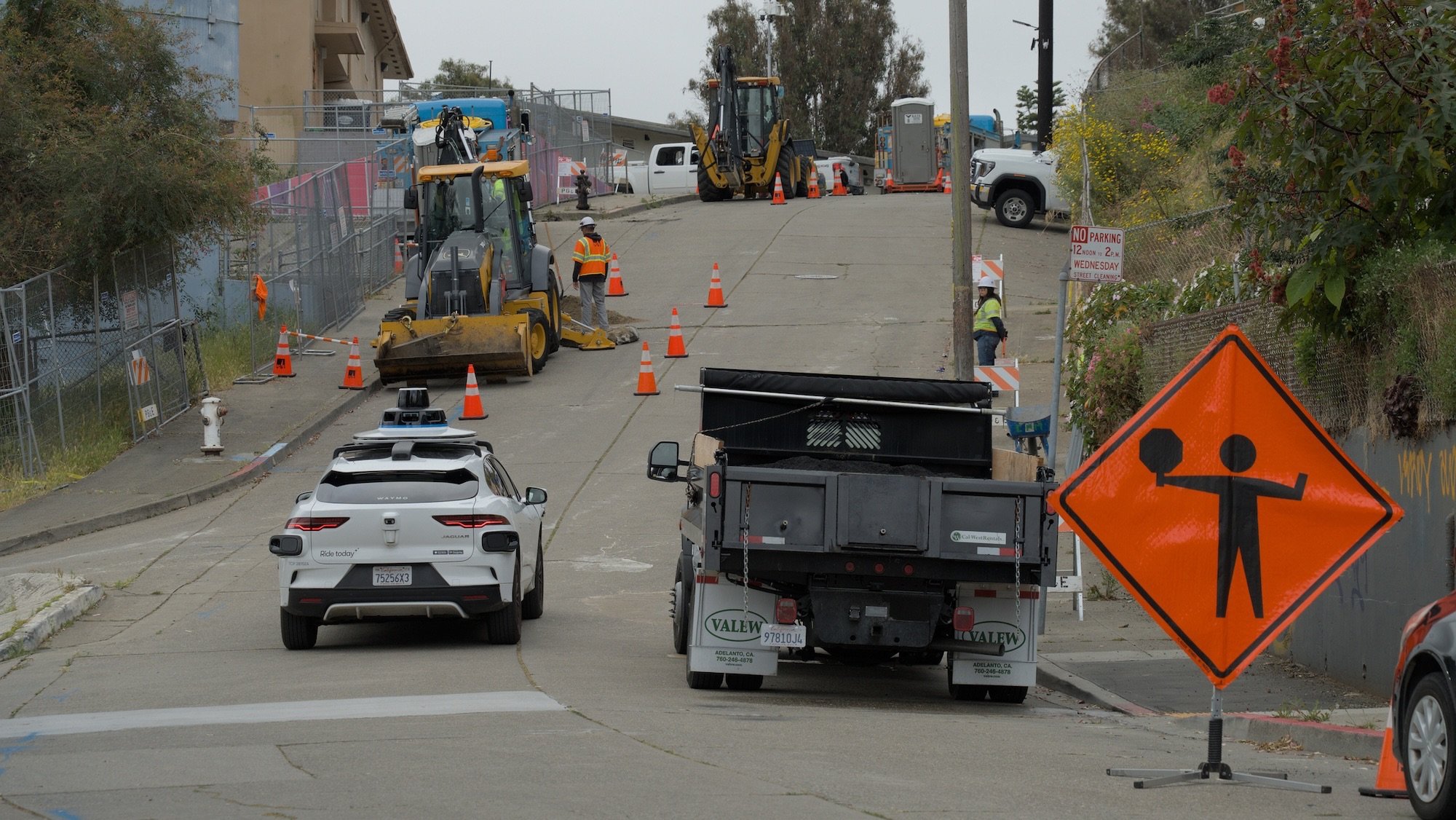
An autonomous Waymo car drives into the blocked off Potrero Annex construction site while a construction worker watches.
An autonomous Waymo car drives into the blocked off Potrero Annex construction site while a construction worker watches. Image: Getty Images Thomas Hunter II/Alamy Live News

“It’s an indirect mechanism to enforcement, but it is not enforcement through money and points,” Walker Smith said.

Raifman compares this enforcement method to how regulators manage pollution from power plants. Local governments often grant permits allowing a facility to emit certain pollutants, but only up to a specified amount. If a plant exceeds that or otherwise violates its permit, regulators can issue a notice of violation, which, depending on its severity, can lead to a permit suspension or even cause operation to shut down. 

That’s a different process than the one facing an individual resident who pollutes their own backyard. In that case, they’d likely just receive a citation. In both the power plant case and now with AVs, enforcement relies on an ongoing back-and-forth between corporations and regulators, rather than a single punishment to an individual.

That may make sense on paper, but it’s also frustrating for everyday drivers, many of whom are just now seeing AVs spring up in their towns and on their roads without their input. The frustration shows up in comment sections and forums, with some describing what can seem like two separate rules or laws–one for humans and another for robots and their owners. 

“They pay the fine and just keep doing what they are doing,” one Reddit post on the topic reads. “This is the corporate reality we live in, where corporations are supposedly people, but have none of the responsibilities or need to deal with things like following the law that the rest of us do.”

Raifman believes enforcement and accountability for driverless cars are broadly improving, but he also empathizes with annoyed drivers who feel the status quo is unfair. One major issue contributing to that frustration, he notes, is that the “pain” felt by a human driver and an AV company violating the same law isn’t equal. A robotaxi company accruing hundreds of thousands of dollars in parking tickets can simply shrug it off as a cost of doing business. For a human driver living on a budget, however, just a few tickets can severely impact their finances.

“I think that’s where there’s an asymmetric relationship compared to humans, and I think that’s a source of frustration,” Raifman says. 

Autonomous vehicles are a physical manifestation of growing AI anxiety 

That pent-up frustration stems, in part, from a familiar pattern in tech: innovations move fast, maybe breaking some things along the way, and regulators end up playing catch-up. Right now, cities with the most exposure to driverless cars (San Francisco, Los Angeles, Phoenix, and Austin) have just begun to sort out what fair and consistent enforcement looks like, even as the technology keeps expanding well ahead of it. 

In just the last year, Waymo has nearly quintupled its fleet, from around 700 vehicles to nearly 4,000, according to The New York Times. Zoox and Tesla are both preparing significant robotaxi launches in multiple cities, and changes to federal rules mean many of these vehicles won’t even have visible steering wheels or pedals. Driverless 18-wheelers are already barreling across Texas highways, and the prospect of individual car owners swapping on true hand-off, eyes-off driving features in their own vehicles gets closer every day. 

And even if the AV supporters are right that the technology is ultimately safer than humans, sheer scale means more and more people will end up watching these vehicles behave badly. In a climate where public trust in automation and AI broadly is souring, driverless carmakers may have more incentive than ever to keep their cars from running afoul of the law, not just to satisfy regulators, but because the cars themselves have become a material stand-in for how people feel about AI writ large.

“I think people are going to put a lot of their hopes and fears about AI generally disproportionately on automated vehicles because they’re so visceral and physical and real and obvious,” Walker Smith said.

In Ask Us Anything, Popular Science answers your most outlandish, mind-burning questions, from the everyday things you’ve always wondered to the bizarre things you never thought to ask. Have something you’ve always wanted to know? Ask us.

The post What happens when driverless cars break the law?  appeared first on Popular Science.
  •  

Why do dogs’ legs shake during pets? It’s not because they like it.

Imagine this: You’re at the doctor’s office, and instead of one quick tap with the reflex hammer—the kind that makes your leg kick out without you meaning to—they just…keep going. Tap, tap, tap, right on that same spot below your knee, for a solid two minutes straight. It wouldn’t hurt you. But after a while, you’d probably start feeling pretty strongly about wanting it to stop—and if they didn’t, you might start wanting to kick someone on purpose. 

Now imagine you’re a dog, and someone finds your “sweet spot”—that one particular patch of skin on the side or back—and won’t quit scratching it. Suddenly, your back leg is kicking without your permission, over and over, like it’s got somewhere better to be. As adorable as it looks from the outside, it’s probably not exactly a party for you.

“It’s an annoyance,” says Nancy Thomas, DVM, a veterinarian with Telavets, an online veterinary expert consultation service. “It doesn’t do any good to continue doing it. The spinal cord is trying to say ‘get off of me.’”

So what is the mechanism behind your pup’s leg acting on autopilot?

Your dog’s leg has a mind of its own 

So it might look like your dog is practicing to bend it like Beckham, or maybe is angling for a spot with the Rockettes, but what is really happening is entirely out of your pet’s control. It’s something called the pruritic scratch reflex. 

It’s a reflex arc, a shortcut in the nervous system that bypasses the brain altogether to allow for an instant response. When something (your hand, a flea, a burr caught in the fur) touches the skin in that spot, sensory nerves pick up on it and send a signal straight to the spinal cord. The spinal cord doesn’t pause to think it over, according to Thomas; it’s the same shortcut your body uses when you touch a hot stove, although your dog’s involuntary kicks do not involve pain.

“You touch a stove, and the signal goes from the sensory nerves up to the spinal cord, and the spinal cord immediately sends a message back to your finger to get off the stove,” Thomas says. “It’s a millisecond kind of a deal.”

When dogs twitch during pets, it’s not because they like it. Video: That’s the Spot, @TheDogRufferee

The reason dogs have the pruritic scratch reflex basically comes down to pest control: that particular area along your dog’s flank is prime real estate for fleas, ticks, mites, and burrs—the kind of small, easy-to-miss irritants that can burrow in or bite before a dog even notices. Rather than relying on conscious awareness to catch the pest, dogs’ built in a shortcut: If something touches down in that zone, the leg kicks automatically on the off chance it’s actually a threat trying to dig in. 

It’s the same basic reflex that makes a horse’s skin twitch to shake off a fly, says Thomas, who also created an emergency medical ID tag for horses and their riders.

“It’s a mechanism designed to keep nefarious things off the body,” Thomas says.

It’s not the same as tickling

A very common misunderstanding around the pruritic scratch response is that it is a form of tickling, and it’s easy to see why: your dog is responding in a riotous, involuntary, and rather comical way to a physical trigger. 

But as gleeful as it looks when your dog breaks into those rapid-fire leg kicks, the experience is probably neutral at best for your dog. By continuing to do it, you could be “perpetuating the annoyance,” according to Thomas. Even tickling isn’t universally and unequivocally loved.

“A lot of people hate being tickled,” she says. 

Related 'Ask Us Anything' Stories

A scratch your dog will actually enjoy

To be clear, this doesn’t mean your dog is necessarily having a miserable time every time you find that spot. In general, the reflexive leg kick is just proof that your dog’s built-in protective wiring is working exactly the way it’s supposed to. But there’s one pattern worth keeping an eye on. If your dog reacts almost anywhere you touch them, or seems unusually sensitive even on their belly (which is normally a calmer, less reactive area due to its lack of contact with the ground), that’s worth mentioning to your vet. 

“That’s a possible red flag for atopy,” Thomas says, referring to allergies or skin inflammation that leaves the whole body more sensitive. It’s similar to how a patch of poison ivy makes even light touch uncomfortable.

“That might be a bit of a sign,” Thomas says. “These dogs might be a little extra sensitive, due to a skin condition.”

To make bonding with your dog more enjoyable for both of you, Thomas advises sticking to areas not commonly associated with the pruritic scratch reflex, such as the belly. She also recommends watching your dog’s body language to ensure they’re having as much fun as you. It’s a much better way to ‘get your kicks’ without turning your dog into a full-on kickboxer. 

“If you’re rubbing their belly, and they’re all spread out and relaxed-looking, that’s a sign you’re on the right track,” she says. 

In Ask Us Anything, Popular Science answers your most outlandish, mind-burning questions, from the everyday things you’ve always wondered to the bizarre things you never thought to ask. Have something you’ve always wanted to know? Ask us.

The post Why do dogs’ legs shake during pets? It’s not because they like it. appeared first on Popular Science.

  •  

You might be eating too much protein

Growing up, many of us remember dutifully taking a few more bites of protein (and, of course, vegetables) to appease our moms before we were allowed to progress to the sweet, carb-heavy goodness of dessert. Lately, it seems hard to say whether our moms would be delighted or horrified to see what has happened to protein since.

Just walk into any grocery store right now, and protein is everywhere. Protein water. Protein chips. You can even request protein foam on your favorite fancy latte. Somewhere, a bodybuilder is chugging a protein shake the size of a fire extinguisher as you read this. It’s safe to say this is not your mother’s protein.

To be fair, protein deserves at least some of its mom-and-jock-endorsed reputation. It helps build muscles, keeps you feeling full, and is an essential nutrient we truly can’t live without. Older adults, especially, have been told to eat more of it as they age. 

So, is more protein always better? According to a large review of several recent studies, the answer may be no.

“We think of protein as beneficial,” Dr. Dudley Lamming, a professor at the University of Wisconsin-Madison and lead researcher of the review, told Popular Science, “but a number of studies have started to come out showing that when you look at large populations over the course of decades, people who were eating more protein over the course of these decades were having higher rates of age-related diseases.”

A pattern in the data sparked new questions 

Lamming didn’t set out looking for a problem with protein. If anything, he was surprised by a contradiction he was noticing between population data and the conventional wisdom about protein—people who ate more protein over time were showing higher rates of cancer, diabetes, and cardiovascular disease. 

“The question is, how can this be?” he remembers wondering.

Proteinmaxxing is spiking prices for whey protein. Video: ‘Proteinmaxxing’: How this trend is spiking whey protein demands, @WKYCChannel3

Lamming’s review looked at more than 350 studies in total, most of which were conducted in mice and other lab models, examining things like lifespan, metabolic health, and cellular aging. 

But a smaller slice, about five or six randomized trials, tested protein restriction directly in people. Those human trials showed consistent short-term benefits: People lost weight, their fat mass declined, and in one study of people with type 2 diabetes, insulin sensitivity improved.

Lamming adds that these results do not appear to be associated with mere calorie reduction.

“In fact, because dietary protein is satiating, people in our studies and others actually ate more calories when they were on a protein-restricted diet,” he says. “But they lost weight, and that’s because energy expenditure increases.”

One hormone may explain what’s happening

To understand the potential connection between protein restriction and increased energy expenditure, Lamming’s review explored existing mouse studies on the topic. Findings from these studies indicate that when protein intake drops, the liver releases a hormone called FGF21. That hormone signals the brain, which in turn triggers what researchers call “beiging.”

“This is a process that essentially tells your fat tissue to stop simply storing fat, but actually to start metabolizing it and burning it for energy,” says Lamming. 

In practice, protein restriction doesn’t mean cutting protein out altogether. Most people get about 16 to 17 percent of their calories from protein; in the studies Lamming and his team reviewed, that’s typically cut by around half, down to roughly seven to nine percent.

“We’re not talking about restricting to an unhealthy level where you’re protein insufficient,” he says. “What we’re really talking about, in most cases, is restricting down to the recommended daily allowance as reported by the World Health Organization, which is about 0.8 grams per kilogram [of body weight].” 

So the average man (weighing an average of about 200 pounds) would need about 73 grams of protein a day. The average woman, on the other hand, (weighing about 170 pounds) would need 62 grams of protein a day. For reference, a small three ounce filet of salmon contains about 24 grams of protein.

You don’t necessarily have to restrict protein as a whole to achieve these benefits, either; mouse studies found that cutting back on specific amino acids, including methionine, isoleucine, and valine, may provide some of the same benefits in terms of fat mass, blood sugar control, and longevity. 

Related 'Ask Us Anything' Stories

Exercise may change the equation

This doesn’t necessarily mean everyone should be in a hurry to throw away their protein waffles. Lamming is careful to note that people who exercise routinely may be an exception.

“We actually think that dietary protein has negative metabolic health outcomes for sedentary people, like the general population, since most of the population is fairly sedentary,” he says. “But maybe people who are exercising need more protein to help build muscle, and maybe it wouldn’t have these negative metabolic outcomes.”

Although these findings are based only on mouse studies so far, they may suggest that working out might protect against the downsides of higher protein intake, Lamming says. 

“Fortunately,” he says, “a lot of the people who are very pro-protein are also people who are exercising.”

Lamming says his team plans to test these ideas—specifically, whether protein supplementation genuinely benefits those who exercise, and whether restriction benefits those who don’t—more directly in both mice and people over the next few years.

“For your typical person who’s not engaged in exercise, we would suspect, based on our research, that eating more calories in the form of protein would be detrimental,” he says. 

Lamming’s own suggestion for sedentary people: Consider skipping the protein-added version of a product when a regular option is available.

He was quick to add, however, that those who can safely exercise certainly should.

“No one’s going to argue that more exercise would be bad,” he says.

In Ask Us Anything, Popular Science answers your most outlandish, mind-burning questions, from the everyday things you’ve always wondered to the bizarre things you never thought to ask. Have something you’ve always wanted to know? Ask us.

The post You might be eating too much protein appeared first on Popular Science.

  •  

When’s the best time to drink coffee?

A lot of us like to start our days with a cup of coffee. Whether it’s a pour-over you make at home or a latte from your favorite coffee shop, many people need caffeine to wake up and feel alert. 

If you rely on coffee as a productivity hack, you might be wondering if there’s a time of day that would optimize its effects on the brain. It turns out the answer isn’t that straightforward. How the body reacts to caffeine depends on factors such as age, metabolism, and tolerance. So, here’s what the experts say about how to time that cup of joe. 

What effect does coffee have on the body? 

Caffeine is the central stimulant found in coffee and other foods like tea, soda, and chocolate. It helps us feel more awake by blocking adenosine, a naturally occurring chemical that builds up in the brain while we’re awake. Experiencing morning grogginess, or sleep inertia, is related to residual adenosine in the brain, though other factors like your sleep quality also play a role.  As adenosine builds up throughout the day, it makes us feel increasingly tired and helps signal to the brain that it’s time for sleep. 

Since caffeine has a similar chemical structure to adenosine, it fits into the same receptors in the brain. When caffeine binds to these receptors, it blocks adenosine from doing its job. As a result, the brain receives fewer of the signals that make us feel tired, helping us feel more awake, alert, and energized.  

Caffeine is the central stimulant found in coffee. Video: How does caffeine keep us awake? – Hanan Qasim, TED-Ed

“But this perceived energy does come at a cost,” says Dustin Lee, an assistant professor of psychiatry and behavioral science at Johns Hopkins, in an email to Popular Science. The brain adapts to these conditions incredibly well, so over time, the brain produces more adenosine receptors. 

The more receptors your brain has, the more caffeine it needs to feel alert, eventually leading to caffeine tolerance and withdrawal. “Withdrawal symptoms, which I’m sure most of us have some familiarity with, include headache, irritability, fatigue, and difficulty concentrating,” Lee explains. 

If you want to quit caffeine or miss your usual cup of joe, then you’re likely to experience these symptoms very quickly. They usually start within 12 to 24 hours after stopping caffeine, peak within 48 hours and resolve within two to nine days. 

When should you drink coffee? 

“There’s no set answer for everyone,” says Marie-Pierre St-Onge, a professor of nutritional medicine at Columbia University Medical Center, to Popular Science. It depends on your age, metabolism, and caffeine tolerance. 

“Peak caffeine absorption occurs rapidly, at about 30 to 60 minutes after ingestion,” says Lee, so a simple answer to the question would be to drink coffee about an hour before whatever activity that would benefit from caffeine’s stimulating effects. If you’re going on a run, for example, you might want to get some caffeine in before heading out, says St-Onge. That’s why its use is limited by some sports governing organizations like the National Collegiate Athletic Association. 

You shouldn’t really need caffeine right when you wake up, as your body should already be alert, says St-Onge. “If you’re starting to feel a slump a few hours after waking up, that would be when to drink coffee.” 

Related 'Ask Us Anything' Stories

There’s no one-size-fits-all answer

Both Lee and St-Onge stress that the answer to when you should drink coffee really depends on the individual. The ability to metabolize caffeine slows down with age, so the amount of time to clear caffeine from your bloodstream gets longer as you get older. Your circadian rhythm also changes as you get older, which means you might get tired earlier in the day. 

“Compounded, [these changes] make it so that you would want to consume your caffeine earlier as you get older,” explains St-Onge. 

“Caffeine dose matters just as much as the time at which you drink your cup of coffee,” adds Lee. 

A cup of coffee can actually have a wide range of caffeine—the dose can depend on the ratio of coffee to water, how you brewed your cup, and even bean type. And “tolerance has a major effect on caffeine’s effects, so the morning cup of coffee might serve more to partially reverse overnight caffeine withdrawal, so that should be taken into consideration as well,” he says. Basically, that means that for regular coffee drinkers, the first cup of the day is contributing to reversing the effects of not having had any caffeine since the day before. 

When should you not drink coffee?

“Not too close to bedtime,” says St-Onge. If you’re finding that you’re having trouble falling asleep, make sure that you’re not drinking coffee too late in the afternoon. 

Drinking coffee on an empty stomach can also be too abrasive for some people, and may lead to side effects like increased jitters and an increased urge to go to the bathroom. (Though the idea that it can lead to stomach ulcers is a myth.) If you’re someone with a sensitive stomach, try eating something alongside your cup of coffee to be safe. 

Finally, Lee says it’s important to remember that the FDA says that for most healthy adults, 400 milligrams a day—about two to three 12-fluid-ounce cups of coffee—is the amount generally not associated with negative effects. 

So, don’t fret too much the next time you’re thinking of when to have a cup of coffee. Just remember: not too late, and not too much. Then you might become dependent on the stuff.  

In Ask Us Anything, Popular Science answers your most outlandish, mind-burning questions, from the everyday things you’ve always wondered to the bizarre things you never thought to ask. Have something you’ve always wanted to know? Ask us.

The post When’s the best time to drink coffee? appeared first on Popular Science.

  •  

Could a whale really swallow a human? We asked a biologist.

Imagine this: A giant sperm whale (Physeter macrocephalus) has just swallowed you whole.

It might seem like a bizarre scenario to envision, but you’d hardly be the first. In the Bible’s Book of Jonah, the belly of a whale is the setting for the prophet Jonah’s  three days of repentance and prayer. In the 1940 Disney film Pinocchio, Geppetto manages to rig up a cozy living space inside the stomach of Monstro the sperm whale, complete with amenities including  a small fire and a fishing setup for seafood that drifts in. Even his pet goldfish, Cleo, is swimming inside the microcosm of her highly ironic fishbowl.

Surviving inside of a giant sea creature has become a classic “fish tale” of human resilience and redemption. In the latest reimagining of this theme, the upcoming movie Whalefall, a scuba diver is swallowed by a sperm whale and has exactly one hour to escape before his oxygen runs out.

But for all our fascination with extended whale-squatting, one fact remains: it has never actually happened. The few close calls with whale ingestion have involved humpback whales, a species physically incapable of swallowing a person. In all cases, the whale spat the person up as quickly as you might cough up a bug that flew into your mouth.

“I wouldn’t call that swallowed,” Shane Gero, a whale biologist and Lead Biologist at Project CETI, tells Popular Science. “I would call that a mistake by both the mammals involved.”

So, if it’s never actually happened, is it even possible?

A highly unlikely accident 

Whalefall is the film adaptation of a 2023 novel of the same name by Pulitzer Prize winning author Daniel Kraus, and arrives in theaters on October 16.Protagonist Jay Gardiner is on a diving expedition to find the remains of his late father, a mariner who died at sea. Suddenly, Jay is swallowed by a giant sperm whale, with only an hour of oxygen remaining in his scuba tank. To try and survive, Jay deploys a series of highly resourceful, increasingly MacGyver-esque maneuvers, including using the beak of a squid to cut through the whale’s stomach lining, and navigating his climb up into the whale’s throat using the glow of a jellyfish. 

The ordeal is an adrenaline-fueled adventure for Jay, but could any of it ever happen? Gero, who has studied sperm whales for over 20 years, thinks it’s highly improbable, starting with the swallowing part.

“To my knowledge, no one has ever been eaten by a sperm whale,” he says.

Gero hypothesizes that after some generous suspension of disbelief about sperm whales’ feeding habits and anatomy, there could be a situation where “the largest sperm whale ever” could accidentally ingest a human.

a sperm whale with a diver in its mouth
Austin Abrams as Jay Gardiner in 20th Century Studios’ WHALEFALL. Image: © 2026 20th Century Studios. All Rights Reserved.

“I think anatomically, maybe you could shove a slender human down the throat of a very large, male sperm whale,” he says. “Would it happen? Very unlikely. Certainly not with scuba gear and a scuba tank making the human that much bigger.”

Yet Gero, who has read the novel, praised the book’s meticulous efforts to make the science line up, including its explanation for why a sperm whale would be anywhere near a scuba diver. Sperm whales usually feed at about 3,000-feet-deep at the bottom of the ocean, an area not typically occupied by scuba divers. The book reconciles this by having a giant squid (Architeuthis dux) struggling at the surface to escape being eaten by the sperm whale. When the whale comes to the surface to eat the squid, the squid latches onto Jay, who is then pulled into the whale’s mouth. But even after accepting this explanation, Gero notes that sperm whales use echolocation, which would likely distinguish a human as unusual prey, not a potentially tasty morsel.

“Eating a human by accident seems very unlikely, but it makes for a really exciting story,” Gero says.

The odds of surviving inside a whale

If a person somehow managed to survive entering the mouth of a sperm whale without drowning from the propulsive rush of water, Gero says that their luck would worsen almost immediately.

“More than likely, the human drowns the second they get smashed into the mouth of the whale, whether they were drawn in by a squid or accidentally brought into the mouth of a whale,” he says. “My guess is the person dies the second they enter the mouth.”

Gero raises another interesting possibility. Sperm whales usually prey on boneless squid, so consuming a scuba-outfitted human could be a choking hazard, and could choke to death. 

a sperm whale swimming in the mediterranean sea
Male sperm whale swimming at the surface, Pelagos Sanctuary, Mediterranean Sea, Italy. Image: by wildestanimal via Getty Images.

This would certainly make for a shorter movie, but Gero notes that the whale’s body could also have a more lively response to an unwanted foreign object in its mouth.

“When I swallow something that I shouldn’t have, it’s like a non-controllable response — your body just starts moving its mouth and coughing,” Gero says. “In that sort of movement, or freakout, it probably is going to do a lot of physical damage to the human.”

Although Gero acknowledges that he is not a  whale anatomist, he still believes that it would be highly unlikely for any living creature to make it into the stomach of a sperm whale, let alone set up camp there.

“There are acids and gases,” he says. “The digestive tract of any mammal is not meant to be a livable place for any prey that ends up there.”

Dr. Joy Reidenberg, a comparative anatomist at the Icahn School of Medicine at Mount Sinai in New York City who consulted on the anatomy for both the Whalefall book and film, explains that a sperm whale’s stomach is divided into four chambers. These chambers are a vestige from their early days as a land-based, plant-eating mammal about 50 million years ago. The first chamber is lined with thick, muscular tissue. It’s responsible for mashing up food, since sperm whales’ teeth, found only on the lower jaw, are too pointed to chew.

If Jay needed something solid to grab onto and pull himself toward the whale’s throat, Reidenberg tells Popular Science he wouldn’t find much. It would mostly be “wet, slimy, squishy walls,” with “no hooks, no handles.” The one exception is the whale’s voice box, or larynx, which sticks up like a rigid pipe. 

“If he gets his arm around that, he can pull himself out,” she explains.

Even in that situation, Reidenberg says, few people would live to tell this phenomenal tale.

“Most people, unless they have protection and air, couldn’t survive this situation. Also, a sperm whale would probably never swallow a person.”

Meet your actual nightmare 

While the  fictitious scenario of a massive sperm whale swallowing a human relies as much on poetic license as it does grounded science, could any other land or sea animal engulf an entire human being?

Horrifyingly, yes. The reticulated python (Malayopython reticulatus), which is the world’s longest snake species and can measure as much as  26-feet-long, has been known to take in an entire human. According to a 2025 study tracking python-related deaths in Indonesia, 17 people were preyed upon by reticulated pythons between 1927 and 2025. Astonishingly, four of these people survived, although it’s unlikely they spent any quality time inside the snake. In several of the fatal cases, the humans were swallowed whole.

Gero notes that a green anaconda (Eunectes murinus) might also be up to the task, since they can swallow animals as large as deer. Even then, this prey is already dead when it’s consumed.

“Anacondas famously wrap around and crush their prey,” Gero says. “The body is limp by the time it goes down.”

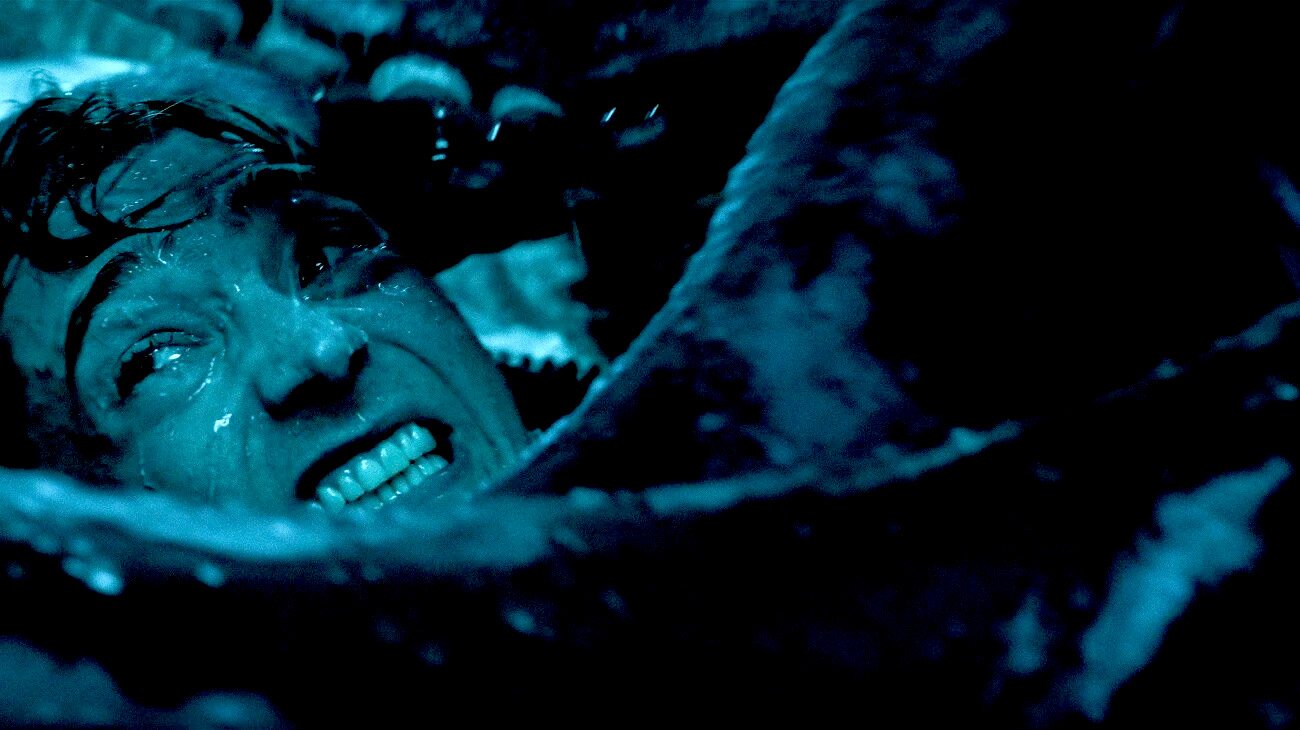
a man grits his teeth while inside of a sperm whale
Austin Abrams as Jay Gardiner in 20th Century Studios’ WHALEFALL. Image: © 2026 20th Century Studios. All Rights Reserved.

Why these fish tales endure

Gero also makes one key distinction about sperm whales: they have absolutely no interest in preying on humans, intentionally or otherwise. In fact, humans have spent centuries slaughtering whales for oil, an uneasy relationship that may be part of why they loom so large in our storytelling.

“If those stories exist from the whaling days, they’re more a lesson to future whalers than they are based in reality,” he says. “I’ve never seen any kind of aggression from a sperm whale. These are gentle giants of the deep.”

Gero hopes movies like Whalefall will spark genuine curiosity about the intelligent, peaceful animals behind the myth. He and the team at Project CETI are working to decipher how sperm whales communicate with each other. In the meantime, you can visit listen.projectceti.org to record what you’d say to a sperm whale, if you ever had a chance. 

This story is part of Popular Science’s Ask Us Anything series, where we answer your most outlandish, mind-burning questions, from the ordinary to the off-the-wall. Have something you’ve always wanted to know? Ask us.

Related Stories

The post Could a whale really swallow a human? We asked a biologist. appeared first on Popular Science.

  •  

Why dogs tilt their heads, according to science

“Do you want a treat, Milton?” “Do you want to go for a walk, Bernie?” Annnnd, cue the head tilt from your dog.

Many dogs turn their heads, perk their ears, and stand at attention when their humans say certain words. But why? Well, it’s not just cute. There’s some serious science and fascinating theories about dogs’ ability to understand language. On the latest episode of Ask Us Anything, we explain how dogs’ head tilting likely makes your furry friend able to listen and process information better.

Ask Us Anything answers your most outlandish, mind-burning questions—from the everyday things you’ve always wondered to the bizarre things you never thought to ask. So, yes, there’s a reason why is thunder so dang loud and no, cruise ships aren’t floating petri dishes. If you have a question for us, send us a note. Nothing is too silly or simple.

This episode is based on the Popular Science article “Why do dogs tilt their heads? It isn’t just cute.“

Subscribe to Ask Us Anything

Listen and follow Ask Us Anything on your favorite podcast platform:

Spotify | Apple Podcasts | YouTube | Or wherever you get your podcasts.

Full Episode Transcript

Sarah Durn: You’re sitting on the couch and your dog is staring at you. So naturally, you start talking to them: “Do you wanna go for a walk?” 

And then it happens: Their ears shoot up, their eyes lock onto yours, and their head slowly tips to one side. 

So you try it again: “Do you want a walk?” And there it goes, the head tilts the other way.

But why does your precious Max do this? Why do dogs tilt their heads? Scientists still aren’t really sure why.

Welcome to Ask Us Anything, from the editors of Popular Science, where we answer your questions about our weird world, from “Why didn’t our ancestors need braces” to  “Do cats really hate water?” No question is too offbeat or mundane. 

I’m Sarah Durn, an editor at Popular Science.

Annie Colbert: And I’m editor-in-chief, Annie Colbert.

SD: Here at PopSci, we’re always pondering quirky questions.

AC: And this week, we’re wondering, why do dogs tilt their heads? So Sarah, tell us, why are our cute furry friends looking at us all askew?

SD: Well, scientists aren’t totally sure.

AC: Seriously? Something dogs do all the time, they don’t know why?

SD: I know, I know. There are a few theories out there, though. Maybe our pups are trying to hear us better.

AC: I guess that makes sense. I remember my dad used to kind of tilt his head when he didn’t have his hearing aids in.

SD: That might have just been a your dad thing. 

AC: Yes, probably.

SD: Yeah, there’s also a chance dogs are trying to get a better look at our faces.

AC: That also feels plausible.

SD: But there’s another possibility that’s a lot more interesting. 

AC: Ooh, okay.

SD: Researchers have found that some dogs are more likely to tilt their heads when they hear words they recognize.

AC: Wait, so they might be thinking?

SD: Maybe. That little head tilt could have something to do with how dogs pay attention to, and process, what we’re saying.

AC: Which somehow makes it even cuter.

SD: Right? So why do some dogs tilt more than others? What’s actually happening in their brains? And does your dog understand more of what you say than you realize?

AC: I must know.

SD: We’re gonna get into all of it. But before we do, we wanna hear from you. What questions are you head tilting, AKA thinking about?

AC: If there’s something you’ve always wanted to know, something that makes you tilt your head, submit your question by clicking the “Ask Us” link at popsci.com/ask.

SD: Send us your questions.

AC: Yes. And coming up, we’ll dig into what might actually be going on when your dog does that adorable little head tilt.

SD: And what it could tell us about how much they really understand when we talk to them.

AC: That’s after this quick break.

SD: Welcome back. Annie, now before we get into the science, I feel like we have to establish our dog credentials here. So did you grow up with dogs?

AC: Yes. We always had at least one dog growing up, everything from mixed breed dogs to cocker spaniels named after various bread products. We had both a Muffin and a Biscuit at one point.

And then we had pugs, and I think I can confidently say that pugs were definitely the biggest head tilters.

a pug
Annie’s parents’ pug, Herbie, pictured in 2007. Image: Annie Colbert / Popular Science

SD: Mm.

AC: And I always assumed it’s just because they were perpetually confused by life.

SD: I mean, aren’t we all? I grew up with Saint Bernards.

AC: Hmm.

SD: So my family has had, oh, five. 

AC:Wow. 

SD: And my grandmother, who started the trend, actually had something like nine throughout her life.

AC: What? That’s so many.

SD: I know. I love Saint Bernards. And Saint Bernards, at least the ones I’ve gotten to know, are not huge head tilters.

AC: Hmm, interesting. Is it maybe because their heads are just too heavy to tilt?

SD: There is a lot of head to move for a Saint Bernard. Hmm.

AC: Yeah.

SD: But our newest puppy, Tartufo, we call him Tufo, is actually a little bit of a head tilter, and sometimes if you say a word he knows, he’ll look right at you and just tip.

a saint bernard in a kitchen
Tufo. Image: Sarah Durn / Popular Science

AC: Aw. 

SD: I know, it’s so cute. I love him so much. He’s like a super sweet, like, expressive dog, so the head tilt just, you know, sends it over the edge.

AC: Love it.

SD: But here’s the really cool part: Tufo seems to head tilt more when he hears words he recognizes, and scientists think that might be a clue about what the head tilt actually means.

AC: All right, so what’s happening in that giant Saint Bernard brain?

SD: Potentially language processing.

AC: Excuse me?

SD: I know. Dogs have lived alongside humans for roughly 20,000 to 30,000 years, and over that time they’ve gotten remarkably good at dealing with this extremely weird thing humans do all day long.

AC: Talk at them.

SD: Constantly. And brain scans suggest dogs process parts of human speech in ways that are surprisingly similar to us. When a dog hears a familiar word, the left side of its brain becomes active, even if you change your tone of voice. But if you say an unfamiliar word using a familiar tone, the right side becomes more involved.

AC: So their brains are basically going, “Okay, I recognize that word,” versus, “I don’t know what you’re saying, but you sound excited.”

SD: Yeah, and that brings us to a 2025 study that basically asked, okay, where does the adorable head tilt fit into all of this? Researchers recruited 103 dog owners and had them film their dogs in four different situations.

First: Dog doing nothing.

AC: A challenging assignment for most dogs.

SD: Totally. Totally. And then second: Owner silently staring at dog.

AC: It’s kind of intimidating.

SD: Right. And then, this is my favorite: Owner talking to dog about ancient Egyptian civilization.

AC: Finally, that canine Egyptology study we were always waiting for.

SD: Exactly. I know everyone was on the edge of their seats. The idea was, you know, to give dogs speech that was neutral or unfamiliar. And then in the final and fourth condition, owners used familiar words with a warm, excited tone.

AC: Like, “Wanna go for a walk?”

SD: Exactly. And that is when the head tilt really showed up.

Dogs tilted much more often when their owners were saying familiar things in that enthusiastic, excited way.

AC: So they weren’t just reacting to the sound. Right.

SD: Courtney Sexton, one of the authors of the study, described it as a kind of communicative exchange. The dog isn’t necessarily going, “Ah, yes, I fully comprehend this sentence,” but something about you talking to them using words they know seems to make that little head go sideways.

AC: Which feels like watching the loading wheel appear over their little brains.

SD: Oh, yeah, totally. Like… Processing, processing, walk detected.

AC: Uh, that is exactly what it sounds like.

SD: Oh, yeah, 100%. And, you know, somehow this all gets a little weirder. Because researchers also noticed that most of the dogs who tilted went to the right.

AC: Huh. There’s a preferred head tilt direction? 

SD: Apparently. And there’s a possible brain connection here. Brains process sensory information contralaterally, which is a fancy way of saying that the left side of the brain is connected to the right side of the body and vice versa. So one hypothesis is that a right head tilt could be connected to the dog engaging the left hemisphere of the brain, the side involved in processing familiar language.

AC: So we might literally be seeing the dog’s brain work.

SD: Maybe, but, you know, giant asterisk here. Researchers are not saying right tilt equals language happening. That part is still very much a hypothesis. The study also had another really weird result.

AC: What’s that?

SD: Male dogs tilted more often than female dogs, and when they tilted, male dogs leaned further to the right.

AC: Why are boy dogs so dramatic?

SD: Aren’t all guys, really? Scientists don’t really know why this is happening yet, but one possibility is that male and female dogs may use their brain hemispheres a little differently when processing language. But only around 40 of the 103 dogs in the study actually tilted at all, so the researchers are very cautious about drawing any sort of broad conclusion.

AC: All right. But dogs don’t only tilt their head when people talk to them, right?

SD: Right. And this is where our very satisfying head tilt equals language explanation gets messier. Another study found dogs tilting their heads after being startled by a jack-in-the-box.

AC: Okay, that’s a reasonable response to a jack-in-the-box.

SD: Yeah, extremely reasonable. And that suggests, though, that head tilting might have something to do with novelty or surprise, not just language. There’s even this possibility called cognitive offloading.

AC: Which sounds like something I need at the end of every workday.

SD: Oh my gosh, same. Um, yeah, basically we make a physical gesture while our brain is working something out. You furrow your brow, you exhale, you stare into space for five seconds while trying to remember why you walked into the kitchen. 

AC: Constantly. 

SD: Same. The head tilt could be a dog version of that, a little physical reset while their brain processes something new.

But Courtney Sexton from that study we talked about doesn’t think that explains the whole thing because in the 2025 experiment, the dogs tilted overwhelmingly during the social language condition.

AC: Okay, I have another scientific hypothesis. 

SD: Shoot. 

AC: Dogs know that the head tilt makes us powerless to their adorableness.

SD: That is actually an important scientific question.

AC: Called it.

SD: You did, because humans do rate head tilting dogs as cuter. But Sexton doesn’t think dogs are sitting there plotting, you know, “If I rotate my head 15 degrees, perhaps she’ll give me cheese.”

AC: But you cannot prove they’re not.

SD: Okay, fair, but there is a reason it absolutely destroys us.

During domestication, dogs develop something called neoteny, meaning adult dogs retain juvenile features like large eyes and soft facial proportions, basically permanent baby face, and humans are very, very responsive to baby face. So the head tilt isn’t necessarily designed to be cute. 

AC: We’re just helpless against it.

SD: Exactly. Which brings us back to the original question: why do dogs tilt their heads? And the slightly frustrating answer is: Scientists still don’t completely know. 

It could involve language processing, attention, surprise, maybe even that little physical reset while the brain figures something out. But the strongest evidence we have suggests that at least sometimes the head tilt is a visible sign that your dog is actively processing and responding to you.

So when Tufo hears a word that he knows and tilts his head, that enormous Saint Bernard brain may actually be hard at work. 

AC: Thinking important thoughts. 

SD: Extremely important thoughts. Probably mostly about snacks.

AC: Yes. But now I have a question. 

SD: Yes, go. 

AC: If we can use something like a head tilt to get a tiny glimpse into what a dog is thinking, can we actually tell how smart a dog is?

SD: Funny you should ask, because the internet has come up with some pretty questionable ways to test your dog’s IQ.

AC: All right, I’m intrigued.

SD: And scientists have some much better ones.

AC: Unsurprising.

SD: Unsurprising. Now, we have to take a quick break, but when we come back, we’ll explain how you can actually test your dog’s IQ.

AC: I mean, Tufo genuinely sounds like a genius.

SD: I mean, he is. I won’t argue with, with that at all.

AC: Welcome back. Okay, Sarah, before the break, you promised that we could actually put Tufo’s brain to the test.

SD: I did. Because we spent this whole episode talking about what his head tilt might tell us about what’s happening inside his brain, naturally the next question is how smart is my adorable little Saint Bernard?

AC: Little?

SD: He’ll always be a little puppy to me.

AC: Debatable. Anyhow, uh, I’ve seen a pet IQ test online called the wall test where you hold up your dog and you slowly move them toward a wall to see if they put their paws out.

SD: Yes, yes. I’ve seen that one, too, but I don’t think anyone’s lifting Tufo, and that might actually be a good thing because experts say you should not do the wall test.

AC: Really?

SD: Yes. Don’t do it. Whether a dog sticks out their paw actually has nothing to do with intelligence. It’s a neurological reflex vets use to check that a dog’s nervous system is working properly, kind of like when a doctor taps your knee and your leg automatically kicks.

AC: Hmm. So it’s not really an IQ test at all.

SD: No.

AC: But how do I find out if my dog is a genius?

SD: Well, obviously they are. But scientists would say that’s actually the wrong question.

AC: Rude.

SD: Because there isn’t one thing called dog intelligence. Some dogs are amazing problem solvers, some are great navigators, and some are especially good at reading us.

AC: Which feels especially relevant after an entire episode about dogs listening to us.

SD: Exactly. And you can test this even at home. Just grab two identical cups and a treat. While your dog isn’t looking, hide the treat under one cup, then put both cups down and either point at the correct cup or just look at it, and then let your dog choose which cup they’re drawn to.

AC: So if they pick up the right cup…

SD: They successfully read your social cue. That’s a skill called social cognition.

AC: Hmm. Genius.

SD: Good at one particular type of cognition.

AC: Or genius.

SD: Fine. Genius. All dogs are geniuses. Yeah. But if they choose the wrong cup or, you know, just wander off down the hallway, that doesn’t mean they’re dumb. Dogs have different strengths, and just like us, they have to actually be motivated to participate.

AC: So if my dog completely ignores my carefully designed scientific experiment…

SD: You might just need better treats.

AC: Fair.

SD: And I think that brings us right back to the head tilt. One cute little behavior cannot tell us exactly what’s happening inside our dog’s brain, alas.

But it can give us a clue and remind us that there’s a whole lot going on behind those puppy dog eyes.

AC: Even when it looks like there absolutely is not.

SD: Watch it.

And that’s it for this episode. But don’t worry, we’ve got more episodes of Ask Us Anything live in our feed right now. Follow or subscribe to Ask Us Anything by Popular Science wherever you enjoy your podcasts. And if you like our show, leave a rating and review.

AC: We care what you think. We care what your dogs think, geniuses or not. Our producer is Alan Haburchak, and this week’s episode was based on stories written for Popular Science by Nidhi Sharma and Clarissa Brinkett.

SD: Thank you, team, thank you, dogs, and thanks everyone for listening.

AC: And one more time, if you want something you’ve always wondered about explained on a future episode, go to popsci.com/ask and click the “Ask Us” link. Keep the questions coming. Till next time, may your dog always listen when you call.

SD: May your pockets be full of sufficiently motivating treats.

AC: And may your dog’s head tilts always be ridiculously cute.

SD: Like, they can never not be. They’re always cute.

AC: Pugs, pugs, pugs. 

The post Why dogs tilt their heads, according to science appeared first on Popular Science.
  •  

What shapes your personality? Your genes and environment play a big role.

I consider myself to have a somewhat challenging personality. The popular Myers-Briggs test labels me an ‘INTJ,’ commonly referred to as an “Architect.” We’re supposedly independent, determined, curious, and original, but we’re also considered combative, overly critical, dismissive of emotions, and more concerned with “rationality and success over politeness.” 

My family would generally agree with that description of me. Perhaps thankfully, we are a rare bunch: only two to four percent of people, and about one percent of women, are INTJs.

I’m expecting my first child, a daughter, in January. The prospect of meeting a mini “Architect” has me wondering: Are we born with our personalities?

The answer is complicated—and still evolving. 

“All of it comes from genes, and all of it comes from [the] environment in a sense,” says Matthew Keller, a behavioral geneticist at the University of Colorado Boulder. 

Dozens of twin studies have found that personality is partly heritable, but exactly how genes shape who we become is far from straightforward, and it’s even less clear how environmental factors play a role.

What is personality?

The very definition of personality is complex and somewhat “squishy,” Ted Schwaba, a personality psychologist at Michigan State University, concedes.

Most people think of personality as traits. The adjectives we use to describe a person: creative, hard-working, honest, kind. But personality also encompasses identity, life story, reputation, and how other people see you, says Schwaba. 

Brent Roberts, a personality psychologist at the University of Illinois Urbana-Champaign, adds that skill, ability, interests, and motivations also play a role. Someone can have remarkable talent in, say, soccer or music, but without the interest or motivation to pursue those areas, one’s ability may never become central to what they do.

“Personality is really any kind of stable characteristic of a person that makes them who they are,” says Schwaba. 

The Myers-Briggs test is a popular self-report questionnaire that categorizes people into 16 different personality types. Video: Myers-Briggs Explained in Less than 5 Minutes – 16 Personalities, Frank James

While personality itself remains somewhat difficult to define, most psychologists use the standardized “Big Five” model to measure it. The framework scores people along five broad traits: openness, conscientiousness, extraversion, agreeableness, and neuroticism, the tendency to experience negative emotions. 

Though imperfect, the model lets researchers compare personality across people and over time. The Big Five and other measures of personality have proven consistent predictors of school and work performance, relationships, health, and even longevity. 

How much of personality is genetic?

Throughout much of the 20th century, researchers studied twins to understand how genes and environment shaped personality. One 1996 study compared 123 pairs of identical twins, who share nearly all their DNA, with 127 pairs of fraternal twins, who share about half, and found that genetic differences accounted for roughly 40 to 60 percent of variation across the Big Five traits.

That estimate has endured. A 2015 meta-analysis of more than 100,000 people found that personality is about 40 percent heritable. 

Heritability tells us how much of the variation in personality, or other traits, can be linked to genetics. If something is 100 percent heritable, all the differences we see among people would be linked to genetics, Keller explains. If it is 0 percent heritable, then genetics would explain none of those differences.

So, when researchers say personality is about 40 percent heritable, they don’t mean 40 percent of a person’s personality comes from their genes. An outgoing mother may pass along genetic variants that make her child more likely to be outgoing too, but her daughter is not destined to share the trait. 

And just because a trait is heritable doesn’t mean it is immutable or set at birth. Environmental factors still matter. Height, for example, is roughly 80 to 90 percent heritable, yet genes don’t determine exactly how tall someone will become. A child with tall parents may have the genetic potential to be tall, but without proper nutrition may never reach that potential.

Most psychologists use the standardized “Big Five” model to measure personality. Video: The Big 5 OCEAN Traits Explained – Personality Quizzes, Practical Psychology

Both height and personality are genetically complex. A 2022 study of 5.4 million people identified more than 12,000 genetic variants associated with height, while a 2024 study of the Big Five identified 254 genes associated with at least one trait. There is no single gene for height nor is there a single gene for being extroverted, agreeable, or conscientious. Instead, these traits appear to arise from the combined effects of many genes, each with a very small influence.

Schwaba likens individual genetic variants to grains of sand on a beach. One grain tells you nothing about what the beach will look like, but collectively thousands of them help shape the landscape.

What else shapes our personality?

If genes explain only part of personality differences, what explains the rest? Scientists are still trying to figure that out.

Over the past few decades, researchers have investigated everything from parenting and birth order to socioeconomic status and major life events. Except for extreme experiences such as abuse, trauma, or severe deprivation, most non-genetic aspects have turned out to have surprisingly small effects. 

Roberts calls it “death by a thousand cuts.” No single experience appears to explain much, but thousands of small environmental influences may accumulate over a lifetime to shape personality.

Studying environmental factors is much harder than studying DNA. Scientists can sequence a genome, but understanding environmental impacts requires psychologists to follow thousands of people for decades.  

Researchers do know that personality isn’t fixed; it can change over the course of one’s life. People can even deliberately alter some traits. Therapy can change personality, Schwaba says, and adults can even become more outgoing, for example, if they put intensive effort into socializing and pushing themselves outside their comfort zone.

Scientists aren’t certain when personality first emerges. Schwaba says individuality is obvious by preschool, but recently he and a colleague found themselves wondering whether future extroverts might kick more in the womb. 

“We don’t actually know of a study on that,” he says.

Will my daughter be a mini-Architect? Maybe in some ways. The genes she inherits may nudge her personality in certain directions, but they won’t lock her into them. Who she becomes will depend on a lifetime of experiences that scientists are still trying to untangle.

In Ask Us Anything, Popular Science answers your most outlandish, mind-burning questions, from the everyday things you’ve always wondered to the bizarre things you never thought to ask. Have something you’ve always wanted to know? Ask us.

Related 'Ask Us Anything' Stories

The post What shapes your personality? Your genes and environment play a big role. appeared first on Popular Science.
  •  
❌