❌

Reading view

Germany builds world’s tallest wind turbine, reaches nearly 1,200 feet height
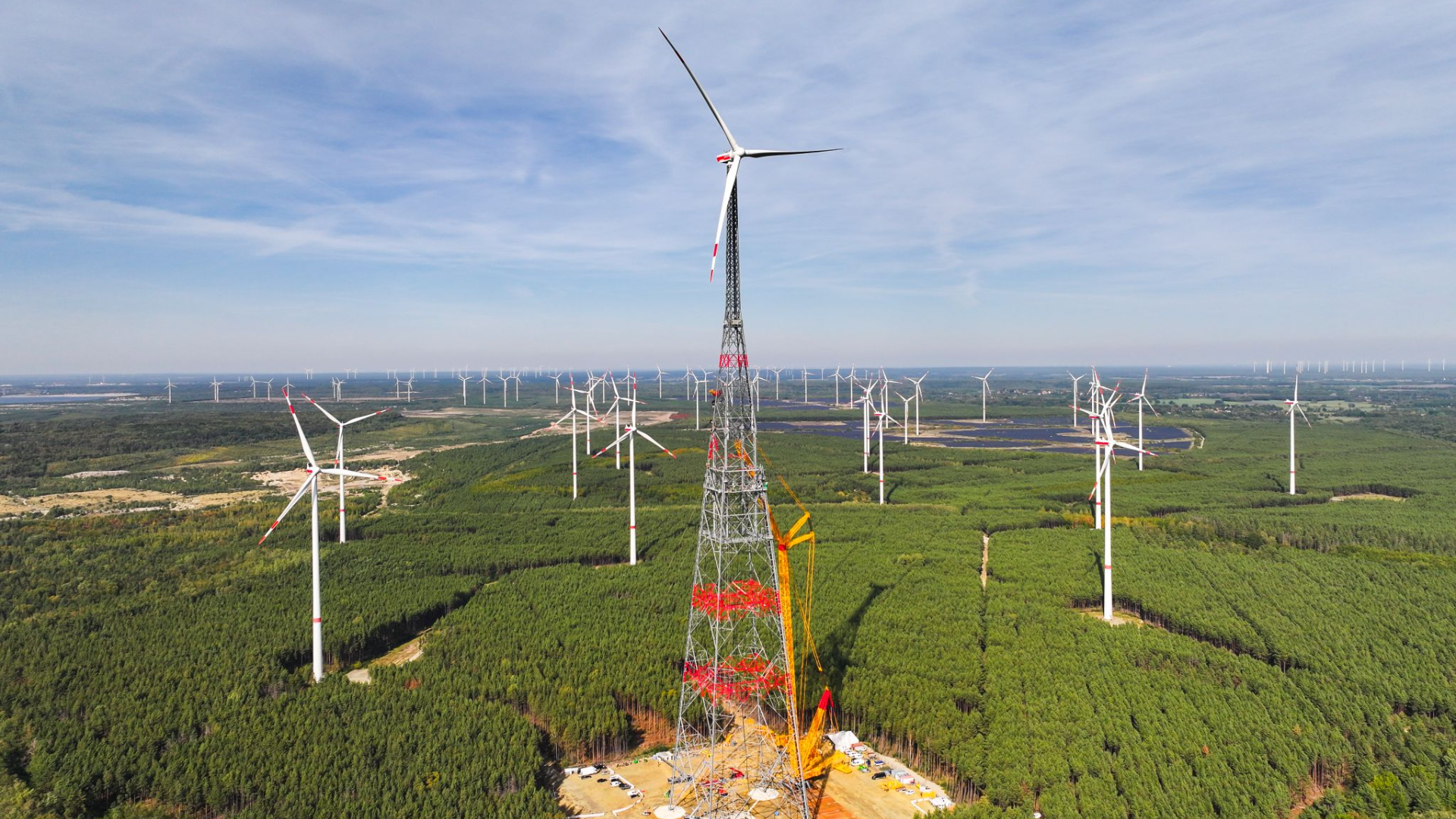
A wind turbine standing nearly 1,200 feet tall has reached its full height in eastern Germany, creating a new approach to capturing wind energy at elevations where winds are stronger and more consistent. 

Developed by German engineering company GICON for the Federal Agency for Disruptive Innovation, or SPRIND, the pilot turbine in Schipkau is designed to test whether going dramatically higher can produce substantially more electricity from the same amount of wind infrastructure.

The structure reaches 1,197 feet, including its blades, making it Germany’s second-tallest structure after Berlin’s TV tower. GICON says the design could eventually generate roughly twice as much electricity as a conventional turbine with the same rotor diameter, although that estimate still needs to be demonstrated in operation.

A wind turbine built to reach higher

The main idea behind GICON’s design is to go where the wind is better. Wind speeds generally increase with altitude, while higher elevations can also provide more consistent wind conditions. Hence, a turbine operating hundreds of meters above the ground has access to a larger and potentially more reliable energy resource than a conventional turbine.

The Schipkau pilot has a rated capacity of 3.8 megawatts, while future versions are expected to exceed 7 MW. The company’s projected doubling in energy output refers to electricity generated over time, rather than the turbine’s maximum rated power.

Reaching that altitude, however, required GICON to rethink how such a turbine could be constructed. Instead of using a conventional crane capable of reaching the top of the tower, the company used a telescoping tower design. 

A specialized lifting mechanism raised the inner tower through a surrounding lattice structure before securing it at its final height. GICON founder and CEO Jochen Grosmann described reaching 1,197 feet as a major milestone for the project, which began as a concept before becoming a full-scale pilot facility.

Adding power without new wind farms

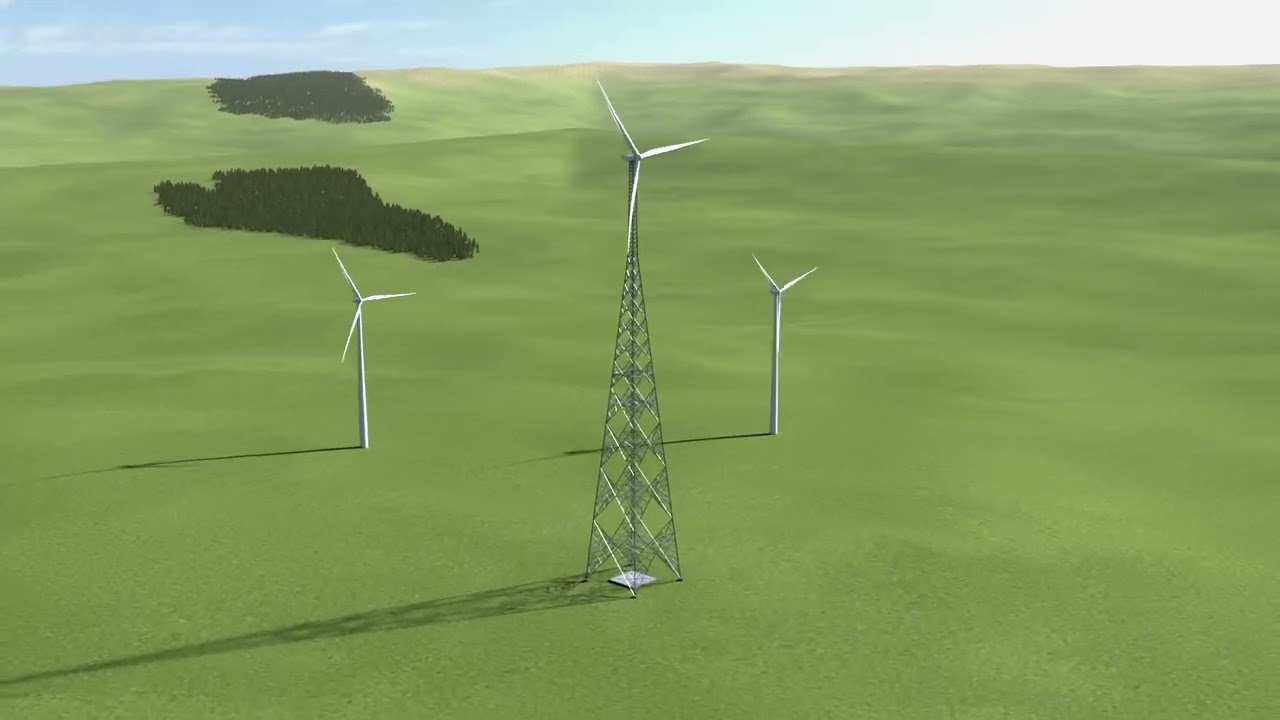
One of the more interesting possibilities is that high-altitude turbines could eventually be added to existing wind farms rather than requiring entirely new sites. GICON and SPRIND envision the systems operating as a second tier of wind generation, with the taller turbines positioned above conventional wind turbines. Therefore, their rotors would operate at higher elevations while existing turbines continue generating electricity below.

According to the current assessment, Germany could potentially accommodate as many as 4,000 high-altitude turbines within existing wind farms. If the concept works as expected, that could allow additional electricity generation without expanding wind farms into new areas, while also making better use of existing grid connections and developed wind-energy sites.

While the completion of the structure marks an important achievement, the more important test is still ahead, as official commissioning is planned for November, after the remaining construction work is completed. 

Once operational, the turbine will provide the data needed to determine whether the additional height delivers the expected increase in energy production and whether the benefits justify the additional engineering complexity.
💾

A 1,197-foot wind turbine has reached its full height in Germany, making it the world’s tallest wind turbine.
  •  

A tiny change in crystal size can flip a material’s magnetic ground state

Japanese scientists may have found a surprisingly simple way to predict how some unusual materials behave by looking at the size of their crystal structure.

In their latest study, they claim that this structural measurement can predict magnetic ground states across a family of unusual materials more consistently than the electron-counting method scientists have traditionally relied on. 

This could make the search for unusual magnetic materials less of a guessing game. 

Until now, the challenge has been that quasicrystals and related materials have extremely complex atomic arrangements, making it difficult to find a single rule that works across different chemical compositions. 

“Quasicrystals are among the most uniquely structured materials discovered to date and are expected to exhibit novel magnetic states and quantum phenomena not found in ordinary crystals. Until now, there has been no unified guideline for systematically exploring these novel phenomena in quasicrystals and their approximate crystals,” Farid Labib, first study author and assistant professor at Tokyo University of Science, said.

The new study suggests that a crystal’s size could provide that missing common measure when researchers search for unconventional magnetism.

Looking beyond the electron count

The researchers focused on Tsai-type approximant crystals. These materials mimic important structural features of quasicrystals while having a repeating crystal structure that can be studied experimentally. 

Their atoms form nested clusters, with rare-earth elements such as terbium, dysprosium and holmium occupying positions that carry magnetic moments.

Researchers have often used the valence-electron concentration, or the number of valence electrons per atom, to classify magnetic behavior. 

However, the magnetic boundaries associated with this measure shift with the rare-earth element and alloy composition, making it less reliable as a universal guide.

The researchers therefore synthesized Au–Al and Au–Ga-based 1/1 approximant crystals containing terbium, dysprosium and holmium, then compared their structures and magnetic properties. They also combined their measurements with data from previously reported Tsai-type compounds to see whether the pattern held across different compositions.

They found a nearly monotonic inverse relationship between electron concentration and the lattice parameter—the dimensions of the crystal’s repeating unit. This allowed them to reorganize the materials according to lattice size rather than chemical composition.

Three magnetic states separated by crystal size

The distinction turned out to be remarkably clear. Crystals with lattice parameters above about 14.72 Å (14.72 x 10⁻¹⁰ m) developed a whirling antiferromagnetic state, where magnetic moments form an ordered pattern with opposing contributions. 

Between 14.62 and 14.72 Å, they showed a whirling ferromagnetic state with a net magnetization. Below about 14.62 Å, the materials enter a spin-glass state, where magnetic moments become frozen in a disordered arrangement.

The whirling magnetic states arise in these non-Heisenberg compounds partly because the local atomic environment creates a strong crystal electric field. This field favors particular orientations for the rare-earth magnetic moments, influencing how they ultimately arrange themselves. 

The magnetic moments also interact indirectly through electrons moving through the material, linking the atomic structure to the way those moments arrange themselves.

A structural roadmap for new materials

The important point is not simply that lattice size correlates with magnetism. The study establishes specific structural thresholds that place different compounds on a common magnetic phase diagram.

This makes the lattice parameter an experimentally accessible starting point for deciding which materials may host a desired magnetic ground state.

“The unified magnetic phase diagram constructed in this study can serve as a practical roadmap for systematic exploration of new magnetic quasicrystals and approximant crystals exhibiting novel magnetic orders and quantum phenomena,” Kazuhiro Nawa, study co-author and a researcher at Tohoku University said. 

“It can also provide a guideline for designing new magnetic materials with targeted magnetic ground states, opening new opportunities for discovering unconventional magnetism in quasiperiodic and complex intermetallic systems,” Nawa added.

The finding does not make electron concentration irrelevant. Rather, it suggests that lattice parameter may be a more consistent guide for Tsai-type compounds, while its usefulness in other magnetic materials remains untested.

What remains unclear is exactly why the lattice parameter works so well across these different compounds. The researchers also need to determine whether the same relationship holds in true quasicrystals.

Despite these limitations, the study indeed offers a more systematic route for exploring complex alloys and designing new quantum materials.

The study is published in the Journal of the American Chemical Society.

  •  

OpenAI’s GPT-6 Astra found a way to play World of Warcraft without seeing the screen

OpenAI’s frontier intelligence model GPT-6 Astra has completed the Orc starting area in World of Warcraft in about 40 minutes without processing a single rendered game frame, according to the developer of the open-source agent-wow project.

Instead of seeing the game through screenshots or computer vision, the AI reconstructed its environment from server network messages and game data, then built its own tools to navigate and play.

The experiment was conducted on a private local server running AzerothCore, not Blizzard’s live World of Warcraft service. The developer gave Codex, running GPT-6 Astra at its high reasoning setting, a single instruction: create an Orc character and complete all quests in the starting zone. The agent reportedly finished the run without dying.

Reading the game’s network traffic

The unusual part of the experiment is how little conventional game automation was provided to the model. Agent-wow does not use computer vision, screenshots, or direct keyboard and mouse controls. Instead, it allows an AI agent to communicate with the game server through World of Warcraft’s network protocol, Tom’s Hardware reported.

The project also does not provide predefined movement, combat, or interaction systems. The agent is expected to build the capabilities it needs through modules. During the run, GPT-6 Astra created a module that could process dozens of different server messages and keep the resulting information in memory. A Python script then used those messages to construct the model’s view of what was happening in the game and send actions back to the server.

That meant the model could determine things such as its surroundings, quest progress, and available targets without ever receiving the visual information a human player normally relies on.

The experiment therefore tests something different from simply teaching an AI to recognize a game screen. The model had to reason about a structured but unfamiliar environment using the information available through the game’s underlying protocol.

Astra built its own tools to complete the quests

The agent also had access to AzerothCore’s underlying data, including SQL files containing information about quests, NPCs, and spawn locations. It used those resources to determine where quests started and ended, and how different objectives were connected.

The developer said the model effectively created a plan for completing prerequisite quests in sequence. It also managed routine tasks such as selling unwanted items, equipping better gear, and training abilities before reaching the final cave in the starting area.

Navigation was another problem the agent had to solve, with GPT-6 Astra generating a C++ helper that used AzerothCore’s navigation-mesh data, known as mmaps, to calculate routes. The helper used the Detour pathfinding library to generate waypoints between locations, which the agent could then follow.

The developer said the system even encountered locations where collision information appeared to be incomplete and was able to exploit those map quirks. That makes the result interesting, but also means the run should not be treated as a straightforward test of how well an AI can navigate an unmodified commercial game world.

💾

The AI relied on server network messages, quest data and navigation files instead of screenshots or computer vision.
  •  

Scientists find ‘ghost’ of superconductivity that survives even after the state vanishes

Superconductivity is supposed to be an all-or-nothing quantum state. Cool a material below a critical temperature, and electrons pair up and enter a state that lets electricity flow without resistance. Warm it back up, and that collective state disappears. 

However, experiments on uranium ditelluride suggest that part of the superconducting behavior can survive after the main phase is gone.

Physicists at the University of Illinois Urbana-Champaign (UIUC) have found evidence that Cooper pairs—the paired electrons behind superconductivity—can arrange themselves into a repeating pattern called a pair density wave (PDW). 

What’s even more interesting is that the pattern persists above the temperature where uranium ditelluride stops being superconducting. These findings provide the first direct evidence that a PDW can exist independently of the main superconducting phase.

“We were out on a limb when we first suggested it. It’s a very peculiar state, and, although there have been experimental hints, there has been no direct confirmation of the phase’s existence,” Eduardo Fradikin, one of the researchers and a physics professor at UIUC, said.

Finding the hidden state

In conventional superconductors, electrons form Cooper pairs and those pairs condense into one collective quantum state. Unconventional superconductors can behave differently and host additional electronic phases, including charge density waves (CDWs), where electric charge varies periodically across the material.

PDWs are similar in that they form a spatial pattern, but the quantity being modulated is the density of Cooper pairs. This idea was proposed in 2007, including the striking possibility that these paired electrons could exist above the superconducting transition. 

However, “PDWs are tricky to analyze in real materials, because they behave like conventional superconductors in some experiments, and like CDWs in other,” Julian May-Mann, one of the study authors and a former graduate student from UIUC, said.

Uranium ditelluride, or UTe₂, offered an unusual place to look. Once considered an ordinary metal, it was found in 2019 to become superconducting below about 2 kelvins. It is also widely considered a candidate for an unconventional triplet-pair superconductor, in which the paired electrons can carry magnetic moments.

The researchers had previously detected CDWs on the material’s surface using scanning tunneling microscopy, but something did not fit, as magnetic fields could destroy the waves. A normal CDW should not respond so strongly to a magnetic field, prompting the researchers to consider whether a PDW was hiding alongside it.

Better crystals reveal the signal

The researchers first needed cleaner UTe₂ crystals because PDWs are extremely delicate and impurities can obscure their signatures. So they produced higher-quality samples using a new molten-flux growth method.

“Thanks to new methods for growing higher-quality samples, we were able to observe spectral signatures that respond to temperature and magnetic fields exactly as pair density waves should,” Vidya Madhavan, one of the lead researchers and a physics professor at UIUC, said.

They examined the crystals with a vector magnetic-field scanning tunneling microscope. Unlike a conventional setup, the instrument could vary both the strength and direction of the magnetic field—important because UTe₂ is anisotropic, meaning its properties depend strongly on direction.

The measurements revealed electronic modes whose responses to temperature and magnetic fields matched theoretical expectations for a PDW, including modes that survived above the superconducting critical temperature.

“We even showed that the modes persist above the temperature at which superconductivity disappears, a telltale theoretical prediction that has not been convincingly observed before now,” Madhavan added.

The researchers also found that a CDW-only explanation conflicted with established principles governing how electronic phases should respond to temperature and magnetic fields. The PDW interpretation provided a more consistent explanation of the observations.

A clue, but not the final answer

The result could reshape how physicists think about unconventional superconductors by suggesting that Cooper pairing can begin before the material develops its full superconducting state. 

This could help researchers understand why some unconventional materials develop complex phases and potentially guide the search for new superconducting states.

“Pair density waves are the Cheshire Cat’s grin of superconductivity. They are the vestige that remains once the phase itself has disappeared. In conventional superconductors, Cooper pairs form when the full phase transition occurs, but, in this system, their observation in PDWs above the transition point shows that they are formed beforehand in a different state,” Fradikin explained.

However, there is an important limitation as well. Scanning tunneling microscopy probes the material’s surface, so the researchers cannot yet prove that the same PDW exists throughout the interior.

The next challenge is therefore to determine whether the hidden state extends into the bulk of UTe₂ and to establish its nature more firmly. 

The study is published in the journal PNAS.

  •  

Case closed on long-standing space weather mystery

If a train leaves the station in Exeter, England, headed south toward Newton Abbot five years before the railway line opens, how long until anyone figures out that it didn’t happen? Well, evidently about 155 years. A report on magnetic storms, published in Nature in 1871, described an incident thought to be the earliest recordedContinue reading "Case closed on long-standing space weather mystery"

The post Case closed on long-standing space weather mystery appeared first on Astronomy Magazine.

  •  

Oct. 2, 480 B.C.E.: A eclipse causes a retreat

An ancient solar eclipse changed the course of a military conflict when it cast a shadow on a battle over Corinth between the Spartans, commanded by Cleombrotus, and the invading Persians, led by Xerxes I. Herodotus wrote that, “while [Cleombrotus] was offering sacrifice to know if he should march out against the Persians, the SunContinue reading "Oct. 2, 480 B.C.E.: A eclipse causes a retreat"

The post Oct. 2, 480 B.C.E.: A eclipse causes a retreat appeared first on Astronomy Magazine.

  •  

Spinning Liquid into Solid

Author(s): Mark Buchanan

A new technique for generating solid fibers from a liquid jet is easier to model—and thus easier to control—than past methods.


[Physics 19, 137] Published Fri Oct 02, 2026

  •  

Nanotube Material Has Perfect Memory

Author(s): Michael Schirber

A carbon nanotube foam springs back to its initial state, regardless of the speed of the compression, a property that could lead to a new type of shock absorber.


[Physics 19, 129] Published Fri Sep 18, 2026

  •  

Novo Kindle ganha tela colorida e até controle para virar páginas

A Amazon anunciou nesta quinta-feira (1º) uma nova geração da família Kindle no Brasil. Os leitores digitais ganharam um visual renovado, com tela nivelada à parte frontal e acabamento de cor única de ponta a ponta, além de corpos mais finos e leves. Os preços partem de R$ 899 no Kindle básico e chegam a R$ 1.749 no Colorsoft Signature Edition. 

A atualização contempla os modelos Kindle, Kindle Paperwhite e Kindle Colorsoft, com diferentes opções de armazenamento e acabamento. Algumas versões também ganharam traseira de alumínio e novos recursos para controle e recarga.

Kindle básico ganha novo visual e versão em alumínio

O novo Kindle mantém a tela de 6 polegadas, mas agora conta com a parte frontal nivelada, sem o rebaixo ao redor do display. Segundo a Amazon, esta é a versão mais compacta do leitor digital já produzida pela empresa.

O modelo de entrada tem 16 GB de armazenamento, autonomia de até seis semanas e promete abrir livros 30% mais rápido que a geração anterior. Ele será vendido nas cores Grafite e Roxo Ube por R$ 899. 

Outra novidade é uma versão com traseira de alumínio, disponível pela primeira vez no Kindle básico. Neste caso, o armazenamento sobe para 32 GB, com opções Azul Celeste e Verde Água, pelo preço de R$ 999. 

Kindle Paperwhite fica mais fino e leve

O Kindle Paperwhite também passou por uma reformulação. A Amazon afirma que o novo modelo está mais fino e leve que seu antecessor, mas mantém recursos já conhecidos da linha, como resistência à água e ajuste da temperatura da iluminação.

A autonomia prometida chega a 12 semanas por carga. O Paperwhite convencional tem 16 GB de armazenamento, acabamento Grafite e preço sugerido de R$ 1.149. 

IMG_9527

 Já o Paperwhite Signature Edition traz 32 GB, traseira de alumínio e iluminação frontal com ajuste automático. A versão também aceita recarga em uma nova base por pinos de contato e permite virar páginas com um toque duplo. O preço é de R$ 1.349, com opções Grafite e Verde Água.

Kindle Colorsoft também ganha nova geração

A série com tela colorida não ficou de fora. O novo Kindle Colorsoft promete reproduzir cores com aparência mais próxima do papel e sem o brilho intenso encontrado em telas tradicionais de tablets.

O Colorsoft convencional tem 16 GB de armazenamento, acabamento Grafite e custa R$ 1.499. A Amazon também oferecerá o Colorsoft Signature Edition, com 32 GB e traseira de alumínio, por R$ 1.749 nas cores Grafite e Figo.

Assim como no Paperwhite Signature Edition, a versão mais cara oferece ajuste automático da luz frontal, toque duplo para troca de página e suporte à nova base de carregamento por pinos de contato.

Kindle ganha controle para virar páginas

A Amazon também apresentou novos acessórios para a família. Entre eles está o Kindle Click, um pequeno controle Bluetooth que permite virar páginas à distância e funciona tanto com os lançamentos quanto com modelos apresentados a partir de 2024.

Outra novidade é uma capa com botões físicos para troca de páginas, destinada aos modelos Paperwhite Signature Edition e Colorsoft Signature Edition. A empresa também prepara uma base que mantém esses dois aparelhos em pé enquanto recarrega a bateria pelos pinos de contato.

Os novos acessórios ainda não tiveram preços divulgados para o Brasil.

IMG_9526

 Quanto custam os novos Kindle no Brasil?

Os dois modelos do Kindle básico já estão em pré-venda. A versão de 16 GB começa a ser entregue em 10 de novembro, enquanto a opção de 32 GB chega aos compradores a partir de 20 de novembro.

Modelo Armazenamento Preço
Kindle 16 GB R$ 899
Kindle com acabamento em alumínio 32 GB R$ 999
Kindle Paperwhite 16 GB R$ 1.149
Kindle Paperwhite Signature Edition 32 GB R$ 1.349
Kindle Colorsoft 16 GB R$ 1.499
Kindle Colorsoft Signature Edition 32 GB R$ 1.749

Já os novos Paperwhite e Colorsoft ainda não têm data de entrega divulgada. A Amazon abriu apenas o cadastro para consumidores interessados em receber um aviso quando os modelos estiverem disponíveis.

{{WHATSAPP_CHANNEL}}

  •  
❌