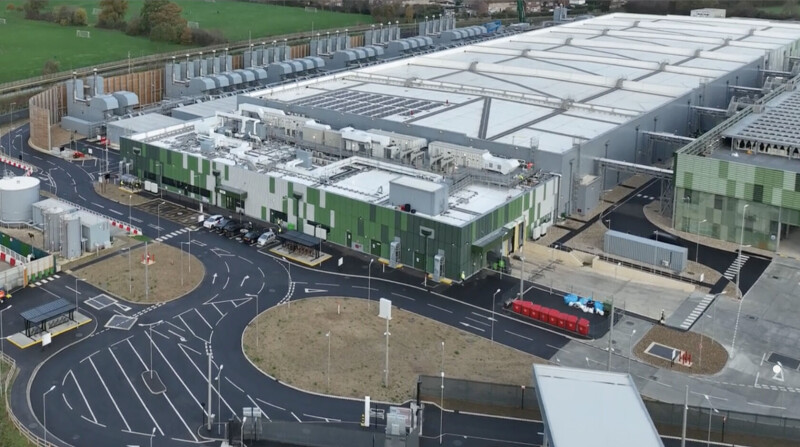
Financial service biz Moody's says the availability of power is still a major constraint on US datacenter growth as the pace of construction exceeds the speed at which the nation's grid infrastructure can add the requisite capacity. America is the epicenter of the datacenter construction boom, driven by the AI craze and demand for compute capacity to train ever-larger foundation models. The latest report from Moody's estimates the power needed by all those bit barns will reach 426 terawatt-hours (TWh) in 2030, citing data from the International Energy Agency (IEA). That is almost double the 2025 figure. It falls on the power sector to develop new resources to meet this extra demand as traditional power generation is struggling to keep pace. Moody's calculates that building the additional generation capacity will cost about $110 billion, adding an estimated $25 billion to $30 billion a year to electricity system costs. Yet efforts to supply the rapidly growing number of cloud and AI server farms are running up against lengthy permitting processes and long lead times for key equipment and materials, causing delays of up to seven years in some cases. Management consultancy Bain & Company highlighted the problem nearly two years ago when it warned that energy companies needed to significantly boost their generation capacity, reversing years of flat or declining demand. Transmission buildout is a parallel bottleneck, with $80 billion to $115 billion in grid investment through 2030 already approved or under construction across US power markets, Moody's says, with the potential to triple over the next decade. Investment bank Jefferies reported in June that half of the extra US datacenter capacity planned for 2026 is unlikely to come online this year, blaming power availability and grid connection setbacks, along with other issues including zoning and permitting challenges. Regions able to accelerate development, such as Texas, have experienced a wave of datacenter construction. The resulting pressure on local grids has prompted some authorities to clamp down on new connections for compute sheds. Moody's believes most new IT campus operators are still likely to seek grid connections to limit development costs and benefit from service reliability and shared redundancy. Yet many are also seeking alternatives, including on-site behind-the-meter (BTM) power generation to avoid delays in bringing facilities online. The document also notes that the growing energy demands from server farms are inflating power prices and customer bills in some regions of America, as The Register reported earlier this year. This has led to affordability concerns, fueling opposition to datacenters and prompting measures such as stricter approval frameworks and moratoriums on new projects. President Trump even introduced a Ratepayer Protection Pledge, under which tech giants and energy companies committed to shielding consumers from rising energy costs due to the datacenter boom. In the long term, Moody's believes that large-scale infrastructure investment will ultimately strengthen grid reliability and affordability, despite the risks. Extra generation capacity will alleviate longstanding supply constraints, it says, reducing price volatility during periods of extreme weather or high demand, while expanded transmission networks could improve access to lower-cost generation resources, particularly when datacenter developers or their tenants help finance the associated infrastructure. ®
Microsoft has released an out-of-band update for Windows 11 24H2 and 25H2 after September's record-breaking Patch Tuesday addressed almost 1,000 vulnerabilities across the company's products – and introduced several new problems. Those problems are related to USB Audio Class 1.0 devices, Remote Desktop Services, and host folders shared with certain Hyper-V-based Linux virtual machines via Plan9. While the Hyper-V and Remote Desktop Services issues are fixed, there is still work to do on USB audio. The update restores multichannel playback on USB Audio Class 1.0 devices that continued to work in stereo, but other affected devices may remain silent, have unresponsive volume controls, or display "This device cannot start (Code 10)" in Device Manager. Owners of devices still giving them the silent treatment were told: "Microsoft is working on a resolution and will update this documentation when more information is available." The cumulative update also includes protections for CVE-2026-62721, an elevation-of-privilege vulnerability in the Windows User-Mode Power Service. Separate September security updates for Excel also broke that rarely used function, Paste, on some installations. Microsoft has yet to issue a fix. Readers were impressively supportive of Microsoft's efforts to ensure its patches don't disrupt workflows. Paratiritis noted: "The issue with all these versions of Excel is understandable, considering such changes require testing, either manual or automated, which cannot be taken for granted for such cryptic functionality as Paste." Roj Blake suggested that perhaps somebody had tried submitting a bug report, but was unable to paste the data for some reason. ®
Local authorities across the US often lack the negotiating power and know-how to work effectively with developers proposing new datacenters in their communities. The Federation of American Scientists (FAS) is trying to fill that gap by arming officials with the right questions to ask and the bargaining tools to use. The AI industry has triggered a surge in server farms construction, leaving many local governments to negotiate with developers over massive new facilities, often for the first time. To help, FAS has put together a report combining an overview of what local governments are already doing with a look at Community Benefits Agreements (CBA) between authorities and developers. The document, Before Breaking Ground: A Local Government Guide to Better Data Center Policy and Community Benefits, can be downloaded from the nonprofit think tank’s website. One key recommendation is that state and local governments should not allow for tax exemptions or provide economic incentives to datacenter operators without the provision of opening these up for negotiation beyond five years. This is because the property value of the site may increase substantially while the authority ends up out of pocket, as The Register has previously reported. Some states are losing more than $1 billion per year in tax abatementsand rebates offered as incentives to developers. CBAs have been used in numerous contexts to ensure local community groups obtain the benefit of the bargain when negotiating with a developer over large infrastructure projects. Their purpose is to ensure developers act in the interest of the community, such as building or upgrading infrastructure, hiring locally, and abiding by sustainable practices. The report lists 10 CBAs, nut only one - between Lancaster, Pennsylvania and the developers of two AI campuses - is explicitly labeled a CBA and written specifically around community benefits. In general, they cover a number of policy areas, including taxes and financial contributions, energy and water use, noise, lighting and e-waste, plus legal compliance and potential remedies. The FAS recommends future agreements specify what happens during a sudden surge in energy demand, and whether the datacenter would generate its own power or draw from the grid. Likewise, agreements should include reporting requirements on the facility's water use, and the procedure for securing additional water beyond an average day’s demand. However, one activist has already filed a lawsuit against Amazon Web Services, alleging the company published false and misleading statements about water use at its facilities in Virginia. Authorities wishing to limit noise should consider adding a specific, measurable - and therefore enforceable - numerical figure in their CBA, plus yearly testing near to local residences regardless of whether complaints are received or not. When looking to specifying remedies, CBAs could include language allowing special or consequential damages, and contain a clause on alternative dispute resolution, like mediation, instead of relying on litigation for issue resolution. The FAS also advises that CBAs should supplement local authority ordinances – laws or regulations - rather than replacing them. The two also need to be written to reinforce each other because “a CBA cannot fix a zoning gap and a zoning ordinance cannot capture specific project commitments like a CBA can.” Another notable point in the report relates to decommissioning regulations remaining largely untested. FAS isn't aware of a single case where a datacenter had ceased operations or been formally decommissioned, meaning enforcement provisions in agreements and ordinances have yet to be tested. However, it recommends that authorities should approve a decommissioning plan before a datacenter gets the go-ahead. ®
Nscale accounts for nearly two-thirds of the equity funding raised by UK datacenter infrastructure companies, according to a report from Tracxn. The market research firm identifies the rent-a-GPU operation as the only unicorn – a privately held company valued at more than $1 billion – in Britain's datacenter infrastructure sector. Nscale leads the pack with $3.7 billion raised, according to Tracxn, out of $5.7 billion across the sector. Other notable players identified by Tracxn include GreenScale, with $1.3 billion; Kao Data, with $177 million; Verne, with $125 million; Iceotope, with $107 million; and Six Degrees Group, with $106 million. Iceotope is not a datacenter operator but a developer of liquid-cooling systems, hence its inclusion in Tracxn's broader infrastructure category. Tracxn counts 154 companies in the sector, 24 of which have raised equity funding. It says investment has surged in recent years amid growing demand for AI infrastructure. Tracxn's report, Datacenter Infrastructure – UK, covers British companies that operate server farms or provide supporting IT infrastructure, such as Iceotope. It excludes businesses focused on datacenter construction or real estate. Companies based in London attracted 93 percent of the funding tracked by Tracxn, highlighting the sector's geographic concentration. Tracxn also says that the Brit datacenter infrastructure sector has recorded 36 acquisitions but only two IPOs. TelecityGroup was the largest acquisition, absorbed by US giant Equinix for $3.8 billion. Reports covering the broader UK datacenter construction market provide a different perspective. Infrastructure specialist Onnec cites Barbour ABI figures showing nearly 100 UK datacenter projects worth more than £36 billion ($49 billion) in the pipeline. That construction activity includes substantial investment by overseas operators, a market excluded from Tracxn's figures. US-headquartered operators including Digital Realty, Vantage Data Centers, CyrusOne, and Equinix have a substantial UK presence, alongside cloud giants Amazon Web Services, Microsoft, and Google. Onnec's research also points to the risk of datacenter infrastructure failing to keep pace with investment in AI hardware. Its latest survey found that 43 percent of operators had needed infrastructure upgrades or remedial work after facilities went live. The survey covered 300 decision-makers across the UK, Ireland, and the Nordic countries, rather than the UK alone. ®
Google plans to invest at least €13 billion ($15 billion) in digital infrastructure and supporting projects in Finland over the next two years. The cloud and search services giant says it is deepening its long-term commitment to Finland and to Europe through additional datacenters and investments in low-carbon electricity generation, onshore wind, and battery storage. Google already has a massive campus at Hamina, on Finland's south coast, which houses seven separate data halls. This is just along the coast from Loviisa, where one of Finland's two operating nuclear power plants is sited. The firm says it intends to expand its facilities at Hamina, but is also constructing new datacenters at sites near Kajaani, Muhos, and Vaala, further north in the country. However, it declined to specify how many facilities it is building, or how much extra infrastructure capacity the projects will add to Google's global network. Google said it chose the sites after consulting Business Finland and grid operator Fingrid, focusing on locations in northern and central Finland with existing grid infrastructure and access to carbon-free electricity. Local energy partnerships also form part of the Chocolate Factory's plans. It has signed a 22-year power purchase agreement (PPA) with Fortum to support the extension and upgrade of the energy company's Loviisa nuclear plant. Fortum said the plant could not continue operating beyond 2030 without this investment. The Google agreement provides revenue certainty for that work, which is intended to keep the plant – currently responsible for about 10 percent of Finland's electricity – operating through 2050. According to Reuters, the agreement will give Google access to as much as 50 percent of the plant's generating capacity. Fortum said the deal will begin at a lower level in 2028 before reaching 50 percent from 2030 through 2049, which Google confirmed to The Register. The cloud and search firm says it has secured additional onshore wind PPAs with green energy firms Valorem and Suomen Hyötytuuli, bringing the new-to-the-grid onshore wind capacity it has contracted in Finland to 629 MW. Google has also contracted for a 94 MW battery system near its Kajaani site, which is expected to connect to the grid in late 2027. The system is intended to balance supply and reduce price volatility during cold, windless periods. "This investment underscores Google's commitment to grow our presence responsibly, pairing the expansion of our technical infrastructure with new energy capacity, grid enhancements, and energy affordability initiatives," commented Ruth Porat, president and chief investment officer of Alphabet and Google. Google did not answer when The Register asked why it had chosen Finland for this expansion. Obvious attractions include its extensive carbon-free electricity supply – almost 96 percent of the country's generation is described as carbon-neutral – as well as established grid infrastructure near the selected sites. ®
Two runways are currently closed at Miami International Airport after an Amazon-branded cargo plane overran a runway, resulting in five fatalities. The leased 767, which bears the “Prime Air” brand Amazon uses for its air freight and drone operations, landed but was unable to stop before the end of the 2850-meter runway 30. The plane appears to have exited the runway and the airport grounds, crossed a road, and come to a halt in what looks like a carpark. As it ran across grass beyond the runway, the plane’s nose pitched down into the ground, its starboard engine caught fire, and the craft sustained extensive damage. Local authorities have confirmed that five people died, and three are severely injured. A statement from Amazon spokesperson Kelly Nantel says the company is”heartbroken to learn that five people lost their lives in today’s incident at Miami International Airport.” The statement identifies the operator of the plane as 21Air, a company that leases cargo planes and crew to its customers. 21Air CEO Keith Winters said “We are devastated by the accident involving one of our aircraft in Miami today. Our deepest condolences are with the families and loved ones of those who lost their lives. Our immediate priorities are supporting those affected, assisting the authorities, and ensuring that accurate information is communicated as it becomes available.” At the time of writing, the crash is just over 12 hours in the past, so investigators’ work has just begun. A video purportedly showing the plane landing depicts dark storm clouds and rain around the airport. That weather could conceivably have created gusty conditions that made landing unusually challenging. Federal records indicate the plane rolled off the Boeing production line in 1994. According to Planespotters, its first owner was Belgian carrier Sobelair, and it was later bought by carriers from Vietnam, Spain, Kenya, and Russia, before freight airline Atlas acquired it in 2015 and converted it from passenger to freight operations. That’s a common fate for older planes, which passenger airlines sell at very low prices. Cargo airlines can therefore pick up well-maintained planes at very low prices, meaning they have lower borrowing or leasing costs. That cheap purchase price offsets the higher maintenance and operating costs that come with older planes. All commercial aircraft, however, share strict airworthiness requirements. This is the second major crash involving a 767 leased by Amazon, after the 2019 incident that saw a plane unexpectedly nose-dive. ®
The Green Party of England and Wales wants the government to end the blanket designation of new bit barns as “critical infrastructure” and change planning rules to stop such facilities taking precedence over households for water and energy. The current UK government designated datacenters as critical national infrastructure (CNI) back in 2024, putting them on the same footing as essential services such as water and power. This made them eligible for special protection, but may also make it easier for developers to overcome any local objections to their construction, as The Register pointed out. The Green Party claims that CNI status means that server farms are prioritized for access to water and energy, even when ordinary households are hit with drought restrictions, as over 27 million people currently are in England. It wants to see planning permission for new facilities granted only when the developer can show it will meet the highest environmental standards, and there has been full community consultation. “We need to slam the brakes on the rampant building of new datacenters which could put our communities at risk of water shortages and drive up energy bills – and yet are currently being waved through by our government,” said Green Party leader Zack Polanski. “Data should serve people, not the other way around – but right now, because datacenters are designated as critical infrastructure, people come a poor second, with datacenters even being given priority for water and electricity.” “We need clear criteria to distinguish between datacenters vital to national security or public services, and those that simply serve private tech companies and private profit,” Polanski added. There was certainly talk earlier this year of prioritizing "strategically important" grid connections, which would include data campuses, and a report published by the London Assembly late last year highlighted the pressure on the power supply in the capital, with some areas of West London having to put a hold on new housing developments. On the water side, MPs were warned earlier this year that official forecasts of England's future water needs excluded datacenters, despite the growing number of them, and that they could end up competing with homes and businesses for supply. The Green Party claims that a single large-scale datacenter can use around 1.5 million liters (396,258 US gallons) of water per day, comparable to the daily water needs of a town of around 10,000 people. Yet bit barn construction is projected to expand rapidly, with growth often concentrated in areas already classified as water-stressed, like London and the South East. But water consumption can vary, depending on the cooling systems in use at specific facilities. In theory, newer campuses should require less water, especially if they are deploying AI infrastructure that uses so-called direct-to-chip cooling, where fluid is circulated through a closed-loop system. A government spokesperson told us: “A pause on building new datacenters would simply send investment and good jobs abroad, while leaving Britain dependent on overseas computing for the processing of sensitive health and defense data. Put simply, it would be a disaster for jobs and national security.” However, the spokesperson added: “This does not mean a blank cheque for Big Tech or that every datacenter should be approved. Developers should prioritize clean power, use water responsibly, create British jobs and supply chains, and provide investment to the communities in which they are built." The Green Party is also calling on the government to urgently develop a comprehensive national strategy for AI infrastructure, as the country is currently dependent on foreign-owned infrastructure for critical services, from healthcare to public safety – something the Institute for Public Policy Research was warning about just this week. ®

 Login