Scientists have identified a new-to-science, reddish-brown snake from specimens found in the forests of Papua New Guinea and named it after Slash, the lead guitarist of the rock band Guns N’ Roses. Slash’s groundsnake (Lielaphis slashi) is the twentieth species to be confirmed within the genus Lielaphis, a group of groundsnakes found primarily on the island of New Guinea – which is split between Papua New Guinea in the east and Indonesia in the west, the researchers reported in a recent study. The snake’s name honors the musician Saul Hudson, professionally known as “Slash”, of Guns N’ Roses, for his lifelong promotion and advocacy of snakes, zoos, and museums, the authors write. “As a long-time herpephile, I am extremely honored and humbled to have Lielaphis slashi from New Guinea named after me,” Slash said in a press release. “It is really exciting, I never would have imagined this moment would arrive.” Slash’s groundsnake has a reddish-brown, unpatterned back and an unmarked white or cream underside. Study co-author Christopher Austin, professor of natural science and curator of amphibians and reptiles at Louisiana State University in the U.S., first found the snake in July 2006 in a largely undisturbed secondary forest in Sandaun Province, Papua New Guinea. “Snakes in general are pretty hard to find, and these nocturnal snakes are especially challenging to find,” Austin told Mongabay by email. “Given that there are several venomous snake species in New Guinea, one needs to be especially careful finding these snakes at night.” Austin…This article was originally published on Mongabay
Guided by its national philosophy of Gross National Happiness, the Himalayan kingdom of Bhutan aims to achieve food self-sufficiency by 2029 under its 13th five-year plan. However, the rugged, landlocked nation faces challenges in the form of steep terrain and logistical bottlenecks, chef and restaurateur Bleu Tshering Dorji told host Mike DiGirolamo on a recent episode of the Mongabay Newscast. “We are a mountainous landlocked country, and only a small percentage of our land is, I think, actually suitable for agriculture,” Dorji said. Bhutan’s five-year plan seeks to dramatically boost domestic production of key commodities while supporting smallholder farmers. Agriculture employs more than 40% of Bhutan’s 800,000 citizens, but arable land is extremely limited, and remote farms struggle with unpaved roads and a lack of cold storage. Dorji said the biggest challenge for farmers is getting their produce from farm to market due to the rugged terrain. “Every extra hour in transit affects quality and freshness.” Labor is also increasingly scarce as young people leave agriculture. “We need our young Bhutanese people to be able to see farming as not a last resort, but as a profession that you could be proud of,” Dorji said. To counter these issues, the government is investing approximately $180 million under the plan, with $139 million targeting smallholder farmers, the majority of whom in Bhutan are women, according to the five-year plan. Sonam Wangchuk, an executive specialist at Bhutan’s Ministry of Agriculture and Livestock, told DiGirolamo on the newscast that under the current five-year…This article was originally published on Mongabay
A massive wildfire within a national park in Indonesia has forced a total closure of one of the country’s best-known tourist destinations. Some 899 hectares (2,222 acres) of savanna and forest within Bromo Tengger Semeru National Park (TNBTS) in East Java province have been destroyed by fire as of the morning of Aug. 11, the provincial disaster management agency told Mongabay. The fire, which broke out on Aug. 3 in the park’s eastern entrance, is suspected to be human-caused, TNBTS chief Rudijanta Tjahja Nugraha told local media. TNBTS spokesperson Endrip Wahyutama confirmed the blaze originated along a path used as a shortcut by local residents that bypasses the park’s official tourist roads. “The source is … not a tourist location, and not a public road either,” Endrip said as quoted by Detik.com. The Bromo Tengger Semeru National Park Agency, which manages the protected area, has ordered it closed until further notice. Daryono Perwira Sakti, a disaster mitigation educator who previously oversaw the earthquake and tsunami directorate at the BMKG, Indonesia’s weather agency, posted on social media that it’s crucial the park be closed because vegetation on loose volcanic soil there is highly vulnerable to severe fires, which could trigger more disaster. “The extreme heat from this fire not only destroys vegetation cover and natural seed reserves (seed bank), but also triggers the formation of a water-repellent soil layer,” Daryono wrote. He said this water-repellent soil layer eliminates water absorption into the soil, elevating risks of massive gully erosion and landslides…This article was originally published on Mongabay
There’s no conservation motive or benefit behind the Uzbekistan government’s recent releases of more than 2,000 captive-bred Asian houbara bustards across its desert regions, according to an expert on the threatened species. The government has touted the releases over the past three months as a wildlife restoration effort, but Nigel Collar, a conservation biologist at BirdLife International, suggested the birds are meant to serve as quarry for hunting parties. “In reality both areas [where they were released] are hunting concessions for Gulf State falconers and these are birds being put out in the wild simply to provide ‘sport,’” Collar, who also co-chairs the Bustard Specialist Group at the IUCN, the global wildlife conservation authority, told Mongabay by email. “[T]here is no conservation strategy related to these releases, because they are not intended for conservation except in the sense that they can absorb some of the hunting pressure on wild populations,” he added. Neither Falcon Hunting Solutions LLC nor Uzbekistan’s National Committee on Ecology and Climate Change, both involved in the releases, had responded to Mongabay’s requests for comment by the time this story was published. The Asian houbara (Chlamydotis macqueenii) is listed as vulnerable to extinction on the IUCN’s Red List. It migrates between Central and South Asia and the Middle East, and is hunted intensively across this range. Uzbekistan released nearly 900 of the birds in the Aral Sea region of Karakalpakstan in May this year, followed by some 670 birds in June, according to statements from the National…This article was originally published on Mongabay
Human-induced climate change has more than doubled the likelihood of the extreme weather conditions that fueled Canada’s destructive 2026 wildfire season, finds a rapid analysis. As of early August, thousands of wildfires torched more than 3.8 million hectares (9.4 million acres) across the country — an area already significantly in excess of Canada’s 30-year annual average of 2.7 million hectares (6.7 million acres). The 2026 wildfire season has escalated with astonishing speed, with approximately 94% of the total burned area accumulating in a brief five-week window between late June and late July. In its analysis of Canada’s wildfires, the team at World Weather Attribution (WWA), a global network of scientists who examine the influence of climate change on extreme weather events, focused on a metric called daily severity rating (DSR). It integrates temperature, wind, humidity and dryness to measure how difficult a fire is to suppress once ignited. By combining observational data with climate models, the researchers found that the kind of fires that burned in July 2026 can now be expected in today’s climate influenced by greenhouse gas emissions every two to six years in the Northwest Territories and every six to 15 years in Ontario. In a pre-industrial, cooler climate, such fires would occur every 50 years or so. “Our research is yet another piece of evidence for this shift being due to climate change,” Theodore Keeping, research associate in extreme weather and climate change at Imperial College London, said in a press release. “The geographic spread…This article was originally published on Mongabay
Beaches in San Vicente municipality in the Philippines’ Palawan province are crucial nesting grounds for olive ridley sea turtles. But the turtles and their babies face perilous journeys on those beaches — from dogs, tourism, and increasingly severe storms and high tides. To counter these threats, the NGO Large Marine Vertebrates Research Institute Philippines (LAMAVE) has partnered with residents to patrol the beaches and rescue turtle eggs, reports contributor Rachel Duckett for Mongabay. In Santo Niño village, volunteers and patrollers conduct intensive night patrols covering more than 8 kilometers (5 mile) of the beach in five shifts. When the patrollers find a nesting turtle, they protect her from dogs. When she’s done nesting, they measure her and take photographs of her before she reenters the water. These help them identify her in the future. Then they relocate the eggs to protected hatcheries, a move researchers say is vital because nests left on the beach are almost always lost to stray dogs or flooding. Sometimes, they encounter dead nesting mothers or turtles mortally wounded by dogs. They remove eggs from those nests as well. “In the end, even though she’s dead, at least her babies survive,” said researcher Klara Simon at LAMAVE. In the hatcheries, the eggs are placed in nests in the sand, which the researchers check on every few hours. Baby olive ridleys (Lepidochelys olivacea) start emerging two months after the eggs are laid. According to LAMAVE data from last season and preliminary data from this season, their hatcheries…This article was originally published on Mongabay
A mountainous reserve near Manila, the Philippine capital, is a critical ecological refuge, harboring high levels of plant diversity despite its proximity to the highly urbanized city, according to a recent study. The findings come from surveys done 10 years earlier, however, and mounting pressures on the area’s forests since then may have had an impact, the authors say. As the last remaining natural lowland forest in Cavite province, on the southern shores of Manila Bay, Mounts Palay-palay-Mataas-na-Gulod Protected Landscape serves as a vital stronghold for Philippine biodiversity, researchers say. In July 2016, they surveyed plants within the landscape, known as MPPMGPL. At the time, they documented 294 species of plants across the landscape’s varied habitats, from grasslands and secondary forests to old-growth stands. They found that 42 species, or 16%, are found only in the Philippines, while 31 species are classified as threatened on national or international red lists. “The most remarkable finding is that this landscape … harbors an incredibly high concentration of biodiversity despite being so close to highly urbanized zones,” study lead author Enrico Replan, an assistant professor at the Institute of Environmental Science and Meteorology (IESM) at the University of the Philippines Diliman, told Mongabay by email. The study also identified 43 species that likely represent new records for Cavite province, “filling major geographic knowledge gaps,” Replan said. Among the most significant findings was the dominance of guijo (Shorea guiso), a critically endangered tree species, in the forest’s interior core. This highlights the role of…This article was originally published on Mongabay
In April 2026, Malaysia enacted an absolute ban on the import of electronic waste, moving to end its role as a primary destination for the world’s hazardous electrical and electronic scrap. The regulation aims to shutter a black market of illegal recycling yards that use falsified paperwork to smuggle toxic materials into the country, reports contributor Ashley Yeong for Mongabay. Investigators and NGOs have long raised concerns about containers with falsely declared documents frequently slipping into Malaysia’s illegal recycling sites. To get through customs, smugglers often declare electronic waste, or e-waste, as legitimate raw materials. The large volume of shipping containers that pass through Malaysian ports makes the detection of the illegal waste challenging, Nik Ezanee Mohd Faisal, the commander of the Malaysian Border Control and Protection Agency (AKPS) in Port Klang, told reporters in February. In the first five months of 2026 alone, Port Klang, located in the west coast of Malaysia, processed approximately 3.2 million standard shipping containers. Despite the challenge, a specialized joint task force known as Op Green Shield has started to see results. Between January and July 2026, the task force inspected 685 containers and successfully repatriated more than 3,000 metric tons of e-waste to their countries of origin. Jim Puckett, executive director of the Basel Action Network (BAN), told Mongabay that a major hurdle is the U.S., a top e-waste exporter that is not a party to the Basel Convention on hazardous waste, which regulates the movement and trade of hazardous waste. “The US…This article was originally published on Mongabay
There’s a thriving illegal wildlife trade in Cambodia that caters to high-ranking government officials and wealthy Chinese nationals, according to a report on a yearlong undercover investigation by the U.S.-based NGO Earth League International (ELI). The report, titled “Sandokan,” identified five kingpins allegedly running transnational criminal networks involved in wildlife smuggling, human and drug trafficking, and sophisticated scam centers, reports Mongabay’s Spoorthy Raman. The investigation found that products made from parts of endangered species, including tigers, rhinos and elephants, are openly sold in shops and exclusive restaurants across the country. ELI investigators documented tiger bone wine sold in ornate tiger-shaped bottles as a prestige item; tiger cub meat served as a culinary delicacy; and rooms filled with rhino horns and elephant ivory. “The big surprise was the incredible quantity of wildlife in the hands of these people,” said Andrea Crosta, executive director of ELI. The report highlights a convergence of environmental crime and organized syndicate activity. Wildlife products were often stored in warehouses located in special economic zones (SEZs) — designated industrial and commercial areas that offer tax incentives. The same buildings also housed illicit drugs and illegally logged timber, the investigation found. Wildlife trafficking often coexisted with money laundering through casinos in the SEZs, a model also present in Laos for more than a decade, as exposed by the U.K.-based Environmental Investigation Agency (EIA) in its 2015 report about Kings Romans Casino in Laos’s Golden Triangle SEZ. One individual who said they worked in logistics told ELI investigators he…This article was originally published on Mongabay
Human-induced climate change drastically fueled the weather behind recent devastating wildfires in France and Spain, according to a new rapid analysis by researchers studying the role of climate change on today’s extreme weather. In its report, the World Weather Attribution (WWA), a global network of researchers, noted that severe blazes scorched 140,000 hectares (346,000 acres) in Spain and more than 115,000 hectares (284,000 acres) in France, forcing more than 300,000 people to flee. The researchers found that “tinderbox conditions” that favor fires, including extreme heat waves and unusually low rainfall, are at least twice as likely in southwestern France and at least 20 times more likely in central Spain in today’s climate than during the preindustrial climate. (Average temperatures back then, before the advent of large-scale greenhouse gas emissions, were 1.4° Celsius (2.52° Fahrenheit) cooler.) These figures are considered conservative estimates, the researchers said. In today’s climatic conditions, the report said, fires of the intensity seen in July are expected every 20 years in southwestern France and every six years in central Spain. The analysis found that a critical driver of the wildfires was above-average winter rainfall that spurred lush vegetation growth, followed by an exceptionally dry spring and summer that turned that biomass into highly flammable fuel. “Relentless heat — fuelled by human-caused climate change — has created the conditions for sparks to take hold and become massive, dangerous wildfires,” report co-author Clair Barnes, a research associate at Imperial College London, said in a press release. The analysis also…This article was originally published on Mongabay
The Indo-Pacific finless porpoise is one of India’s smallest cetaceans, inhabits turbid coastal waters, and lacks a dorsal fin — all of which make it a difficult species for researchers to spot. Recent research suggests these animals are far more prevalent in Indian waters than visual sightings suggest, yet they may be disappearing before they can be accurately counted, reports contributor Mansab Sayyad for Mongabay India. A fully grown Indo-Pacific finless porpoise (Neophocaena phocaenoides) measures 1.5-1.9 meters (4.9-6.2 feet) in length and weighs about 30-45 kilograms (77-88 pounds). It’s highly inconspicuous: it has a blunt, rounded head, no dorsal fin, and occupies shallow, muddy waters, surfacing only briefly. But the finless porpoise can be “heard”. It navigates turbid waters by echolocation, emitting high-frequency pulses that are unique to the species and far above the range of human hearing — but detectable by specialized sound-recording devices. In 2025, a study counted finless porpoises using both visual and acoustic surveys off the Sindhudurg coast, north of Goa state. The acoustic surveys detected finless porpoises four times more often than visual surveys. Lead author Isha Bopardikar, from the Indian Institutes of Science Education and Research (IISER) Tirupati and Cornell University’s K. Lisa Yang Center for Conservation Bioacoustics, said relying on visual estimates in Indian waters is a significant drawback due to limited visibility and the animal’s brief surfacing. This means that population assessments that only use conventional visual sightings from boats may be capturing only part of the picture. Understanding the population trends…This article was originally published on Mongabay
Indonesian authorities are wrongfully prosecuting environmental defenders and Indigenous leaders who protest deforestation, pollution and land grabs, says a new report by international nonprofit Human Rights Watch (HRW). In its 70-page report, HRW uses 15 publicly recorded cases from 2015 to 2025 as examples to suggest how police use complaints from companies and politicians to criminalize activists and community leaders demanding customary land rights. According to the report, while most cases were initiated before he took office in 2024, President Prabowo Subianto’s administration has escalated crackdowns on free expression. The government has increasingly deployed the military to expand state-owned mining operations, oil palm plantations, infrastructure projects and “food and energy estates”, which includes food and biofuel crop production particularly in Sumatra, Kalimantan, Sulawesi, the Moluccas and Papua, the report says. “Successive Indonesian governments have sought to silence activists and Indigenous leaders protesting forced displacement, loss of customary land, and deforestation by prosecuting them for baseless crimes,” Elaine Pearson, Asia director at HRW, said in a press release. “The Prabowo government, while cracking down on corporate corruption, has ignored local community grievances and instead deployed the military and other heavy-handed measures to pursue its economic objectives”. Based on 69 interviews with Indigenous people, villagers, environmentalists and lawyers, the report says police and prosecutors use vague provisions in the Criminal Code to charge activists with defamation, treason, threatening violence and even “spreading communism” to silence protests over environmental harm. The report says authorities frequently use legislation such as the Plantation Law, the Mineral…This article was originally published on Mongabay
As artificial intelligence increasingly becomes a part of ecological monitoring, a growing body of research suggests integrating Indigenous ecological knowledge (IEK) into ethical frameworks for AI governance to prioritize environmental reports contributor Shradha Triveni for Mongabay. Researchers in a recent study published in the journal AI and Ethics examined how the Navajo philosophy of Hózhó, meaning balance and harmony, and the Māori concept of Kaitiakitanga or guardianship, could reshape AI development. They argue that these Indigenous values emphasize collective responsibility and reciprocity, offering a basis for questioning the environmental costs of large-scale AI models. AI tools are already being used in partnership with Indigenous communities to track illegal mining in the Amazon and causes of deforestation in the Congo Basin and Indonesia. But AI infrastructure often poses significant risks. Data centers, for instance, can place immense stress on local water resources. In another study, Sebastián Lehuedé, a researcher at King’s College London, observed that Indigenous resistance to such infrastructure, such as efforts that recently halted a Google data center in Chile, views natural resources as enabling a way of being rather than as commodities to be owned. In both studies, researchers noted that when AI tools, infrastructure or value chains exclude the values of Indigenous and local communities, they often face backlash. However, non-Indigenous engineers and developers writing Indigenous values into academic frameworks is a form of digital colonialism, said to Karaitiana Taiuru, an independent expert in Indigenous data sovereignty, referring to the study published in AI and Ethics. Taiuru…This article was originally published on Mongabay
In the rugged, high-altitude meadows of the Eastern Himalayas in India, researchers have confirmed the presence of a tiny plant with purple-blue flowers, last documented in the country more than 150 years ago. The plant, Cyananthus hookeri, was previously recorded in India by British botanist Sir Joseph Dalton Hooker who collected some specimens from the northeastern state of Sikkim in 1867. Last year, a research team located the species at an altitude of 3,600 meters (11,811 feet) in Chuna Valley in Tawang district of Arunachal Pradesh state, also in northeast India. This milestone, documented in a recent update in Oryx, marks the first confirmed record of the species in Arunachal Pradesh and the first record from India in 158 years, the researchers write. Sudhanshu Sekhar Dash, one of the botanists on the research team from the Botanical Survey of India, told Mongabay over email that the rediscovery of Cyananthus hookeri “is an exciting and significant botanical finding.” “What impressed us most was that such a distinctive species had remained undetected despite extensive botanical exploration in the eastern Himalaya,” Sekhar Dash said. “This highlights how remote alpine ecosystems still harbor poorly documented plant diversity.” C. hookeri is a small, short plant that grows in mat-like clumps. It has densely hairy stems, and striking purple-blue flowers with hairy throats. Sekhar Dash said the plant is a highly specialized herb that’s adapted to harsh mountain climates. “It creates robust, hairy cushions that protect it from the severe mountain conditions,” he said. Despite the…This article was originally published on Mongabay
More than 40 years after sediment from a volcanic eruption filled up a stretch of the North Fork Toutle River in the U.S. state of Washington, beavers are turning the smothered waterway into a thriving wetland. However, a planned infrastructure project now threatens to undo five years of restoration progress, reports contributor Isabel Gil for Mongabay. Following the 1980 eruption of Mount St. Helens, Mark and Dawn Smith, owners of the Eco Park Resort, watched as volcanic sediment accumulated over native vegetation and wildlife along the river. The degradation was exacerbated when the U.S. Army Corps of Engineers in 1989 built a sediment retention structure (SRS) to hold back sediment to protect shipping routes and downstream communities from flooding. The structure trapped volcanic material, creating a massive sediment plain on the Smiths’ property. In 2021, the Smith family began collaborating with natural resource experts from the Cowlitz Indian Tribe, the Cascade Tribe, and conservation groups to reintroduce beavers (Castor canadensis) to the area. Emily Fairfax, an assistant professor of geography at the University of Minnesota, told Mongabay that 58 beavers have been relocated to the resort in the last five years. Many of them were at risk of being euthanized after coming into conflict with humans in other areas. The relocated beavers have established a complex network of dams and what Smith described as “honeycomb” canals, deepening ponds and allowing native willows and alders to take root. Smith said he’s seen ducks and elk return to his property. Moreover, the…This article was originally published on Mongabay
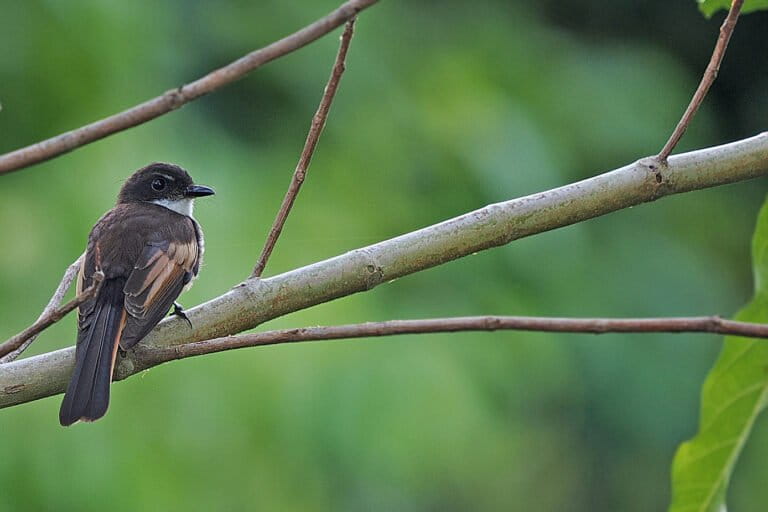
A songbird species previously thought to occur across two Indonesian islands has turned out to be two distinct species, according to a recent study. For more than 120 years, many scientists believed that Indonesia’s Babar Islands in eastern Banda Sea, and Tanimbar Islands, roughly 135 kilometers (84 miles) east of the Babar Islands, were both home to the cinnamon-tailed fantail (Rhipidura fuscorufa). But a team of researchers led by James A. Eaton of Birdtour Asia Limited and Alex J. Berryman of BirdLife International has confirmed that the songbird on Babar Islands is a distinct species, which they’ve named the cheerful fantail (Rhipidura laguceria). To confirm these findings, the researchers analyzed 19 museum specimens of birds labeled cinnamon-tailed fantail, historically collected from both Tanimbar and Babar islands. They also recorded songs of the birds on both islands, then played the recorded calls back to the wild birds 132 separate times over several years. The researchers found that physical differences between the populations on the two islands are subtle: The cheerful fantail possess slightly darker upperparts and less extensive cinnamon plumage below than the cinnamon-tailed fantail. However, their songs vary considerably. The researchers said in the study that songs of the birds on Babar typically consist of “single whistles that rise in pitch towards the end.” By contrast, the Tanimbar birds combine very short and longer whistles, which gives their songs a “much more rhythmic cadence,” with pitch that typically goes up and down. The song recording experiments also revealed that birds…This article was originally published on Mongabay
Decades of unchecked deforestation for coffee production has devastated Vietnam’s Central Highland forests, according to a new investigation by the Berlin-headquartered watchdog group Coffee Watch. Vietnam is currently the world’s second largest coffee producer, supplying nearly 40% of the world’s exports of Robusta coffee (Coffea canephora). The investigation, which analyzed satellite data and government records, found that tropical forest cover in Vietnam’s Central Highlands region, which produces 95% of the country’s coffee, plummeted from 42.8% in 1990 to just 19% by 2020. Forest loss was most rapid between 1995 and 2010, and stabilized at low levels in the 2020s, the investigation found. Much of the remaining tropical moist forest is now confined to “steeper, less accessible terrain, often at higher elevations and within formally designated protected areas,” the Coffee Watch’s report notes. Historically, government policy and international development financing incentivized the rapid expansion of coffee in the Central Highlands, according to Coffee Watch. The ecological cost has been severe, the nonprofit adds, resulting in fragmented habitats, accelerated soil erosion and a “nutrient treadmill” where farmers must use increasing amounts of fertilizer to maintain yields in exhausted soils. The Coffee Watch report notes that forest loss has affected water flow and recharge, soil stability and moisture, carbon storage and pests in the Central Highlands. It warns that 50% of Vietnam’s robusta belt could become unsuitable for coffee owing to the added impacts of climate extremes such as rising temperatures and erratic rainfall. Ly Thi Minh Hai, Vietnam country director at the…This article was originally published on Mongabay
A beekeeping initiative is enabling women in India’s Western Ghats, a biodiversity hotspot that runs parallel to India’s west coast, to strengthen their livelihoods with more reliable honey harvests. The 50 women are part of the Women for Bees project, launched in India in April 2025 by UNESCO in partnership with local nonprofit the Keystone Foundation. The project provides training and equipment to women from the Irula, Kurumba and Kattunayaka Indigenous communities across the southern states of Tamil Nadu and Kerala, reports Mongabay-India’s Arathi Menon. Traditionally, many of these communities were skilled wild honey hunters, a practice that is often risky and increasingly restricted by forest protection laws. Managed beekeeping, using hive boxes, offers a safer, more predictable alternative. The women are trained to rear the native Asian honey bee (Apis cerana indica), which is more resistant to local diseases and parasites than the commercially dominant European honey bee (Apis mellifera). A 2023 study comparing the two species suggests that, while the life cycles are generally similar, A. cerana colonies are better able to defend themselves against threats, diseases and disruptions. The economic impact of the honey harvests from the hive boxes has been immediate, providing many participants with their first taste of financial independence. Neelavathi, an Irula woman from Tamil Nadu state, has used her earnings to support her family and purchase household goods. “Since I am the beekeeper at home, my family lets me keep the income for my own needs,” she told Mongabay-India. Malavika Jayakrishnan, who leads…This article was originally published on Mongabay
The ongoing war in Iran, which began following a joint U.S.-Israeli attack on Feb. 28, has intensified the long-standing isolation of the country’s wildlife conservation community, Mongabay’s John Cannon reports. While the current war has directly hindered research and damaged educational facilities, conservationists and researchers said that decades of international sanctions and political disconnect had already crippled Iranian conservation efforts long before the first bombs fell this year. “Iran’s nature, Iranian conservationists and Iranian researchers have been isolated for a long time,” Iman Ebrahimi, deputy director of the Isfahan-based NGO AvayeBoom Bird Conservation Society, told Mongabay. “The war has made that isolation more visible, but it did not create it.” This isolation has restricted access to global funding, professional collaboration, and basic research tools such as reliable internet, academic journals and robust banking channels. AvayeBoom continues to monitor the conflict’s effect on critical habitats. During a brief ceasefire in April, the team documented at least 5,000 greater flamingos (Phoenicopterus roseus) at Maharloo Lake, a salt lake that was full of water at the time. Ebrahimi said industries and agricultural activities were possibly drawing less water from the lake. The nonprofit also works with local communities around the Arjan wetland to protect bird species like the ruddy shelduck (Tadorna ferruginea). The wetland is part of the UNESCO-listed Arjan and Parishan Biosphere Reserve, in southwestern Iran, home to thousands of species, but also illegal bird hunting. Ebrahimi expressed concern about researchers who are forced to leave the country due to a lack…This article was originally published on Mongabay
In the West African nation of Benin, Vodun, an ancient spiritual religion rooted in a deep connection between humans and nature, has become a primary tool for protecting the country’s disappearing mangroves. By invoking the authority of the Zangbéto deity, local communities and conservationists create spiritual sanctuaries that forbid the destruction of mangroves under threat of divine punishment, reports Mongabay Africa’s Jahëna Louisin. Mangroves are vital carbon sinks, capable of capturing up to four times as much carbon as terrestrial forests. Benin’s mangroves are under extreme pressure from logging, salt production, intensive agriculture and urbanization. Between 1995 and 2015, mangrove cover in the country decreased by 29%, according to a study published in 2025. To combat this loss, the NGO Eco-Bénin partners with Vodun dignitaries to designate specific areas as sacred. In the last decade, this collaboration has preserved about 500 hectares (more than 1,235 acres) of mangroves. The process involves seeking permission from the spirits through a Fâ priest, a mediator who uses a traditional spiritual language to communicate with the divine. In the video, Isidore Jinou, a 57-year-old advertising director and the son of a fisherman, emphasizes the importance of this spiritual oversight for the Mono River region in the southwestern corner of Benin. This region is home to Bouche du Roy, an estuary and one of the richest mangrove ecosystems on the Beninese coastline. “All our resources, all our wealth comes from the water,” Jinou, who was initiated into the Vodun religion 14 years ago, tells Mongabay.…This article was originally published on Mongabay

 Login