Login

Orchem Unveils TGV Plating, Adhesion Technologies for Glass Substrates
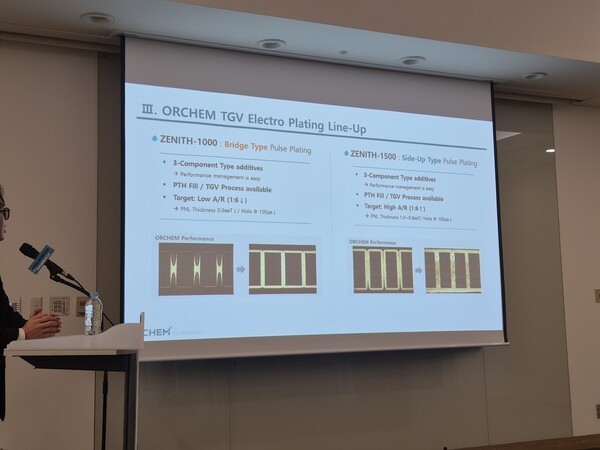
Orchem has introduced two plating approaches for metallizing through-glass vias (TGVs) in glass substrates. The company also unveiled a wet-process adhesion technology designed to improve bonding between glass and copper and between glass and insulating layers.
Orchem introduced its TGV plating and wet seed layer technologies at a technical seminar held during KPCA Show 2026 at Songdo Convensia in Incheon on Sept. 10. The company specializes in plating and surface-treatment chemicals used in semiconductor packaging and printed circuit board (PCB) manufacturing.
Orchem has developed two TGV plating approaches depending on substrate thickness and hole diameter. One is the bridge-fill method, commonly called center fill, which first forms a copper bridge at the center of the TGV hole and then fills the spaces above and below it. The other is the side-up fill method, which grows copper from the hole sidewalls toward the center.
The bridge-fill method uses Orchem's ZENITH-1000 plating solution. Filling the spaces above and below the copper bridge separately shortens overall plating time. The method is suited to TGVs with a low aspect ratio (AR). As substrates become thicker or hole diameters smaller, however, a higher AR can result in deeper enclosed holes, or blind vias, above and below the copper bridge.
ZENITH-1500 is used for side-up fill, in which copper grows across the entire TGV sidewall until the copper layers meet at the center. The approach can reduce void formation in high-AR TGVs. Orchem has completed plating evaluations on glass substrates up to 1 millimeter thick and is evaluating smaller hole diameters with aspect ratios of up to 20:1. Because copper grows across the entire hole sidewall, however, a thicker copper layer also forms on the substrate surface and plating takes longer.
Orchem has also developed an adhesion promoter (AP) to improve bonding between glass and copper or between glass and Ajinomoto Build-up Film (ABF). Glass has lower surface roughness than organic substrates, making it difficult to achieve sufficient adhesion. Palladium (Pd) catalysts used in electroless plating also have difficulty bonding copper to the glass surface.
The company synthesized the AP based on 3-aminopropyltriethoxysilane (APTES), a conventional silane-based adhesion material, by increasing the number of functional groups and molecular size. It is designed with separate functional groups that bond to glass and to copper or ABF, improving adhesion. The adhesion promoter can be wet-coated onto the glass surface before electroless copper plating. The coating is less than 100 nanometers thick.
Orchem also plans to commercialize bottom-up plating and a sputter-less process. Bottom-up plating grows copper from the bottom of a TGV hole and can reduce void formation even at high aspect ratios. The company is currently evaluating technology to uniformly form a seed layer at the bottom of the hole. The sputter-less process uses an adhesion promoter and electroless plating to form a copper seed layer without conventional sputtering. Orchem plans additional evaluations and aims to commercialize the adhesion material for the sputter-less process by year-end.
"TGV plating chemicals have already reached the commercialization stage," an Orchem official said. "Development of the adhesion material for the sputter-less process is complete, and our goal is to commercialize it by year-end after additional evaluation and validation."