❌

Reading view

AI Could Warn of Dangerous Blood Sugar Changes Before They Happen

Living with type 1 diabetes means making decisions about blood sugar every day. Even when people carefully count carbohydrates, use insulin correctly, and check their glucose regularly, their levels can still rise or fall unexpectedly. Researchers at Kaunas University of Technology, or KTU, are testing whether artificial intelligence could make these changes easier to anticipate. […]

The post AI Could Warn of Dangerous Blood Sugar Changes Before They Happen appeared first on Knowridge Science Report.

  •  

Why Apple’s new audio AI features aren’t the privacy nightmare you think they are

Macworld

With the Apple Watch Series 12 and Ultra 4, Apple is introducing some neat new audio-based AI features that seem genuinely useful and exciting.

The new S11 processor includes hardware that makes it possible to continually listen and (lightly) process audio without ruining battery life, and Apple is using that to provide four new AI-powered features. It calls these features “Audio Intelligence” because Apple can’t help but brand everything.

  • Full-time Shazam: The watch can detect music playing and automatically identify it using Shazam, displaying it on widget in the Smart Stack. Apple Watches already do this on demand, but the new thing here is that it does it continuously in the background like Pixel phones.
  • Sound recognition: The same feature you can get on HomePods and iPhone now comes to Apple Watch. You can get notified visually when your watch hears sounds such as doorbells, fire alarms, sirens, etc. You used to need your iPhone nearby to use this feature, but the Series 12 and Ultra 4 can do it independently.
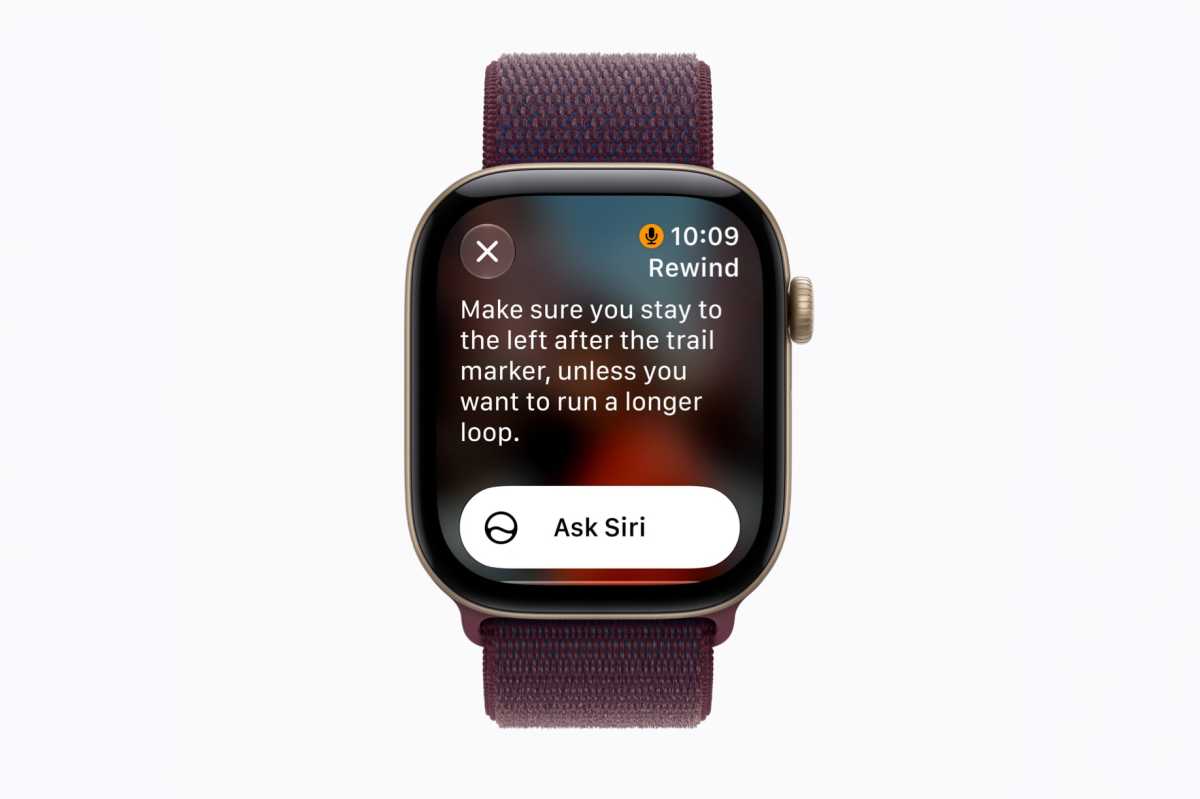
  • Live Rewind: Double-tap the digital crown to see a text readout of the last 15 seconds of what was said around you. You can then ask Siri about it or save it to the Siri app.
  • Siri Recap: Get a high-level summary of an entire conversation in the Siri app, so you don’t forget specifics or need to take notes.

The first two of those features don’t really bother anyone. Those are existing features, and the only new thing is that the Apple Watch can do them in the background without iPhone intervention. The last two will be available later this year as a beta, and those are the ones that have people freaking out. Are people’s Apple Watches going to be recording you all the time?

Apple has issued a Audio Intelligence Security Overview white paper to help users understand how all this works and how it protects everyone’s privacy. It’s worth a read, but here are the highlights.

How Live Rewind works

On the Apple Watch Series 12 and Ultra 4, audio from the microphone is continuously flowing into a little buffer in the Secure Enclave. This actually happens on lots of Apple products; it’s how they know if you’ve said “Hey Siri” or not. This is a rolling buffer, where new data continuously replaces old data.

The Secure Enclave is a completely separate hardware block that is not accessible to the rest of the operating system, or any apps, or even Apple. It’s where your Face ID and Touch ID data is stored, for example.

apple watch siri live rewind

Live Rewind will show you what you missed—privately.

Apple

When you double-press the Digital Crown, the last 15 seconds of that buffer is sent via an encrypted secure transfer to your iPhone, where an AI model transcribes it. This happens in the iPhone’s Secure Enclave, so the audio cannot be accessed by the rest of iOS, or any app, or the user, or even Apple. This is just a straight voice-to-text transcription; it doesn’t identify or label people who are speaking. The audio is then immediately discarded.

The text of the translation is then sent back to Apple Watch where it appears on the display. It is not saved unless you ask Siri about it or save it to the Siri app to revisit later. The Siri app’s data is end-to-end encrypted and synced between devices, and users can control whether conversations are automatically deleted after 30 days, 1 year, or saved forever. Apple cannot decrypt this data, even with a court order—only the user has the key.

And one more thing, an audible chime plays from the speaker on your Apple Watch when you implement Live Rewind, even if your Apple Watch is on silent or you have headphones connected.

So that’s how Live Rewind protects your privacy and those around you. Raw audio data can’t ever be accessed by the user, the system, Apple, or any apps. It’s just straight translated to text, which is then optionally saved in the end-to-end encrypted Siri app.

How Siri Recap works

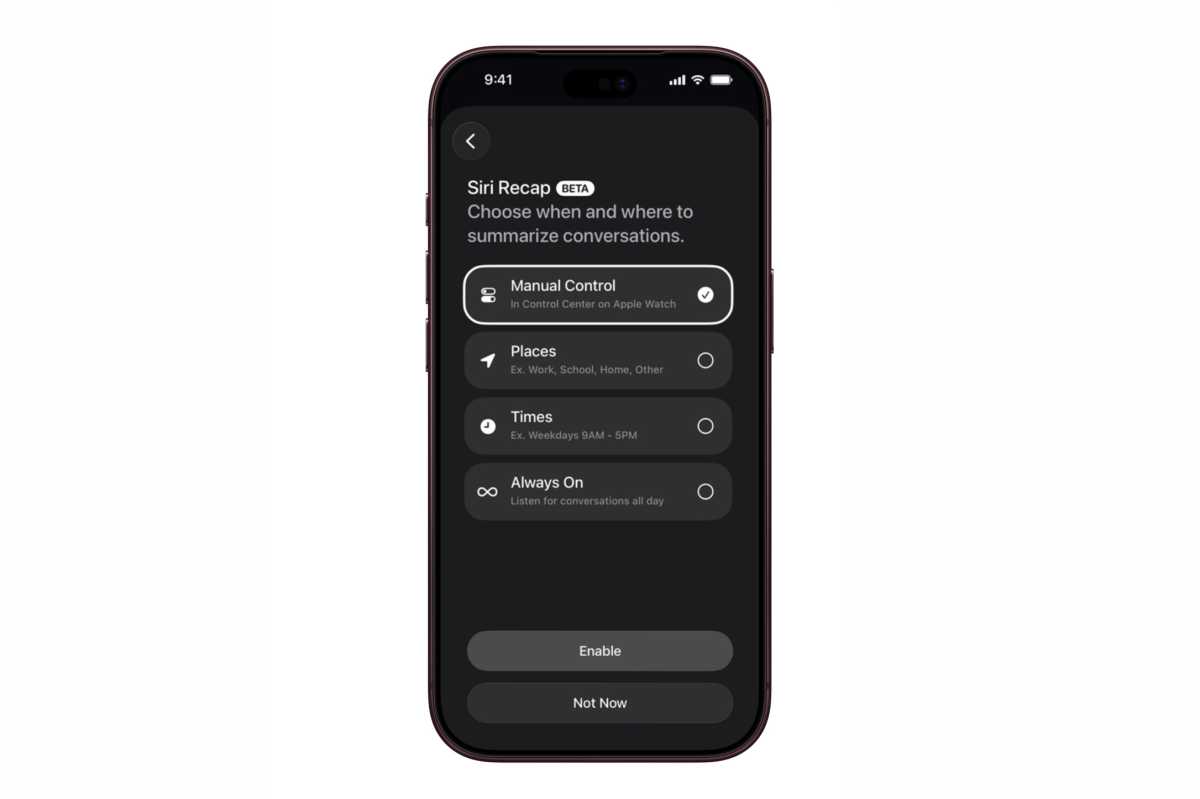
Siri Recap works in a similar way, but there’s more going on. You’ll be able to leave it on all the time, only when you trigger it manually, or specify certain places or times when it can’t operate.

First, a tiny little lightweight model simply detects if a conversation is happening at all.

If it is, that encrypted and secure audio buffer is sent to the iPhone (via an encrypted data transfer) for processing. It is transcribed to condensed text, and the raw audio is then immediately discarded. It is never accessible to the OS, apps, the user, or Apple.

This transcribed text passes through a safety filter than will remove potentially harmful terms. Then it is encrypted and sent to Apple’s Private Cloud Compute servers to be summarized, along with relevent contextual data that can make the summary better (such as what music you might be listening to, a relevant calendar entry, or high-level place information like what city you’re in).

Siri recap

Apple

Private Cloud Compute generates a title and summary with key points. It removes any specific identifiable or sensitive info such as place names or financial data, while leaving generic places names like “park” or “grocery store.” That summary is then sent back to your devices, encrypted, where it is stored in the Siri app in a new Recaps tab. All data on Apple’s Private Cloud Compute servers is always discarded immediately after processing; Apple never saves any of it.

The summaries in the Recaps tab are deleted automatically after seven days unless you choose to save it.

Like Live Rewind, Siri Recap does not create a recording, does not identify speakers, and does not even create a verbatim transcript. No audio is ever accessible at any step of the process by the user, any app, or Apple.

Finally, Live Rewind and Siri Recap are not available for users under the age of 13. For users under 18 on a Child Account, access to Live Rewind and Siri Recap must be turned on by a parent or guardian.


  •  

OpenAI is launching special ChatGPT tools for bankers and financial services workers

  • OpenAI for Financial Services comes with built-in premium datasets
  • Third-party subscription sharing is also in the works
  • GPT-6 promises 100% on the 256-512K Long Context benchmark

OpenAI has lifted the wraps off ChatGPT for Financial Services, its latest industry-specific version of ChatGPT Work designed to give sector professionals access to relevant reasoning and models.

The company warned that analysts regularly spend too much time finding data, checking figures, building models and turning complex analysis into presentation-friendly reports – all things it hopes to be able to tackle with this iteration of ChatGPT Work.

Core to this new product is, of course, GPT-6 Astra, but OpenAI also worked with investment experts from Morgan Stanley and Evercore to guide its development.

ChatGPT for Financial Services

With the launch of ChatGPT for Financial Services, OpenAI has built premium datasets from the likes of Daloopa, PitchBook and LSEG News directly into the tool, so users won't need to negotiate their own external datasets. By hosting and indexing that data itself, OpenAI can ultimately improve performance and latency for end users.

OpenAI also promises to be working with S&P Capital IQ, LSEG, MSCI, Dow Jones Factiva and Moody’s so that users can access their subscription benefits directly through their ChatGPT login to reduce the friction further.

All of this with the benefits of OpenAI's latest frontier model, Astra, which sees marked improvements across the board. The jumps from 91.5% to 100% at 256K-512K and from 73.8% to 96.3% at 512K-1M are especially noteworthy on the Long Context MRCR benchmarks when compared with GPT-5.6 Sol, because finance work often requires handling long documents like annual reports and filings.

The company also advertises a 100% score for the ExploitBench cybersecurity benchmark, which should come as welcome news to this highly-regulated industry.

Only eligible financial institutions will gain access to the tool for now, and they must contact OpenAI for options.

"ChatGPT for Financial Services is one way we serve customers across the industry, but we recognize that it will require a range of solutions to address the needs of the finance industry," the company said in its launch blog post.

"OpenAI has a long history of collaborating with innovators to unlock novel AI solutions. Financial services firms and developers can use our API to build specialized applications for the needs they understand best. OpenAI brings frontier models and the capabilities to put them to work. Financial institutions, data providers, and software partners bring specialized expertise, trusted information, and customer relationships."

Google logo on a black background next to text reading 'Click to follow TechRadar'

  •  

OpenAI pauses $200 Pro tier as Astra demand strains capacity

OpenAI has paused new sign-ups and upgrades to its $200 ChatGPT Pro tier, citing a surge in demand for its Astra capability that is placing pressure on system capacity, according to company statements and an executive post on X.

“To make sure our current users have an incredible experience and continued access to Astra, we are going to pause subscriptions to our $200 Pro plan,” OpenAI member of technical staff Thibault Sottiaux wrote in a post on X. “These put the most strain on our systems and we wanted to take the smallest step that allows us to continue giving the broadest access possible.”

The company separately confirmed the move in its help documentation, stating that “as of September 10, 2026, we’re temporarily pausing new sign-ups and upgrades to the ChatGPT Pro $200 plan (Pro 20X).” The pause applies to users across Free, Go, Plus, and Pro $100 tiers seeking to upgrade, while “existing ChatGPT Pro $200 subscriptions … are not affected by this pause,” it said.

Sottiaux added that “there is no impact to existing accounts and we are working on adding more capacity as fast as we can,” pointing to ongoing efforts to scale infrastructure in response to demand.

Users who cancel or downgrade during the pause will not be able to re-subscribe to the $200 tier until the restriction is lifted, according to the company’s help page. The $100 Pro tier remains available, with lower usage limits. Promotions tied to the $200 tier are also paused, the page read.

Astra demand drives capacity decisions

The decision is directly tied to the uptake of Astra, which OpenAI has positioned as a more advanced capability within its platform. The scale of that demand, according to Sottiaux, has been atypical.

“Demand for Astra is really unprecedented,” he wrote in the post. “We’re pulling all the levers possible to sustain the demand, but I’ve not seen anything like it until now and we went through very steep growth before.”

He added that “priority will always be to keep excellent service for existing users,” noting that the company “might have to pause new Pro subscriptions for a bit if this continues.”

The pause comes amid broader rollout challenges tied to Astra. OpenAI Chief Executive Sam Altman recently described the launch as “messy” after some paying users were unable to access the model immediately, reflecting the operational complexity of deploying high-demand AI systems at scale.

Capacity constraints surface for enterprise workloads

The pause, analysts said, reflects how demand for high-intensity AI workloads is intersecting with infrastructure limits, particularly at the highest usage tiers.

“It signals that frontier capacity is still rationed,” said Bhupendra Chopra, chief revenue officer at Kanerika. “One week after launching Astra, OpenAI paused new sign-ups and upgrades to the $200 Pro tier, the plan with the heaviest Astra usage limits, while the $100 Pro tier, the API, Business and Enterprise all stayed open. That tells you the priority order.”

“Consumer power users are the release valve. Enterprise contracts are what the vendor protects,” Chopra said. “For CIOs the lesson is that a model being announced and a model being available to your workloads at the volume you need are two different events.”

Chopra said the move reflects how access to advanced AI capabilities is being managed.

“We are already there,” he said. “Rate limits, usage caps, queueing and now sign-up pauses are all forms of capacity gating, and every frontier vendor uses some of them.”

“A subscription buys you a place in the line. A fixed slice of compute comes only from a contract that says so,” he added.

Planning for constrained supply

For enterprise IT leaders, Chopra said model capacity should be treated as a dependency.

“Treat model capacity like any other supply chain dependency,” he said. “Ask the vendor three questions before you sign. What throughput is contractually committed, what happens to my workloads when demand spikes, and how quickly can I fail over to another model.”

“If a workload is production-critical, it should run on an enterprise agreement with committed capacity… and it should have a second model tested and ready,” he said.

A recurring pattern

Chopra said the pause reflects a broader pattern seen in recent launches.

“This is at least the third time in two years OpenAI has throttled or paused access at launch,” he said. “Each launch outruns capacity, capacity catches up, and the next model outruns it again.”

“OpenAI calls this pause temporary, and it will lift once capacity catches up,” he added. “The structural condition… will persist as long as model capability keeps outpacing data center buildout.” OpenAI has not provided a timeline for when new sign-ups to the $200 Pro tier will resume, stating only that the restriction is temporary.

The article originally appeared on CIO.com.

  •  

Siri Recap Privacy Explained: What Apple Does With Your Conversations

Apple says Siri Recap can listen for conversations on Apple Watch, process the audio, and create a short high-level summary without keeping an audio recording for replay. The feature is opt-in, and users can control it by time, location, or a manual switch. Apple’s Audio Intelligence support document says raw audio is not recorded or […]

The post Siri Recap Privacy Explained: What Apple Does With Your Conversations appeared first on The Mac Observer.

  •  

The Cheapest Way Into Apple Intelligence in 2026: Free on 15 iPhones, $699 If Yours Is Not One

If your iPhone is one of the 15 models on Apple’s Apple Intelligence device list, the cheapest way in costs nothing: iOS 27 arrives free on Monday, September 14. If it is not, the least expensive route Apple sells is the $699 iPhone 17e, and the same model was listed at $599 before September 9. […]

The post The Cheapest Way Into Apple Intelligence in 2026: Free on 15 iPhones, $699 If Yours Is Not One appeared first on The Mac Observer.

  •  

Will Siri AI Speak Hindi? What Apple Has Published for India

Apple has published no timeline for Siri AI in Hindi, and no timeline for Apple Intelligence in Hindi either. Hindi is not among the 16 languages Apple lists, and the one dated expansion Apple has announced covers French, Japanese, Korean, Portuguese and Spanish in October. That is the honest answer to a question a very […]

The post Will Siri AI Speak Hindi? What Apple Has Published for India appeared first on The Mac Observer.

  •  

iOS 27 on Monday or Wait for 27.1? Apple Has Published No Point Release Date

If you are planning to skip Monday and wait for iOS 27.1, understand what you are waiting for: Apple has not published an iOS 27.1, has not dated one, and has not published a single word about how iOS 27 itself will roll out beyond the date. iOS 27 arrives Monday, September 14 as a […]

The post iOS 27 on Monday or Wait for 27.1? Apple Has Published No Point Release Date appeared first on The Mac Observer.

  •  

iOS 27 on an iPhone 15 Pro: The Apple Intelligence You Get and the Tier You Do Not

The iPhone 15 Pro and iPhone 15 Pro Max are the oldest iPhones on Apple’s Apple Intelligence list, so on Monday, September 14 they get the full iOS 27 feature set as most people understand it: Siri AI in beta, Image Playground, the new Photos editing tools and Call Context. What they do not get […]

The post iOS 27 on an iPhone 15 Pro: The Apple Intelligence You Get and the Tier You Do Not appeared first on The Mac Observer.

  •  
❌