Astronomers once thought winds generated by supermassive black holes affected only their host galaxies, but a recent study found that their energy can also reach surrounding galaxies. Winds from a supermassive black hole can carry energy far beyond the galaxy that contains it. New observations show that this influence can extend roughly 300,000 light-years and [...]
A Curtin University-led research team has successfully identified the mysterious origin of several 4,000-year-old 25-ton stones, which ancient architects used to construct Britain’s iconic Devil’s Arrows, as Birmingham Rocks in North Yorkshire, over 11 miles (18 kilometers) from the monument’s location.
The researcher behind the first-ever geological source identification of the ancient stone monument said the quarry’s distance and the work required to move such massive stones suggest the ancient architects intentionally selected the material used to construct Devil’s Arrows.
Unraveling the Mysterious Origin of the 4,000-Year-Old Devil’s Arrows
Announcing the discovery, the research team, which included scientists from the University of York, UK, noted that the famous stone pillars stand up to seven meters (22 feet) tall. The team also said the site is unusual because such alignments are rare in lowland settings. Still, researchers have struggled to locate the mysterious origin of the massive stone pillars used to create the over 4,000-year-old monument.
The Curtin-led team noted that previous studies determined that the stones used in Devil’s Arrows were transported to the site during the Late Neolithic or Early Bronze Age. This range means the site could have been constructed as early as 2000 BC.
Lead author Dr Anthony Clarke, from Curtin’s School of Earth and Planetary Sciences, noted the significant challenges with moving the stones over such difficult terrain.
“Each stone weighs more than 25 tonnes, so moving them would have required incredible planning, coordination and engineering skill,” the researcher explained.
Dr. Clarke also highlighted the value this effort suggests these ancient Britons “placed real importance” on the material used in the monument’s construction and the landscape itself.
“It wasn’t just about convenience – the location the stones came from likely held meaning for them,” the researcher explained.
Low Impact Sampling Method Confirms Ancient Stone’s ‘Fingerprints’
To unravel the ancient site’s mysterious origin, the researchers placed tiny pieces of low-adhesion tape on the stones and then removed them. The team said this “low impact” sampling process collected several tiny mineral grains on the tape without measurable damage to the ancient monuments.
According to the statement announcing their solution to the Devil’s Arrows origin mystery, the team performed an analysis of the “fingerprints” of the selected grains. The results matched material from Brimham Rocks.
Critically, the mystery’s solution also addressed the possibility that glacial movement or other natural processes moved the stones over the needed distance. Instead, the team said their results demonstrated that “the stones were intentionally transported by people.”
“Our research shows these stones weren’t simply taken from the nearest available source – they were deliberately chosen from a challenging landscape 18 kilometers away,” Dr Clarke said.
Clarke also said that the results eliminate the nearer site of Plimpton Rocks, which “had previously been identified as the probable source of the stones.”
“Our findings instead point to Brimham Rocks, showing that prehistoric builders transported these enormous stones significantly further than thought,” he explained.
Solving Similar Stone Monument Origin Mysteries
After discovering the mysterious origin of the 4,000-year-old pillars, Dr Clarke said the team will apply its low-impact sampling method to similar stone monument origin mysteries. The team also hopes to conduct future “targeted excavations” at the Devil’s Arrows site and the newly identified source.
Dr. Clarke said that analysis might help explain how these ancient architects moved the massive stone pillars several miles over rugged terrain over 4,000 years ago. The research said the work could also unravel “how these extraordinary monuments were constructed.”
Co-author Dr Jim Leary from the University of York echoed Dr Clarke’s sentiments, while also suggesting that the team’s findings ‘reshaped’ how researchers understand the art of prehistoric monument-building.
“These results show that ancient communities were making deliberate and meaningful choices about where their stones came from,” Dr Leary explained.
The York researcher said their solution to the Devil’s Arrows origin mystery also “highlights the importance of landscape and shared belief systems, as well as the remarkable effort involved in transporting and raising stones of this size.”
Christopher Plain has spent the last six years as Associate News Editor and Head Science Reporter at The Debrief. Follow and connect with him on X, learn about his novels at plainfiction.com, or email him at christopher@thedebrief.org.
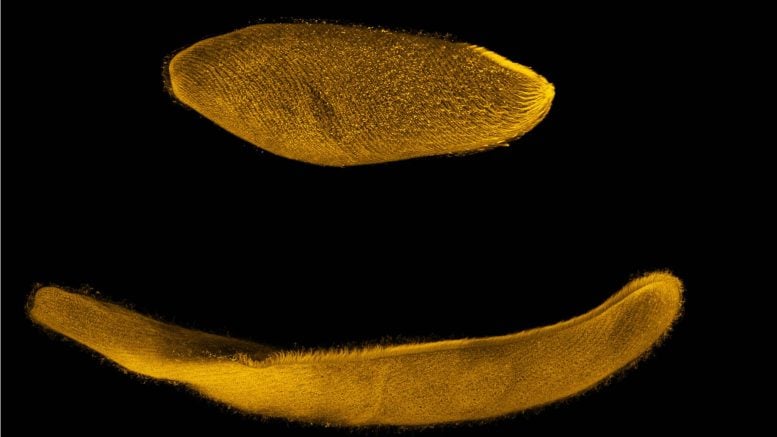
Spirostomum uses a calcium-activated protein network to contract at remarkable speed without conventional muscle fibers. In less than five milliseconds, the aquatic single-celled organism Spirostomum ambiguum can shrink to one quarter of its body length, a movement hundreds of times faster than a human blink. Researchers have now traced that speed to an unusual calcium-activated [...]
Using a new computational toolkit, Yale researchers recovered evolutionary clues from highly degraded DNA and identified two extinct lineages of giant tortoises. Some Galapagos giant tortoise specimens preserved in museums contained so little usable DNA that less than 1% of their genomes could be read. Yet Yale researchers were still able to recover enough genetic [...]
A new image of the Helix Nebula reveals how dying stars return material to the galaxy. The Helix Nebula offers a rare look at what happens after a dying star releases its outer layers into space. New observations show fragments of that material colliding with surrounding gas, breaking apart, and beginning their return to the [...]
Researchers developed a model showing how lava-covered planets close to their stars can hold onto their atmospheres, which could help guide the search for life beyond our solar system. Some planets orbit so close to their stars that intense radiation should strip away their atmospheres. Yet several of these scorching, lava-covered worlds still retain thick [...]
Two researchers who study the debilitating sleep disorder have won a prestigious Lasker Award. Their research in animals laid the groundwork for a new drug that addresses the condition’s root cause.
Australian researchers have identified a promising new approach that could help stop one of the most aggressive forms of breast cancer from spreading. Triple-negative breast cancer becomes especially dangerous once tumor cells escape the breast and establish themselves elsewhere in the body. Australian researchers have now identified a molecular weakness that could eventually help determine [...]
One sleepless night can blur the brain, but just 20 minutes of exercise or a well-timed nap may help new memories survive for days. In a McGill University-led study, participants who exercised for 20 minutes or slept for 90 minutes after prolonged wakefulness performed about 22 percent better on a delayed memory test than those [...]
Princeton’s PACMAN AI can control fusion plasma in milliseconds and predict dangerous instabilities before they start. In some fusion energy systems, particles can reach temperatures hotter than the center of the Sun. The challenge is keeping that extreme plasma under control, because disturbances can develop within just a few thousandths of a second, much faster [...]
A major trial found that implantable cardioverter-defibrillators may benefit some patients younger than 70 with mild-to-moderate heart dysfunction and cardiac scarring. A more than decade-long randomized trial suggests that implantable cardioverter-defibrillators may benefit some patients who have heart scarring and only mild-to-moderate loss of heart function, a group that currently falls outside standard treatment guidelines. [...]
On August 27, I wrote to Duke's Office of Counsel, informing them that Howell’s book has been withdrawn by its publisher because of the fabricated quote.
A bacterial molecule called gladiolin can disarm invasive Candida albicans and strengthen the effects of a major antifungal drug. Candida albicans usually lives harmlessly in the human body, but under the wrong conditions it can transform into an invasive form capable of damaging tissue and causing life-threatening infection. Researchers from Monash University and the University [...]
In a promising advancement in the search for dark matter, scientists have transformed a tiny magnet into a detector that can sense some of nature’s faintest forces—with a little help from levitation.
The research could help researchers detect some of the heaviest particles that are believed to have ever inhabited the universe, according to physicists.
Led by Rice University physicist Christopher Tunnell, the achievement was made using a tiny permanent magnet—one around the size of a grain of sand—which they levitated over a superconductor that was chilled to freezing cold temperatures just above absolute zero.
Since the magnet floats without encountering any surfaces, this dramatically reduces friction, allowing the Rice team to carefully monitor its movements, some of which are as small as around one-hundredth of a single atom. Such subtleties of its motion offer a novel possibility: that the magnet’s faint movements could serve as an effective signal if a massive dark matter particle passed through the detector.
The tiny magnet used by the Rice University research team (Image Credit: Christopher Tunnell/Rice University).
Unusual Candidates for Dark Matter Particles
“Dark matter could be hiding at masses that our traditional experiments were never built to reach,” Tunnell said in a recent statement, noting that by leveraging the team’s novel detector, “we can begin searching a part of the dark matter landscape that has largely been out of experimental reach despite being the focus of extensive theoretical study by my Rice cosmology colleague Andrew Long.”
Among the most mysterious phenomena in the universe, dark matter is believed to comprise most of the matter that populates the cosmos and exerts gravitational effects that influence the formation and behavior of galaxies. Despite this, scientists have remained unsuccessful in detecting it or even determining what it is comprised of.
There are several experiments that hunt for hypothetical dark matter particles, which scientists believe have masses that are similar to those of atoms or subatomic particles. Still, there are some theoretical models which suggest much heavier particles could also qualify—some approaching sizes as large as a human cell.
A Novel Means of Detecting Dark Matter
Detecting something so large would require a very different kind of dark matter detector. To search for the kinds of interactions that smaller particles would be expected to generate, the Rice researchers instead looked for an impulse—one more likely to result from such an “ultraheavy” dark matter particle as it interacted with the detector.
“Instead of looking for a steady signal, we are waiting for very small knocks,” explained Rice postdoctoral researcher Juehang Qin.
The Rice research unit, led by associate professor Christopher Tunnel (left).
Over the course of one month, the team collected observations that focused mainly on quiet overnight periods when vibrations and other environmental disturbances were minimized. Unfortunately, no promising detections were made during this time.
Still, important results can also be derived from a lack of any definitive discoveries, especially when it comes to a field like particle physics. In this case, that’s because the absence of a signal allowed the researchers to place a few constraints on the combinations of dark matter masses and interaction strengths that should have been expected to produce detectable effects.
Altogether, the team’s experiment looked at nine orders of magnitude in its search for possible dark matter particle passes, which included searches for particles as much as 10 million times heavier than those investigated in past similar experiments.
Next Steps
Going forward, the next step would be to increase the experiment’s sensitivity by cooling the magnet even further, observing for longer periods, and eventually successfully levitating several magnets simultaneously. Multiple detectors could also help scientists determine whether real interactions involving dark matter are occurring, as opposed to false positives that might arise from vibrations or other kinds of interference.
Although the Rice team’s work is only a first step, their experiments with a tiny levitating magnet mark a promising pathway toward future potential detections, which may finally unlock new clues to the universe’s mysterious dark matter landscape.
The team’s research was detailed at the 2026 International Conference on Particle Physics and Cosmology, and additional details can be found here.
Micah Hanks is the Editor-in-Chief and Co-Founder of The Debrief. A longtime reporter on science, defense, and technology with a focus on space and astronomy, he can be reached atmicah@thedebrief.org. Follow him on X @MicahHanks, and at micahhanks.com.
Machine vision is becoming a practical part of Apple’s U.S. factory training strategy, giving smaller manufacturers access to techniques that help production systems inspect what they make. The recent opening of the Houston manufacturing training center extends that effort into a working electronics production campus, while courses developed with Michigan State University introduce businesses to image analysis, machine learning, and automated quality checks.
For a manufacturer, the attraction can be straightforward: finding a missing component before a product leaves the line, identifying a surface defect before more material is added, or recognizing an assembly error while it can still be corrected cheaply.
These are manageable problems with measurable costs. They also offer an accessible starting point for businesses interested in AI but unsure where it belongs inside their operations.
Machine Vision Enters the Manufacturing Curriculum
The Apple Manufacturing Academy’s current course catalog includes Machine Learning with Vision, a course introducing machine learning and deep learning through practical activities using Apple devices. It sits alongside instruction in automation, quality fundamentals, manufacturing data, maintenance, and process improvement.
That placement gives the subject useful context. A camera can produce an image, but a factory needs a decision: accept the part, flag it for review, check its position, or investigate a process that may be drifting out of tolerance.
Machine vision connects image capture to those operational decisions. Some applications use established rules to measure dimensions or identify patterns. Others use machine learning to recognize acceptable variations and defects that are difficult to describe through fixed rules.
The academy’s public description confirms introductory activities with Apple devices. It does not identify a particular iPhone, Mac configuration, software framework, or industrial camera package that every participant must use.
For smaller businesses, the educational value is learning how to define an inspection problem before purchasing equipment. A company that understands what it needs to detect can have a much more productive conversation with an automation supplier.
Houston Brings Training Closer to Production
Apple opened its 20,000-square-foot Advanced Manufacturing Center on August 13. According to the Houston opening announcement, the free program offers small and medium-sized businesses instruction in advanced manufacturing, interactive labs, and experience with representative production equipment.
The first cohort worked with machine learning for quality control and advanced automation. Participants also explored production challenges, used a holographic table, and assembled and laser etched a product.
The location adds context: the center occupies the same Houston facility that builds advanced AI servers and is scheduled to begin Mac mini manufacturing this year. Its teaching program includes final assembly principles and design considerations for printed circuit board assembly.
Houston is the company’s second U.S. manufacturing learning site, following the Detroit academy established with Michigan State University in August 2025. By the Houston opening, Apple said the academy had helped nearly 1,000 workers, students, and entrepreneurs.
That figure measures people reached through the program. It should not be interpreted as 1,000 factories already operating AI inspection systems.
Apple Machine Learning Adapters
A Useful Inspection Starts With a Specific Problem
Imagine a small business assembling control panels. Each panel needs the same set of connectors, positioned correctly before the enclosure closes. A machine vision station could check for a missing connector while the assembly remains accessible.
The value comes from catching that error at the right moment. Discovering it after packaging creates extra handling and rework. Discovering it after delivery may involve a return, a service visit, and an unhappy customer.
A useful pilot would therefore begin with that single inspection point. The business could compare the existing process with the assisted one, recording missed defects, unnecessary rechecks, inspection time, and the cost of correcting mistakes.
The camera is only part of the exercise. Workers must agree on what constitutes a defect, collect representative examples, and decide what happens when the result is uncertain.
Those decisions draw heavily on experience already present on the factory floor. An operator may know that an unusual mark is harmless, while a barely visible change in alignment predicts a later assembly problem. Turning that knowledge into consistent inspection criteria is valuable work in its own right.
These are examples of how manufacturers could apply the training, rather than projects Apple has announced for individual participants.
Teaching Machine Vision to Handle Ordinary Variation
A demonstration can look impressive when every part arrives clean, centered, and evenly lit. Production introduces variation: different surface finishes, reflections, changing positions, and batches that look slightly different while remaining within specification.
The inspection system must distinguish those acceptable differences from actual failures. Otherwise, it can reject good products or allow defective ones to continue.
Industrial vision supplier Cognex’s deployment guidance recommends validating systems across product models, defect types, and manufacturing lines. It also describes an approach in which automated inspection handles preliminary checks while experienced inspectors review borderline cases.
For a business learning machine vision, that offers a realistic way to introduce the technology. Employees can compare its decisions with their own, investigate disagreements, and determine whether the results justify extending its role.
An inspection system also needs an owner after installation. Someone must understand when a product change requires new examples, when equipment needs attention, and when performance has slipped. Training that responsibility into the workforce helps prevent an initially successful project from becoming an unreliable fixture.
Smaller Manufacturers Are Already Applying the Training
The academy’s reach extends beyond companies producing consumer electronics. In its May update on participating manufacturers, Apple highlighted Block Imaging, a Michigan business that services and refurbishes medical imaging equipment.
The company hosted visitors during the academy’s Spring Forum and described applying techniques learned from Apple engineers and Michigan State experts to its operations. Apple reported that the academy had supported more than 150 American businesses at that point.
The announcement did not identify a particular machine vision deployment at Block Imaging or publish a percentage improvement attributable to visual inspection. It does provide an example of the training reaching businesses whose work differs substantially from building an iPhone.
That wider participation could benefit Apple indirectly. More capable domestic manufacturers can support equipment maintenance, tooling, components, and specialized production services. Participation itself does not establish a supplier relationship, but the skills can be used across customers and industries.
Access Without a Large Training Budget
The academy’s participation information says eligible small and medium-sized U.S. manufacturers can take courses free of charge. Online learning includes on-demand materials and interactive modules, while in-person sessions add workshops and more personalized instruction.
Digital badges are available for different topics, and completed course materials remain accessible for review. That gives a business room to train an employee around existing production commitments and return to the material when an actual project begins.
Free instruction does not remove the eventual cost of cameras, lighting, integration, maintenance, or employee time. It can help a manufacturer understand those costs before committing to a system.
The first proposal brought back to the factory might be modest: inspect one recurring defect at one station and record the results for several weeks. A supervisor can then weigh the time saved against the extra reviews, maintenance, and mistakes. That is the kind of evidence a business owner can use when deciding whether to install a second station.
New research from Indiana University suggests that when your brain makes a decision, it may not actually “make” it in the way neuroscientists have traditionally assumed.
Conventionally, decision-making has been described as a sequence: you have options to consider, you choose one, and then you act. However, neuroscientist Tom James argues that this sequence may not accurately reflect what actually happens in the brain.
Traditional models suggest that the brain has centralized processes responsible for making decisions. James argues that what people experience as “decision-making” may instead arise from ongoing interactions among perception, movement, the body, and the environment. If correct, this perspective could significantly change how scientists understand human behavior.
The Sandwich Model Debated
James describes one traditional approach to cognition as the “sandwich model”: sensory systems take in information, cognitive processes evaluate it and determine what to do, and motor systems then carry out the chosen action.
The problem, James argues, is that while scientists can identify many of the physical mechanisms involved in sensation and movement, it is much harder to locate a central point in the brain where a “decision” actually occurs.
Instead, James proposes thinking in terms of “action selection,” in which sensory, sensorimotor, and motor processes continually interact to produce behavior. But does that mean humans don’t actually make decisions?
“Of course they do. We use this language all the time, and it’s very helpful in terms of describing behavior,” James said in a statement. “The leap, I think, is to say that the brain works by having decision-making or control processes. It produces behavior that is well described in that way. But it doesn’t need a process that does that to make it look that way.”
In his view, “decision-making” may therefore be a useful way of describing human behavior rather than something the brain accomplishes through a specific, centralized process or system.
“As mental phenomena, they are defined on too abstract a level for the goals of cognitive neuroscience,” adds James.
Decisions are not “things”
Bridging neuroscience and philosophy, James draws on a physicalist framework associated with philosopher Daniel Dennett. Consider an object’s center of mass: it helps us describe and predict how the object behaves, but it isn’t a separate physical component causing the object to move.
James suggests decisions may work similarly. We can say someone “decided” to pick up a glass, but that does not necessarily mean there is a central location in the brain where that decision was made. Instead, the action could emerge from multiple brain and bodily processes working together.
As an analogy, James describes a robot programmed to follow a wall. Someone watching it might interpret its movements as a series of decisions, yet the robot does not require a centralized decision-making system. Instead, its sensors continually interact with its surroundings to guide its behavior.
James suggests that aspects of human behavior could be understood in much the same way.
A philosophical challenge
James’s argument also addresses a longstanding philosophical problem. If the brain contains a central system that observes information and decides how we should act, what controls that controller?
This resembles what Dennett famously called the “Cartesian Theater”: the idea of an internal observer somehow watching and interpreting what happens inside the brain. But proposing such an observer only pushes the problem back another step—who, then, observes the observer?
Rather than placing a hypothetical decision-maker somewhere inside the brain, James argues that researchers should focus on the interacting physical systems that produce behavior.
That could mean studying cognition as something that emerges through the ongoing relationship between the brain, body, and environment, rather than as a sequence of isolated stages.
The feeling that “I made a decision” may remain perfectly real and useful as a description of human experience, even if there is no single place or process in the brain where that decision occurs. From James’s perspective, what we call a decision may instead be the outcome of interactions among the brain, body, and surrounding world.
Chrissy Newton is a PR professional and the founder of VOCAB Communications. She currently appears on The Discovery Channel and Max and hosts the Rebelliously Curious podcast, which can be found on YouTube and on all audio podcast streaming platforms. Follow her on X: @ChrissyNewton, Instagram: @BeingChrissyNewton, and chrissynewton.com. To contact Chrissy with a story, please email chrissy @ thedebrief.org.

 Login

 Astronomers once thought winds generated by supermassive black holes affected only their host galaxies, but a recent study found that their energy can also reach surrounding galaxies. Winds from a supermassive black hole can carry energy far beyond the galaxy that contains it. New observations show that this influence can extend roughly 300,000 light-years and [...]