❌

Reading view

Sorry Gove, Education Has Already Been Rewilded

It's already too late for Michael Gove to prevent the "rewilding" of Britain's schools, says Joanna Gray. This Left-wing fantasy of dumbed-down education is already firmly entrenched and working its anti-magic.

The post Sorry Gove, Education Has Already Been Rewilded appeared first on The Daily Sceptic.

  •  

Peer-led computing camps engage children, study finds

High school student Khushi Khurana creates and leads coding and artificial intelligence (AI) summer camps for K–12 students in her community outside Philadelphia. Priya Kumar, PNC Technologies Career Development Professor in Penn State's College of Information Sciences and Technology (IST), studies how young people navigate the digital world. Their shared interests led to a research collaboration exploring a youth-led STEM learning model that puts children's voices at the center of the learning experience.

  •  

New EAMA highlights showcase 30-year cohort generation research findings

Thirty years after a small group of European professors of geriatric medicine first warned that the continent’s fastest-growing population was being cared for by physicians who had never been formally trained to care for them, the program they created to fix the problem is marking its anniversary with a scientific milestone of its own. A new special article published in European Geriatric Medicine documents the research output of the most recent graduating cohort of the European Academy for Medicine of Ageing, or EAMA, and in doing so offers a rare longitudinal measure of how a structured, pan-European leadership program in geriatric medicine translates into scholarly productivity, professional advancement and, ultimately, better care for older people.

The new paper, titled “‘Highlights of latest EAMA’: generation research outputs of the 30-year anniversary cohort,” was authored by Thomas Münzer of the Geriatric Clinic St. Gallen in Switzerland, Hannes B. Stähelin of Basel, and Barbara van Munster of the University of Groningen Medical School in the Netherlands, writing on behalf of the EAMA Board. It arrives at a moment when the demographic arithmetic of Europe has made the question of geriatric capacity more urgent than ever: the proportion of people over 65 continues to climb, multimorbidity, frailty and polypharmacy have become the daily reality of hospital medicine, and health systems across the continent still struggle to recruit and retain physicians trained specifically in the medicine of ageing. The article’s premise is simple but rarely examined with this degree of rigor — if you invest systematically in the education of mid-career geriatricians, what do you get back?

To understand the significance of the anniversary cohort’s research output, one has to go back to the early 1990s, when the group of European Professors in Medical Gerontology published a stark assessment in the journal Age and Ageing. Writing in 1994, Stähelin and colleagues documented that medical gerontology was taught unevenly, and in many countries not at all, in European medical schools. Geriatric medicine, despite being one of the few specialties whose patient population was guaranteed to expand every single year, was frequently a subordinate unit within internal medicine, staffed by physicians who had acquired their expertise on the job rather than through dedicated training. The professors’ conclusion was that Europe needed not merely more geriatricians but a new cadre of academic leaders — clinicians who could teach, publish, shape curricula and advocate for the specialty within their national health systems.

That diagnosis led, in 1995, to the founding of the European Academy for Medicine of Ageing, an intensive postgraduate program deliberately modeled on leadership academies rather than conventional continuing medical education. EAMA’s structure has remained remarkably stable across its three decades: a small, competitively selected cohort of physicians, typically already experienced clinicians, is brought together for a series of residential courses spread over roughly two years, interspersed with mentored projects that require participants to produce original scholarly work. The curriculum spans the full breadth of the medicine of ageing — from the biology of ageing and the physiology of frailty, through geriatric syndromes such as falls, delirium, incontinence and sarcopenia, to the organizational science of acute geriatric units, nursing home medicine, rehabilitation and end-of-life care. Crucially, faculty are drawn from across Europe, exposing participants to radically different national models of geriatric care and building a professional network that persists long after the formal courses end.

The “reloaded” reform of the program, described in a 2018 paper by Roller-Wirnsberger and colleagues in European Geriatric Medicine, formalized what three decades of experience had taught the academy’s faculty. That paper set out explicit competencies and standards for a European leadership program in geriatric medicine, defining what a graduate of EAMA should be able to do: not just diagnose and treat, but design services, lead multidisciplinary teams, mentor juniors, conduct and critique research, and represent the specialty at institutional and governmental levels. The competency framework aligned the academy with modern medical-education theory, in which learning objectives are specified in advance and assessed rather than assumed. It is against this framework that the anniversary cohort’s performance, as documented in the new article, can be read as an evaluation of the program itself.

The central finding of the new special article is that the latest cohort of EAMA graduates has generated a substantial body of research output — the “generation research outputs” of the title — spanning peer-reviewed publications, presentations and ongoing projects in geriatric medicine. Each participant in the program is expected to develop a scholarly project under faculty mentorship, moving from a research question through protocol design, data collection and analysis to presentation and, ideally, publication. For the 30-year anniversary cohort, the academy compiled and highlighted these outputs, creating what the authors describe as the “Highlights of latest EAMA” — a curated snapshot of what a single generation of emerging European geriatric leaders produced during and immediately after their training.

Why does this matter beyond the individual careers involved? The technical answer lies in how research capacity compounds. A single published paper changes one evidence base marginally; a cohort of trained researchers who continue publishing changes the trajectory of an entire specialty. Geriatric medicine has historically been under-represented in high-impact clinical research relative to the burden of disease it manages. Conditions such as delirium, frailty and multimorbidity were for decades excluded from major trials or treated as confounders rather than outcomes, precisely because the specialty lacked enough investigator-trained clinicians to insist on their inclusion. Programs like EAMA attack that bottleneck at its root: every graduate who learns to design a study, secure a mentor and navigate the publication pipeline becomes a node through which clinical questions from the bedside can flow into the literature and back.

The pedagogical machinery behind that outcome is worth examining, because it explains why the anniversary cohort’s productivity is treated by the authors as more than a curiosity. EAMA’s residential courses are built around case-based, small-group learning in which participants bring real clinical and organizational problems from their home institutions and work them through with international faculty. The mentored projects between courses impose deadlines and accountability — the two ingredients that, as anyone who has supervised doctoral students knows, most reliably convert good intentions into submitted manuscripts. The academy also functions as a peer-review incubator: draft papers are critiqued by senior European geriatricians before submission, giving participants exposure to the standards of international journals at a stage of their careers when feedback is most formative.

The anniversary article also carries a personal and institutional poignancy. Hannes B. Stähelin, one of the co-authors, is identified in the publication as deceased; he was among the founding professors whose 1994 analysis launched the academy, and his presence on the author line of a paper published in 2026 spans the full thirty-year arc of the program. The continuity from the GEPMG position paper through the 2002 retrospective review of the academy’s first years, published in Gerontology, through the 2018 competency framework, and now to this documentation of cohort research output, constitutes something rare in medical education: a thirty-year, multi-generation audit trail of a single intervention in specialty training, documented by the people who built it.

For health systems, the implications are concrete. Europe’s national models of geriatric care differ enormously — from the fully established departments of the United Kingdom and the Netherlands to countries where geriatrics is still fighting for recognition as an independent specialty. EAMA’s cohorts deliberately mix these national traditions, so that a geriatrician from a country without an acute geriatric unit model trains alongside colleagues who run such units daily. The research outputs of the anniversary cohort, the authors suggest, function as a form of technology transfer: projects conceived in one system are published in international journals and become adaptable blueprints for colleagues elsewhere. In an era when the European Union explicitly tracks health-workforce capacity, an academy that reliably produces clinicians who can lead services and generate evidence is a strategic asset, not a professional courtesy.

The article is also, implicitly, an argument about how educational interventions should be evaluated. Medical education research is notoriously dominated by satisfaction surveys and self-reported confidence measures, which correlate weakly with actual performance change. Research output — publications generated, projects completed, academic positions attained — is a harder, more objective endpoint, and the EAMA Board’s decision to compile and publish the anniversary cohort’s outputs signals a commitment to accountability by measurable results. It is a methodology other postgraduate leadership programs in medicine, from palliative care to rural health, could plausibly adopt: define the competencies, train against them, and then report what the trainees actually produced.

The publication timeline of the article itself — received in December 2025, revised in April 2026, accepted in June and published on 6 July 2026 in European Geriatric Medicine, the journal of the European Geriatric Medicine Society — places it squarely in the anniversary year it commemorates. As Europe’s population ages at a pace with no historical precedent, the question the founding professors asked in 1994 — who will teach the teachers, and who will lead the specialty? — has an answer that can now be pointed to in print: thirty years of EAMA cohorts, and a newest generation whose scholarly work is documented, highlighted and, the academy clearly hopes, replicated by the cohorts to come.

Subject of Research: Research outputs and scholarly productivity of the 30-year anniversary cohort of the European Academy for Medicine of Ageing (EAMA), a pan-European postgraduate leadership program in geriatric medicine

Article Title: “Highlights of latest EAMA”: generation research outputs of the 30-year anniversary cohort

Article References: Münzer, T., Stähelin, H. B., van Munster, B., & the European Academy for Medicine of Ageing (EAMA) Board (2026). “Highlights of latest EAMA”: generation research outputs of the 30-year anniversary cohort. European Geriatric Medicine. https://doi.org/10.1007/s41999-026-01536-5

Image Credits: AI Generated

DOI: 10.1007/s41999-026-01536-5

Keywords: European Academy for Medicine of Ageing, EAMA, geriatric medicine, medical education, research output, leadership program, ageing, Europe, geriatric care, anniversary cohort, lifelong learning

  •  

Gaza women bear invisible psychological scars of war, study finds

Nearly every displaced woman in Gaza surveyed in a new study screened positive for severe post-traumatic stress symptoms, a finding researchers describe as an unprecedented psychological toll linked directly to hunger, overcrowded displacement, and the collapse of everyday life under war.

The study, published in the International Journal for Equity in Health, assessed 503 displaced women in the Gaza Strip during the 2023–2025 war using a mixed-methods design that combined a structured quantitative survey with in-depth qualitative interviews. The average participant was 29.4 years old, with a standard deviation of 7.3 years, and the majority were married, unemployed, and living below the deep poverty line. Most had been displaced for nearly a year, and the overwhelming majority were sheltering in tents under conditions of severe overcrowding and acute food shortage.

When researchers measured post-traumatic stress symptoms using the Impact of Event Scale–Revised, a widely used screening instrument that evaluates intrusion, avoidance, and hyperarousal symptoms following traumatic exposure, they found that 98.2 percent of participants scored in the severe range. The mean IES-R score across the sample was 61.5, with a standard deviation of 9.5 — a figure far above the thresholds typically used to flag clinically significant trauma-related distress. The authors are careful to note that because symptoms were assessed with a screening tool rather than a formal diagnostic clinical interview, the results should be interpreted as reflecting an extremely high burden of trauma-related distress within the study sample rather than confirmed clinical diagnoses. Even with that caveat, the near-universality of severe scores stands out even against the backdrop of other conflict-affected populations, where severe symptom prevalence rarely approaches such levels.

Food emerged as one of the strongest statistical correlates of psychological suffering. Severe food insecurity, measured with the Food Insecurity Experience Scale developed by the Food and Agriculture Organization, affected approximately 71 percent of participants. Women experiencing severe food insecurity had significantly higher PTSD symptom severity scores, an association that held at a p-value below 0.001. The researchers also identified a cluster of socioeconomic and living-condition factors associated with worse outcomes: being divorced or widowed, living in an extended-family household, sheltering in a tent or collective shelter during displacement, and reporting that food was simply unavailable were all significantly linked to elevated symptom scores.

These quantitative patterns were given texture and depth by the qualitative arm of the study, in which trained researchers conducted semi-structured, face-to-face interviews in Arabic with 34 of the women. Analysis of the transcripts revealed five overarching themes: poverty and inequity; food as a luxury; wounds you cannot see; on the move, nowhere to belong; and small acts of resilience. Together, the themes trace an arc from material deprivation to psychological injury and, ultimately, to the fragile coping strategies women deployed to keep themselves and their families functioning.

The theme of food as a luxury captured how a basic biological need had been transformed into an object of obsession and grief. Women described rationing scraps, skipping meals so children could eat, and the humiliating experience of standing in lines for aid that never arrived. The researchers note that this chronic preoccupation with food security operated on two fronts — it was simultaneously a source of traumatic stress in its own right and an amplifier of existing war trauma, since hunger stripped away one of the last remaining domains in which mothers could still protect their children.

The “wounds you cannot see” theme speaks directly to the invisible nature of psychological injury in wartime. Women recounted nightmares, intrusive memories of bombings and the deaths of relatives, hypervigilance, emotional numbness, and an inability to feel safe even in moments of quiet. Several described the stigma of admitting psychological suffering, or the sense that mental distress was a luxury they could not afford to acknowledge while survival demanded constant action. The researchers interpret these accounts as illustrating how trauma in this context is not a discrete event but a continuous condition, woven into the fabric of daily life.

Displacement itself — the theme of being “on the move, nowhere to belong” — emerged as a distinct psychological stressor. Women described repeated forced evacuations, the loss of homes that anchored family identity and memory, and the corrosive instability of living in tents that leaked in rain, baked in heat, and offered no privacy for grieving or for motherhood. The loss of place, the authors suggest, compounds the loss of people, producing a grief that has nowhere to settle.

Yet the final theme, small acts of resilience, complicates a narrative of pure victimhood. Women described prayer, mutual aid among neighbors, storytelling with children, and small rituals of domesticity — making tea, arranging a tent, celebrating a birthday with almost nothing — as deliberate acts of psychological resistance. The researchers frame these behaviors as adaptive coping mechanisms that, while insufficient to protect against severe trauma symptoms, sustained a sense of agency and dignity under conditions designed to strip both away.

Methodologically, the study relied on a convenience sample recruited through structured surveys administered via Google Forms, a pragmatic choice given the destruction of infrastructure and the impossibility of random sampling in an active war zone. The authors acknowledge this limitation, along with the screening-based measurement of PTSD and the absence of consistent formal referral pathways for psychological care during data collection, which meant that women who became distressed during interviews could not always be directed to clinical services. Interviews followed strict ethical protocols approved by the Institutional Review Board at An-Najah National University, with verbal informed consent, anonymization, and trained interviewers instructed to pause or terminate any conversation that caused visible distress.

The demographic profile of the sample underscores the socioeconomic dimension of psychological vulnerability. That most participants were unemployed and living below the deep poverty line before and during the war reflects broader patterns in which economic deprivation and mental health outcomes are tightly intertwined in conflict settings. Divorced and widowed women — those without a partner’s social and economic support — fared significantly worse, as did women in extended-family households, possibly reflecting crowded conditions and multiplied caregiving burdens.

The study carries a sobering human footnote. The acknowledgments honor the memory of co-author Ayman S. Abutair, a clinical nutrition researcher at Al-Azhar University-Gaza, who lost his life during the war before the paper’s publication. His death stands as a stark reminder that the researchers documenting these invisible wounds were themselves living within the same catastrophe.

The authors argue that their findings demonstrate an urgent and unmet need for comprehensive humanitarian and psychosocial support tailored to displaced women — support that integrates mental health care with food assistance, shelter improvement, and protection for female-headed households. They emphasize that because caregiving responsibilities fall disproportionately on women during war and displacement, their psychological deterioration radiates outward to children and entire family systems, making women’s mental health a strategic priority for any humanitarian response rather than an afterthought.

What the study ultimately documents is the entanglement of hunger and trauma at a scale rarely captured in research. Where most studies of conflict-related PTSD examine populations after violence has subsided, this research measured psychological injury while bombs were still falling, while displacement was ongoing, and while food systems had collapsed. The result is a portrait of a population in which severe trauma symptoms are not an unfortunate consequence of war but, in effect, a near-universal condition — visible not in wounds, but in sleepless nights, interrupted meals, and the quiet endurance of half a million women carrying burdens that remain, for now, largely untreated.

Subject of Research: Prevalence and determinants of post-traumatic stress disorder symptoms among displaced women in Gaza during the 2023–2025 war, examined in relation to food insecurity, displacement conditions, and socioeconomic vulnerability.

Article Title: War’s invisible wounds: prevalence and determinants of post-traumatic stress disorder among Gaza women amidst the war: a mixed-method study

Article References: Al-Amouri, F. M., Abutair, A. S., Morjan, S., Anabtawi, O., Ali, D. O., Faris, M., & Badrasawi, M. (2026). War’s invisible wounds: prevalence and determinants of post-traumatic stress disorder among Gaza women amidst the war: a mixed-method study. International Journal for Equity in Health. https://doi.org/10.1186/s12939-026-02952-6

Image Credits: AI Generated

DOI: 10.1186/s12939-026-02952-6

Keywords: Gaza, post-traumatic stress disorder, displacement, food insecurity, women’s mental health, war trauma, famine, humanitarian crisis, IES-R, psychosocial support

  •  

Reading app boosts kids' literacy

A new Flinders University study of primary school children shows a science-based digital phonics reading app can accelerate early reading while helping teachers quickly identify students needing extra support.

  •  

Reading app boosts kids' literacy

A new Flinders University study of primary school children shows a science-based digital phonics reading app can accelerate early reading while helping teachers quickly identify students needing extra support.

  •  

What More Evidence Does the Blob Need That Michael Gove Was Right?

The just-published 2025 PISA data about the UK’s schools, showing England racing ahead of Scotland and Wales, completely vindicates Michael Gove’s education reforms. So why is Labour so determined to dismantle them?

The post What More Evidence Does the Blob Need That Michael Gove Was Right? appeared first on The Daily Sceptic.

  •  

Germany's 15-year-olds post lowest PISA results since testing began 25 years ago

The PISA study regularly assesses 15-year-olds' ability to understand and solve real-life problems in reading, mathematics and science toward the end of their compulsory education. It demonstrates the extent to which young people are prepared for the demands of a knowledge-based society and can participate in social life on their own terms.

  •  

AI School Hooking Children Up to Heart Monitor in Front of Class While Playing Critiques of Their Work

Schools across the world are experimenting with AI tools, usually to the dismay of unsuspecting parents. But one privately-run school is explicitly embracing AI as part of its sales pitch, and the in-class experience sounds more bizarre than anything you’d imagine.

A blistering new article by education policy writer and cognitive scientist Benjamin Riley took a look under the hood of Alpha School, a private K-12 school company in the US which boasts an AI-based teaching model, among other highly dubious features.

To make the grade, high school students are required to pass an eight-week “bootcamp.” After being invited to follow social media accounts of other students at Alpha School, Riley observed a process more akin to hazing than high school orientation, as the private company made its prospective pupils jump through increasingly degrading hoops to secure their spot on the roster.

For example, students in the bootcamp are required to start a brand-new account on X-formerly-Twitter, for which they’re required to get a minimum of 100 organic followers, pay for X Premium, and post an unknown number of replies to “bigger accounts with real substance,” as one student explained.

“‘Great post’ replies don’t count,” the anonymous student posted in a screenshot shared by Riley. “Buying followers or spamming = automatic fail.”

But forced social media assignments are just the beginning. As part of the bootcamp, students are also required to pass an eyebrow-raising heart rate challenge, in which they’re hooked up to live monitors in front of their classmates and presented with a pre-recorded video of their parents berating them.

“The challenge rule was simple,” one student wrote: “my resting heart rate was 80bpm, and I had to stay within 10 percent of that the whole time. Anything above 88 was a fail.”

It isn’t clear what educational purpose this particular trial was supposed to serve, or what the penalty would be for students who fail the heart rate challenge, or the boot camp overall. At least one student said the eight-week hazing period is meant to “prove I deserve to be here,” though Alpha School didn’t comment on Riley’s inquiry.

“I ended up averaging 87bpm,” the student continued, evidently just barely making the grade. “Barely made the cutoff by one single beat, and my hands were shaking the entire rest of the afternoon.”

As part of boot camp, Alpha School students apparently have their heart rates monitored as they watch recorded videos of their parents critiquing them. This activity takes place in front of their classmates, and students must keep their heart rates within 10 percent of their baseline to pass.

— Benjamin Riley (@benjaminjriley.bsky.social) 2026-09-08T10:55:43.919Z

Additionally, Riley noted that Alpha School “requires students to do unpaid labor cleaning restaurant kitchens or gas-station bathrooms” in a test of “grit and hard work.”

This “assignment,” confirmed by two Alpha School pupils, involved students recording themselves and narrating their tasks, with any complaint or negative comment resulting in an automatic fail.

“We have to find and execute an unglamorous job with zero pay, whether that means mucking horse stalls, cleaning grease traps after closing, washing trash bins, or scrubbing gas station bathrooms,” one of the students explained.

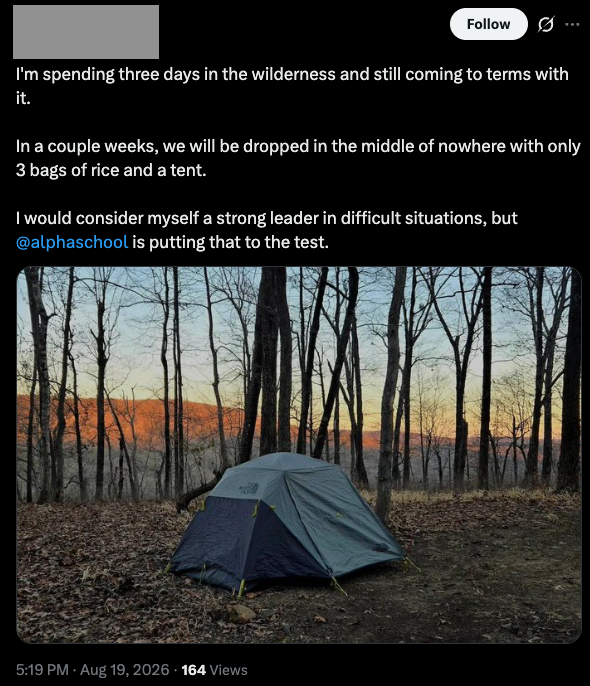
Other challenges abound, like a requirement to complete an entire unit of a standard Advanced Placement course without a teacher — AI chatbots only — and pass an exam within just five days. One 14-year-old student wrote that they were required to survive for three days in an unfamiliar section of wilderness “with only 3 bags of rice and a tent.”

Screenshot of a post on X-formerly-Twitter by a student at Alpha School, whose name and handle have been anonymized. The post contains an image of a small tent in the wilderness.

Contacted by Riley for comment, Alpha School flipped the script, hounding the writer for daring to report on the “social media activity of minor children.”

“We ask that you weigh the ethics of identifying minors in this way in your reporting, and we expect any published piece to protect their identities,” an Alpha School representative said.

Responding to Riley’s story, educator and writer Audrey Watters said that “Alpha School’s promises have always been mostly snake-oil: this idea that artificial intelligence can deliver high-speed, high-quality education is mostly the stuff of science fiction, not reality.”

“What we witness with Alpha School isn’t a matter of simply ignoring the weatherman, fingers-crossed hoping that the sun will continue to shine on the chosen few and that the winds will shift again in industry’s favor,” Watters continued, referring to rising outrage against AI, and the Silicon Valley-ethos underlying Alpha School’s mission. “Rather, it’s pretty clear that there’s an absence of any moral compass at all.”

More on AI in education: The Results of Middle and High School Students Using AI Are Extremely Ominous

The post AI School Hooking Children Up to Heart Monitor in Front of Class While Playing Critiques of Their Work appeared first on Futurism.

  •  
❌