❌

Reading view

A New Cold War Is Unfolding in Orbit as China Advances Satellite Surveillance

Chinese scientists at the Beijing Institute of Technology have run satellite proximity simulations to extend potentially hostile observation of U.S. space assets in Geostationary Earth Orbit (GEO), seemingly inching both countries closer to a potential war in space.

Although the new simulations focus on orbital adjustments to extend observation times and increase proximity to U.S. satellites, including critical missile warning and other space defense-oriented systems, Chinese scientists also plan to integrate reinforcement learning methods into future space assets to give satellites even more independence from human operators.

Study Includes Accusations of Cold War in Space Activities

In the 20th century, the concept of war in space remained mostly in the realm of science fiction, as depicted in popular films like Star Wars. Today, advances in space access, orbital maneuvering technologies, and weapons systems have made the possibility of a future conflict in space a very real security concern, and several nations engage in espionage using reconnaissance spacecraft to obtain information on valuable defense targets in Earth’s orbit.

According to the authors of the new study, “acquiring multi-aspect payload information of non-cooperative targets to infer their functions and mission statuses is of great significance for space security assessment.”

The study authors highlight a series of relative motion configurations that modern spy satellites employ, including fly-around, hovering, and drifting flight. They also point to real-world “adversarial” U.S missions they suggest were designed to gather intelligence on their GEO defense assets.

“Since 2014, the US GSSAP (United States Geosynchronous Space Situational Awareness Program) satellite has carried out hundreds of maneuvers and has conducted close observation operations on dozens of normally working satellites near GEO orbit,” the Beijing University of Technology scientists write.

The study authors also include a specific July 2021 accusation, where they charge that “the U.S. satellite ‘USA-271’ deliberately approached the operational ‘Practice 20’ satellite in geostationary orbit and flew in close proximity.”

In an email to The Debrief, a U.S. Space Command Spokesperson did not address the specific incident or the accusations of “dozens” of similar operations, but offered some insight into the agency’s thinking.

“USSPACECOM, working with allies and partners, plans, executes, and integrates military spacepower into multi-domain global operations in order to deter aggression, defend national interests, and when necessary, defeat threats,” the spokesperson told The Debrief, adding that “we have nothing additional to add in response to the article.”

Getting Closer to Adversarial Satellites and Extending Observation Time

In a step toward potential dogfights between satellites, the Chinese scientists looked at several challenges faced by current spy satellites.

For example, they explain, since most spacecraft observation cameras are mounted in a fixed position, “frequent large-angle attitude maneuvers are time-consuming and consume substantial fuel.” The researcher also noted that several different angles and approaches could yield different categories of intelligence data.

However, changing angles and orbital planes requires fuel, an extremely limited resource in GEO. Therefore, the researcher accounting for all the variables required to gather intelligence on adversarial spacecraft as efficiently as possible “has become a key bottleneck in enhancing space situational awareness capabilities.”

To find an optimized solution, the team designed what they called a “waypoint trajectory planning scheme” and a “multi-impulse maneuver strategy” using a common game-theory tool called “minimum integral squared control” theory. Unlike previous research aimed at extending spy satellite observation time and fuel efficiency, the Chinese scientists said their use of sequential coalition game theory “is introduced for the first time into the multi-model combined observation problem.”

Next, the researchers designed a “game tree.” A press release said this approach lets the spacecraft select the “optimal combination of initial motion points and close-range operation models at each stage under minimum fuel constraints, thereby generating an optimal observation strategy sequence.”

Finally, the researchers ran simulations to see whether their approach improved sensor observation times and field of view while reducing fuel use.

Successful Simulations and Future Reinforcement Learning Plans

As hoped, the Beijing University of Technology team said their simulations supported the theories. Specifically, the study authors said the simulations showed that their spacecraft efficiency algorithm “can successfully generate a multi-model combined observation strategy sequence under minimum fuel constraints.”

“The effective observation time increases with larger observation distances and field-of-view angles, and reducing the model configuration size also contributes to improved observation performance,” they explained. The study authors also said that the simulation results “demonstrate that the algorithm can successfully generate the optimal combined observation sequence under minimum fuel constraints.”

When discussing next steps, the Chinese scientists said they will explore optimal initial points to further improve maneuver efficiency. They also plan to explore a “reinforcement learning method,” suggesting future spacecraft could learn and adapt to evolving conditions to further enhance their cold war in space information-gathering capabilities.

Study’s War in Space Implications “Extends Beyond any Single Algorithm”

To understand the potential implications of the Chinese study, including its impacts on a potential future war in space, The Debrief reached out to former U.S. Air Force officer Shelli Brunswick, CEO and Founder, SB Global LLC.

According to the author and futurist, the Chinese team’s research matters not just because it proves China has deployed a “new operational surveillance capability.” Instead, Brunswick said that the work is significant because it “illustrates how sophisticated coordination and optimization could make spacecraft observation more efficient, persistent, and strategically useful.”

The Blue Marble Space Visiting Scholar also told The Debrief that the work “should not be interpreted as demonstrating a complete pursuit-and-evasion capability against a spacecraft that is actively responding,” since the work assumes a stationary target without maneuvering capabilities. Still, Brunswick noted, the Chinese framework “shows how game-theoretic planning could help an observing satellite gather information from multiple angles while managing limited resources.”

When discussing the potential implications for the broader U.S.-China space-security competition, including how such enhanced spacecraft could lead to more activities that could be construed as hostile, the space strategist said this area of research “extends beyond any single algorithm.”

“As rendezvous and proximity operations become more sophisticated, the line between inspection, space situational awareness, intelligence gathering, and potentially threatening behavior becomes increasingly difficult to interpret,” she explained.

When suggesting what potential strategic responses the U.S. and its allies might employ in the emerging cold war in space, Brunswick told The Debrief that they should include “more resilient architectures, improved space-domain awareness, clearer expectations for close approaches, stronger communication mechanisms, and deeper coordination with commercial and international partners.”

“The challenge is not simply detecting another spacecraft—it is understanding capability and intent early enough to respond responsibly and effectively,” Brunswick explained.

The study “Spacecraft Proximity Operation Model-Based Sequential Coalitional Observation Game Strategy Design” was published in Space: Science & Technology. 

Christopher Plain has spent the last six years as Associate News Editor and Head Science Reporter at The Debrief. Follow and connect with him on X, learn about his novels at plainfiction.com, or email him at christopher@thedebrief.org.


  •  

Here's what we know about the "space academy" Trump just announced

During a visit to Johnson Space Center, President Trump on Friday signed an executive order to establish a new commission with the purpose of creating the first national space academy.

"It's clear that we will need to educate and train an entire generation of skilled service members, engineers, and civil operators, and everything else to do what we have to do," Trump said. "I will sign an executive order to begin the process of creating a new national academy. It's called the US Space Academy. That's a big deal."

The proposed United States Space Academy would fall under the jurisdiction of NASA, and according to US space officials, is not intended be a traditional service academy in the sense that it educates and trains officers for the armed services, such as the Air Force Academy.

Read full article

Comments

© Kent NISHIMURA / AFP via Getty Images

  •  

Rocket Lab Unveils ‘GHOST,’ a Game-Changing New Portable Launch System That Can Carry Payloads to Orbit from Anywhere on Earth

Private space launch services company Rocket Lab has unveiled its GHOST (Global Hypersonic & Orbital Spaceport Technology) self-contained mobile launch system, capable of placing payloads in orbit or enabling suborbital launches from virtually anywhere on Earth.

Designed to accommodate the company’s Electron and HASTE rockets, the company said GHOST’s “launch-anywhere, launch-anytime” capability can support multi-launch flight campaigns for commercial applications. Rocket Lab said the system’s versatility also offers benefits for “critical” national security missions.

GHOST Private Space Launch System Fits Into Standard Shipping Containers

In science fiction, rockets can launch spacecraft from just about anywhere. However, until recently, most launches have occurred at dedicated, government-owned and operated facilities. Even the relatively recent proliferation of private launch services companies promising cheaper, faster alternatives hasn’t reduced the need for a launch facility specially designed to send rockets into orbit.

Now, Rocket Lab says the company has created an all-in-one launch solution called GHOST that can accommodate rocket launches from seemingly anywhere.

For example, when announcing the formal unveiling of GHOST, the company said the entire system can be packaged in standard shipping containers. This includes all the hardware to launch complete rockets and the ground support infrastructure needed to complete single-launch missions or multi-launch campaigns.

Perhaps most critically, the system can be shipped to any destination for customized launch services worldwide. If the already scheduled real-world inaugural launches prove the claims, that launch-location versatility could give Rocket Lab a technological edge over its private space launch competitors.

Two New Alaska Launch Pads Will Provide the System its First Real-World Test

When unveiling GHOST, Rocket Lab also announced its first launch site. Dubbed Rocket Lab Complex 4, GHOST’s new home will be at the Pacific Spaceport Complex at Kodiak, Alaska. The company said this inaugural site will include two distinct launch pads for “high-frequency launch campaigns.”

The new site will join the already operational Launch Complex 1 in New Zealand and Launch Complexes 2 and 3 in Virginia. The company said that taken together, Rocket Lab now controls six total launch pads “across two hemispheres.” Along with its reported mobility, the company emphasized GHOST’s ability to accommodate both Electron and HASTE.

“GHOST delivers a dual-launch capability across new locations, allowing Rocket Lab to expand the mission profiles of both vehicles and meet increasing international demand for orbital and suborbital sovereign launch capability,” the company explained.

Rocket Lab also said that the mobile launch platform is “purpose-built to support responsive launch needs and time-critical national security missions, enabling rapid site activation and simultaneous launch possibilities.”

The company expects to conduct its first GHOST-supported launch from Launch Complex 4 in 2027, including launches announced in July for the U.S. Space Force.

“The size and scale of this contract reflects the Space Force’s confidence in our ability to meet their urgent national security demands with speed, responsiveness, and scale, and we’re proud to provide the high-frequency launch capacity required to keep the U.S. ahead of global threats,” company CEO Sir Peter Beck said at the time of the announcement.

“Leading the Field in Small Launch for Missile Defense and National Security”

After noting that Rocket Lab has been “leading the field in small launch for missile defense and national security for years,” Sir Beck heralded GHOST’s seemingly sci-fi-sounding ability to launch a rocket into space from virtually anywhere in the world as another example of the launch service reliability and repeatability.

“Creating GHOST is about packaging that up into a deployable system that can serve the world’s most important programs from wherever those missions need,” Sir Beck said. “Whether it’s for missile defense and deterrence, or opening up more trajectories, orbital missions, and sovereign launch capabilities in allied nations, GHOST is the answer to launching anywhere, anytime, and without compromise.”

Christopher Plain is a Science Fiction and Fantasy novelist and has spent the last six years as Associate News Editor and Head Science Writer at The Debrief. Follow and connect with him on X, learn about his books at plainfiction.com, or email him at christopher@thedebrief.org.

  •  

Inside the effort to show Congress what war in space looks like

The Space Force Association’s National Spacepower Center is building an unclassified environment for demonstrating threats to satellites and their consequences on Earth

The post Inside the effort to show Congress what war in space looks like appeared first on SpaceNews.

  •  

Space Force-backed mission does its best impression of Top Gun in orbit

An ongoing military exercise happening hundreds of miles above Earth has—for the first time in an unclassified setting—demonstrated how future satellites might evade and pursue one another in a future conflict.

That was the announcement Wednesday from True Anomaly, one of the companies involved in the exercise. True Anomaly's Jackal satellite, also known as Panther, played the cat-and-mouse game with another spacecraft named Puma, based on Rocket Lab's Pioneer satellite platform.

"This is what we've really been building towards for the past four years," said Even Rogers, True Anomaly's co-founder and CEO.

Read full article

Comments

© Rocket Lab

  •  

Space Force awards All Points $250 million to expand satellite processing at Vandenberg

All Points Logistics is the third company selected under a Commercial Solutions Opening to add facilities where satellites can be inspected, tested, fueled and prepared for integration with launch vehicles

The post Space Force awards All Points $250 million to expand satellite processing at Vandenberg appeared first on SpaceNews.

  •  

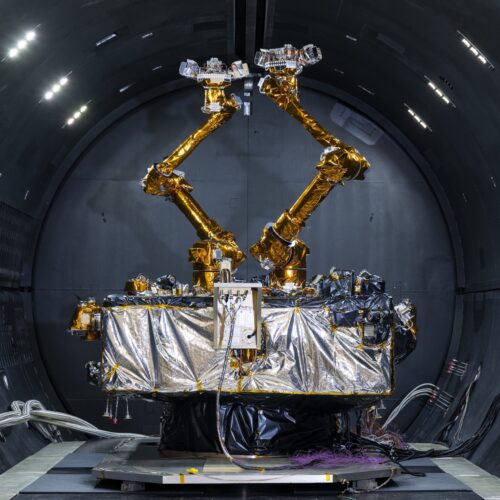
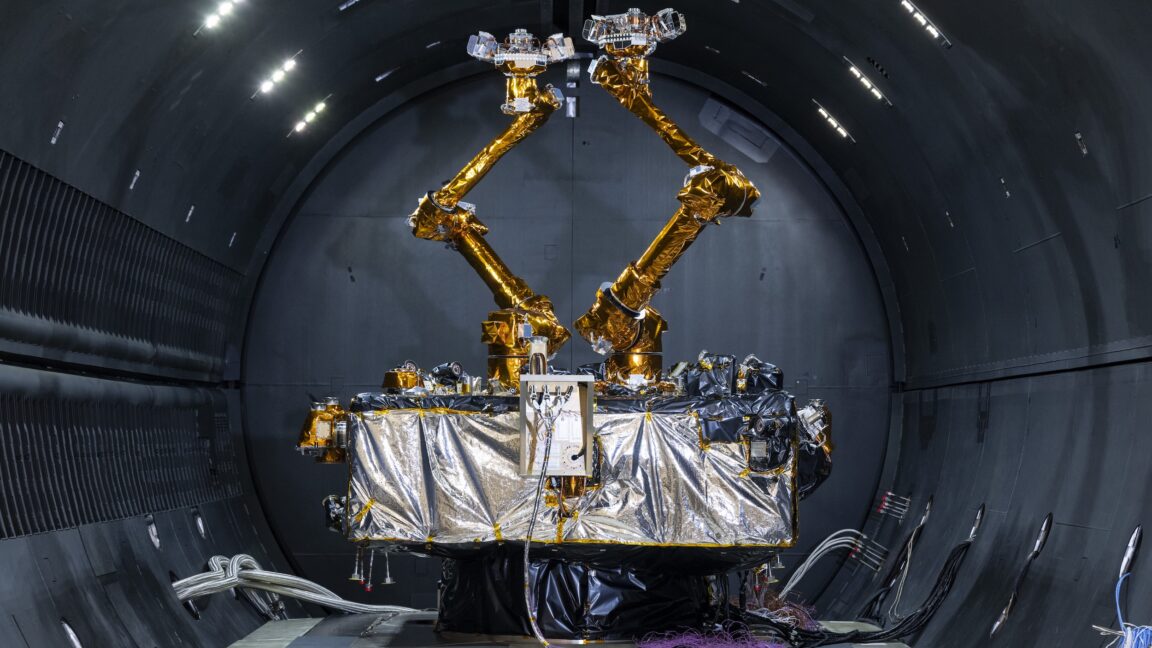
This is the world's most advanced robotic servicing satellite—that we know about

A spacecraft fitted with two flexible robotic arms is on the way to geosynchronous orbit after launching earlier this week on a SpaceX Falcon 9 rocket, kicking off a planned decade-long mission to open new frontiers in satellite servicing.

The Mission Robotic Vehicle, owned and built by Northrop Grumman, rocketed into orbit from Cape Canaveral Space Force Station in Florida on Tuesday. Three small propulsion pods, each functioning as standalone spacecraft, accompanied the MRV aboard the Falcon 9 rocket.

The Falcon 9 deployed all four payloads within about an hour of liftoff. It will take about a year for the satellites to maneuver from their initial elliptical drop-off orbit into a circular orbit more than 22,000 miles (nearly 36,000 kilometers) over the equator. At this altitude, the MRV and the three Mission Extension Pods (MEPs) will travel in lockstep with Earth's rotation, operating in the same kind of orbit as numerous civilian and military communications satellites, missile warning platforms, and a growing number of spy satellites.

Read full article

Comments

© US Navy/Sarah Peterson

  •  

U.S. Space Development Agency Orders 36 Space Vehicles for Defense Against Missile Attacks

The United States Space Development Agency (SDA), in support of the U.S. Space Force, has awarded contracts to L3Harris Technologies and Sierra Space Corporation to build and deliver 36 Accelerated Missile Defense Tranche 3 (AMDT3) space vehicles (SVs) designed to operate in four distinct orbital planes.

Part of the Tracking Layer for Tranche 3 of the Proliferated Warfighter Space Architecture (PWSA), the space vehicles will support the White House’s space-based segment ‘Golden Dome for America’ antimissile defense system to expand the country’s missile tracking and defense network, with a projected delivery date of 2028.

36 Space Vehicles Orbiting in Four Separate Planes Will Aid Missile Defense

According to a statement announcing the awards, the 36 space vehicles will operate across four separate orbital planes. Half of the vehicles covering two of the four orbital planes will be made by Sierra Space Corporation. The statement from the SDA describes the vehicles as “missile warning/missile tracking” SVs loaded with specialized sensor packages. An official at the SDA speaking on background told The Debrief that the details of the sensor technologies and capabilities are not available at this time.

The second half of the vehicle order covering the other two orbital planes will be made by defense technology company L3Harris Technologies. Their award calls for 18 Hypersonic and Ballistic Tracking Space Sensor (HBTSS)-like missile defense variant SVs.

When The Debrief asked the SDA for clarification on the term “variant” space vehicles, the official explained that this designation represents the different types of sensor packages that each company will provide. For the L3Harris award, the SDA explained that their sensor is an advancement on earlier work performed with the Missile Defense Agency under the Hypersonic and Ballistic Tracking Space Sensor (HBTSS) program.

Infrared Sensors Will Integrate with a Low-Latency Communication Network

When discussing the significance of the twin awards, the SDA said their deployment will expand the company’s missile defense sensing established in previous phases “in support of homeland defense and theater defense.”

“Each AMDT3 SV will be interoperable with all SDA Tranche 1, Tranche 2, and Tranche 3 SVs and will operate in an integrated fashion through a common ground system,” the statement explained.

They also note that the tracking layer is equipped with infrared sensors “that will integrate with a low-latency communication network.”

“With these awards, SDA is accelerating the deployment of the Tracking Layer to provide the homeland, our deployed forces, and allies with global, persistent indications, detection, identification, warning, tracking, and defense against advanced and evolving missile threats,” explained G.P. Sandhoo, Space Force Portfolio acquisition executive for Missile Warning and Tracking and SDA director. “AMDT3 expands upon SDA’s previous and current Tracking Layer generations — Tranches 1, 2 and 3 — marking another milestone in delivering a resilient, global missile warning, missile tracking, and missile defense capability.”

Future Satellites Will Offer Even Greater Capability to the Warfighter

Although a specific delivery date for each of the company’s separate awards was not made public, the announcement did say they are expected to be available for launch “by the end of 2028.” Once aloft and in their respective orbital planes, the missile tracking and defense space vehicles will be operated and maintained by the U.S. Space Force.

When asked by The Debrief if there are any plans to add capabilities beyond detection and tracking to the multi-layer system in the future, the SDA said future improvements are one of the main pillars of the organization’s business model.

“We use spiral development to deliver new generations of satellites (we call them “tranches”) every few years,” the SDA explained. “Each new tranche represents an enhancement over the previous and offers greater capability to the warfighter, either through additional sensing coverage, or through technology advances (or potentially both).” 

Christopher Plain is a Science Fiction and Fantasy novelist and has spent the last six years as Associate News Editor and Head Science Writer at The Debrief. Follow and connect with him on X, learn about his books at plainfiction.com, or email him at christopher@thedebrief.org

  •  

Next Space Force chief throws cold water on the idea of space privateers

In the early years of the United States, when the nascent US Navy was still getting its sea legs, several presidents used privateers to capture or destroy enemy warships when armed naval vessels were unable to do so.

President John Adams was one of the most vigorous proponents of commissioning private vessels for national ends. His administration issued letters of marque and reprisal during the so-called "Quasi-War" with France in the final years of the 18th century. These letters created the legal distinction between privateering and piracy.

One of the letters signed by Adams, dated November 1799, authorized the use of a merchant ship to "subdue, seize, and take any armed French vessel" found near US coastal waters of "elsewhere on the high seas." France also routinely used privateers against US shipping at the time.

Read full article

Comments

© MPI/Getty Images

  •  

The Space Force is now seeking to buy up to $30 billion in rocket launches

It seems as though $5.6 billion wasn't enough. That was the news from the US Space Force on Friday, when military officials announced they were tripling the maximum value of one of the service's National Security Space Launch contracts to $17 billion.

The expansion of the Space Force's National Security Space Launch (NSSL) Phase 3 contract comes as the Pentagon signals rising demand for military satellite launches. The NSSL program is set up to allow Space Systems Command, which oversees the Space Force's launch program, to select from a pool of launch providers for individual missions to deliver the military's satellites to orbit.

The NSSL program has two parts. Lane 1 covers the Space Force's more risk-tolerant missions, such as medium-lift launches with experimental payloads or rideshare missions carrying satellites for the Pentagon's surveillance or data relay constellations. Lane 2 includes higher-priority strategic missions, like the government's largest and most expensive spy satellites, or radiation-hardened communications satellites designed to survive a nuclear war.

Read full article

Comments

© SpaceX

  •  
❌