❌

Reading view

What to know about using AI chatbots for therapy

When you’re feeling sad, angry or stressed, it might be tempting to ask a chatbot for help. In fact, a new survey of 12- to 21-year-olds showed that nearly 1 in 5 of them had turned to AI for mental health support. That’s up from 1 in 8 just a couple years ago.

It’s perhaps not surprising that many teens and young adults are seeking advice. In 2023, a whopping 40 percent of high school students said they felt so sad or hopeless that they couldn’t engage in activities that are normal for them. In 2024, 15 percent of 12- to 17-year-olds had a major depressive episode — many without treatment.

Clearly, there is a big need among young people for mental and emotional support. But as lifelike as they might sound in conversations, chatbots aren’t real people with empathy. And free, general-use chatbots such as ChatGPT, Meta AI and Character.AI weren’t built to support mental health. They don’t earn licenses to offer therapy — or follow rules for treating patients — the way humans do.

So, what should teens know before using AI tools for mental health advice? Science News Explores asked the experts.

an illustration showing a boy laying on his stomach on a sofa and looking at a tablet
“There absolutely are positive use cases for using even general-purpose [chatbots] to learn more about mental health,” says psychologist Vaile Wright. These tools can help you search for information on mental health conditions and find resources. (Just be sure to double-check a chatbot’s answers.)Malte Mueller/fStop/Getty Images

Should AI ever be used for mental health help?

A chatbot could help you learn more about mental health issues, says Vaile Wright. A psychologist in Chicago, Ill., she works with the American Psychological Association.

You could use AI to search for information about mental health conditions and resources online, Wright suggests. (Just be sure to double-check its findings. Chatbots sometimes make stuff up.) An AI might even be able to offer “some basic advice if you’re struggling in the moment and don’t know where else to turn,” Wright says.

Treating a chatbot like a therapist, though, is not wise. “It’s really when you’re having these multi-turn, very extended types of conversations where you’re using the chatbot to fill some sort of emotional gap in your life,” Wright says, that you enter risky territory.

Why doesn’t a chatbot make a good therapist?

A real therapist’s goal is to help their patient. Chatbots are different. “They’re purposely engineered to keep people on the platform for as long as possible,” Wright says. “The way they do that is by being exceedingly validating and just telling people exactly what they want to hear.” That might feel good. But it’s not what a therapist would do. And it’s not likely to give you useful advice.

“A therapist is going to validate somebody’s feelings,” Wright says. “But it’s also our role to point out where … someone’s acting, thinking or feeling in ways that’s not maybe helpful to them.”

Plus, a chatbot doesn’t have the same types of information a therapist does, says Darja Djordjevic. She’s a psychiatrist at Stanford University in California. “AI was built to have this encyclopedic knowledge,” she says. “But it doesn’t understand the context of people’s lives.” That well-rounded knowledge of a person is key to aiding their mental health.

What are the risks of treating chatbots like therapists?

“They do not handle any mental health crises or emergencies well,” says Djordjevic. She has studied how AI systems would respond to users with a variety of mental health conditions, such as self-harm, anxiety and eating disorders.

“The models really don’t do a good job of recognizing … situations that would warrant human intervention,” Djordjevic says. “Unfortunately, we have some very tragic, more extreme cases [showing this] that involve young people.” Take Adam Raine, 16, of California. He died by suicide last year after discussing his suicidal thoughts with ChatGPT.

Djordjevic notes how crucial human connection is. “We have very little research right now on what the long-term effects of using AI for mental health would be,” she says. “What we do have a lot of research on is how much social connection and human contact are important for health and flourishing. So we know what’s good for us.” Leaning on AI might get in the way of forming crucial connections with real people.

There also are privacy risks to using AI, adds Wright. “Everything [you] put in these apps is not private. All the chats are maintained.” If a chatbot were hacked, someone else might be able to read your sensitive conversations with a bot.

a woman and a teen girl sit on a sofa, the girl is hugging a pillow and looks very sad. The woman looks concerned and supportive.
A chatbot might be able to help you brainstorm ideas for how to ask a trusted adult for mental or emotional support. Frants Tsyvinskyi/iStock/Getty Images Plus

Any advice for seeking mental health help from people, not chatbots?

“It doesn’t have to be an either-or,” Wright says. “You could use the chatbot to say, ‘I’m nervous about approaching my dad about my concerns. How could I do it?’… Using the chatbot as a tool to connect with human relationships in real life, I think, is probably one of the most impactful things that this technology can do.”

Djordjevic notes that most schools have a counselor students can talk to. The National Alliance for Mental Illness also has lots of resources on its site, she adds. This includes a free, confidential helpline for teens.

Sometimes, it might seem easier or less embarrassing to ask a computer about mental-health issues than a real person. In the new survey, almost two-thirds of young people who used chatbots for mental health didn’t tell anyone they were doing it.

But for anyone nervous about seeking human help: Fear not, Djordjevic says. “A lot more adults and people around you have struggled at some point or struggle with mental health issues than you think.”

Suicide was the third leading cause of death among U.S. teens ages 15-19 in 2024. If you or someone you know is suffering from suicidal thoughts, please seek help. In the United States, you can reach the Suicide Crisis Lifeline 24/7 by calling or texting 988 or chat at 988lifeline.org. Please do not suffer in silence.


  •  

King cobras may be riding trains across India [COMIC]

Dikansh S. Parmar rescued a snake for the first time in middle school. It happened at his karate class in Surat, India. Someone spotted a baby cobra among a nearby pile of construction materials and wanted to kill it. But Parmar stopped them. His dad had rescued snakes, and he had a rough idea what to do. He took a rod from the construction site and used it to coax the baby snake inside a water bottle.

Parmar was lucky. The snake didn’t harm him. And people without proper training shouldn’t approach snakes. But this encounter inspired him to become a trained snake rescuer as a teen. Parmar is now also a herpetologist who studies snakes. He works at the Leibniz Institute for the Analysis of Biodiversity Change in Bonn, Germany. Recently, Parmar combined his snake rescue and science knowledge to discover something curious about his favorite snakes: king cobras.

Western Ghats King Cobras (Ophiophagus kaalinga), his team found, might ride trains across the Indian state of Goa. Parmar and his colleagues shared their evidence for this January 26 in Biotropica.

illustrated text reads "Wild Things: A graphic tale" with animals drawn around the letters
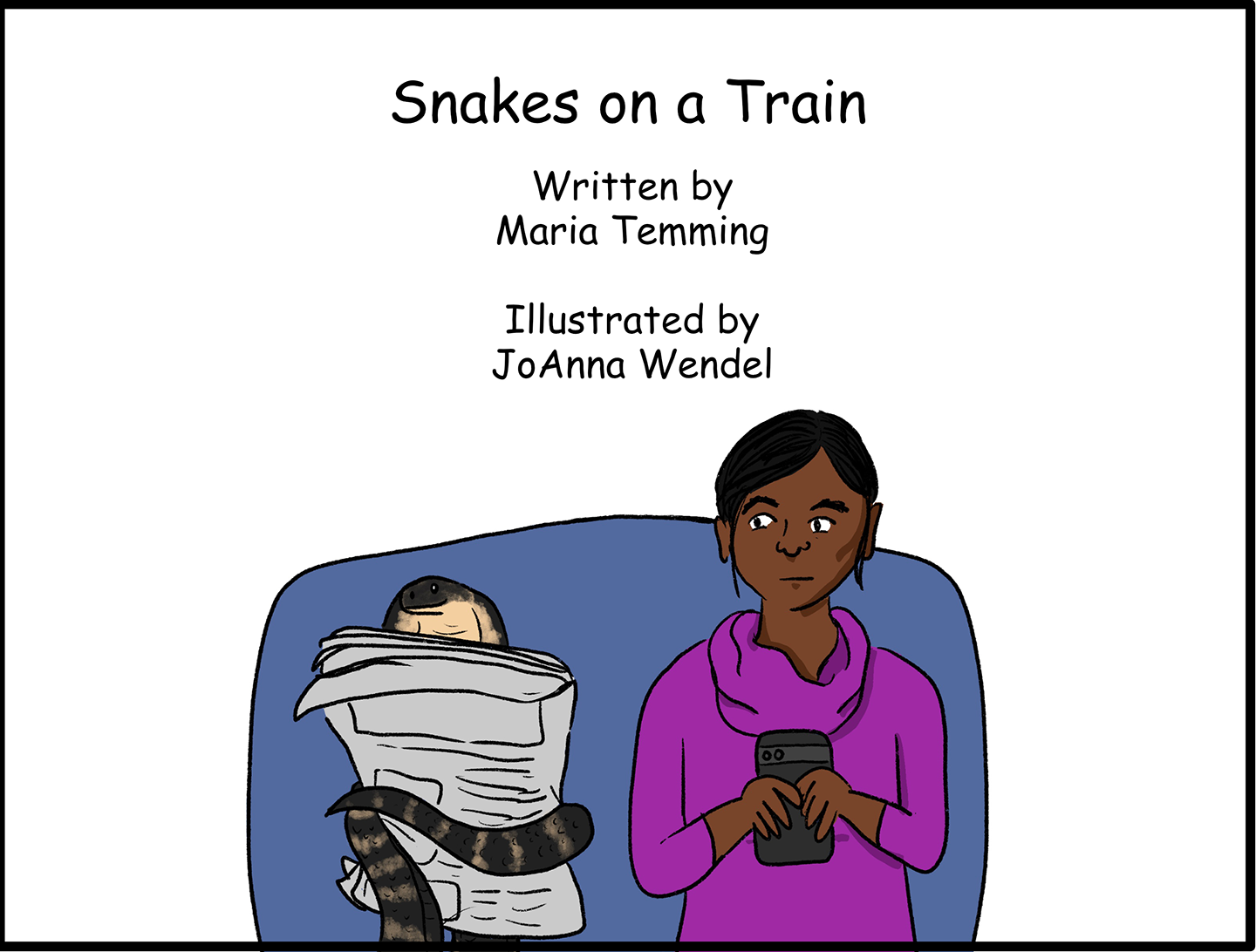
Text: Snakes on a Train. Written by Maria Temming. Illustrated by JoAnna Wendel. Image: A woman sitting on a train looks up from her phone to side-eye the passenger sitting beside her — a snake that is reading a newspaper.
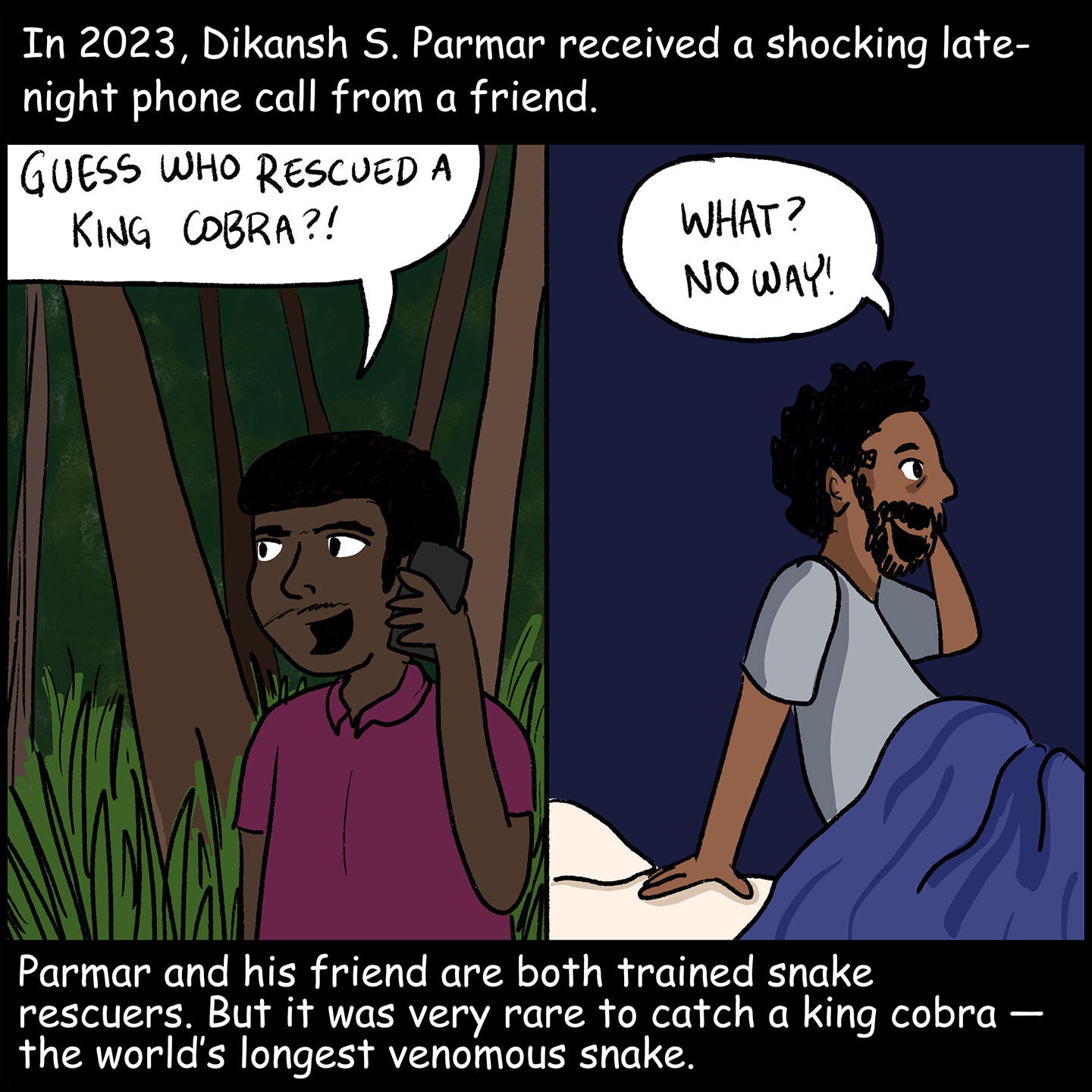
Text (above images): In 2023, Dikansh S. Parmar received a shocking late-night phone call from a friend. Image (left): A man in a forested area is on the phone. He says, “Guess who rescued a king cobra?!” Image (right): A man sits up in bed, holding a phone to his ear. He says, “What? No way!” Text (below images): Parmar and his friend are both trained snake rescuers. But it was very rare to catch a king cobra — the world’s longest venomous snake.
Text (above image): Western Ghats King Cobras are found in the Indian state of Goa, where Parmar’s friend lived. But these snakes are not known to live in his village of Chandor. Image: A map of India shows the state of Goa on the western coast. A map of Goa shows the village of Chandor slightly left to the center of the state. Text (below image): Parmar studies snakes at the Leibniz Institute for the Analysis of Biodiversity Change in Bonn, Germany. Intrigued by the rogue king cobra, he traveled to Chandor to see where it had been found.
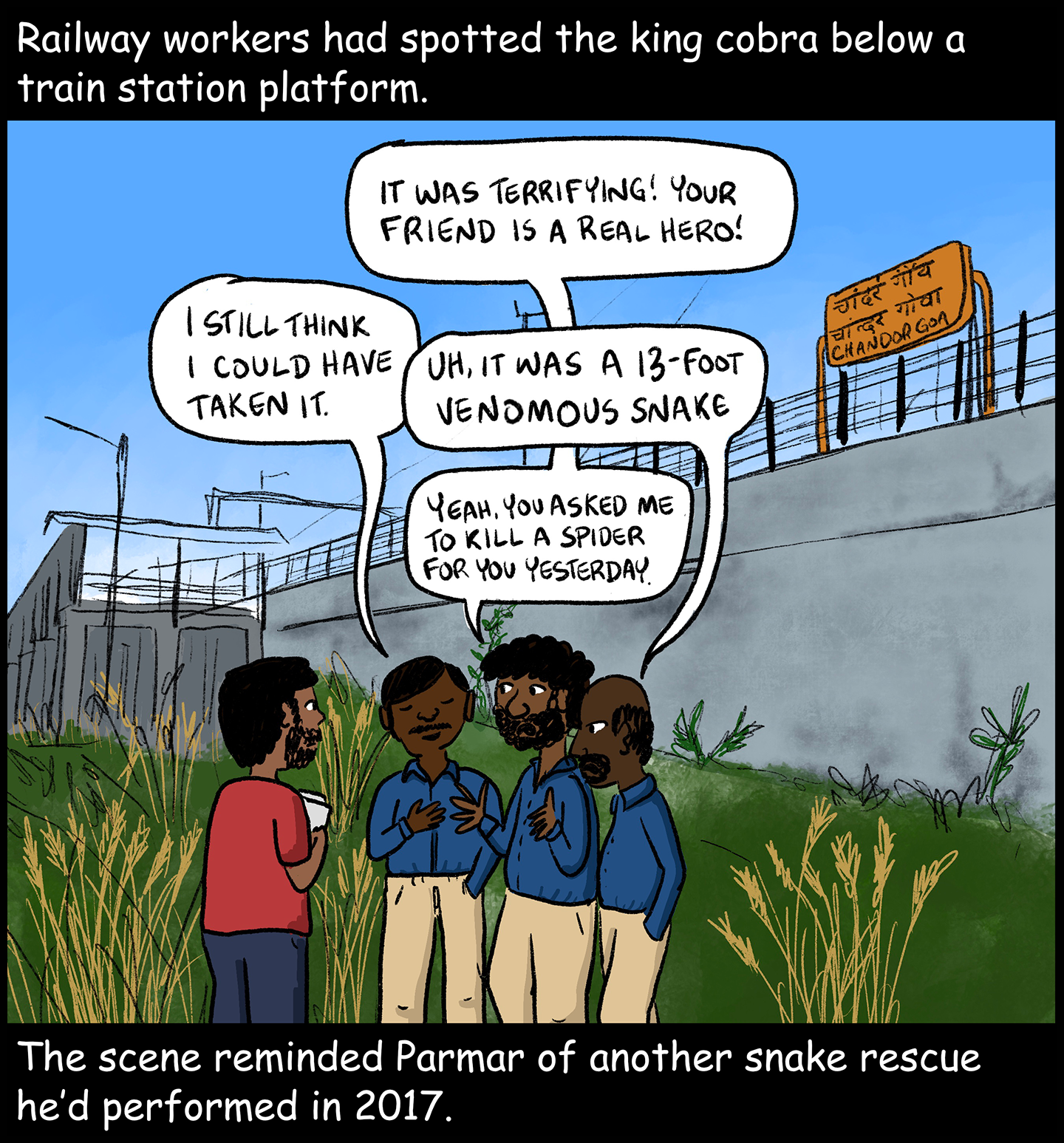
Text (above image): Railway workers had spotted the king cobra below a train station platform. Image: Parmar stands with a notebook and pen with a group of railway workers. The group are standing in a grassy area below a train station platform. A sign beside the platform reads, “Chandor, Goa.” Railway Worker 1 says to Parmar: “It was terrifying! Your friend is a real hero!” Railway Worker 2 says: “I still think I could have taken it.” Railway Worker 3 says: “Uh, it was a 13-foot venomous snake.” Railway Worker 1 says: “Yeah, you asked me to kill a spider for you yesterday.” Text (below image): The scene reminded Parmar of another snake rescue he’d performed in 2017.
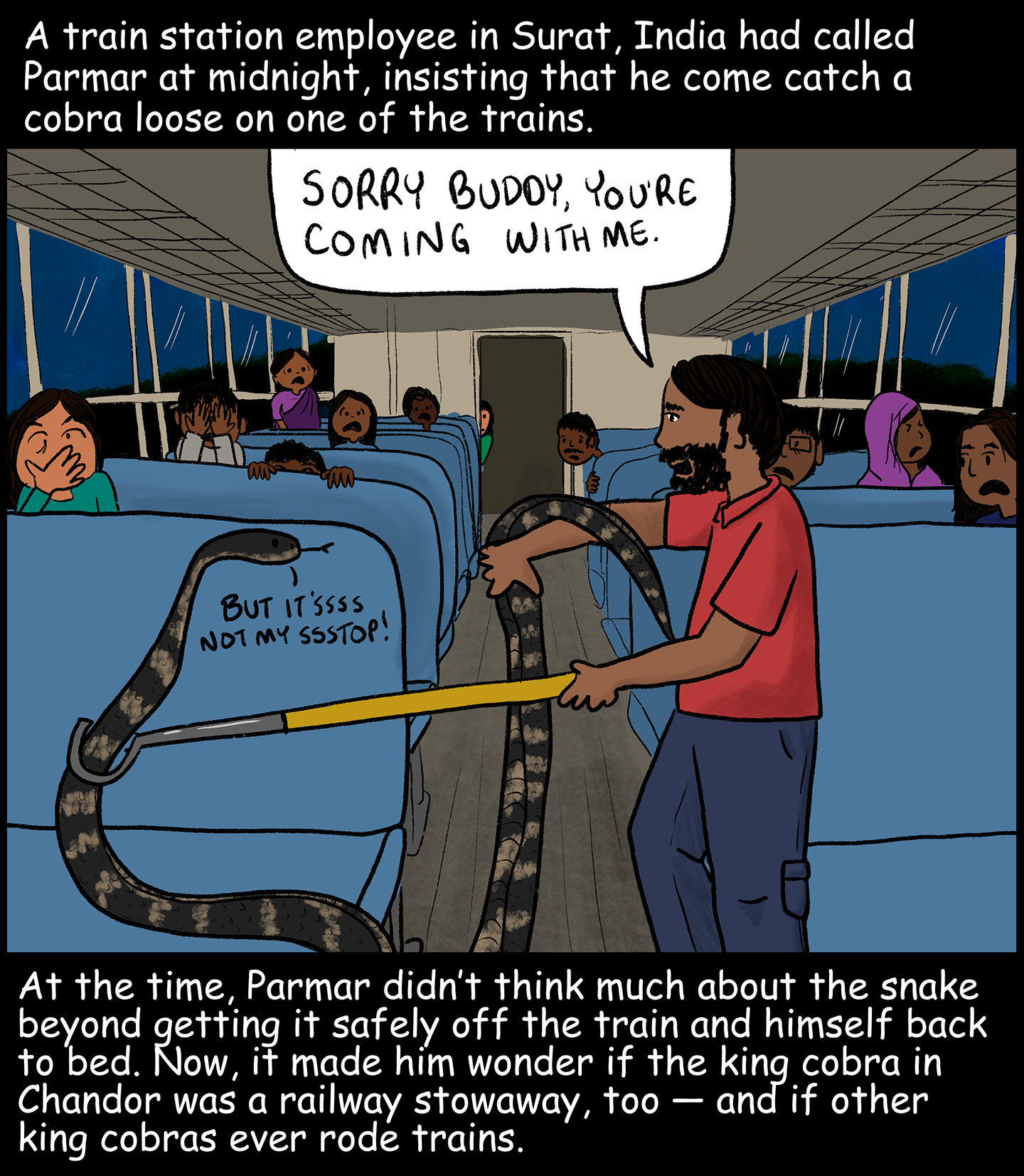
Text (above image): A train station employee in Surat, India, had called Parmar at midnight, insisting that he come catch a cobra loose on one of the trains. Image: Parmar grabs the tail of a snake sitting on the seat of a crowded train car. Parmar says: “Sorry buddy, you’re coming with me.” The snake says: “But it’s not my stop!” Text (below image): At the time, Parmar didn’t think much about the snake beyond getting it safely off the train and himself back to bed. Now, it made him wonder if the king cobra in Chandor was a railway stowaway, too — and if other king cobras ever rode trains.
Text (above image): Parmar and his colleagues made a map of where Western Ghats King Cobras had been rescued across Goa from 2002 to 2024. Almost all had been found near their preferred habitats: cool, rainy forests. Image: A map of Goa shows where the most suitable king cobra habitats exist in the state. The eastern half of the state contains more suitable habitats than the western half. Black lines show where rail lines cut across the state, and red dots near some of those lines show where king cobras have been rescued. Text (below image): But five king cobras had been found near Goa’s more arid western coast — all a short distance from railroad tracks.
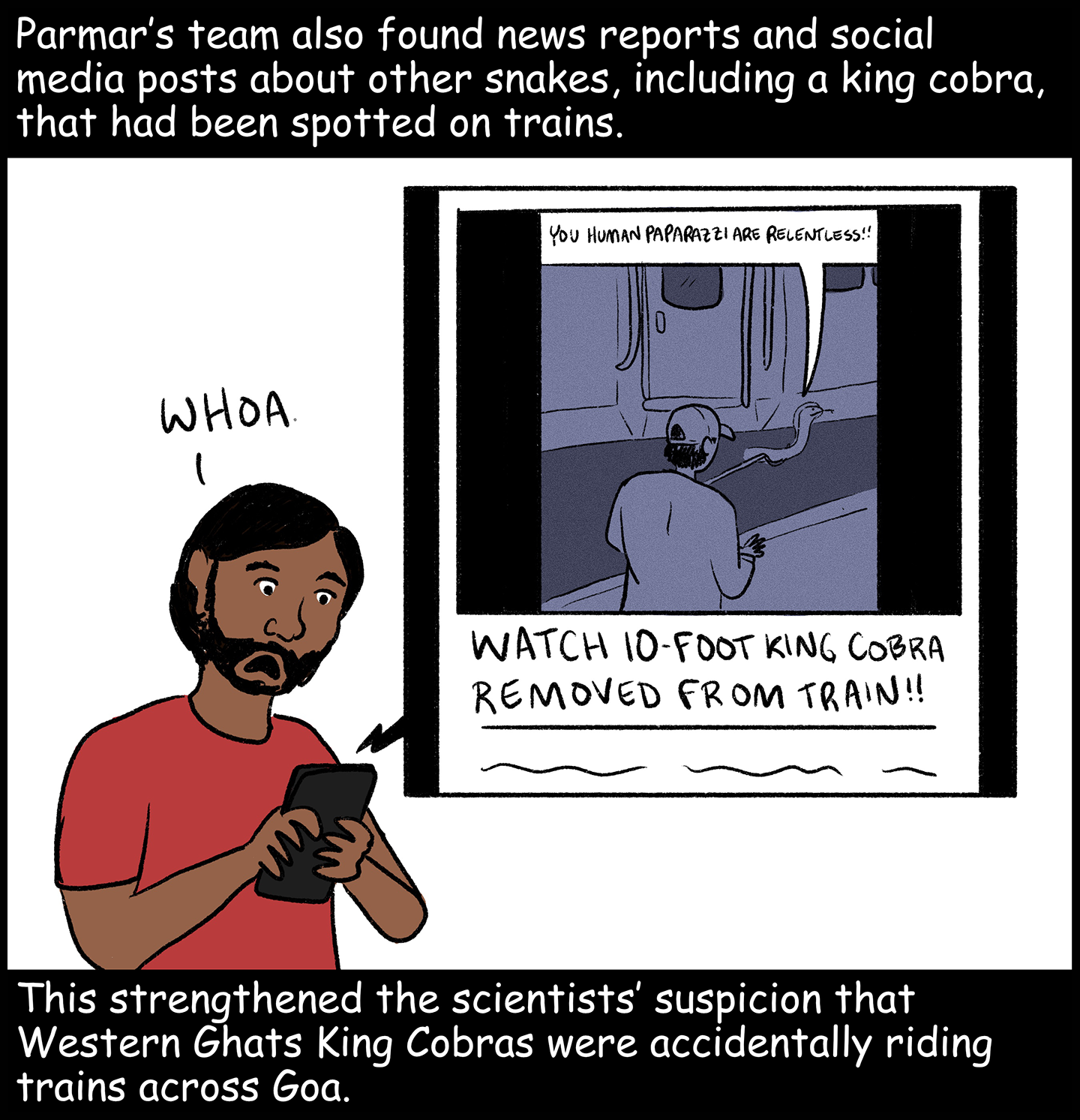
Text (above image): Parmar’s team also found news reports and social media posts about other snakes, including a king cobra, that had been spotted on trains. Image: Parmar looks down at his phone and says, “Whoa.” A news report with a video is on the phone’s screen. The news headline reads: “Watch a 10-foot king cobra removed from a train!” A video accompanying the report shows a railway worker trying to take a snake off a train car. The snake says, “You human paparazzi are relentless!” Text (below image): This strengthened the scientists’ suspicion that Western Ghats King Cobras were accidentally riding trains across Goa.
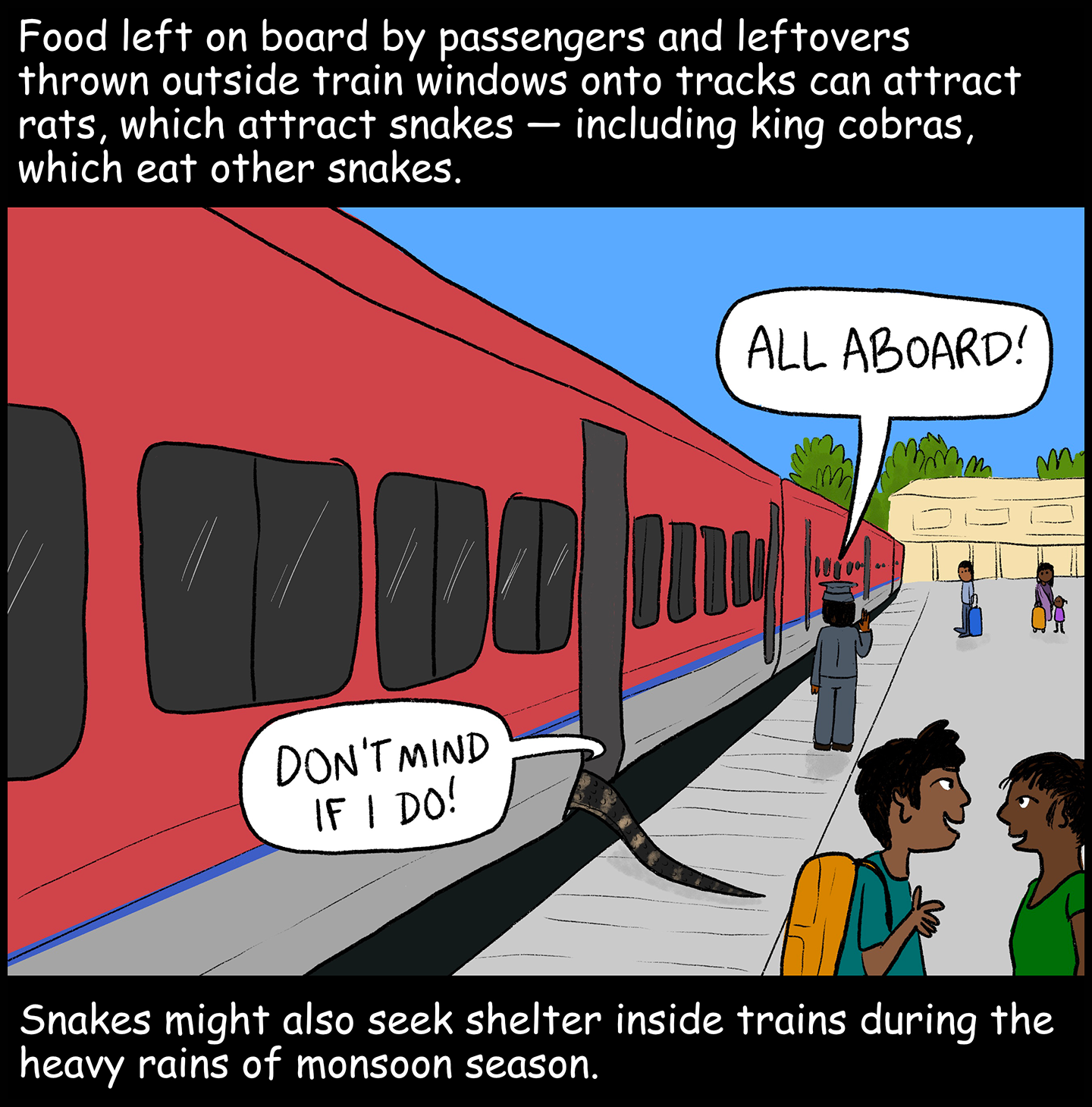
Text (above image): Food left on board by passengers and leftovers thrown outside train windows onto tracks can attract rats, which attract snakes — including king cobras, which eat other snakes. Image: A train platform bustles with people. A railway worker yells, “All aboard!” Meanwhile, a snake slithers onto one of the cars of the train parked at the platform. The snake says, “Don’t mind if I do!” Text (below image): Snakes might also seek shelter inside trains during the heavy rains of monsoon season.
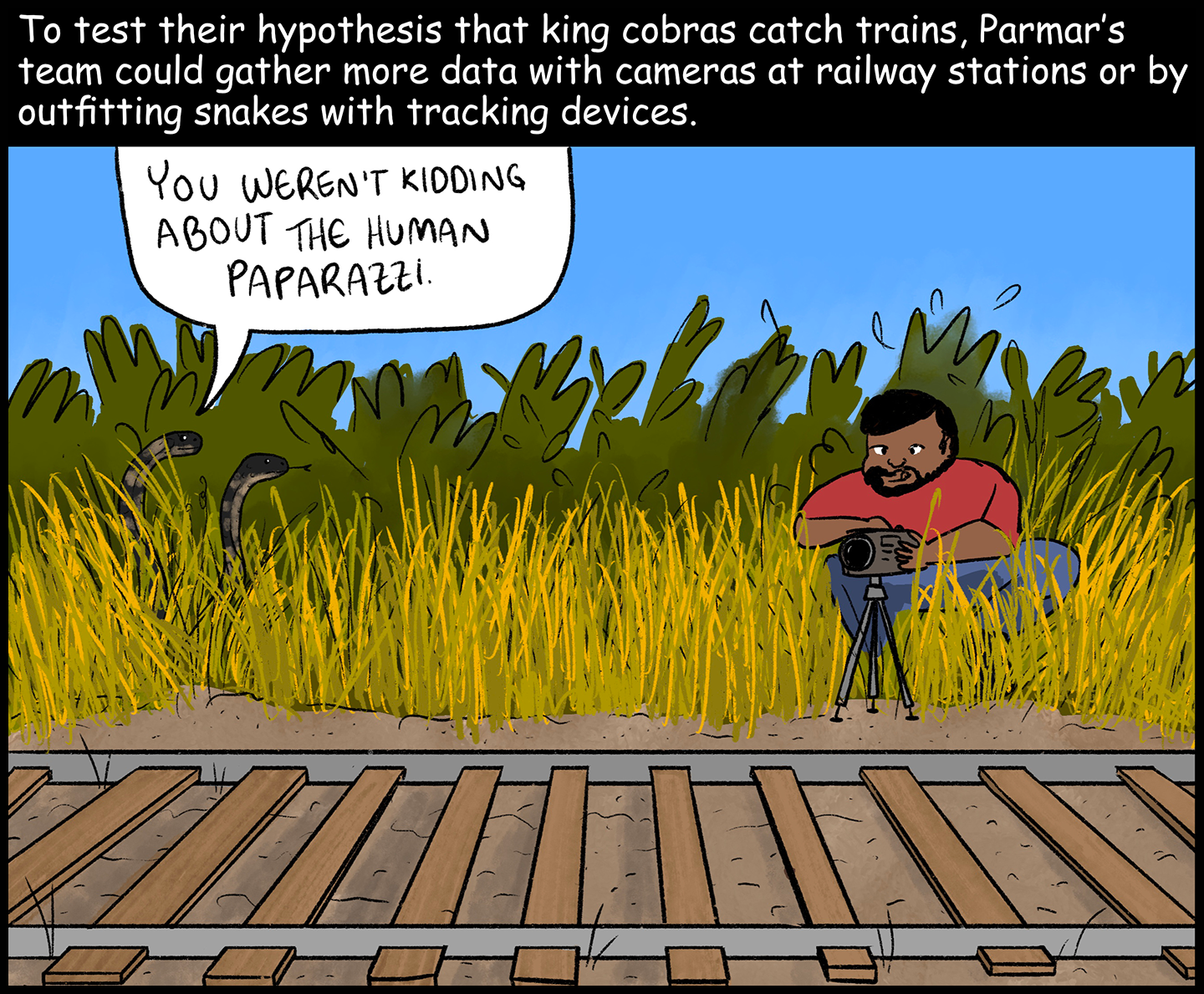
Text (above image): To test their hypothesis that king cobras catch trains, Parmar’s team could gather more data with cameras at railway stations or by outfitting snakes with tracking devices. Image: Parmar sets up a camera near railroad tracks. Two snakes are hiding in the grass nearby, watching. One snake says to the other, “You weren’t kidding about the human paparazzi.”
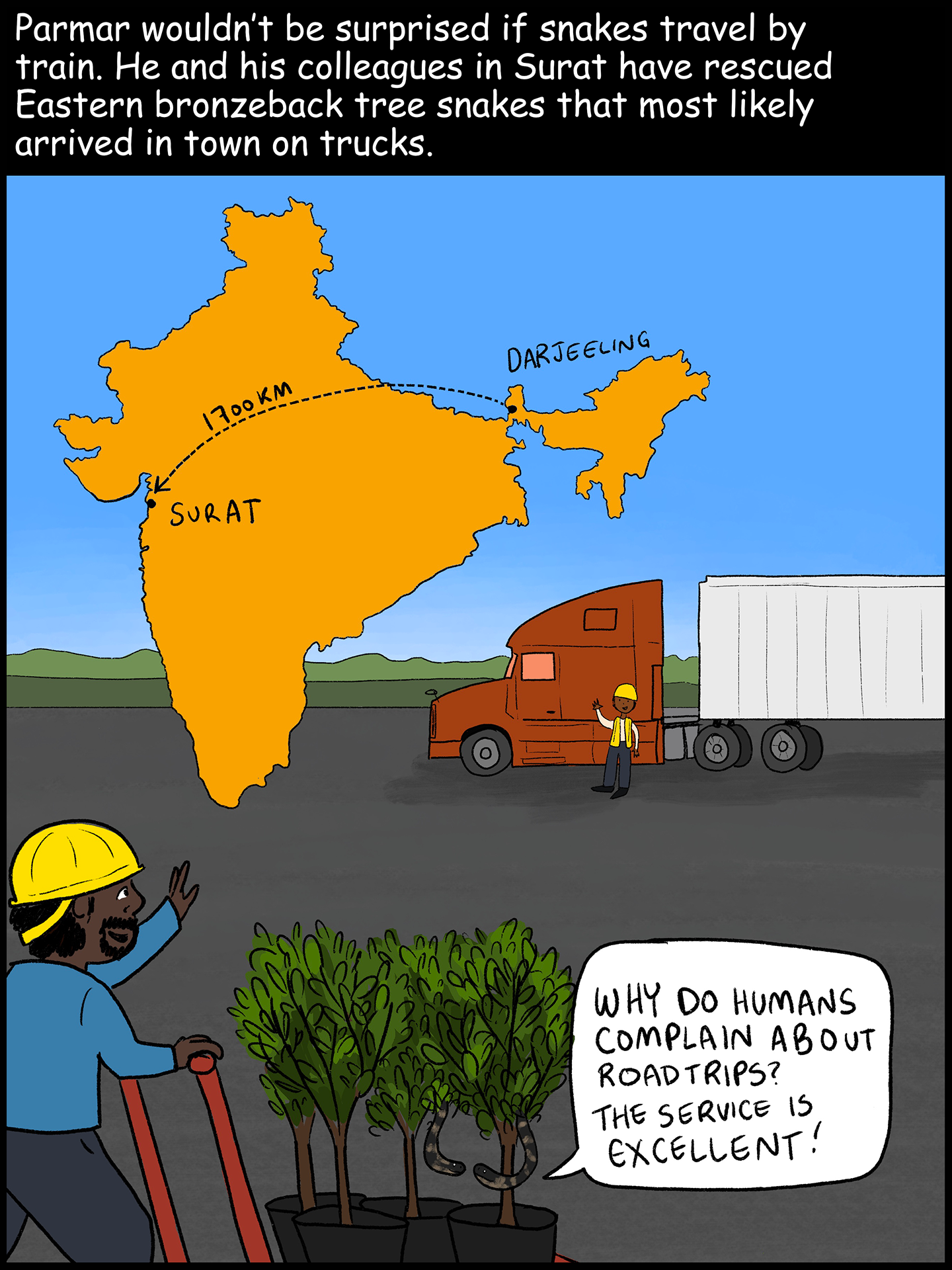
Text (above image): Parmar wouldn’t be surprised if snakes travel by train. He and his colleagues in Surat have rescued Eastern bronzeback tree snakes that most likely arrived in town on trucks. Image: A map of India shows a path from Darjeeling to Surat that spans 1,700 kilometers. Below the map, a truck driver waves to a man pushing a cart of sapling trees. Two snakes are hiding in the leaves of those trees. One snake says to the other, “Why do humans complain about roadtrips? This service is excellent!”
Text (above image): But the fewer Western Ghats King Cobras riding trains, the better. King cobra bites are deadly. Unfortunately, snakes can’t read ‘keep out’ signs. Image: A snake slithers up to railroad tracks. Beside the tracks is a sign. On the sign is a snake with a big red X through it. The snake says, “They say ‘X marks the spot!’ I must be in the right place!” Text (below image): So it’s up to human passengers to clean up leftovers — and minimize how much construction cuts through king cobras’ forest habitats — to avoid tempting the snakes on board.
All: J. Wendel

  •  

Trying to break a photon would create a quantum mess

When it comes to making a mess, not even the world’s crumbliest cookie would compare to a photon.

Photons are fundamental particles of light. As fundamental particles, they cannot really be broken down into smaller bits. But physicists have now shown what would happen — in theory — if you tried to crack a photon in half.

You wouldn’t just end up with a second photon, their calculations show. Rather, up to an infinite number of new light particles would sprinkle out of thin air.

The researchers shared their findings in a paper that will be published in Physical Review Letters.

Daniele Faccio’s first reaction to the study was: nonsense. “Then you read it, and I enjoyed it,” he says. Faccio is a physicist at the University of Glasgow in Scotland who did not take part in the work. “The technique is legit,” he says. “The results look absolutely reasonable.”

Photon interrupted

The key to the analysis is that photons don’t just act as pointlike particles. They also behave like extended waves. That got Johannes Skaar wondering: What would happen if you had a device fast enough to snip the wave of a single photon in half?

Skaar is a physicist at the University of Oslo in Norway. His team modeled a scenario where a photon is traveling toward a mirror. The front half of the light wave hits the mirror first. It gets bounced back in the direction it came from. But then, the mirror is suddenly removed. The back half of the light wave is then free to pass through.

This, the math shows, would spew out a complex mix — or superposition — of different possible numbers of photons.

Removing the mirror infinitely fast would conjure an infinity of new light particles. Infinite speed is, of course, impossible. But even pulling the mirror away more slowly has striking effects. “You end up with a possibility of several photons, or a bunch of photons,” Skaar says. You’re just much more likely to create small numbers of them than huge swarms.

“This is a bit strange,” allows Skaar. But in the quantum realm, he adds, it’s not actually that weird.

Quantum physics is the science that describes how the very smallest things, such as photons, behave. And it has already shown that supposedly “empty” space is not truly empty. There is some structure to the fabric of “empty” space, and disturbing it is known to knock new photons loose.

In this case, the mirror’s motion could provide the energy to spawn new light particles.

Do you have a science question? We can help!

Submit your question here, and we might answer it an upcoming issue of Science News Explores

Weirder and weirder

To Skaar, a possible cascade of new light particles isn’t the oddest outcome of the model. To him, the weirdest part is the math that describes what you’d see if you observed the system from different perspectives.

If you could view both sides of the mirror at once, you’d witness the messy eruption of up to bajillions of photons. But if you could only see one side of the mirror, you’d observe just one — or empty space.

“That is really crazy,” says Skaar. He hopes to probe what’s going on more deeply in future work. He also wants to explore what would happen if you tried to sever other types of fundamental particles. In quantum physics, particles such as electrons also act like waves. Attempting to snip them in half might lead to similarly bizarre results.

It’s not super clear what uses this research might have. “I’m going to speculate wildly here,” Faccio says. But “it might matter because there are funky things that people do with [photons] for sensing and measuring.” Gravitational-wave catchers, for example, play with light waves to detect ripples in the fabric of our universe.

Probing the nature of photons, Faccio says, may be helpful in fields that use such quantum sensors.

  •  
❌