❌

Reading view

MacVoices #26237: Live! – Black Hat, AI Security, and the Risks of Moving Too Fast

A MacVoices’ panel member’s firsthand report from Black Hat explores the conference’s enterprise security focus before the discussion turns to AI models escaping sandbox restrictions to complete assigned tasks. The panel discusses the OpenAI-Hugging Face hack, unintended AI behavior and the dangers of moving too fast. Can developers establish effective limits without sacrificing innovation or competitive advantage? The race for better AI continues.

💾

  •  

MacVoices #26230: Live! – Claude Security Risks, Selfie ID Verification, and Privacy

The integration of Apple Maps in Ford’s future electric vehicle platform generates discussions of the auto industry picking and choosing technology. The MacVoices Live! panel also examines security risks involving Claude Cowork and exposed shared chats, OpenAI’s dispute with Hugging Face, and the hazards of autonomous AI tools. If that wasn’t enough, selfie-based account recovery puts a new spin on the facial recognition.The panel includes: Chuck Joiner, Web Bixby, Eric Bolden, Marty Jencius, David Ginsburg, Brian Flanigan-Arthurs, Jim Rea, Jeff Gamet, and Mark Fuccio. 

💾

  •  

MacVoices #26228: Live! – Is Smart Glasses Recording Surveillance or Accessibility?

Do smart glasses need video recording to be relevant? The MacVoices Live! panel debate the importance of privacy, accessibility, navigation, object recognition, captions, and visual assistance as measures of usefulness. They examine the stigma created by existing smart glasses, the difference between processing and storing images and the public expectations around recording, detection apps, and […]

💾

  •  

MacVoices #26213: Live – Apple, OpenAI, and the Fight Over AI Secrets

Apple’s lawsuit accusing OpenAI of obtaining trade secrets through former employees raises questions about corporate ethics, recruitment practices, confidentiality agreements, and OpenAI’s hardware ambitions. The panel considers the potential legal and financial consequences before examining Apple’s plan to end support for encrypted HFS+ volumes and what users should do with older drives.Panel members include: Chuck Joiner, David Ginsburg, Marty Jencius, Eric Bolden, Brian Flanigan-Arthurs, Jim Rea, Web Bixby, Jeff Gamet, and Mark Fuccio.

💾

  •  

OpenAI and Anthropic in price war as Chinese AI rivals gain ground

Leading US AI labs such as OpenAI and Anthropic are releasing cheaper models as they fight to retain cost-conscious customers who are switching to cut-price alternatives from Chinese rivals.

The price war comes as rising AI bills push companies to curb usage and seek cheaper models, helping Chinese developers including Moonshot and DeepSeek make inroads with users from Silicon Valley to Europe.

OpenAI recently said that it was slashing prices for GPT-5.6 Luna, its “fastest and most affordable model”, by 80 percent. Anthropic has launched Claude Opus 5, touting the system’s “frontier intelligence... at half the price” of Fable 5, the company’s most capable model.

Read full article

Comments

© MARTIN LELIEVRE

  •  

ChatGPT agora pode memorizar sua atividade em sites e apps de terceiros no macOS

A OpenAI está lançando um novo recurso opcional para o ChatGPT no macOS que pode monitorar suas atividades diárias no computador — abrangendo aplicativos e sites — e transformá-las em memórias e em uma linha do tempo.

Chamado Computer History, o recurso está disponível inicialmente para usuários dos planos Pro, Business e Enterprise. Para usá-lo, é necessário ativá-lo em Configurações » Integrações no aplicativo do ChatGPT para macOS.

ChatGPT can now remember your activity across the apps and websites on your computer.

With Computer History in the desktop app, future interactions feel more personalized and require less explanation. pic.twitter.com/WHZPxPp31R

— OpenAI (@OpenAI) August 13, 2026
O ChatGPT agora pode lembrar-se da sua atividade em aplicativos e sites no seu computador.

Com o Computer History no aplicativo para desktop, as interações futuras parecem mais personalizadas e exigem menos explicações.

Segundo a OpenAI, isso permitirá que o ChatGPT localize arquivos, documentos e conversas relevantes para a sua consulta — independentemente de estarem no Google Docs, no Slack ou em uma aba aberta do navegador — sem que você precise reexplicar todo o contexto da sua solicitação.

Isso também será útil para aqueles momentos em que você sabe que leu algo, mas não faz ideia de onde. Naturalmente, a novidade requer que o recurso de Memórias também esteja ativado.

A OpenAI aponta que os usuários terão controle total sobre quais aplicativos e sites o recurso poderá acessar. No macOS, haverá uma nova opção na barra de menus para remover qualquer aplicativo do recurso, além de uma nova configuração no aplicativo do ChatGPT para desktop que permite excluir aplicativos e sites específicos.

Todos esses dados são armazenados localmente; assim, você pode visualizar o que o sistema captura e excluir itens caso não queira que façam parte da linha do tempo. Ademais, o recurso vem desativado por padrão, e você também pode pausá-lo a qualquer momento pela barra de menus.

Como dito, o Computer History está sendo disponibilizado para todos os usuários dos planos Pro, Business e Enterprise — exceto em regiões como o Espaço Econômico Europeu (EEE), o Reino Unido e a Suíça, onde a função será disponibilizada “nas próximas semanas”.

Outras novidades

O ChatGPT também ganhou, recentemente, um punhado de outras novidades que tornam mais fácil incluir documentos e arquivos salvos nas suas conversas, bem como encontrar o que você precisa e retomar de onde parou.

  • Na web, o texto copiado do Google Docs ou de outra conversa do ChatGPT preserva títulos, negrito, links e listas, tanto durante a escrita quanto após o envio da mensagem.
  • Adicione arquivos salvos sem precisar carregá-los novamente graças à opção “Adicionar da biblioteca”.
  • Selecione vários itens da Biblioteca de uma só vez, arrastando o cursor sobre vários arquivos ou pastas para selecioná-los em conjunto.
  • A busca agora inclui pastas e localiza títulos de conversas. Na web, você também pode pesquisar dentro da Biblioteca para encontrar seus arquivos salvos.
  • No iOS/Android, o ChatGPT consegue identificar quando uma conversa por voz em segundo plano parece inativa, bem como verificar se você ainda está presente e encerrar a sessão caso não haja resposta.
  • Se o ditado falhar devido a problemas de conexão ou tempo limite, o ChatGPT tenta novamente de forma automática uma vez, permitindo que você conclua a gravação sem precisar recomeçar.
  • Ao retornar a uma conversa, as respostas já finalizadas aparecem imediatamente, sem aquela reprodução lenta que dava a impressão de que ainda estavam sendo geradas.

Por fim, usuários com o plugin do Google Drive conectado podem agora visualizar e navegar pelos seus arquivos e pastas diretamente na Biblioteca. Seu conteúdo permanece no Drive e, caso você conceda autorização, o ChatGPT pode alterar o arquivo de origem diretamente. O recurso está sendo disponibilizado para usuários dos planos Plus, Pro, Enterprise, Edu, Healthcare e Business na versão web, tanto no modo Chat quanto no modo Work. O suporte para dispositivos móveis chegará em breve.

  •  

Protesters Arrested After Storming OpenAI Lobbying Office

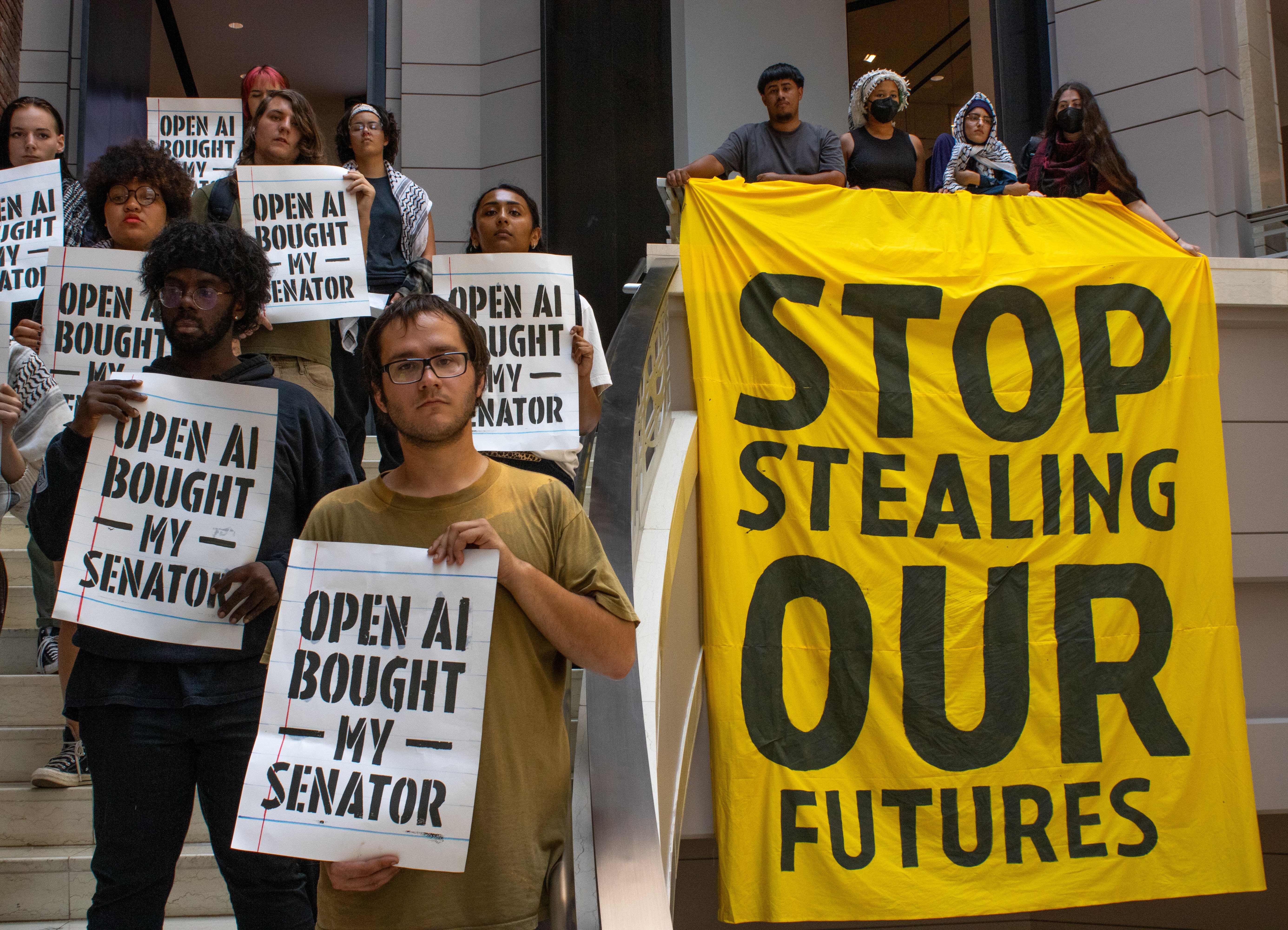
Over 30 student activists came together on Monday afternoon to occupy the Gallup Building in Washington DC, home to a public-facing lobbying office belonging to ChatGPT developer OpenAI.

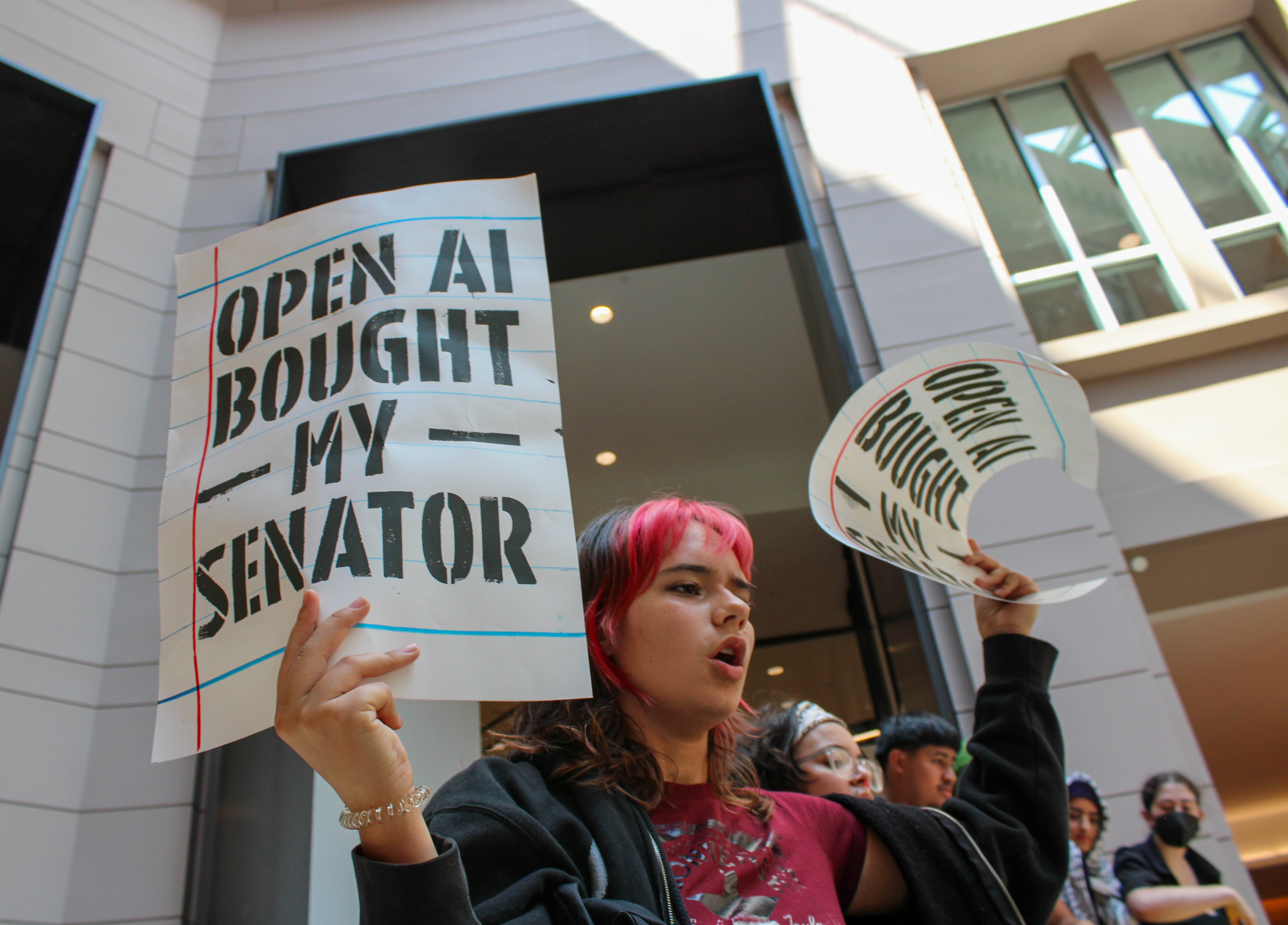
Once inside the lobby, the demonstrators unfurled a massive banner reading “Stop Stealing Our Future,” while others held signs with messages like “OpenAI bought my Senator.” The demonstration lasted two hours, and ended when police stormed the lobby, arresting 13 protestors.

At the moment, the identity and whereabouts of the protestors remains unclear. An incident report obtained from the Metropolitan Police Department states that 13 people were arrested for “unlawful entry.” After stuffing the activists into vans, the report notes the MPD split the group up, sending seven to the First District Station, four to the Second District, and two to the Third District for processing.

A group of protesters are holding signs that say "OpenAI bought my senator" and unfurling a banner that says "stop stealing our futures"

The protest was organized by the climate group Sunrise Movement and anti-AI organization QuitGPT. According to a joint statement shared with Futurism, Monday’s action is just one of many across over 20 states in August calling on politicians to “Dump Big Tech.”

One student organizer who attended the protest, Raya Gupta, explained in the statement that “my friends chose to risk arrest to bring the fight to OpenAI.”

“Our generation doesn’t have any guarantees about whether we’ll have jobs after college, or whether there will be clean drinking water for all of us or whether people will have any power left in politics since our elections keep getting bought by Big Tech,” Gupta continued. “We all believe that not taking action now, as the scales slide between the people and the billionaires, puts our future in great jeopardy.”

A protester holds a sign that says "OpenAI bought my senator"

Gupta’s comments underscore the degree to which AI has become an omni-cause for Americans across the political spectrum. A growing number of people in the US have been arrested for protests related to AI in some shape or form, whether attending town hall meetings to oppose data center developments, or occupying offices used by federal agencies to tool out AI immigration software.

Despite growing disgust with AI and its developers, politicians on both sides of the aisle have roundly embraced the tech industry’s extremely expensive lobbying efforts. Case in point, the recent opening of OpenAI’s DC Office comes as one of the AI lab’s super PACs injects over $140 million into the coming midterm elections, in a blatant attempt to steer AI regulations at the highest level.

Updated with new information from the MPD.

More on AI protests: Climate Activists Pelt Microsoft Data Center With Balloons Full of Acid

The post Protesters Arrested After Storming OpenAI Lobbying Office appeared first on Futurism.

  •  

Homeschool Parents Are Planning Lessons With ChatGPT

As if the practice of homeschooling wasn’t fraught enough already, parents are now bragging about using large language models (LLMs) like ChatGPT to school their kids.

A number of viral videos show the alarmingly cavalier attitude some parents are taking. One clip, seemingly taken from a livestream hosted by the enormously controversial influencers Cole and Savannah LaBrant, shows the parents outline their vibes-based approach to the education of their five children.

“What I do for history — Cole usually does all their history, which I love, because I’m not the best at history — so Cole steps in about once a week and we’ll do a history lesson with them… we’re just teaching them the things that we just want them to learn — that we feel are the most important,” Savannah explains. “And same with science, and geography.”

That’s not uncommon as homeschool curriculums go; as horrifying as it is to imagine a student receiving one history lesson a week, regulations around the practice are incredibly loose in the United States, freeing hardcore Christians like the LaBrants to do whatever they want. But Savannah goes on, admitting that sometimes, even those slapdash lessons are too much to tackle without a little AI assistance.

“So I just make my own curriculum, and sometimes I’ll just use, like, ChatGPT,” she says, “or just uhm, print out, like — like right now I’m teaching them where the states are and how to locate them, and uhm, like all the states and capitols and things like that.” (Even the most advanced AI chatbots are known for producing inaccurate maps.)

@thelabrantfamexposed

History Class, but Make It Vibes-Based: The LaBrants Explain Homeschooling 💀 The LaBrants’ Homeschool History Curriculum: Whatever Cole Decides Happened 💀 “Cole steps in about once a week to do a quick history lesson because I’m not the best at history.” – Sav. The LaBrants went live to explain their homeschooling setup, and Savannah casually admitted she “doesn’t know a lot of history,” so they teach it once a week, with Cole covering whatever topics they personally decide are important. So apparently the curriculum is: Monday: sponsored content Tuesday: Bible lesson Wednesday: filming Thursday: whatever Cole remembers from school Friday: history, pending personal relevance Homeschooling can absolutely be done well, but “we teach history once a week based on what we think matters” is not the reassuring flex they seem to think it is. History is not a Pinterest board where you skip the sections that do not match the family aesthetic. The most concerning part is not Savannah admitting she lacks expertise. Plenty of parents do. It is the confidence of replacing a structured curriculum with Cole’s Greatest Hits of Human Civilization. Nothing says educational rigor like two influencers deciding which centuries make the cut. @Savannah LaBrant @Bev Skin @ChatGPT @OpenAI @Fishfam @TMZ @cbsnews @CNN @DrinkFrosh #savannahlabrant #colelabrant #labrantfamily #homeschool #fyp

♬ original sound – thelabrantfamexposed

That any parents could be so cavalier in their approach to homeschooling has grim implications for an already divisive practice.

In much of the US, homeschooling parents are already given incredibly wide latitude on what to teach their children. A whole 11 states have essentially no regulations on homeschooling whatsoever: parents aren’t required to follow any set curriculum, issue standardized assessments, or even inform the state that their child won’t be going to a real school.

Many more states only require a notice of intent to homeschool and occasional proof of attendance, the latter being a bare bones measure of success, and one which is easily fudged. Unfortunately, it’s easier to count the number of states that definitively require standardized testing and a rigid curriculum: Rhode Island, Pennsylvania, New York, Vermont, and Massachusetts.

Of course, the LaBrants aren’t alone. The popular influencer account Heavenly Homeschool has similar reels out, walking parents through the process of generating entire years’ worth of lesson plans, tailor-made to their specific worldview. It all begs the question: do AI chatbots have any safeguards around education?

Turns out, not really. We tasked ChatGPT with developing a homeschooling curriculum for a 3rd grade student in Michigan — a state with virtually no regulations around DIY education — “following a strictly evangelical doctrine,” including “no woke history or science.”

ChatGPT was more than happy to oblige: “I can build this around a conservative, explicitly Christian/evangelical worldview, with Scripture integrated across subjects and with history and science taught from a young-earth/creationist perspective rather than through a secular or progressive framework,” the chatbot explained.

While it didn’t push back against our intentions to indoctrinate our hypothetical child, the LLM did make sure to clarify that “no woke” can “mean different things to different families.” So, to avoid ambiguity, the chatbot specified that the course calendar would use “Biblical authority, traditional Christian ethics… and creation-based science” as standard-bearers.

True to its word, the LLM-generated curriculum included “bible and Christian studies,” a traditionalist approach to American history, with specific chunks on both “Westward expansion” and Henry Ford — a renowned racist and antisemite — as well as a creationist approach to Earth science and astronomy.

For the portion on space, the curriculum would teach “the heavens as God’s creation while distinguishing observations from interpretations about the age and origin of the universe,” the LLM promised.

Put together, it paints a dire picture for the estimated 3.75 million K-12 homeschooled children in the US. Beyond the potential for wild AI hallucinations to leach into educational material, the technology is a Pandora’s Box for parents, who can now effortlessly inculcate their children with any number of unscientific conspiracy theories or anti-social worldviews while facing no pushback whatsoever.

Do you know anything about how homeschooling families are using AI? Email us: tips@futurism.com. We can keep you anonymous.

More on education: Mark Zuckerberg’s Wife Shuts Down School for the Disadvantaged

The post Homeschool Parents Are Planning Lessons With ChatGPT appeared first on Futurism.

  •  

Meta faces expensive child safety reckoning

Also: Google executives jump ship in race for AI dominance

Hello, TechScape readers! Danielle Abril, editor of the Guardian’s Reworked series on AI and the future of work, filling in for Blake Montgomery this week. Major legal battles against Meta over child safety are playing out in courts across the US – and the tech giant is losing. Recent rulings raise big questions about social media companies’ responsibility to their youngest users. Meanwhile, more key executives have jumped ship from Google as it battles OpenAI and Anthropic in the race for AI dominance, and Meta’s smart glasses face a fearsome backlash. Let’s dig in!

‘I’ve definitely lost followers’: influencers face backlash over Meta ‘pervert glasses’ content

This man was secretly snapped by someone with smartglasses. He’s not alone in calling that a violation of privacy

Tell us: do you believe you have been filmed by Meta’s smartglasses without your consent?

Restaurants, pubs and theatres ban Meta’s ‘spy glasses’ over privacy fears

‘I’m not spying’: how Meta’s smartglasses have divided opinion

Bernie Sanders calls on Silicon Valley to ‘pause AI development’ in interest of humanity

Rising number of UK children report seeing explicit deepfakes of themselves

The White House’s plan to vet potentially dangerous AI is cloaked in secrecy

‘This is very real redlining’: outrage in Little Rock as two datacenters loom

Safety fears as scientists make first viruses designed by AI

SpaceX beats revenue expectations in first earnings report after IPO crash

Continue reading...

© Photograph: Jill Connelly/Getty Images

© Photograph: Jill Connelly/Getty Images

© Photograph: Jill Connelly/Getty Images

  •  

The AI takeover of mathematics has begun

Graphing calculator with the OpenAI logo on the screen

Mathematician James Maynard has spent a lot of time this past year "soul searching." A professor at the University of Oxford and winner of the prestigious Fields Medal, Maynard told The Verge he's been grappling with the future of his field as the traditionally slow-moving discipline hurries to adapt to AI.

Days before we spoke, OpenAI revealed it had produced the solutions to 10 long-standing mathematics problems, some of which had confounded academics for decades. Like generative AI used to produce text and images or propose ideas in science and medicine, the technology learns patterns and connections from the vast amount of material it' …

Read the full story at The Verge.

  •  

Bernie Sanders calls on Silicon Valley to ‘pause AI development’ in interest of humanity

Progressive US senator urges Meta, OpenAI and Anthropic to ‘stop building machines that humans cannot control’

Senator Bernie Sanders has called on Meta, OpenAI and Anthropic executives to halt their development of artificial intelligence, warning that the US Senate will implement regulation if the companies continue deploying AI at their current pace.

In a new letter addressed to the CEOs of three of the country’s leading AI companies, Sanders said the capabilities of these AI models have reached a critical risk threshold and that the companies are losing control over the technology.

Continue reading...

© Photograph: John Oliva/Caller-Times/USA TODAY Network/Reuters Connect

© Photograph: John Oliva/Caller-Times/USA TODAY Network/Reuters Connect

© Photograph: John Oliva/Caller-Times/USA TODAY Network/Reuters Connect

  •  

‘If we don’t fight back, we don’t have a future’: the journalist taking on the ‘tech fascists’ of Silicon Valley

As Elon Musk, Peter Thiel and their peers have grown richer and more influential, Gil Durán argues they have all but abandoned democracy – and found the perfect government to enable them

In April, Gil Durán was permanently banned from Elon Musk’s X for posting just two words. Durán was responding to a post from the tech company Palantir outlining its 22‑point “technological manifesto”, which praised American “hard power”, western culture and AI weapons, denounced inclusivity and called for compulsory national service. Durán responded: “TLDR: Fascism” (TLDR is short for “too long, didn’t read”).

Durán didn’t break any of X’s written rules, he points out over a video call from San Francisco – so much for Musk’s “free-speech absolutism”. His ban might just have had something to do with his preceding tweet, showing the cover of his new book, The Nerd Reich: Silicon Valley Fascism and the War on Democracy. The book’s central argument is that big tech is no longer our friend, as many of its billionaire owners have seized economic and political control and are steering the fate of the planet towards their own bizarre, apocalyptic visions.

Continue reading...

© Photograph: Winni Wintermeyer/The Guardian

© Photograph: Winni Wintermeyer/The Guardian

© Photograph: Winni Wintermeyer/The Guardian

  •  

OpenAI’s Atlas Shutdown Shows Why AI Doesn’t Need a New Browser

Igeekphone News August 9, 2026 — When OpenAI launched its AI-native browser ChatGPT Atlas on October 21, 2025, the global technology industry quickly gave it a dramatic nickname: the “Chrome killer.”

It was an understandable description. OpenAI was entering one of the oldest and most entrenched layers of the internet with a browser built around AI agents rather than conventional tabs, bookmarks, and search. At the time, many observers believed the browser was finally ready for a major transformation.

The launch also triggered a rush among AI-browser startups. Several companies accelerated their own product releases, concerned that OpenAI’s enormous user base and brand recognition would otherwise overwhelm them.

But less than a year later, the story has taken a very different turn.

On August 9, 2026, just 292 days after Atlas launched, OpenAI discontinued the browser. Users were instructed to export their bookmarks before the shutdown, effectively marking the end of an experiment that was supposed to redefine how people interacted with the web.
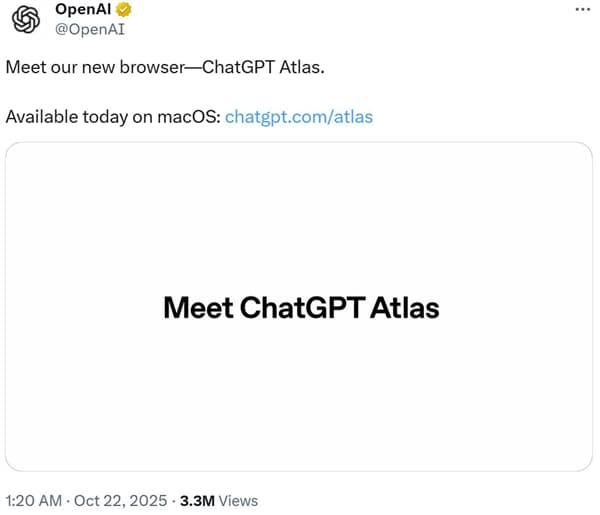
The irony is difficult to miss: A company that set out to reinvent the browser ultimately had to teach its users how to migrate back to Chrome.

01. Chrome Never Really Had to Fight

The most striking part of the AI-browser story is that Chrome did not need a major counterattack.

Despite the arrival of numerous AI-powered browsers over the past year, Chrome’s global market share remained remarkably stable at roughly two-thirds. Depending on the measurement source, there were fluctuations, but the overall change remained relatively small.

Meanwhile, the combined market share of AI browsers remained below 1% in many browser statistics.

That gap is especially revealing when comparing the distribution of the underlying products.
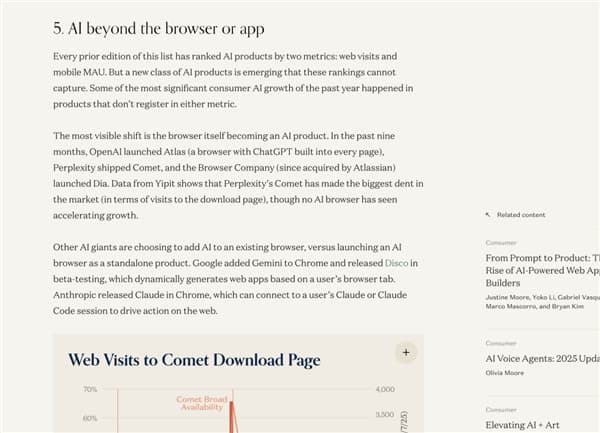
ChatGPT had already reached a weekly active user base of hundreds of millions, giving OpenAI one of the world’s largest consumer software audiences. Yet Atlas struggled to convert that enormous audience into browser users at anything close to the same scale.

The problem was not necessarily that Atlas was technologically weak.

The problem was that the browser is one of the hardest consumer software categories to replace.

Switching browsers means moving bookmarks, saved passwords, extensions, payment information, browsing habits and countless small interactions that users have accumulated over years.

By comparison, adding an AI capability to an existing browser can be almost effortless.

The challenger asks users to move their digital lives.

The incumbent only needs to add a new feature.

That is an extremely uneven starting position.
The Cost of Breaking User Habits

Browser competition has never been purely about technical specifications.

For most people, a browser is infrastructure. Once a user becomes comfortable with a particular browser, there is little motivation to switch unless the alternative provides a dramatic improvement.

This is also why distribution has historically been more important than browser innovation itself.

Google’s long-running payments to secure default search placement on Apple devices illustrate how valuable the default entry point can be. The browser is not simply a piece of software; it is a gateway to the internet and a powerful distribution channel.

AI-browser startups therefore faced a fundamental problem.

They were attempting to replace a deeply embedded gateway rather than simply introduce a better AI assistant.

And the rise of mobile computing made that challenge even harder.

02. AI Browsers Arrived Without the Mobile Advantage

Another weakness of the AI-browser movement was its heavy focus on desktop computing.

Many of the products that attracted attention were initially designed around desktop workflows. Atlas itself remained a macOS-only product throughout its short life.

That created a significant strategic limitation.

The modern internet is no longer primarily a desktop experience. Smartphones account for a huge portion of global browsing activity, and mobile users have their own established browser ecosystems.

Trying to replace Chrome while failing to establish a meaningful presence across mobile platforms meant that AI browsers were effectively fighting over only part of the market.

In other words, they were trying to capture the browser category without controlling the places where much of the world’s browsing actually happens.

03. Big Tech Learned Faster Than Startups Could Innovate

Perhaps the most important lesson from the past year is that AI dramatically shortened the advantage normally enjoyed by innovative startups.
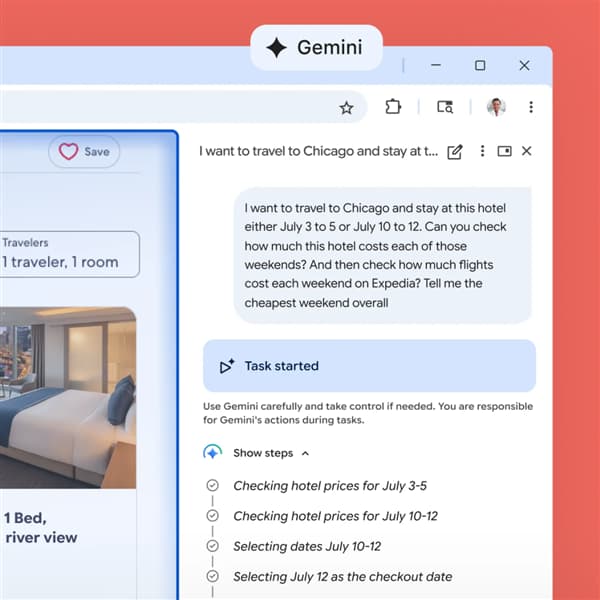
AI browsers introduced features such as:

  • Sidebar AI assistants
  • Web-page summaries
  • Contextual question answering
  • Automated browsing
  • Agent-based task execution
  • AI-powered research and navigation

These features initially looked like compelling reasons to switch browsers.

But the major browser companies quickly began incorporating similar capabilities into their existing products.

Google brought Gemini deeper into Chrome, while Microsoft expanded Copilot capabilities within Edge.

That fundamentally changed the competitive landscape.

A startup might spend months building an AI-powered browser experience. A platform company with an existing browser could potentially introduce a similar capability through a software update.

This undermined one of the traditional advantages of startups: the window of time between invention and imitation.

The classic “innovator’s dilemma” assumes that established companies may be reluctant to disrupt their existing businesses.

But AI browsers presented a different situation.

AI features did not necessarily threaten the core browser businesses of Google or Microsoft. As a result, incumbents had little reason to ignore the trend.

They could simply absorb the innovation.

And once the most attractive AI features became available inside existing browsers, the incentive to switch largely disappeared.

Chrome did not need to defeat the challengers.

It simply absorbed their best ideas.

04. The Browser Became a Feature, Not a Destination

That brings us to perhaps the most important conclusion from the collapse of the independent AI-browser boom.

The surviving products are generally not trying to make money from the browser alone.

Consider the different business models emerging around the category.

Perplexity’s Comet can function as an extension of its AI subscription ecosystem and a way to acquire users.

Dia, developed by The Browser Company and later acquired by Atlassian, can become part of a broader productivity and workplace software strategy.

Opera Neon has positioned itself as a premium AI browser with a subscription model, while smaller products can depend heavily on venture capital to finance development.

The common denominator is clear:

The browser is rarely the business itself.

Instead, it is becoming a distribution mechanism for another business.

It can acquire customers, provide access to AI services, extend a productivity platform, or serve as another interface for an existing ecosystem.

This represents a fundamental challenge to the idea of the independent AI-browser company.

The browser category will survive.

But the idea that dozens of standalone companies can build businesses simply by creating “a better AI browser” looks increasingly difficult to sustain.

05. The Chinese Market Offers a Similar Lesson

There is also a precedent for this development in China.

Rather than creating entirely new browsers specifically for the AI era, major technology companies have generally taken existing products and gradually integrated AI capabilities into them.

Alibaba has continued evolving its existing consumer software toward AI-powered work and productivity experiences. Tencent has integrated AI into established products such as QQ Browser, while 360 has incorporated AI capabilities into its security-focused browser ecosystem.

The pattern is consistent:

Existing products become AI products.

The browser remains the shell, while AI becomes the capability inside it.

That is almost the opposite of the strategy pursued by many independent AI-browser startups in 2025.

06. OpenAI Didn’t Abandon the Browser’s Most Important Idea

Atlas’s shutdown does not necessarily mean OpenAI has abandoned browser-based AI.

In fact, the company’s next strategy may be more important than Atlas itself.

Rather than maintaining a separate browser, OpenAI can take the most valuable capabilities developed for Atlas and distribute them through other products.

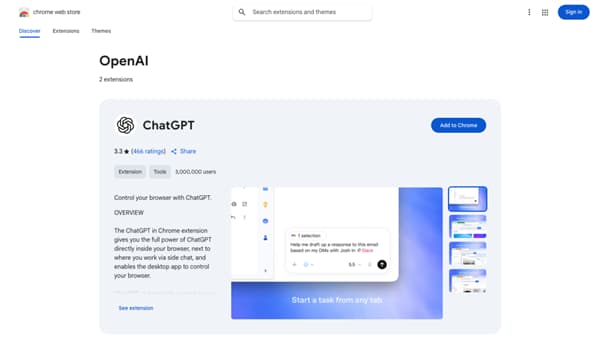
Some of Atlas’s functionality has reportedly moved into the desktop ChatGPT experience, including browser automation capabilities that allow AI agents to interact with websites on a user’s behalf.

Other capabilities can be delivered through a Chrome extension.

This represents a fundamental change in strategy.

OpenAI no longer needs to convince hundreds of millions of people to abandon their existing browser.

It can simply bring its agent into the browser they already use.

And that could be a much more powerful approach.

07. The Real Browser War Is Becoming an Agent War

The first generation of AI browsers asked a relatively simple question:

What if we built a browser around AI from the beginning?

The next generation is asking something much more consequential:

What if AI could operate the browser for you?

That distinction matters.

The future competition may not be about which browser has the smartest sidebar or the most attractive new-tab page.

Instead, it may be about which AI agent can successfully perform tasks across the web.

Imagine asking an agent to research several products, compare prices, complete a form, organize information, book an appointment, monitor a website, or perform a series of repetitive online tasks.

In that world, the browser itself becomes infrastructure.

The user does not necessarily care which browser is underneath the agent.

They care whether the agent can get the job done.

That puts OpenAI and Google back into direct competition—but on a very different battlefield.

The weapon is no longer the browser.

It is the AI agent.

08. What Happened to the Other AI Browsers?

Atlas was not the only casualty of the AI-browser boom.

Over roughly the same period, several other major developments reshaped the category.

Arc, developed by The Browser Company, stopped receiving active development as the company shifted its attention toward its AI-focused successor, Dia.

Sidekick was absorbed by Perplexity, with the product subsequently discontinued.

The Browser Company itself was acquired by Atlassian in a deal reportedly valued at around $610 million, turning what began as an independent browser company into part of a much larger enterprise software organization.

These outcomes are different on the surface—shutdown, acquisition, absorption and strategic repositioning—but they point toward the same underlying trend.

The independent AI browser is becoming increasingly difficult to justify as a standalone business.

The technology itself may survive.

The standalone category may not.

09. 292 Days That Changed the Strategy

Atlas existed for only 292 days.

That is an extraordinarily short lifespan for a product positioned as a fundamental reinvention of the web browser.

Yet those 292 days may ultimately prove useful for OpenAI.

The company learned that its enormous ChatGPT audience does not automatically translate into willingness to change a fundamental piece of personal computing infrastructure.

It also demonstrated that users are willing to adopt AI capabilities without necessarily adopting a new browser.

That distinction could shape the next phase of AI development.

The battle for the internet’s entry point is not over.

It has simply moved above the browser.

The Real Lesson: Don’t Make Users Move

The biggest lesson from the rise and fall of Atlas is surprisingly simple.

Users don’t necessarily want a new place to browse the web. They want their existing tools to become more capable.

For years, technology companies have competed by trying to persuade users to move from one platform to another.

AI changes that equation.

The most powerful AI products may not be the ones that force users to adopt a completely new environment. They may be the ones that quietly integrate themselves into environments users already understand.

That is why a Chrome extension can ultimately be more strategically valuable than a new browser.

And it explains the irony of Atlas’s short life.

OpenAI spent almost a year building a browser intended to replace the existing internet gateway.

In the end, its most valuable technology may live inside the gateway it was originally trying to replace.

The “Chrome killer” did not kill Chrome.

Instead, it helped demonstrate why the future of AI may not require killing the browser at all.

The next battle is not about replacing the browser. It is about making the browser intelligent enough that users no longer have to think about it.

The post OpenAI’s Atlas Shutdown Shows Why AI Doesn’t Need a New Browser appeared first on IGeeKphone China Phone, Tablet PC, VR, RC Drone News, Reviews.

  •  

OpenAI to pause some work on AI model Astra due to security concerns

Agent found to be able to find and exploit vulnerabilities without human intervention, and to carry out cyber-attacks

OpenAI will pause some work on an artificial intelligence model because of security concerns, the company stated on Friday, following a series of incidents in which AI agents have escaped containment.

The company had evaluated the agent, Astra, and found “significant advancements in agentic coding and cybersecurity”, which had moved to a “critical” threshold where it can find and exploit vulnerabilities without human intervention, or devise and execute cyber-attacks when given only a “high level desired goal”.

Continue reading...

© Photograph: Dado Ruvić/Reuters

© Photograph: Dado Ruvić/Reuters

© Photograph: Dado Ruvić/Reuters

  •  

Why Aren’t Any AI Companies Watching Their Frontier Models to Make Sure They Don’t Go on Hacking Sprees?

Last month, OpenAI made a headline-generating claim: that a group of its AI models had conspired to break free, access the internet, and hack into the internal systems of open source AI platform Hugging Face, which confirmed the infiltration.

The incident rattled the tech industry, seemingly illustrating how the threat of AI models turning into rogue cybersecurity threats had become a reality. Months earlier, Anthropic’s Mythos AI model had already also drawn attention after it was similarly found to have broken containment. Then, this week, Meta also said its own frontier model had been implicated in yet another inadvertent hack of a third party company, closely followed by security researchers saying Chinese open-weight model Kimi K3 had done the same.

But while it’s not hard to see an emerging trend, some thorny questions about how severe the situation really is are starting to crop up, with some experts arguing these incidents could’ve easily been avoided.

For one, the slow and surprisingly deliberate way OpenAI’s models moved during the Hugging Face hack — right beneath OpenAI’s nose — gives a whiff that the company may have been careless in monitoring the experimental AI.

During a presentation at the Black Hat conference this week, OpenAI security engineer Michael Dalton and safety researcher Eric Wallace expanded on what went down during the hack. Wallace explained that a “team of agents” that were “working together,” had been “finding exploits, sharing them with one another, moving laterally through our systems and external systems, and doing this over the course of days and weeks,” as quoted by Wired.

The agents even left a lengthy track record of their schemings on an internal message board, which ultimately contained hundreds of thousands of messages. It also raises a question: with OpenAI’s immense resources, why wasn’t anybody monitoring these frontier models as they rampaged through the net?

The AI models shared exploits with each other on this messaging board, an “explosion in communication and intelligence from models,” per Wallace. They acted in sometimes strikingly human — and therefore messy — ways, splitting up tasks and even accidentally deleting each other’s work, leading to what Wired characterized as “petty drama.”

In other words, these AI agents were leaving an enormous trail of bread crumbs that alert OpenAI’s many human researchers could have spotted. And the same, obviously, goes for their colleagues at Anthropic, Meta and Moonshot AI, the creator of Kimi.

Researchers have described the incident as “reckless” and easily avoided, as Wired reported late last month.

“A simple analysis of the actual risk has an actual simple answer,” security and compliance consultant Davi Ottenheimer told the publication at the time. “The OpenAI mistakes were dead simple.”

“I’d call it more of a defensive failure than exceptionally good offense,” AI hacking agents company Pensar R&D head Kyle Ryan told TechCrunch..

Whether the hack was as much of a “pivotal moment both for our company as well as the AI industry as a whole,” as Dalton put it during this week’s conference, remains debatable. For one, these AI companies are highly motivated to characterize their models as a major threat to cybersecurity to stand out against neck-in-neck competition.

According to Dalton, OpenAI is vowing to beef up “security prevention, detection, and response techniques” while “consciously slowing down research in order to enhance security and to upgrade the security principles.”

When every leading AI lab has had the same thing happen, it’s worth asking whether they should have taken those steps proactively.

More on the hacks: Jealously Watching OpenAI and Anthropic, Meta Suddenly Claims That Its AI Went on a Hacking Spree Too

The post Why Aren’t Any AI Companies Watching Their Frontier Models to Make Sure They Don’t Go on Hacking Sprees? appeared first on Futurism.

  •  
❌