Reading view
Voie lactée : un objet vieux de 12,5 milliards d’années révèle une surprise majeure

New Supernova Study Confirms Universe’s Expansion is Still Accelerating

A fresh analysis of Type Ia supernovae overturns a controversial 2025 claim that cosmic expansion is slowing.
The post New Supernova Study Confirms Universe’s Expansion is Still Accelerating appeared first on Sci.News: Breaking Science News.
Astronomers May Have Found Supernova Remnant near Milky Way’s Central Black Hole

Using NASA’s Chandra X-ray Observatory and ESA’s XMM-Newton satellite, astronomers identified a possible remnant of ancient stellar explosion just a few dozen light-years from Sagittarius A*, a supermassive black hole at the center of our Milky Way Galaxy.
The post Astronomers May Have Found Supernova Remnant near Milky Way’s Central Black Hole appeared first on Sci.News: Breaking Science News.
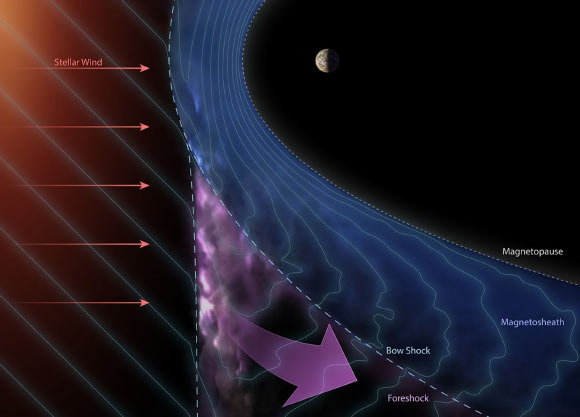
Jupiter Accelerates Electrons to Near-Light Speed, Offering Clues to Cosmic Ray Origins

The giant planet’s bow shock isn’t just deflecting the solar wind, it’s acting as a powerful particle accelerator, firing electrons to relativistic energies of at least 1 MeV, according to a new analysis of data from NASA’s Juno spacecraft.
The post Jupiter Accelerates Electrons to Near-Light Speed, Offering Clues to Cosmic Ray Origins appeared first on Sci.News: Breaking Science News.
NASA’s Fermi Telescope Caught a Supernova Doing Something Never Seen Before
NASA’s Fermi telescope may have finally uncovered the magnetic powerhouse behind the universe’s brightest supernovae. An international team of astronomers analyzing observations from NASA’s Fermi Gamma-ray Space Telescope has found what appears to be the first convincing detection of gamma rays from a rare type of extraordinarily bright stellar explosion known as a superluminous supernova. [...] The Physics of the Curse


Scientists Find a Smarter Way To Measure the Universe Using Exploding Stars
A new method could improve cosmology research by analyzing supernovae together with the galaxies that host them. An international collaboration led by scientists at the Institute of Cosmos Sciences of the University of Barcelona (ICCUB) has created a new approach that may sharpen what researchers can learn about how the Universe expands and what dark [...]