Des analyses isotopiques permettent de savoir si les 79 hommes menottés, enchaînés, de l’Esplanada étaient oui ou non des mercenaires étrangers, comme on l’a présumé.
La possibilité de séquencer des fragments d’ADN ancien a révolutionné l’étude du passé, même très lointain. Mais s’il constitue pour les paléogénéticiens une mine d’informations sur les populations humaines, le portrait qu’il en dresse reste incomplet.
La baisse exceptionnelle du niveau du Danube en Bulgarie a révélé des ossements de mammouth dans le nord du pays. Découverts par hasard par un habitant, ils seraient ceux d'un mammouth laineux de l'ère glaciaire.
Deux siècles durant, on a cru qu’un chamane métallurgiste avait été inhumé dans le tumulus d’Upton Lovell, à moins de 20 kilomètres de Stonehenge. Mais une analyse de son ADN révèle aujourd’hui une tout autre histoire.
Les routes de la soie sont-elles plus anciennes qu’on ne le pensait ? C’est ce que laissent entendre trois cocons de Bombyx mori mis au jour en Ouzbékistan. Datés du 2e millénaire avant notre ère, ils précèdent de 2000 ans l’établissement de la Route de la soie telle qu’on la conçoit généralement.
A Amazon solicitou à Comissão Federal de Comunicações (Federal Communications Commission, ou FCC) dos Estados Unidos uma licença para operar uma nova rede de 5.105 satélites destinada a fornecer serviços para dispositivos celulares, com planos de iniciar os lançamentos em 2028.
À época da notícia, inclusive, a Apple e a Amazon firmaram um acordo pelo qual a Globalstar operará em conjunto com a rede de satélites Leo 1Low Earth orbit, ou órbita terrestre baixa. da Amazon; de modo que ambas as redes sustentarão futuros serviços via satélite para a Maçã.
A Amazon Leo já anunciou um acordo com a Apple para viabilizar serviços via satélite para modelos compatíveis de iPhone e Apple Watch — incluindo SOS de Emergência via satélite, Mensagens, Buscar e Assistência Rodoviária via satélite — e para colaborar com a Apple em futuros serviços via satélite utilizando a rede expandida.
A Amazon planeja implantar cinco camadas orbitais projetadas para cobrir diferentes regiões do planeta. Três delas atenderão áreas densamente povoadas, enquanto as outras estenderão o serviço às regiões polares.
Il n’existait jusqu’à présent aucune preuve des fouilles qui ont mené en 1937 à la découverte des ossements d’Henri 1er de Saxe dans la cathédrale Saint-Servais de Quedlinbourg, ce qui a semé le doute sur leur réalité. Un document d’archive prouve qu’elles ont bien eu lieu, et que les nazis ne s’embarrassaient pas des détails de la science.
NASA’s Juno mission scientists have reported the first successful temperature measurements below the surface of Jupiter’s moon Io, including indications of significant heating within the moon’s shallow subsurface.
Collected during a pair of close flybys of the Solar System’s most volcanically active world, the Juno mission measurements were described as a complete “surprise” since the instrument was designed for a different purpose.
“[The readings] break new observational ground for both fiery and icy worlds beyond our planet,” the team said.
MWR Instrument Designed to Probe Jupiter’s Atmosphere Provides Double Duty
Due to the extreme gravitational pull of its host planet, Jupiter, Io is repeatedly stretched and pulled as its slightly elliptical orbit carries it around the massive gas giant. This repeated motion generates a tremendous amount of heat, which the scientists note is “many times greater” than the same type of heat generated on Earth.
However, a detailed understanding of this process has remained elusive, as the only data on the moon’s inner heat came from infrared telescope observations. The team notes this data is limited to the temperature of Io’s upper rocky surface layer.
Conversely, Juno is equipped with an instrument called the Microwave Radiometer (MWR). According to the team’s statement announcing the successful subsurface temperature detection, Juno’s Microwave Radiometer was custom designed by Scott Bolton, the mission’s principal investigator at Southwest Research Institute in San Antonio and a co-author of the study detailing the team’s findings, to “peer beneath Jupiter’s top clouds” for a closer look at the gas giant’s complex atmosphere.
“The MWR’s six microwave antennas serve as a single instrument, simultaneously detecting microwaves at a wide range of wavelengths, from about half an inch to 20 inches (1.3 to 51 centimeters),” the team explains.
“Everywhere We Looked, We Found the Temperature Rising”
Bolton said the team’s novel approach allowed the instrument to observe wavelengths from different depths, “providing a new way to characterize the deep atmosphere of giant planets and the subsurface crusts of icy and rocky moons.” This included observations of Jupiter’s other ‘Galilean’ moons, Ganymede and Europa.
“At Ganymede and Europa, we explored tens of miles below the surface, assuming their ice shells were mostly pure water,” the mission scientists explained.
However, Bolton added, using the instrument to successfully probe into Io’s volcanic rock “was an unexpected discovery.”
This map represents data captured by the Microwave Radiometer instrument aboard NASA’s Juno, indicating heat rising from just beneath the surface of Jupiter’s moon Io. The colors illustrate a distinct temperature gradient across the moon, with the most extreme, localized heat output in red. Image Credit: NASA/JPL-Caltech/SwRI/USGS.
The feat was accomplished during a pair of flybys on December 30, 2023, and February 3, 2024, where Juno came within roughly 930 miles (1,500 km) of Io’s surface. Shannon Brown, the paper’s lead author at NASA’s Jet Propulsion Laboratory in Southern California, said that during these flybys the MWR instrument measured the moon’s thermal emission “at depths ranging from a few inches down to tens of feet.”
“Everywhere we looked, we found the temperature rising by more than 40 degrees Fahrenheit just several feet into the surface — a gradient far steeper than solar heating alone can explain,” Brown said.
This graphic illustrates the areas of Io sampled by the Microwave Radiometer instrument aboard NASA’s Juno spacecraft during two close flybys of the Jovian moon. Image Credit: NASA/JPL-Caltech/SwRI/USGS.
Although more information is likely needed to make a conclusive determination, the team said that the data suggests two possible explanations for the readings. The first option is heat rising steadily through what the team termed a “conductive crust.”
“While this background heat flow — measured at 1 to 3 watts per square meter — is relatively gentle on a local scale (roughly equivalent to a small nightlight glowing under every square yard), across the entire moon it represents a release of energy up to 30 times Earth’s average,” they explained.
Another possibility proposed by the joint research team suggested that the heat signal detected by Juno’s MWR could be coming from cooling lava flows covered by 30 to 35 feet (9 to 11 meters) of solidified crust that cover approximately 10% of Io’s surface “at any given time.”
A Similar Instrument Could be Used to Scan Earth
When discussing the implications of the team’s findings, Bolton said the “surprising” ability to see below Io’s surface “has important implications for studying Earth’s volcanoes.” He also noted that if scientists used a similar instrument to measure areas on Earth near volcanoes, they might see a similar heat signature in the planet’s subsurface temperature gradient, “providing new information on how terrestrial volcanoes work.”
“Io provides a unique window into learning how tidal heating works throughout the cosmos, a fundamental process that provides energy and heat to worlds that are far from their parent star,” Bolton explained. “This process can not only create the most volcanic body in the solar system, in the case of Io, but also fuels the subsurface oceans on the moons of giant planets, such as Europa and Ganymede.”
“Up until this point, we could only observe the heat escaping at the surface or through eruptions,” the mission scientists added. “Now we can characterize how the heat is moving from the interior toward the surface.”
Christopher Plain is a Science Fiction and Fantasy novelist and has spent the last six years as Associate News Editor and Head Science Writer at The Debrief. Follow and connect with him on X, learn about his books at plainfiction.com, or email him at christopher@thedebrief.org.
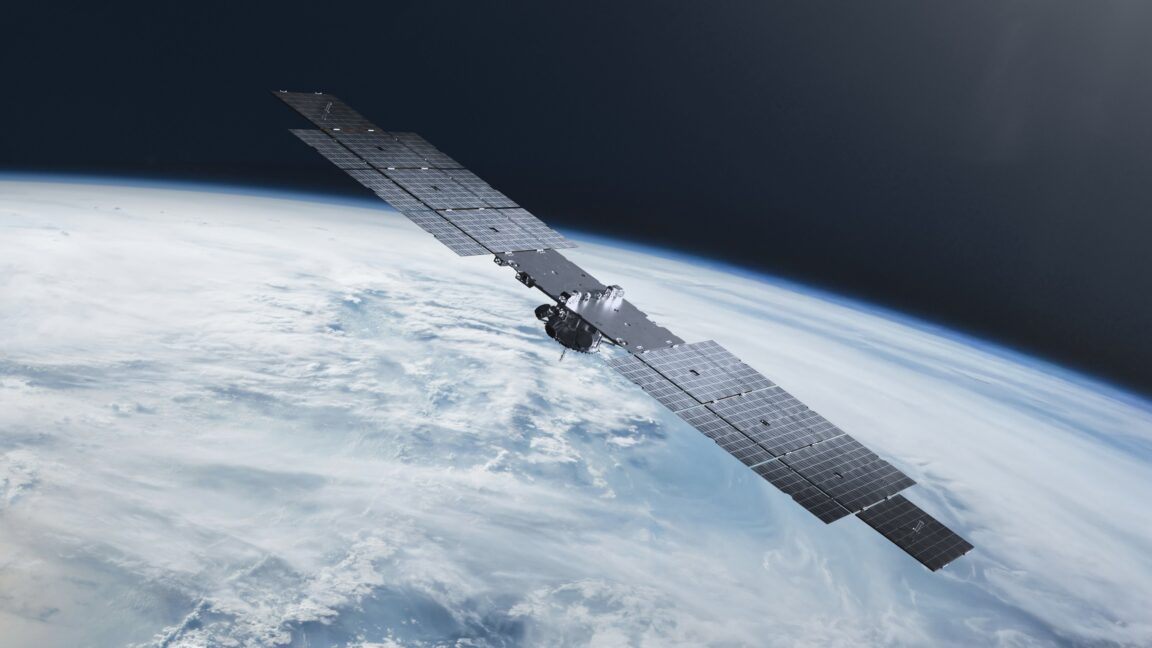
New navigation satellites in low-Earth orbit could provide 100 times stronger signal strength compared to GPS and other global navigation satellite systems operating from higher orbital altitudes—enabling greater location accuracy within dense cities, under thick foliage, and even inside buildings. Such signals would also likely prove more resilient to interference at a time when commercial flights, maritime shipping, and even various smartphone apps face increasingly widespread disruption from GPS jamming.
That vision may start to take shape when the first six production satellites of California-based Xona Space Systems are scheduled to launch in October 2026, with early service starting in 2027. Once the full constellation of 258 Pulsar satellites has been launched in the following years, Xona claims that customers will be able to accurately pinpoint their locations anywhere on Earth to within several centimeters.
“That added power means that we can get into that indoor environment that GPS can't get to today,” Adrien Perkins, co-founder and VP of engineering at Xona Space Systems, told Ars. “Our higher power allows you to get into those jamming environments a lot further than you would with GPS by itself.”
Des archéologues ont mis au jour une tombe vieille de 3.000 ans près de la ville de Louxor, dans le sud de l'Egypte, ont annoncé dimanche 12 juillet les autorités, qui espèrent stimuler le tourisme grâce à une série de découvertes.
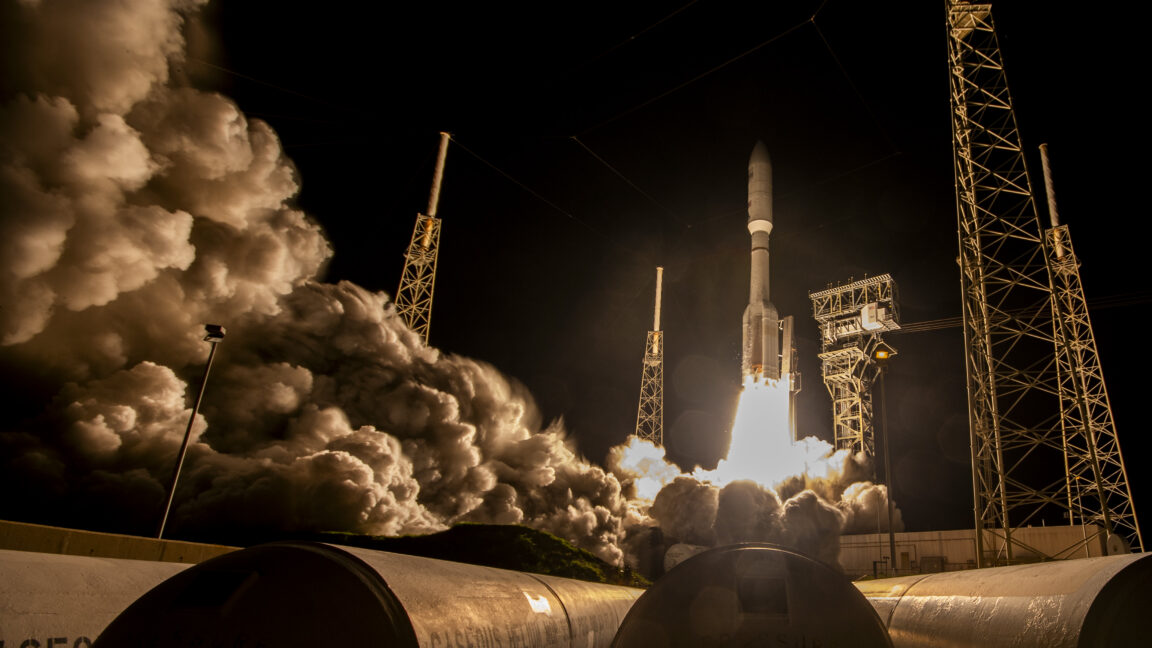
The final flight of United Launch Alliance's Atlas V rocket is still several years off, but an important era for the once-dominant launch company came to a close last week.
The final flight of an Atlas V for the Amazon Leo broadband constellation lifted off from Cape Canaveral Space Force Station in Florida at 12:30 am EDT (04:30 UTC) last Thursday, sending 29 satellites to orbit to move the network closer to providing initial services.
All 29 spacecraft deployed from the Atlas V rocket less than an hour after launch. They will use onboard propulsion to raise their orbits from an altitude of approximately 289 miles (465 kilometers) to their final operating positions at 392 miles (630 kilometers) above the Earth.
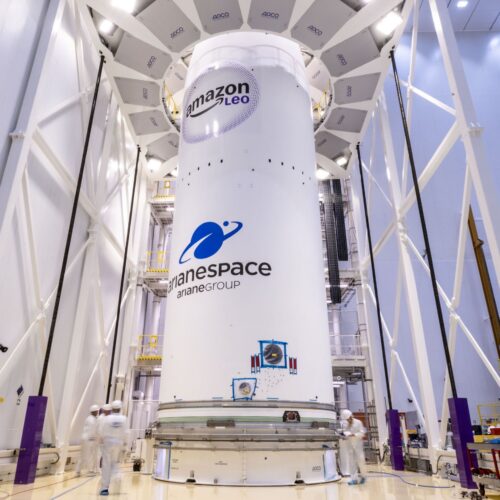
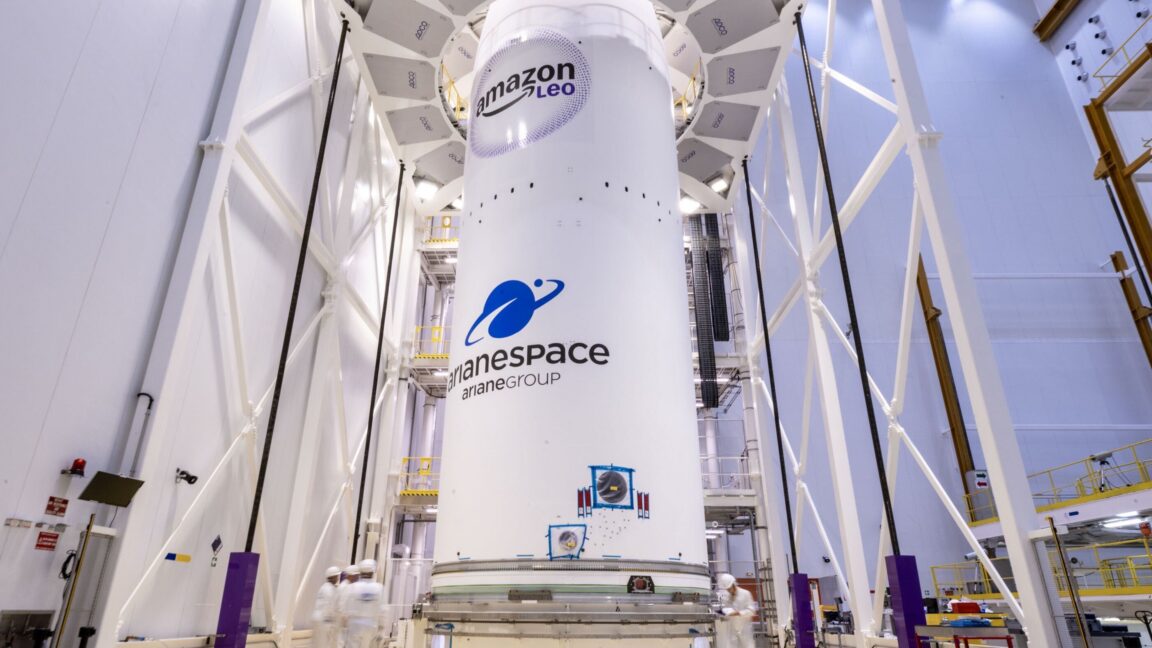
Marcando o oitavo voo consecutivo realizado com sucesso, o foguetão Ariane 6 colocou em órbita 36 satélites da constelação Leo da Amazon, aproveitando para bater o recorde europeu do voo mais “poderoso” de sempre.
An Ariane 6 with upgraded solid rocket boosters successfully launched three dozen Amazon Leo satellites June 17 as ESA weighs options for increasing the vehicle’s launch rate.
Amazon now has hundreds of flight-ready satellites standing idle in Florida, waiting to join the company's low-Earth orbit Internet constellation, an Amazon official said Tuesday.
"They're built, and sitting in a payload processing facility waiting for trips to orbit," said Steve Metayer, vice president of Amazon Leo Production Operations, during a teleconference with reporters. "And we're currently manufacturing several satellites a day."
Metayer spoke on the eve of the company's next mission, during which an Ariane 64 rocket will launch three dozen Amazon Leo satellites into orbit from a spaceport in French Guiana. Liftoff is targeted for 7:53 am ET (11:53 UTC) on Wednesday.
Le prochain vol de la fusée européenne Ariane 6 est prévu pour le 17 juin. Il s'agira du premier décollage dans cette configuration avec quatre nouveaux propulseurs plus puissants pour mettre en orbite la charge utile la plus importante jamais envoyée par ce lanceur.

 Login