❌

Reading view

La missione Juno della NASA, sotto la guida dello scienziato Scott Bolton d…

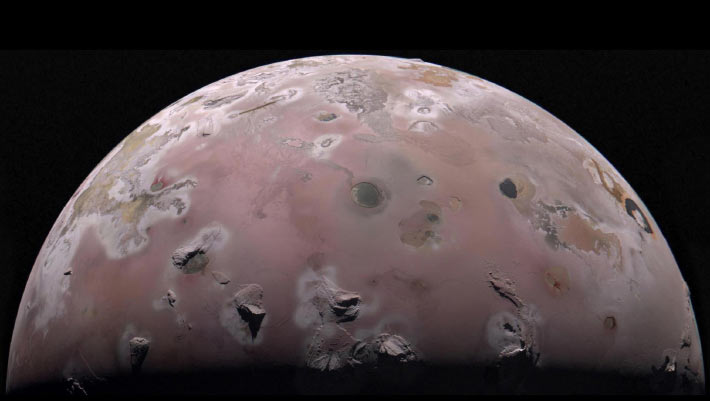
La missione Juno della NASA, sotto la guida dello scienziato Scott Bolton del Southwest Research Institute, ha rivelato la struttura interna di Io, la luna di Giove caratterizzata dalla piΓΉ intensa attivitΓ  vulcanica dell'intero Sistema Solare. Sottoposta a spaventose forze di marea gravitazionali da parte di Giove, Europa e Ganimede, la roccia di Io subisce un continuo attrito che genera un enorme calore interno. Le rilevazioni dello strumento JIRAM mostrano la presenza di un esteso strato magmatico sottocostale e bacini di lava (paterae) i cui strati superficiali sprofondano ciclicamente nel magma fuso, confermando l'esistenza di un pianeta la cui crosta Γ¨ in perenne e violenta trasformazione.
  •  

Juno’s Microwave Vision Peers beneath Surface of Jupiter’s Volcanic Moon Io

The north polar region of Io was captured by NASA’s Juno spacecraft on December 30, 2023. Image credit: NASA / JPL-Caltech / SwRI / MSSS / Gerald EichstΓ€dt.

New data from NASA’s Juno spacecraft show temperatures spike more than 20 degrees Celsius just a few meters under Io’s surface, providing the first look at what’s happening below the crust of the Solar System’s most volcanic world.

The post Juno’s Microwave Vision Peers beneath Surface of Jupiter’s Volcanic Moon Io appeared first on Sci.News: Breaking Science News.

  •  

Jupiter Accelerates Electrons to Near-Light Speed, Offering Clues to Cosmic Ray Origins

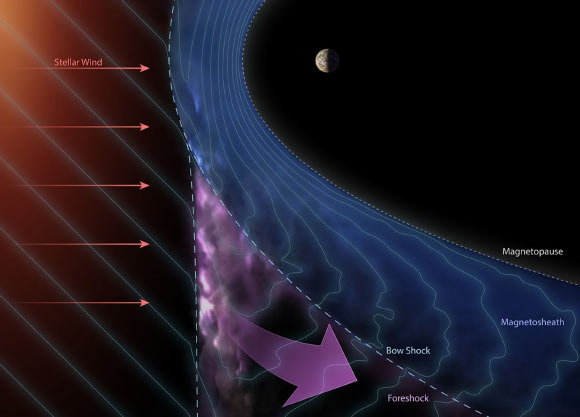
As planets and stars travel through the streams of charged particles flowing across space, their magnetic fields act like obstacles; incoming particles are slowed and deflected, forming a boundary called the bow shock; just ahead of this boundary lies the foreshock, a variable region where magnetic conditions can accelerate some particles to nearly the speed of light. Image credit: Ben C. Smith, Johns Hopkins Applied Physics Laboratory.

The giant planet’s bow shock isn’t just deflecting the solar wind, it’s acting as a powerful particle accelerator, firing electrons to relativistic energies of at least 1 MeV, according to a new analysis of data from NASA’s Juno spacecraft.

The post Jupiter Accelerates Electrons to Near-Light Speed, Offering Clues to Cosmic Ray Origins appeared first on Sci.News: Breaking Science News.

  •  
❌