
❌

Reading view

New class of magnons live a hundred times longer
University of Vienna researchers
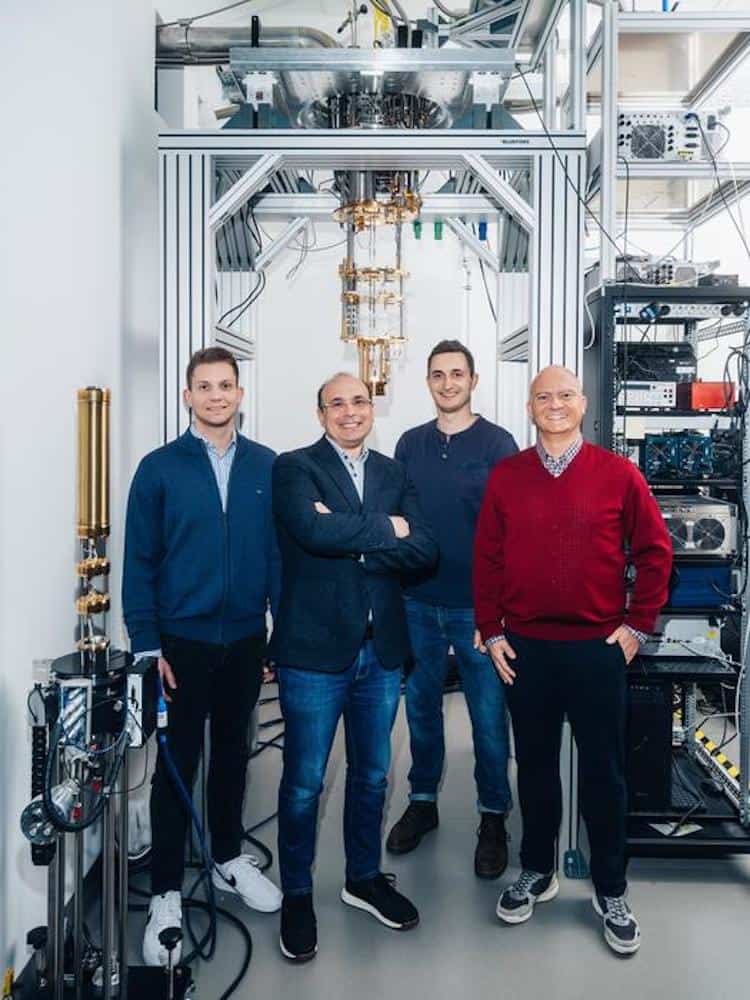
From left to right: University of Vienna researchers Rostyslav Serha, Andrii Chumak, David Schmoll and Sebastian Knauer standing in front of a cryostat. (Courtesy: Ian Ehm)

Bosonic quasiparticles such as magnons show much promise for enabling on-chip quantum information technologies that can be scaled down to the nanoscale, but their too-short lifetime has held back such applications until now. An international team of physicists says it has now increased this lifetime by a hundredfold, thanks to the discovery of a new class of magnons known as short-wavelength dipole-exchange magnons.

Magnons are the collective oscillations of coupled magnetic spins in a material. They are particularly promising for next-generation computing because they could allow for information processing based on the wave-like dynamics of these spins rather than the flow of electrons, thereby significantly reducing energy losses. They can also naturally couple to many other fundamental quasiparticles, such as phonons and photons, which makes them ideal as the building blocks for hybrid quantum systems.

The main drawback of magnons, however, is that they die too fast, explains Andrii Chumak of the University of Vienna, who led this latest study. “Indeed, their lifetimes are typically limited to a few hundred nanoseconds, something that puts a hard ceiling on what we can do with them in a quantum architecture.”

A lifetime of up to 18 µs

In this work, which is detailed in Science Advances, the researchers discovered short-wavelength dipole-exchange magnons in highly pure, single-crystal yttrium iron garnet (YIG) spheres held at millikelvin temperatures. These magnons last for up to 18 µs, which is nearly two orders of magnitude longer than that previously observed for these quasiparticles.

As often in science, the discovery was accidental, says Chumak. “We had prepared three YIG spheres with varying degrees of purity for planned quantum experiments with superconducting qubits, and we simply wanted to characterize these spheres and identify the one that hosted the longest magnon lifetime,” he recalls.

“An 18 microsecond lifetime places magnon coherence on a par with that of typical transmon superconducting qubits used in today’s quantum processors,” he tells Physics World. “This reshapes the role magnons can play in hybrid quantum architectures – from lossy intermediaries to robust quantum memories and low-loss links able to mediate interactions between distant qubits on a chip.”

A programmable on-chip “quantum bus”

And that’s not all: long-lived magnons coupled to superconducting circuits could act as a programmable on-chip “quantum bus”, entangling many distant quantum bits (qubits) made from these hybrid structures along a common waveguide, rather than only nearest neighbours, he adds. The results also point to a clear materials-science route to push magnon lifetimes even further, in particular by continuing to reduce rare-earth impurity concentrations in YIG.

There is a way to go before real-world applications see the light of day, however. For one, the researchers still have some physics to understand, but that is what makes the project so intriguing for them, they say.

Chumak says that the most immediate future step in his team’s work will be an echo-type experiment to measure the lifetime of these magnons directly, rather than inferring it from the so-called parametric instability threshold, as was done in this work. “In parallel, we will need to learn how to excite and detect these short-wavelength magnons efficiently using nanoscale transducers, which is essential before they can be integrated with superconducting qubits.”

“The field of quantum magnonics is still very young compared to other quantum platforms,” Chumak notes, “so it will take some time before we reach actual quantum computing applications – but the path is now much more concrete than it was a year ago.”

The post New class of magnons live a hundred times longer appeared first on Physics World.

  •  

Altermagnets can turn neighbouring materials altermagnetic, too

Altermagnets can transfer their unusual magnetic properties to nonmagnetic materials placed next to them, say theorists in China and the US. This so-called “proximity effect” had already been observed in ferromagnets and superconductors, but it is new for altermagnets, which were only recognized as a distinct class of magnetic materials in 2024. If confirmed experimentally, the team says the effect could aid the development of advanced quantum materials with applications in fields such as spintronics, valleytronics and fault-tolerant quantum computing.

In ferromagnets, proximity effects make it possible to tune properties such as magnetic anisotropy, coercivity and exchange bias in nonmagnetic materials that have acquired magnetic polarization from a neighbouring ferromagnet. Similarly, ordinary materials that have picked up superconducting correlations from a nearby superconductor are a mainstay of experiments on topological superconductivity and topological quantum computing.

In the latest research, physicists led by Tong Zhou of the Eastern Institute of Technology in Ningbo sought to understand whether altermagnets could likewise transfer their behaviour to a neighbouring material. To do this, they created a model of a van der Waals bilayer heterostructure in which the bottom layer is a two-dimensional (2D) altermagnet, V2Se2O, while the top layer is a non-magnetic semiconductor, PbO.

Zhou explains that the vanadium atoms in V2Se2O form two opposite-spin sublattices that are connected by rotational symmetry rather than by simple translation or inversion. This complex structure is what gives V2Se2O its characteristic altermagnetic spin splitting, with a band structure in which spin-up and spin-down electrons have different energies that vary in periodic patterns. V2Se2O also has a so-called spin texture, which is a pattern of spin polarization that produces a net zero magnetization in the material.

First-principles calculations

Using first-principles calculations, the researchers found that the distinctive symmetry-patterned magnetism of V₂Se₂O can indeed transfer into the PbO layer across the interface between them. As a result, Zhou says the originally spin-degenerate bands of PbO develop a clear momentum-dependent spin splitting.

Importantly, this pattern is not arbitrary. Instead, it follows the symmetry expected from the altermagnetic order of V2Se2O. What is more, the real-space spin density of the PbO mirrors the symmetry of the V2Se2O, showing that it has inherited altermagnetism rather than simply becoming generically spin polarized.

When the researchers rearranged the V2Se2O into a conventional antiferromagnetic configuration with no alternating spin splitting, they found that the induced splitting in PbO disappeared. They also observed that the degree of induced splitting decreases when the PbO is placed further away from the V2Se2O, confirming the proximity effect.

As a final piece of evidence, the researchers searched for similar proximity effects in other altermagnetic systems, ranging from insulators to metals and covering material platforms with 3D architectures as well as 2D ones. “Even graphene, one of the most common 2D materials, can acquire altermagnetic characteristics when interfaced with CrSb, which is an experimentally well-established altermagnet,” Zhou notes.

Altermagnets as interfacial “spin-pattern generators”

One of the work’s main implications is that altermagnets could be used to generate spin patterns in many otherwise non-magnetic materials, Zhou tells Physics World. “This means that instead of searching only for intrinsic altermagnets, we can now design ‘proximitized’ altermagnetic systems by combining an altermagnet with a semiconductor, metal or superconductor,” he says.

In semiconductors, Zhou notes, the altermagnetic proximity effect can induce controllable spin and valley splitting, which are promising for spintronics and valleytronics devices, respectively. In superconductors, meanwhile, the effect can generate momentum-dependent spin splitting without the need to apply an external magnetic field or introduce net magnetization – something that Zhou says offers a new route toward topological superconductivity and the Majorana modes that could revolutionize fault-tolerant quantum computing. “More generally, this effect provides a versatile platform for designing field-free spin devices, topological quantum devices and multifunctional van der Waals heterostructures,” he says.

Looking ahead, Zhou and colleagues say they would now like to observe the altermagnetic proximity effect in heterostructures fabricated in the laboratory. They also want to find out how to control the strength of the effect – for example, by changing interlayer spacing, stacking, strain, gating and possibly even layer twisting.

“More fundamentally, an important question is how fast and how reversibly altermagnetic order, and therefore the altermagnetic proximity effect, can be reconfigured dynamically,” Zhou says. “That would be especially interesting for controlling spin-dependent transport and topological phases in real time.”

The research is described in  Physical Review Letters.

The post Altermagnets can turn neighbouring materials altermagnetic, too appeared first on Physics World.

  •  

Pigeons’ immune system can sense Earth’s magnetic field, study suggests

Some animals could sense Earth’s magnetic field by using the superparamagnetic properties of white blood cells in their livers, a new interdisciplinary study has revealed. Led by Clivia Lisowski at the University of Bonn, the team’s insights into homing pigeon navigation could help scientists resolve the decades-old mystery of how animals can sense magnetic fields. The research also shines new light on the inner workings of the immune system.

Animals ranging from sharks to bats appear to use Earth’s magnetic field to navigate during long migratory voyages. However, the nature of this magnetoreception is poorly understood.

“How they sense Earth´s magnetic field has been a mystery,” Lisowski explains. “Several hypotheses were suggested, but these have often resulted from laboratory experiments. They were hardly ever done in the field, and so couldn’t explain how migration would work at night or in dark environments.”

In their study, Lisowski’s team investigated the origins of magnetoreception in homing pigeons. These birds are famous for finding their way back home after being released in unfamiliar locations. “We combined expertise from research fields that usually are not intersected, namely immunology, physics and animal behaviour,” Lisowski explains. “[This gave] us a truly interdisciplinary approach to solve the mystery of magnetoreception in homing pigeons.”

Searching for magnetism

As part of this approach, the researchers searched for magnetism in several different tissues of the bird – including the liver, spleen, muscle, and beak. They used vibrating-sample magnetometry (VSM), whereby samples are placed in a constant magnetic field and vibrated up and down. If the sample is magnetic, it will induce an electric field that is proportional to its magnetization.

The team also did field studies of homing pigeon flight patterns and studied the birds’ anatomy. The latter involved using dyes to visualize microscopic structures embedded in tissues along with genomic assays of the tissues.

This combined analysis revealed the presence of superparamagnetic macrophages in homing pigeon livers. Macrophages are specialized white blood cells whose primary function is to engulf and digest pathogens. They are a cornerstone of the immune system. Superparamagnetic means that the macrophages are very easily magnetized.

“The macrophages are superparamagnetic due to their physiological function of degrading old and damaged red blood cells,” Lisowski explains. “They sequester and store the iron from red blood cells as oxide nanoparticles in ferritin proteins.”

Connecting to the brain

Within homing pigeon livers, the researchers found that these macrophages were often in the vicinity of – and sometimes even in direct contact with – nerve fibres in liver tissue. This could allow magnetic information to be passed from macrophages to the brain.

At the atomic level, Lisowski’s team proposes that the effect emerges from unpaired electrons in ferritin proteins, which interact with each other through magnetic dipole–dipole coupling to enhance their magnetic susceptibility. This subatomic effect could in turn explain the distinctive circling behaviour observed in pigeons after they take off. This circling could allow these unpaired electrons to be imprinted with magnetic information, before the birds settle into a more uniform flight.

The research could also improve our understand of the immune system. The team suspects that the sensing abilities imparted by their superparamagnetic properties could enable macrophages to better gauge their surrounding environments: distinguishing between what to fight, and what to tolerate.

“Our finding that the immune system can also sense the Earth´s magnetic field is a completely new layer in this concept of ‘immuno-sensation’, and opens the door to new research,” Lisowski says.

The research is described in Science.

The post Pigeons’ immune system can sense Earth’s magnetic field, study suggests appeared first on Physics World.

  •  
❌