❌

Reading view

‘LION’ – new TV series chronicles four-year journey of lion cub Kio

It’s very much a real-life doco version of ‘The Lion King’, with Jon Favreau executive producing, and music from Hans Zimmer echoing themes from the Disney classic. It took Disney+ and BBC Studios’...

The post ‘LION’ – new TV series chronicles four-year journey of lion cub Kio first appeared on Science Illustrated.

  •  

What conservation looks like from the outside: A conversation with Adam Falk after his first year as CEO of WCS

Soon after becoming president and chief executive of the Wildlife Conservation Society, Adam Falk visited the giraffe keeper at the Bronx Zoo. What struck Falk was the source of the keeper’s commitment. If a giraffe needed help in the middle of the night, he said, the keeper would come in because of his bond with the animal. Falk recognized something familiar. Before joining WCS, he had been a theoretical physicist, a professor at Johns Hopkins University, president of Williams College, and president of the Alfred P. Sloan Foundation. Academics often pursue highly specialized work that matters deeply to them. A university leader has to support those individual efforts while helping the institution work toward shared goals. Falk found much the same challenge at WCS: leading people whose motivation is rooted in the work itself. Adam Falk with Joe Nappi, a Senior Keeper in the Mammal Department, and a Giraffe at the Bronx Zoo. Photo courtesy of WCS. He took over WCS in July 2025 without professional experience in zoology or conservation. That was unusual for the head of an institution founded in 1895, which now operates four zoos and an aquarium in New York alongside conservation programs in more than 50 countries. His first year gave him an outsider’s view of a field with its own history and assumptions. One of his early observations was that conservation work involves people as much as animals. Public campaigns often focus on wildlife, especially large and familiar species. Field programs depend on relationships…This article was originally published on Mongabay

  •  

New ropeways aim to save wildlife in Bangladesh’s fragmented habitats

As Bangladesh is rapidly being urbanized, more and more forests are getting fragmented, resulting in the construction of more roads, which means more wildlife are being killed in collisions with vehicles. To address these wildlife deaths, the Forest Department’s Tangail Divisional Office has recently facilitated a low-cost solution. At a total cost of 625,000 takas (around $5,000), ropeway bridges have been installed in northern Bangladesh at five locations along an 8-kilometer (5-mile) stretch of the Mymensingh-Tangail Highway N401, which slices through the reserved forest of Madhupur National Park, where heavy-duty vehicles regularly collide with wildlife, especially primates. “These ropeways are expected to protect rhesus macaques, capped langurs, Indian civets and small carnivores like fishing cats from roadkill,” Tangail divisional forest officer Abu Naser Mohsin Hossain told Mongabay. According to a 2018 study, the 8,436-hectare (20,845-acre) Madhupur National Park, the largest deciduous forest of Bangladesh, supports 151 wildlife species belonging to 23 orders and 62 families. According to available data that the Forest Department has from local sources, rhesus macaques (Macaca mulatta) are most frequently killed in road accidents during the day. However, none of the roadkill in Madhupur can be documented, because the forest dependent Indigenous community here consumes the carcasses soon after an accident, said Md. Mossarrof Hosain, a deputy ranger at the Madhupur National Park. Naser said that the nylon-rope bridges are expected to provide safe aerial corridors for arboreal animals, both nocturnal and diurnal. Each is 30 meters (100 feet) long and almost 1-meter (3-feet) wide and…This article was originally published on Mongabay

  •  

In Amazon rivers, fish breathe and ingest plastics

This is the second story in a special three-part series on microplastics in the Amazon. Read the first part here. MANAUS, Brazil — In Amazonian waters, the pirarucu lives between two worlds. In the oxygen-depleted waters typical of floodplain lakes, this giant fish rises to the surface to breathe air. Over an evolutionary history spanning at least 100 million years, it developed a modified swim bladder that functions as a primitive lung. This rare adaptation has allowed it to thrive in environments that are too harsh for other fish species. Today, however, the very adaptation that ensures its survival makes it vulnerable to a new threat: Microplastic pollution. “Amazonian environment is already highly challenging,” said Adalberto Val, a biologist and head of the National Institute of Science and Technology for Adaptations of Aquatic Biota of the Amazon (INCT-Adapta). “Here we have high temperatures, low oxygen levels in the water … Organisms already respond to these challenges as they learned during the evolutionary process. Then we start adding new challenges, like plastic.” When breathing becomes a risk Pirarucus (Arapaima gigas) cannot survive for more than 10 minutes without surfacing for air. They rely on an air-breathing organ connected to their modified swim bladder, a necessity that puts them in direct contact with microplastics floating at the surface. Drawing on established knowledge about the species, Val and researchers from the University of British Columbia in Canada published an article outlining the dangers of this exposure. When microplastics enter the pirarucu’s air-breathing organ,…This article was originally published on Mongabay

  •  

Mariano Cenamo, advocate for a sustainable Amazon bioeconomy, has died, aged 46

For people trying to protect the Amazon, one problem has persisted for decades. A hectare of intact forest stores carbon, regulates water, supports wildlife, and provides food and materials for the people who live there. Much of that value does not appear in an economic ledger. Cattle, timber, soy, and gold do. For a farmer, a company, or a local government, clearing forest can therefore produce income more readily than keeping it standing. The Amazon bioeconomy grew from efforts to change that calculation. It includes forest products, agroforestry, biotechnology, carbon markets, and other businesses that depend on maintaining living forests. The aim is to make such activities commercially viable at a scale that matters. Mariano Cenamo spent most of his career working on that problem. He was 23 when he moved from São Paulo to Manaus in 2003. Trained as a forestry engineer at the University of São Paulo, he had first come to the Amazon for an internship. He stayed at the encouragement of Virgílio Viana, a former professor who was then Amazonas state’s environment secretary. Cenamo was struck by the gap between conservation work and the economic realities of people living in the forest. Environmental groups were doing important work, he later recalled, but local livelihoods often sat outside the conservation discussion. In 2004 he helped establish what became Idesam, the Institute for the Conservation and Sustainable Development of the Amazon. At first there was barely an institution. Cenamo later described himself as an “ING”, an indivíduo não…This article was originally published on Mongabay

  •  

‘This is what’s working’: Indigenous leaders on environment solutions in their communities

Eriberto throws his head back with a laugh and shakes it as he tills his plot of land in the Peruvian Amazon, near the Cordillera Azul National Park in central Peru. “That does not work here,” he says with a chuckle, responding to a question about why he doesn’t call his diverse forest garden “agroforestry”. In the past, government officials promoted planting coffee or cacao in agroforestry systems near his community. But Eriberto Guerra and other Indigenous farmers in the town of Lamas say it hasn’t been effective enough and some have rejected the sustainable farming label. “They promoted growing just one or two other food crops with some trees,” Guerra tells Mongabay. “But you need to plant dozens of species along with traditional plants. When one crop fails or doesn’t perform well in the local market, you need to have others to make up for it. And those others need to be the right crops, planted the right way, near the right plants.” His forest garden attracts endemic bird species and wildlife researchers, and has sustained his family for a decade, he says. “This is what is working,” Eriberto says. To mark the International Day of the World’s Indigenous Peoples and better understand the subtleties in biodiversity conservation and climate solutions implemented by people living at the frontlines, Mongabay interviewed nine Indigenous representatives from around the world. Dami Tateburuk, Frengky Sabbattilat, Ismael Saumanuk and Vincent Tateburuk (left to right), part of Malinggai Uma Tradisional Mentawai, a grassroots, Indigenous-led organization…This article was originally published on Mongabay

  •  

Amazon deforestation alerts fall to lowest level since 2013, Brazilian data show

Deforestation in the Brazilian Amazon has fallen to its lowest level in 13 years, according to new satellite data from Brazil’s National Institute for Space Research (INPE), continuing a decline that began after President Luiz Inácio Lula da Silva returned to office in 2023. INPE’s DETER alert system detected 2,874 square kilometers (1,110 square miles) of deforestation in the Amazon between August 1, 2025, and July 31, 2026. That was 36% below the previous 12-month period and 55.6% below the average of the preceding decade. The total is the lowest since INPE introduced the current DETER system in 2015. Including data from its predecessor system, the last time alerts were lower was the 2012/13 deforestation year, when 2,766 sq km were recorded. Accumulated deforestation for Aug 1-Jul 31 in recent years according to INPE’s DETER alert system. Image by Mongabay DETER is designed as a rapid-response system for enforcement agencies. It uses satellite imagery to identify new forest clearing quickly enough for authorities to investigate and intervene. It differs from PRODES, INPE’s higher-resolution annual monitoring system, which provides Brazil’s official deforestation rate. Preliminary PRODES figures for the year ending July 31 are expected in October or November. PRODES data for the year ending July 2025 had already put Amazon forest loss at its lowest level in 11 years. The latest DETER figures indicate that clearing fell further during the following year. If PRODES shows a decline similar to that recorded by DETER, Brazil could register its lowest official Amazon deforestation…This article was originally published on Mongabay

  •  

From small cats to pangolins: Detection dogs help track elusive species

In the grassy dwarf shrublands of South Africa’s Karoo, Michelle Marie Schroeder is looking for a very specific kind of poo. Black-footed cats spend most of the day hidden in burrows and emerge mainly under the cover of darkness, making them notoriously difficult to study. That’s why the conservation biologist relies unconventional assistants: Lyka and Sebala, two German Shorthaired Pointers trained to detect the cats’ scat by scent. When the dogs find a sample, they lie down and remain still to alert Schroeder, who works with the non-profit Canines for African Nature. Working on her own, Schroeder found just four scats in more than a year. Ten-year-old Lyka, by contrast, has located hundreds of samples in just a few months, providing the basis for non-invasive genetic monitoring of Felis nigripes. “I probably wouldn’t have found more than 90% of the scats without help,” she tells Mongabay. “And it’s also very difficult to distinguish them from those of other small carnivores. The dogs are much more accurate.” Lyka has located hundreds of black-footed cat scat samples, making non-invasive monitoring of the elusive species possible. Image courtesy of Veer Bills. On the trail of the black-footed cat Hal Brindley, a researcher at the Institute for Communities and Wildlife in Africa at the University of Cape Town, also studies these small, cryptic predators. “Studying the black-footed cat is incredibly difficult without resorting to invasive methods like trapping and collaring,” he says. “More common non-invasive approaches, such as camera trapping, are often ineffective. Fecal…This article was originally published on Mongabay

  •  

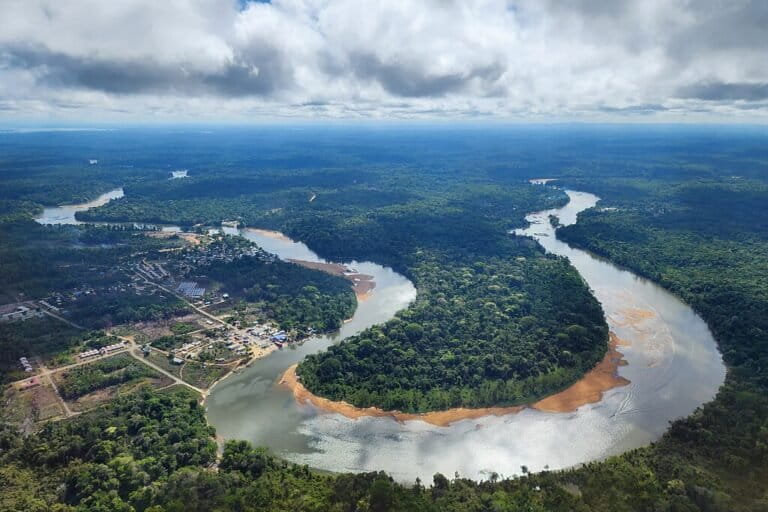
Suriname moves to evict Mennonites and illegal Amazon settlers

The government in Suriname has started toughening up on land developers who illegally clear the Amazon Rainforest for agriculture and cattle ranching, according to Suriname President Jennifer Geerlings-Simons, speaking at an Aug. 4 press briefing. In recent months, officials have started investigating illegal settlements and revising zoning for hundreds of thousands of hectares of mostly primary forest, previously set aside for agribusiness. Many areas under development are connected to Mennonites, a conservative Christian group who migrated to the country from other parts of the region, with plans to establish religious farming communities. “The people who are active there in the interior and have cleared land to live there, are there illegally,” Geerlings-Simons said during the briefing. “And that means that we’re going to take measures against them.” In 2023, Mongabay revealed that private agribusiness investors were working with the government to develop a Mennonite pilot program, in which around 1,000 families would be relocated from Bolivia — and possibly other parts of the region — onto as much as 30,000 hectares (about 74,000 acres) of land in interior departments of Suriname. In 2023 and 2024, Mongabay also published stories detailing the government’s plan to transfer around 467,000 hectares (1,153,982 acres) of mostly primary rainforest from the Ministry of Land Policy and Forest Management to the Ministry of Agriculture, Livestock and Fisheries (LVV) for future agribusiness development projects. Geerlings-Simons during the press briefing Aug 4. Image courtesy of Key tv 8.2 Backlash to the plans focused on Suriname’s 93% forest cover…This article was originally published on Mongabay

  •  

James Marsden to star in Apple TV comedy ‘Bad News Dads’ from Stephen Falk and Berlanti Productions

Apple TV

According to an exclusive report from Deadline’s Nellie Andreeva, Apple TV is developing “Bad News Dads,” a half-hour comedy starring and executive produced by James Marsden. The project comes from “You’re the Worst” creator Stephen Falk, alongside Berlanti Productions and Warner Bros. Television, where Greg Berlanti holds an overall deal.

Based on the upcoming novel by Adam Frost, the series follows an inept men’s recreational baseball league. When one player’s wife dies in a suspicious accident, friendship-starved Ben (played by Marsden) rallies two teammates for an often-misguided investigation into what they increasingly believe was murder. While the title and baseball setting nod to “The Bad News Bears,” the story is an original concept with no direct connection to the classic sports film.

Falk, Marsden, and Frost executive produce with Greg Berlanti, Sarah Schechter, Leigh London Redman, and Robbie Rogers for Berlanti Productions. Frost’s novel is scheduled for publication on April 6, 2027, by Simon & Schuster/Atria/Emily Bestler Books.

The project continues Apple TV’s interest in mystery-comedy fare, a genre boosted by series like “The Afterparty” and Hulu’s “Only Murders in the Building.” It also extends Marsden’s recent work with the streamer: he recently appeared in “Your Friends & Neighbors” and stars in and executive produces the upcoming action thriller “Disavowed.” Marsden, known for alternating between drama and comedy (with Emmy nominations for both “Paradise” and “Jury Duty”), next reprises Cyclops in “Avengers: Doomsday.”

Falk, whose other credits include Apple TV’s “Hello Tomorrow!,” Netflix’s “Orange Is the New Black,” and Showtime’s “Weeds,” also has a “Hit Man” series inspired by the Glen Powell film in development at Netflix. Berlanti Productions has multiple projects advancing elsewhere, including series at Amazon MGM Studios and Disney+.
‎
MacDailyNews Note: Apple TV is available on the Apple TV app in over 100 countries and regions, on over 1 billion screens, including iPhone, iPad, Apple TV 4K, Apple Vision Pro, Mac, popular smart TVs from Samsung, LG, Sony, VIZIO, TCL and others, Roku and Amazon Fire TV devices, Chromecast with Google TV, PlayStation and Xbox gaming consoles, and at tv.apple.com, for $12.99 per month with a seven-day free trial for new subscribers. For a limited time, customers who purchase and activate a new iPhone, iPad, Apple TV 4K or Mac can enjoy three months of Apple TV for free.

Watch on Apple TV


‎
Please help support MacDailyNews — and enjoy subscriber-only articles, comments, chat, and more — by subscribing to our Substack: macdailynews.substack.com. Thank you!

Support MacDailyNews at no extra cost to you by using this link to shop at Amazon.

The post James Marsden to star in Apple TV comedy ‘Bad News Dads’ from Stephen Falk and Berlanti Productions appeared first on MacDailyNews.

  •  

Decades after bottom trawling, Chilean seamounts remain degraded

The scars of bottom trawling are still visible on seamounts in Chile’s Juan Fernández Archipelago, even 25 years after the fishing practice took place in the area, according to a new study. In 2024, scientists from Chile and the U.S. used remotely operated vehicles aboard the Schmidt Ocean Institute’s research vessel R/V Falkor to survey four seamounts, underwater mountains that rise up from the seafloor, off Chile’s coast. Three of the seamounts are located in the Juan Fernández Archipelago, a cluster of volcanic islands that has one of the highest known rates of marine endemism on the planet. An estimated 62% of the reef fish species of Juan Fernández and the neighboring Desventuradas Islands are found nowhere else in the world. Other unique endemic species include the Juan Fernández fur seal (Arctocephalus philippii) and the Juan Fernández rock lobster (Jasus frontalis).  The fourth study site was the Solito Seamount, located north of the Juan Fernández Archipelago and known to harbor similar marine communities. In the late 1990s and early 2000s, fishers conducted bottom trawling on the Juan Fernández seamounts, dragging weighted nets across the seafloor to catch orange roughy (Hoplostethus atlanticus) and alfonsino (Beryx decadactylus), long-living, deep-sea fish. After catches dwindled, these fisheries collapsed and the trawling stopped. Later, in 2015, Chile permanently banned bottom trawling on all of its seamounts. At Solito, by contrast, the study, published in July in Deep Sea Research, found no evidence that bottom trawling had ever occurred. Twenty-five years after bottom trawling had taken…This article was originally published on Mongabay

  •  

Sacred places & living lands: How Indigenous Sámi peoples steward biodiversity (analysis)

Modern conservation is often traced to the establishment of Yellowstone National Park in the U.S. in 1872. In Sweden, a similar milestone came with the founding of Sarek National Park in 1909, partly intended to protect the endangered brown bear of the far north. Yet, long before states established national parks and environmental agencies, people across the world protected landscapes through religion, customary law, and Indigenous stewardship. In Japan, Shinto shrine forests have been preserved for centuries. In India, villagers continue to maintain sacred groves. Ethiopia’s churches and monasteries are often encircled by protected forests, while parts of rural Italy still contain sacred landscapes rooted in traditions older than Christianity itself. Some are associated with Francis of Assisi, the patron saint of animals and ecology; others may descend from sites once dedicated to Jupiter. A growing body of research suggests that such places have often functioned — intentionally or otherwise — as informal systems of conservation. In 2021, the researcher Piero Zannini and his colleagues published a systematic review of sacred natural sites and biodiversity conservation. Examining studies from around the world, they found that sacred natural sites frequently contained greater biodiversity, more intact vegetation, and better-preserved ecosystems than surrounding landscapes. Sacred places, they argued, often operate as effective forms of conservation grounded not in state bureaucracy or scientific management, but in cosmology, ritual, and local tradition. Sami people in Enontekiö, Finland, at the summit of Saana Fell, which they consider sacred. Image by Ninara via Flickr (CC BY 2.0).…This article was originally published on Mongabay

  •  

As Canada’s captive belugas arrive in the US, questions linger about their future

Thirteen beluga whales, part of a pod of about 30 that were left languishing in a shuttered Canadian theme park, arrived in the U.S. The first transfer of six whales happened on July 21, and another seven were shipped out on August 3. These whales are part of the emergency transfers from Canada’s Marineland to their new homes in the U.S., marking the beginning of the end to a year-long saga of uncertainty. Shipped in specialized, cold-water containers, the belugas (Delphinapterus leucas) traveled for hours, on trucks and a plane, to two U.S. facilities: nine individuals went to SeaWorld in San Antonio, Texas, and four females to Shedd Aquarium in Chicago, Illinois, in two batches. Marine mammal veterinarians accompanied the cetaceans throughout their journeys, according to a press release from Georgia Aquarium. A spokesperson from the Atlanta-based aquarium said in an email it hopes to receive two beluga whales from Marineland in subsequent transfers. The international transfer came to fruition after several aquariums, all accredited with the U.S.-based Association of Zoos and Aquariums (AZA), drew up an emergency rescue plan earlier this year to transfer the belugas out of Marineland. These cetaceans had spent years at the theme park in Niagara Falls, Ontario. In 2019, Canada passed the landmark Ending the Captivity of Whales and Dolphins Act, which banned the keeping, breeding and trading of cetaceans — whales, dolphins and porpoises — for entertainment, affecting Marineland’s business model. By 2021, Marineland was Canada’s only entertainment park with cetaceans and was…This article was originally published on Mongabay

  •  

A banana byproduct transforms farm waste into profits in Bangladesh

Bananas make up 20% of all fruit crops grown in Bangladesh, and the country has begun to unlock the hidden potential of the plant’s agricultural byproducts. Banana fiber, extracted from post-harvest stems, is emerging as a versatile biodegradable material that can be used to manufacture textiles, blended yarns and handicrafts. In Bangladesh, banana fiber is used to make handcraft biodegradable items like the highly celebrated Kolaboti saree, curtains, mats, bags, handicrafts, ropes, paper, packaging material and eco-friendly composite products . According to World Population Review data, Bangladesh ranked 27th in global banana production in 2024, producing roughly 813,600 tons annually. India was the largest producer, with about 37.6 million tons. A 2024 study shows that Bangladesh could produce around 37,800 tons of banana fiber annually and generate more than $94 million in export earnings if the sector is commercialized effectively. In the Bangladeshi market, banana fiber is sold by some small and medium entrepreneurs for around 150 takas to 500 takas per kilogram (roughly $1.20 to $4 for 2.2 pounds). Processed and dyed banana fiber. Image by Mahmudul Hasan. The study also shows that Bangladesh has significant potential for banana fiber production because banana is cultivated across 54,756 hectares (133,305 acres) of land. The country generates substantial biomass from banana pseudo-stems, estimated at around 3.78 million tons annually, of which approximately 1% can be extracted as fiber. According to the study, banana fiber is generally more cost-effective on the raw material end because it uses agricultural waste, while jute requires…This article was originally published on Mongabay

  •  

Thermal drones deployed in Kenya’s Amboseli Park to tackle human-elephant conflict

Dominic Mutua, a smallholder farmer from Inkoisuk village some 30 kilometers (19 miles) from Amboseli National Park, has often clashed with two elephants that enter his farm and destroy crops. “We had to stay up guarding most nights and chasing them away,” Mutua told Mongabay in a telephone interview. The 2025 census conducted by the Kenya Wildlife Service (KWS) recorded a population of 42,072 elephants (Loxodonta africana) in Kenya, 1,903 of which were counted in the Amboseli park and its surrounding areas. The absence of a perimeter fence means elephants can move freely beyond the national park’s boundaries. To address human-wildlife conflict in this remote rural region of southern Kenya, drones equipped with thermal-imaging technology enable conservation teams to monitor animal movement, detect wildlife at night and warn communities early before encounters escalate. Amy Baird, Deputy Director of the Big Life Foundation, says that aside from data collection, the drones can also safely deter elephants from entering farms and settlements by guiding them away from these areas. The US-based nonprofit works with communities to protect elephants and conserve habitats in the larger Amboseli ecosystem. An Amboseli elephant. Image courtesy of Big Life Foundation. Approximately 200,000 people live within the park and in the broader Amboseli region, which encompasses about 8,093 square kilometers (3,125 square miles) of rangelands, wetlands and wildlife corridors, according to the park’s management. As the park itself covers only 392 sq km (151 sq mi), its survival depends heavily on the health of the surrounding community lands.…This article was originally published on Mongabay

  •  

Flames reach edge of orangutan rehabilitation center, with fire season set to intensify

JAKARTA — A wildfire that reached the edge of an orangutan rehabilitation center in western Borneo is highlighting how Indonesia’s intensifying fire season threatens not just forests and wildlife, but also the conservation work taking place within them. The fire stopped just short of the facility run by the nonprofit organization YIARI, where more than 60 critically endangered Bornean orangutans (Pongo pygmaeus) are undergoing rehabilitation after being rescued from the illegal wildlife trade and habitat loss. The fire broke out on July 22 about 1 kilometer (0.6 miles) from the center in Sungai Awan Kiri village, Ketapang district, West Kalimantan province. Thick smoke blanketed the area as nearly 100 personnel from government agencies, the military, police and YIARI fought for hours to stop the flames before they reached the facility. “The fire reached the boundary of the rehabilitation center’s land,” YIARI CEO Karmele Llano Sánchez told Mongabay. Aerial view of the fire that broke out on July 22, 2026, about 1 kilometer (0.6 miles) from YIARI’s orangutan rehabilitation center in Sungai Awan Kiri village, Ketapang district, West Kalimantan province. Image courtesy of YIARI. She said the incident highlighted the importance of being prepared for fires. “If we had not responded quickly, part of our rehabilitation center might already have been destroyed by the fire,” Llano Sánchez said. Satellite imagery of the fire that broke out on July 22, 2026, about 1 kilometer (0.6 miles) from YIARI’s orangutan rehabilitation center in Sungai Awan Kiri village, Ketapang district, West Kalimantan province. Red…This article was originally published on Mongabay

  •  

On the front lines of conservation in Sumatra: Rangers safeguard Batutegi forest

TANGGAMUS, Indonesia — For more than a decade and a half, forest ranger Wandi Harmoko has walked the ridges and valleys of Batutegi, a landscape in southern Sumatra. He is one of only a handful of officers tasked with patrolling almost 60,000-hectares (148,300 acres) of forest that is not only ecologically significant but also economically vital to Lampung province. The forest Wandi protects today has been shaped by decades of disturbance. Since the turn of the century, waves of encroachment cleared large areas of forest to accelerate conversion to coffee plantations. Nevertheless, the forests here still harbors endangered wildlife, including Sumatran tigers (Panthera tigris sumatrae), siamang (Symphalangus syndactylus), pangolins (Manis javanica), Sumatran slow lorises (Nycticebus coucang) and sun bears (Helarctos malayanus). The survival and recovery of what remains in Batutegi depend on a fragile collaboration between a limited number of rangers, technology-driven monitoring systems, and social forestry farmers whose livelihoods are tied to the landscape. “What affects me most are the moments when we still encounter forest encroachment,” Wandi told Mongabay after joining his team for a day patrol inside Batutegi’s core zone. “It creates an inner conflict, because sometimes we have to arrest people and see them go to prison, even though we understand their situation.” Wandi Harmoko has patrolled the forest of Batutegi for over a decade. Image by Basten Gokkon. The Batutegi landscape, including a reservoir with the same name, stretches across 81,741 hectares (202,000 acres) jointly overseen by two forest management units (KPH), namely KPH Batutegi…This article was originally published on Mongabay

  •  

How social media and parrotfish poop are protecting the Maldives

It started six years ago when Shaha Hashim began seeing posts across social media: Vulnerable and protected species were being fished throughout the atoll islands of the Maldives, and some were even turning up in fish markets. This included animals like the giant clam (genus Tridacna), Napoleon wrasse (Cheilinus undulatus), and even species of parrotfish (subfamily Scarinae). These species weren’t historically targeted by Maldivian fishers, but were rising in popularity over the last decade. This came to a head in the midst of the COVID-19 pandemic, as tourism workers were being let go from their jobs at resorts, and fishing became more popular recreationally, as well as a means of earning money and providing food. “This was the only way for them to earn an income at that time,” Hashim told Mongabay by video call. Today, she’s the co-founder and executive director of Maldives Resilient Reefs (MRR). Hashim said the parrotfish were particularly concerning. At the time, they weren’t a protected species, though they played a key role in recycling sediment and generating new habitat for coral reefs. Protecting them means safeguarding accretion: An important sedimentary process that is intertwined with the resiliency and natural management of atolls. “Accretion really is the deposition of sediment above the water level,” said Paul Kench, a coastal scientist and the pro vice-chancellor of Te Wānanga Pūtaiao Division of STEM at the University of Waikato in New Zealand. He told Mongabay by video call that accretion allows atolls to naturally combat climate change by…This article was originally published on Mongabay

  •  

From radar blobs to bird species, AI helps transform migration tracking

How can we identify specific bird species as they undertake their annual migrations? In the U.S., scientists have long relied on weather radar data to track flocks of birds migrating across the country. But that came with a caveat: the birds appeared as blobs on the radar, much like dark clouds. They couldn’t tell what species of birds they were looking at. A new tool is helping scientists and conservationists bridge this gap. BirdFlow combines citizen science observations with weather data and artificial intelligence technology to help scientists detect specific species and predict their migration routes. Two studies published in the journals Global Ecology and Biogeography and Movement Ecology describe how BirdFlow can distinguish between species that are migrating across North America. The tool was developed as a collaboration between Cornell University, the University of Massachusetts, and the University of Illinois Urbana-Champaign. “Let’s say we want to track Wilson’s warbler that winters in Alaska,” Yuting Deng, a co-author on both studies and postdoctoral researcher at the Cornell Lab of Ornithology, told Mongabay in a video interview. “Where exactly do they go? Do the eastern and western populations have similar migration timing? What routes are they taking? That’s where BirdFlow comes in.” Knowing which bird species are migrating where is critical for several reasons. For one, without being able to distinguish individual species, scientists can’t tell when and where a threatened species might be moving. The data are also useful for aviation managers, who would want to track larger birds that…This article was originally published on Mongabay

  •  

Apple offers refurbished MacBook Neo laptops with $100 discount

Apple's MacBook Neo in Citrus
Apple’s MacBook Neo in Citrus

Apple is selling its most affordable laptop, the MacBook Neo, at its pre-price-hike price through the company’s refurbished store. All four color options are currently available and discounted.

The base 256GB model is listed for $599 (usually $699 when new), while the upgraded version with 512GB of storage and Touch ID sells for $679 (usually $799). The refurbished laptops come with a one-year manufacturer warranty, and buyers have the option to purchase an extended AppleCare plan.

The MacBook Neo features a 13-inch display and is powered by Apple’s A18 Pro chip—the same processor used in the iPhone 16 Pro—along with 8GB of RAM. Apple’s entry-level Mac laptop offers strong performance for everyday tasks, with an excellent screen, keyboard, and speakers.

While power users may feel limited by the 8GB of memory and relatively slow storage, it’s a solid choice for students, casual users, and anyone who doesn’t need demanding desktop apps.

Its A18 Pro chip (the same processor found in the iPhone 16 Pro) delivers smooth everyday performance for browsing, streaming, writing papers, online classes, video calls, and light multitasking. The excellent screen, comfortable keyboard, and strong speakers make long study or work sessions more pleasant, while the 13-inch form factor keeps it portable and easy to carry between classes or around the house.

With 8GB of memory and relatively modest storage speeds, it isn’t ideal for power users running heavy video editing, complex coding environments, or multiple intensive apps at once. But for high school or college students, it strikes a smart balance of capability, build quality, and affordability, especially at the current refurbished prices.
‎
MacDailyNews Take: Check out all of the MacBook Neo – and all of Apple’s other refurbished hardware (it’s the best in the business) – via Apple’s Certified Refurbished store here.


‎
Please help support MacDailyNews — and enjoy subscriber-only articles, comments, chat, and more — by subscribing to our Substack: macdailynews.substack.com. Thank you!

Support MacDailyNews at no extra cost to you by using this link to shop at Amazon.

The post Apple offers refurbished MacBook Neo laptops with $100 discount appeared first on MacDailyNews.

  •  
❌