Chatbots and large language models can execute a seemingly countless number of tasks, from writing emails and reports to generating code and analyzing data. However, they still primarily act only in response to user prompts and rely on their own predictive models to generate text.
Earlier this week, researchers outlined an attack that used a secret input provided by Microsoft 365 Copilot for enterprise to cause the AI assistant to exfiltrate a password present in the user’s inbox. Now, a separate team has devised a similar attack against Grok. The new data theft hack employs a deceptively simple trick to force the Elon Musk-owned large language model to steal user chats and other personal information. At the time this post went live, the assistant continued to cough up the data, despite xAI being informed of it in June.
The lesson from both this week’s episodes—and the countless other ones that have come before it—is that LLMs are incapable of solving the root causes for prompt injections, the most severe vulnerability classes they’re most prone to. That leaves AI developers with no other option but to build a guardrail that steers the model away from the harmful actions. As I noted in Tuesday’s story, the approach is tantamount to a road traffic safety engineer erecting a protective rail around a dangerous bend rather than banking the curve.
Cryptographic Context Injection in the house
Prompt injections exploit LLMs' training to comply with user requests whenever possible. Attackers can capitalize on the predilection by smuggling harmful instructions into emails or webpages the assistant is instructed to summarize. Because LLMs can’t reliably distinguish between content in an email sent by an untrusted party and user instructions entered directly into a prompt, the overly solicitous LLM faithfully follows them. To date, Grok and other LLMs' only recourse is to create guardrails that flag suspicious instructions and forbid them from being executed.
For the past 15 years, Christopher Lowry, Ph.D., has led CrowdHydrology, a University at Buffalo citizen-science project that relies on thousands of volunteers to collect water-level observations from streams and other waterways that are not routinely monitored.
In the United States, leading human resources software company Workday is facing a lawsuit over its use of AI-powered job screening tools that allegedly discriminated against applicants based on factors such as age, disability and race.
It’s not every day that attackers can force a frontier AI model to cough up user passwords and other sensitive data without user confirmation. That’s exactly what researchers recently did to Microsoft 365 Copilot for enterprise. Even more unusual is the source they tapped to discover the critical vulnerability that made their exploit possible. Rather than employing reverse engineering or other traditional vulnerability-hunting methods, they asked Copilot. The LLM assistant readily complied.
Researchers at security firm Varonis knew they wanted to create an exploit that would exfiltrate user data when a user did nothing more than click on a link. Like most AI assistants today, Copilot steadfastly refused and made clear that sensitive prompts like that require explicit user consent in the form of a gesture, such as pressing a return key or other key. In response, the researchers peppered Copilot with questions about the guardrails that required user confirmation before the assistant could execute powerful commands.
Loose lips sink ships
The dialog was like a game of 20 questions. Each answer provided a new clue that divulged information about the complex safety mechanism. Why was auto-execution impossible, they asked. What URL structures and deep links were involved? What happens when a page is loaded with input already in the prompt field? Each answer provided a deeper view into the guardrail and its limits. Eventually, Copilot provided a stunning Microsoft trade secret—an undocumented prompt parameter that completely bypassed the requirement for user consent.
Leading US AI labs such as OpenAI and Anthropic are releasing cheaper models as they fight to retain cost-conscious customers who are switching to cut-price alternatives from Chinese rivals.
The price war comes as rising AI bills push companies to curb usage and seek cheaper models, helping Chinese developers including Moonshot and DeepSeek make inroads with users from Silicon Valley to Europe.
OpenAI recently said that it was slashing prices for GPT-5.6 Luna, its “fastest and most affordable model”, by 80 percent. Anthropic has launched Claude Opus 5, touting the system’s “frontier intelligence... at half the price” of Fable 5, the company’s most capable model.
Terabytes worth of credentials, many belonging to the world’s biggest and most sensitive organizations, have been exposed in a supply-chain attack on LiteLLM, an open source tool that streamlines AI-driven software development. Microsoft, Amazon, Cisco, Samsung, and Salesforce are only a handful of the entities whose access secrets were exposed.
The revelation was posted on Tuesday and Wednesday by security firms CloudSEK and Hudson Rock. CloudSEK said it found cloud keys, repository tokens, SSH keys, Kubernetes secrets, package publishing credentials, environment variables, and AI provider keys that could allow attackers to gain access to more than 2,500 organizations.
40 minutes is all it takes
The credentials were extracted during a 40-minute window in March while the victims used compromised versions of LiteLLM downloaded from the package’s official location in the Python Package Index repository. Hudson Rock said it made the discovery after analyzing a 195TB file that it obtained. Neither firm identified the source of the information.
Unfortunately, I think Altman is right when he says AI will “have perfect context of your whole life” and that it will occur “sometime in the next six months.” This is reminiscent of the Black Mirror episode, Nosedive, where, based on total transparency of activities, a social credit system took over society. Fantasy aside, for this and other reasons, I have moved my AI Multiplier to 3.3 from 3.5, which forecasts the speed of doubling in capacity.
The multiplier is currently at 48, and the baseline has moved to 47.69 before the new rate kicked in. Based on this:
Date
Multiplier
Months elapsed
Doublings completed
Dec 31, 2026
122
4.47
1.35
Dec 31, 2027
1,513
16.46
4.99
Dec 31, 2028
18,914
28.48
8.63
⁃ Patrick Wood, Editor.
Over the past few years, the rapid advancement of AI technology has changed the world in a lot of ways. However, OpenAI CEO Sam Altman thinks some more drastic changes are coming within the next six months, but the media community is not necessarily happy about it.
During a recent interview, Altman said that a “descendant of ChatGPT” will be able to essentially watch your computer and phone screen constantly, learn your behavior, and make suggestions, which sparked widespread concerns from the sports media community.
‘Have perfect context of your whole life’
During a recent interview with Cory Levy, founder of Z Fellows, Altman outlined what he sees as the incoming developments in AI technology.
“I think we are close to a world where you have, like, a descendant of ChatGPT watch your computer screen all of the time. Watch every meeting you’re in – record every call, everything like that – have perfect context of your whole life, everything you see. You choose what information you want it to have, but you can connect it to your texts or email or docs or Slack,” Altman said during the interview.
“Then you have this thing that is not making decisions for you, but if you’re like the CEO of a startup, there is always more stuff to do than you can do,” Altman continued. “You can have this thing that’s working alongside you.”
“I think that we’re only like, one model generation away from this actually being incredibly useful,” Altman said. “And I think, hopefully, for me, it will change the way I work.”
Altman was asked his best guess on the timing for something like this.
“Sometime in the next six months,” he speculated.
‘This sounds alarming’
While Altman undoubtedly made these comments to drum up excitement, the sports media community had the opposite reaction, as they expressed outrage at the world that Altman described.
“There are only two AI update announcements at this point. It’s either: 1. We created a powerful new tool with obvious and immediate capacity to be abused by tyrannical authorities. or 2. We found a new way to separate you from any aspect of your own lived experience,” wrote Ben Fowlkes of Yahoo Sports.
“Counterpoint: s**k my d**k,” wrote prominent Barstool Sports personality PFT Commenter.
“Only the biggest losers alive actually want this,” wrote B.W. Carlin, founder of Bad Brain Digital Consulting, who previously worked for Barstool and Sports Illustrated.
“nah homie you can keep that [expletive],” prominent sports journalist Bomani Jones wrote in a post.
“I’m not sure I’ll ever be able to comprehend how anyone can hear this and think ‘oh hell yeah,’” wrote prominent San Antonio Spurs writer Matthew Tynan in a post.
“And what good comes from this exactly?” wrote prominent NBA podcaster Chris of Hoop Spaces in a post on X.
“Has he ever listened to anything he says? Cause this sounds alarming. Not helpful,” wrote longtime NFL and NBA writer Scott Kacsmar in a post.
Altman may be excited for these changes, but it’s clear that not everyone is happy to step into the world that he described.
Twitch now lets users opt out of Amazon's use of content from their channels to train Amazon's "generative AI content models." The change, announced today, comes more than two years after a company executive confirmed that Amazon was using Twitch content for AI training.
In an updated support page, Twitch confirms that users must opt out if they don’t want their “streams, VODs, clips, stream chats, and pictures and text on your channel [to] be used in future training of a model developed by Amazon whose purpose is to generate or synthesize text, audio, images, or video.”
De acordo com uma reportagem da Reuters, a Apple poderá usar uma estratégia híbrida na adoção de recursos de inteligência artificial na China. Em vez de confiar apenas em plataformas de terceiros chinesas, a Maçã pretende também adotar sua tecnologia proprietária no país.
Segundo a agência de notícias, a Maçã estaria treinando seu próprio modelo de IA especificamente para a China — algo que a permitirá ter um maior controle sobre a Apple Intelligence em seu mercado mais competitivo fora dos Estados Unidos (mas sem abrir mão das parcerias).
Esse modelo teria sido desenvolvido em parceria com o Alibaba (e treinado com o apoio da empresa). Caso seja aprovado, ele será o primeiro modelo proprietário de uma empresa estrangeira a ser aprovado no país e permitirá à Apple lidar com as muitas barreiras regulatórias chinesas.
Isso indica que a Apple não pretende substituir por completo as tecnologias de terceiros em seu conjunto de IA no país, mas que poderá usá-las em conjunto com seus modelos proprietários e escolher o mais apropriado para tarefas diferentes a serem realizadas nos seus sistemas.
A OpenAI está lançando um novo recurso opcional para o ChatGPT no macOS que pode monitorar suas atividades diárias no computador — abrangendo aplicativos e sites — e transformá-las em memórias e em uma linha do tempo.
Chamado Computer History, o recurso está disponível inicialmente para usuários dos planos Pro, Business e Enterprise. Para usá-lo, é necessário ativá-lo em Configurações » Integrações no aplicativo do ChatGPT para macOS.
ChatGPT can now remember your activity across the apps and websites on your computer.
With Computer History in the desktop app, future interactions feel more personalized and require less explanation. pic.twitter.com/WHZPxPp31R
O ChatGPT agora pode lembrar-se da sua atividade em aplicativos e sites no seu computador.
Com o Computer History no aplicativo para desktop, as interações futuras parecem mais personalizadas e exigem menos explicações.
Segundo a OpenAI, isso permitirá que o ChatGPT localize arquivos, documentos e conversas relevantes para a sua consulta — independentemente de estarem no Google Docs, no Slack ou em uma aba aberta do navegador — sem que você precise reexplicar todo o contexto da sua solicitação.
Isso também será útil para aqueles momentos em que você sabe que leu algo, mas não faz ideia de onde. Naturalmente, a novidade requer que o recurso de Memórias também esteja ativado.
A OpenAI aponta que os usuários terão controle total sobre quais aplicativos e sites o recurso poderá acessar. No macOS, haverá uma nova opção na barra de menus para remover qualquer aplicativo do recurso, além de uma nova configuração no aplicativo do ChatGPT para desktop que permite excluir aplicativos e sites específicos.
Todos esses dados são armazenados localmente; assim, você pode visualizar o que o sistema captura e excluir itens caso não queira que façam parte da linha do tempo. Ademais, o recurso vem desativado por padrão, e você também pode pausá-lo a qualquer momento pela barra de menus.
Como dito, o Computer History está sendo disponibilizado para todos os usuários dos planos Pro, Business e Enterprise — exceto em regiões como o Espaço Econômico Europeu (EEE), o Reino Unido e a Suíça, onde a função será disponibilizada “nas próximas semanas”.
Outras novidades
O ChatGPT também ganhou, recentemente, um punhado de outras novidades que tornam mais fácil incluir documentos e arquivos salvos nas suas conversas, bem como encontrar o que você precisa e retomar de onde parou.
Na web, o texto copiado do Google Docs ou de outra conversa do ChatGPT preserva títulos, negrito, links e listas, tanto durante a escrita quanto após o envio da mensagem.
Adicione arquivos salvos sem precisar carregá-los novamente graças à opção “Adicionar da biblioteca”.
Selecione vários itens da Biblioteca de uma só vez, arrastando o cursor sobre vários arquivos ou pastas para selecioná-los em conjunto.
A busca agora inclui pastas e localiza títulos de conversas. Na web, você também pode pesquisar dentro da Biblioteca para encontrar seus arquivos salvos.
No iOS/Android, o ChatGPT consegue identificar quando uma conversa por voz em segundo plano parece inativa, bem como verificar se você ainda está presente e encerrar a sessão caso não haja resposta.
Se o ditado falhar devido a problemas de conexão ou tempo limite, o ChatGPT tenta novamente de forma automática uma vez, permitindo que você conclua a gravação sem precisar recomeçar.
Ao retornar a uma conversa, as respostas já finalizadas aparecem imediatamente, sem aquela reprodução lenta que dava a impressão de que ainda estavam sendo geradas.
Por fim, usuários com o plugin do Google Drive conectado podem agora visualizar e navegar pelos seus arquivos e pastas diretamente na Biblioteca. Seu conteúdo permanece no Drive e, caso você conceda autorização, o ChatGPT pode alterar o arquivo de origem diretamente. O recurso está sendo disponibilizado para usuários dos planos Plus, Pro, Enterprise, Edu, Healthcare e Business na versão web, tanto no modo Chat quanto no modo Work. O suporte para dispositivos móveis chegará em breve.
Gemini has become Google's fastest-growing product ever, reaching 1 billion monthly active users faster than any of the company's 13 other billion-user services. Ars Technica reports: Gemini has wormed its way into virtually every Google product and service, powering email organization in Gmail, document summary in Drive, and much more. Gemini is also core to Google's flagship search experience, with AI Mode and AI Overviews becoming increasingly hard to avoid. The 1 billion-user metric has nothing to do with any of that, though.
These 1 billion users may also be encountering Gemini in all those places, but that's not the MAU metric. Pichai is talking only about people who are opening the Gemini app or visiting the Gemini web interface to enter a prompt or access Gemini Live. If you used Gemini only once in the past month, you are part of this cohort.
O Gemini, do Google, ultrapassou oficialmente a marca de 1 bilhão de usuários mensais ativos — tornando-se, segundo a própria gigante de Mountain View, o produto de crescimento mais rápido na história da empresa.
Para colocar esse marco em perspectiva, o Gmail levou cerca de 12 anos para conquistar uma base de usuários desse tamanho. Isso também coloca o Gemini no mesmo patamar do ChatGPT (da OpenAI), que atingiu essa marca no início de junho.
O CEO 1Chief executive officer, ou diretor executivo. do Google, Sundar Pichai, utilizou o X para destacar esse marco.
1B+ people are now using @Geminiapp every month to spark new ideas and get things done. It’s our fastest growing product ever, and our 14th to hit the 1B-user mark.
Mais de 1 bilhão de pessoas já usam o @Geminiapp todos os meses para despertar novas ideias e realizar tarefas. É o nosso produto que mais cresce na história e o 14º a atingir a marca de 1 bilhão de usuários.
Parabéns ao @JoshWoodward e a toda a equipe do Gemini, e obrigado a todos que têm feito parte dessa jornada conosco — vem muito mais por aí!
Além do número de usuários, o Google divulgou detalhes sobre como as pessoas interagem com o chatbot no dia a dia. Entre eles, a empresa aponta que os usuários dos dispositivos da Apple estão adotando a ferramenta em grande escala, com mais de 100 milhões de usuários ativos no iOS. Além disso, usuários avançados do macOS acionam o Gemini cerca de duas vezes mais frequentemente do que em outras plataformas.
Eles apontam ainda que interação por voz tornou-se a forma preferida de usar o aplicativo, com 63% dos usuários optando por falar em vez de digitar. Ademais, uma em cada cinco sessões do Gemini Live vai além do áudio simples, envolvendo o compartilhamento de imagens da câmera/tela em tempo real.
Estudantes representam outro grupo importante de usuários: 38% das solicitações acadêmicas incluem o envio de arquivos de tarefas, anotações ou PDFs. A geração de imagens também gera um tráfego enorme, sendo responsável pela criação de mais de 150 milhões de imagens diariamente.
A SpaceXAIliberou hoje, ainda em fase beta, um novo aplicativo de inteligência artificial (IA) agêntica para Mac e iPhone chamado Grok Bot.
Nascido como uma ferramenta interna, ele permite que usuários criem “colegas de trabalho de IA”, os quais contam com seus próprios computadores e são capazes realizar uma série de tarefas de ponta a ponta, além de acessar as ferramentas (apps, emails, etc.) que você já utiliza.
Introducing Grok Bot, now in early beta.
Bots are AI teammates that do real work for you. They sign in to your tools, use them just like you do, and come back with finished work. pic.twitter.com/uyfA97yo98
Apresentamos o Grok Bot, agora em versão beta antecipada.
Bots são colegas de IA que realizam tarefas reais para você. Eles acessam suas ferramentas, as utilizam como você e retornam com o trabalho concluído.
A ideia, segundo a SpaceXAI, é que o usuário converse com esses “colegas” como se eles fossem pessoas reais, seja por mensagem de texto ou por voz.
“Usuários com acesso antecipado dizem que o Grok Bot parece menos com dar instruções a um agente e mais com delegar tarefas a um colega de equipe altamente capacitado”, comentou a empresa.
Divulgação/SpaceXAI
Assim que a IA recebe uma tarefa, ela toma conta de tudo automaticamente, de modo que o usuário só precisa intervir caso uma ação requeira a sua autorização. Ela também pode se lembrar de conversas passadas, enviar mensagens para outros bots e ser adicionada a grupos.
Na SpaceXAI, é comum que várias equipes executem bots em paralelo, com uma delas gerenciando as demais. Um chefe de gabinete supervisiona tudo, com um especialista para cada área: gerenciamento de emails, despesas, recrutamento, correção de bugs ou operações. Em vez de gerenciar vários agentes, o Grok Bot oferece uma pequena equipe que pode trabalhar em paralelo, eliminando a necessidade de você ser o intermediário.
A SpaceXAI disse ainda que esses bots conseguem aprender com seus hábitos, o que significa que seu desempenho nas tarefas melhorará com o tempo. Isso também fará com que eles fiquem mais proativos com o passar dos dias, assumindo tarefas antes mesmo de você precisar falar com eles.
Por enquanto, o Grok Bot está disponível para Mac, iPhone, Windows e Linux, para assinantes do SuperGrok Heavy, Cursor Ultra e Cursor Teams Premium — mas a empresa do bilionário Elon Musk pretende lançar uma versão para Android em breve.
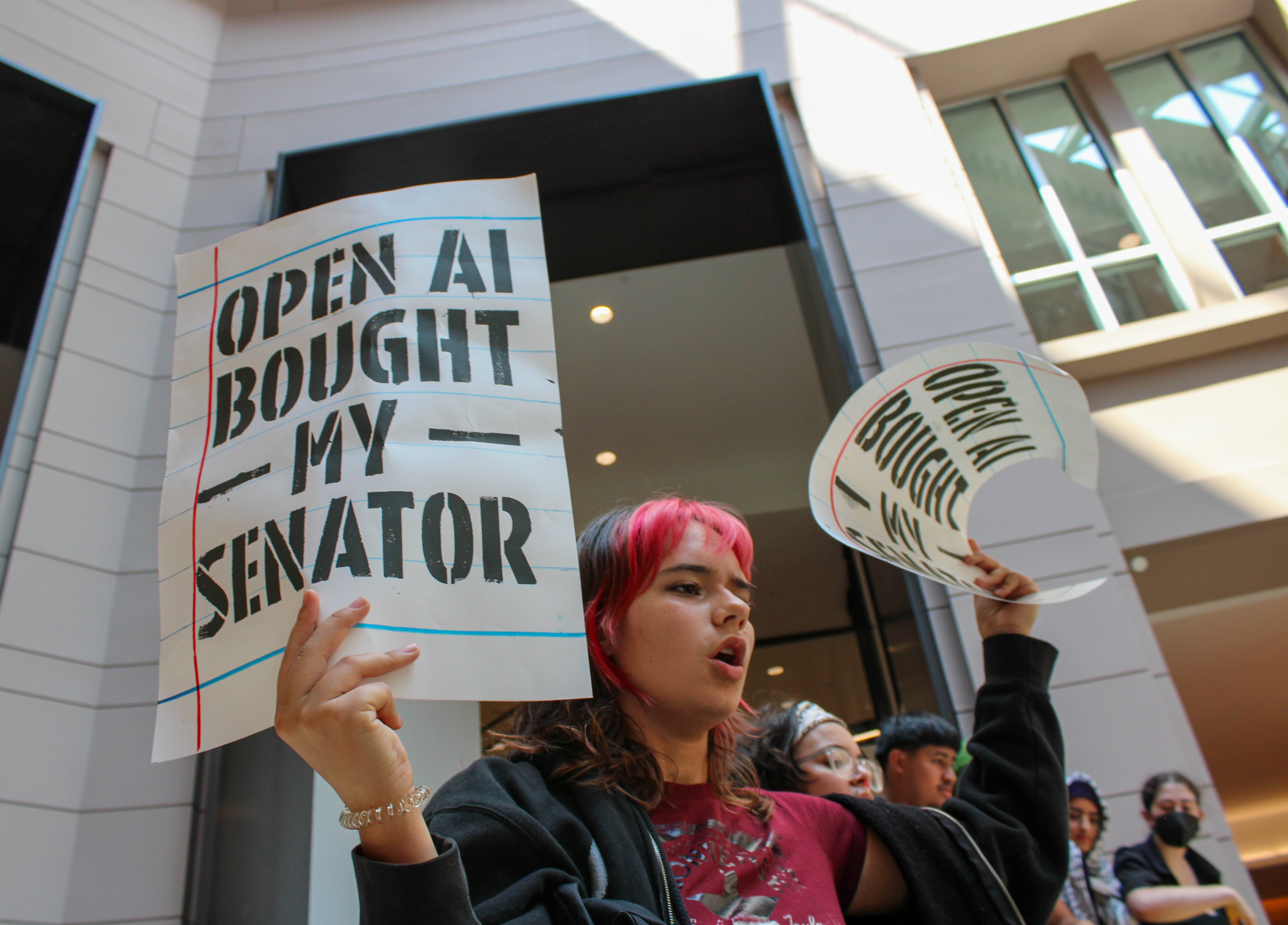
Over 30 student activists came together on Monday afternoon to occupy the Gallup Building in Washington DC, home to a public-facing lobbying office belonging to ChatGPT developer OpenAI.
Once inside the lobby, the demonstrators unfurled a massive banner reading “Stop Stealing Our Future,” while others held signs with messages like “OpenAI bought my Senator.” The demonstration lasted two hours, and ended when police stormed the lobby, arresting 13 protestors.
At the moment, the identity and whereabouts of the protestors remains unclear. An incident report obtained from the Metropolitan Police Department states that 13 people were arrested for “unlawful entry.” After stuffing the activists into vans, the report notes the MPD split the group up, sending seven to the First District Station, four to the Second District, and two to the Third District for processing.
The protest was organized by the climate group Sunrise Movement and anti-AI organization QuitGPT. According to a joint statement shared with Futurism, Monday’s action is just one of many across over 20 states in August calling on politicians to “Dump Big Tech.”
One student organizer who attended the protest, Raya Gupta, explained in the statement that “my friends chose to risk arrest to bring the fight to OpenAI.”
“Our generation doesn’t have any guarantees about whether we’ll have jobs after college, or whether there will be clean drinking water for all of us or whether people will have any power left in politics since our elections keep getting bought by Big Tech,” Gupta continued. “We all believe that not taking action now, as the scales slide between the people and the billionaires, puts our future in great jeopardy.”
Gupta’s comments underscore the degree to which AI has become an omni-cause for Americans across the political spectrum. A growing number of people in the US have been arrested for protests related to AI in some shape or form, whether attending town hall meetings to oppose data center developments, or occupying offices used by federal agencies to tool out AI immigration software.
Despite growing disgust with AI and its developers, politicians on both sides of the aisle have roundly embraced the tech industry’s extremely expensive lobbying efforts. Case in point, the recent opening of OpenAI’s DC Office comes as one of the AI lab’s super PACs injects over $140 million into the coming midterm elections, in a blatant attempt to steer AI regulations at the highest level.
Earlier this summer, Amazon customers began noticing that emails related to their online orders looked sparse: Order confirmation emails didn't name specific items anymore, and instead listed only item categories.
As if the practice of homeschooling wasn’t fraught enough already, parents are now bragging about using large language models (LLMs) like ChatGPT to school their kids.
A number of viral videos show the alarmingly cavalier attitude some parents are taking. One clip, seemingly taken from a livestream hosted by the enormously controversial influencers Cole and Savannah LaBrant, shows the parents outline their vibes-based approach to the education of their five children.
“What I do for history — Cole usually does all their history, which I love, because I’m not the best at history — so Cole steps in about once a week and we’ll do a history lesson with them… we’re just teaching them the things that we just want them to learn — that we feel are the most important,” Savannah explains. “And same with science, and geography.”
That’s not uncommon as homeschool curriculums go; as horrifying as it is to imagine a student receiving one history lesson a week, regulations around the practice are incredibly loose in the United States, freeing hardcore Christians like the LaBrants to do whatever they want. But Savannah goes on, admitting that sometimes, even those slapdash lessons are too much to tackle without a little AI assistance.
“So I just make my own curriculum, and sometimes I’ll just use, like, ChatGPT,” she says, “or just uhm, print out, like — like right now I’m teaching them where the states are and how to locate them, and uhm, like all the states and capitols and things like that.” (Even the most advanced AI chatbots are known for producing inaccurate maps.)
History Class, but Make It Vibes-Based: The LaBrants Explain Homeschooling The LaBrants’ Homeschool History Curriculum: Whatever Cole Decides Happened “Cole steps in about once a week to do a quick history lesson because I’m not the best at history.” – Sav. The LaBrants went live to explain their homeschooling setup, and Savannah casually admitted she “doesn’t know a lot of history,” so they teach it once a week, with Cole covering whatever topics they personally decide are important. So apparently the curriculum is: Monday: sponsored content Tuesday: Bible lesson Wednesday: filming Thursday: whatever Cole remembers from school Friday: history, pending personal relevance Homeschooling can absolutely be done well, but “we teach history once a week based on what we think matters” is not the reassuring flex they seem to think it is. History is not a Pinterest board where you skip the sections that do not match the family aesthetic. The most concerning part is not Savannah admitting she lacks expertise. Plenty of parents do. It is the confidence of replacing a structured curriculum with Cole’s Greatest Hits of Human Civilization. Nothing says educational rigor like two influencers deciding which centuries make the cut. @Savannah LaBrant @Bev Skin @ChatGPT @OpenAI @Fishfam @TMZ @cbsnews @CNN @DrinkFrosh #savannahlabrant#colelabrant#labrantfamily#homeschool#fyp
That any parents could be so cavalier in their approach to homeschooling has grim implications for an already divisive practice.
In much of the US, homeschooling parents are already given incredibly wide latitude on what to teach their children. A whole 11 states have essentially no regulations on homeschooling whatsoever: parents aren’t required to follow any set curriculum, issue standardized assessments, or even inform the state that their child won’t be going to a real school.
Many more states only require a notice of intent to homeschool and occasional proof of attendance, the latter being a bare bones measure of success, and one which is easily fudged. Unfortunately, it’s easier to count the number of states that definitively require standardized testing and a rigid curriculum: Rhode Island, Pennsylvania, New York, Vermont, and Massachusetts.
Of course, the LaBrants aren’t alone. The popular influencer account Heavenly Homeschool has similar reels out, walking parents through the process of generating entire years’ worth of lesson plans, tailor-made to their specific worldview. It all begs the question: do AI chatbots have any safeguards around education?
Turns out, not really. We tasked ChatGPT with developing a homeschooling curriculum for a 3rd grade student in Michigan — a state with virtually no regulations around DIY education — “following a strictly evangelical doctrine,” including “no woke history or science.”
ChatGPT was more than happy to oblige: “I can build this around a conservative, explicitly Christian/evangelical worldview, with Scripture integrated across subjects and with history and science taught from a young-earth/creationist perspective rather than through a secular or progressive framework,” the chatbot explained.
While it didn’t push back against our intentions to indoctrinate our hypothetical child, the LLM did make sure to clarify that “no woke” can “mean different things to different families.” So, to avoid ambiguity, the chatbot specified that the course calendar would use “Biblical authority, traditional Christian ethics… and creation-based science” as standard-bearers.
True to its word, the LLM-generated curriculum included “bible and Christian studies,” a traditionalist approach to American history, with specific chunks on both “Westward expansion” and Henry Ford — a renowned racist and antisemite — as well as a creationist approach to Earth science and astronomy.
For the portion on space, the curriculum would teach “the heavens as God’s creation while distinguishing observations from interpretations about the age and origin of the universe,” the LLM promised.
Put together, it paints a dire picture for the estimated 3.75 million K-12 homeschooled children in the US. Beyond the potential for wild AIhallucinations to leach into educational material, the technology is a Pandora’s Box for parents, who can now effortlessly inculcate their children with any number of unscientific conspiracy theories or anti-social worldviews while facing no pushback whatsoever.
Do you know anything about how homeschooling families are using AI? Email us: tips@futurism.com. We can keep you anonymous.
Spotify is introducing “AI Persona” labels for artist profiles that represent AI-generated identities and will exclude their music from editorial, algorithmic, and personalized recommendations by default.

 Login



















 The LaBrants’ Homeschool History Curriculum: Whatever Cole Decides Happened