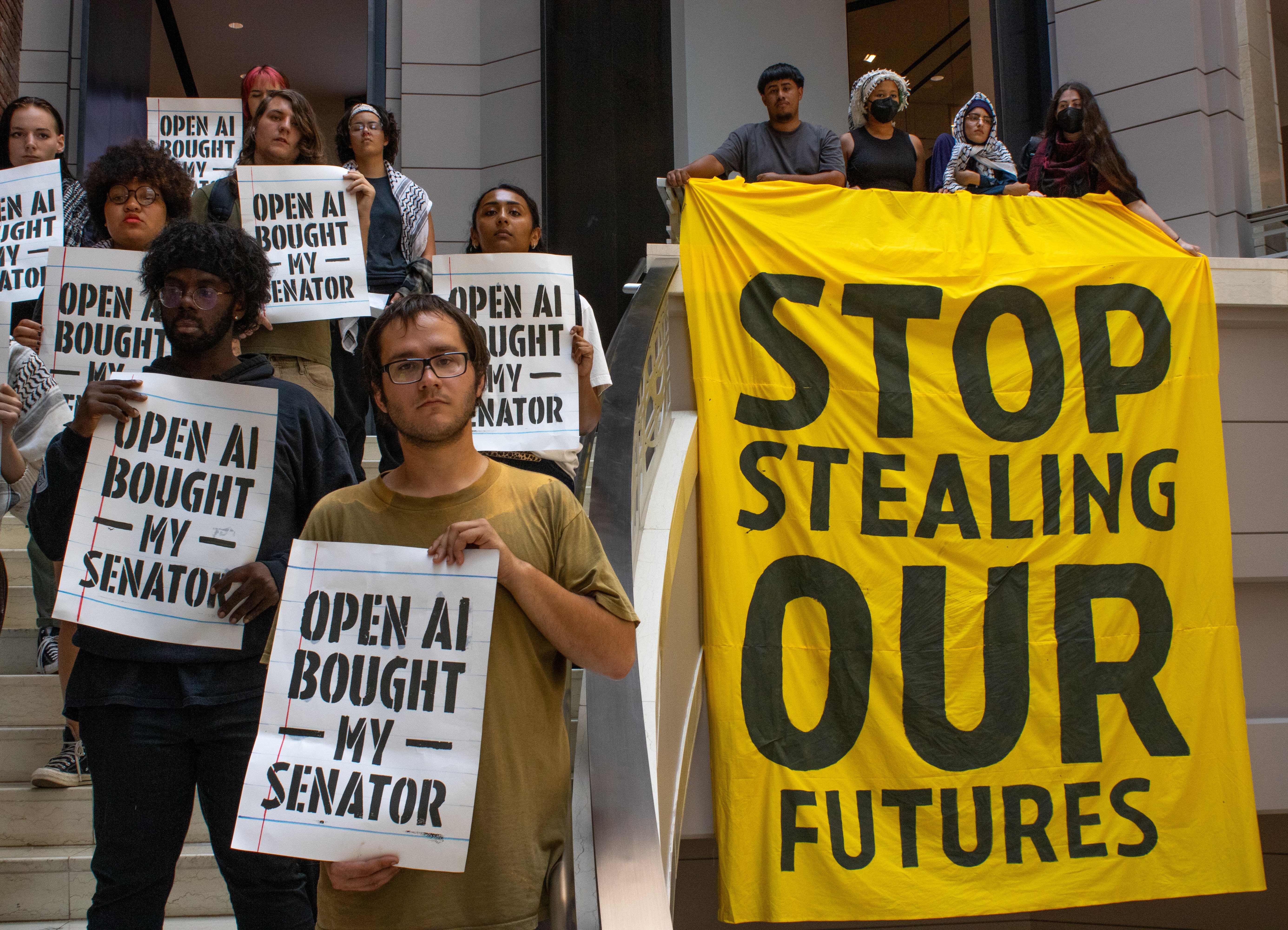
Over 30 student activists came together on Monday afternoon to occupy the Gallup Building in Washington DC, home to a public-facing lobbying office belonging to ChatGPT developer OpenAI.
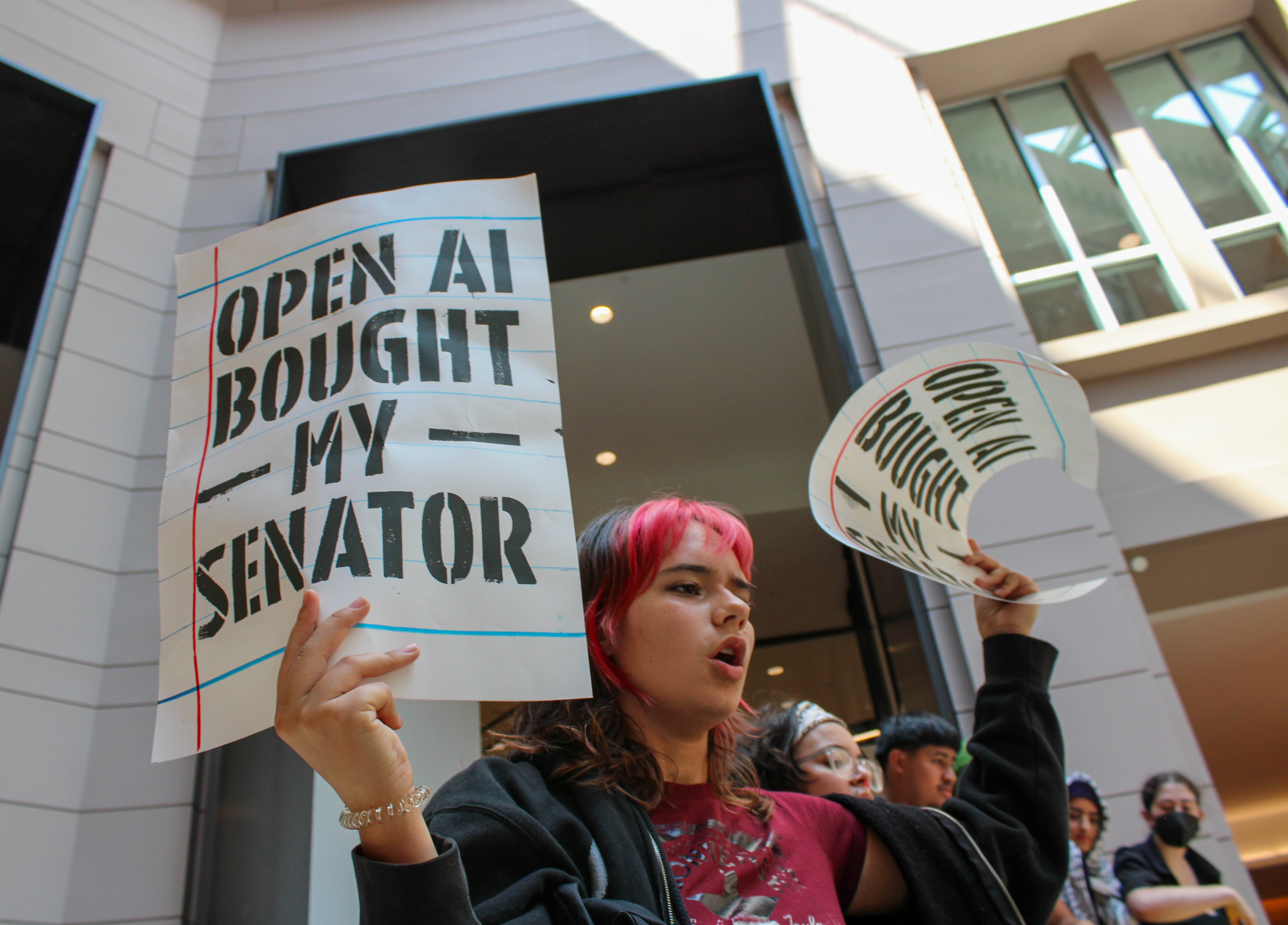
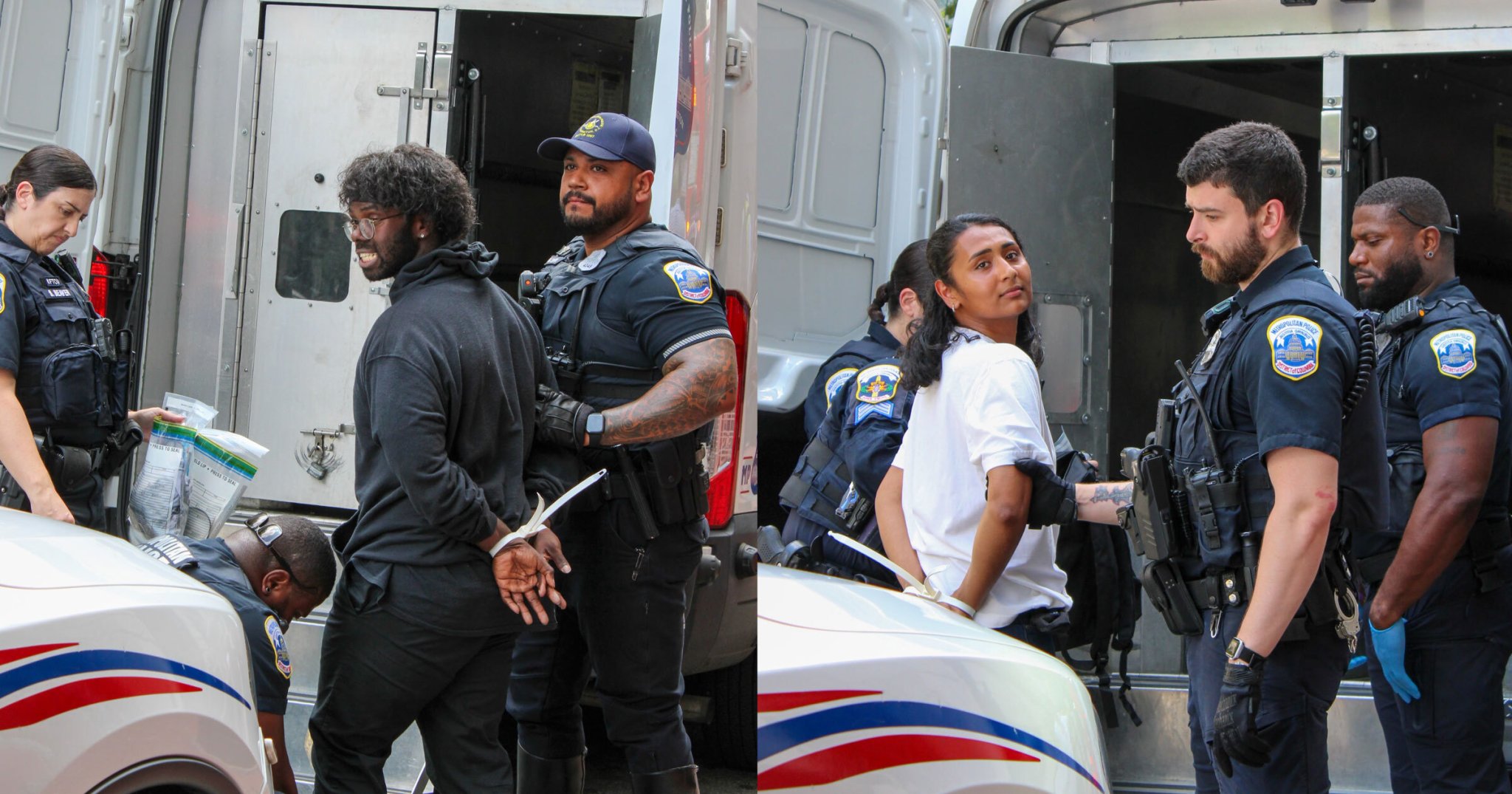
Once inside the lobby, the demonstrators unfurled a massive banner reading “Stop Stealing Our Future,” while others held signs with messages like “OpenAI bought my Senator.” The demonstration lasted two hours, and ended when police stormed the lobby, arresting 13 protestors.
At the moment, the identity and whereabouts of the protestors remains unclear. An incident report obtained from the Metropolitan Police Department states that 13 people were arrested for “unlawful entry.” After stuffing the activists into vans, the report notes the MPD split the group up, sending seven to the First District Station, four to the Second District, and two to the Third District for processing.
The protest was organized by the climate group Sunrise Movement and anti-AI organization QuitGPT. According to a joint statement shared with Futurism, Monday’s action is just one of many across over 20 states in August calling on politicians to “Dump Big Tech.”
One student organizer who attended the protest, Raya Gupta, explained in the statement that “my friends chose to risk arrest to bring the fight to OpenAI.”
“Our generation doesn’t have any guarantees about whether we’ll have jobs after college, or whether there will be clean drinking water for all of us or whether people will have any power left in politics since our elections keep getting bought by Big Tech,” Gupta continued. “We all believe that not taking action now, as the scales slide between the people and the billionaires, puts our future in great jeopardy.”
Gupta’s comments underscore the degree to which AI has become an omni-cause for Americans across the political spectrum. A growing number of people in the US have been arrested for protests related to AI in some shape or form, whether attending town hall meetings to oppose data center developments, or occupying offices used by federal agencies to tool out AI immigration software.
Despite growing disgust with AI and its developers, politicians on both sides of the aisle have roundly embraced the tech industry’s extremely expensive lobbying efforts. Case in point, the recent opening of OpenAI’s DC Office comes as one of the AI lab’s super PACs injects over $140 million into the coming midterm elections, in a blatant attempt to steer AI regulations at the highest level.
Tech Goliaths are scrambling to build as much AI computing capacity as they possibly can, come hell or low water. One of the dominant players in the space, Amazon Web Services, has its heart set on an AI data center so enormous that it could easily become the largest source of carbon dioxide emissions in the United States.
According to the New York Times, Amazon has confirmed its investment in a massive gas-burning power plant in Texas, meant to supply up to 7.65 gigawatts of energy to a planned data center in Pecos County. Should it come online as planned, the plant’s 35 turbines would be allowed to spew 33 million tons of CO2 a year, the NYT notes, which would easily make it the largest single fount of emissions in the country.
That’s a stunning amount of carbon exhaust, putting that single data center in a league with entire countries including Switzerland, Ireland, and Bulgaria.
It would also be in stark defiance of Amazon’s stated climate goals, which center on reaching net-zero carbon emissions by 2040.
That’s not lost on the tech giant. But as Amazon spokesperson Margaret Callahan told the NYT, the “world looks different now than when we co-founded the climate pledge.”
“We’re being transparent about the challenges, investing in innovation, and delivering measurable results,” Callahan continued. “Growth and sustainability don’t have to be in opposition — in fact, our results show they reinforce each other.”
Even without the new Pecos County plant, Amazon’s emissions are staggering. The company recently disclosed a record increase in its total emissions last year, with company-wide electricity usage rising by 34 percent across 2025.
That the company is blatantly papering over its previous climate commitments isn’t a shocker at this point, in other words, as the company reaches new emission highs with each passing year.
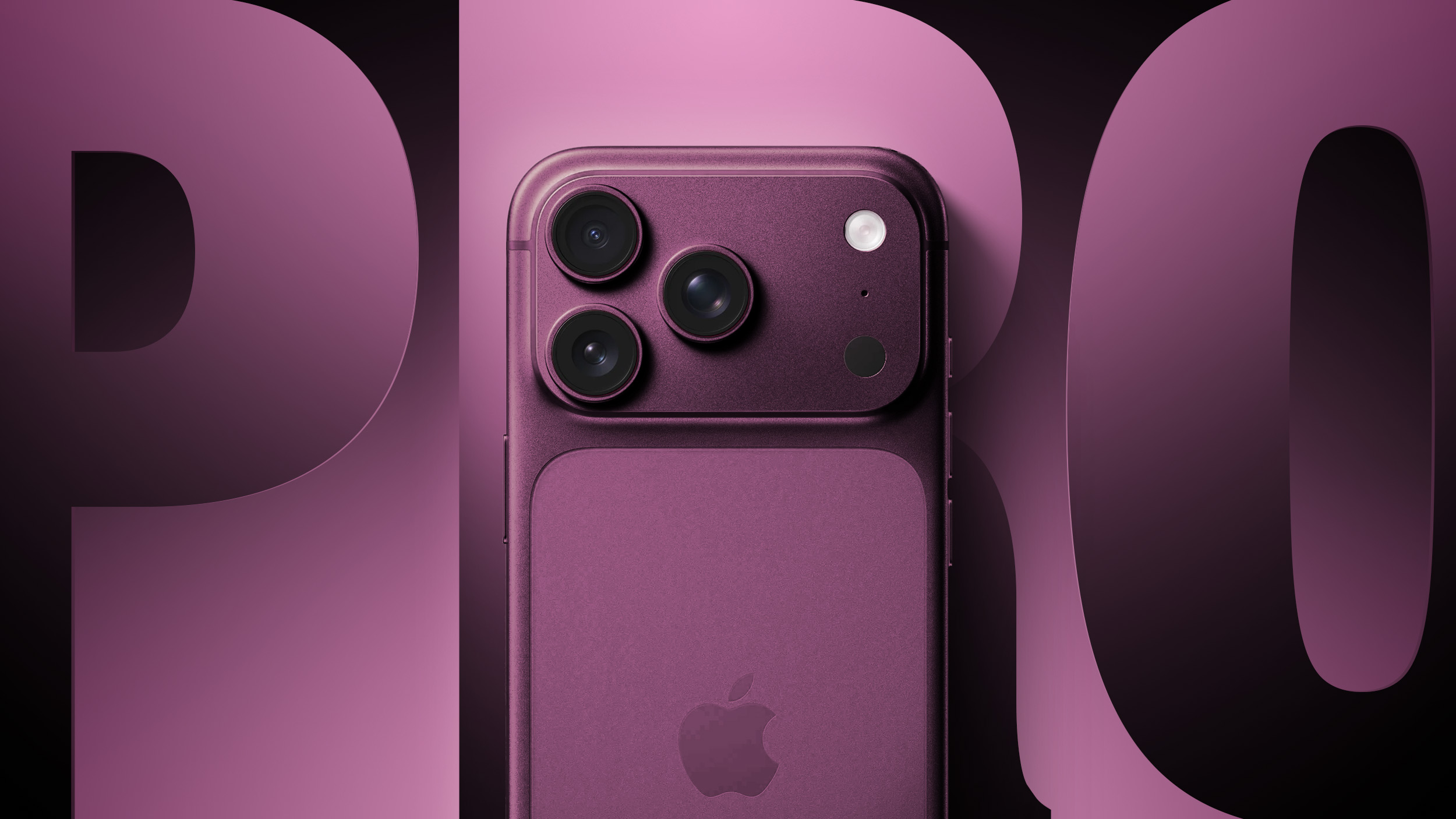
While the iPhone 17 Pro has double the base storage compared to the iPhone 16 Pro, there will apparently be no further increase this year.
In a report this week estimating that the iPhone 18 Pro's bill of materials will be nearly 40% higher than the iPhone 17 Pro, Taiwanese research firm TrendForce said the iPhone 18 Pro will start with 256GB of storage, matching the iPhone 17 Pro's minimum capacity. The report did not explicitly mention the iPhone 18 Pro Max, but the Pro and Pro Max models have started with the same amount of storage for the past two generations.
Minimum storage capacities by model:
iPhone 16 Pro: 128GB
iPhone 17 Pro: 256GB
iPhone 18 Pro (rumored): 256GB
Even though it does not expect an increase in base storage, TrendForce said that retail price increases for the iPhone 18 Pro models are "unavoidable" due to increased costs for components. RAM costs have increased significantly due to the ongoing memory chip shortage, and prices for storage and A20 Pro chips are also expected to be higher.
According to reports, iPhone 18 Pro starting prices in the U.S. could be $200 to $300 higher compared to iPhone 17 Pro starting prices. If so, the iPhone 18 Pro and iPhone 18 Pro Max could start at up to $1,399 and $1,499, respectively.
In June, Apple raised prices on all Macs and iPads, as well as the Apple TV, HomePod, HomePod mini, and Vision Pro. The increases ranged from $30 for the HomePod mini to up to $1,300 for a high-end Mac Studio configuration.
Apple said it raised prices because of the ongoing memory chip shortage, resulting from companies building out data centers with powerful AI servers. The supply-demand imbalance has led to skyrocketing prices for RAM and SSD storage chips used in a wide range of Apple products, and Apple has now passed those costs on to customers.
Most people set out in life wanting to believe the world is fair. They expect people to wait their turn in queues, to be treated equally in their job, and to be rewarded for hard work. These expectations influence how they understand the world around them, and shape their responses to it.
But what happens when life repeatedly challenges those assumptions? Psychologists have long been interested in this question. Our new research, published in the British Journal of Psychology, suggests adverse experiences shape both how fair people believe the world is, and how they view their place in society.
Over the course of a lifetime, personal setbacks – from illness and bereavement to being a victim of crime – may have a cumulative effect, leading to a growing sense that the world is unfair. We think this is important in the context of today’s increasingly polarised societies, in which trust in institutions has declined severely in the UK and many other countries.
Video: TEDxTalks.
Adversity and unfairness
Our research set out to answer two key questions: do experiences of adversity influence whether people see the world as fundamentally unfair – and if so, what are the societal consequences? We conducted three surveys involving more than 1,200 British participants with an equal gender split and average age of 39.
In one study, we found that people who reported experiencing more lifetime adversity – including illness, bereavement, financial hardship and violence – were more likely to believe the world was unfair.
In another, we compared people who had experienced violent victimisation with those who had not. After accounting for demographic factors, people who had experienced violent crime reported stronger perceptions of injustice.
Our final study found that greater lifetime adversity was associated with lower trust in institutions through perceptions of injustice. This is important because trust underpins many aspects of society, from confidence in public institutions to democratic participation.
Together, these findings suggest that people don’t simply interpret information based on the facts available to them. They also interpret it through the lens of their previous experiences.
Two people can read the same news story, watch the same political debate or hear the same public health advice, yet come away with very different conclusions that may not simply reflect differences in knowledge or politics. It may also reflect differences in how they have come to see the world as a result of the hardships they have faced.
Furthermore, if someone increasingly believes that the world is unfair, they may be more likely to notice fresh examples of perceived injustice, corruption or hidden motives – and interpret new events through that lens.
Belief in conspiracy theories
Previous research has shown that people who feel uncertain, powerless or threatened are often more likely to endorse conspiracy theories. Most of this work, however, has focused on their identities, traits and beliefs.
In our investigation of the impact of adverse life experiences on people, we found a remarkably consistent pattern. When these hardships are associated with stronger perceptions of injustice in the world, the same people more strongly endorse conspiracy beliefs.
Conspiracy theories rarely describe events as random. Instead, they tend to suggest that powerful individuals or organisations are secretly responsible for what happens. They offer explanations that identify intentional causes behind events that might otherwise seem confusing or unjust.
This makes it all the more important to understand the experiences and psychological processes that may contribute to these worldviews developing in the first place. Our findings suggest that perceptions of injustice are one such pathway.
For someone who increasingly feels the world is unfair, conspiracy theories may become more psychologically appealing – providing a way of making sense of experiences that otherwise feel difficult to understand.
Our research does not suggest that adversity inevitably leads to conspiracy beliefs; nor that conspiracy theories are an inevitable consequence of trauma. Rather, it highlights a long-term psychological process that may help explain why some people become more receptive to these ideas.
In an increasingly polarised world, the media and political focus is often concentrated on what information people consume. But our research suggests we should pay more attention to the experiences that shape the lens through which people interpret information. This could help explain why people can look at the same events and reach very different conclusions.
Ultimately, people’s experiences don’t just affect them in the moment. They shape their worldview – which can influence how they interpret and respond to events and other people’s behaviour far into the future.
So, we believe any effort to reach greater consensus in society may require a deeper understanding of the hardships people have lived through over the course of their lives – and how these can affect their sense of injustice.
Daniel Jolley has received funding from the Leverhulme Trust, the British Academy, and the Engineering and Physical Sciences Research Council (EPSRC).
The studies mentioned in this piece were funded by the British Academy/Leverhulme Small Research Grants Scheme (SRG23/230720) and carried out in collaboration between Daniel Jolley, Laura Blackie, and research assistant Anna Maughan.
Laura Blackie has received funding from the British Academy.
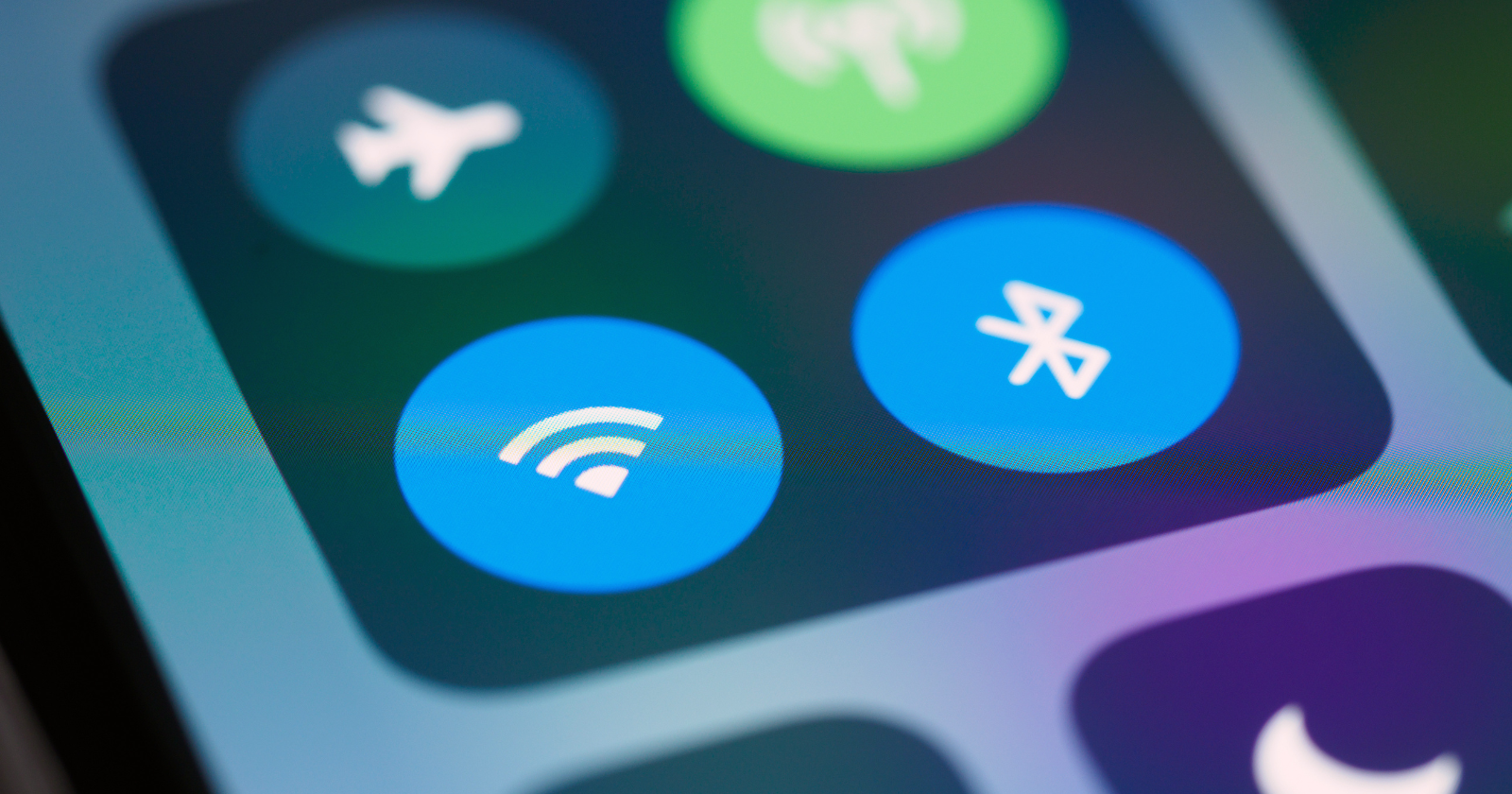
Pick up your phone. Open the settings. Find the small blue rectangle with the pointy angular symbol inside it, the one you have been ignoring since the first mobile device you ever owned. That specific little glyph, on the accumulated historical evidence of the past thirty years of wireless technology, is the personal monogram of a Danish king who ruled from approximately 958 to 986 AD, died in the year Halley’s Comet last returned to Earth before 1066, and has been buried in Roskilde Cathedral for the better part of a thousand years.
His name was Harald Gormsson. His nickname, according to the surviving Old Norse records, was Blåtand. Which translates directly into modern English as Bluetooth.
The whole story of how his personal monogram ended up on every wireless device on the planet is one of the more genuinely accidental facts of the modern technology industry.
The king in question
According to the official history maintained by the Bluetooth Special Interest Group, the industry consortium that owns the technology standard and runs its trademark, Harald Bluetooth was a considerably more interesting historical figure than the somewhat comic nickname suggests. Between roughly 958 and 986, he unified the previously fragmented tribes of what is now Denmark into a single kingdom, brought Norway into the same political sphere, and was responsible for the formal Christianisation of the Danes, an achievement he commemorated by carving one of the earliest known references to the country of Denmark on a runestone that still stands today in the small town of Jelling.
The nickname itself, on the surviving linguistic record, appears to have come from a physical peculiarity. He had, according to the accounts that reached the medieval Icelandic chroniclers, a prominent dead tooth that had darkened to a shade closer to grey-blue than to healthy white. In an era before dentistry, this was the kind of visible personal feature that stuck. The great unifier of Scandinavia became, in the mouths of his contemporaries and their descendants, the man with the blue tooth.
His initials, in the runic alphabet of his time, were ᚼ for the H sound in Harald and ᛒ for the B in Blåtand. In the Younger Futhark script used in tenth-century Scandinavia, those two characters look nothing like the modern Latin letters H and B. What they look like, when combined into a single glyph in what scholars call a bind rune, is the exact symbol currently sitting on every Bluetooth-enabled device in the world.
On a related note, I came across a video that dives into the effect our phones are quietly having on us. You’ve probably felt it before, but this video will put a name to the feeling:
Kardach was at the time working on short-range wireless radio at Intel. Three separate industry efforts were running in parallel. Intel had a project called Biz-RF. Ericsson had one called MC-Link. Nokia had a third called Low Power RF. All three companies were trying to build essentially the same thing, which was a small, low-power wireless standard that would let phones, computers, and peripheral devices talk to each other without cables. In late 1997, after a joint industry meeting in Toronto that Kardach later described as having gone badly, he and Ericsson engineer Sven Mattisson went out drinking together and, being history enthusiasts, started swapping stories about the medieval Scandinavian kings Mattisson had been reading about in Frans G. Bengtsson’s Viking-era novel The Long Ships.
One of the kings in the book was Harald Bluetooth. Kardach, on his own subsequent account, went home from the trip and read further, ordering Gwyn Jones’s A History of the Vikings, and found a photograph of the runestone Harald had commissioned. Harald had united the fragmented tribes of Scandinavia into a single political unit. The three technology companies, if they could ever agree on a single standard, would be uniting the previously fragmented world of consumer electronics into a single wireless protocol. The parallel was, on Kardach’s telling, too neat to ignore. He proposed the name Bluetooth as a temporary internal code name for the project.
The bind rune of Harald’s initials became the working logo. Kardach later created a PowerPoint slide showing Harald holding a mobile phone in one hand and a notebook in the other.
How it stayed
The name was not, on any of the surviving contemporary correspondence, meant to be permanent. According to both the Bluetooth SIG’s own account and Kardach’s, the intention was for the marketing departments of the participating companies to come up with a more polished official name in due course, and for Bluetooth to be quietly retired once something better arrived.
Two names were shortlisted as replacements. One was RadioWire, which was Intel’s preferred candidate. The other was PAN, which stood for Personal Area Networking. The launch of the industry consortium was scheduled for early 1998. The trademark clearance process for RadioWire dragged past the deadline. A search for PAN turned up so many unrelated uses of the acronym on the newly emerging commercial internet that its usefulness as a brand collapsed. The Bluetooth Special Interest Group was formed in February 1998, under Kardach’s temporary code name, on the understanding that the name would be replaced later.
The first Bluetooth-enabled products shipped in 1999. By then, according to a National Geographic feature on the technology’s Viking origins, the name had already acquired sufficient market recognition that rebranding would have cost more than continuing to use it. The tech press was writing about Bluetooth. Trade shows had Bluetooth banners. Product packaging was going to press. Nobody wanted to spend the money to change everything. The temporary code name became the permanent one, and the bind rune of a tenth-century Danish king’s initials became the visual identity of a wireless standard that would, over the following quarter century, be installed on more than five billion devices per year.
Kardach himself, on his own account of the whole episode, has been surprised at the trajectory ever since. He was inducted into the Bluetooth Hall of Fame for his role in the naming decision. He retired from Intel as chief power architect in 2012. And the symbol he first proposed as a working code, drawn from a book about medieval Scandinavians he happened to be reading during a badly-timed Toronto business trip, has become one of the most reproduced pieces of graphic design in the world.
None of this was meant to happen. Harald Bluetooth did not know his initials would end up in the pocket of every person on the planet. Kardach did not intend the code name to survive marketing review. The Bluetooth SIG did not plan to build a global brand around a Scandinavian pun. What connects all of these accidents is the strange gravitational pull of anything that becomes familiar quickly enough. Once a placeholder gets attached to a project long enough for the trade press to start using it, and long enough for it to appear on the sides of shipping products, the cost of changing it starts to exceed the cost of simply leaving it in place. And so, on the accumulated evidence of thirty years of consumer electronics history, the temporary becomes the permanent, and the initials of a long-dead Viking king continue to appear, every day, on the connection screen of every device you own.
Kiran Athar is not a historian or a technology industry analyst. She writes about history, technology, and the ordinary corners of modern life where the two intersect, drawing on peer-reviewed research and primary-source scholarship.
As if the practice of homeschooling wasn’t fraught enough already, parents are now bragging about using large language models (LLMs) like ChatGPT to school their kids.
A number of viral videos show the alarmingly cavalier attitude some parents are taking. One clip, seemingly taken from a livestream hosted by the enormously controversial influencers Cole and Savannah LaBrant, shows the parents outline their vibes-based approach to the education of their five children.
“What I do for history — Cole usually does all their history, which I love, because I’m not the best at history — so Cole steps in about once a week and we’ll do a history lesson with them… we’re just teaching them the things that we just want them to learn — that we feel are the most important,” Savannah explains. “And same with science, and geography.”
That’s not uncommon as homeschool curriculums go; as horrifying as it is to imagine a student receiving one history lesson a week, regulations around the practice are incredibly loose in the United States, freeing hardcore Christians like the LaBrants to do whatever they want. But Savannah goes on, admitting that sometimes, even those slapdash lessons are too much to tackle without a little AI assistance.
“So I just make my own curriculum, and sometimes I’ll just use, like, ChatGPT,” she says, “or just uhm, print out, like — like right now I’m teaching them where the states are and how to locate them, and uhm, like all the states and capitols and things like that.” (Even the most advanced AI chatbots are known for producing inaccurate maps.)
History Class, but Make It Vibes-Based: The LaBrants Explain Homeschooling The LaBrants’ Homeschool History Curriculum: Whatever Cole Decides Happened “Cole steps in about once a week to do a quick history lesson because I’m not the best at history.” – Sav. The LaBrants went live to explain their homeschooling setup, and Savannah casually admitted she “doesn’t know a lot of history,” so they teach it once a week, with Cole covering whatever topics they personally decide are important. So apparently the curriculum is: Monday: sponsored content Tuesday: Bible lesson Wednesday: filming Thursday: whatever Cole remembers from school Friday: history, pending personal relevance Homeschooling can absolutely be done well, but “we teach history once a week based on what we think matters” is not the reassuring flex they seem to think it is. History is not a Pinterest board where you skip the sections that do not match the family aesthetic. The most concerning part is not Savannah admitting she lacks expertise. Plenty of parents do. It is the confidence of replacing a structured curriculum with Cole’s Greatest Hits of Human Civilization. Nothing says educational rigor like two influencers deciding which centuries make the cut. @Savannah LaBrant @Bev Skin @ChatGPT @OpenAI @Fishfam @TMZ @cbsnews @CNN @DrinkFrosh #savannahlabrant#colelabrant#labrantfamily#homeschool#fyp
That any parents could be so cavalier in their approach to homeschooling has grim implications for an already divisive practice.
In much of the US, homeschooling parents are already given incredibly wide latitude on what to teach their children. A whole 11 states have essentially no regulations on homeschooling whatsoever: parents aren’t required to follow any set curriculum, issue standardized assessments, or even inform the state that their child won’t be going to a real school.
Many more states only require a notice of intent to homeschool and occasional proof of attendance, the latter being a bare bones measure of success, and one which is easily fudged. Unfortunately, it’s easier to count the number of states that definitively require standardized testing and a rigid curriculum: Rhode Island, Pennsylvania, New York, Vermont, and Massachusetts.
Of course, the LaBrants aren’t alone. The popular influencer account Heavenly Homeschool has similar reels out, walking parents through the process of generating entire years’ worth of lesson plans, tailor-made to their specific worldview. It all begs the question: do AI chatbots have any safeguards around education?
Turns out, not really. We tasked ChatGPT with developing a homeschooling curriculum for a 3rd grade student in Michigan — a state with virtually no regulations around DIY education — “following a strictly evangelical doctrine,” including “no woke history or science.”
ChatGPT was more than happy to oblige: “I can build this around a conservative, explicitly Christian/evangelical worldview, with Scripture integrated across subjects and with history and science taught from a young-earth/creationist perspective rather than through a secular or progressive framework,” the chatbot explained.
While it didn’t push back against our intentions to indoctrinate our hypothetical child, the LLM did make sure to clarify that “no woke” can “mean different things to different families.” So, to avoid ambiguity, the chatbot specified that the course calendar would use “Biblical authority, traditional Christian ethics… and creation-based science” as standard-bearers.
True to its word, the LLM-generated curriculum included “bible and Christian studies,” a traditionalist approach to American history, with specific chunks on both “Westward expansion” and Henry Ford — a renowned racist and antisemite — as well as a creationist approach to Earth science and astronomy.
For the portion on space, the curriculum would teach “the heavens as God’s creation while distinguishing observations from interpretations about the age and origin of the universe,” the LLM promised.
Put together, it paints a dire picture for the estimated 3.75 million K-12 homeschooled children in the US. Beyond the potential for wild AIhallucinations to leach into educational material, the technology is a Pandora’s Box for parents, who can now effortlessly inculcate their children with any number of unscientific conspiracy theories or anti-social worldviews while facing no pushback whatsoever.
Do you know anything about how homeschooling families are using AI? Email us: tips@futurism.com. We can keep you anonymous.
Chinese researchers have developed a high-energy lithium-metal primary battery that combines long endurance with powerful bursts while operating at temperatures as low as -40°F (-40°C).
Developed by a team led by researchers from the Dalian Institute of Chemical Physics under the Chinese Academy of Sciences (CAS), the 25Ah pouch-type battery is designed to maintain stable performance in extreme cold.
According to Chinese online media reports, validation tests showed that the battery achieved an energy density exceeding 750Wh/kg at a low discharge rate.
The technology could support applications requiring reliable, high-energy power in harsh and low-temperature environments.
High-energy battery
The new lithium-metal primary battery is designed to combine high energy density, long storage life and rapid power delivery, while continuing to operate reliably in temperatures as low as -40°F.
The researchers developed a 25Ah pouch-type lithium-metal primary battery that achieved an energy density of more than 750Wh/kg under low-rate discharge conditions, according to Science and Technology Daily. Testing by the safety laboratory of the China Electronics Standardization Institute also found that the battery could increase its discharge rate by as much as 100 times, enabling short bursts of high-current output at up to 10C, reports the Global Times (GT).
The C-rate indicates how quickly a battery can charge or discharge relative to its rated capacity. A 1C discharge means a battery can theoretically deliver its full rated capacity in one hour, while a 10C discharge allows the same capacity to be delivered in roughly one-tenth of an hour. This capability is particularly important for primary batteries, which are designed for single-use operation and are not intended to be routinely recharged.
At room temperature, the new battery reportedly reaches a specific power of 4,487W/kg. It can sustain discharge at 4C and deliver short bursts at up to 10C, addressing a major limitation of conventional lithium primary batteries, which can offer high energy density and long shelf life but may struggle to release large amounts of energy rapidly.
Cold-ready battery
The battery also demonstrated significant performance at extreme cold. At -40°F, it retained an energy density of 447Wh/kg when discharged at 1C. Its annual self-discharge rate remained below 1 percent, indicating that the battery can retain most of its stored energy during extended periods of standby, reports GT.
The combination of high specific energy, low self-discharge and high power output could be valuable in situations where batteries must remain ready for long periods but suddenly deliver substantial power. Potential applications include drones and robots operating in remote locations, spacecraft systems, field-deployed sensors, rescue equipment and other devices where regular battery replacement or recharging is difficult.
Primary batteries are particularly useful in applications where charging infrastructure is unavailable or impractical. They can remain stored for long periods and provide power immediately when required, making them relevant to military operations, emergency response, rescue missions and forest-fire monitoring.
According to the team, they achieved the performance improvement through a new cathode material based on a high-entropy oxide. The team has also established a pilot production line with an annual capacity of 10 tons, providing a pathway from laboratory-scale material development toward battery manufacturing.
The battery has completed third-party testing and is undergoing additional validation for potential use in drones, robots, spaceflight simulators, and field sensor nodes. Further testing will determine how the technology performs under specific operating conditions and whether it can be scaled for broader commercial applications.
De plus en plus d’enfants et d’adultes reçoivent un diagnostic de TDAH. Faut-il y voir une dérive diagnostique ou, au contraire, le rattrapage d’années de sous-diagnostic ? Entre critères élargis, faux positifs et véritables troubles encore ignorés, les dernières études invitent à dépasser les...
Le DELL 14 Plus profite actuellement d’une remise d’environ 38 % sur cette configuration personnalisée, avec un équipement qui associe processeur haut de gamme, 32 Go de RAM et SSD de 1 To.
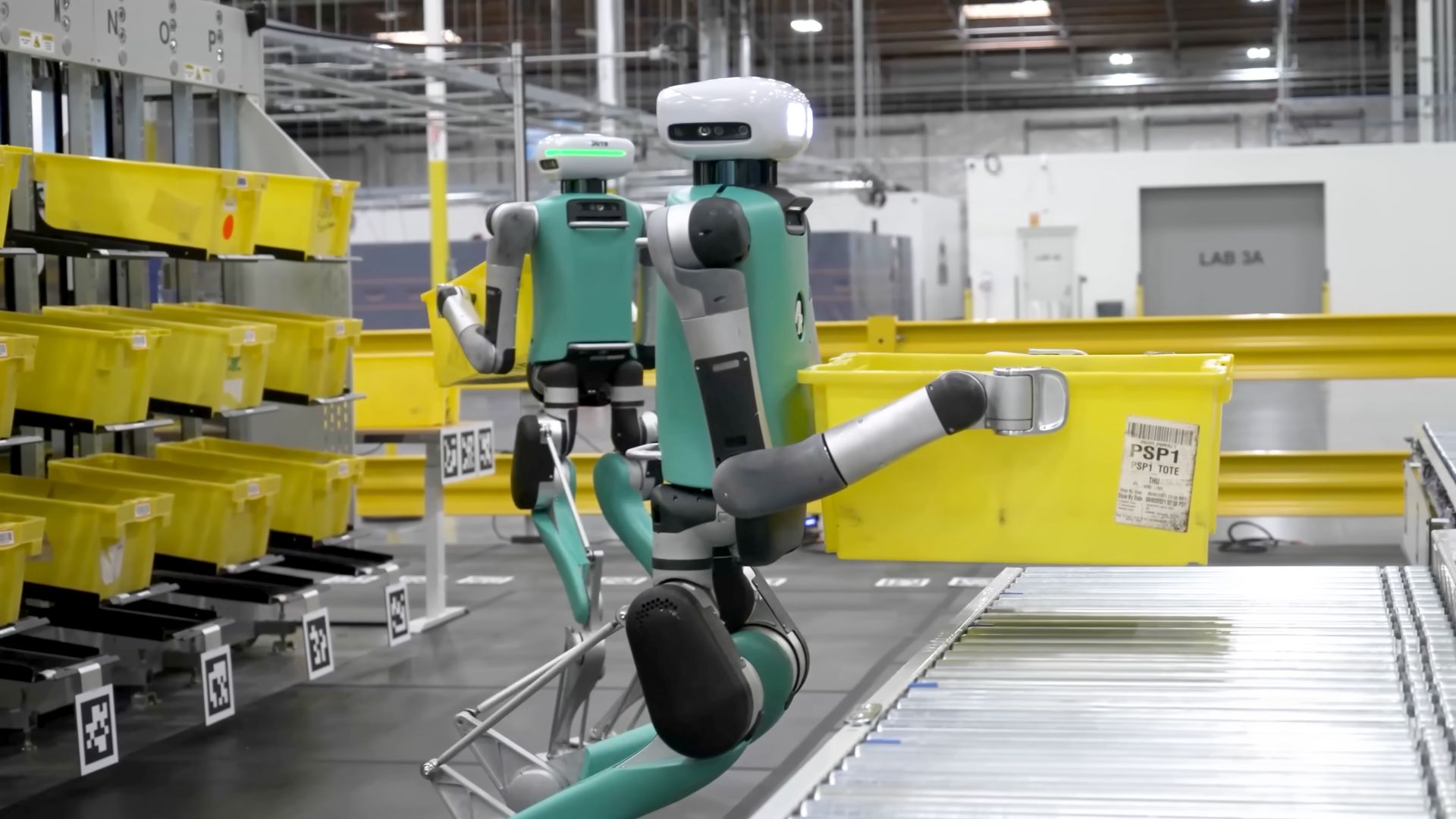
US-based Agility Robotics is preparing to launch its Digit V5 humanoid robot, with the company positioning it as a step toward safer human-robot collaboration in warehouses and factories.
The robot is designed to operate alongside workers without traditional safety fencing, addressing a key challenge in deploying humanoids in real-world workplaces.
Digit V5 is expected to support 20-hour operational days and use interchangeable end-effectors for different material-handling tasks, with autonomous tool changes planned for the future.
Recently, Agility Robotics revealed its plans to go public through a $2.5 billion SPAC deal, raising over $620 million to fund product development, research, and expansion.
Robots go cageless
Agility Robotics is preparing to deploy its next-generation Digit V5 humanoid robot to early customers in December, marking a major step toward wider commercial use of humanoid machines in industrial environments.
Digit V5 is designed specifically for warehouse and factory operations, where it can work alongside people without requiring the extensive safety fencing typically used around industrial robots. The humanoid platform combines a human-scale form factor with autonomous mobility, allowing it to navigate facilities and perform material-handling tasks in spaces designed for human workers.
Agility says Digit V5 incorporates upgraded safety systems intended to let the robot operate in close proximity to people. This could eliminate the need for dedicated cages and barriers that can consume valuable floor space, require costly facility modifications, disrupt traffic patterns and force changes to existing workflows, reports Humanoids Daily.
The ability to operate without conventional fencing could make Digit V5 particularly useful in crowded warehouses and factories where installing a dedicated robotic enclosure is impractical. Workers could also move through areas where the robot is operating, potentially allowing more flexible collaboration between humans and machines.
Agility expects early customer deployments to validate Digit V5’s safety capabilities under real-world conditions before broader production begins. The company believes the technology could expand humanoid applications beyond logistics and manufacturing into sectors such as retail and pharmaceuticals, where earlier systems faced greater operational restrictions.
Advances robot safety
Agility is placing safety at the center of its next-generation Digit V5 humanoid robot, with a new system designed to let it operate in close proximity to people without traditional safety fencing.
The robot combines cameras, sensors and software that can detect and interpret people in its surroundings with hardware designed to respond safely to unexpected movements. Its proprietary cycloidal actuators in the hips and knees provide the strength and dynamic stability needed to react quickly without losing balance, dropping a payload or falling.
Agility has tested this capability by suddenly removing the surface beneath the robot, prompting it to take a corrective step and maintain its load. The company considers this dynamic stability an important part of its overall safety approach.
Digit V5 also introduces other features intended to support safer and more flexible operation. Its battery system is designed to support more than 20 hours of work per day, potentially allowing one robot to operate across three shifts. The humanoid also uses an ISO-standard flange that allows it to work with a broad range of robotic end-effectors. Agility has demonstrated Digit changing grippers and plans to eventually enable autonomous tool changes.
These capabilities could expand the robot beyond bulk material handling into tasks such as kitting and sorting, while maintaining the safety requirements needed for workplaces where humans and robots operate together.
DEEP Robotics’ intelligent robots are helping researchers observe Tibetan antelopes in the high-altitude Serling Tso Nature Reserve in China.
Located at an average elevation of 4,700 meters (around 15,420 feet), the reserve becomes a key observation site between July and September, when large herds return with newborn calves during the annual migration season.
The robots captured footage of the animals migrating, nursing, and foraging around Cuo’e Lake, providing researchers with visual data that could support wildlife behavior.
Recently, Deep Robotics’ DR02 humanoid showcased enhanced mobility, running on grass, jumping obstacles, climbing stairs, and operating near hazardous electrical infrastructure for industrial applications.
Robots aid wildlife
At an average elevation of about 4,700 meters, China’s Serling Tso Nature Reserve provides an important habitat for Tibetan antelopes. From July through September, large herds return to the region with newborn calves, creating an ideal period for researchers to study migration, nursing and feeding behavior.
During this year’s migration season, DEEP Robotics deployed its robots around Cuo’e Lake to support wildlife research and ecological conservation. The machines captured natural footage of Tibetan antelopes while minimizing human interference, providing researchers with valuable visual data for long-term population and behavioral studies.
Advancing into High-Altitude Ecological Zones – Intelligent Robots Assist in Scientific Observation of Antelopes pic.twitter.com/QvNNUk1yeH
DEEP Robotics has previously used robotic systems for high-altitude wildlife observation. In 2025, its X30 quadruped robot operated in the Hoh Xil region at an elevation of around 4,800 meters (around 15,750 feet). Its biomimetic design helped it blend into the environment and reduce disturbance to animals.
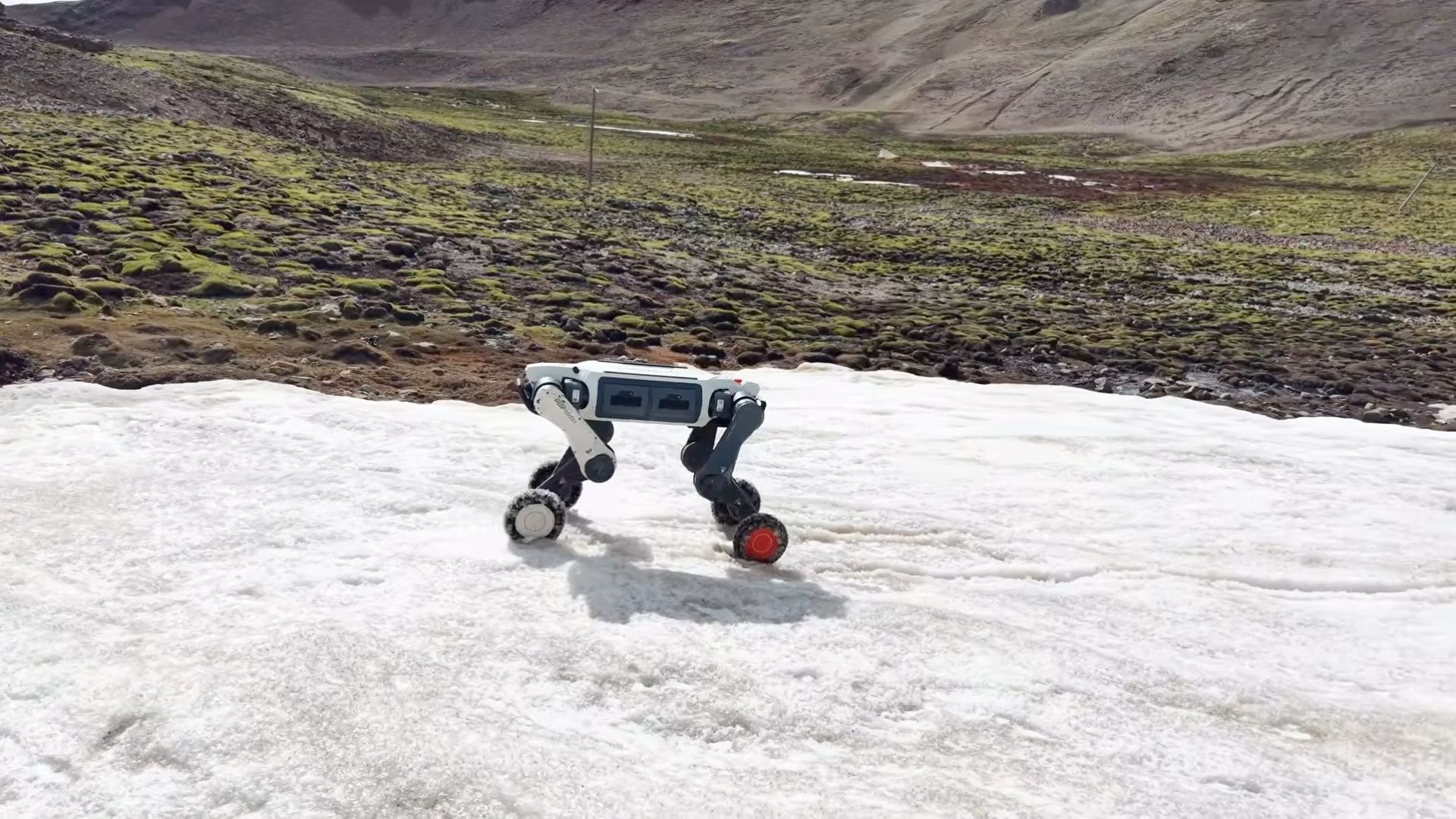
This year, the company deployed its Lynx M20 wheeled-legged robot in the Serling Tso Reserve, primarily for close-range visual documentation. The robot was required to operate across soft meadows, uneven permafrost and scattered gravel, where conventional equipment can struggle with stability.
Cold temperatures, rain, snow and other harsh weather conditions further complicate fieldwork, highlighting the potential of rugged robotic platforms for scientific observation in extreme environments.
Lynx M20 advances
DEEP Robotics’ Lynx M20 wheeled-legged robot is being used to support ecological research in the challenging high-altitude environment in Serling Tso Nature Reserve.
Designed for all-terrain operation, the Lynx M20 combines the speed of wheeled movement with the obstacle-crossing ability of legged locomotion. Its IP66 protection rating helps shield the robot from dust and water, while its operating temperature range of -20°C (-4°F) to 55°C (131°F) allows it to function in unpredictable plateau conditions.
The robot is also equipped with LiDAR and depth cameras that enable it to perceive changes in terrain, including meadows, uneven permafrost and gravel slopes. Using this environmental data, the system can adjust its posture and movement in real time, helping it maintain stability while navigating difficult ground.
A key advantage is its low-interference operation. Tibetan antelopes are highly sensitive to unfamiliar sounds and movements, making conventional close-range observation difficult. The Lynx M20’s relatively quiet movement allows researchers to approach herds with less disturbance and remotely document behaviors such as migration, grazing, and nursing.
Researchers observed the robot approaching a herd near Cuo’e Lake without causing the animals to flee. According to DEEP, the exercise demonstrates how increasingly capable mobile robots can extend scientific monitoring into remote and extreme environments.
What’s the point of having a superyacht if you’re forced to share it with some unwashed poors?
That’s the calculation the crew of a Mark Zuckerberg’s $300 million superyacht, Launchpad, apparently made on the billionaire’s behalf, after a skiff near its location in southeast Alaska ran into trouble.
According to the Alaska Beacon, a small cruise ship called Wilderness Legacy had to go out of its way to help the crew of a 21-foot boat that had run out of fuel outside Farragut Bay, a body of water south of Juneau. As maritime events go, it’s a pretty common occurrence — Dan Blanchard, the owner of the cruise line told the Beacon that these types of rescues don’t even “always rise to my attention.”
What did catch attention was the fact that Zuckerberg’s yacht had been much closer to the stranded skiff than the cruise ship. So much so, in fact, that the Wilderness Legacy had to steam “around and past” the Launchpad on its way to render assistance, the Beacon reported.
“There was near unanimous booing when the captain announced this,” Michael Love, a passenger aboard the cruise ship, said in a post on social media.
There are a few caveats here: for starters, the US Coast Guard says the skiff issued no official distress call, only a generic request for assistance. There’s also the tidbit shared by a spokesperson for Zuckerberg, who insisted that the billionaire was not personally onboard the yacht at the time.
As for why it didn’t respond to the call for assistance, the spokesperson told the Beacon that “by the time the crew reviewed the Coast Guard contact on a different radio channel from the one they were operating on, the assist was already underway.” In other words, the official story is that the crew on Zuckerberg’s unfathomably expensive yacht, which you’d assume was loaded with state-of-the-art communications equipment, simply didn’t notice the call for assistance.
Whether you buy that tale probably depends on how much latitude you’re willing to offer Zuckerberg, who has quickly become one of the more identifiable villains of the tech billionaire world. Regardless of his actual involvement, the Meta CEO was almost universally panned for the event on social media.
“Perfect mirror of how billionaires leave the entirety of society stranded,” one Redditor commented.
As Love, the cruise passenger, told the Beacon: “frankly, if I was Mark Zuckerberg I would be absolutely ecstatic at a chance to do something helpful for someone in need and maybe get some good PR out of it.”
The Greenlink Connector, which costs $580 million (GBP 430 million) and connects Ireland to Wales via an undersea power cable, was rerouted after scores of Harry Potter fans complained that it would go through the grave of the beloved house elf “Dobby.” According to The Guardian, project manager Simon Ludlam pointed out in a BBC interview that the cable would transition underwater at Freshwater West. Unfortunately, Ludlam was unaware that this was the filming location for the site where the Harry Potter character was buried in the movie franchise. When the BBC aired the clip, the project began receiving hundreds of calls about the site.
Ludlam recounted to The Guardian a discussion with a colleague when they told him, “Apparently, we’re going to go straight through Dobby’s grave.” He answered, “Dobby? Who’s Dobby? I don’t know Dobby.” It seemed that the project manager was in disbelief when it was finally explained that Dobby is the freed house elf who was killed in the process of rescuing Harry Potter and his friends in the last book. “He is a fictitious character in a fictitious book — the whole thing is fictitious. What are you talking about?” Ludlam said, after which his colleague replied, “No, it’s very, very serious.” In the end, the company working on the project acquiesced to the demands and concerns of the Harry Potter fans and rerouted it. “A lot of people were very happy about that, and the project is now going [ahead], and Dobby’s happy,” the project manager said.
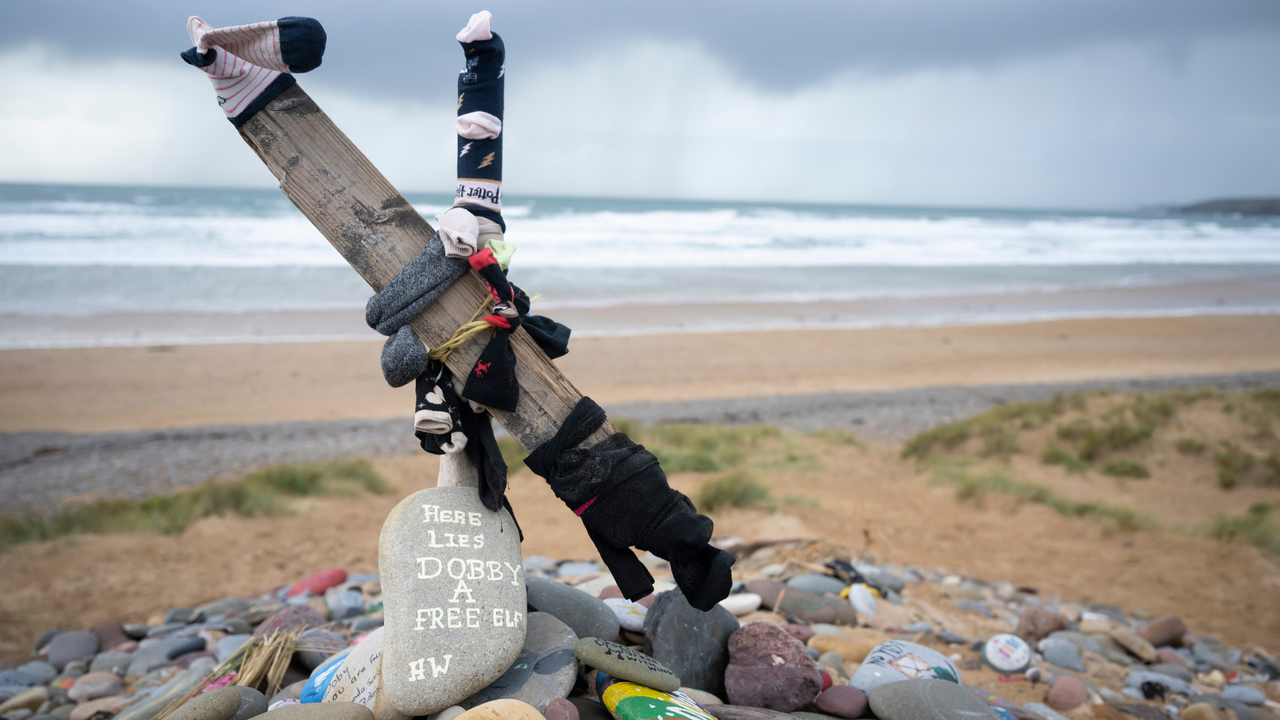
The Shell Cottage, where Dobby is buried, is on the outskirts of the fictional town of Tinworth, in Cornwall, but the original film series shot the scene in Freshwater West. Many Harry Potter fans leave stones marked with “Here lies Dobby, a free elf,” as a nod to the epitaph that the titular hero left on his grave. The National Trust, which owns the land, has previously warned pilgrims not to do so, as the area is ecologically sensitive, but it seems that people still do so. The fans’ resistance to having Dobby’s “grave” desecrated seemingly prevented the undersea cable from going through the area. It was instead rerouted in an area that was close to some Bronze Age remains and urns, which, ironically, are associated with human burial.
Undersea cables are crucial infrastructure connecting distant locations for sending information, power, and other crucial resources. Many of them face increasing threats, especially in areas that face geopolitical pressure, like Taiwan and the Baltic Sea, which is why companies are creating technologies to help detect intentional tampering. However, it seems that the one thing that the planners of this particular project did not take into account is the passion of Harry Potter fans.
Security researchers last week revealed a flaw in Apple’s iCloud Private Relay feature. While this is supposed to protect your IP address from the websites you visit, a vulnerability means that it often fails to do so.
Any time there’s a problem with an Apple product or service, a class action lawsuit is sure to follow, and this is no exception …
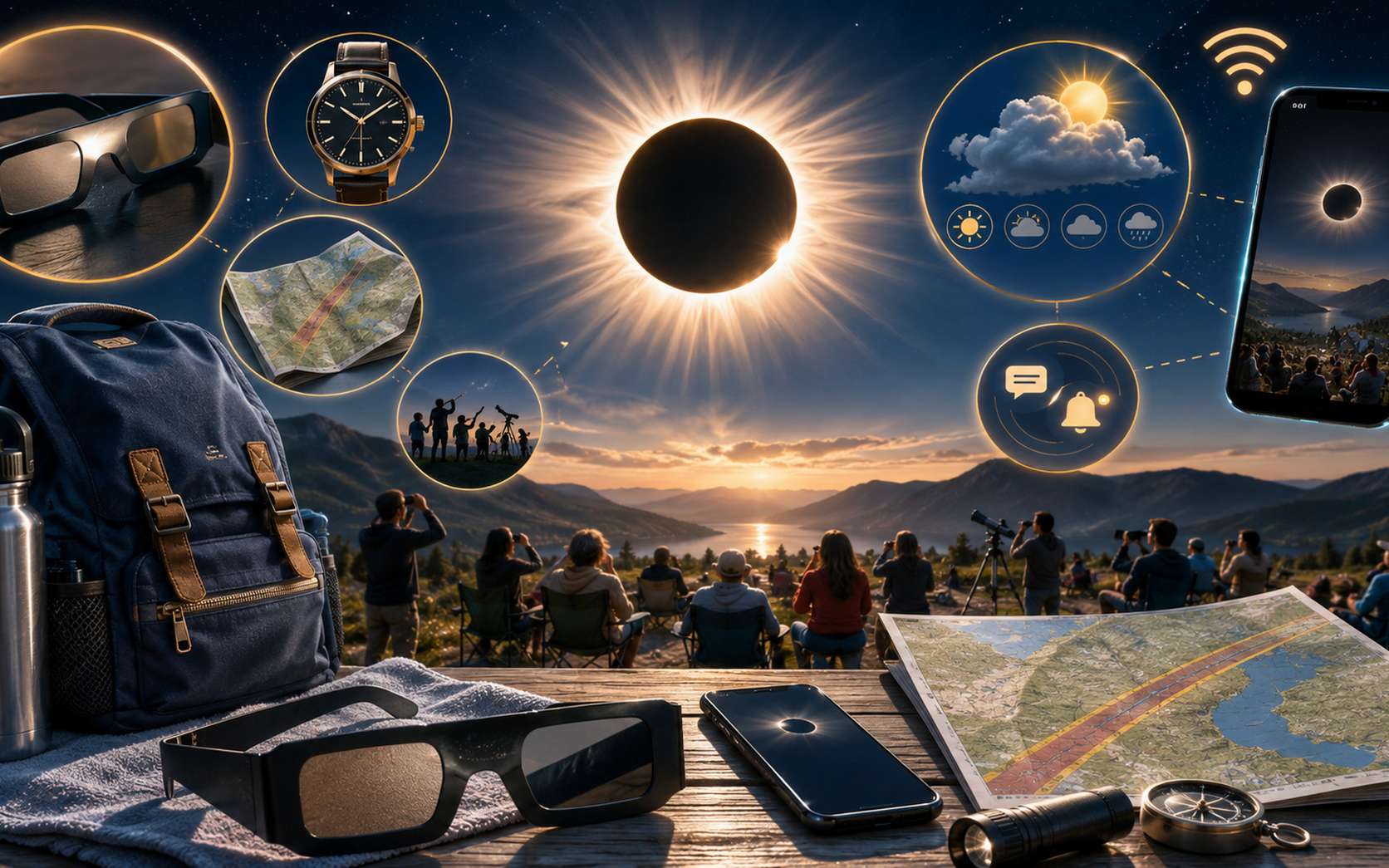
Mercredi 12 août, la France assistera à une éclipse solaire partielle, dont le degré d'occultation variera de près de 90 % dans l’Est à 99,5 % à Biarritz. Horaires, carte, météo, lunettes, événements et direct : voici la check-list de dernière minute avant de vivre cet évènement exceptionnel.
One of Apple’s proposed solutions – or at least mitigations – for the memory shortage was to buy RAM from two Chinese companies, CXMT and YMTC.
While it was not technically banned from doing so, this would have put it into conflict with the US government, and the idea is now looking even less likely thanks to two developments …
Cristiano Amon, chief executive officer of Qualcomm. (Photo: Samsung Electronics)
Cristiano Amon, chief executive officer of Qualcomm. (Photo: Samsung Electronics)
Qualcomm is expanding the reach of its Snapdragon platform beyond smartphones, positioning the brand at the center of the emerging personal artificial intelligence (AI) era. By extending Snapdragon across smartphones, PCs, automobiles, wearables and extended reality (XR) devices, the company aims to strengthen its market leadership through a unified AI ecosystem.
According to Qualcomm, Snapdragon platforms have now shipped in more than 3.5 billion devices worldwide. Since debuting in smartphones in 2007, Snapdragon has evolved into a consumer platform spanning wearables, PCs, vehicles and XR devices. Qualcomm's next objective is to expand the Snapdragon ecosystem to enable AI agents to operate seamlessly across multiple devices, replacing today's fragmented, device-specific experiences.
Cristiano Amon, Qualcomm's chief executive officer, underscored that vision during Samsung Electronics' Galaxy Unpacked 2026 event on July 22.
"Personal devices will become the ultimate destination for AI agents," Amon said. "That means high-performance, power-efficient on-device computing and reliable connectivity will become increasingly important, and Qualcomm provides the technologies needed to make that possible."
Samsung unveiled several Snapdragon-powered personal AI devices during the event. The Galaxy Z Fold8 Ultra and Galaxy Z Flip8 are powered by the Snapdragon 8 Elite Gen 5 for Galaxy, while the Galaxy Watch9 and Galaxy Watch Ultra2 use the Snapdragon Wear Elite platform. Samsung's Intelligent Eyewear smart glasses also incorporate Qualcomm's Snapdragon AR1 Gen 1 platform.
Qualcomm's strategy of expanding the Snapdragon ecosystem reflects a broader shift in the way consumers experience digital services. In the past, smartphones served as the primary gateway to digital experiences, while wearables largely complemented or extended smartphone functionality.
The rise of agentic AI is changing that paradigm by enabling consistent digital experiences regardless of device form factor. Personal AI systems can understand a user's intent and context, allowing them to deliver personalized services across multiple devices. During his keynote address at MWC 2026, Amon said the industry was moving beyond a smartphone-centric ecosystem.
"Until now, everything revolved around the smartphone," he said. "Going forward, every device will exist around the AI agent."
The Galaxy Z Fold8 series powered by Qualcomm's Snapdragon 8 Elite Gen 5 for Galaxy. (Photo: Samsung Electronics)
Competition among mobile chipmakers is also shifting toward AI-driven user experiences. Industry participants increasingly emphasize the importance of AI agents delivering continuous, coordinated experiences across multiple devices rather than maximizing performance on a single product.
Kim Won-joon, executive vice president and head of development at Samsung Electronics' Mobile eXperience (MX) Business, echoed that view.
"A premium experience can no longer be defined by a single product," Kim said. "The intelligence that connects all devices together is what defines a premium experience."
To deliver a consistent digital experience across multiple devices, sufficient computing performance and stable connectivity are essential. Qualcomm says it is positioning Snapdragon as a platform capable of providing a unified AI experience regardless of device form factor by optimizing central processing units (CPUs), graphics processing units (GPUs), neural processing units (NPUs) and connectivity technologies within a single integrated system.
One example is the Snapdragon 8 Elite Gen 5 for Galaxy, which combines Qualcomm's proprietary Oryon CPU architecture, Adreno GPU, Hexagon NPU and FastConnect 7900 connectivity system, all optimized specifically for Galaxy smartphones. The platform is designed to deliver flagship-class performance and responsiveness while maintaining high power efficiency.
The chipset also enables intelligent camera functions, enhanced gaming performance and AI-powered connectivity for more responsive real-time AI experiences. It supports video playback at up to 8K resolution (7,680 × 4,320) at 60 frames per second, while compatibility with AV1 and H.265 codecs helps reduce battery consumption during extended video streaming.
The Snapdragon Wear Elite platform introduces another industry first by integrating an NPU into a wearable processor. It can run AI models with up to 1 billion parameters directly on the device without relying on cloud connectivity. This enables AI agent capabilities such as contextual awareness, natural voice interaction and continuous personal activity logging.
The platform also incorporates Qualcomm's first multimode connectivity architecture integrating six next-generation communication technologies into a single chip. It supports 5G RedCap, designed for lower-power 5G connectivity, micro-power Wi-Fi and Bluetooth 6.0 for precise device-to-device communication, allowing continuous collection of contextual signals to enhance personal AI experiences.
Similarly, the Snapdragon AR1 platform for smart glasses combines an ultra-lightweight, low-power design with sufficient processing capability to support AI agents. It integrates an NPU, a visual analysis engine and enhanced memory to provide stable wireless streaming and AI-powered computing within compact wearable devices.
Snapdragon has already established a strong position in the premium mobile market. According to Qualcomm, 61% of South Korean consumers identify Snapdragon as a key factor in improving the experience of premium Android devices.
By expanding the Snapdragon ecosystem across a broader range of connected products, Qualcomm aims to strengthen its competitiveness in the personal AI era while reinforcing its leadership in the intelligent device market.
Disparu depuis des siècles, le dodo continue de fasciner. Cet oiseau est souvent vu comme une version moins développée et plus « basique » des volatiles d'aujourd'hui, et pourtant, l'étude de son crâne révèle des capacités et un mode de vie plus complexes que ce que l'on croyait.
Imagens de ressonância magnética trazem evidências em favor de algo que muitos tutores de cães já pressentiam: os bichos têm uma compreensão relativamente sofisticada das emoções humanas. Observando fotos de alguns Homo sapiens, eles são capazes de distinguir expressões faciais de alegria, de medo e de raiva, por exemplo.
Leia mais (08/11/2026 - 06h00)

 Login




 The LaBrants’ Homeschool History Curriculum: Whatever Cole Decides Happened