
❌

Reading view

AGN SIG Spotlight Series, 21 July 2026

AGN SIG Spotlight Series

Active Galactic Nuclei Science Interest Group

AGN SIG about AGN SIG Spotlight Series

Location

Virtual

Dates

21 July 2026
1:00pm ET / 10:00am PT

Community

AGN SIG

Type

Seminar

Spin Signatures in Horizon-Resolved Images of LLAGN

Speaker

Dr. Daniel Palumbo, Harvard University

Abstract

With the advent of the Event Horizon Telescope (EHT), near-horizon black hole imaging with sub-mm very-long-baseline interferometry (VLBI) is now routine for the two sources for which terrestrial VLBI is sufficient to resolve the black hole shadow: Messier 87* and Sagittarius A*. Since the first images of M87*, the theoretical analysis of these images has advanced a broad class of black hole spin tracers in horizon-resolving observations, all of which have complex interplay with the astrophysical conditions near the horizon. Meanwhile, space VLBI mission concepts such as the Black Hole Explorer aim to drastically improve the angular resolution available via sub-mm VLBI, resolving out the primary accretion disk image to isolate the strongly lensed “photon ring,” which more robustly exposes black hole mass, spin, and viewing inclination to distant observers. In this talk, I will detail the spin signatures in both of these angular resolution regimes, and how they work together to build a “robustness ladder” for spin measurement with which the spins of many more low-luminosity AGN will soon become accessible as sub-mm VLBI sensitivity, frequency coverage, angular resolution improves. The resulting local “spin census” will help fill in missing pieces of the history of accretion and merging in the broader AGN population.

Coupling Driven H2 Excitation in Seyferts: GATOS JWST/MRS

Speaker

Daniel Delaney, University of Alaska

Abstract 

We utilize James Webb Space Telescope/Mid Infrared Instrument (JWST/MIRI) Integral Field Unit observations from the Galaxy Activity, Torus and Outflow Survey to investigate the diverse range of ionized outflow rates of obscured active galactic nuclei (AGN) with similar bolometric luminosity and explore potential associations with AGN feedback. We explore spatial correlations between ionized emission potentially associated with fast shocks ([Fe II]5.34μm) and the excitation of H2. We further constrain our investigation to the inner 400 pc (the nuclear and circumnuclear regions r < 200 pc), and estimate the excitation temperature and column density of H2 assuming local thermodynamic equilibrium and using the S(1)–S(8) rotational H2 emission lines visible to JWST/MIRI spectroscopy. We report the molecular gas temperature of the deprojected 400 pc nuclear region to correlate with the ionized mass outflow rate. We also observe a stronger degree of spatial correlation between [Fe II]5.34μm emission and H2 gas temperature. We observe regions of enhanced [Fe II]5.34μm/[Ar II]6.99μm spatially coincident with the ionization cones of objects with higher ionized outflow rates and [Fe II]5.34μm/[Ar II]6.99μm in the deprojected 400 pc nuclear region to scale positively with both the ionized outflow rate and the estimated molecular gas temperature. We do not observe the estimated jet cavity power within the central 400 pc as strongly correlated with the ionized mass outflow rate or molecular gas temperature of the nuclear region. We take the preceding observations to suggest a higher degree of interaction between AGN outflows and the circumnuclear disk.

Seminar Connection

Zoom Registration (note this is a new registration link), you will receive connection details by email after registration: 

https://alaska.zoom.us/meeting/register/V1okit8uSk2ql97gegbdzg

News Straight to Your Inbox

Subscribe to your community email news list

We will never share your email address.
Privacy Policy

Sign Up
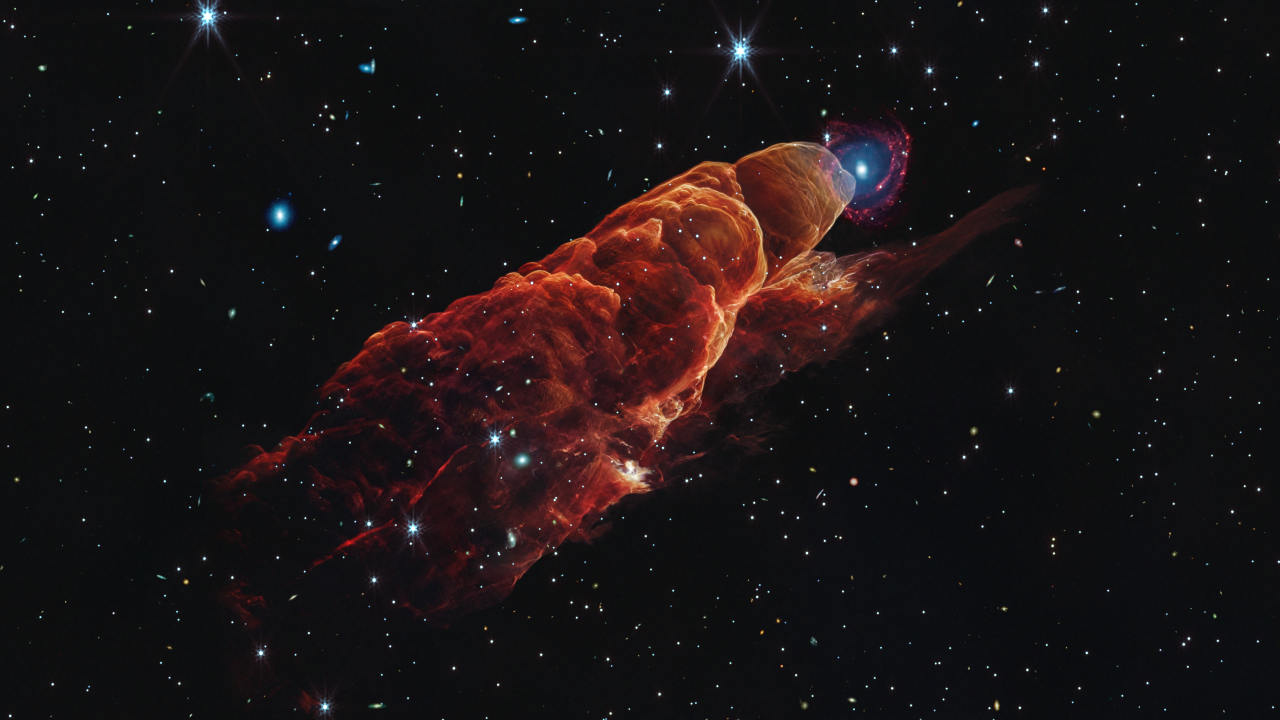
Angled from the upper left corner to the lower right corner is a cone-shaped orange-red cloud known as Herbig-Haro 49/50. This feature takes up about three-fourths of the length of this angle. The upper left end of this feature has a translucent, rounded end. The conical feature widens slightly from the rounded end at the upper right down to the lower right. Along the cone there are additional rounded edges, like edges of a wave, and intricate foamy-like details, as well as a clearer view of the black background of space. In the upper left, overlapping with the rounded end of Herbig-Haro 49/50, is a background spiral galaxy with a concentrated blue center that fades outward to blend with red spiral arms. The background of space is speckled with some white stars and smaller, more numerous, fainter white galaxies throughout.

The post AGN SIG Spotlight Series, 21 July 2026 appeared first on NASA Science.
  •  

DGCE SIG Seminar, 23 July 2026

DGCE SIG Seminar

Diffuse Gas in Cosmic Ecosystems Science Interest Group

DGCE SIG about DGCE SIG Seminar

Location

Virtual

Dates

23 July 2026
4:00pm ET / 1:00pm PT

Community

DGCE SIG

Type

Seminar

From Micro to Macro: Connecting the Physics of Galaxy Formation Across Scales

Speaker

Drummond Fielding, New York University

Abstract

Galaxy formation is controlled by the cycling of diffuse gas through the ISM, CGM, and larger-scale environment, but predictive models remain limited by unresolved microphysics. I will discuss how sub-pc processes—including cosmic-ray transport, magnetic reconnection, and turbulent mixing—regulate multiphase structure, energy and momentum transport, and the launching of galactic winds. I will then describe how simulations, analytic models, and new multi-scale numerical methods can connect these processes to kpc-scale feedback and Mpc-scale galaxy evolution. The aim is to build physically grounded models of gas cycling that can sharpen our interpretation of observations and move galaxy formation theory beyond phenomenological feedback prescriptions.

Seminar Connection

Join the Seminar

News Straight to Your Inbox

Subscribe to your community email news list

We will never share your email address.

Privacy Policy

Sign Up
Angled from the upper left corner to the lower right corner is a cone-shaped orange-red cloud known as Herbig-Haro 49/50. This feature takes up about three-fourths of the length of this angle. The upper left end of this feature has a translucent, rounded end. The conical feature widens slightly from the rounded end at the upper right down to the lower right. Along the cone there are additional rounded edges, like edges of a wave, and intricate foamy-like details, as well as a clearer view of the black background of space. In the upper left, overlapping with the rounded end of Herbig-Haro 49/50, is a background spiral galaxy with a concentrated blue center that fades outward to blend with red spiral arms. The background of space is speckled with some white stars and smaller, more numerous, fainter white galaxies throughout.

The post DGCE SIG Seminar, 23 July 2026 appeared first on NASA Science.
  •  

HWO SIG Seminar, 12 August 2026

HWO SIG Seminar

Habitable Worlds Observatory Science Interest Group

HWO SIG about HWO SIG Seminar

Location

Virtual

Dates

12 August 2026

Community

HWO SIG

Type

Seminar

Title TBA

Speaker

TBA

Seminar Connection

Join the Seminar

News Straight to Your Inbox

Subscribe to your community email news list

We will never share your email address.

Privacy Policy

Sign Up
Angled from the upper left corner to the lower right corner is a cone-shaped orange-red cloud known as Herbig-Haro 49/50. This feature takes up about three-fourths of the length of this angle. The upper left end of this feature has a translucent, rounded end. The conical feature widens slightly from the rounded end at the upper right down to the lower right. Along the cone there are additional rounded edges, like edges of a wave, and intricate foamy-like details, as well as a clearer view of the black background of space. In the upper left, overlapping with the rounded end of Herbig-Haro 49/50, is a background spiral galaxy with a concentrated blue center that fades outward to blend with red spiral arms. The background of space is speckled with some white stars and smaller, more numerous, fainter white galaxies throughout.

The post HWO SIG Seminar, 12 August 2026 appeared first on NASA Science.

  •  

GW SIG Seminar, 23 July 2026

GW SIG Seminar

Gravitational Wave Science Interest Group

GW SIG about GW SIG Seminar

Location

Virtual

Dates

23 July 2026
10:00am – 11:15am ET

Community

GW SIG

Type

Seminar

LISA Preparatory Science and LISA Science Gaps

Details TBA

Seminar Connection

Join the Seminar

News Straight to Your Inbox

Subscribe to your community email news list

We will never share your email address.

Privacy Policy

Sign Up
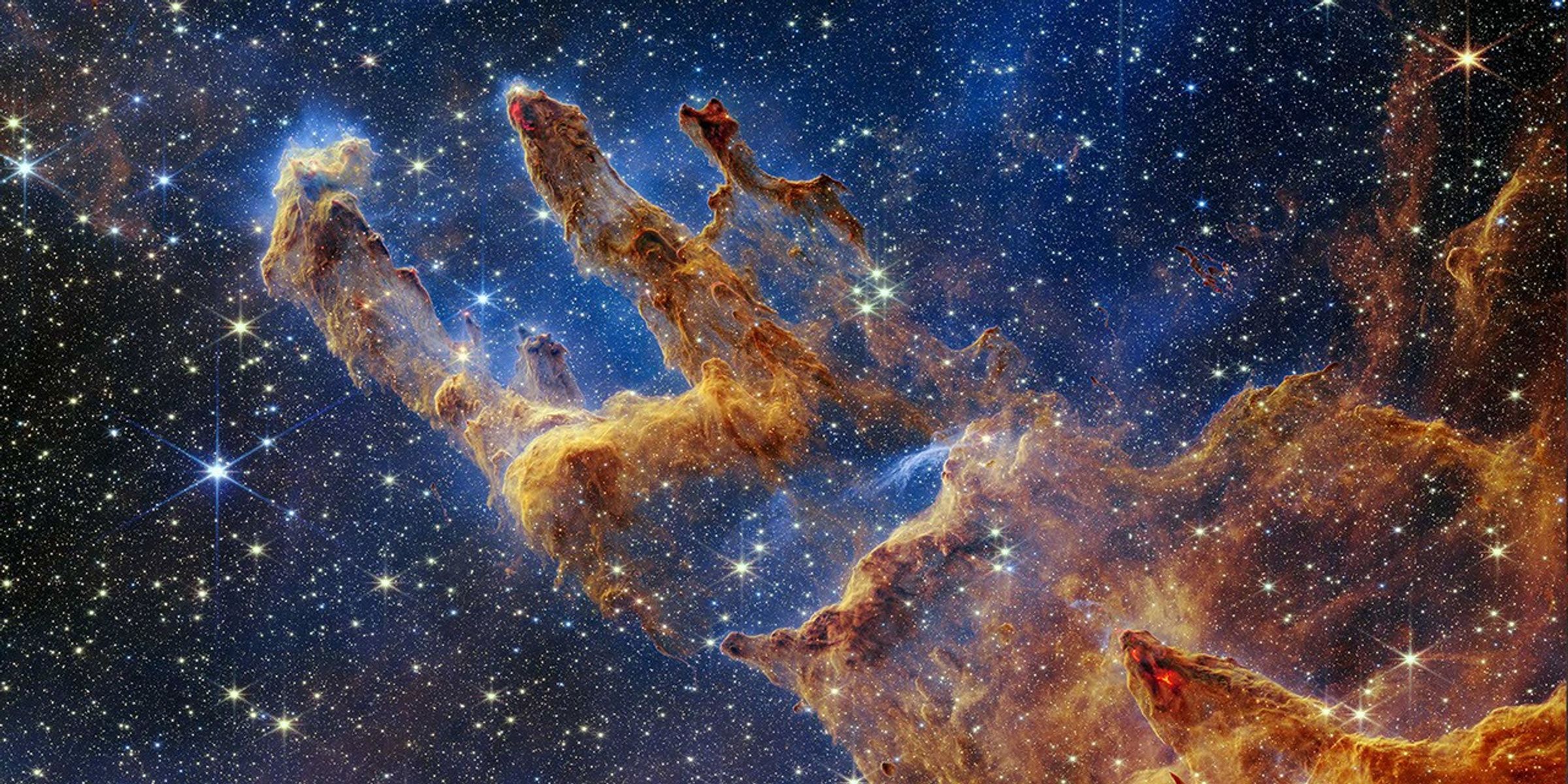
This cropped horizontal image has layers of semi-opaque rusty red colored gas and dust that starts at the bottom right and goes toward the top left. There are three prominent pillars rising toward the top left. The left pillar is the largest and widest. The peaks of the second and third pillars are set off in darker shades of brown and have red outlines.

The post GW SIG Seminar, 23 July 2026 appeared first on NASA Science.

  •  

Habitable Worlds Observatory SIG Seminar, 12 Aug 2026

Habitable Worlds Observatory SIG Seminar

Habitable Worlds Observatory Science Interest Group

HWO SIG about Habitable Worlds Observatory SIG Seminar

Location

Virtual

Dates

12 August 2026

Community

HWO SIG

Type

Seminar

Title TBA

Speaker

TBA

Seminar Connection

Join the Seminar

News Straight to Your Inbox

Subscribe to your community email news list

We will never share your email address.

Privacy Policy

Sign Up
This cropped horizontal image has layers of semi-opaque rusty red colored gas and dust that starts at the bottom right and goes toward the top left. There are three prominent pillars rising toward the top left. The left pillar is the largest and widest. The peaks of the second and third pillars are set off in darker shades of brown and have red outlines.

The post Habitable Worlds Observatory SIG Seminar, 12 Aug 2026 appeared first on NASA Science.

  •  

GW SIG Seminar, 29 June 2026

GW SIG Seminar

Gravitational Wave Science Interest Group

GW SIG about GW SIG Seminar

Location

Virtual

Dates

29 June 2026
1:00pm ET

Community

GW SIG

Type

Seminar

Laser Interferometer Lunar Antenna: a Sub-Hertz GW Detector on the Moon

Speaker

Volker Quetschke, University of Texas Rio Grande Valley

Abstract

The moon offers unique opportunities and challenges to realize interferometric gravitational wave detectors that are sensitive over a range of frequencies that are currently not covered. Compared with Earth-based detectors, the moon’s reduced gravity and lower seismic activity allow us to shift the sensitivity to lower frequencies.

An update on the Laser Interferometer Lunar Antenna (LILA) project—a next generation gravitational-wave detector on the surface of the Moon—will be presented. The LILA detector will have unique access to sub-Hertz frequencies of gravitational waves. This frequency range of waves cannot be measured by any ongoing or upcoming experiment on the Earth or in space, thus fundamentally changing the landscape of multi-messenger astrophysics that otherwise cannot be achieved. LILA will provide early warnings prior to mergers of black holes and neutron stars. Measurements in the deci-Hertz regime can vastly improve measurements of the Hubble constant, the equation of state of neutron stars, and tests of General Relativity. Furthermore, LILA will uniquely observe phenomena like white dwarf mergers as Type Ia supernovae progenitors, tidal disruption around intermediate mass black holes, and novel dark matter probes.

A preliminary design for the LILA project and the planned future development stages will be shown: the LILA Autonomous Interferometry Technology Demonstration (LILA-AITD), the Initial LILA (iLILA) strainmeter and the full, operational LILA Observatory.

Seminar Connection

Join the Seminar

News Straight to Your Inbox

Subscribe to your community email news list

We will never share your email address.

Privacy Policy

Sign Up
This cropped horizontal image has layers of semi-opaque rusty red colored gas and dust that starts at the bottom right and goes toward the top left. There are three prominent pillars rising toward the top left. The left pillar is the largest and widest. The peaks of the second and third pillars are set off in darker shades of brown and have red outlines.

The post GW SIG Seminar, 29 June 2026 appeared first on NASA Science.

  •  

AMMB STIG Seminar, 1 July 2026

AMMB STIG Seminar

Astrophysics from the Moon, Mars, and Beyond Science and Technology Interest Group

AMMB STIG about AMMB STIG Seminar

Location

Virtual

Dates

1 July 2026
2:00pm -3:00pm ET
11:00am – 12:00 pm PT

Community

Physics of the Cosmos

Type

Seminar

Why and Where Do We Want to Put Telescopes on the Moon?

Speaker

Nivedita Mahesh, CU Boulder

Abstract

The Moon is emerging as a uniquely valuable platform for astrophysics, enabling observations that neither Earth nor free-flying spacecraft can support. This talk surveys the scientific motivation across four complementary regimes. At low radio frequencies, the radio-quiet lunar farside opens a window onto the cosmological Dark Ages and the magnetospheres of exoplanets. In the mid-band gravitational-wave regime, the Moon’s low seismic activity bridges the sensitivity gap between terrestrial and space-based detectors. At ultraviolet wavelengths, its natural vacuum and long coherence times allow high-resolution stellar imaging beyond what is possible on Earth. And in the far-infrared, the cold, stable conditions of permanently shadowed regions offer a naturally cryogenic, absorption-free site for probing star and planet formation and the obscured Universe.

For each regime, I will share updates from the mission concept leads on the efforts now developing within the Astrophysics from the Moon, Mars & Beyond (AMMB) Science Interest Group. Together, these cases point to a paradigm shift: astrophysics from the Moon is becoming not just desirable but necessary.

Seminar Connection

Join the Seminar

News Straight to Your Inbox

Subscribe to your community email news list

We will never share your email address.

Privacy Policy

Sign Up
This cropped horizontal image has layers of semi-opaque rusty red colored gas and dust that starts at the bottom right and goes toward the top left. There are three prominent pillars rising toward the top left. The left pillar is the largest and widest. The peaks of the second and third pillars are set off in darker shades of brown and have red outlines.

The post AMMB STIG Seminar, 1 July 2026 appeared first on NASA Science.

  •  

Cosmic Structure SIG Seminar, 17 July 2026

Cosmic Structure SIG Seminar

Cosmic Structure Science Interest Group

CoS SIG about Cosmic Structure SIG Seminar

Location

Virtual

Dates

17 July 2026
10:00am PT / 1:00pm ET

Community

CoS SIG

Type

Seminar

Constraints on Dynamical Dark Energy from the Full Dark Energy Survey

Speaker

Sujeong Lee, Ohio University

Abstract

The nature of dark energy remains one of the central open questions in cosmology, and recent analyses have reported a weak but intriguing preference for an evolving equation of state. I will present constraints on the w0-wa parameterization from the full six-year Dark Energy Survey (DES) dataset, combining growth and geometric probes — supernovae, BAO, and weak lensing and galaxy clustering (3x2pt) — within a single survey. The DES-only combination yields the tightest such constraints using multiple probes from any single survey, and adding external CMB and DESI BAO data gives a 3.0-sigma deviation from a cosmological constant, with the best-fit always favoring w0 > -1, wa < 0. Because DES relies on different probes and systematics than DESI, this provides an independent cross-check on the recent hints for dynamical dark energy. I will discuss how to interpret these results, and what they imply for Stage IV surveys. This work realizes the multi-probe dark energy program envisioned at the inception of DES.

Seminar Connection

Join the Seminar

News Straight to Your Inbox

Subscribe to your community email news list

We will never share your email address.

Privacy Policy

Sign Up
This cropped horizontal image has layers of semi-opaque rusty red colored gas and dust that starts at the bottom right and goes toward the top left. There are three prominent pillars rising toward the top left. The left pillar is the largest and widest. The peaks of the second and third pillars are set off in darker shades of brown and have red outlines.

The post Cosmic Structure SIG Seminar, 17 July 2026 appeared first on NASA Science.

  •  

AI/ML STIG Lecture Series, 29 June 2026

AI/ML STIG Lecture Series

Artificial Intelligence and Machine Learning Science and Technology Interest Group (AI/ML STIG)

Module 9: AI for Science and Engineering at NASA

AI/ML STIG about AI/ML STIG Lecture Series

Location

Virtual

Dates

29 June 2026
4:00pm – 5:00pm ET

Community

AI/ML STIG

Type

Seminar

Speaker

Steven M. Crawford, NASA HQ

Details TBA

Seminar Connection

TBA

News Straight to Your Inbox

Subscribe to your community email news list

We will never share your email address.

Privacy Policy

Sign Up
Angled from the upper left corner to the lower right corner is a cone-shaped orange-red cloud known as Herbig-Haro 49/50. This feature takes up about three-fourths of the length of this angle. The upper left end of this feature has a translucent, rounded end. The conical feature widens slightly from the rounded end at the upper right down to the lower right. Along the cone there are additional rounded edges, like edges of a wave, and intricate foamy-like details, as well as a clearer view of the black background of space. In the upper left, overlapping with the rounded end of Herbig-Haro 49/50, is a background spiral galaxy with a concentrated blue center that fades outward to blend with red spiral arms. The background of space is speckled with some white stars and smaller, more numerous, fainter white galaxies throughout.

The post AI/ML STIG Lecture Series, 29 June 2026 appeared first on NASA Science.

  •  

AMMB STIG Seminar, 1 July 2026

Astrophysics from the Moon Seminar

Astrophysics from the Moon, Mars, and Beyond Science and Technology Interest Group

AMMB STIG about Astrophysics from the Moon Seminar

Location

Virtual

Dates

1 July 2026
2:00pm -3:00pm ET
11:00am – 12:00 pm PT

community

Cosmic Origins

Type

Seminar

Why and Where Do We Want to Put Telescopes on the Moon?

Speaker

Nivedita Mahesh, CU Boulder

Abstract

The Moon is emerging as a uniquely valuable platform for astrophysics, enabling observations that neither Earth nor free-flying spacecraft can support. This talk surveys the scientific motivation across four complementary regimes. At low radio frequencies, the radio-quiet lunar farside opens a window onto the cosmological Dark Ages and the magnetospheres of exoplanets. In the mid-band gravitational-wave regime, the Moon’s low seismic activity bridges the sensitivity gap between terrestrial and space-based detectors. At ultraviolet wavelengths, its natural vacuum and long coherence times allow high-resolution stellar imaging beyond what is possible on Earth. And in the far-infrared, the cold, stable conditions of permanently shadowed regions offer a naturally cryogenic, absorption-free site for probing star and planet formation and the obscured Universe.

For each regime, I will share updates from the mission concept leads on the efforts now developing within the Astrophysics from the Moon, Mars & Beyond (AMMB) Science Interest Group. Together, these cases point to a paradigm shift: astrophysics from the Moon is becoming not just desirable but necessary.

Seminar Connection

Join the Seminar

News Straight to Your Inbox

Subscribe to your community email news list

We will never share your email address.

Privacy Policy

Sign Up
Angled from the upper left corner to the lower right corner is a cone-shaped orange-red cloud known as Herbig-Haro 49/50. This feature takes up about three-fourths of the length of this angle. The upper left end of this feature has a translucent, rounded end. The conical feature widens slightly from the rounded end at the upper right down to the lower right. Along the cone there are additional rounded edges, like edges of a wave, and intricate foamy-like details, as well as a clearer view of the black background of space. In the upper left, overlapping with the rounded end of Herbig-Haro 49/50, is a background spiral galaxy with a concentrated blue center that fades outward to blend with red spiral arms. The background of space is speckled with some white stars and smaller, more numerous, fainter white galaxies throughout.

The post AMMB STIG Seminar, 1 July 2026 appeared first on NASA Science.

  •  

AMMG STIG Seminar, July 1, 2026

Astrophysics from the Moon, Mars, and Beyond STIG Seminar

23 June 2026

2:00pm ET July 1st, 2026

Why and Where Do We Want to Put Telescopes on the Moon?

https://science.nasa.gov/astrophysics/programs/physics-of-the-cosmos/community/ammb-stig-seminar-1-july-2026

Speaker

Nivedita Mahesh | CU Boulder

Abstract

The Moon is emerging as a uniquely valuable platform for astrophysics, enabling observations that neither Earth nor free-flying spacecraft can support. This talk surveys the scientific motivation across four complementary regimes. At low radio frequencies, the radio-quiet lunar farside opens a window onto the cosmological Dark Ages and the magnetospheres of exoplanets. In the mid-band gravitational-wave regime, the Moon’s low seismic activity bridges the sensitivity gap between terrestrial and space-based detectors. At ultraviolet wavelengths, its natural vacuum and long coherence times allow high-resolution stellar imaging beyond what is possible on Earth. And in the far-infrared, the cold, stable conditions of permanently shadowed regions offer a naturally cryogenic, absorption-free site for probing star and planet formation and the obscured Universe.

For each regime, I will share updates from the mission concept leads on the efforts now developing within the Astrophysics from the Moon, Mars & Beyond (AMMB) Science Interest Group. Together, these cases point to a paradigm shift: astrophysics from the Moon is becoming not just desirable but necessary.

News Straight to Your Inbox

Subscribe to your community email news list

We will never share your email address.

Privacy Policy

Sign Up
Angled from the upper left corner to the lower right corner is a cone-shaped orange-red cloud known as Herbig-Haro 49/50. This feature takes up about three-fourths of the length of this angle. The upper left end of this feature has a translucent, rounded end. The conical feature widens slightly from the rounded end at the upper right down to the lower right. Along the cone there are additional rounded edges, like edges of a wave, and intricate foamy-like details, as well as a clearer view of the black background of space. In the upper left, overlapping with the rounded end of Herbig-Haro 49/50, is a background spiral galaxy with a concentrated blue center that fades outward to blend with red spiral arms. The background of space is speckled with some white stars and smaller, more numerous, fainter white galaxies throughout.

The post AMMG STIG Seminar, July 1, 2026 appeared first on NASA Science.

  •  

DGCE SIG Seminar, June 25, 2026

Diffuse Gas and Cosmic Ecosystems SIG Seminar

23 June 2026

4:00pm ET June 25th, 2026

Cosmic Origins Science in the New Landscape of Space Astrophysics

https://science.nasa.gov/astrophysics/programs/cosmic-origins/community/dgce-sig-seminar-25-june-2026

Speaker

Swara Ravindranath | Deputy Chief Scientist of NASA’s Cosmic Origins Program (NASA GSFC)

Abstract

Cosmic Origins Science covers a broad range of topics that are fundamental to our understanding of the evolution of structure in the Universe and the physical processes that can explain the formation of galaxies, stars, and planets that we observe today. The various space telescopes that operate across the electromagnetic spectrum have been crucial to address some of the most fundamental questions related to our cosmic origins. The landscape of Space Astronomy is evolving fast with innovative technology, industry partnerships, and new commercial launch capabilities. In this talk, I will review the Cosmic Origins Program and discuss the new opportunities that offer strategic pathways for focused-science missions.

News Straight to Your Inbox

Subscribe to your community email news list

We will never share your email address.

Privacy Policy

Sign Up
Angled from the upper left corner to the lower right corner is a cone-shaped orange-red cloud known as Herbig-Haro 49/50. This feature takes up about three-fourths of the length of this angle. The upper left end of this feature has a translucent, rounded end. The conical feature widens slightly from the rounded end at the upper right down to the lower right. Along the cone there are additional rounded edges, like edges of a wave, and intricate foamy-like details, as well as a clearer view of the black background of space. In the upper left, overlapping with the rounded end of Herbig-Haro 49/50, is a background spiral galaxy with a concentrated blue center that fades outward to blend with red spiral arms. The background of space is speckled with some white stars and smaller, more numerous, fainter white galaxies throughout.

The post DGCE SIG Seminar, June 25, 2026 appeared first on NASA Science.

  •  

Ad ASTRA Workshop Deadline Extended

Ad ASTRA Workshop Abstract and Mission Concept Deadline Extended to 1 July 2026

23 June 2026

Dear Astrophysics Strategic Technology & Research Accelerator (ASTRA) community members-

As we prepare for our Ad ASTRA Community Science workshop, we are writing to share important updates regarding workshop abstract submissions, as well as ASTRA Mission Concept submissions.

Ad ASTRA Workshop

The deadline for abstract submission for the Workshop has been extended to 1 July 2026.

Submit workshop abstracts via the workshop webpage. If you have already submitted an abstract and would like to modify it based on the guidelines above, please delete your previous contribution and send another submission. Note while talks will be focused on science and technological capability themes, we encourage participants to present their mission concepts as posters, and will offer the opportunity to present as posters any abstracts for which there is insufficient room in the parallel sessions.

ASTRA Mission Concepts

The deadline for submitting ASTRA Mission Concept Documents has also been extended to 1 July 2026.

Mission Concept Document submissions should use this Word template [DOCX], and should be submitted using this submission portal [Google Form].

We look forward to your abstract submissions and to a highly collaborative and productive workshop! 

News Straight to Your Inbox

Subscribe to your community email news list

We will never share your email address.

Privacy Policy

Sign Up
Angled from the upper left corner to the lower right corner is a cone-shaped orange-red cloud known as Herbig-Haro 49/50. This feature takes up about three-fourths of the length of this angle. The upper left end of this feature has a translucent, rounded end. The conical feature widens slightly from the rounded end at the upper right down to the lower right. Along the cone there are additional rounded edges, like edges of a wave, and intricate foamy-like details, as well as a clearer view of the black background of space. In the upper left, overlapping with the rounded end of Herbig-Haro 49/50, is a background spiral galaxy with a concentrated blue center that fades outward to blend with red spiral arms. The background of space is speckled with some white stars and smaller, more numerous, fainter white galaxies throughout.

The post Ad ASTRA Workshop Deadline Extended appeared first on NASA Science.

  •  

Review of Progress Toward the Decadal Survey

Review of Progress Toward the Decadal Survey Pathways to Discovery in Astronomy and Astrophysics for the 2020s

23 June 2026

https://www.nationalacademies.org/projects/CAST-ASA-26-01

The most recent decadal survey in Astronomy and Astrophysics (released in late 2021) identified the most compelling science goals, presented a program of ground- and space-based activities for future investment, and recommended critical actions to support the foundations of the profession as well as the technologies and tools needed to carry out the science. At the request of NASA, NSF, and DOE, this midterm assessment reviews progress towards the priorities from the decadal survey.

The National Academies of Sciences, Engineering, and Medicine (the National Academies) shall convene an ad hoc committee to review the responses of NASA’s Astrophysics program, NSF’s Astronomy program, and DOE’s Cosmic Frontiers program (hereafter the Agencies’ programs) to previous National Academies advice, primarily the 2020 National Academies decadal survey, “Pathways to Discovery in Astronomy and Astrophysics for the 2020s” (Astro2020). 

The committee’s review will include the following tasks:

  • Scientific and Technical Landscape: Identify and evaluate the most significant scientific discoveries, technological advancements that could impact implementation, changes to the facilities landscape, and relevant programmatic changes in astronomy and astrophysics since the publication of Astro2020.
  • Alignment with Decadal Priorities: Assess the extent to which the programs of the relevant agencies align with the strategies, goals, and priorities outlined in Astro2020 and other pertinent National Academies reports in the context of the Agencies’ current strategic priorities and budgets thus far allotted to them.
  • Recommendations for Maximizing Scientific Return: Considering 1 – the advice provided since the publication of Astro2020 by any Federal Advisory Committees active at the time, 2 – the Agencies’ strategic plans, and 3 – the mid-decade contingencies described in the decadal survey, recommend actions that maximize the scientific return of the Agencies’ programs.
  • Foundational and Enabling Activities: Evaluate progress and alignment with recommendations on foundational activities, including workforce development, technology maturation, and data infrastructure.

Consideration of International Partnerships and Cross-Agency Opportunities: Assess opportunities to advance the implementation of priorities outlined in Astro2020 that are presented by changes in international partnerships and cross-agency cooperative capabilities.

The review should not revisit or alter the scientific priorities or mission recommendations provided in the decadal survey and related National Academies reports but may assess progress in implementation of the recommended science and activities portfolio and on other potential activities in preparation for the next decadal survey.

News Straight to Your Inbox

Subscribe to your community email news list

We will never share your email address.

Privacy Policy

Sign Up
Angled from the upper left corner to the lower right corner is a cone-shaped orange-red cloud known as Herbig-Haro 49/50. This feature takes up about three-fourths of the length of this angle. The upper left end of this feature has a translucent, rounded end. The conical feature widens slightly from the rounded end at the upper right down to the lower right. Along the cone there are additional rounded edges, like edges of a wave, and intricate foamy-like details, as well as a clearer view of the black background of space. In the upper left, overlapping with the rounded end of Herbig-Haro 49/50, is a background spiral galaxy with a concentrated blue center that fades outward to blend with red spiral arms. The background of space is speckled with some white stars and smaller, more numerous, fainter white galaxies throughout.

The post Review of Progress Toward the Decadal Survey appeared first on NASA Science.

  •  

AI/ML STIG Leadership Council Nominations Are Open!

AI/ML STIG Leadership Council Nominations Are Open!

Nominate yourself or a colleague to join the leadership council of the NASA AI/ML Science and Technology Interest Group (STIG). We welcome early-career researchers (graduate students, postdocs, and early-career scientists) broadly interested in AI and astronomy. Duties are light: suggesting speakers and helping run remote seminars by sending reminders and introducing the speaker.

https://docs.google.com/forms/d/e/1FAIpQLSc5ccFmCWEw-fDmkjlldeUvSK81f6M_2DauycSif3GN3rw9tw/viewform

As we begin planning the next iteration of the NASA Artificial Intelligence and Machine Learning Science and Technology Interest Group (AI/ML STIG) seminar series, we are expanding our leadership council and would love your help. We are writing to invite you to nominate yourself or a colleague to join.

We are especially looking for early-career researchers, including graduate students, postdocs, and early-career scientists, who are broadly interested in the intersection of AI and astronomy. You do not need to be an expert across the whole field; curiosity and a willingness to help the community learn matter most.

The organizational duties are light. Council members help suggest speakers and run the remote seminars, which mainly means sending email reminders and introducing the speaker. It is a great way to meet people across the field and to help shape a series that reaches the NASA community and beyond.

Two themes will anchor next year’s series:

  1. Agentic AI for Astrophysics. How LLM agents and multi-agent systems can accelerate astronomical research, from literature and data analysis to simulation and discovery workflows.
  2. AI and Astronomy in the US: Initiatives, Funding, and Broader Impacts. The wider landscape of AI in astronomy, including national initiatives, funding opportunities, AI pedagogy, the ethics and philosophy of AI in science, and ways AI can support NASA priorities such as ASTRA.

Please use this Google form to nominate yourself or someone else by the end of next week (extended to 27 June 2026).

News Straight to Your Inbox

Subscribe to your community email news list

We will never share your email address.

Privacy Policy

Sign Up
Angled from the upper left corner to the lower right corner is a cone-shaped orange-red cloud known as Herbig-Haro 49/50. This feature takes up about three-fourths of the length of this angle. The upper left end of this feature has a translucent, rounded end. The conical feature widens slightly from the rounded end at the upper right down to the lower right. Along the cone there are additional rounded edges, like edges of a wave, and intricate foamy-like details, as well as a clearer view of the black background of space. In the upper left, overlapping with the rounded end of Herbig-Haro 49/50, is a background spiral galaxy with a concentrated blue center that fades outward to blend with red spiral arms. The background of space is speckled with some white stars and smaller, more numerous, fainter white galaxies throughout.

The post AI/ML STIG Leadership Council Nominations Are Open! appeared first on NASA Science.

  •  

TODAY: Planning for the Future of Astrophysics & the ASTRA Initiative, 18 June 2026

TODAY: Planning for the Future of Astrophysics and the ASTRA Initiative, June 18th, 2026

10:00am – 11:30am PT

Dear Astrophysics Strategic Technology & Research Accelerator (ASTRA) community members this serves as a reminder for those attending AAS248. This session is in-person only.

AAS248 Block Schedule: https://submissions.mirasmart.com/AAS248/Itinerary/EventDetail.aspx?evt=70

Summary

NASA’s astrophysics fleet of observatories push the limits of human vision and understanding, exploring the most profound questions of our existence while driving innovations that transform the extraordinary into the everyday and reinforce U.S. leadership in space. This special session, organized by the NASA Astrophysics Division, will provide insight into the ASTRA Initiative, share initial findings from the May 2026 Innovation for Astrophysics Missions Workshop, and will discuss plans for the September 2026 Astrophysics community science (Ad ASTRA) workshop. Talks will be followed by a panel to address questions from the community.

TimeSessionLocation
10:00am ‑ 11:30amSpecial Session: Planning for the Future of Astrophysics and the ASTRA Initiative Pasadena Convention Center ‑ 
Ballroom G

ASTRA Initiative Special Session

TimeTopicSpeaker
10:00am ‑ 10:10amIntroduction from the NASA Astrophysics Division DirectorShawn Domagal‑Goldman, NASA HQ
10:10am ‑ 10:25amThe ASTRA Initiative: Overview & Path ForwardJessica Gaskin, NASA HQ
10:25am ‑ 10:40amInnovation for Astrophysics Workshop: Initial FindingsKendra Short, JPL
10:40am ‑ 10:55amAd ASTRA Community Science WorkshopPeter Kurczynski, NASA/GSFC
10:55am ‑ 11:30amPanel DiscussionFrancesca Civano, NASA/GSFC

Wishing you the best,

Dr Ron Gamble
Cosmic Origins Support Scientist, NASA GSFC

Dr Bernard Kelly
PhysCOS Support Scientist, NASA GSFC

News Straight to Your Inbox

Subscribe to your community email news list

We will never share your email address.

Privacy Policy

Sign Up
This cropped horizontal image has layers of semi-opaque rusty red colored gas and dust that starts at the bottom right and goes toward the top left. There are three prominent pillars rising toward the top left. The left pillar is the largest and widest. The peaks of the second and third pillars are set off in darker shades of brown and have red outlines.

The post TODAY: Planning for the Future of Astrophysics & the ASTRA Initiative, 18 June 2026 appeared first on NASA Science.

  •  

TODAY: Planning for the Future of Astrophysics & the ASTRA Initiative, 18 June 2026

TODAY: Planning for the Future of Astrophysics and the ASTRA Initiative, June 18th, 2026

10:00am – 11:30am PT

Dear Astrophysics Strategic Technology & Research Accelerator (ASTRA) community members this serves as a reminder for those attending AAS248. This session is in-person only.

AAS248 Block Schedule: https://submissions.mirasmart.com/AAS248/Itinerary/EventDetail.aspx?evt=70

Summary

NASA’s astrophysics fleet of observatories push the limits of human vision and understanding, exploring the most profound questions of our existence while driving innovations that transform the extraordinary into the everyday and reinforce U.S. leadership in space. This special session, organized by the NASA Astrophysics Division, will provide insight into the ASTRA Initiative, share initial findings from the May 2026 Innovation for Astrophysics Missions Workshop, and will discuss plans for the September 2026 Astrophysics community science (Ad ASTRA) workshop. Talks will be followed by a panel to address questions from the community.

TimeSessionLocation
10:00am ‑ 11:30amSpecial Session: Planning for the Future of Astrophysics and the ASTRA Initiative Pasadena Convention Center ‑ 
Ballroom G

ASTRA Initiative Special Session

TimeTopicSpeaker
10:00am ‑ 10:10amIntroduction from the NASA Astrophysics Division DirectorShawn Domagal‑Goldman, NASA HQ
10:10am ‑ 10:25amThe ASTRA Initiative: Overview & Path ForwardJessica Gaskin, NASA HQ
10:25am ‑ 10:40amInnovation for Astrophysics Workshop: Initial FindingsKendra Short, JPL
10:40am ‑ 10:55amAd ASTRA Community Science WorkshopPeter Kurczynski, NASA/GSFC
10:55am ‑ 11:30amPanel DiscussionFrancesca Civano, NASA/GSFC

Wishing you the best,

Dr Ron Gamble
Cosmic Origins Support Scientist, NASA GSFC

Dr Bernard Kelly
PhysCOS Support Scientist, NASA GSFC

News Straight to Your Inbox

Subscribe to your community email news list

We will never share your email address.

Privacy Policy

Sign Up
Angled from the upper left corner to the lower right corner is a cone-shaped orange-red cloud known as Herbig-Haro 49/50. This feature takes up about three-fourths of the length of this angle. The upper left end of this feature has a translucent, rounded end. The conical feature widens slightly from the rounded end at the upper right down to the lower right. Along the cone there are additional rounded edges, like edges of a wave, and intricate foamy-like details, as well as a clearer view of the black background of space. In the upper left, overlapping with the rounded end of Herbig-Haro 49/50, is a background spiral galaxy with a concentrated blue center that fades outward to blend with red spiral arms. The background of space is speckled with some white stars and smaller, more numerous, fainter white galaxies throughout.

The post TODAY: Planning for the Future of Astrophysics & the ASTRA Initiative, 18 June 2026 appeared first on NASA Science.

  •  

PhysCOS Activities at AAS 248 – 18 June 2026

PhysCOS Activities at AAS 248 – Thursday, 18 June 2026

18 June 2026

Dear Physics of the Cosmos (PhysCOS) community members-

If you’re attending the American Astronomical Society’s 2026 Summer Meeting (AAS 248) in Pasadena CA, please join us for the following PhysCOS-organized activities (all times Pacific):

Thursday 18 June

  • 10a ‑ 11:30a, Ballroom G: (Special Session) Planning for the Future of Astrophysics and the ASTRA Initiative

Additionally, the following activities may be of special interest to the PhysCOS community:

Thursday 18 June

  • 10a ‑ 11:30a, Ballroom F: Gravitational-Wave Astronomy in the Next-Generation Era
  • 10a ‑ 10:40a, Ballroom C: High Energy Astrophysics

And please drop by the PhysCOS table in the Exhibit Hall!

For more information on PhysCOS throughout the meeting, check out our meeting webpage.

Wishing you the best,

Dr Francesca Civano & Dr Brian Humensky

PhysCOS Chief Scientists, NASA GSFC

Dr Bernard Kelly

PhysCOS Support Scientist, NASA GSFC

American Astronomical Society

The 248th Meeting of the AAS

The 248th AAS meeting (joint with the High Energy Astrophysics and the Laboratory Astrophysics Divisions) will be held 14-18 June 2026 in Pasadena, California.

Learn More
Black line art with letters on a white background
American Astronomical Society (AAS)

News Straight to Your Inbox

Subscribe to your community email news list

We will never share your email address.

Privacy Policy

Sign Up
This cropped horizontal image has layers of semi-opaque rusty red colored gas and dust that starts at the bottom right and goes toward the top left. There are three prominent pillars rising toward the top left. The left pillar is the largest and widest. The peaks of the second and third pillars are set off in darker shades of brown and have red outlines.

The post PhysCOS Activities at AAS 248 – 18 June 2026 appeared first on NASA Science.

  •  

PhysCOS Activities at AAS 248 – 17 June 2026

PhysCOS Activities at AAS 248 – Wednesday, 17 June 2026

16 June 2026

Dear Physics of the Cosmos (PhysCOS) community members-

If you’re attending the American Astronomical Society’s 2026 Summer Meeting (AAS 248) in Pasadena CA, please join us for the following PhysCOS-organized activities (all times Pacific):

Wednesday 17 June

  • 11:40a ‑ 1:10p, Conference Center 212: (XR SIG Special Session)

HEAD: Toward the 2030 Decadal: Science Cases for Potential Future X-ray Mission Concepts

Additionally, the following activities may be of special interest to the PhysCOS community:

Wednesday 17 June

  • 10a ‑ 11:30a, Conference Center 211: Time Domain and Multi-messenger Astrophysics
  • 11a ‑ 12n, Conference Center 204: The NASA Astrophysics ROSES Program
  • 2p ‑ 3:30p, Conference Center 211: Stellar/Compact Objects 2: HMXBs and Pulsar Phenomena
  • 3:40p ‑ 5:10p, Conference Center 212: HEAD: Chandra: Today and Tomorrow

And please drop by the PhysCOS table in the Exhibit Hall!ll!

For more information on PhysCOS throughout the meeting, check out our meeting webpage.

Wishing you the best,

Dr Francesca Civano & Dr Brian Humensky
PhysCOS Chief Scientists, NASA GSFC

Dr Bernard Kelly
PhysCOS Support Scientist, NASA GSFC

American Astronomical Society

The 248th Meeting of the AAS

The 248th AAS meeting (joint with the High Energy Astrophysics and the Laboratory Astrophysics Divisions) will be held 14-18 June 2026 in Pasadena, California.

Learn More
Black line art with letters on a white background
American Astronomical Society (AAS)

News Straight to Your Inbox

Subscribe to your community email news list

We will never share your email address.

Privacy Policy

Sign Up
This cropped horizontal image has layers of semi-opaque rusty red colored gas and dust that starts at the bottom right and goes toward the top left. There are three prominent pillars rising toward the top left. The left pillar is the largest and widest. The peaks of the second and third pillars are set off in darker shades of brown and have red outlines.

The post PhysCOS Activities at AAS 248 – 17 June 2026 appeared first on NASA Science.

  •  

Nominate for NASA AI/ML STIG Leadership Council

Nominate Yourself or a Colleague: NASA AI/ML STIG Leadership Council

16 June 2026

Dear Physics of the Cosmos (PhysCOS) community members-

As we begin planning the next iteration of the NASA Artificial Intelligence and Machine Learning Science and Technology Interest Group (AI/ML STIG) seminar series, we are expanding our leadership council and would love your help. We are writing to invite you to nominate yourself or a colleague to join.

We are especially looking for early-career researchers, including graduate students, postdocs, and early-career scientists, who are broadly interested in the intersection of AI and astronomy. You do not need to be an expert across the whole field; curiosity and a willingness to help the community learn matter most.

The organizational duties are light. Council members help suggest speakers and run the remote seminars, which mainly means sending email reminders and introducing the speaker. It is a great way to meet people across the field and to help shape a series that reaches the NASA community and beyond.

Two themes will anchor next year’s series:

1. Agentic AI for Astrophysics. How LLM agents and multi-agent systems can accelerate astronomical research, from literature and data analysis to simulation and discovery workflows.

2. AI and Astronomy in the US: Initiatives, Funding, and Broader Impacts. The wider landscape of AI in astronomy, including national initiatives, funding opportunities, AI pedagogy, the ethics and philosophy of AI in science, and ways AI can support NASA priorities such as ASTRA.

Please use this Google form to nominate yourself or someone else by the end of this week (20 June 2026). 

Wishing you the best,

Dr Francesca Civano & Dr Brian Humensky
PhysCOS Chief Scientists, NASA GSFC

Dr Bernard Kelly
PhysCOS Support Scientist, NASA GSFC

News Straight to Your Inbox

Subscribe to your community email news list

We will never share your email address.

Privacy Policy

Sign Up
This cropped horizontal image has layers of semi-opaque rusty red colored gas and dust that starts at the bottom right and goes toward the top left. There are three prominent pillars rising toward the top left. The left pillar is the largest and widest. The peaks of the second and third pillars are set off in darker shades of brown and have red outlines.

The post Nominate for NASA AI/ML STIG Leadership Council appeared first on NASA Science.

  •  
❌