A team of researchers from the University of Burgos and the Atapuerca Foundation has published the first detailed analysis of the bone retouchers found in the Valdegoba cave, in the municipality of Huérmeces (Burgos). This site, occupied by Neanderthals during the Middle Paleolithic, has yielded 38 bone fragments that were used as tools to retouch […]
Using ‘spy glasses’ made by Facebook owner leads to floods of negative comments, say content creators
It was hardly an offensive video. Amid the buzz of the Tour de France finale, Oliver Hooson filmed himself whipping up a delicious-looking flat white for a fellow cycling enthusiast. But after posting the footage on social media, the comments that soon rolled in were a real shock. “PERV,” read one. “Out here pushing creep glasses,” said another. His mistake? Documenting the moment with Meta’s “spy glasses”.
Despite being marketed as the latest must-have gadget, Meta’s smartglasses, which can record video footage while being worn, have faced a vicious backlash, particularly relating to concerns about surveillance. There are widespread fears about the glasses being used to film people, especially women, without their consent, and the resultant footage being posted on social media. This has earned them the label of “pervert glasses”, and content creators, no matter how they are used, have faced a flood of negative comments for deploying them.
Rice University engineers have developed a new strategy for controlling how therapeutic peptides are released from gelatin-based materials, a step that could make the small but powerful molecules more useful in tissue engineering and drug delivery.
Rice University engineers have developed a new strategy for controlling how therapeutic peptides are released from gelatin-based materials, a step that could make the small but powerful molecules more useful in tissue engineering and drug delivery.
Finance sector will gain from the tech but it will need substantial investment and create risks, says rating agency
The rating agency Moody’s has said the race to adopt AI is putting big banks at the mercy of a small group of Silicon Valley firms, leaving them vulnerable to widespread outages and price gouging by profit-hungry tech bosses.
The financial sector’s efforts to integrate AI into day-to-day operations will eventually cut costs and increase revenues across the City and Wall Street, Moody’s said.
Agent found to be able to find and exploit vulnerabilities without human intervention, and to carry out cyber-attacks
OpenAI will pause some work on an artificial intelligence model because of security concerns, the company stated on Friday, following a series of incidents in which AI agents have escaped containment.
The company had evaluated the agent, Astra, and found “significant advancements in agentic coding and cybersecurity”, which had moved to a “critical” threshold where it can find and exploit vulnerabilities without human intervention, or devise and execute cyber-attacks when given only a “high level desired goal”.
Inside the world’s newest data centers, energy-guzzling computations proceed round the clock as AI chatbots and other generative AI tools tackle tasks from the frivolous to the weighty: assembling imagery for social media, proffering relationship advice, analyzing medical images to diagnose cancer, creating code for developers or detecting financial scams for banks.
Just as the popularity of AI tools has skyrocketed in recent years, so have the associated environmental costs. Data centers now consume 414 terawatt-hours per year, or about 1.5 percent of global electricity use, according to the International Energy Agency — an amount that grew by 12 percent annually for five years before jumping to 17 percent in 2025. By 2030, the agency projects that demand for electricity by data centers will more than double. Much of the increasing demand for electricity is being met by fossil fuels, while experts also worry about the use of local water resources to cool data centers in drought-struck regions.
Use of AI to generate text or imagery probably accounts for a mere sliver of any given person’s environmental footprint. And experts stress that the onus is on tech companies to reduce AI’s resource consumption, from creating smarter, energy-saving algorithms to building more efficient hardware.
Yet there are simple actions people can take to ensure that their AI usage has as little environmental impact as possible — from carefully considering where AI is needed to tailoring prompts to minimize the amount of computation required.
“Individual choices are not meaningless, and some are more powerful than people realize,” says computer scientist Ivana Drobnjak of University College London.
It is notoriously tricky to estimate the energy expended on processing an individual chatbot query. Google, for example, estimates that its chatbot Gemini consumes around 0.24 watt-hours to respond to a median-length text query — equivalent to the electricity needed to watch TV for less than nine seconds. It also uses about 0.26 milliliters of water and emits the equivalent of 0.03 grams of carbon dioxide (driving a gas-powered car for a mile would emit about 400 grams). Small individually, these expenditures build up for those individuals and companies that use AI tools a lot.
The reason AI models consume so much energy lies partly in the processors that power them, such as the graphic processing units (GPUs) that consume significantly more energy than the central processing units (CPUs) that fuel simpler tasks like web searches and email. It also has to do with the models that underlie most popular generative AI tools, including the large language models (LLMs) that power AI chatbots and assistants.
These are based on a particular design called transformer architecture. This allows LLMs to train on vast swaths of language patterns in text and, from this, compute hundreds of billions or trillions of parameters. These parameters can then be used to generate new strings of text, by predicting which words are likely to follow one other.
A transformer-based LLM is computationally intensive because for each new word it generates in response to a user’s query, it runs the query and the words that have been written so far through the model, performing billions of calculations each time.
Tech companies note that LLMs have become more energy-efficient over time; according to Google’s 2025 calculations, the 0.24 watt-hours that Gemini consumes on a median-length text prompt represents a 33-fold decrease compared with the model’s energy consumption the previous year.
In any case, even small amounts of energy add up quickly given the scale of AI use. Based on 2025 numbers from tech company OpenAI, Drobnjak estimated in May that, at that point, around 3.2 billion queries are being sent every day to its chatbot ChatGPT. Users are asking AI tools to process and produce vast quantities of text, images and video. Some are having lengthy conversations with chatbots. And, increasingly, people are creating their own “AI agents” that themselves send queries to AI chatbots.
So what can users do to minimize the resources spent on their AI use? Experts have some tips.
Don’t give up on search
As a first, simple measure to save energy, users should carefully consider whether they truly need AI for a given task. “Asking ChatGPT ‘What should I wear today?’ or ‘How is the weather?’ is like taking a Concorde to travel to your supermarket,” says Günter Klambauer, an AI expert at Johannes Kepler University in Austria.
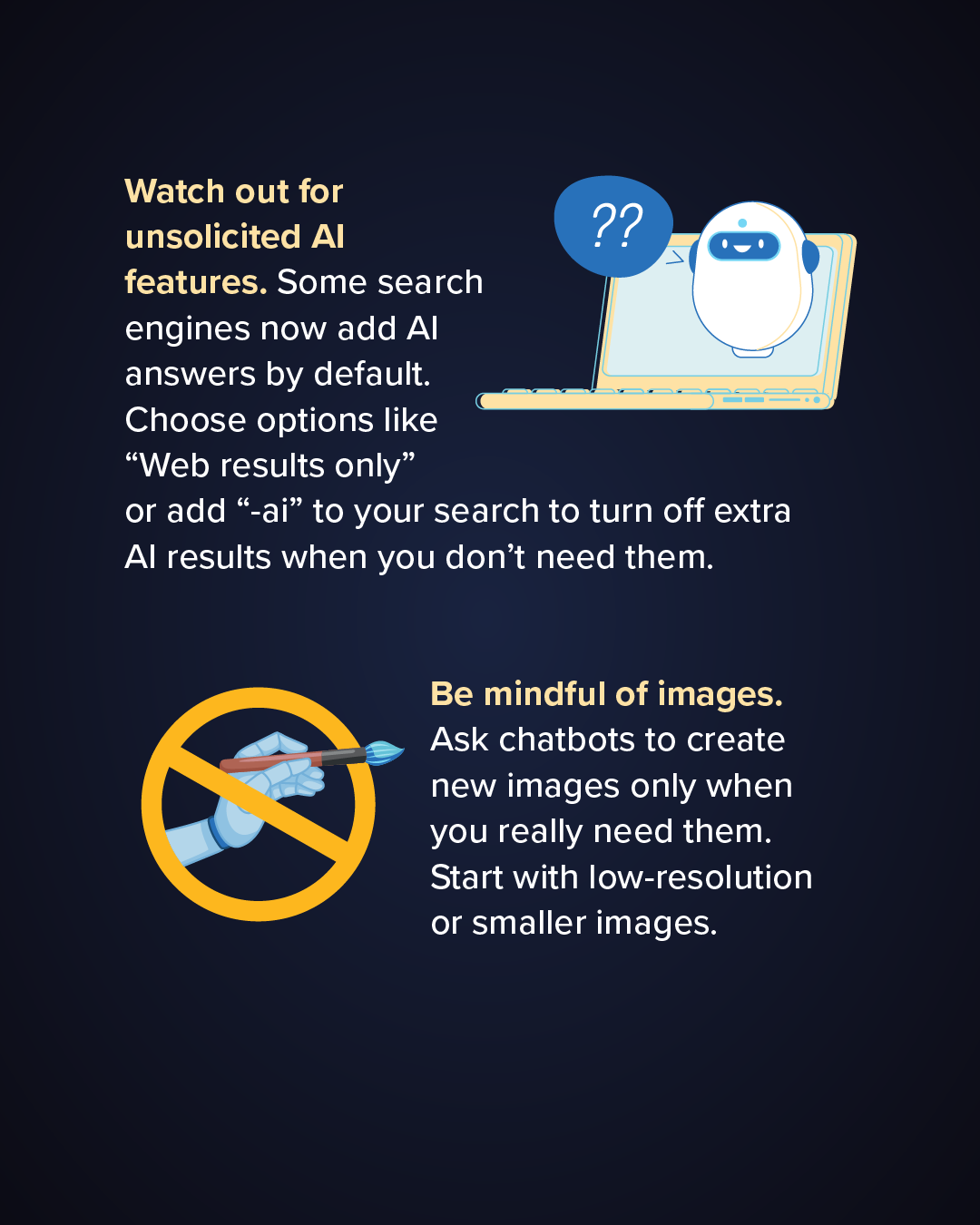
The same goes for web search engines that use AI to automatically generate a response to a query alongside the actual search results, such as Google’s AI overviews or Bing’s Copilot search. “If you’re just looking for a particular article, turning that off could be powerful from a saving-energy perspective,” says Udit Gupta, an expert in electrical and computer engineering at Cornell Tech in New York City. Selecting “Web results only” in one’s browser or including “-ai” in the wording of your web search can do the trick.
Smaller models use less energy
People and businesses that use AI tools a lot for specific tasks like translating or summarizing could consider shifting to smaller language models that are specialized to these tasks. Because these are trained more narrowly and perform fewer computations, they expend less energy than the massive, all-purpose LLMs on the same tasks.
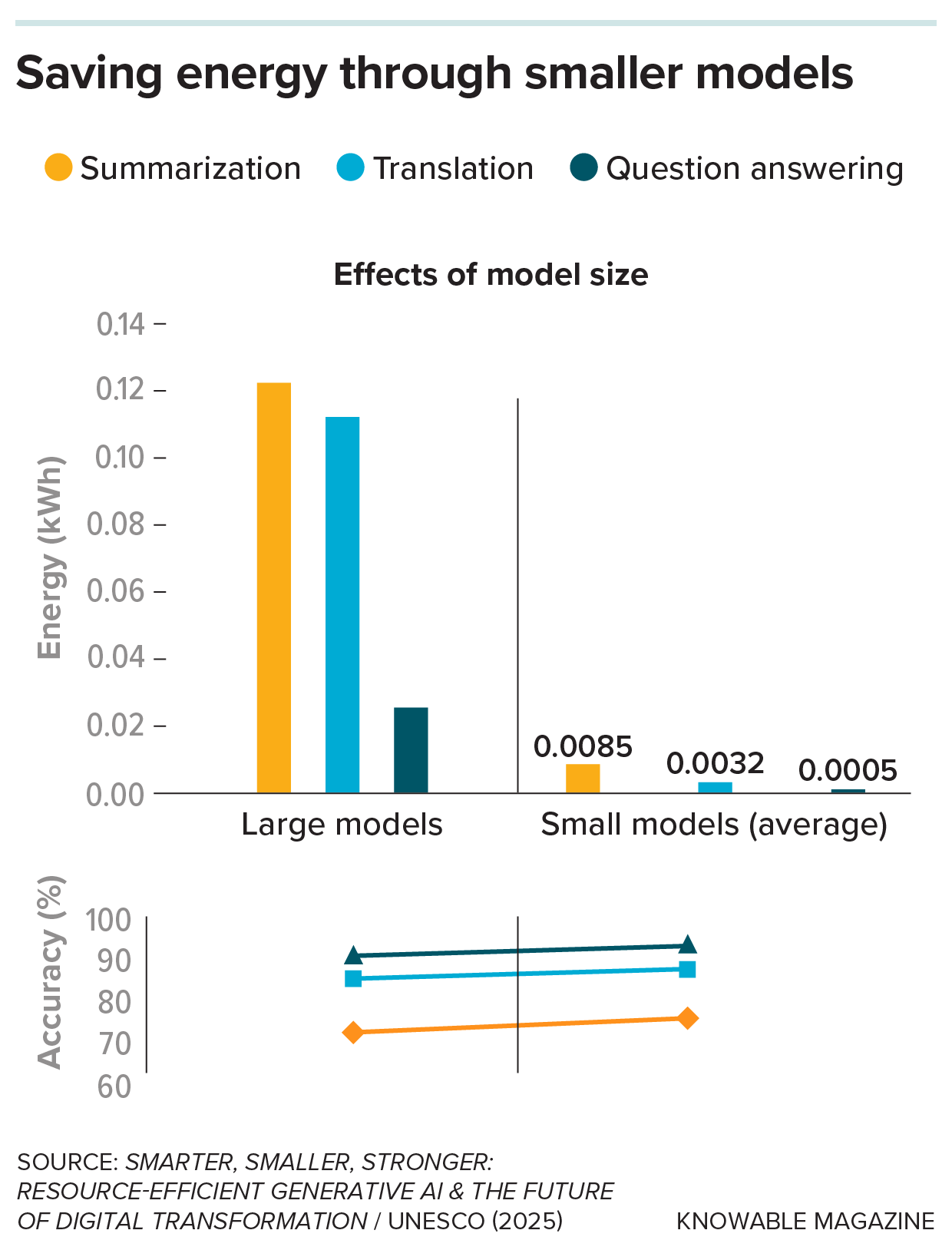
In one 2025 study published by UNESCO, Drobnjak tested the benefits of using small models — such as one called opus-mt-en-es for English-Spanish translations, and other models for summarization and query-answering — in lieu of the model Llama 3.1 developed by Meta. Though these smaller models are often less user-friendly than more popular AI models, they’re freely available from the AI platform Hugging Face. The small models consumed between 15 and 50 times less energy while producing higher-quality outputs on the tasks for which they were designed, the study found.
Using small, specialized models for particular tasks consumes a fraction of the energy guzzled by large, all-purpose models, with similar if even slightly better accuracy. (Image credit: Knowable Magazine)
The shift away from larger models resulted in a 90 percent decrease in energy use overall, making this the most powerful single energy-saving strategy Drobnjak tested in her study. As Gupta puts it, “You don’t need to use a trillion-parameter model for editing an email.”
Less chatty chatbots
Because LLMs perform so many computations for every consecutive word they produce, it helps to choose models that produce less text in general. AI systems expert Mosharaf Chowdhury of the University of Michigan, who has been measuring the electricity usage of LLMs that have been made publicly available, has learned that models that are “chattier” by nature tend to consume more energy.
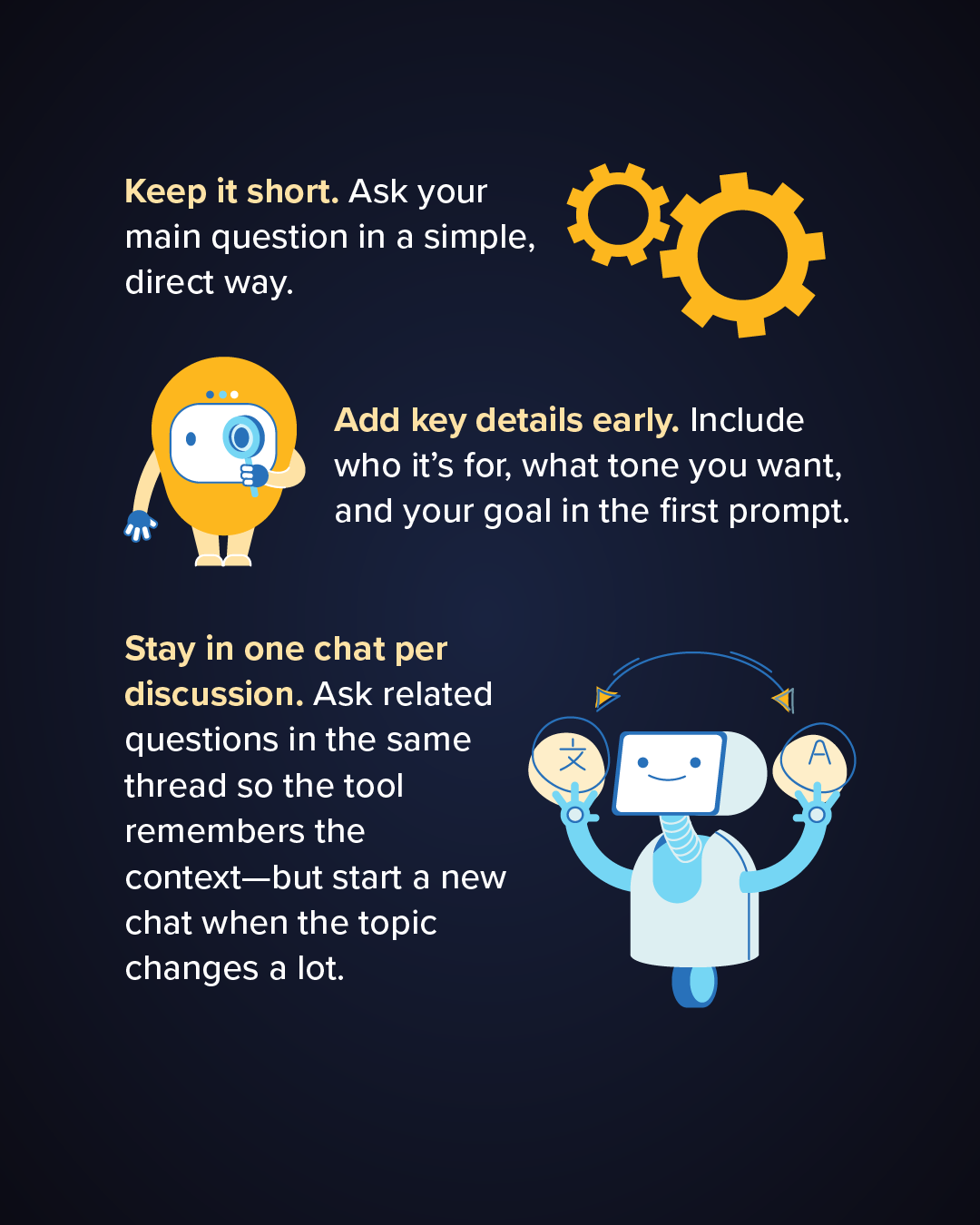
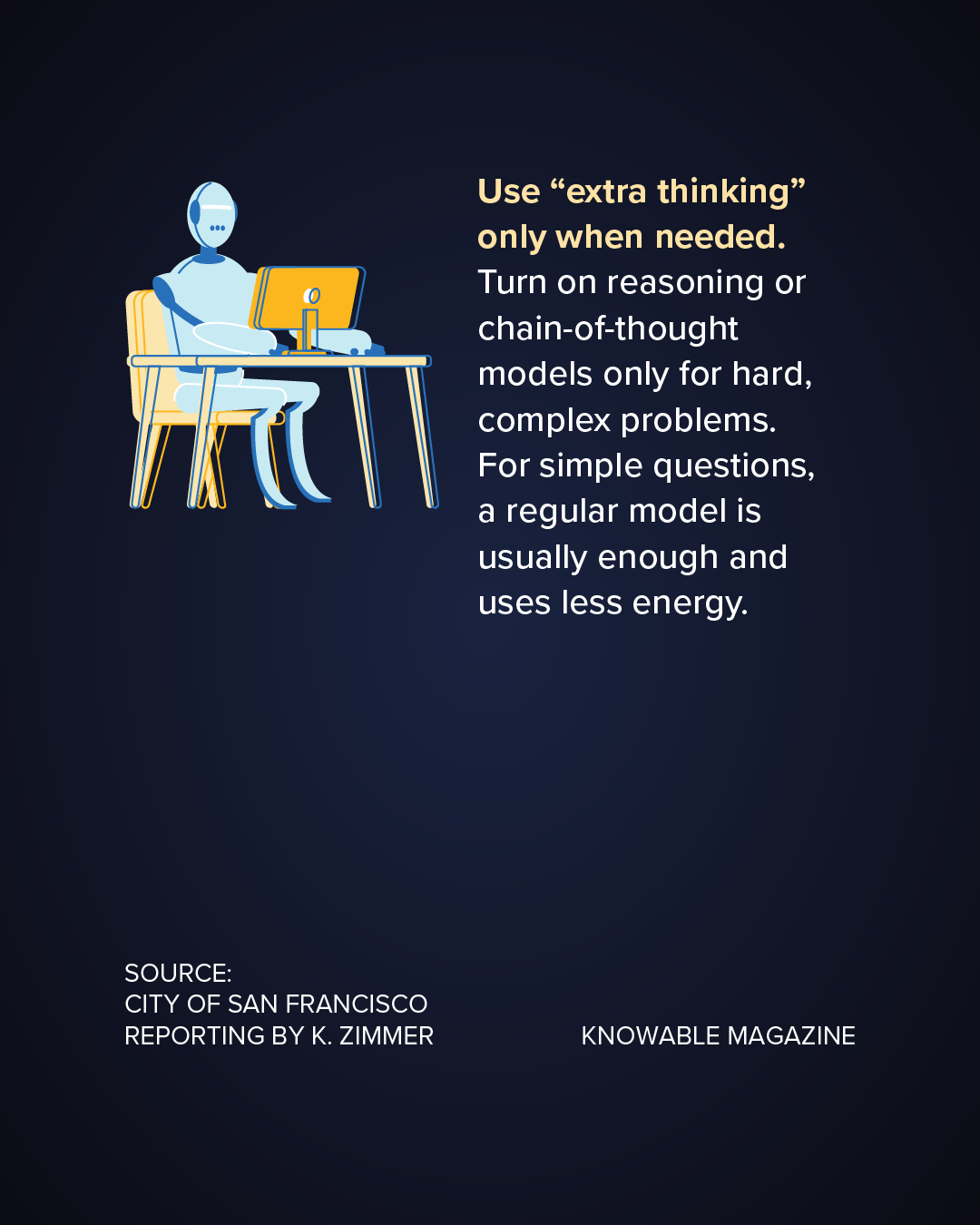
For instance, one version of the model Qwen developed by Chinese company Alibaba Cloud consumes significantly more energy when it’s in “problem solving with reasoning mode,” where it produced roughly 10 times as many words in response to a prompt compared to its “text conversation” mode. So some experts recommend using reasoning mode only for complex questions and otherwise sticking with a chatbot’s standard mode.
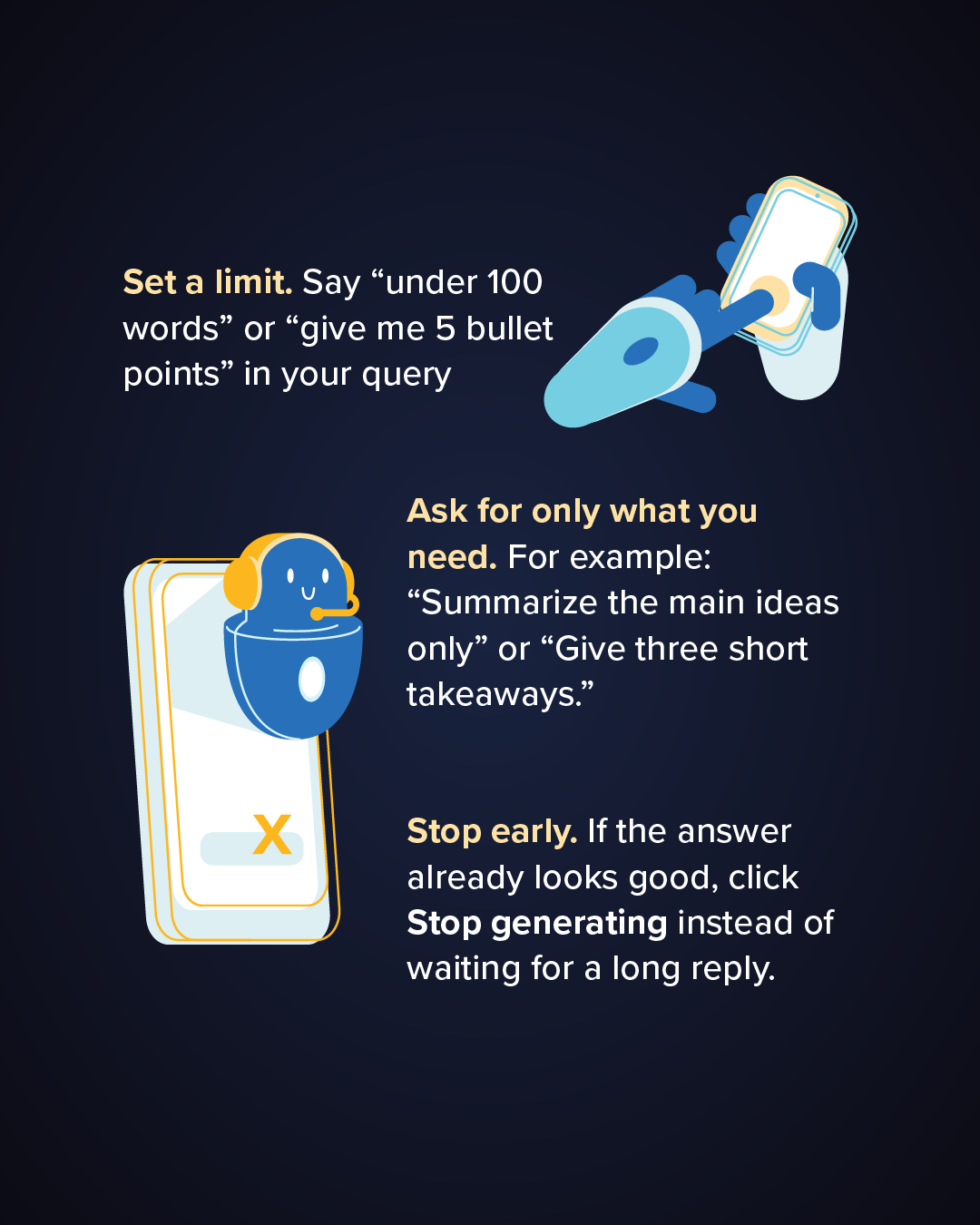
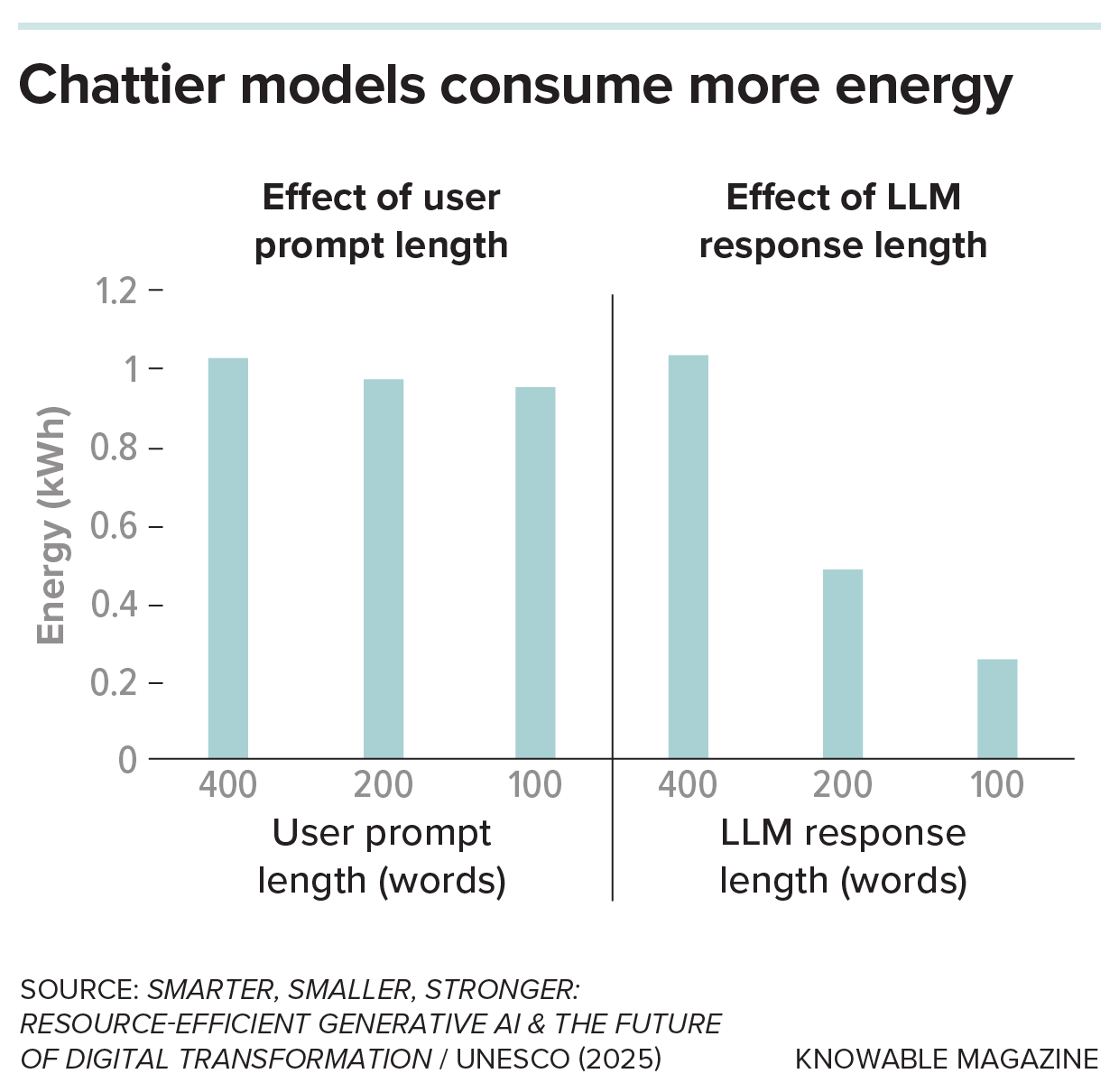
Simply asking AI chatbots to “be brief” or giving them a word limit can also save energy. In the UNESCO paper, Drobnjak and her colleagues found they could reduce the energy consumption of the Llama model by 50 percent when they instructed it to halve its output. By contrast, keeping the prompt itself short had less significant savings — just 5 percent for a prompt that was half the length of the original query.
“The size of the output is what determines and drives the energy expenditure the most,” Drobnjak says. She has collaborated with the city of San Francisco to develop energy-saving tips for AI users, which include being as specific as possible and adding instructions like “five bullets max.”
Keeping chatbot prompts short can conserve some energy, but asking chatbots to keep their responses brief amounts to much bigger savings. (Image credit: Knowable Magazine)
Go low-res and batch video
Similar recommendations apply for generating images and video, which can consume orders of magnitude more energy than generating text, as they involve iterating millions of pixels many times over, each time processing the entire image anew, says Drobnjak. Such tools are highly popular: Nearly 40 percent of teens ages 13 to 17 surveyed in a recent study by the Pew Research Center use AI to create or edit images or videos.
Drobnjak recommends generating images or videos only when necessary and only at the resolution necessary. “One option is to just start in low resolution,” she says, “and if the algorithm is in the right direction, you then start increasing resolution.” She also notes that editing existing images is always less computationally intensive than generating new ones from scratch.
And when generating multiple images, it helps to do so in a single session or batch, which is more efficient than doing so in multiple separate requests.
These actions may seem like a drop in a bucket, and in many respects they are, experts say. But small things add up. While waiting for tech companies, scientists and policymakers to find ways of reducing AI’s overall environmental impact, “the individual who knows to reach for the right tool can make a real difference,” Drobnjak says. “AI is [consuming] so much energy that we have to look at it from every angle.”
Editor’s note: This story was updated on July 21, 2026, to clarify that the energy use of individuals who use AI tools a lot is cumulative, not necessarily huge, as was originally stated.
The mission of the Flock app is quietly subversive: to encourage users to ditch their screens and explore the wonderful world of birding
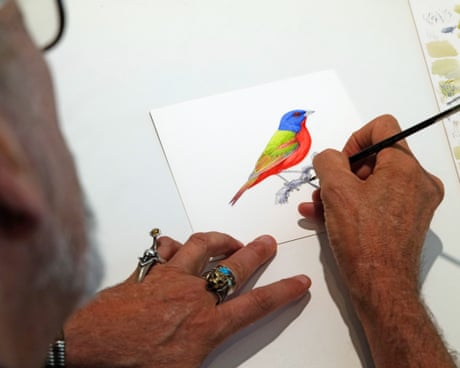
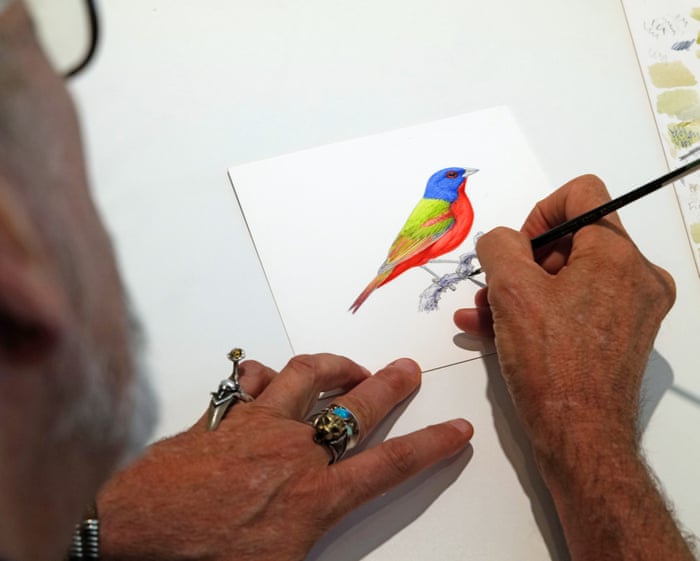
On a brilliantly bright afternoon in his gallery and studio in Bolinas, a small town on the northern California coast, Keith Hansen was putting the finishing touches on a watercolor of an almost improbably flamboyant painted bunting.
With an ultra-fine sable brush, he made a few intricate additions to the cobalt blue plumage on the bunting’s head, and, satisfied with his work, slipped the watercolor into a stout binder that every few days welcomes a new addition.
Exclusive: anonymous flagging service says cases have surged, as watchdog says AI is making sexualised or ‘nudified’ content easier to produce
Children in the UK have reported a surge in explicit deepfake images featuring their likenesses, as a safety watchdog warned AI is making such content easier to produce.
The Report Remove service, which blocks intimate images from appearing online, said there had been a rapid increase in imagery that had been digitally manipulated or “faked” in some way, including with AI and nudification tools.
On the web, if I build something that works within the standards, it works. Whether people use it is up to them. On iOS, there is another question entirely: whether Apple decides it should exist.
[…]
In the past couple of years I’ve built three apps that were rejected from the App Store on various grounds.
[…]
A while ago I tried to submit an iOS app for Dark Hours, my astronomy website for normal people. It was rejected on the grounds that it was astrology.
[…]
I see countless ChatGPT wrappers with nearly identical icons and eye-watering subscriptions. I see astronomy apps requesting permissions that have nothing to do with looking at the night sky. My kids download games that interrupt play every few minutes to advertise the developer’s other subscription apps, each with their own $20–50 yearly plans.
But if you actually look at Godier’s Dark Hours, for even just a few seconds, it is instantly obvious that it pertains to the science of astronomy and has absolutely nothing — zero, zilch, nada — to do with astrology.
[…]
Godier proceeded through a series of escalations up to the App Review Board and the Review Board responded that they determined the original rejection was valid because, I shit you not, “We understand that the app includes a live tarot reading feature.” Which isn’t even about astrology. It’s straight out of Kafka.
[…]
This isn’t just contrary to the benefit of developers, like Godier. It’s obviously contrary to the benefit of Apple itself, which should not just accept an app like Dark Hours, but celebrate it as an exemplar of the platform.
Mistakes happen. But in a functioning system mistakes get corrected, and mistakes as obvious as this one get corrected almost instantly and include a quick apology for the conflation. The App Store is not a functioning system.
To the best of my recollection, this is the first post I’ve retracted in the 24 years I’ve been writing Daring Fireball. I hope it’s the last. I was misled, both overtly and through omissions[…]
[…]
The truth is, the app, as originally submitted by Godier to the App Store (under the name “Asterly”, not “Dark Hours”), was entirely dedicated to astrology, not astronomy, and did in fact include a “Tarot card of the day” feature amongst other occultist horseshit.
[…]
I wrongly took Godier at his word, both in his public blog post and in private iMessage correspondence yesterday, that the rejection wasn’t just merely debatable, but completely and rather preposterously ungrounded. Whether Godier ever submitted a build of “Asterly” to the App Store that contained no occult horseshit and only the hard-science astronomy features that were present in his “Dark Hours” website that was available for the last week, I don’t know. But I have no reason to believe that he did.
[…]
In an uncomfortable exchange between Beher and Godier on Bluesky, Beher pointed out that Godier’s Dark Hours had the same bug as Beher’s that routed people to “random fields in Mexico”. Earlier today, Godier took his web app down and redirected his darkhours.io domain to Beher’s darkhours.app.
I’m really unhappy about this, both for my role in spreading a false story and because I think it will hurt the cause of reforming App Review. I know there are many crazy rejections and have experienced some first-hand. This story was believable because of that well-known history and because Godier didn’t seem like a nobody trying to get attention—he was the developer of another highly regarded app. But now people are going to point to true developer stories and accuse them of being fakes, too.
BOTH projects were generated using Claude. So you have two people - both generating the same app from the same training data - having a public throw down over who copied who.
[…]
The “original” developer does claim to know how to code - which wasn’t clear from my research. That still doesn’t necessarily mean the original app was the source of the training data. They both may be a result of the same training data.
Holy shit, so the “Claude plagiarised an app” story is actually “Claude produced the same app twice when prompted to do so by two separate developers” 😅
It’s not clear to me exactly how much each developer relied on Claude or which training data was used, but I wanted to note this angle of the story.
With all this talk of an astrology app being rejected by App Store review I’m reminded there’s still a flat Earth/astrology app on the App Store that actively leaks the location of all of its users.
In an update to the initial advisory, the Dutch agency said it received a report indicating that the vulnerability is being exploited in the wild in attacks where port 5900 is exposed to the internet.
According to the NCSC, the attacker obtained root access to the system and deployed a Monero cryptocurrency miner.
The vulnerability, identified as CVE-2026-65400, could allow an attacker on the network to authenticate to Screen Sharing without valid credentials. Reports now indicate that the vulnerability has been actively exploited on Macs where Screen Sharing was accessible from the Internet.
[…]
[We] strongly recommend that all Screens users install the latest macOS updates as soon as possible.
[…]
For users who want to further restrict access to Screen Sharing, Screens can connect to a Mac through an SSH tunnel instead of exposing the Screen Sharing service directly.
A new genomic resource from the Texas A&M AgriLife Research plant genomics team is providing a powerful new foundation for faster, more precise turfgrass genetics and breeding. The team discovered a breakthrough genome that finally reveals the full genetic blueprint of zoysia grass.

 Login