❌

Reading view

Curiosity Finds Massive Field of Honeycomb-Shaped Fractures on Mars

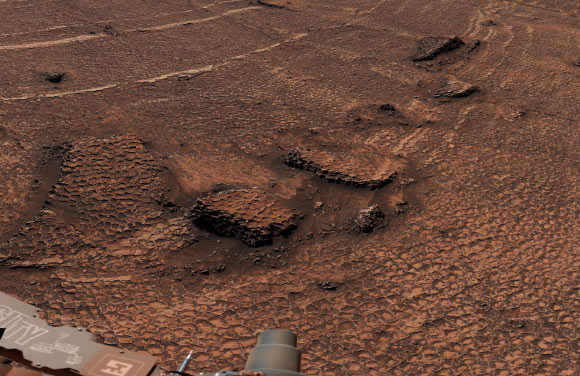
The polygon fractures discovered by Curiosity in Gale crater, Mars. Image credit: NASA / JPL-Caltech / MSSS.

NASA’s Curiosity rover has stumbled on the largest patch of polygon-shaped ground fractures it has ever seen on Mars, a discovery that could reveal more about the planet’s watery past.

The post Curiosity Finds Massive Field of Honeycomb-Shaped Fractures on Mars appeared first on Sci.News: Breaking Science News.

  •  

Pluto’s Thin Atmosphere May Be Starting to Shrink

According to NASA scientists, complex chemical compounds called tholins give Pluto a distinctive blue haze. Image credit: NASA / Johns Hopkins University Applied Physics Laboratory / Southwest Research Institute.

Pluto’s tenuous atmosphere appears to have begun contracting after years of holding steady, according to a new study published in the Planetary Science Journal.

The post Pluto’s Thin Atmosphere May Be Starting to Shrink appeared first on Sci.News: Breaking Science News.

  •  

Mystery of Martian “Honeycombs” Deepens with Discovery of Unusual Patterns by NASA’s Curiosity Rover

NASA’s Curiosity rover continues to uncover unusual polygon-shaped features resembling “honeycombs” on the Red Planet.

The latest images depicting these unique geometric formations, known as polygonal fractures, were revealed this week by NASA, showing the rugged Martian terrain around the Vallee Grande area covered in the unusual-looking features.

Polygons as Far as the Eye Can See

In Curiosity’s photos captured by the rover between June 19th and 20th, a sprawling web of the Martian honeycombs could be seen spreading across the terrain in all directions.

Mars polygons
A field of polygon structures visible across the Martian landscape, as seen from the vantage of NASA’s Curiosity rover (Image Credit: NASA/JPL-Caltech/MSSS).

Ashwin Vasavada of NASA’s Jet Propulsion Laboratory in Southern California and the mission’s project scientist likened the discovery to a “sea” of Martian polygons that he said took the Curiosity team’s breath away.

“We’ve seen a lot of fascinating landscapes through Curiosity’s eyes,” Vasavada said in a statement. “We measured their shapes and chemistry carefully and are hopeful there are clues in the data as to how these features formed.”

Ideas on “Honeycomb” Formation

According to Vasavada and his colleagues, some of these unique structures appear to have formed from mud cracks, although the polygonal shape appears to occur under a range of different conditions on the Martian terrain.

Among the reasons for their appearance, scientists have determined that temperature changes can cause moisture to be squeezed out of sediment layers, producing the characteristic structured appearance.

Long before Mars became the cold, arid world we see in NASA imagery today, lakes and streams used to exist along the base of Mount Sharp, the 3-mile-high mountain that Curiosity has been slowly climbing and studying since 2014. Since beginning its trek, the rover has uncovered chemical traces of the planet’s wetter past, including carbon-based organic molecules considered the precursors to RNA and DNA.

While researchers remain uncertain about whether these compounds are the result of biological processes or simply natural geological conditions, their discovery adds to the mounting evidence for an ancient Mars that once would have held the chemical requirements for life to have once existed there.

Ongoing Discoveries

Curiosity has discovered these unique polygon-shaped features on several occasions in the past, although NASA mission scientists say they’ve never seen as many in a single location.

One of the recent similar discoveries took the Curiosity team by surprise, as images of the region obtained by the Mars Reconnaissance Orbiter (MRO) had not indicated anything unusual about the terrain. Once Curiosity arrived, however, a web of unusual polygon features was revealed in the surrounding terrain.

In another instance in 2025, several areas resembling waffle or honeycomb patterns were spotted by Curiosity’s Front Hazard Avoidance Camera (Front Hazcam) on May 1, 2025.

Additional details about Curiosity’s ongoing studies of the Martian landscape can be found on NASA’s official Curiosity page.

Micah Hanks is the Editor-in-Chief and Co-Founder of The Debrief. A longtime reporter on science, defense, and technology with a focus on space and astronomy, he can be reached at micah@thedebrief.org. Follow him on X @MicahHanks, and at micahhanks.com.

  •  

Astronomers May Have Found the First Moon Beyond Our Solar System

Artist’s Impression of CD 35 2722, a System With a Moon Like ObjectA Jupiter-mass object orbiting a brown dwarf could become the first confirmed moon beyond our Solar System. A massive object appears to be circling a brown dwarf in the CD-35 2722 system, but calling it a moon is not straightforward. Unlike moons in our Solar System, it does not orbit a planet. Instead, it travels [...]
  •  

UK’s £3 Million Bet Could Help NASA Find Life on Nearby Planets

Conceptual Design of the Habitable Worlds ObservatoryA £3 million investment could help secure a leading UK role in NASA’s future search for life on nearby planets. An Earth-like planet orbiting a nearby star would appear as little more than a dim point beside a light source 10 billion times brighter. British astronomers are preparing technology that could help NASA separate that [...]
  •  

Giant Alien World Found Hiding in Plain Sight for 11 Years

Around Beta PictorisA giant planet spent more than a decade concealed inside one of astronomy’s most closely watched star systems. Astronomers have discovered a planet named Beta Pictoris d orbiting a young star just 63 light-years from Earth. The gas giant is about 100 times fainter than Beta Pictoris b, the first planet found in the system, [...]
  •  

Rules of the road needed for orbital data center constellations

Starcloud

As companies develop large constellations of orbital data center satellites, experts say now is the time to start thinking about some critical space safety topics and rules of the road.

The post Rules of the road needed for orbital data center constellations appeared first on SpaceNews.

  •  

Dinosaur-Killing Asteroid Didn’t Just Strike Earth, Its Dust Cloud Cooked It

Ankylosaurus magniventris, a large armored dinosaur species, witnesses the impact of an asteroid, falling on the Yucatan peninsula 66 million years ago. Image credit: Fabio Manucci.

The Chicxulub impact not only plunged Earth into an impact winter but also produced a dust blanket that later overheated the planet, according to new research from Purdue University and the University of Colorado, Boulder.

The post Dinosaur-Killing Asteroid Didn’t Just Strike Earth, Its Dust Cloud Cooked It appeared first on Sci.News: Breaking Science News.

  •  

Hidden Clues in Spirit Rover Data Suggest Mars Once Had Far More Water than Scientists Realized

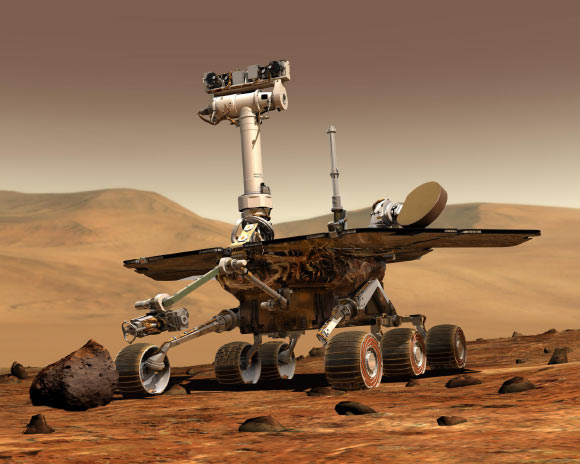
NASA’s Spirit rover on Mars. Image credit: NASA.

A new look at more than two decades’ worth of archival data from NASA’s Spirit mission suggests that the Martian soil may hold iron-bearing minerals -- hematite and altered magnetite -- that were too faint for scientists to detect in real time during the mission.

The post Hidden Clues in Spirit Rover Data Suggest Mars Once Had Far More Water than Scientists Realized appeared first on Sci.News: Breaking Science News.

  •  

Planetary-Mass Exomoon Found Circling Brown Dwarf

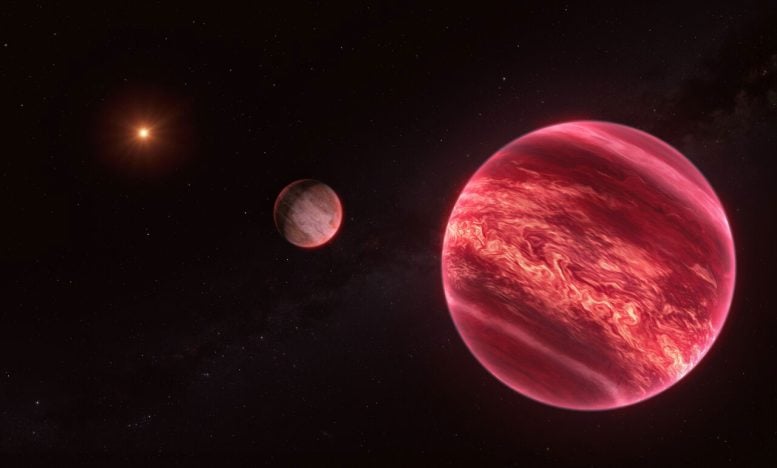
This illustration shows the stellar system CD-35 2722, with the newly found exomoon at the center; the star has about half the mass of our Sun, and it is orbited by a brown dwarf, the reddish-brown object seen here in the foreground (right). Image credit: ESO / M. Kornmesser.

Astronomers using ESO’s Very Large Telescope (VLT) have discovered a gas giant around a brown dwarf in the stellar system CD-35 2722.

The post Planetary-Mass Exomoon Found Circling Brown Dwarf appeared first on Sci.News: Breaking Science News.

  •  

Astronomers Detect an Atmosphere on a Potentially Earth-Like World

Artist’s Illustration of Exoplanet LHS 1140 BThis discovery marks a major milestone in the search for life on worlds beyond our solar system. A faint stream of helium escaping from a distant rocky world has revealed something astronomers had never clearly detected before: an atmosphere around an Earth-like planet in another star’s habitable zone. The result is the strongest evidence so [...]
  •  

Barnard’s Star Contains Inhospitable Exoplanets—But They Could Still Tell Us Something Important in the Search for ET

The small exoplanets of our Sun’s second-nearest neighbor, Barnard’s Star, are inhospitable wastelands, British astronomers say.

Located six light-years from Earth, Barnard’s Star is separated from our closest neighbor, Alpha Centauri, by about 66° in our sky. Now, University of Cambridge researchers have revealed their findings on this exosolar system in a recent paper published in the Monthly Notices of the Royal Astronomical Society.

After careful analysis, the astronomers announced that the exoplanets are unlike any in our solar system, presenting a brutal and barren environment.

Barnard’s Star Exoplanets

Scientists only discovered these four small planets orbiting Barnard’s Star in 2025. Unlike anything in our solar system, these orbital bodies fit into a size range larger than Mars, but smaller than Earth or Venus.

Like a peeled onion, these smaller planets are rich in a mineral only found deep below the Earth’s surface. Chemical analysis revealed large amounts of the mineral periclase on the surface of these planets, something typically only found hundreds of kilometers deep on our planet.

“Barnard’s Star has an enormous amount of the element magnesium compared to other stars, so its planets are likely to be rich in magnesium too,” said lead author Xander Byrne from Cambridge’s Institute of Astronomy. “On Earth, that magnesium goes into making minerals called olivines, which are really important for storing water within the planet.”

A Lack of Water and Atmosphere

Unfortunately for those looking for extraterrestrial life, magnesium serves a different purpose on these exoplanets. Instead of water-storing olivine, it produces the abundant periclase, which is a poor store of water.

Even worse, these inhospitable exoplanets likely no longer have an atmosphere. According to the University of Cambridge team, these ten-billion-year-old planets probably only managed to hold an atmosphere for two billion years at most.

“These planets were always going to be hostile, because they’re really close to their star,” said Byrne. “Even the outermost planet orbits ten times closer than Mercury orbits the Sun. When you’re that close to your star, and have such little gravity, your atmosphere just gets blown off.”

In addition to the lack of atmosphere, the planets’ proximity to Barnard’s Star leaves them tidally locked, like our Moon, with one side always facing toward the star.

Exoplanet Stability

However, there is one positive element to these small planets. Typically, such close-orbiting systems are highly unstable, with the planets shooting out from the system, falling into their host star, or catastrophically colliding. Yet in this case, the system is as ordered as a piece of music. 

The three inner planets of the exosolar system have years in a 9:12:16 ratio, producing two of what is known as a “perfect fourth” in music. This musical harmony is known as an orbital resonance, with the same type of effect stabilizing Jupiter’s moons in their orbits around that planet. 

While our ability to view Barnard’s Star from Earth may be limited, the European Space Agency’s upcoming Plato mission may allow astronomers to discover ever smaller worlds orbiting in the nearby exosolar system.

“Larger planets are much easier to detect than small ones, so we know about very few sub-Earth planets like the ones in this system,” said Byrne. “But the sensitivity of these new missions will help to reduce this bias, allowing us to discover more and more planets that are small and rocky, like Earth.”

The true significance of the research may lie in the value of a null result. While these planets are bleakly hostile to life, observing this exosolar system’s composition can aid future astronomers in narrowing down the search for extraterrestrial life.

The paper, “The Barnard’s Star Planetary System: Stability, Composition, and Evolution of Four Sub-Earth Exoplanets,” appeared in Monthly Notices of the Royal Astronomical Society on June 24, 2026.

Ryan Whalen covers science and technology for The Debrief. He holds an MA in History and a Master of Library and Information Science with a certificate in Data Science. He can be contacted at ryan@thedebrief.org, and follow him on Twitter @mdntwvlf.

  •  

Giant Rift Valleys Hint Venus is Still Tectonically Active

This hemispheric view of Venus was created using radar observations, including images from NASA’s Magellan spacecraft. Magellan imaged more than 98% of Venus. Gaps in the Magellan coverage were filled with images from the Earth-based Arecibo radar. The composite image was processed to improve contrast and to emphasize small features, and was color-coded to represent elevation. Magellan launched on May 4, 1989, and was deployed from the cargo bay of Space Shuttle Atlantis on May 5, 1989. The spacecraft orbited Venus from August 10, 1990, until October 13, 1994 when the spacecraft was commanded to plunge into the atmosphere of Venus. Image credit: NASA / JPL-Caltech / USGS.

New 3D computer simulations from ETH Zurich show that young rift flanks on Venus stay tall and steep, while older ones flatten out over time.

The post Giant Rift Valleys Hint Venus is Still Tectonically Active appeared first on Sci.News: Breaking Science News.

  •  

Rare “Super-Jupiter” Discovered on an Extraordinary 180-Day Orbit

NGTS 38 bScientists discovered a rare planet larger than Jupiter orbiting a distant star once every 180 days. A planet nearly five times as massive as Jupiter circles a distant star once every 180 days. Known as NGTS-38 b, it is an exoplanet, meaning a world that orbits a star outside our solar system. NGTS-38 b is [...]
  •  

James Webb Telescope Discovers Hidden Giant Planet in Famous Star System

Beta Pictoris System (Artist’s Concept)Webb found a hidden giant planet by detecting its atmospheric chemistry through a bright debris disk. For years, a third giant planet remained concealed within the bright dust surrounding Beta Pictoris, one of the most closely observed planetary systems in the Milky Way. NASA’s James Webb Space Telescope has now exposed the hidden world by [...]
  •  

Space Weather May Warp Martian Weather during Dust Storms, Planetary Scientists Suggest

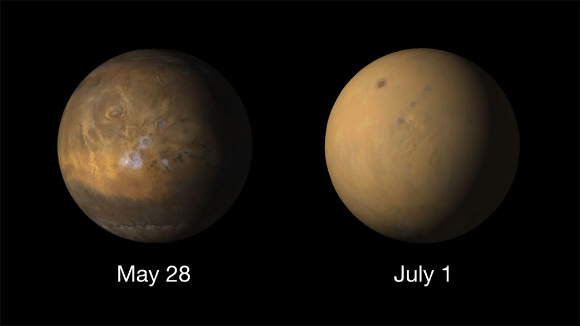
These images from Mars Color Imager (MARCI) aboard NASA’s Mars Reconnaissance Orbiter (MRO) show Mars before (left) and during (right) the June 2018 dust storm. Image credit: NASA / JPL-Caltech / University of Arizona.

Planetary researchers have found the first evidence that bursts of energetic particles from the Sun could warm the lower atmosphere of Mars during massive dust storms, hinting at an unexpected link between space weather and Martian climate.

The post Space Weather May Warp Martian Weather during Dust Storms, Planetary Scientists Suggest appeared first on Sci.News: Breaking Science News.

  •  

NASA’s Psyche Mission Captures Crescents and Surface Details During Recent Martian Flyby

New NASA imagery has revealed a growing Martian “crescent” and surface details on the Red Planet as the agency’s Psyche spacecraft recently completed a flyby of Earth’s nearby planetary neighbor.

Launched on October 13, 2023, Psyche is currently on its way toward a rendezvous with a metal-rich asteroid after which the space probe was named. Now, in a series of composite images captured as the spacecraft flew past Mars during a gravity assist in early May, the growing crescent shape of the Red Planet is shown in successive views of Earth’s nearby planetary neighbor.

“After these views were captured by the spacecraft’s multispectral imager instrument, Mars began to overfill the field of view as Psyche made close approach with the planet and captured a series of high-resolution images of the surface,” read a NASA statement accompanying the imagery.

NASA Psyche Mars
Composite imagery of Mars recently obtained by NASA’s Psyche spacecraft (Image Credit: NASA)

In several of the images, Mars appears as a thin sliver due to the high phase angle of approach as Psyche made its way toward the planet. In the days that followed, the crescent is shown as it appears to “grow” as more sunlight illuminates its surface.

A Detailed Glimpse of the Martian Surface Captured by Psyche

The recent crescent features weren’t all that Psyche captured during its recent near approach to Mars. In additional images released by the American space agency, the Martian surface appeared in colorful views obtained by the spacecraft’s multispectral imager instrument.

The resulting “mosaic” was created from four separate images acquired near the end of Psyche’s recent visit, shown in enhanced color that highlights several details visible on the Martian surface.

Traveling along a southwesterly path with relation to the Martian poles, the mosaic imagery appears slightly blurry, as it represents close to six minutes of travel above the planet. According to NASA, pixel scale resolution in the imagery “varies from 381 meters per pixel on the right to 440 meters per pixel on the left.”

Mars Psyche terrain
Imagery showing the Iapygia region of the rugged southern highlands of Mars, obtained by NASA’s Psyche spacecraft (Image Credit: NASA)

Color enhancements to the imagery, collected with the imager’s green, blue, and near-infrared filters, reveal additional details about the various features of the volcanic region of Mars that Psyche flew over on May 15, 2026, known as the Iapygia region.

This area comprises part of the Martian southern highlands, and in the recent imagery, Fournier crater—the largest shown in the new imagery—can be seen, alongside hills, cliffs, and other features, including the irregular Oenotria Scopuli cliff system, forming one side of the boundary of a massive ancient impact feature on the Red Planet.

Additional details about the new imagery, as well as information about Psyche’s mission, can be found on NASA’s official mission page.

Micah Hanks is the Editor-in-Chief and Co-Founder of The Debrief. A longtime reporter on science, defense, and technology with a focus on space and astronomy, he can be reached at micah@thedebrief.org. Follow him on X @MicahHanks, and at micahhanks.com.

  •  

“A Major Milestone in the Search for Life on Other Planets”: First Ever Detection of an Atmosphere Around an Earth-Like, Habitable Zone Rocky Exoplanet

An international research team led by Harvard scientists has announced the first-ever detection of an atmosphere on an Earth-like rocky exoplanet, LHS 1140 b, orbiting within its star’s habitable zone, only 48 light-years away.

The researchers behind the historic discovery, which they are calling “a major milestone in the search for life on other planets,” said the detection of an atmosphere on an Earth-like rocky exoplanet offers the strongest evidence to date that worlds with similar compositions and temperatures to Earth that are also capable of supporting life could exist beyond our solar system.

Models Predicted First Earth-like Rocky Habitable Zone Exoplanet Atmosphere

In a statement announcing the detection of an atmosphere around a habitable-zone rocky exoplanet, the discovery was motivated by theoretical predictions suggesting that LHS 1140 b may contain an atmosphere. The planet was even more tantalizing because its orbit around its host red dwarf star allows for liquid water on its surface, a key ingredient for life as we know it.

Although thousands of exoplanets have been confirmed since 1995, including habitable-zone rocky worlds similar in size and composition to Earth, the team notes that determining whether any of these potential Earth analogs maintain an atmosphere. Like water, an atmosphere is considered a likely necessity for life to emerge.

“An atmosphere is essential for a planet to support life as we know it,” explained Collin Cherubim, the lead author of a study detailing the findings, who recently earned his Ph.D. in Earth and Planetary Sciences from Harvard University.

Robin Wordsworth, the Gordon McKay Professor of Environmental Science and Engineering and Professor of Earth and Planetary Sciences at Harvard, said that as recently as twenty years ago, astronomers still didn’t know if other, terrestrial-type planets “even existed.” However, he explained, they quickly found that this type of planet was common, including some orbiting within their star’s habitable zone.

“The next question was whether any of them had managed to keep an atmosphere,” the professor added.

Infrared Observations Confirm Historic First  

Before performing any direct observations, the team used computer models to predict what they might find on LHS 1140 b. As noted, those models predicted an upper atmosphere rich in helium. The models also suggested that the atmospheric helium was slowly escaping into space.

To test the model’s predictions, Cherubim and colleagues gained access to the Warm Infrared Echelle (WINERED) Spectrograph on the Magellan Observatory in Chile. The team noted that this powerful telescope allowed them to observe an alignment of LHS 1140 b and another planet transiting its star “on the same night.”

When analyzing the data, the team found that one of the planets appeared to lack any measurable atmosphere. However, as their models had predicted, helium was actively escaping from LHS 1140 b. The finding confirmed that this rocky exoplanet orbiting within its star’s habitable zone was actively maintaining an atmosphere.

David Charbonneau, the head of the Harvard Department of Astronomy and an astronomer at the Center for Astrophysics | Harvard & Smithsonian, and Cherubim’s co-advisor with Wordsworth, was initially skeptical because the entire concept was based on a mathematical prediction of a phenomenon astronomers had never witnessed directly. However, Professor Charbonneau ended up praising the student’s determination and follow-through, which led to the historic detection.

“Collin analyzed the planets we knew about and predicted that this one would have a helium atmosphere,” Charbonneau said. “Then he organized telescope time, got the data, and the detection was statistically rock solid.”

“Hopefully it’s just the First of Many More Observations to Come”

When discussing the implications of the findings, Cherubim noted that “this is the first time anyone has found an atmosphere on a rocky planet in the habitable zone of another star.” Professor Wordsworth agreed, once again noting that until now, planets in these categories with atmospheres had been purely theoretical.

“Now we know at least one has,” the professor said.

The data also suggest that LHS 1140 b’s atmosphere has likely survived for more than three billion years, roughly three-quarters of Earth’s existence. This durability makes LHS 1140 b an excellent candidate for future exoplanet atmosphere studies.

More broadly, the team said that using ground-based observatories to search for escaping gases, such as the helium detected leaving LHS 1140 b, “may become an important tool for studying atmospheres on rocky exoplanets.” They also note the potential value of atmospheric detection for astrobiologists searching for signs of life in the cosmos.

As for Cherubim, he plans on following up his historic discovery with a more detailed analysis of the planet’s atmospheric composition. He also said he would like to investigate the possible presence of surface oceans or other planetary characteristics typically associated with habitability and life. The entire team also said they would like to use Cherubim’s model to search for similar Earth-like, habitable-zone rocky exoplanets.

“This has been a model validation, and hopefully it’s just the first of many more observations to come,” Cherubim said.

The study, “Helium escaping from the atmosphere of a nearby rocky exoplanet orbiting in a habitable zone,” was published in Science.

Christopher Plain is a Science Fiction and Fantasy novelist and Head Science Writer at The Debrief. Follow and connect with him on X, learn about his books at plainfiction.com, or email him directly at christopher@thedebrief.org.

  •  

Potential Atmosphere Detected on Habitable-Zone Exoplanet LHS 1140b

An artist’s concept of rocky planets LHS 1140b and LHS 1140c. Image credit: Melissa Weiss / Harvard & Smithsonian’s Center for Astrophysics.

Using spectral data from the Magellan Clay telescope at Las Campanas Observatory, astronomers detected helium escaping from LHS 1140b, a rocky exoplanet that orbits in the habitable zone of the nearby low-mass star LHS 1140.

The post Potential Atmosphere Detected on Habitable-Zone Exoplanet LHS 1140b appeared first on Sci.News: Breaking Science News.

  •  
❌