How much ice is stored in the world's glaciers? And where exactly is it located? A new study led by Ca' Foscari University of Venice, in collaboration with the Institute of Polar Sciences of the National Research Council of Italy (CNR-ISP), provides an updated global map of glacier ice volume.
How much ice is stored in the world's glaciers? And where exactly is it located? A new study led by Ca' Foscari University of Venice, in collaboration with the Institute of Polar Sciences of the National Research Council of Italy (CNR-ISP), provides an updated global map of glacier ice volume.
A brewing "super" El Nino cycle is poised to unleash heat waves, floods and drought worldwide, with the effects amplified by long-term human-caused climate change.
A team of Brazilian researchers discovered the first direct evidence that goethite—the mineral responsible for the brown color of soils—can withstand extreme pressures and temperatures all the way to the planet's interior inside a diamond just 3 millimeters (0.1 inch) long, within a microscopic impurity. Goethite forms in soil and on the ocean floor from iron-rich minerals in the presence of water. It incorporates some of these water molecules into its mineral structure. The study suggests that goethite may transport and release water into a region known as the lower mantle.
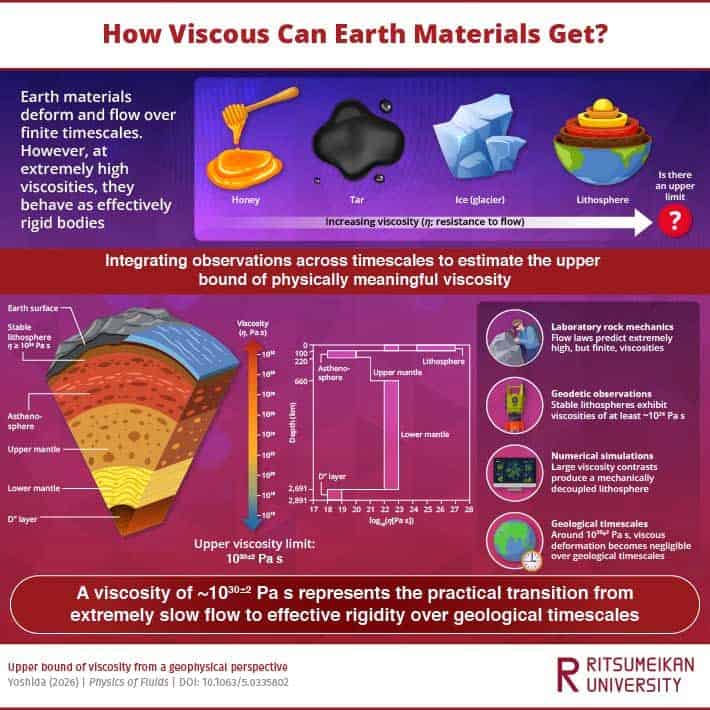
At what point does a material become so viscous that it cannot flow? The question is a tricky one because some apparently solid objects are not as rigid as they seem. A glacier, for example, may look immobile, but when viewed over long-enough timescales, its slow flow becomes apparent.
Now, thanks to satellite observations of tectonic plate deformations as well as physical and geodynamic modelling, geophysicist Masaki Yoshida of Ritsumeikan University, Japan, claims to have found an answer. The upper limit for viscosity, he says, is 1028 Pascal-seconds (Pa s), and the new boundary could yield insights into Earth’s geodynamics.
Viscosity is a measure of a material’s resistance to flow. Gases such as air and hydrogen have a viscosity of 10-5 Pa s at room temperature; the viscosity of liquid water is 10-3 Pa s; and glaciers have a viscosity of 1013–1017 Pa s depending on factors such as temperature, stress and microstructure. At the upper end, Yoshida says that the long-held view, based on rock deformation experiments, is that the viscosity of tectonic plates at the Earth’s surface (where temperatures are relatively low) is 1070 Pa s.
This number is so high that for most purposes, it might as well be infinite, meaning that these plates should behave like rigid bodies. But this accepted wisdom poses a problem: “I realized that I was unable to explain to my students why plates with such high viscosity bend and subduct into the mantle,” Yoshida tells Physics World.
Observed flow and flow parameters
To determine the “effective viscosity” of rock under the temperature and pressure conditions on Earth, Yoshida began by analysing satellite data showing tectonic plate deformations over tens to hundreds of kilometres. Using these data, he could ascertain strain rates – deformations in the plate over a given distance and time – as small as 10-9 per year.
Slow flow: Geodetic observations, laboratory rock-deformation experiments and numerical simulations suggest that there is a geophysically meaningful upper bound of viscosity that marks the transition from deformable flow to effectively rigid behaviour over geological timescales. (Courtesy: Masaki Yoshida/Ritsumeikan University)
By comparing regions under similar stress levels, Yoshida obtained an indication of comparative effective viscosity, which depends on factors such as temperature, composition, grain size, water content, stress state, deformation mechanism and structural heterogeneity. After accounting for assumed stresses, these observations suggested that observed viscosity maxes out at 1028 Pa s.
Yoshida also considered empirical descriptions for the viscosity of various minerals under different types of deformation using parameters from the literature. These yielded a similar upper bound of 1030+/-2 Pa s. Numerical simulations further corroborated this value as a viscosity maximum.
Importance of an upper bound
Taras Gerya, a geodynamicist at ETH Zürich in Switzerland who was not involved in the study, calls Yoshida’s work “an interesting discussion on the significance of viscous deformation for the lithosphere”. However, he notes that, given a realistic stress level of 30 MPa, the maximum viscosity identified gives a cumulative viscous deformation of just 8.5 m for the full 4.5 billion years of Earth’s history. That, he says, is “1000 times smaller than elastic deformation for the same deviatoric stress level”.
While pinning down an exact magnitude for such high viscosities may not greatly change models of deformation, Yoshida thinks that delineating an upper bound may nevertheless improve our understanding of the physical quantities that characterize the behaviour of matter. He also points out that thermal conductivity, which indicates how easily heat is transferred in materials, ranges over only about five orders of magnitude from water to diamond, making it “surprising that viscosity spans a range of about 35 orders of magnitude”.
Yoshida is keen to explore other implications of these results. During the first hundreds of millions of years of Earth’s existence, when it formed and rapidly cooled, he explains that it was covered by a single rigid lid known as the lithosphere. Plate boundaries and motion didn’t emerge until later, approximately 4 billion years ago. “I believe that the question of why plate motion began after the rigid lid formed is closely related to the results of this study,” he says.
The most severe droughts in the ancient Eastern Mediterranean arose when multiple natural climate cycles coincided, according to a new study from Stockholm University published in Science Advances. The findings shed new light on the climate conditions surrounding the Late Bronze Age collapse and may help improve understanding of future drought risks in a warming world.
Many people are familiar with fossilized wood as a decorative item from a museum shop. However, the fact that it can preserve the geological history of entire regions spanning millions of years is a new discovery. A research team led by geologist Dr. Steffen Trümper from the University of Münster has now demonstrated for the first time that fossilized wood is a natural archive from which the geological history of an entire region over hundreds of millions of years can be deduced.
A new review in Limnology and Oceanography led by scientists at UC San Diego's Scripps Institution of Oceanography warns that the rapid loss of oxygen from the ocean and other aquatic ecosystems is pushing Earth toward an "unsafe space," with consequences that could be irreversible on human timescales.
Alberto Borges, oceanographer at the University of Liège, has conducted a comparative study in Belgium and Africa on the microbial oxidation of methane in rivers, a natural process in which certain bacteria consume this powerful greenhouse gas before it is released into the atmosphere. His research reveals that this biological filter, which is more active in African rivers than in Belgian rivers, remains insufficient to offset the rise in methane emissions expected because of global warming and nitrate pollution.
Heavy precipitation becomes more intense with every degree Earth warms. This affects flooding. Using hourly data from 384 rivers in the Alps, researchers from the WSL Institute for Snow and Avalanche Research SLF modeled how flooding will change by the end of the century. Their projections are significantly bleaker than earlier ones. The findings are published in the journal Science Advances.
 Login