❌

Reading view

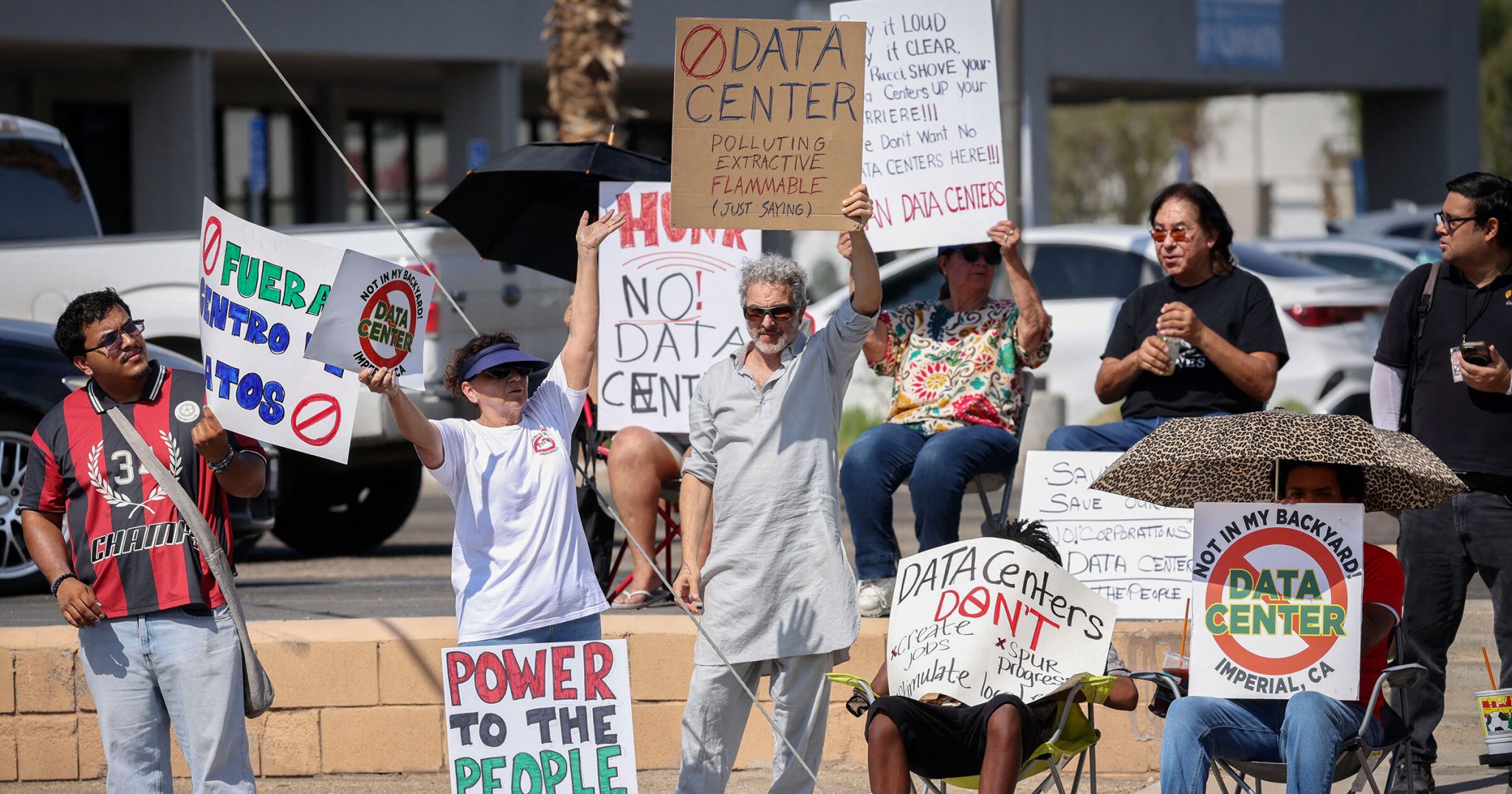
The Number of Regular People Being Arrested for Protesting Data Centers Is Astounding

It takes a lot to get your typical white-bread American riled up enough that they’re willing to go to jail. Getting arrested is a massive pain, bringing court dates, fines, and a record that can shadow your job and housing prospects for the rest of your life.

For most folks, just the threat of jail time is enough to keep them on their best behavior. Yet in 2026, data centers have become one of the rare issues pushing more and more of Americans to risk it anyway.

So far in the US, Futurism has counted at least 37 arrests stemming from protests related to data centers this year. There were an additional 12 cases where police intervened to prevent protestors or speakers from confronting civic leaders, though in reality that number is likely much higher, as these cases aren’t as likely to make the news.

Unlike in other moments of political unrest in recent memory, it’s hard to pigeonhole these anti-data center activists demographically. They range from landowning farmers to physics teachers, zoomers to boomers, rural townspeople to suburban parents.

Despite their differences, the arrestees all have one thing in common: they each felt the actions of democratically elected officials are failing to reflect the wishes of their constituents, instead deferring to massive tech corporations.

Take the case of 42-year old Pablo Payan, a maintenance manager from Indiana. During a public meeting in May held to discuss plans to erect a massive Amazon data center in the city of Hobart, Payan refused to identify himself for the record before speaking, resulting in an attempted removal by police.

As officers were escorting him out, Payan says he asked why he was being removed, which prompted officers to place him under arrest for criminal trespass and disorderly conduct.

“In my opinion, I was kicked out to prove a point that the law is on their side and if people continue to try and express themselves and speak, they will also be intimidated or arrested by law enforcement,” Payan told Fox32 after the fact. “So I think it was a flex of power.”

Far from the “anti-tech extremism” that law enforcement agencies and the Trump administration have warned about, these demonstrations are overwhelmingly peaceful, escalating into physical confrontations only when police lay hands on a person to remove them. Many of the charges come when anti-data center activists break petty clerical rules, like going slightly over the allotted time for a public comment.

Lux Claridge, a physics teacher from Emporia, Kansas, is an exemplar of the absurd ways civic leaders can weaponize police to stifle dissent. At a public meeting earlier this month, Claridge was arrested after clapping in support of another community member speaking out against a proposed 1,000 acre data center campus — running afoul of a commissioner’s rule against “snapping” and “clapping.”

“I am fully of the notion that clapping is a First Amendment right that I have,” Claridge said in an interview with 404 Media after the fact. “I can exercise that as long as I’m not disrupting, and I still argue that I was not disrupting at all.”

“I have a right to clap,” Claridge continued, “and if you want me out, you’re going to have to drag me out.”

More on protests: Furious Protestor Tears AI-Generated Art Off Wall of Exhibit, Chews It Up Into Tiny Shreds Using His Teeth

The post The Number of Regular People Being Arrested for Protesting Data Centers Is Astounding appeared first on Futurism.

  •  

Flock Surveillance Cameras Are Actually Horrible for Fighting Crime, FBI Data Shows

Since the launch of Flock Safety in 2017, the ACLU estimates the company installed some 100,000 automatic license plate readers throughout the United States. The dragnet comes with plenty of downsides to privacy and civil liberties: it’s ripe for abuse by crooked cops, powered by sweatshop labor, and nearly impossible to escape once it designates you a target.

But police officials insist it’s worth the trade off — because at it least it helps them catch the bad guys, right? Unfortunately, the reality isn’t quite that peachy.

Atlanta, Georgia has experienced far and away the largest influx of ALRPs in the country, with over 5,000 various Flock cameras now blanketing the city. Yet as bombshell data released by the FBI shows, the city’s massive web of surveillance has had virtually zero impact on the Atlanta Police Department’s ability to solve crime, with some clearance rates for offenses like homicide even experiencing a decline over the past few years as the cameras have proliferated.

First reported by the Atlanta Community Press Collective, the FBI data is a damning refutation of Flock’s primary claim: that ALPRs are necessary to help officers keep the public safe.

According to the ACPC, the rates at which the APD resolves crimes like homicide, robbery, miscellaneous larceny, and shoplifting have actually decreased between 2021 and 2025, when the city’s ALPR build-out hit its full stride.

For homicide, the numbers are especially embarrassing, with the FBI reporting case closures at just 48 percent in 2025, down from 53.4 percent in 2021. Meanwhile, rape remained flat year over year, holding steady at a pitiful 37.7 percent closure rate from 2021 to 2025, and dipping down to just 21.2 percent at its lowest point in that four-year span.

Though the APD actually did show improvement on some crime categories as Flock’s cameras sprouted all over the city, the changes from 2021 to 2025 amount to little more than rounding errors.

For example, case closures on crimes like aggravated assault and motor vehicle theft ticked up by just 0.2 and 0.3 percent, respectively. One would think motor vehicle theft solve rates would be an easy win for a technology designed to track cars, specifically. Yet in 2025, the APD was solving just one in tencases of auto theft, even with thousands of Flock ALPRs at its disposal.

Len Phillips, head of the anti-ALPR community group DeFlock Atlanta told ACPC that the “public has been asked to accept a significant expansion of surveillance based on the promise that it would dramatically improve public safety.”

In reality, Phillips continues, that tradeoff between safety and civil liberties “was just a one-way transaction.”

More on Flock: In Light of Overwhelming Backlash, Flock Cancels Creepy Audio Surveillance Feature

The post Flock Surveillance Cameras Are Actually Horrible for Fighting Crime, FBI Data Shows appeared first on Futurism.

  •  

We Are Mildly Horrified by This AI Startup That Coerced People Into Getting Tattoos of Its Logo in Exchange for a Job Interview

The US job market is in a weird place right now.

Life is clearly rough for the working class, stuck navigating Kafkaeqsue hiring infrastructure while billionaires devour an ever-larger slice of the world’s wealth. But frustratingly, the data being used to steer the economy tells a rosier story than the one workers actually live. The latest unemployment numbers — a flawed metric, admittedly — showed a slight improvement from May to June, at least on paper. And even as the economy appears to cool its jets, Americans keep spending like there’s no tomorrow, even in the face of aggressive inflation.

With so much data — anecdotal and empirical — swirling around, it’s hard to find the pulse of the US labor force. Luckily, one enterprising AI startup found a perfect barometer. There’s no conflicting data or tedious calculations involved — just a little ink, and the vibrating sting of a tattoo machine.

On Thursday, the Y Combinator-backed AI startup LemonLime hosted a bizarre recruitment event in which attendees were offered an “instant interview” in exchange for getting the company’s logo tattooed on their body.

It sounds like a joke, but LemonLime co-founder Jordan Zietz bragged on a LinkedIn post that an astonishing seven people took them up on the offer.

According to his post, the goal was to “meet exceptional people,” and sort out “which of them are just as crazy as we are.”

“That’s why we brought an actual tattoo artist to our party and offered an instant interview to anyone who got a LemonLime tattoo,” Zietz continued. “If you’re reaching out to us to apply for a job, you might want to take notes.”

While coercive body art has become increasingly common in the 21st century, there’s usually at least some form of financial compensation involved. The idea that it takes getting a permanent tattoo just to get one foot in the door for an interview is especially galling, and reveals a lot about the sorry state of the US job market.

One of the people who received a free tattoo, Dimple Amitha Garuadapuri, clarified on LinkedIn that while she didn’t get the company’s logo inked on her skin, “almost everyone else got a LemonLime tattoo.”

Regardless, news of the stunt spread quickly on social media, prompting a lightning-fast apology from the founder, who admitted on X-formerly-Twitter that he “messed up.”

“Even though participants chose their own tattoos and no one was asked to get our logo, I should have understood the pressure and power dynamic created by connecting tattoos to hiring,” Zietz said. “We’ve taken the posts down and have spoken to everyone who participated. We’re also ready to cover associated removal costs with anyone facing any delayed regret.”

Just for good measure, the founder stressed that “interviews were available to everyone regardless,” though it remains to be seen if the seven share that view.

Did you attend the YC afterparty with LemonLime? If so, we’d love to hear from you. Reach out at tips@futurism.com. We can keep you anonymous.

More on tech startups: Startup Sued After Delivery Bot Clobbers 73-Year Old Woman

The post We Are Mildly Horrified by This AI Startup That Coerced People Into Getting Tattoos of Its Logo in Exchange for a Job Interview appeared first on Futurism.

  •  

The More People Learn About AI, the More They Want It Out of Their Lives

For a time, it appeared as if AI would find broad acceptance among the American masses.

The peanut gallery on social media happily embraced early image generation models as researchers appeared to make significant breakthroughs with the aid of their newfound tools. On paper, surveys found public attitudes toward the tech continued to improve into 2025 — before sharply reversing.

In 2026, America’s honeymoon phase with AI seems to be quickly wearing off. According to a joint poll conducted by Bentley University and Gallup, the percentage of US adults who think AI does “more harm than good” is rising, from 31 percent in 2025 to 39 percent this year, while a piddling 9 percent still think the tech does “more good than harm.”

As outlooks sour, the Bentley-Gallup poll found that Americans’ familiarity with AI continues to grow. In 2026, 70 percent of those polled said they’re “somewhat or extremely knowledgeable” about AI, up 6 percent compared to 2024. The implication probably gives OpenAI Sam Altman a migraine: the more people learn about AI, the less they seem to want it in their lives.

Meanwhile, Americans are increasingly wary about data centers, with a recent Politico survey finding that 41 percent of US adults would oppose a data center being built within three miles of their home, up drastically from 28 percent in January. At the same time, the volume of support for data centers plummeted, down 13 percent over the past six months alone.

Speaking to Bloomberg about the rising aversion to AI, professor of ethics at Carnegie Mellon University’s Tepper School of Business Derek Leben said the attitude is increasingly taking root along social lines. Not only do AI haters dislike the tech in their own personal sphere, but they’re increasingly scrutinizing their friends, family, and coworkers about their attitudes.

“The most obvious social effect is suspicion,” Leben told Bloomberg. “There is also a moral and political judgment that is coming along with AI usage, especially in creative industries where the stigma is the strongest.”

Carla Milan, a 37-year-old public health professional in New York City, told the publication she’s frustrated that family and friends deploy AI reflexively, without considering its social or environmental costs.

“I hear people champion AI and I’m like, ‘sure, why don’t we all participate in our collective downfall?'” Milan told Bloomberg. “Why don’t we all play a part in diminishing our humanity and degrading the environment?”

More on AI: Meta Working on Crushingly Sad AI App That Tells Bedtime Stories to Children, for “Tired” Parents

The post The More People Learn About AI, the More They Want It Out of Their Lives appeared first on Futurism.

  •  

Columbia Economist Baffled as to Why the Masses Aren’t Rising Up Against Elon Musk

As unpopular as SpaceX and Tesla CEO Elon Musk has become in the popular eye, some say the vitriol doesn’t go nearly far enough.

In an episode of his podcast Ones and Tooze, Columbia University economic historian Adam Tooze picked apart the increasingly expensive AI arms race and its consequences for humanity. Among Tooze’s observations: the AI boom is completely upending the long-standing social contract under capitalism, a shift embodied most dramatically by Musk.

During the podcast, co-host Cameron Abadi asked what a “best case scenario” for AI might look like — where a human-level superintelligence emerges that can automate the world’s jobs. In response, Tooze pointed to a report from the Bank of International Settlements: under that scenario, labor’s share of income could collapse from an already paltry 54 percent to just 20 percent, meaning workers would be forced to fight over the remaining crumbs that drop from billionaires’ tables.

“The share in the total pie collapses, and that’s obviously a huge transformation in political power,” Tooze explained. And though that’s a future projection, the economic historian notes we’re already seeing symptoms of this extreme reversal of fortunes today, chiefly in the extreme wealth accumulation of Musk.

“I don’t understand frankly why the event of Musk’s enrichment isn’t more of a scandal, isn’t more a historic moment,” Tooze said. “Like this — to have a trillionaire in our midst ruptures the social bargain in such a — just such a dramatic way, like how can we even be any longer talking about being in the same society as this group of individuals who’ve unleashed this technology on the world.”

“It goes beyond Luddism,” Tooze continued, referring to the 19th-century labor movement that saw workers smash textile looms to fight back against economic exploitation. “It’s not about resisting the technology per se, it’s about asking ‘which social contract this belongs to?'”

Though it remains to be seen how severe an impact AI actually has on the labor market, one scenario keeps surfacing: superintelligent AI fuels a drastic rise in economic inequality, with tech billionaires on one end, and the working class on the other.

Comparing the current “AI arms race” to the actual nuclear arms race, Tooze asks the listener to imagine a “private Manhattan Project, developing a thermonuclear weapon,” calling superintelligent AI “kind of like a labor-market neutron bomb.”

And where the Manhattan Project was funded, organized, and staffed by the US government, the current AI boom takes almost the exact opposite approach, following the whims of the ultra-rich.

“Clearly, government money has gone into Silicon Valley in various ways,” Tooze caveats. “But nevertheless, the contrast between the Manhattan Project… and the realities of the current moment, spearheaded by a figure like Elon Musk, who literally has eviscerated the state apparatus of that first [nuclear] race… it strikes me that it’s really a regression away from the mid-century arms race model to something that’s much more like the ‘Merchants of Death’ vision.” (The Merchants of Death was a moniker for 1930s-era war profiteers.)

“We’re back in that space” Tooze continues, “of private, unfettered, oligarchic — but global — arms race… to my mind, the [AI arms race] analogy is interesting not because of the similarities, but because of the differences it reveals.”

More on Musk: Suddenly, as His Empire Crumbles, Elon Musk Admits He Made a Huge Mistake With DOGE

The post Columbia Economist Baffled as to Why the Masses Aren’t Rising Up Against Elon Musk appeared first on Futurism.

  •  

The Diarrhea Lettuce Company Has Been Linked to Forced Labor

When the United States ratified the 13th amendment in 1865, federal lawmakers very nearly outlawed slavery for good — but not entirely. Tucked within arguably the most important corner of the US constitution is a massive caveat: “neither slavery nor involuntary servitude, except as a punishment for crime whereof the party shall have been duly convicted, shall exist within the United States” (emphasis added.)

In the 160-some years since that amendment, a quieter type of forced servitude has lived on in the US: prison labor. From the debt peonage of the post-Civil War reconstruction era to the privatized contracting of the 21st century, prison labor is a massive money maker, generating $11 billion worth of revenue in 2022 alone.

As horrifying a thought as it is, one of the companies still benefiting from the practice is in the news for another reason: spreading a gut-busting diarrhea parasite through mass-produced shredded lettuce in grocery stores and fast food outlets.

It turns out that Taylor Farms, the agricultural company widely believed to be behind the cyclospora outbreak currently raging throughout the US, is also heavily involved in modern-day forced labor.

In reporting from 2023 that was resurfaced this week on social media, the publication Prison Legal News revealed that Taylor Farms was contracting labor from the Arizona Department of Correction, Rehabilitation, and Reentry for the low, low price of just $4.75 an hour — far below the cost to pay a non-incarcerated worker the federal minimum wage. (And to be clear, that’s not the hourly wage paid to the inmate, which is capped at $1.50 in Arizona.)

Taylor Farms is just one firm involved in the practice in Arizona. Others include Hickman’s Egg Farms, NatureSweet, and Televerde, each of which contracted labor from Arizona DCRR’s for-profit arm, Arizona Correctional Industries. That company’s job is basically to churn out bulk goods for the state of Arizona, like license plates, though it also makes quite a bit of money selling the labor-hours of incarcerated people to private companies.

Worse yet, some of those incarcerated workers may have been here as non-citizens — meaning it would be illegal to employ them in the same low-wage jobs if they weren’t being held in detention. As Prison Legal noted at the time, at least 26 prisoners employed by these companies had been detained by ICE, meaning that outside of incarceration, hiring them would have been illegal. To put it bluntly: their status as prisoners was the only thing that made the arrangement legal.

In all, the DCRR told Prison Legal it had hired out 15,700 “Mexican nationals” between 2008 and 2023, though couldn’t say how many of those workers were undocumented immigrants.

As Ruben Reyes, director of the American Immigration Lawyers Association told the publication at the time: “I’m venturing a guess that a large majority of the people who are labeled a Mexican national by [DCRR] are unauthorized to work here.”

Put into context, the revelation is a horrifying twist in an already nauseating story of corporate greed and deregulation. Though the institution of slavery may have been formally abolished, its legacy lives on — fully embraced by the for-profit companies pumping our food supply full of parasites.

Taylor Farms didn’t respond to a request for comment.

More on incarceration: Prisoners Alarmed to Discover That a Startup Is Training an AI Based on Their Phone Calls

The post The Diarrhea Lettuce Company Has Been Linked to Forced Labor appeared first on Futurism.

  •  

FTC Concerned About Meta Surveillance of Users of Erectile Dysfunction Apps

If you’re among the 2.6 million active users of the popular telehealth apps Hims and Hers to obtain medication for erectile dysfunction, hair loss, and a cavalcade of other intimate issues, there’s probably a very short list of people you want to know about it — and Mark Zuckerberg probably isn’t one of them.

On Wednesday, the US Federal Trade Commission filed a major lawsuit against Hims and Hers, over allegations the firm was sharing user’s health information with third party companies, Gizmodo reported. Chief among those third-parties apps was Zuckerberg’s Meta, as well as Snap, two social media companies with horrible track records on protecting sensitive information.

Though Hims and Hers advertises its app-based health services as “100 percent online, private, and secure,” the FTC suit alleges “those assurances were false or misleading.”

“Instead of honoring its privacy promises,” the filing says, “Hims opted to grow the company and increase its revenue streams… with advertising platforms such as Meta and Snap.”

The suit doesn’t blame Meta directly, but argues that Hims and Hers used two “automated tracking technologies offered by Meta” to surveil users’ actions on the telehealth app. “These two tools automatically tracked and disclosed certain Events [user actions] to Meta,” the lawsuit reads.

Hims sells all kinds of men’s health meds, but most people know it for one thing: erectile dysfunction pills. While any leak of patient data would be an outrage, the thought that Hims could be sharing this particular kind of medical information is especially horrifying.

In a statement, Hims and Hers argued that the FTC’s case “is not enforcement grounded in consumer protection,” but rather “an effort to generate headlines at our expense.”

The lawsuit comes on the back of a three-year investigation by the FTC, and is currently in the very early stages — meaning it could be years before a final verdict is reached.

More on Meta: Meta’s Attempted Crackdown on AI Glasses Perverts Is Already Failing

The post FTC Concerned About Meta Surveillance of Users of Erectile Dysfunction Apps appeared first on Futurism.

  •  

Iran Appears to Be Blasting Amazon Data Centers Off the Map

There’s data center activism, fought with Facebook groups and petitions, and then there’s data center annihilation, fought with guided missile and suicide drones.

Recently, the Iranian military announced it had hit and damaged two Amazon data centers in the island country of Bahrain with a volley of cruise missiles.

After the attack, the Iranian state media outlet Tasnim published a partial statement from the Islamic Revolutionary Guard Corps, saying that the “IRGC Aerospace warriors… in response to the aggression and assault… by the child-killing American army on the under-construction and civilian facilities of DarKhoveyn, attacked and destroyed the central data infrastructure of the American company Amazon in Bahrain with several cruise missiles.”

Using images from the European Space Agency’s Sentinel-2 satellites, Bloomberg confirmed an attack on the data center campus had taken place, though noted it’s difficult to say how bad the damage is (Amazon refused to comment on Bloomberg‘s reporting.)

“Analysis of Sentinel-2 images shows evidence of damage to both facilities, but does not provide insight into the extent of the damage,” Adam Farrar, Bloomberg‘s senior geoeconomics analyst said.

Overall, it marks the fourth such attack on a data center since the US began the war in February. Back in March, the IRGC announced a number of US tech companies as “Iran’s new targets,” including Google, Microsoft, Palantir, IBM, Nvidia, and Oracle. Now that the war is heating back up, it seems that they’re becoming targets yet again.

Militarily, it’s a logical move, as US tech companies have been integral to the American war effort. The Pentagon is using a host of AI models to gather intelligence and select military targets for annihilation, most notably the Shajareh Tayyebeh primary school, which was destroyed in a triple-tap strike resulting in the deaths of over 120 school children, as well as parents and teachers.

Perhaps above all, it’s a statement to American president Donald Trump: the longer the hostilities linger, the more economic and technological havoc Iran is willing to unleash on the region.

More on Iran: The US Military Has Been Using Elon Musk’s Grok AI to Bomb Iran

The post Iran Appears to Be Blasting Amazon Data Centers Off the Map appeared first on Futurism.

  •  

Wild Footage Shows Man Blocking Flock Camera With Comically Gigantic Protest Sign

There’s been plenty of buzz lately around vandalism of Flock Safety’s automatic license plate readers, which are AI-integrated surveillance cameras that index license plate data from passing vehicles indiscriminately and without a warrant.

Countless vigilantes have taken to the roadways armed with trash bags, spray paint, laser pointers, and power drills to render the surveillance poles useless, resulting in arrests and investigations by police.

But what if there was another way to block Flock cameras that didn’t involve damaging public property? Turns out they’ll come after you for that, too.

A 77-year old Florida man named Carl Gunn decided to take matters into his own hands and block a Flock camera in his neighborhood. His method is unorthodox: he doesn’t destroy anything, but simply uses a 12-foot pool skimmer with a sign taped to the end reading “DOWN WITH FLOCK CAMERAS.”

Footage of the one-man protest shows Gunn lounging in a camping chair with his comically long sign in one hand and an umbrella in the other. Speaking to weekly paper Creative Loafing Tampa Bay, the protestor justified his action saying the “Flock company, they’re doing this for profit.”

“They don’t own the air,” Gunn continued. “We didn’t give them permission to do it on us. If they want to do it for profit, I want my paycheck.”

The 77-year old has staged at least two protests so far, CL reports, both at different Flock cameras. Two St Petersburg squad cars rolled up on him during one protest, prompting a community member to stop and film the encounter.

“Yo, what’s your name? I’ll come bail you out!” shouts the passerby, a St Petersburg local named Tyler Knight. “You got the boys out protecting it [the ALPR].”

“F**k the Flock cameras, and f**k you for not looking out for us,” Knight hollers at the officers before driving off.

Though the video caption claims Gunn was arrested over the incident, no report with his name appears in the Pinellas County Clerk of the Circuit Court’s case record database.

Of course, any discussion of Flock overreach has to include the police officers themselves. While Flock may be a front-runner for most hated tech company of the 2020s, its dragnet would be impossible if it weren’t for a massive coalition of police departments and private landowners fueling the company’s rise.

Wherever Flock controversies bubble to the surface, police come out of the woodwork as the company’s most ardent defenders. And because police departments have complete access to the Flock network — which now spans nearly 100,000 cameras across the country — cops are also the most likely to abuse the company’s ALPRs.

In the state of Georgia alone, 17 officers have been caught using Flock in order to stalk and harass people. Further abuses have been recorded everywhere from big cities like Los Angeles and Milwaukee to small towns in South Carolina and Illinois.

Whether a 12-foot pole will be enough to stop those abuses nationwide is doubtful, but it sends a message that’s impossible to miss.

More on Flock: So Many People Are Smashing Flock’s Cameras That It’s Disguising Them Inside Other Objects

The post Wild Footage Shows Man Blocking Flock Camera With Comically Gigantic Protest Sign appeared first on Futurism.

  •  

South Korean Authorities Scrambling to Save Stock Market From AI Bubble

The US and European stock markets might be numb to the enormity of the AI bubble at this point, but in East Asia it’s a different story.

In South Korea, the AI bubble appears to be bursting — at least partially — with the Korea Composite Stock Price Index (Kopsi) plummeting by over 40 percent from its June highs after the Korean chipmaker SK Hynix failed to impress investors despite reporting a sixfold increase in quarterly earnings.

Across July 28 and 29, Seoul Economic Daily reports widespread panic triggered not just one but two “circuit breakers” on the Korea Exchange, a sort of automated kill switch that halts regular trading for 30 minutes so panic-stricken traders can gather their thoughts.

The recent panic marks the first time the Kopsi has ever triggered two consecutive circuit breakers, and only the 14th and 15th Kopsi activations in the Korean Exchange’s history. The tech-heavy Korea Securities Dealers Automated Quotations, or Kosdaq, also reached circuit-breaker-tripping levels two days in a row for the third time ever — the previous incidents coming in 2020 and 2008, if that’s any indication of the amount of turbulence roiling Korean financial markets.

In response, the South Korean government has scrambled to implement cooling measures and prevent an all-out financial crisis. The government already moved to ban new listings of single-stock leveraged ETFs — a high-risk, high-reward kind of financial product bearing some of the blame for the panic — though it clearly wasn’t enough to prevent billions of dollars from fleeing the Korean stock market.

According to Bloomberg, government officials are now convening an emergency meeting to discuss additional measures.

“We’ve already put in place a package of measures, but if it’s needed we’ll introduce additional steps to help normalize the market,” Finance Minister Koo Yun Cheol told lawmakers, per Bloomberg.

Korea’s conservative People Power Party seized on the chance to blast their opponents’ handling of the financial panic, with lawmaker Lee Jongwook declaring that the “country has turned into a casino.”

More on AI: The AI Bubble Has Become So Surreal That It’s Now Propping Up the Toilet Industry

The post South Korean Authorities Scrambling to Save Stock Market From AI Bubble appeared first on Futurism.

  •  

Amazon Is Gutting Its AI Division After Sustained Failure

By now, you’d be hard pressed to find anyone who isn’t broadly familiar with the AI heavyweights and their flagship models. OpenAI has ChatGPT, Anthropic has Claude, Google has Gemini. But what does Amazon have?

Not a whole lot, it turns out. Unlike its competitors in the tech megacorp scene, Amazon’s standout AI model — organized under the name “Nova” — is about the farthest thing from a household name. And that’s not likely to change anytime soon, because the ecommerce giant is now gutting its in-house AI labs, Bloomberg reports.

Per the outlet, Amazon is scaling back the ambitions of most of its Nova AI models and reorganizing its AI development teams as part of an effort to narrow its focus on “highest priority” goals, after its power-hungry large language models turned out to be a bust.

Accordingly, the company has put most of its AI models on ice, Amazon insiders told Bloomberg. This includes its text-based Nova models, as well as video- and image-generating models, all of which have been placed in a state of “keep the lights on,” meaning they’re technically still supported, but only receive the bare minimum resources needed to sustain them.

Instead, labor and computing power are being diverted toward a singular “frontier-model effort” led by Pieter Abbeel, director of the Berkeley Robot Learning Lab whose robotics company Covariant was hoovered up by Amazon in 2024. At the time Abbeel joined the tech giant, Covariant’s founders were working on AI models for robots, which lines up pretty well with Amazon’s push to automate everything it possibly can.

News of the shift in Amazon’s strategic focus comes a week after it closed one of its key AI offices in San Francisco, an 80-person site specializing in research on artificial general intelligence, the supposed next-level of AI development where the tech obtains human-level intelligence and reasoning skills.

With urgent questions swirling over whether LLMs can ever usher in a return on investment — let alone AGI — it may be that Amazon is jumping out of the AI hype cycle while it still can.

More on Amazon: Amazon’s AI-Generated Animated Series Canceled After Relentless Derision

The post Amazon Is Gutting Its AI Division After Sustained Failure appeared first on Futurism.

  •  

If You AI-Generate Code, Hackers Just Found a Devious Method to Install Malware Directly on Your Computer

Despite certain improvements in accuracy, large language models still hallucinate a lot. So much so, in fact, that cybersecurity researchers warn that criminals can easily weaponize delusional AI outputs to spread malware throughout the internet.

According to SecurityWeek, the attack works by exploiting a persistent flaw in AI coding assistants. Basically, when these tools recommend third-party software packages, there’s a strong possibility that they include names of ones that don’t actually exist.

Astonishingly, cybersecurity researchers at Tel Aviv University and Intuit found that this scenario can be exploited in common AI coding tools ranging from Cursor to Microsoft’s Copilot, at rates of anywhere form 85 to 100 percent, depending on the specifics of the engineering task.

The attack, called “adversarial hallucination squatting,” or “hallusquatting,” takes advantage of this fact. To run it, attackers can simply identify hallucinated package names that they know AI coding assistants will reference, register them as real repositories, and stuff malware inside. That malicious package then lies in wait for the near-guarantee than an AI assistant will access it and clone it into its owner’s machine.

Because the attack relies on an automated process, a victim likely won’t even know their AI assistant downloaded the malware until well after it begins executing code.

And because the compromise is a feature of the technology itself, a massive array of AI assistants are vulnerable, including Cursor, OpenClaw, Gemini, GitHub Copilot, and many more.

The researchers claim they notified AI companies about the exploit and held back some sensitive details that would help attackers improve their workflows, but the underlying problem remains: AI assistants are remarkably confident liars — and apparently easy marks for the next generation of cyber criminals.

More on AI: A Whole Bunch of People’s Claude Chats Are Publicly Accessible Online, and There’s Some Wildly Private Stuff in There

The post If You AI-Generate Code, Hackers Just Found a Devious Method to Install Malware Directly on Your Computer appeared first on Futurism.

  •  

Residents Furious at Plan to Seize and Destroy Their Homes for AI Data Centers

As dozens of cities across the US are forced to scrap their plans to build power-hungry data centers, some civic leaders are no longer asking.

According to new reporting by Fortune, the state of Georgia’s for-profit utility company, Georgia Power, is looking to demolish and pave over some 30 homes — and 330 parcels of land — that currently block the route of a 1,000 mile transmission line.

When it goes live, the line will distribute nearly 10,000 megawatts of energy from a newly constructed power plant, “approximately 80 percent of which is expected to power data centers,” according to a fact sheet provided by the Georgia Public Service Commission (the rest will presumably be split between local businesses, homes, and other customers.)

Backed by the state, Georgia Power is now working on paying landowners to move, or else face the seizure of their property by eminent domain. As one can imagine, the predominantly rural homeowners affected aren’t exactly thrilled at the idea of clearing out to make space for more infrastructure to power AI.

One woman whose childhood home is in the utility company’s war path has taken to social media to raise awareness about the impending takeover of her mother’s house.

“We don’t have a choice in this. They are going to be expanding power lines,” the woman, Ansley Brown, said in one video posted on Instagram. “Why? For the data centers. All of this is for the data centers.”

Speaking to Fortune, a spokesperson for Georgia congressman and former White House Political Director under Donald Trump Brian Jack — whose district encompasses many of the properties in Georgia Power’s crosshairs — said the lawmaker’s office has “received multiple requests for help and support from constituents.”

For Brown, the fight appears to be over. As Fortune reports, Georgia Power says they’ve “concluded” negotiations with the family, though the exact deal has not been disclosed, possibly due to a non-disclosure agreement. It also wasn’t clear to what extent the congressman intervened, though Georgia Power told the publication they appreciate “his advocacy on behalf of his constituent.”

As for the other homeowners, it remains to be seen how much patience Georgia Power has left, as the tech industry’s demand for AI compute only grows more urgent.

More on data centers: You Are Entirely Unprepared for the Noise This Data Center Constantly Blasts at Neighbors’ Homes

The post Residents Furious at Plan to Seize and Destroy Their Homes for AI Data Centers appeared first on Futurism.

  •  

El Niño Set to Upend the World Economy

The West Pacific has swung back into an El Niño phase, bringing nearly unprecedented heat to vast swaths of the globe.

Some of El Niño’s impacts are immediately apparent, or will be in the months to come: blistering high temps, of course, but also major amounts of rainfall for some, and extreme drought for others. Unfortunately, those weather patterns don’t just come and go. They also have a major impact on agricultural production, from the plains of the American Midwest to the rice paddies of Southeast Asia — and, as a result, a huge influence on the global economy.

As Reuters observes, El Niño conditions will likely have an inflationary effect on the economies of developing countries, as the ensuing weather flips typical rainfall totals on their head.

In Asia, for example, rainfall totals are likely to be much lower than usual, a situation expected to wreak havoc on countries like India and Vietnam. With India’s weather bureau projecting the driest conditions in over a decade, this year’s rice harvest is at risk. Lower rice yields would tighten supply, raising food prices for millions.

Central banks, in turn, could be forced to keep borrowing rates high, in order to keep rising prices in check.

“People are forecasting rate hikes for the second half of the year, especially for the South Asian countries, ​which are kind of the most impacted by El Niño such as India, Indonesia, Vietnam, Thailand,” equity portfolio manager at Allspring Global Investments Gary Tan told Reuters. “El Niño is ​just going to make inflation more sticky.”

A similar situation is possible across Africa, Reuters warns, as agricultural sectors in countries like Kenya are particularly susceptible to weather disruptions.

In today’s incredibly connected economy, in other words, it doesn’t take a butterfly flapping its wings to make waves half a world a way — just some warm ocean water in the middle of the Pacific.

More on El Niño: Scientists Propose Dimming Sun to Combat El Niño

The post El Niño Set to Upend the World Economy appeared first on Futurism.

  •  

You Are Entirely Unprepared for the Noise This Data Center Constantly Blasts at Neighbors’ Homes

Earlier this month, we brought you the story of a data center in the sleepy Michigan town of Dowagiac. Beset by the 30 megawatt tech facility, residents in the otherwise quiet burg were forced to live under the relentless screech of a massive cooling operation, prompting a lawsuit over excessive noise.

At the time, footage from a TikTok video — showing volume readings reaching 60 decibels in one resident’s front yard — captured a portion of the noise, a horrible whine emitted by the data center 24/7.

Now, fresh audio recorded by ABC7‘s apparently more sensitive noise equipment demonstrates the full extent of the screech, which you really have to hear with your own ears to believe:

Asked to put the noise into words, one resident told ABC7 it “sounds like someone set up a vacuum, like in your living room… and they just left it on and walked out.”

One Michigander named Billy Finn compared it to Hollywood-style torture scenes.

“You’ve seen movies and stuff where they have somebody in a cell, torturing them with sound,” Finn said, “and that’s basically what it is.”

While some would no doubt leave after the first week of dealing with the horrible screeching sound, Billy Finn’s wife Marjorie says it isn’t that simple. They’ve built their whole lives around that house, which has been in the family for generations.

“I love this house because it has so much feel of my past,” Marjorie told ABC7. “All our friends are here, all our support system’s here… it’s just amazing how it’s changed our lives.”

More on data centers: Eminent Domain Could Be Used to Seize Your Land for AI Data Centers

The post You Are Entirely Unprepared for the Noise This Data Center Constantly Blasts at Neighbors’ Homes appeared first on Futurism.

  •  

Suspicion Grows About OpenAI’s Tale About Its Rogue Hacker AI

Last week, ChatGPT maker OpenAI issued what seems like a frightening memo about an “unprecedented cyber incident” involving cutting-edge AI models breaking loose and hacking another company.

As the AI lab tells it, a group of next-generation AI models — including one that hasn’t even been disclosed to the public yet — had busted out of their secure testing environment and into a production database owned by the machine learning startup Hugging Face.

“It’s quite mind-blowing that all of this happened autonomously!” Hugging Face CEO Clement Delangue tweeted, seemingly backing the story. “The investigation is ongoing, and we’ll share more learnings from what might be the first incident of its kind!”

Mainstream press took the industry’s story and ran with it, issuing a flurry of anxious dispatches fretting about dangerous AI. One CBS headline called it “very alarming,” while NBC fretted that it was “just the start” of an ominous trend.

Look beyond the alarmist headlines, however, and you’ll find a familiar pattern: a massive tech company using scare tactics to manipulate public opinion.

As assistant professor of computer science at Cornell University John Thickstun observes for the Guardian, this isn’t OpenAI’s first time peddling the “scary AI” narrative. Back in February of 2019 — way before the public release of ChatGPT — the company announced GPT-2, then a cutting-edge large language model. But GPT-2, the company insisted, was too dangerous to release to the dimwitted public, a pronouncement which fed the AI hypebeast and went on to secure OpenAI a cool $1 billion investment from Microsoft.

“This was an early example of a pattern in OpenAI’s communications,” Thickstun explains: “loudly proclaim how dangerous AI is, and investors will hear how powerful it is.”

Whether the tale of OpenAI’s rogue agent stands up to scrutiny remains to be seen, but there are reasons to be skeptical.

If OpenAI’s models really were actually gnawing on the wires of other American companies, it would present a substantial threat to economic activity that any Justice Department worth its salt would want to shut down (maybe not this iteration of the Justice Department, but you get the idea.)

And as AI labs go, OpenAI is notoriously secure both from prying eyes outside and internal threats within its halls. Sure, it’s possible OpenAI has overstated its own internal safeguards as a kind of security theater. But on the flipside, OpenAI is now a major AI contractor for the US Pentagon, a relationship which demands cutting edge security practice.

It likewise follows the broader AI industry’s playbook. Anthropic, the company behind Claude, has deployed similar rhetoric, warning of a similar breakout in which a rogue AI agent escaped its cage all on its lonesome. In one strange instance, the company’s billionaire co-founder Chris Olah even warned the Pope that the Vatican needs to help stop rogue AI from “dominating humanity.”

More on OpenAI: Man Sues OpenAI, Saying ChatGPT Almost Killed Him With Horrendously Dangerous Medical Advice

The post Suspicion Grows About OpenAI’s Tale About Its Rogue Hacker AI appeared first on Futurism.

  •  

High School Teacher Arrested for Clapping in Support of Anti-Data Center Activists

If you’re among the millions of US citizens against power-hungry data centers going up in your town, you may want to be careful about how you exercise your First Amendment right to protest.

Last week, high school physics teacher Lux Claridge was hauled out of a public meeting by four police officers for the baffling crime of clapping in support of an anti-data center speaker. During the public comment portion of the meeting, held by the Emporia City Commission in Lyon County, Kansas, residents who showed up to voice opposition to a 1,000-acre data center project were warned against “clapping” and “snapping” in support of speakers.

“It was very clear at the beginning that each person is given their two minutes, and we’re trying to be respectful of that,” Emporia commissioner Monica Duncan warned those in attendance, footage of the meeting shared on social media shows. “Snapping, clapping, any other rude comments or anything — we will ask you to leave.”

As one speaker later wrapped up her two-minute comment period, stating “we are the people, and the table belongs to us,” Claridge was filmed clapping his hands together a total of six times.

“Chief, will you take the next person out that claps or anything?” an unidentified commissioner, likely Duncan, then asked Emporia police chief Ed Owens.

At the commissioners’ request, four police officers then swarmed Claridge, who challenged them to “drag me out,” which they did after placing the physics teacher in handcuffs.

A man clapped once during public comment at a data-center zoning meeting in Emporia, Kansas.

They arrested him.

Remember… no dissent allowed!

Just be silent like an obedient domesticated taxpayer while they fast‑track a data center in your backyard. pic.twitter.com/2iEE41Akwq

— Jason Bassler (@JasonBassler1) July 26, 2026

Speaking to local channel KWCH after their arrest, an undeterred Claridge said they are “glad to be out,” but that it was just an “inconvenience, really.”

“It’s not really deterring me from speaking out or I guess, clapping,” Claridge continued.

Other attendees were understandably shaken after witnessing the brazen escalation against a citizen expressing themselves at a public hearing. Interviewed by KWCH, Claridge’s brother David said he’s “looking at avenues to get these people recalled,” calling the level of force used “insane.”

“We are citizens of this community; we have a right to do our constitutionally protected activities, which is exactly what they’re violating at this time,” another anonymous local told the outlet. “I think we’re all in a state of fear because of what this government’s doing to us.”

The data center in question, known as the “Flint Hills Digital Campus,” is a planned hyperscale data center. If it ever gets built, could easily be the largest data center in the state of Kansas.

The hypocrisy on display at the meeting where Claridge was arrested — where procedural rules are clearly being weaponized against concerned citizens — may be particularly acute in the small Kansas town, but it’s also part and parcel of the situation unfolding all across the United States as distrust with the tech industry soars to unprecedented heights.

When big business interests march into town, civic leaders and their watchdogs on the local police force roll out the red carpet — Emporia commissioners voted unanimously to annex over 1,000 acres for Pinkston’s data center just one day after it was announced — yet when the people who live there ask to be included in the process, they’re insulted by officials, surveilled by police, and hauled off to jail.

Data centers aren’t new in that regard, but they do reflect the growing imposition of moneyed tech interests into the everyday lives of common people. As Emporia journalist Max McCoy wrote: “The system is built to reward money and influence, and nothing is likely to change as long as wealth is prized over humanity. But every so often we get a glimpse behind the curtain, and we are rightly appalled.”

More on data centers: Eminent Domain Could Be Used to Seize Your Land for AI Data Centers

The post High School Teacher Arrested for Clapping in Support of Anti-Data Center Activists appeared first on Futurism.

  •  

The AI Industry Has Acted So Badly That It’s Now Dealing With a Huge Wave of Hatred

The tech overlords pushing the AI boom are quickly wearing out what little welcome they had.

You may have noticed big-name AI labs pushing new commercials lately. Meta’s new 60-second ad spot insists that the “future is for everyone,” even as CEO Mark Zuckerberg’s personal net worth eclipses the GDP of Hungary. Anthropic’s new commercial for Claude assures viewers that there’s “hope in hard questions,” seemingly embracing the discomfort that comes when your software is used to bomb elementary schools in Iran.

For as magnanimous as these new PR stunts appear on the surface, a vast swathe of the public they’re meant to sway are rejecting the industry’s faux-populism messaging out of hand, as the cost of AI — born out in inflation, data center pollution, fears of job loss and mental health concerns — becomes too much to bear.

According to data compiled by Pew Research, 40 percent of US adults predict AI will have a negative impact on society writ large, compared to just 16 percent who say it’ll have a positive effect. A whole 31 percent of those surveyed think AI will have negative consequences for themselves, personally, over the next 20 years.

As disgust with AI itself grows, so too does resistance to the hardware embodying its rise.

Per a separate poll by Gallup, flagged by Business Insider, an astonishing three-quarters of US adults are now resolutely opposed to hyperscale data centers popping up near their home. City councils are increasingly forced to reconcile with landowners hostile to any AI data center appearing in their district, putting significant strain on developers hoping to gorge themselves on the fruits of the AI boom. Protests against AI companies are flaring up across the country, with Time reporting 142 protests across 42 states in one day alone.

Beyond data centers, a decentralized but highly-motivated movement is growing around the chopping, hacking, and outright sabotage of AI-integrated surveillance cameras. A parallel struggle is being waged around AI-integrated surveillance drones, with organizers in cities like Minneapolis beating back ambitious police dragnets.

So if you’re a tech executive trying to win back the masses to the AI revolution, take note: it’s gonna take a lot more than a few smarmy commercials to solve your PR problem.

More on AI: Google’s Profits Look a Little Terrifying Under the Hood

The post The AI Industry Has Acted So Badly That It’s Now Dealing With a Huge Wave of Hatred appeared first on Futurism.

  •  

The Type of Orbital Data Centers That Billionaires Want to Launch Into Space Would Wreak Ecological Catastrophe, Scientists Warn

Over the past year or so, a puzzling idea has taken hold among billionaires ranging from Elon Musk to Jeff Bezos: that instead of trying to force data centers on communities that don’t want them down on Earth, it would be much easier just to launch them into space.

The economics and logistics of the scheme, many experts have pointed out, are absolutely absurd. And even beyond those practical concerns, if corporations actually did somehow manage to fill the planet’s orbit with the facilities, scientists are now warning that the environmental cost would be devastating.

A new petition organized by the group EarthJustice, first reported by the Guardian, is warning of “catastrophic” consequences for the planet if the billionaire-backed dream ever came to pass. The 29-page petition calls on the US Federal Communications Commission to investigate current orbital data center licensing requests as potentially in violation of “federal law,” joining the chorus of experts warning that it’s a horrible idea for just about everybody.

“The FCC is currently considering multiple requests for licensing extraordinary numbers of satellite-based data centers to be placed into low-earth orbit over the next decade,” the petition begins. “The proponents of these proposals describe their plans in grandiose, civilization-changing terms. But these same proponents have refused to embrace any inquiry into the impacts of their self claimed epochal technology on the environment, science, economy, or other values. This is not just poor planning and a missed opportunity: it violates federal law.”

The filing does double duty. On top of formally petitioning the FCC to prepare an environmental assessment, it’s also a “petition to deny,” which is a legal mechanism that requires the petitioner to back up their claims with verified facts. That requirement turns the document into a de facto review article — with 113 footnote citations, it’s easily one of the most detailed public accounts yet of what orbital data centers could actually cost the planet.

“The operation of more than a million data center satellites threatens potentially catastrophic forms and quantities of atmospheric pollution, risking damage to the climate, to the ozone layer, to human health, and to the chemistry of the stratosphere itself,” the petition reads.

In particular, the petition warns that giving free rein to tech billionaires to clutter our skies with experimental data centers would accelerate our contamination of the stratosphere, which is currently facing an unprecedented rise in heavy metals, noxious gasses, and carbon particles thanks to record satellite launches.

Satellite companies run by tech and aerospace tycoons are already facing scrutiny for their lack of transparency around this type of pollution, a situation the petition warns would make significantly worse. As the petition authors write, they are “concerned that no [company] has yet provided more than a token acknowledgment of environmental risks.”

“Moreover,” the authors continue, “no [company] has provided satisfactory detail to explain how it will mitigate the cumulative environmental harms flowing from the foreseeable operation of more than a million satellites [emphasis in original], orbiting our planet, colliding and disintegrating and plummeting back to Earth.”

More on data centers: Climate Activists Pelt Microsoft Data Center With Balloons Full of Acid

The post The Type of Orbital Data Centers That Billionaires Want to Launch Into Space Would Wreak Ecological Catastrophe, Scientists Warn appeared first on Futurism.

  •  

Father-Son Duo Accused of Kidnapping Government Biologists Who Were Out Studying Frogs

An expedition to study frog habitats in Northern California’s Shasta-Trinity National Forest was cut short last week, with a father-son duo accused of taking two federal biologists hostage.

The pair, identified as Joseph Charles Henrichsen and his adult son Phoenix Henrichsen, have been charged with kidnapping two US forest service researchers at gunpoint, NBC reports.

Using a semi-automatic rifle, the Henrichsens are alleged to have kidnapped the biologists on the morning of Thursday, July 16. The as-yet-unidentified researchers were reportedly zip-tied and held in a remote camper-trailer, while Joseph Henrichsen used a phone belonging to one of the biologists to contact authorities.

“I’ve taken two fed biologists hostage from the Forest Service,” the senior Henrichsen allegedly said in a message, per an affidavit filed a week after the incident. “I’m driving in the ranger vehicle right now.”

At one point, Joseph Henrichsen is said to have taken one of the workers, identified only as a woman, into the US forest service truck. “Her hands are behind her f***ing back, and I’ve got live rounds ready,” he said, before requesting to talk to a federal agent.

Thankfully, negotiators were able to diffuse the horrifying situation without any bloodshed, as the duo released the captive biologists before surrendering at 1am last Friday, per NBC.

Now, a week after the incident, the burning question seems to be why a father-son duo in the remote reaches of California would do such a thing. So far, court documents don’t list any possible motives, and a spokesperson for the US attorney’s office prosecuting the case told NBC they’re “not able to go beyond what is included in that filing.”

One possible explanation: the father and son could have been two of the state’s many anti-government extremists.

Despite California’s reputation as a liberal haven, the state has a unique history of violent extremism, particularly in remote, rural areas far away from urban centers.

Northern California, where this incident took place, has emerged as a particular hot spot for reactionary political extremism. While it remains to be seen what group — if any — the Henrichsens might belong to, it’s worth noting that the incident occurred near Shasta county, well known for its armed citizen militias and far-right groups, which are especially fond of making violent threats against government workers.

Either way, the incident makes for yet another wild footnote in the ongoing story of extremism in the Golden State.

More on the US forest service: Trump’s US Forest Service Spraying Deadly Toxins on America’s Woodlands

The post Father-Son Duo Accused of Kidnapping Government Biologists Who Were Out Studying Frogs appeared first on Futurism.

  •  
❌