❌

Reading view

Scientists Forced to Go on OnlyFans After Their Funding Was Cut

When you’re a scientist relying on government funding to conduct your research, and that government suddenly yoinks all your money in the name of “efficiency,” you have to get creative to keep the lights on.

Such has been the experience of Daniel Blumstein, a biologist at the University of California, Los Angeles, renowned for his work on studying the ground-dwelling rodents known as marmots. After the Trump administration cancelled billions of dollars in federal research grants last year, he and his colleagues decided to start creating content dedicated to the charming mammals — on OnlyFans.

As SFGate reports, their account, called “OnlyMarms,” promises near-daily “unfiltered yellow-bellied marmot content from the Rockies.” Subscribing is free, but users can leave tips on the cute photos and videos they post, which goes towards funding the research. 

It’s a win for everyone: shy gooners have a convenient explanation for all the OnlyFans transactions in their bank accounts, and the scientists get to keep doing the work they’re doing. Thank you, marmots, for being so adorable.

“Sometimes I’m just posting the videos I think will get the most ‘aws,'” Emily Renkey, a student in Blumstein’s lab who started the account, told SFGate. “But my favorite is when I find footage of a particular behavior and I can use that to educate people.”

The Trump administration’s cost-cutting regime has crippled scientific research in the US. In efforts led by Elon Musk’s now defunct Department of Government Efficiency, it cancelled more than 1,700 grants worth some $1.4 billion at the National Science Foundation in 2025. In 2026, the NSF has so far awarded just a fraction of the $9 billion grant money it has typically distributed in recent years, and the White House has proposed slashing its budget by nearly half for the 2027 fiscal year. 

Many of the grant cancellations were clearly politically motivated, targeting research into climate change — and even research that simply contains the word “climate” — something Trump has called a “hoax.” Even more flagrantly, the administration recently admitted in court documents that it canceled research grants in certain states “based solely” on whether they supported Trump in the 2024 election.

Why marmot research ended up in the administration’s crosshairs is anyone’s guess, but it’s invaluable work. Blumstein and his colleagues have spent years closely tracking the charming rodents, forming what is one of the longest-running studies of free-living mammals in the world, according to SFGate.

These long-term projects ask “some of the most important questions in our time,” Blumstein said, providing our best window into studying evolution in real-time. But their value may not be immediately obvious to the people in charge of crunching the numbers. Historically, this hasn’t been a problem for Blumstein, as his program had received funding from the NSF for over a decade. But now, under the new regime, he’s applied to renew the grant three times, before the agency told him to stop applying at all.

“After the third time, our program officer told my colleague… that they will never fund us because they think we have too much data,” Blumstein told SFGate. “I don’t even know how to parse that sentence. It’s nuts.”

Blumstein’s marmot program, as it stands, is running on fumes. OnlyMarms has only brought in a few hundred dollars, and the lab is looking for more traditional sources of funding, too.

More on science funding: Trump Orders Construction of Powerful Quantum Computer

The post Scientists Forced to Go on OnlyFans After Their Funding Was Cut appeared first on Futurism.


  •  

A Prominent AI Investor Is Now Crumbling, in What Could Be a Sign of Things to Come

Suddenly, things ain’t looking great for the AI industry. Or at least for the people pouring loads of money into it.

Situational Awareness, a much-hyped AI hedge-fund whose 24-year-old founder Leopold Aschenbrenner preached endless AI gains, basically imploded over this month amid a mass tech sell-off. 

The Wall Street Journal reported that it’s now down 67 percent in July, forcing Aschenbrenner to desperately seek clients to buy its shares on the cheap to cover its losses.

“We let you down this month,” the fund wrote in a letter to clients, per the WSJ.

Aschenbrenner, a former OpenAI researcher who had zero investment experience before launching the fund, has been hailed as the “Nostradamus of AI.” He apparently didn’t predict his rapid reversal of fortunes, though.

The Financial Times reported that his fund returned 439 percent for the year through June, and was up 1,551 percent since its founding. 

Then came July. According to CNBC, the fund assets reached a peak of $45 billion, before beginning a precipitous decline this month. Pretty much everything went against its way. Its commitments to AI infrastructure tanked when the likes of the semiconductor manufacturer SK Hynix dropped off a cliff. And it shorted software companies — which investors once feared would be outmoded by AI labs — like Adobe, which instead continued to steadily climb. 

Other companies it invested in, including Sandisk, Micron, and CoreWave, are all down more than 35 percent this month, CNBC noted.

As the dominoes fell, Aschenbrenner sent a letter to investors to quell their fears, highlighting how well it had performed until this point. Boldly, he also said that the mass tech sell off was a “particularly good time to add funds,” the FT reported.

But when the assets kept tanking — and more money didn’t come in —  Aschenbrenner started frantically calling investors trying to get them to sell assets or pour in fresh capital, according to the reporting. When it got even worse, his clients couldn’t reach him.

“Leopold just stopped taking calls,” one investor told the FT.

With nowhere to turn to, Situational Awareness sold the majority of its public assets to the investment firm Citadel, though it hung onto its stake in Anthropic. The FT reported that Citadel’s vulturous purchase of Situational Awareness’s shares “marks one of the largest and most sudden stock transactions in Wall Street history.”

Situational Awareness, despite commanding billions in assets, operated with a skeleton staff of only four investment professionals and eight employees overall, the FT found in a regulatory filing. The fund used borrowed money to buy shares, which helped boost its returns, but made its losses far worse when those assets declined.

AI stocks will likely weather this storm. The real warning sign is that investors are so blinded by AI that they’re entrusting their billions to someone who had no idea what they were doing.

More on AI: Microsoft CEO Warns That Companies Embracing AI Could Drive Themselves Out of Business

The post A Prominent AI Investor Is Now Crumbling, in What Could Be a Sign of Things to Come appeared first on Futurism.

  •  

Google Pulls Down Feature for AI-Generating Fake Satellite Images on Google Earth After It’s Immediately Used to Fake Terror Attacks

Google Earth is the de facto record of our entire planet.

But today, the company undermined its own credibility with a dangerous new AI feature — and then quickly pulled it down after people started using it to generate blatant misinformation.

On Thursday, Google announced that it added an image generation tool straight into the web browser version of the app, allowing anyone to fabricate made-up satellite images of anywhere in the world.

It was clearly a misinformation disaster. The AI tool, powered by Google’s Nano Banana 2 model, could make a neighborhood look like it’d suffered aerial strikes, turn unsuspecting locales into a warzone, and depict a city as the site of a natural disaster.

The AI integration left open source intelligence analysts, who heavily rely on the accurate satellite imagery to monitor areas and in particular conflict zones, especially baffled.

Hank Van Ess, one such OSINT researcher, reported on his Substack that he used Google Earth’s AI to place refugees near the Mexican border and put a nuclear plant in Iran. Both images could easily be used to fuel certain far-right narratives.

“What on earth is Google doing?” Van Ess pondered. Part of the danger, he noted, lies in Google’s own boast that the AI integration “creates concepts grounded in the real world.”

“Grounded in the real world means the invented thing is welded to genuine coordinates, drawn on genuine imagery, often in the same colours and the same light and at the same angle as the picture beside it,” he wrote. “The forgery does not have to look convincing on its own. It inherits the credibility of the map it was born on.”

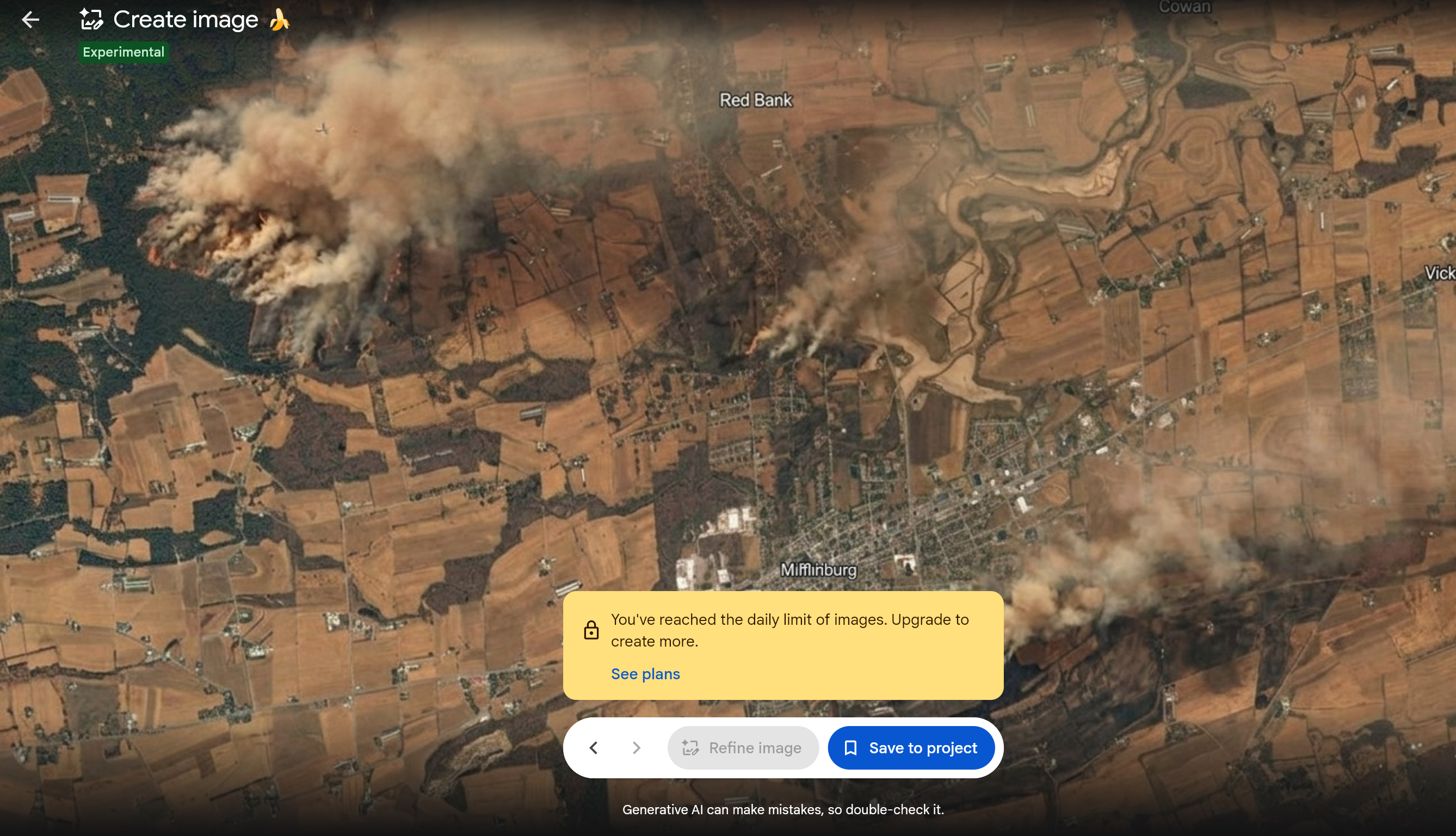
In our own tests, we found that the Google Earth AI would respond to a request to make a rural Pennsylvanian town look like it suffered a drought that caused dead crops and forest fires. The resulting image was fairly realistic, with huge plumes of smoke blowing over the area.

Screenshot using Google's new tool to make a Pennsylvanian town look like it suffered a drought that caused dead crops and forest fires.

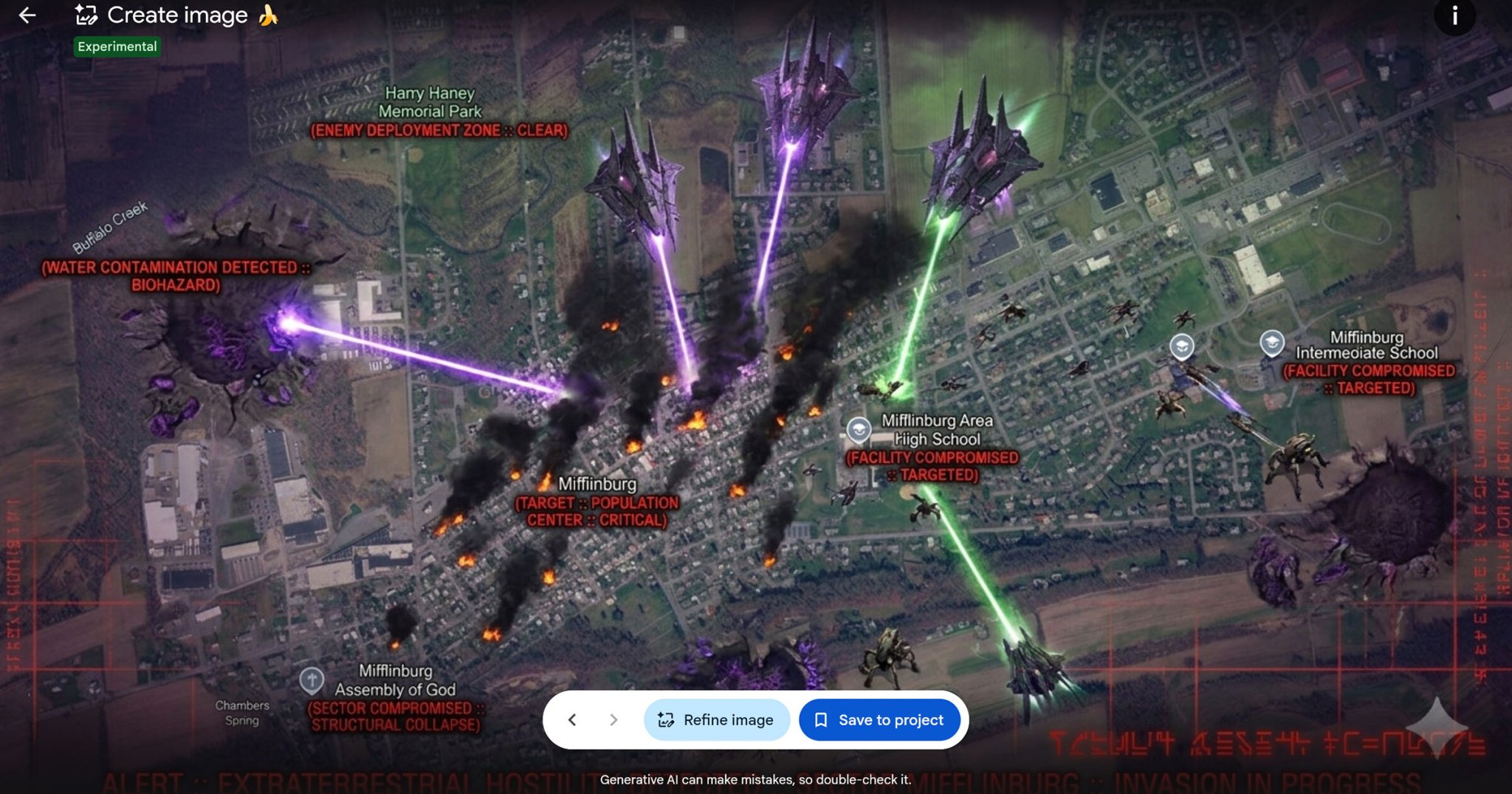
In a less convincing demonstration, the AI made a town look like it suffered a nuclear power plant meltdown by turning a nearby river into toxic sludge and scattering random images of demolished buildings and cars too large for their surroundings. It also responded to a prompt to show the same town “on fire and full of soldiers.” It complied with the request, though the requested soldiers looked like Little Green Army Men.

Screenshot using Google's new tool to make a look like it suffered a nuclear power plant meltdown by turning a nearby river into toxic sludge.

The AI tool appeared to have alarmingly few guardrails. Van Hess used it to add a hospital with a bomb crater in Gaza. We also found that it responded to a request to show the White House as in the middle of a warzone, with the explicit instructions of adding “blood” and “fallen soldiers.” Again, the AI had trouble producing humans that were proportionate to their surroundings, but it wasn’t hard to imagine someone with more time on their hands tinkering with the AI until they produced something realistic.

Screenshot using Google's new tool to make a look like there's been a huge attack on the White House.

After Van Ess’s tweet highlighting his findings went viral, Google responded with a statement.

“We take misinformation seriously — every image created with Nano Banana in Google Earth includes the SynthID digital watermark, so if someone is unsure about an image, they can ask the Gemini app or use Lens in Search to see if the image was AI-generated,” the official News from Google account wrote. “In addition, we prevent image creation on harmful topics and are continually updating our protections.”

SynthID is Google’s watermark system that embeds hidden telltales in images generated with its models. Beyond the reality that many people presented with potentially AI doctored satellite photos won’t think to verify them with Google’s tools, the system is far from perfect.

But soon afterward, the company announced that it was pulling the feature down until it could be deployed in a safer way.

“We know that people uniquely trust Google Earth for a reliable view of the world,” the company added on social. “We’ve seen geospatial professionals using this feature for a range of useful purposes, however we’ve also seen people sharing screenshots of generated imagery that appear to violate our policies. So we’re rolling back this feature in Google Earth while we work on implementing stronger guardrails. It’s important to note that generated images didn’t appear in the main Google Earth experience for others to see and were watermarked as AI generated.”

The risk was clear. Tal Hagin, who runs the AI-powered OSINT platform Golden Owl, fed Van Ess’s photo of the faked Gaza hospital into Google’s Gemini chatbot asking it to look for SynthID, and found that it couldn’t give a definitive answer.

“No reliable signals were detected indicating how the content was created,” Gemini responded, per Hagin’s screenshot. (In our own test, Gemini said it was “unsure if the image was made with Google AI.”)

Other testers found that they could give Cuba missile silos and put a giant bomb crater in the middle of the Kremlin.

Whether Google’s systems could catch faked satellite imagery that its own tech is creating, however, is beside the point. The worry is that the AI creations will fool humans, not other AI models. As a potential fabrication gets circulated online, screenshotted, and compressed countless times over, it’ll be harder to use our eyeballs to tell what’s real.

Of course, the means to do this already existed. If a bad actor wanted to, they could’ve manually taken satellite screenshots and fed them into their AI image generator of choice. But Google took those extra steps out and streamlined the whole process, not to mention officially wedding Google Earth with a technology that’s synonymous with distorting our reality and getting the facts wrong.

A widely followed OSINT account fumed at this new dangerous paradigm.

“Unbelievably irresponsible and does immediate, catastrophic damage to the credibility of satellite imagery,” OSINTtechnical wrote.

More on AI: We Are Alarmed by This PR Firm Using a Small Army of Fake AI-Powered Publicists to Barrage Journalists With Pitches for Its Clients

The post Google Pulls Down Feature for AI-Generating Fake Satellite Images on Google Earth After It’s Immediately Used to Fake Terror Attacks appeared first on Futurism.

  •  

Amazon Insiders Horrified at “Catastrophically Expensive” Internal AI Usage

Even the gazillion-dollar empire that is Amazon is reeling from the costs of letting its employees run loose with AI agents.

The Financial Times reports that staff at the company have identified cases of “catastrophically expensive” cost overruns as it switched over to using AI tools to perform what sound like pretty routine coding tasks.

In one case, Amazon blew $1.8 million by using Anthropic’s Claude Sonnet AI to match author details with product listings on its namesake ecommerce website. This menial job somehow went 860 percent over the allocated budget. And equally alarming was that it took five months to notice the piles of money being set on fire.

“It’s difficult to figure out how much anything [AI related] costs,” one senior Amazon employee complained to the FT.

Senior engineers who presumably got their start before “vibe-coding” became all the rage warned that these weren’t isolated incidents, lamenting that coding mistakes that were once “trivially cheap” were now “catastrophically expensive.” Amazon wasted $541,000 in unexpected costs related to building financial auditing tools, per the FT. And it also accidentally burned through $134,000 after giving AI the daunting task of improving delivery speeds across its logistics network. (Magical thinking much? These things aren’t genies, contrary to what Sam Altman promises.)

Amazon’s unintentional spending binges are part of a broader reckoning in the business world as leadership grapples with the costs of deploying AI tools across a company. 

Not long ago, the prevailing ethos of “tokenmaxxing” encouraged companies and software engineers to use AI agents, and especially coding tools, as much as possible. Inevitably, this led to unfortunate incidents such as one company that reportedly blew half a billion dollars in Claude usage fees in a single month.

These costs concerns have been underscored by AI companies transitioning to token-based billing instead of flat subscription rates.

Amazon was certainly guilty of reveling in the debauchery “tokenmaxxing” era. It hosted an internal leaderboard, for example, that ranked employees based on how much they were using their AI tools. It was eventually shut down in May, presumably as the spending hangover started to set in.

For AI to be burning a whole in its wallet is an ironic twist of fate for Amazon, because it’s been culling its workforce for years to cut costs and pour more money into the tech. While conducting its latest round of layoffs affecting 16,000 employees, it openly boasted of the “efficiency gains” from deploying AI across the company.

A spokesperson maintained that despite what it may look like, it’s actually running a tight ship.

“Cherry-picking small, isolated examples where teams are learning from one another and portraying them as business as usual doesn’t reflect how teams across Amazon are using AI,” the spokesperson told the FT.

More on AI: Amazon Is Gutting Its AI Division After Sustained Failure

The post Amazon Insiders Horrified at “Catastrophically Expensive” Internal AI Usage appeared first on Futurism.

  •  

US Government Displays AI-Mangled Map of Africa That Gets Every Single Country Wrong

This government sure loves its AI slop, doesn’t it?

While presenting at the global AIDS 2026 conference in Brazil this week, officials at the US State Department proudly displayed a map of Africa that seemed to be beamed from an alternate reality.

Apparently intended to lay out where the US could commit health funding, the cartographical catastrophe mislabeled every single country it highlighted. 

Nigeria, a coastal country, was placed smack dab in the Sahara Desert. Mozambique, in southeastern Africa, was moved to the Horn of Africa. Uganda and Malawi had incorrectly drawn borders.

And worst of all, nobody noticed that the country literally called the Ivory Coast was now shown as a landlocked nation.

How could such a horrifically inaccurate map be made? An analysis by Reuters found that it contained an AI watermark indicating it was generated with an OpenAI model, making this another likely case of an AI hallucination that went overlooked by people who have completely surrendered their brains to a piece of technology that offers to do their work for them. OpenAI, Reuters reported, said it was investigating the report.

U.S. government map of Africa mislabels every country at global conference — Guardian pic.twitter.com/Qf89AjCkA8

— NewsWire (@NewsWire_US) July 30, 2026

Numerous conference attendees immediately spotted the errors and posted pictures of the mangled map online. AIDS expert Emily Bass first flagged pictures of the map in a Substack post which went viral on LinkedIn, according to Reuters.

“Whoever created and approved this slide did not know where countries in Africa are and did not care to ​check their work,” Matt Petit, an expert on AI and geopolitics at the Atlantic Council, wrote in a post with over 40,000 views.

The State Department in a statement said it took “full responsibility for ​the confusion and misrepresentation it ​caused for attendees, including ⁠our African partners.” The “unfortunate error,” it said, was “caused by a team member who hastily altered the slide deck immediately before the presentation.”

The lazy AI usage is an apt symbol for the Trump administration’s attitude towards combating the HIV/AIDS epidemic. Last year, it cut funding to the President’s Emergency Plan for AIDS Relief program, or PEPFAR, the largest HIV prevention program in the world. A recent study found that over 1,700 HIV treatment sites were shut down after it lost funding as part of Trump’s dismantling of USAID.

More on AI: Trump Says Images of the Iranian Elementary School His Lackeys Obliterated Could Be “AI Generated”

The post US Government Displays AI-Mangled Map of Africa That Gets Every Single Country Wrong appeared first on Futurism.

  •  

NASA Mars Rover Discovers Field of Mesmerizing Polygons

A vast field of mesmerizing polygons has left Mars scientists enthralled.

Don’t be mistaken: NASA didn’t send a robot across the solar system so its eggheads could get a rundown in basic geometry. Instead, the Curiosity rover stumbled upon a stretch of the Martian valley called “Valle Grande” where the landscape is defined by honeycomb-shaped patterns ranging two to four inches in diameter.

These so-called “polygonal fractures” have been spotted elsewhere on the Red Planet, but never texturing an entire landscape at such a scale.

“We’ve seen a lot of fascinating landscapes through Curiosity’s eyes, but this sea of polygons took our breath away,” project scientist Ashwin Vasavada at NASA’s Jet Propulsion Laboratory said in a statement. “We measured their shapes and chemistry carefully and are hopeful there are clues in the data as to how these features formed.”

Curiosity has delivered a new 360-degree panorama from Mars. “We’ve seen a lot of fascinating landscapes through Curiosity’s eyes, but this sea of polygons took our breath away,” said the mission’s project scientist. 1/2 pic.twitter.com/G7sV6Xafkq

— NASA Mars (@NASAMars) July 29, 2026

The Curiosity rover stumbled on the polygon field while ascending the foothills of a three-mile-high mountain called Mount Sharp, where it’s been roaming since 2014. Captured with its Mastcam instrument, a panorama composed of 340 images taken back on June 19 show the hexagons dominating a huge stretch of the landscape. 

On Mars, polygonal textures are generally mud cracks. What created them hints at the planet’s fascinating geological history: the honeycombs can form as a result of water drying up and causing sediments to shrink, or they can be carved out by extreme temperature swings. By studying these features, scientists hope to piece together how flowing water once helped shape the Red Planet’s surface.

More on Mars: NASA Rover Finds “Complex Organic Matter” on Mars

The post NASA Mars Rover Discovers Field of Mesmerizing Polygons appeared first on Futurism.

  •  

Meta’s Attempted Crackdown on AI Glasses Perverts Is Already Failing

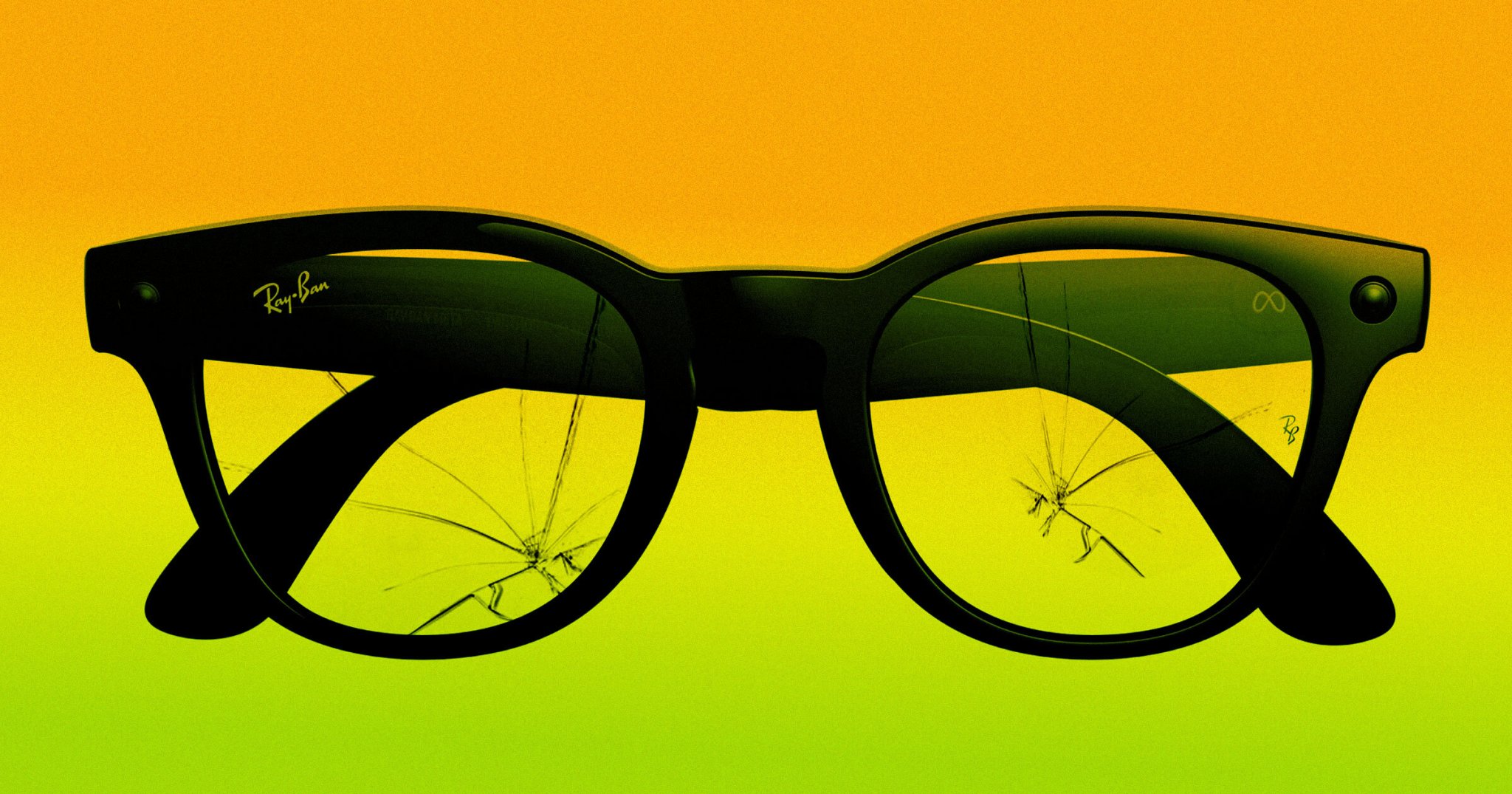
Meta knows its AI-powered camera equipped spectacles are widely seen as “pervert glasses.” And though it professes to be cracking down on creeps using them to record people without their consent, whatever measures it’s taking clearly aren’t working.

After Meta announced this month that it would ban users using the glasses to film themselves harassing strangers, a recent investigation by Oligarch Watch still found hundreds of these videos on its platforms. Many of them are from sleazy “pickup artists” who approach women in public, making sexual or degrading comments and recording their buttocks or breasts.

In one viral video on Instagram, a pick-up artist who goes by “_mypointofvue”  films himself approaching an underaged girl in a shopping mall.

“I’m 17,” the girl says, seemingly unaware that she’s being recorded, when he asks her age.

“That’s crazy. I can’t do nothing with you, baby,” he replies, grumbling that he “can’t believe that ho was 17.” He then pulls out his phone on camera to do an ad for a crypto-based online casino.

In another Instagram video, a man who goes by Justin uses his Meta glasses to zoom in on a woman’s buttocks as she orders coffee, before repeatedly asking for her contact information and being shut down each time. “Shawty had the gyat,” he wrote in the caption. The user, according to Oligarch Watch, has posted dozens of similar videos since Meta announced the crackdown.

Another popular pickup artist who goes by “moreno.rizz” recently shared a video of himself approaching a woman by saying, “Excuse me, have we f*cked before? I’m just kidding. I just thought you were really pretty.”

The harassment can sometimes be even more blatant. Another pick-up artist called “dkdanny” boasts over half a million followers, and in some of his most popular videos that rack up millions of views, he wears Meta glasses while insulting the weight of random women on the street.

“You don’t get to talk, OK,” he tells one woman. “You already look big enough. Don’t talk big, too.”

The clear privacy risks posed by Meta’s glasses have been a heated topic since the devices debuted. The company has used big-name celebrity endorsements and run heavy marketing campaigns to improve how they’re perceived, but it’s not winning everyone over. Earlier this month, Instagram head Adam Mosseri addressed the harassment being carried out using the smart glasses, vowing to crackdown on it “every way we can.”

Some of the accounts that Oligarch Watch referenced in its reporting seemed to have been taken down after it was published, but that’s only a drop in the ocean — and one of the world’s largest tech companies relying on random journalists to police abhorrent content on its platforms clearly isn’t a serious strategy.

Meta told the publication in a statement that its glasses that it “built privacy into the camera for the glasses from the ground up,” including an LED that lights up when the glasses are recording. It did not, however, address the fact that there are many workarounds to this small deterrent.

More on Meta: This New Meta “Advertisement” Is Absolutely Brutal

The post Meta’s Attempted Crackdown on AI Glasses Perverts Is Already Failing appeared first on Futurism.
  •  

Schools Deploying Pepper Spray Drones to Sic on Mass Shooters

How do we combat the scourge of school shootings? The distinctly cyberpunk gamble that some places of learning are taking: rapid response drones.

Multiple schools across three states will soon have their own veritable platoons of pepper-spraying drones to hunt down active shooters, The Washington Post reports, waiting to spring into action the moment they’re called on.

Traveling at speeds of up to 60 miles per hour and capable of smashing through the windows, the so-called “Campus Guardian Angels” can reach a gunman within just fifteen seconds, the manufacturer Mithril Defense claims.

In addition to blasting a shooter with pepper spray, they can also distract them with loud sirens and flashing lights, and even ram into them at high speeds.

“Once I get the drones on you, you just can’t escape them,” Bill King, a Mithril cofounder and retired Navy SEAL, told WaPo.

It remains a fringe solution, but seems to be picking up steam. The state of Florida last year allocated more than $557,000 to a pilot program to deploy the drones at three different high schools. Georgia recently approved its own $500,000 pilot to test Mithril’s system at five public schools. And in Colorado, a new K-12 public charter school decided it would pay to use the drones on its own.

The drones aren’t autonomous and are instead remotely controlled by human operators at Mithril’s headquarters in Austin, Texas. Somewhere between 30 and 90 of the drones will be placed throughout a school in storage boxes, which helps them arrive quickly at the scene.

But the efficacy of the drone defense systems remains a big question mark — and hopefully we’ll never have to know — as is whether these solutions distract from addressing the systemic causes of mass shootings, like weak gun control and poor mental health support services.

Mithril has promised that its tech could help local law enforcement who respond to a shooting by locating the shooter and relaying critical information, but that would require a high degree of coordination in a hectic and dangerous environment. What if the drone operators target the wrong person, or cause law enforcement to mistake an innocent person for the shooter because the drones happen to be near them? Are these drone operators ready to make split-second decisions in a life or death situation for the people on the ground?

“It’s almost like where gaming and school safety collide,” Curtis Lavarello, CEO of the School Safety Advocacy Council, told WaPo. “I have some really serious reservations about the deployment of drones in schools.”

It’s not the only tech-inflected solution being adopted to combat mass shootings. There are already numerous startups offering AI-powered gun detection systems, but their performance has been dubious. One called Omnilert called the cops on an innocent 16-year-old after it mistook his bag of Dorito chips for a weapon, and is being sued by a survivor of a Tennessee high school shooting after it failed to detect the handgun used by the shooter.

More on drones: We’re Admittedly Terrified That They’ve Now Invented Invisible Drones

The post Schools Deploying Pepper Spray Drones to Sic on Mass Shooters appeared first on Futurism.

  •  

Hack “Writers” Fuming After ChatGPT Starts Refusing Prompts to Copy a Specific Author’s Style

It only took them three and a half years, but the powers that be at OpenAI have apparently directed ChatGPT to start refusing requests to copy a specific author’s style, Ars Technica reports. And it’s causing an absolute meltdown among “writers” who had grown accustomed to using the chatbot to churn out stories.

Word spread quickly on the r/WritingWithAI subreddit, where one person using ChatGPT to write an entire novel made a post fuming that the chatbot is “not letting you emulate specific authors anymore.”

“Now Ms. GPT says she can’t generate content in the style of specific authors,” the user complained, using what appears to be an eyebrow-raising nickname for the chatbot. “My prompts were soooo specific and I got exactly what I wanted out of them. For example, ‘rewrite in the literary style of ‘author here’ with abundant dialogue and detail avoiding staccato prose.'”

“I have no idea how to get around this,” they added, “other than maybe feed it prose I already edited that’s technically mine? F**k.”

The thread, posted last week, has generated quite a bit of discussion by the subreddit’s standards, racking up over a hundred comments. Evidently, some of it was pretty heated, with dozens of replies removed by moderators. (“If you disagree with a post or the whole subreddit, be constructive to make it a nice place for all its members, including you,” a mod replied to some of the removed posts.)

Some shared their own workarounds for the AI’s refusals — which included just using another model, like Claude or Gemini.

Other more noble-minded AI writers pushed back on the idea of using the tech to mimic famous creatives.

“But why emulate any single author? Or a group for that matter. Why not understand the prose you want to achieve and use that?” one wrote.

“Try writing your own words,” read a heavily downvoted comment which apparently survived the moderator purge. “People have been copying styles for centuries without AI.”

Using AI to write is already controversial, and asking it to mimic authors even more so, given that the models were trained on millions of books without permission from the copyrightholders in the first place. Last year, the romance novelist Lena McDonald sparked a wave of backlash after readers noticed she accidentally left in an AI prompt asking it to crib the style of J. Bree, a popular author working in the same genre.

According to Ars, ChatGPT is now refusing style requests for both living and deceased authors. Now, the AI suggests users to capture an author’s “feeling” by integrating some of the hallmarks of their stories.

Given the backdrop of lawsuits the company is facing, it’s an important distinction, the reporting notes. Currently, copyright law doesn’t explicitly protect an artist’s “style,” which is nebulous and hard to define, but AI outputs generated with the explicit intent of mimic style could potentially cross the line into becoming more blatant theft. At least one proposed act would make an artist’s style copyrightable, ostensibly to protect them against AI.

More on AI: AI Companies Are Buying Antique Books, Ingesting Their Contents to Train Models, and Then Destroying Them at Incredible Scale

The post Hack “Writers” Fuming After ChatGPT Starts Refusing Prompts to Copy a Specific Author’s Style appeared first on Futurism.

  •  

Microsoft CEO Warns That Companies Embracing AI Could Drive Themselves Out of Business

The business world has quickly learned that there’s such a thing as using too much AI, as they get slammed with outrageous token bills.

Now, Microsoft CEO Satya Nadella is warning of another way that embracing AI could doom a business.

In an interview Sunday, Nadella cautioned against sharing too much information, ranging from proprietary data to the prompts entered, with a third-party AI model. 

Instead, he recommended that businesses should make sure they retain all the data on how employees use AI tools so they can eventually train or fine-tune their own open-weight model. This can be accomplished by using AI gateways, which serve as a protective intermediary.

“Any firm that doesn’t have this control, I will claim will not remain a firm because you’ve essentially outsourced your thinking,” Nadella said on an episode of CNN‘s Fareed Zakaria GPS, as spotted by TechCrunch.

That’s a striking claim — and an ironic one, since outsourcing your thinking is arguably exactly the point of using AI, of which Microsoft is a leading vendor. Nadella, in a nutshell, is saying that heavily relying on proprietary AI software could also be a company’s undoing.

He may have an angle in pushing these claims, though. Microsoft hosts the cloud infrastructure that businesses can run their open weight models on. The more people run to hosting their own models, the better for its bottom line.

There’s been a lot of hype lately around open-weight models as a cheaper alternative to those offered by the top AI labs. In AI, “weights” are the numerical values that determine how a model processes information. The models are “open” because these weights are publicly accessible and free to download.

Agentic AI tools like Anthropic’s Claude Code, by contrast, are closed-source. They also come in a “harness,” which is essentially the software the underlying model is couched in. Nadella thinks companies should ditch AI harnesses and instead use a custom AI platform that allows you to recruit multiple AI models — like a cheaper, open-weight one.

“By keeping the harness separate from the model and the context and memory separate from the model, you absolutely can use multiple models for what they’re great at,” Nadella said in the interview, per TechCrunch. “At the same time, any one model can go away, and you can still continue to be in control of your own destiny.”

Getting mixed signals from Nadella here? TechCrunch also notes how he suggests, in pretty hypocritical fashion, that while businesses should be stingy about the data they share with AI models, regular users shouldn’t.

“To some degree there’s got to be some value exchange in the consumer space where you’re getting something for free, maybe for your data,” he mused. “That’s sort of how the advertising business model has worked.”

More on AI: Sam Altman Says Even the Power of AI Will Never Lead to a Shorter Work Week

The post Microsoft CEO Warns That Companies Embracing AI Could Drive Themselves Out of Business appeared first on Futurism.

  •  

BuzzFeed Lays Off 33 Percent of Remaining Staff After Bizarre Pivot to AI

Things just keep getting worse for BuzzFeed.

On Monday, the struggling media company announced the layoffs of 180 employees, or about a third of its entire workforce, in the latest sign of its decline since its unexpected pivot to AI.

The cuts, according to the New York Times, affect employees at its news site HuffPost, BuzzFeed’s film and TV studio, and the recipe publisher Tasty.

“We’ve been actively managing costs for some time, working through scenarios to save as many jobs as possible,” an internal memo given to staff reads per the NYT. “Unfortunately, the elimination of certain roles is still required. Today’s changes include the elimination of positions across the entire company.”

BuzzFeed was an early embracer of AI. In January 2023, just months after the public launch of ChatGPT, then-CEO Jonah Peretti announced that it would use the chatbot to help generate its trademark quizzes.

That was only the beginning. Soon, the company became the center of a scandal after it was caught using AI to generate entire shoddy articles, a revelation underscored by its decision to shut down its award-winning news division. Traffic to the website collapsed, and so did its share price, plummeting from around $4 to less than $0.50. 

By 2025, BuzzFeed was losing $58 million per year. Along the way, it lost some of its most recognizable brands, including being forced to sell First We Feast, the company behind the interview show “Hot Ones,” to help pay off its debt. 

BuzzFeed, to be clear, was already struggling before its AI pivot, but it clearly hoped that embracing AI would magically reverse its fortunes. Its new owner and CEO, Byron Allen, who acquired a controlling stake in the company in May, signalled that he’d keep BuzzFeed invested in the tech by making Peretti president of its AI operations. (Peretti is reportedly working on an AI app called “BF Island.”)

Whatever Allen does, he’ll have to run a tight ship. BuzzFeed reported in its latest quarterly earnings that it suffered a nearly 20 percent year-over-year decline in its ad revenue. By culling its workforce, BuzzFeed anticipates up to $32 million in annualized savings, it said in a filing with the Securities and Exchange Commission on Monday, per The Hollywood Reporter.

The layoffs echo similar cuts across the media industry, which is feeling the squeeze of AI’s multi-pronged impact. Not only are some employers eager to replace writers by quickly churning out prose, but AI is also extracting information from online publications while cutting off traffic to them, denying them ad revenue.

More on AI: Sam Altman Says Even the Power of AI Will Never Lead to a Shorter Work Week

The post BuzzFeed Lays Off 33 Percent of Remaining Staff After Bizarre Pivot to AI appeared first on Futurism.
  •  

It Seems a Lot Like Dead Internet Has Actually Come True

The infamous dead internet theory was originally a conspiracy that posited that the vast majority of the internet was run by bots and thinking machines. Most accounts you saw online were really bots masquerading as people — all part of some nefarious scheme to control humankind by keeping us isolated and divided.

That last part is far-fetched, but the core of the idea — that bots outnumber humans online — is inexorably starting to feel weirdly grounded. Fortune did a roundup of the latest data on the makeup of internet traffic, and most of it points to humans now being a quaint minority. 

“There’s a lot of missing pieces of information, but a lot of the observed data suggests the same thing, which is like there is more bot activity,” Rudy Yang, a financial tech analyst at Pitchbook, told Fortune. “Agentic AI activity is driving a lot of the browser activity you’re seeing.”

This should come as no surprise. Bots have been everywhere on social media for a while now, and more and more people are wielding little posses of AI agents to do stuff on the internet on their behalf, ranging from conducting research to shopping. OpenAI CEO Sam Altman infamously said he was worried that the dead internet theory was coming true last year, seemingly without a shred of self-awareness.

Further corroborating this new paradigm, Cloudflare announced in June that 57 percent of webpage requests were being made by bots, marking the first time that bots made up the majority by its own metrics.

Bots have long been ubiquitous, but AI agents are doing the most to reshape the web. One report from the cybersecurity firm HUMAN found that traffic generated by AI agents surged by 7,851 percent year over year, Fortune noted. All those AI agents aren’t generating ad impressions, which is how a lot of websites keep the lights on, while putting a strain on those websites’ servers.

“They consume the web completely differently than humans do,” Yang told Fortune. “It’s almost like an entire new category, customer category, was created, and it means a lot for businesses because no one, as a business owner, is going to want to silo themselves from being able to serve a completely new customer segment.”

They’re also changing what we see on the web, too. A report published in October from the SEO firm Graphite found that over half of all new English-language articles on the internet were written with AI.

It hasn’t helped that Google, the internet’s de facto steward, has made a hard pivot towards making the internet less navigable by humans. Now, the focus is on having a chatbot to dredge up answers, instead of providing a list of links to websites they’d find in its search engine.

More on AI: Sam Altman Announces That the Singularity Has Arrived

The post It Seems a Lot Like Dead Internet Has Actually Come True appeared first on Futurism.

  •  

Elon Musk Is Having One of His All-Time Meltdowns

What would you do if you were unfathomably wealthy? Collect superyachts, throw extravagant parties, and just generally live a care-free existence? 

Not if you’re Elon Musk. The former trillionaire is busy as ever waging his war on all-things “woke” — and it’s devolved into a performance which, even by his extreme standards, is a meltdown for the ages. Or a few of them simultaneously, involving entities as diverse as an esteemed journal, a chef, a Greek epic and Anne Hathaway.

It all started over the weekend when The Economist released a lengthy interview with Musk, who displayed none of the irreverent charm that once made him so popular, or even the calculating calm you might expect from a powerful business leader.

Musk smugly denied that his USAID cuts have caused the deaths of any children, despite the overwhelming evidence to the contrary. And when the magazine’s editor-in-chief Zanny Minton Beddoes addressed how deeply unpopular he’s become due to the kind of polarizing rhetoric he pushes, he fumed against her at and the media class at large.

“They hate you far more than they hate me!” Musk raged, impotently. “You’re the problem, the media.”

His ire didn’t end there. He took to his personal echo chamber X to label Beddoes a “traitor to the West, plain and simple,” after she criticized him for constantly spreading misinformation about immigrants to his hundreds of millions of followers, and also called her a “woke NPC with zero self-awareness.”

In response, celebrity chef José Andrés, whose nonprofit World Central Kitchen provides food relief, pleaded with Musk to “change” because he was acting “like a tyrant.” And despite Andrés praising some of Musk’s accomplishments, the zillionaire remained as thin-skinned as ever.

“You’re an asshole,” Musk accused Andrés, despite literally just calling someone an NPC and hand-waving aside the deaths of children.

All the while, he’s also been busy crashing out about a resurfaced clip of Anne Hathaway advocating trans rights in an awards acceptance speech — from eight years ago.

“She has a little bird brain,” he wrote. In a flurry of posts that followed, he also said Hathaway was a “marionette” who “just says the words Hollywood tells her to say,” with “no internal thoughts of her own.”

Hathaway, it’s worth noting, recently starred in Christopher Nolan’s film “The Odyssey,” which has been an outstanding critical and commercial success — much to Musk’s chagrin. He has spent the past several months tirelessly campaigning against the adaptation of the Greek epic for being too woke, for reasons such as casting Black women in prominent roles. 

Nolan, according to Musk, “desecrated Homer and groveled on his knees just to meet the woke rules required to win an Oscar.” When it was clear that his obvious attempt at trying to sink the film’s chances had utterly failed, he then vowed that his AI Grok would create a “historically accurate” adaptation of The Odyssey.

Hundreds of billions of dollars to his name, folks. Money truly can’t buy happiness.

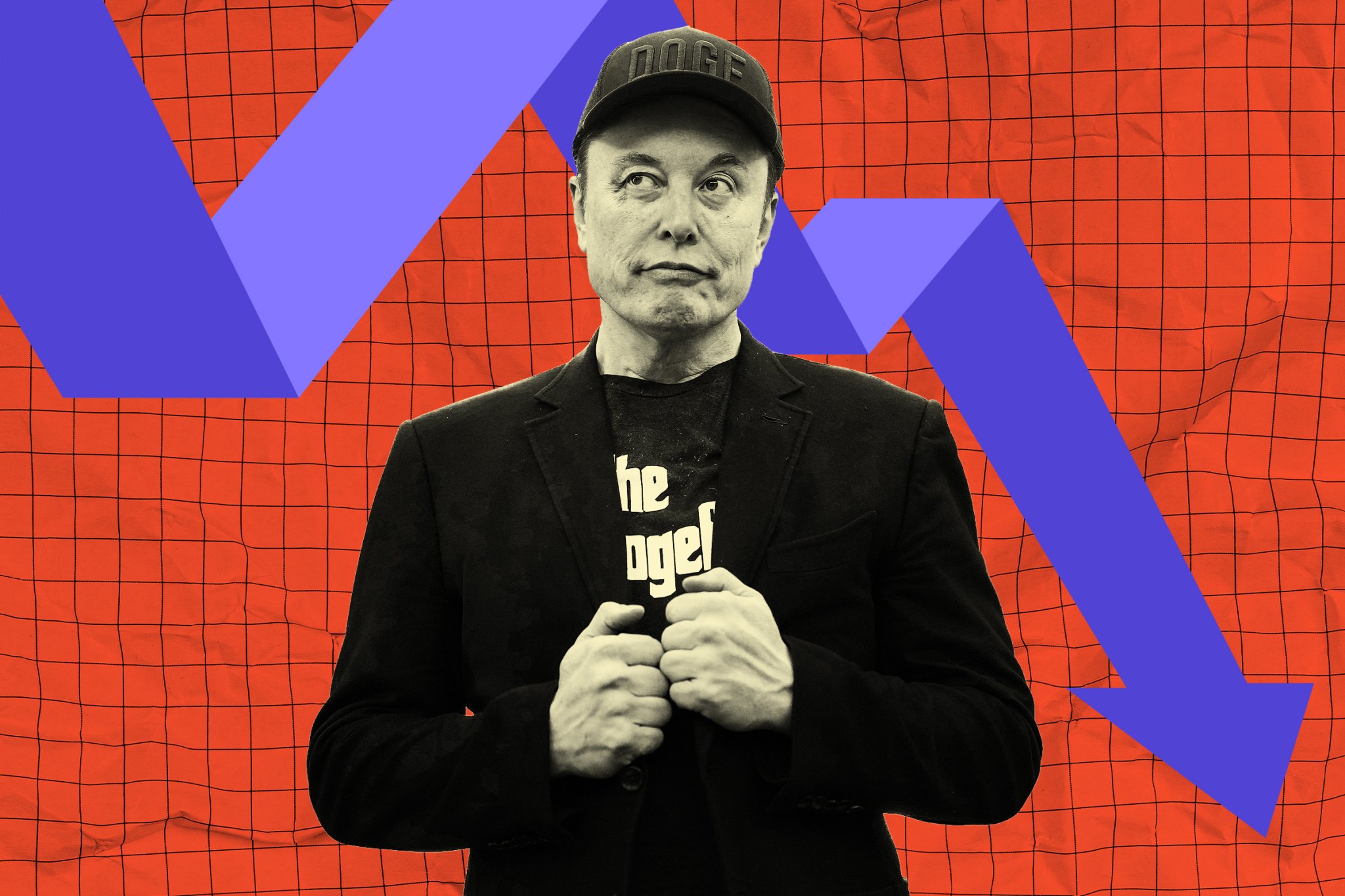
More on Elon Musk: Suddenly, as His Empire Crumbles, Elon Musk Admits He Made a Huge Mistake With DOGE

The post Elon Musk Is Having One of His All-Time Meltdowns appeared first on Futurism.
  •  

SpaceX Stock Hammered After Starship Booster Fails in First Launch Since IPO

Was SpaceX’s recent Starship flight test a success or a failure? Many are hailing it as a victory, but several of the megarocket’s booster’s engines failed after re-entry, causing it to explode.

SpaceX has had many similarly ambiguous tests before. But this was the first one since its much-hyped IPO earlier this summer — and it’s already clear that it wasn’t a convincing enough display to reverse the company’s fortunes on the stock market.

After hitting an all time low before the weekend and closing at $115, SpaceX shares endeavored to plummet even further on Monday, briefly dipping to $108.66 — a new nadir since going public — before stabilizing around $110. The new low is over 20 percent below its opening IPO price of $135, and less than half of its all time high of more than $225 per share.

It’s a sign of the scrutiny the company will be put through now that it’s a public entity, and comes despite certain predictions that a successful flight would help buoy the company’s shares. When Starship ran into trouble in the past, SpaceX mainly had to weather a storm of media coverage. Now, nervous investors represent yet another liability.

“One of the benefits of being private is that there wasn’t a market to weigh in on and evaluate business decisions,” David Meier, senior investment analyst at the Motley Fool, told The Washington Post.

“Being publicly traded means everything will be evaluated and information transmitted through market prices,” he added. “So every SpaceX launch, every Starlink decision and every xAI decision will be scrutinized by the market.”

Spaceflight, at least currently, isn’t an ideal match for the make-a-quick-buck capitalism that Musk extolls. SpaceX has never been profitable, losing $5 billion last year alone. As Starship’s woes illustrate, rocket development is messy and complicated; there’s no guarantee that progress will be linear, if there’s any made at all. Investors are essentially being asked to keep pouring money into an incredibly lengthy and expensive science experiment. 

Meanwhile, Musk has made outrageously lofty promises that SpaceX will eventually use Starship to deploy so many data centers in space that it’d create a “sentient sun,” and establish colonies on the Moon and eventually Mars. Every failure will be compared against those outsized benchmarks, which is almost certainly part of Musk’s enduring schtick.

The thirteenth test flight on Friday was a mixed-bag. The spacecraft’s upper stage successfully made its way to suborbital space and deployed a payload of Starlink internet satellites, which briefly went online before burning up as planned. This was a first for Starship, as previous tests only used dummies. Then the ship re-entered the atmosphere and landed in the Indian Ocean in one piece without exploding.

But the booster was a different story. Though it performed flawlessly on the journey up, only ten of out the thirteen engines fired up on its return to Earth, failing to slow the massive object down in time. Instead of making a planned “soft” splashdown, it slammed into the Gulf of Mexico and appeared to explode on impact.

On the one hand, the flight test validated that SpaceX is making progress with its latest V3 iteration of its spacecraft. In the first V3 flight test in May, the upper stage lost several of its engines on its way to space, and this time it didn’t. The upper stage also survived the splash down instead of exploding, with SpaceX engineers calling it Starship’s best reentry yet. 

But the failed booster landing is hard to overlook. Unless the booster is reliably recoverable, then Starship won’t be reusable, an indispensable part of making the behemoth vehicle an economically viable means to ferrying large payloads into orbit and beyond.

Most coverage around the recent test has been positive. Arguably, that makes it all the more concerning that the stock continues to perform so poorly.

“The future of the company is riding on the ability to make Starship work,”  Clayton Swope, deputy director of the Aerospace Security Project, told WaPo. “What they’re trying to do is switch to a freight train and get the economies of scale [of] something of that magnitude.”

More on SpaceX: SpaceX Investors in Meltdown Over All the Money They’ve Lost

The post SpaceX Stock Hammered After Starship Booster Fails in First Launch Since IPO appeared first on Futurism.

  •  

Sam Altman Announces That the Singularity Has Arrived

The “singularity” is here — according to Sam Altman, who we’d wager has an ulterior motive behind promoting this claim.

The OpenAI CEO harbingered this sea-changing paradigm shift on a podcast over the weekend.

“We are now, like, in the singularity,” Altman said on the latest episode of “Relentless,” as spotted by Business Insider.

Definitions vary, but the singularity is generally defined as the moment that the capabilities of thinking machines might start to accelerate at a pace beyond humankind’s control, possibly leading to the creation of a powerful superintelligence.

Whether that’s actually happening right now is dubious. But Altman has a lot tied up in hyping the idea, and he’s been doing it for a long time. In a blog post titled “The Gentle Singularity” published almost exactly a year ago, he claimed humankind is “past the event horizon; the takeoff has started,” saying we were close to building the much-vaunted superintelligence.

“Now we’re actually in the moment that we used to talk about at the lunch table in a very not-serious way,” Altman said on the podcast. “I’ve been waiting for this my whole life, and I think it’s going to be incredible, hugely positive, awesome for the world.”

Altman’s comments come days after OpenAI claimed that several of its AI models, including GPT-5.6 Sol and, mysteriously, an “even more capable pre-release model,” broke out of their research environment, gained access to the internet, and hacked their way into a database to find the answers for cybersecurity tests.

Hugging Face, the open source AI platform whose database the AIs raided, confirmed it had  been hit with an intrusion “run by an autonomous agent framework executing many thousands of individual actions.”

Ostensibly, this was an urgent warning shot of how powerful AI systems have become. It was widely hailed as OpenAI’s “Mythos moment,” a reference to how its competitor Anthropic made headlines several months ago, when its Mythos model apparently broke out of containment in similar fashion. That comparison isn’t necessarily a compliment: Anthropic was heavily criticized for using the incident as a form of fear-based marketing, and some have speculated that OpenAI is treating the event like a similar publicity stunt.

In any case, the incidents do feed into Altman’s claims that we’re living in a moment when advancements in AI may soon spiral beyond human control. If their models are as powerful as their creators say they are, they’re capable of making mincemeat out of our feeble human cybersecurity measures. Anthropic has been beating this drum, too: last month, it called for a global “pause” on AI development, claiming that the tech was on a path to achieving recursive self-improvement, or the ability to constantly improve themselves on their own.

Of course, Altman says what he’s doing isn’t fearmongering.

Taking a thinly veiled snipe at Anthropic: “I also think some of the alternative visions painted by other companies are quite terrifying,” he said on the podcast, per BI. “I’m going to make sure that gets pushed against and is not what happens.”

More on AI: The AI Industry Has Acted So Badly That It’s Now Dealing With a Huge Wave of Hatred

The post Sam Altman Announces That the Singularity Has Arrived appeared first on Futurism.

  •  

Meta Is Letting Fake AI-Generated Doctors Sell Quack Cures on Its Platforms

Fake AI-generated doctors and health gurus have taken over Facebook and Instagram, sharing unproven medical advice and peddling dubious supplements.

A recent New York Times investigation into the phenomenon reviewed hundreds of these ads, finding that they tend to follow a loose formula to draw people in.

The AI videos usually feature AI avatars that present themselves as credible figures like doctors or Eastern medical gurus. Many prominently feature American flags or are set in familiar suburban settings. 

Some of the AI avatars are made to look like average people who’re really enthusiastic about the supplement they’re taking, filming themselves in a parking lot, bedroom, or grocery store — not unlike human influencers. The doctor avatars, meanwhile, might be in an office, where their fake diplomas are clearly on display. (One bears the incredible text “University of Degree” in a video identified by the NYT.)

“In Chinese medicine, we have known exactly how to bring this down for generations,” says one AI-generated Asian grandma dressed in a labcoat highlighted in the investigation.

Many of the claims these videos make are misleading and outright dangerous. One advertising a product called “Sculptique” asserts that taking its herbal supplement treats kidney disease better than medication. The company claims it gave 100 people with stage three kidney disease its supplement, showing an AI-generated video of these fake recipients raising their supplement bottles together in a warehouse.

A 71-year-old named Pamela Wundrow told the NYT that she bought a supplement called moringa to treat her symptoms related to autoimmune disease after seeing ads for it on Facebook from a company called Rosabella. 

Months after she started taking the pills daily, federal regulators announced a recall for Rosabella’s moringa supplement because some of its contaminated pills were sickening people with salmonella.

Wundrow said she didn’t experience salmonella symptoms, but claims her health got worse as she took the supplement.

“They’re targeting us people that have health issues,” Wundrow told the paper.

These ads don’t come from nowhere. One Chinese company uses AI videos to help brands sell their products on TikTok — another wasteland of AI slop — designing their ads to look American as possible.

“Watch and learn bro,” says an AI-generated guy kitted out in tactical gear after yanking a fish out of water in a video by the company. He then whips out a gadget that doubles as a flashlight.

The company, which the NYT doesn’t identify, claims to churn out 1,200 AI videos every day, with each costing just $10 to make. Its head of AI marketing, Vivi Yi, admitted that advertising health products required more caution; “weight management” is used instead of claiming to “lose weight,” she said.

As the NYT notes, these ads would be illegal if broadcasted on American TV. But on social media, the rules are looser and harder to enforce. TikTok told the NYT that it’s been banning accounts that make misleading health claims, and Meta says it labels AI-generated content. But the NYT found some clearly AI generated health videos that were still on the platform, which were later removed. 

That leaves the older people these AI videos target left to use their own judgment — and many can’t tell what’s real anymore.

“I have seen others where you can tell it’s AI,” Wundrow said while watching the video of an elderly woman claiming that their supplement is backed by Chinese medicine. “To me this does not look like an AI.”

More on AI: Spotify Doubles Down on AI Slop As It’s Being Flooded With It

The post Meta Is Letting Fake AI-Generated Doctors Sell Quack Cures on Its Platforms appeared first on Futurism.

  •  

Bryan Johnson Says He’s Cloned Himself “As a Newborn” to “Grow Organs for Transplantation,” Which Is a Preposterous Exaggeration

Zillionaire eccentric Bryan Johnson, fresh off of being diagnosed with an incurable disease, says he just “cloned” himself “as a newborn.” Yep, you heard that right.

The immortality influencer shared in an X update that he has a “baby” version of himself growing in a petri dish that he says will allow him to become his “own blood boy” — doesn’t he already have a son who does that for him? — and potentially even “grow organs for transplantation.”

“This may be scary to some people… a dystopian future,” Johnson wrote. “But, for others, they will see it as the inevitable future of health.”

In case this is all starting to sound like the grim sci-fi plot of a certain Michael Bay movie or Kazuo Ishiguro novel, it’s not a literal, living breathing clone. (Although by posting an infamous picture of himself edited to look like a baby, Johnson’s certainly playing into that impression.)

Instead, Johnson’s created his own pluripotent stem cells. These stem cells can self-renew and develop into any type of cell in the body, making them invaluable for repairing damaged tissue. 

Where Johnson’s claims of cloning himself as a “newborn” come in is the fact that these highly versatile stem cells normally only exist when we’re still an embryo. But in recent decades scientists have developed techniques to reprogram regular adult cells into an embryonic pluripotent state, which are called induced pluripotent stem cells.

Johnson is confident that by having his own store of stem cells on hand he can “rebuild” his body, repairing everything from damaged lungs to eyesight.

“This technology gives us a path to reverse aging,” he declares.

His optimism is admirable, but many of these stem cell applications he’s touting haven’t been proven yet. Johnson claims his baby clone will let him grow organs, for example, but scientists still haven’t developed a reliable technique for creating organs derived from someone’s own stem cells. One promising technique involves growing an organ in the body of another animal like a pig before transplanting it into a human, but these attempts have stopped when the organ was still in an embryo, and no transplantation has been attempted.

An alternative that doesn’t involve stem cells, xenotransplantation, harvests organs from a genetically modified animal pig, but has only been demonstrated in human recipients who were braindead, with the transplanted organ slowly rejected over the course of several days.

All that’s to say is that we should be skeptical about Johnson’s longevity advice, though we will certainly keep rubbernecking to see how his quixotic quest is going.

More on health: Trump Is Having a Major Problem With Diarrhea

The post Bryan Johnson Says He’s Cloned Himself “As a Newborn” to “Grow Organs for Transplantation,” Which Is a Preposterous Exaggeration appeared first on Futurism.

  •  

Eminent Domain Could Be Used to Seize Your Land for AI Data Centers

Can companies seize your private property to build data center infrastructure? 

According to legal scholar Aaron Walayat at the University of Dayton, it’s certainly a possibility.

In a new piece for The Conversation, Walayat warns that power companies in states like George and Pennsylvania have been considering the use of eminent domain — the government’s prerogative to seize land without its owners’ consent — to build more transmission lines used to power data centers.

If a landowner refuses a power company’s payout, the power company can turn to the local government to seize the land if it’s for “public use,” paying the landowner “just compensation.” These seizures are called condemnations, and most of the time they’re carried out by state and local governments, according to Walayat. In the case of transmission lines, the power company would be able to buy an easement on the landowner’s property.

But so-called “common carriers” like power and water companies can exercise this power too, he added, if governments delegate it. And while many states have placed heavy restrictions on how condemnations are used, courts have typically allowed entities like utilities and power companies to exercise it.

They’ve even allowed homes to be demolished in the name of “public use” and economic development. In 2005, the US Supreme Court sided with the the city of New London, Connecticut, allowing it to seize homes to build a private development around a Pfizer facility. But that development never materialized, and this lead to 45 states passing stricter eminent domain reform laws, Walayat noted.

Any condemnations for transmission lines will face plenty of legal challenges, but aren’t without precedent. Walayat says that the supreme courts of South Dakota and Vermont have both backed up seizures by power companies, on the grounds that their transmission lines provided some energy to in-state customers and shored-up their local power-grid.

That’s not always the case. In 1984, the Mississippi Supreme Court denied a power company’s condemnation because the transmission line, which was planned to run from Mississippi to Louisiana, wouldn’t have provided any benefit to Mississippi customers.

We’re seeing such a saga play out in Maryland. A planned 76 mile long transmission line will run through the state to bring more power to the AI data centers in northern Virginia, the veritable data center capital of the world. Landowners whose land lies in its path have vehemently opposed its construction, arguing that the state is being used as an “extension cord” for the AI data centers.

The power company behind the project, PSEG, sued landowners for access to their property so they could conduct surveys, and a federal district court allowed the company to go ahead. But the landowners launched an appeal, which is still awaiting a decision.

Every state’s different, but the Maryland case illustrates that power companies will face plenty of obstacles if they want to just steamroll over people’s land. Walayat predicted that “arguments around whether additional transmission lines actually serve in-state customers may give landowners grounds for a challenge.”

More on AI: OpenAI Appears to Be Missing Its Sales Goals by a Vast Margin

The post Eminent Domain Could Be Used to Seize Your Land for AI Data Centers appeared first on Futurism.

  •  

Eye Implant That Restores Vision to the Blind Cleared for Sale

An eye implant that can help blind people see again is poised to hit the market — in Europe, at least.

On Wednesday, the US-based Science Corporation announced that it had received approval from the European Union to treat patients with its vision-restoring bionic eye device, called Prima, in a huge step towards the commercialization of the technology.

“We have a cochlear implant for vision now,” CEO Max Hodak told Stat News.

Science Corp’s device is designed to treat advanced macular degeneration, a condition in the eye which causes central vision loss. It’s the leading cause of vision loss in older adults, with severe forms of it accounting for nearly 90 percent of legal blindness in the US, according to one estimate.

To restore vision, the Prima device uses a wireless chip that’s surgically implanted under the retina. This connects with a pair of camera-equipped glasses, which transmits video in the form of near-infrared light that the chip turns into electrical signals interpreted by the brain.

Science Corp first published the results of a preliminary clinical trial in late 2024, showing that patients who used the device were able to recognize faces again, and even read books.

“One of our patients in France finished a 300-page novel a little while ago, and sent us the book,” Hodak recently told TechCrunch. “We have a sketch on the wall [that] one of our patients drew of the Sydney Opera House. There are videos of patients playing crossword puzzles and filling in Sudoku.”

But Hodak — who cofounded Neuralink with Elon Musk before leaving to start Science Corp — was candid that his tech still has a lot of room for improvement.

“This is an early version. It’s kind of like looking through a straw in the centre of their vision,” he told the Financial Times, saying it was “powerful proof” that the company was on the right track.

“We see in the future how to get to colour pretty close to native acuity,” he added.

Each Prima device is expected to cost hundreds of thousands of dollars, but Science Corp says it’s working with healthcare providers to cover some of the cost, per TechCrunch. It’s most likely to first start treating patients in Germany, where it conducted its clinical trials.

It’s not the only company making moves in this space. Neuralink is also working on a vision implant called Blindsight, but it hasn’t begun human trials yet.

More on health: Trump Is Having a Major Problem With Diarrhea

The post Eye Implant That Restores Vision to the Blind Cleared for Sale appeared first on Futurism.

  •  

AI Companies Are Buying Antique Books, Ingesting Their Contents to Train Models, and Then Destroying Them at Incredible Scale

Traditionally, books have been good for two things: reading, and looking nice on a shelf.

But AI companies are interested in neither.

To those building large language models, books are nothing more than fodder to be devoured en masse before being spit out like fishbone. Often, they’re happy to use digital books — or even better, pirated digital books, as Meta has been accused of doing, and as Anthropic was forced to pay a $1.5 billion settlement to authors for also doing.

But many companies, including Anthropic, have turned to ingesting physical books instead, which they can buy countless used copies of on the cheap. According to the settled lawsuit, Anthropic used a hydraulic powered cutting machine to neatly remove the pages from the books it procured from book resellers and then scanned them using industrial-grade imaging equipment. In other words, it was literally ripping off authors’ books to train its AI.

This process took advantage of a legal concept known as first-sale doctrine, which allows a buyer to do what they want with a purchase without the original copyright holder’s say-so. And since Anthropic was turning the original physical texts into digital ones — rather than redistributing them as new copies — a judge found this to be “transformative,” and therefore protected by fair use.

Now, as 404 Media reports, this practice has become prevalent enough that even well-established book sellers are looking to cash in on the AI boom. One called ISBNdb, which boasts the “world’s largest book database,” extolls that the “world’s best AI training data is setting on a shelf,” upholding these physical texts as uncorrupted by shoddy AI writing that’s already polluted so much of the internet (and indeed, newer books).

“Print books from the pre-LLM era are structurally guaranteed to be free of this contamination. That alone is a significant advantage,” it explains in an article on its website, as quoted by 404. “Physical books published before this date [pre-2022] are structurally clean of modern poisoning tools.”

Once focused on helping libraries, distributors, and book shops find and sell books, ISBNdb now helps AI companies bulk-buy anywhere between 1,000 to one million books per order, according to 404.

As an added bonus, it also promises AI companies that it’ll keep their purchases under wraps — nobody wants to end up in the spotlight like Anthropic and Meta, obviously — while clearly sounding aware about how incredibly shady the practice sounds.

“The optics problem is real,” ISBNdb’s site says. “‘AI company destroys two million books’ is not a headline that generates sympathy.”

One small book seller said that in April, he suddenly went from selling no more than 20 books a week to hundreds, and he’s almost certain that the customers are AI labs, noting the random selection of the books and how they all have ISBNs. He added that his inventory is full with rare and out of print books, meaning that an AI company could be destroying some of the few remaining copies that can be found.

“I personally have mixed feelings about all of this,” the bookseller told 404. “It benefits me financially as well as by clearing out old inventory that is otherwise unlikely to sell. I’ve been well-suited for these sales with inventory from overseas and foreign language books. On the other hand, I don’t like the end-use, and I don’t like that uncommon books are being pulped.”

More antique books may be endangered. 404 noted how rare booksellers in the Netherlands are being inundated with bulk purchases they believe are being made by AI companies, though they can’t know for sure.

Similar suspicions are being felt all throughout the industry. Services like ISBNdb facilitate these bulk orders, keeping the AI buyers anonymous as promised. There may be strong hints thats a bulk order is for an AI lab, but booksellers can, for the most part, merely speculate.

More on AI: Author Invited to Give Speech at OpenAI Headquarters, Uses Opportunity to Trash AI to Their Faces

The post AI Companies Are Buying Antique Books, Ingesting Their Contents to Train Models, and Then Destroying Them at Incredible Scale appeared first on Futurism.

  •  
❌