
❌

Reading view

Largest Mammoth DNA Study Suggests Ice Age Hunters Preferred Female Mammoths

An international team of researchers who extracted ancient mammoth DNA from a sample of 500 bones reports that Ice Age humans selectively targeted female woolly mammoths. 

The results of the team’s work show a contrast in sex ratio and mammoth remains, and found that the connection to large bones associated with ancient human activity was dominated by females.

“Whether these massive mammoth bone accumulations were formed naturally or by human hunting has been debated for decades”, says David Díez del Molino, Researcher at the Centre for Palaeogenetics and co-senior author of the study, in a statement. “By comparing the genetic sex ratios of hundreds of mammoths from natural settings with those found in these archaeological contexts, we can now infer that human activity was the primary driver behind these bone accumulations.” 

The team took samples from a total of 521 woolly mammoths, including 448 individuals whose DNA was sequenced for the first time. The study, the team says, became the largest genetic analysis of mammoths ever conducted.

Archaeologists have been wondering for years if the large bone piles they found were created naturally or organized by humans. The new research pointed to a clear answer: these discoveries can be attributed directly to human hunting and organization. 

Excavation in Langmannersdorf 2025. Photo: Marc Händel/Austrian Academy of Sciences.
Excavation in Langmannersdorf 2025. Photo: Marc Händel/Austrian Academy of Sciences (Image Credit: Marc Händel/Austrian Academy of Sciences).

The researchers determined the sex of each mammoth based on genetics and found that remains from natural settings were more likely to be male, with around 66 percent being males and 34 percent females. Scientists believe these reveal a direct connection to the behavior of mammoths, much like modern elephants, where adult males were more likely to be trapped in sinkholes or other related natural disasters, which would increase the chances of their bones being preserved, compared to females. 

However, the sites connected to human organization and consumption told a different story. Around 70 percent of the mammoths found were female, suggesting that during the Ice Age, strategic hunting was being undertaken. The question remains why hunters preferred females over males, which also seems unusual since killing more female mammoths would decrease the population, and therefore decrease the overall food supply of Ice Age hunters.

“While it is tempting to assume that hunters would have targeted females because they were smaller than adult males, the reality may have been more complex. If mammoths behaved like modern elephants, females living in matriarchal herds may have had group defences that would have made encounters with herds equally or even more risky,” says Hannah M. Moots, Postdoctoral Researcher at the Centre for Palaeogenetics and lead author of the study.

Although females were generally smaller than fully grown bulls, researchers caution against assuming they were easier prey.

“Another possibility is that female-led herds moved across the landscape in more predictable ways than solitary males, meaning Upper Palaeolithic hunter-gatherers may simply have encountered them more frequently, whether for hunting or scavenging”, Moots adds. The researchers also suggest that female herds could have followed migration routes, therefore making their movements more predictable for Upper Paleolithic hunter-gatherers. 

The study examined 11 major archaeological sites dating from 30,000 to 20,000 years ago, a time when mammoths were essential to human survival. Hunters during this period used nearly every part of the animal for food, clothing, shelter, tools, and even art.

By analyzing DNA from 100 mammoths found at archaeological sites and 421 from natural deposits, researchers assembled the largest dataset of its kind, revealing new insights into mammoth behavior and Ice Age hunting practices.

The analysis also uncovered the first known case of X0/XX mosaicism, a genetic condition similar to Turner syndrome in modern humans, in an extinct species. The affected mammoth, from Wrangel Island, provides a rare glimpse into the biology of these ancient giants.

The recent study, “Palaeogenomic sex inference of mammoth remains sheds light on the anthropogenic nature of bone accumulations,” appeared in the journal Current Biology. 

Chrissy Newton is a PR professional and the founder of VOCAB Communications. She currently appears on The Discovery Channel and Max and hosts the Rebelliously Curious podcast, which can be found on YouTube and on all audio podcast streaming platforms. Follow her on X: @ChrissyNewton, Instagram: @BeingChrissyNewton, and chrissynewton.com. To contact Chrissy with a story, please email chrissy @ thedebrief.org.
  •  

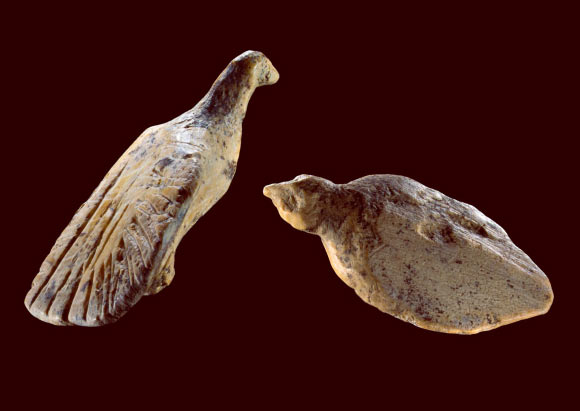
40,000-Year-Old Bird Figurines Found in German Cave

Two bird figurines found at Hohle Fels Cave in Germany. Image credit: Ralf Ehmann / University of Tübingen / Museum of Prehistory and Ice Age Art.

Archaeologists in southwestern Germany have unearthed two miniature bird figurines carved from mammoth ivory, among the smallest and most delicate examples of Ice Age art ever found.

The post 40,000-Year-Old Bird Figurines Found in German Cave appeared first on Sci.News: Breaking Science News.

  •  

Major New Study Uncovers “Hemisphere-wide Evidence” Challenging Past Views on How Ancient Americans Survived

One of the longest-running debates in modern American archaeology involves how the first people who arrived in the New World survived amid the many challenges they faced while migrating into an unfamiliar environment during the final years of the Ice Age. At the heart of that debate is a simple question: what did the earliest Americans rely on as their primary source of food?

Without question, migrations that would ultimately carry humans across two continents are the kind of activity that will burn a lot of calories. Hence, archaeologists have long wondered whether these ancient hunter-gatherers primarily survived by hunting a wide variety of plants and animals, or whether they specialized in pursuing giant megafauna that roamed the Americas, which would have offered a much higher-protein diet.

Now, in a significant new study published in Science Advances, an international team of archaeologists says the evidence strongly points to the latter scenario, meaning that the earliest Paleoindian Americans were likely to be highly specialized hunters whose success depended on their ability to stalk and bring down enormous creatures like mammoths, giant ground sloths, and other late-Pleistocene megafauna.

The study, led by Ben Potter of the University of Alaska Fairbanks, with contributions from Todd Surovell and Robert Kelly of the University of Wyoming, looked at a synthesis of zooarchaeological evidence from sites spanning Eastern Beringia, North America, and South America.

The team’s research now presents a major discovery: that at least 98 percent of the diets of these early populations focused on massive megafaunal herbivores, which would have provided an exceptional source of protein during the early colonization of the New World.

Multiple Lines of Evidence Support a Highly Specialized Diet

The team’s findings challenge the view that the earliest Americans were broad-spectrum hunter-gatherers. Among the best evidence for this, they say, is food remains that were left behind thousands of years ago at locations that would become recognized today as Paleoindian archaeological digs.

“The most direct proxy for paleodiets are the food remains left at archaeological sites,” Potter told The Debrief in an email. “These are most closely connected with the animals targeted, butchered, and consumed.”

Potter adds that the zooarchaeological record of East Beringians, Clovis, and Fishtail Projectile Point Complexes “demonstrates a clear focus on megafauna, no matter how one measures it: bone elements, minimum number of individual animals, or associated edible biomass.”

Potter says that “multiple lines of evidence point to the same conclusion,” which include isotopic data directly obtained from Anzick-1, a Paleoindian child’s remains uncovered in central Montana in 1968 that are still recognized as the only Clovis-era human remains ever found in the Americas, dated to 12,990–12,840 years ago.

Additional evidence comes from “toolkit homogeneity across continents, high residential mobility and limited/no site reuse, and lethal weapon technology, clearly and repetitively associated with megafauna,” Potter explains.

Wide Dispersal in a Short Span of Time

Potter and his coauthors say the dietary specialization evidenced by the available archaeological data helps to explain how humans were able to disperse across the Americas within a relatively short timeframe—possibly just a few centuries.

A key element to the success of these early American hunters would have been the consistency in hunting methods that could be employed with large herbivores across great geographic distances, from as far north as modern-day Alaska to as far south as Patagonia.

“There are a number of reasons this adaptation facilitated rapid expansion into unfamiliar territories,” Potter told The Debrief. Among these is the fact that larger megafauna rich in fat yield far more calories than their smaller counterparts.

“Megaherbivores have large territories and are found through multiple ecosystems,” Potter says. “This focus on megaherbivores allowed tracking their preferred prey into additional regional ecosystems, enabling rapid dispersal across the Americas.” Additional factors he cites include the fact that animal meat and fat offer abundant sources of macro- and micronutrients, and that there would have been relatively little competition from other late-Pleistocene megacarnivore predators.

This adaptation, Potter says, “was a continuation of earlier Beringian strategies, necessitating no major technological innovations or adjustments when encountering radically different habitats,” ranging from geographic locales as diverse as modern Alaska, to Virginia, Florida, and Mexico.

“Mapping onto these few taxa allows for rapid expansion rather than the generations-long time needed to learn each local region with its own endemic plants, animals, fish, shellfish, and birds,” Potter adds. “The overall strategy supports moving into new areas with higher densities (encounter rates) of megafauna, facilitating rapid expansion.”

Clues Pointing to Shared Cultural Traditions

From such evidence, Potter says, another “logical extension of the data and patterns” he and his team observed is potential evidence for shared cultural traditions carried by these ancient migrating populations.

“This is supported by multiple datasets,” Potter told The Debrief, which he says include genetic information supporting a single clade’s rapid expansion sometime after roughly 14,000 years before present, “suggesting a single source population expanding rapidly through the continents.”

Potter also points to the timing of early continent-wide cultural manifestations, which he says are “consistent with the genetics,” and “the cultural connections between Clovis points and Fishtail points,” the latter referring to an early Paleoindian American projectile point type that, in many cases, are fluted in the same manner as Clovis points.

Finally, Potter says the zooarchaeological record he and his colleagues examined, as well as the “time-transgressive nature of megaherbivore extinctions, earlier in the north, later in the south,” all provide additional support for a widespread dispersal within a short period of time, helped by early Paleoindian hunters’ prowess in hunting large herbivorous megafauna.

“In short, Early Paleoindians expanded into Eastern Beringia (~14,000-13,300 cal BP) using the same toolkits that allowed them to migrate throughout northeast Asia (microblades, composite points), continuing a long-standing tradition of woolly mammoth hunting,” Potter told The Debrief. “Woolly mammoth habitat extends from Alaska through the Ice Free Corridor, open at least by 14,000 cal BP, into the Great Lakes Region.”

“There, one group, SNA, encountered a related species, Columbian mammoth, and hunted them throughout North America to Mesoamerica (13,400-12,800 cal BP), where they developed Fishtail fluted points and predated other proboscideans they encountered (Gomphotheres) as well as very large ground sloths (12,900-11,600 cal BP).

Support for the “Overkill” Hypothesis?

Finally, the team’s findings also lend support to the controversial hypothesis that human hunting played a significant role in the extinction of many Ice Age megafauna between roughly 11,000 and 13,000 years ago.

As those giant animals disappeared, Potter and his colleagues argue, Paleoindian populations were forced to diversify their diets, adapting to locally available resources such as bison, birds, fish, shellfish, and plants.

“After these megafauna became extinct, ~13,300 cal BP in Beringia, ~12,800 cal BP in North America, and ~11,600 cal BP in South America, SNA descendents diversified into many regional cultures, focused on locally abundant food resources,” Potter says.

Fundamentally, Potter and his team’s study challenges the long-held view that the first Americans were broad-spectrum foragers, instead portraying them as highly adaptable big-game specialists whose pursuit of megafauna shaped both their extraordinary continental expansion and the course of early human history in the Americas.

The team’s new paper, “Hemisphere-wide evidence of Early Paleoindian megaherbivore specialization,” appeared in Science Advances on July 8, 2026.

Micah Hanks is the Editor-in-Chief and Co-Founder of The Debrief. A longtime reporter on science, defense, and technology with a focus on space and astronomy, he can be reached at micah@thedebrief.org. Follow him on X @MicahHanks, and at micahhanks.com.

  •  
❌