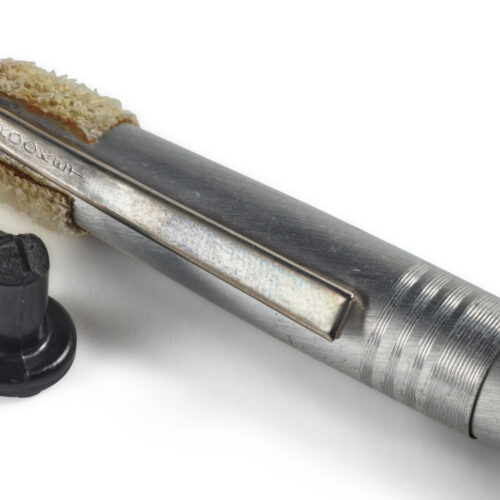
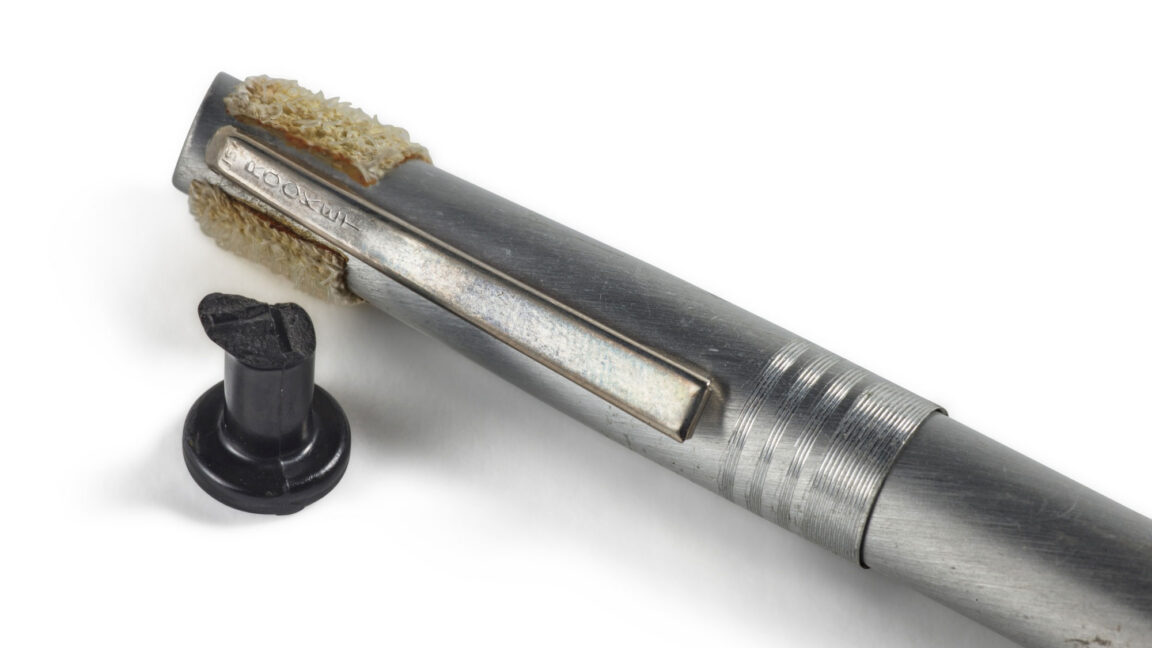
A dried-out felt-tip marker and a snapped-off piece of molded black plastic sold for $857,600 at a Sotheby's auction on Wednesday.
What otherwise might have been worthless bits of trash commanded the highest bids due to where the two items were 57 years ago—lifting off aboard NASA's Apollo 11 spacecraft on humanity's first mission to land astronauts on the Moon. More than flown odds and ends, one was the problem that almost stranded Neil Armstrong and Buzz Aldrin on the lunar surface, and the other was the simple solution to saving the mission.
"Houston, Tranquility. Do you have a way of showing the configuration of the engine arm circuit breaker?" radioed Aldrin to Mission Control after realizing he or Armstrong had inadvertently broken off the top of the circuit breaker switch that would enable their ascent engine to ignite, beginning their trip back to Earth. "The reason I'm asking is because the end of it appears to be broken off. I think we can push it back in again. I'm not sure we could pull it out if we pushed it in, though."
Did you know that the space shuttle once launched the Statue of Liberty into space?
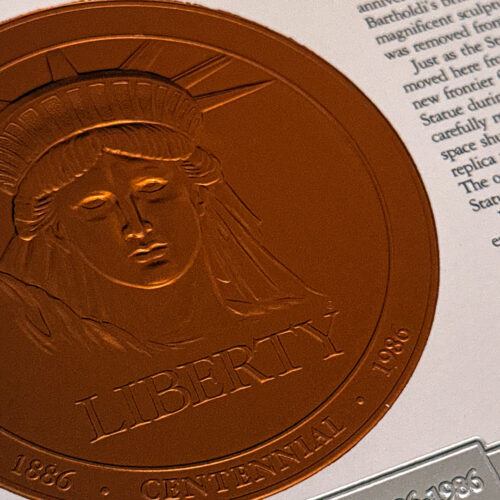
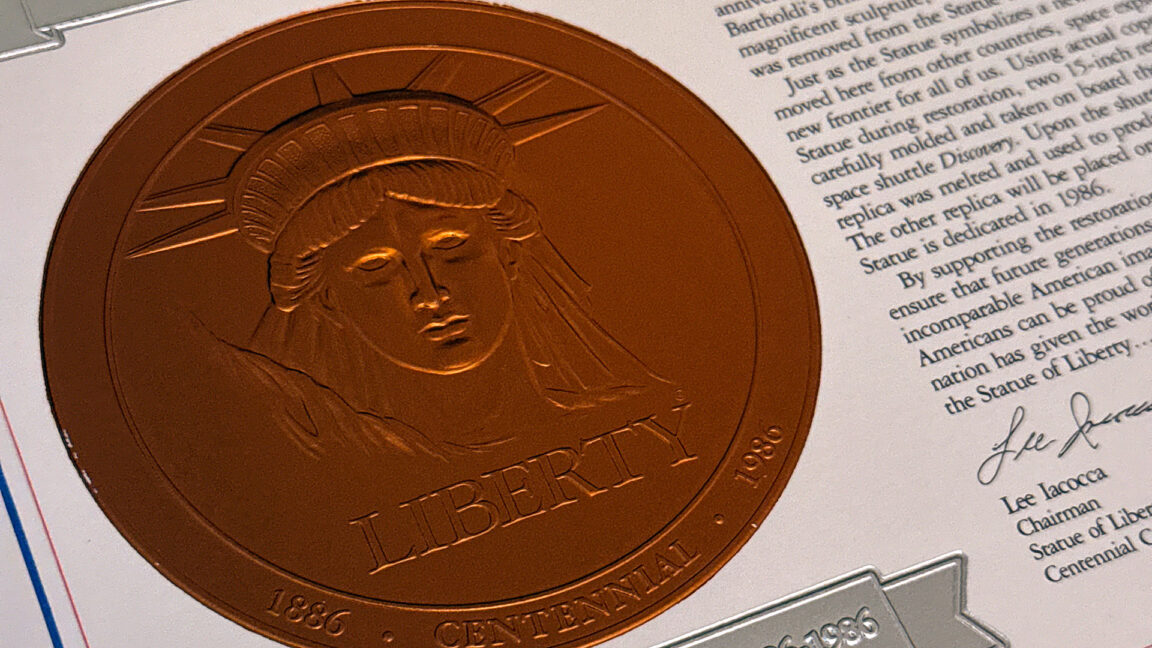
In fact, there were two "Lady Liberties" on board Discovery when it lifted off on its fourth flight in April 1985. To be fair, each statue was only 15 inches tall (38.1 centimeters), but they were also each made of copper that was removed from the full-size statue during its then-still-ongoing restoration.
After the weeklong STS-51D mission was over, one of the space-flown statues was placed on display, and the other was melted down to create copper seals, which were then sold to the public by the Statue of Liberty Ellis Island Centennial Commission.
An unusual artifact unearthed at a site in central Israel is offering researchers an unexpected look at far-reaching trade networks, religious traditions, and cultural change that rocked the ancient Near East.
The tiny relic, uncovered at the ancient settlement of Tel Hadid, is nearly 2,700 years old. Archaeologists have identified it as a stamp seal—a common object from this region and period, although upon closer inspection, what it reveals is something more complex than others of its kind.
“The object is remarkable for its material,” writes Tel Aviv University archaeologist Ido Koch and colleagues in a recent paper published in the journal Levant that describes the object. Crafted from mother-of-pearl, the researchers say this stamp seal is quite unlike any other and represents “a medium hitherto undocumented in the southern Levantine stamp seal corpus.”
Normally, stamp seals were made from durable stone during the Iron Age. What prompted the ancient creator of the recovery from Tel Hadid to use a pearl oyster instead remains perplexing, since this brittle material is so delicate that Koch and his colleagues say engraving it would have been extraordinarily difficult using Iron Age tools.
Varying angles of the stamp seal unearthed at Tel Hadid, Israel (Image Credit: Photo: Sasha Flit, TAU).
In short, crafting such an artifact from mother-of-pearl using known techniques available to artisans in the Near East nearly 2,700 years ago should have been impossible.
So why did its ancient creator choose to undertake such a demanding task in the first place?
Discovery at Tel Hadid
The Tel Hadid site, also known as al-Haditha, is an archaeological site in the Ben Shemen Forest in central Israel found between present-day Tel Aviv and Jerusalem. The site overlooks the country’s coastal plain, and 2,700 years ago, its position also would have held strategic importance.
It was there in 2019 that archaeologists uncovered the stamp seal during excavations led by Koch and his team, which they say belonged to Pinctada margaritifera, a species of pearl oyster native to the Red Sea and Persian Gulf. This identification was significant, since it means the raw material traveled hundreds of miles before ultimately reaching the settlement.
Based on its origins and the craftsmanship that obviously went into its creation, Koch and his colleagues believe the unusual artifact reflects the profound changes that followed the Assyrian conquest of the Kingdom of Israel during the late eighth century B.C.E. At the time, populations that had fallen under Assyrian rule were frequently moved to different locations within the empire, resulting in communities that blended cultures normally only connected by expansive trade routes stretching from Mesopotamia to Arabia and beyond.
The stamp seal appears to reflect these far-reaching connections, since the mother-of-pearl is believed to have been carried by one of the many deported families among their valuables. However, it is also possible that the artifact was imported through the flourishing commercial networks that emerged through the rise of the Assyrian Empire.
A Story in Pictures
However, Koch and his colleagues say the engraved design may also provide clues to the artifact’s origins. Instead of depicting imagery with roots among the Israelites, it depicts a crescent moon mounted on a triangular standard—a human figure is also present, raising its arms in apparent worship.
This imagery is associated with the Mesopotamian moon god Sin, whose worshipers spread quietly amidst Assyria’s western provinces. Apart from the imagery it depicts, the shallow nature of the engraving—perhaps a requirement for working with such delicate material—also suggests that instead of functioning as a practical stamping seal, the object may have been worn as an amulet due to its religious significance.
Altogether, the combination of an exotic and unlikely material for the creation of such an item, along with its foreign religious imagery, and the care that went into its creation, all reveal clues that point to multiculturalism within communities under ancient Assyrian rule.
“The seal thus demonstrates how a recognized colonial motif was materially articulated within a western Assyrian provincial context,” Koch and his colleagues write, “while also providing a rare opportunity to examine the practices and constraints of seal engraving on [mother of pearl].”
Micah Hanks is the Editor-in-Chief and Co-Founder of The Debrief. A longtime reporter on science, defense, and technology with a focus on space and astronomy, he can be reached atmicah@thedebrief.org. Follow him on X @MicahHanks, and at micahhanks.com.
Archaeologists have discovered an unusual artifact they say could represent the earliest known use of written numbers ever discovered in Mesoamerica.
The curious clay figurine features eleven small dots carved into its surface, appearing in three columns. Although its exact purpose remains unclear, researchers who report the discovery in Latin American Antiquity believe it could be one of the oldest examples of graphic notation that may have been used for rudimentary calculation or some similar purpose, dating to as far back as around 750 B.C.
Significantly, the researchers behind the recent study argue that this earliest known evidence of numerical writing could offer clues to “the relationship between numeration, bodies, and identity in ancient Mesoamerican worldviews.”
The Enigma of the Tab Figurines
The figurine, roughly the size and shape of a small television remote, was unearthed at an ancient Mesoamerican site located along Guatemala’s Pacific coast, known as La Blanca. It is among a group of similar artifacts archaeologists call tab figurines, and hundreds of these mysterious relics are known from past discoveries at the site.
Named for their unusual slab-like appearance, these figurines also bear anthropomorphic qualities, which include depictions of jewelry and other ornamentation, although the tab figurines do not directly resemble human heads beyond the presence of such ornaments.
A Remarkable Discovery at Ancient La Blanca
While similar past discoveries recognized as tab figurines have been made at La Blanca, the presence of dots appearing in columns makes this one very unique and presents a novel possibility: that the impressions on the statuette may not have been purely decorative.
“The ordered dots on the La Blanca tab figurine’s headdress, of course, raise more questions than they answer,” write authors Julia Guernsey, Stephanie M. Strauss, and Michael Love in their recent study. “This is often the case with unique examples such as this, which cannot be better contextualized within a larger grouping of like objects from La Blanca or elsewhere.”
The ceramic “tab” figurine with headdress band and potential dot numeration from the Joyas Group at the archaeological site of La Blanca, Guatemala, alongside an artistic rendering of the artifact by Julia Guernsey (Image Credit: J. Guernsey/South American Antiquity)
“Although one might be inclined to dismiss the La Blanca figurine as a curiosity or an isolated addendum to the complicated history of first writing in Mesoamerica,” the authors go on to note, “we believe that it merits this thorough discussion.”
Clues to Unraveling a Mesoamerican Mystery
A clue to the artifact’s purpose may arise from the association between tab figurines and the human head, a region of the body that is traditionally associated with individual identity. This is significant, since archaeologists recognize a potential link between numbers and individual identity in the world of ancient Mesoamerica.
Based on existing archaeological knowledge from the region, it is known that experimentation with numbers had already begun around the time the artifact is believed to have been made. One well-characterized numerical system is known as the dot-and-bar system, which, as the name implies, relies on dots and bars to convey figures of one and five units, respectively.
“In the Mixtec and Aztec codices, one easily becomes accustomed to reading even long strings of single dots and quickly approximating their quantity, a visuo-summation process known as subitizing,” the authors write.
“And no matter what form Mesoamerican numerals took, the vigesimal system was rooted in metaphors/mnemonics of the body: specifically, 10 fingers and 10 toes and concepts of personhood anchored to the number 20,” they add.
Also of significance is the K’iche’ word for person, winik, which is the same word used for the number 20, and for a simple reason: it refers to the ten fingers and ten toes of the human body.
Connections to Mesoamerican Personhood Concepts
Although the connections between the unique figurine unearthed at La Blanca and existing knowledge of Mesoamerican number systems are compelling, the researchers caution against interpreting the artifact solely through the lens of later Mesoamerican writing systems. One main reason why is that scholars think there probably wasn’t ever any single method for recording numbers across the region.
Still, the artifact nonetheless joins a growing body of evidence that could point to the fact that the inhabitants of La Blanca were experimenting with symbolic communication, and at a time centuries before fully developed writing systems emerged in the region.
While the exact meaning of the dots on the statuette remains unknown, the researchers behind the study make a compelling case for why the markings may have represented a name, a date, or another personal identifier. If correct, the placement of the dots may hint at an early connection between numeration, identity, and social expression during a period when some of Mesoamerica’s first urban communities were taking shape.
“Yet a question remains as to whether the identity expressed by the La Blanca tab figurine with its 11 dots was human, supernatural, or a combination thereof,” the authors concede, although concluding that their assessment of the artifact strongly points to the known associations between time, numbers, and the concept of personhood as envisioned in the minds of ancient Mesoamericans.
“Early Mesoamerican conceptualizations of time and the nature of being, perhaps, were not so very different from those of Aristotle for whom Paul Ricoeur noted, ‘Being in time [meant] more than existing when time exists. It [meant] ‘being in number.’”
Micah Hanks is the Editor-in-Chief and Co-Founder of The Debrief. A longtime reporter on science, defense, and technology with a focus on space and astronomy, he can be reached atmicah@thedebrief.org. Follow him on X @MicahHanks, and at micahhanks.com.

 Login