Customers browse Samsung Electronics’ Galaxy Z series devices at Samsung Store Hongdae during the preorder period. (Photo: Samsung Electronics)
Customers browse Samsung Electronics’ Galaxy Z series devices at Samsung Store Hongdae during the preorder period. (Photo: Samsung Electronics)
More than half of the customers preordering Samsung Electronics’ latest foldable smartphones are in their teens, 20s and 30s, with the newly introduced passport-style Galaxy Z Fold8 emerging as the most popular model.
Samsung Electronics said on July 31 that customers in their teens through 30s accounted for more than 50% of preorders placed through Samsung.com for the Galaxy Z Fold8 Ultra, Galaxy Z Fold8 and Galaxy Z Flip8 since reservations opened on July 28. The preorder period runs through Aug. 3.
Among younger customers, the Galaxy Z Fold8 was the most frequently selected model. By color, Cream was the most popular choice, followed by Pistachio and Lavender, both exclusive to Samsung.com.
For the Galaxy Z Fold8 Ultra, Graphite and the Samsung.com-exclusive Green Shadow were the most popular colors. For the Galaxy Z Flip8, Mint, Cream and Pink received the strongest customer preference.
Samsung attributed the higher share of younger buyers to promotional benefits such as storage upgrades and features that simplify transferring data from existing devices to Galaxy smartphones.
Customers who purchase a 256-gigabyte (GB) model during the preorder period will receive a 512GB model. Buyers of the 512GB Galaxy Z Fold8 Ultra and Galaxy Z Fold8 can upgrade to a 1-terabyte (TB) model for an additional 310,700 won.
Preorder customers will also receive a six-month subscription to Google AI Pro, a three-month subscription to audiobook and content platform Welaaa, and discount coupons for Galaxy Watches and accessories. Samsung is also offering its New Galaxy AI Subscription Club program for the new devices, as well as the Flip Youth Subscription program targeted at customers in their teens and 20s.
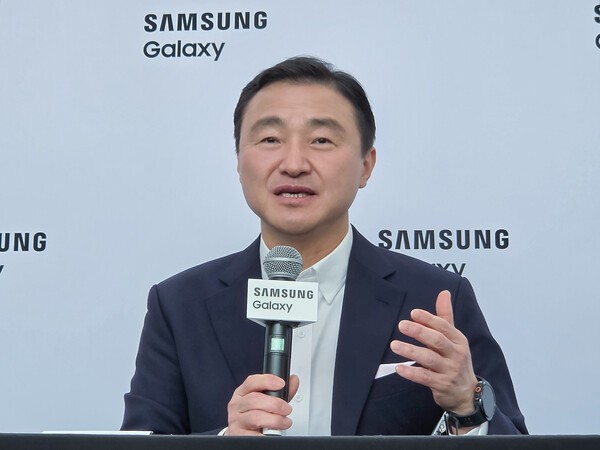
Roh Tae-moon, President, Chief Executive Officer and Head of the DX Division at Samsung Electronics, speaks at a media briefing following the Galaxy Unpacked 2026 event in London on July 22.
Samsung Electronics Co. is expanding its foldable smartphone lineup to three models.
Roh Tae-moon, President, Chief Executive Officer and Head of the Device eXperience (DX) Division at Samsung Electronics, said at a media briefing held after the Galaxy Unpacked 2026 event at Old Billingsgate in London on July 22 that foldable smartphones have moved beyond introducing a new form factor and become part of consumers' everyday lives.
"Foldables have moved beyond the stage of introducing a new form factor and have become part of everyday life," Roh said. "We have broadened customer choice to meet increasingly diverse consumer expectations."
Samsung unveiled the Galaxy Z Fold8, Galaxy Z Fold8 Ultra and Galaxy Z Flip8 at the event, expanding its foldable portfolio from the two-model Fold and Flip lineup it had maintained since launching its first foldable smartphone in 2019.
◇"We Welcome More Foldable Competitors, but Seven Years of Experience Cannot Be Matched"
Roh said he expects more companies to enter the foldable smartphone market in the future.
"As the foldable market matures, more companies will enter," he said. "That means foldables are becoming mainstream and the market is expanding, which we welcome."
However, Roh emphasized that Samsung's seven years of accumulated user experience will be difficult for competitors to replicate in a short period. Foldable devices are not defined solely by folding hardware, he said, but also require the operating system, user interface and third-party applications to be optimized for different display configurations.
"The competitiveness of Samsung's foldables comes from integrating hardware innovation, Galaxy AI and the consumer experience into a single product," Roh said.
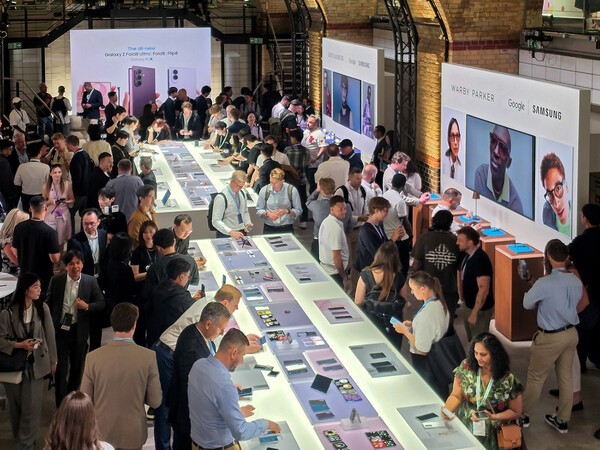
Samsung Electronics' Galaxy Unpacked 2026 event at Old Billingsgate in London on July 22.
◇Galaxy AI Installed Base to Reach 800 Million Devices
Samsung aims to increase the number of devices capable of using Galaxy AI to 800 million by the end of this year, including existing devices upgraded through software updates.
"The competitive advantage of AI will not be how intelligent it is, but how well it understands users," Roh said. "People do not want to learn AI—they want it to provide practical help in their daily lives."
He said AI will evolve beyond simply answering questions into agentic AI capable of completing tasks on behalf of users.
Samsung plans to leverage both proprietary and third-party AI models. The company will use its in-house Samsung Gauss model and Bixby for Samsung applications and device functions, while deploying external models such as Google Gemini for features integrated with Google's services.
Samsung also plans to expand partnerships beyond Google. The company is already working with Perplexity and is evaluating the adoption of additional third-party AI models.
"We are not committed to a single AI solution," Roh said. "If an external AI model is suitable for the mobile user experience and services, we will adopt multiple AI models."
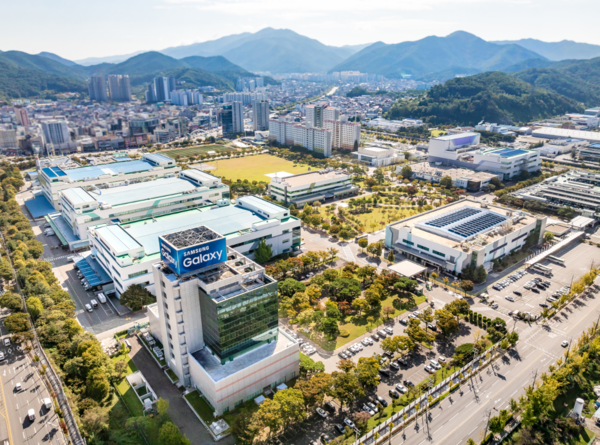
Samsung Electronics' Smart City campus in Gumi, South Korea.
◇CEO-Led Organization to Accelerate Robotics Commercialization
Samsung is also moving its robotics business from research and development into commercialization. The company recently established the Robotics Experience (RX) Business Promotion Office, reporting directly to Roh, bringing together robotics technologies and personnel that had previously been spread across multiple organizations.
"We created a dedicated organization to properly begin the full-scale commercialization of the advanced development and investments we have made in robotics over many years," Roh said. "Robotics is one of the key future growth drivers for the DX Division."
Samsung previously became the largest shareholder of Rainbow Robotics and has operated its Future Robotics Task Force. The company plans to first deploy robots in manufacturing facilities to verify the technology before expanding into enterprise and consumer markets.
Samsung is also preparing a successor to the Galaxy Ring.
"We will not release new products mechanically according to a fixed schedule," Roh said. "We will launch them when innovations that satisfy consumers are ready. We are preparing Galaxy Ring 2 to deliver a new wearable experience."
◇Cost Increases Beyond Supply Chain Efforts May Be Reflected in Prices
Roh said Samsung will work closely with supply chain partners to minimize the impact of rising memory and key component costs. The company said it coordinated supply volumes and delivery schedules in advance with strategic suppliers to ensure stable production of the Galaxy Z Fold8 series.
However, Samsung left open the possibility of reflecting cost increases in product prices if they exceed what can be absorbed through supply chain optimization.
"We will not pass 100% of higher production costs on to consumers and will work with our partners to minimize the burden," Roh said. "However, if cost pressures exceed a manageable level, we will have no choice but to reflect part of the increase in the product's launch price."
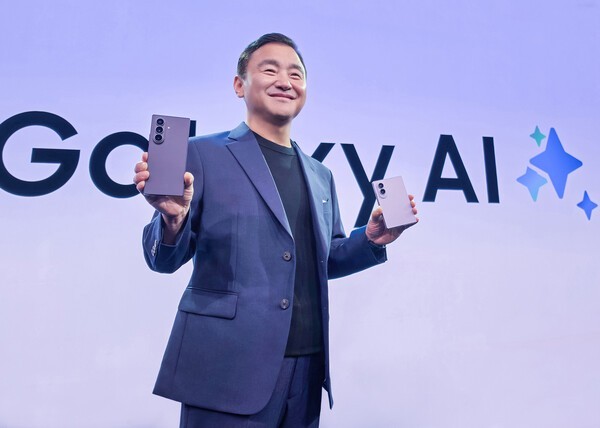
TM Roh, president and head of Samsung Electronics' Device eXperience (DX) Division, introduces the Galaxy Z Fold8 Ultra, Galaxy Z Fold8 and Galaxy Z Flip8 during the Galaxy Unpacked 2026 event at Old Billingsgate in London on July 22. (Photo: Samsung Electronics)
TM Roh, president and head of Samsung Electronics' Device eXperience (DX) Division, introduces the Galaxy Z Fold8 Ultra, Galaxy Z Fold8 and Galaxy Z Flip8 during the Galaxy Unpacked 2026 event at Old Billingsgate in London on July 22. (Photo: Samsung Electronics)
Samsung Electronics unveiled its next generation of Galaxy devices—including foldable smartphones, smartwatches and AI-powered smart glasses—laying out a broader vision for an agentic AI ecosystem in which smartphones, wearables and eyewear work together to anticipate users' needs.
At its Galaxy Unpacked 2026 event in London on July 22, Samsung introduced the Galaxy Z Fold8 Ultra, Galaxy Z Fold8 and Galaxy Z Flip8, alongside the Galaxy Watch Ultra2, Galaxy Watch9 and its upcoming Intelligent Eyewear, which is scheduled to launch later this year.
The company expanded its foldable smartphone lineup from two models to three by adding the flagship Galaxy Z Fold8 Ultra. The Fold8 Ultra features an 8-inch main display, a 200-megapixel camera and a 5,000mAh battery. It measures 4.1mm thick when unfolded and weighs 215 grams.
The standard Fold8 is designed with media consumption in mind, offering a 7.6-inch main display and a 5.5-inch cover display while weighing 201 grams. The Flip8 emphasizes portability with a weight of 180 grams and a thickness of 6.1mm, allowing users to access major apps and AI features directly from the cover screen without opening the device.
Both the Fold8 and Fold8 Ultra are the first Samsung smartphones to incorporate Flex Titanium, a structural technology combining a titanium alloy film with a reinforced titanium plate. Samsung said the redesigned internal support structure and hinge reduce thickness while improving durability and minimizing display creases. Peak display brightness has also increased 15% from the previous generation to 3,000 nits.
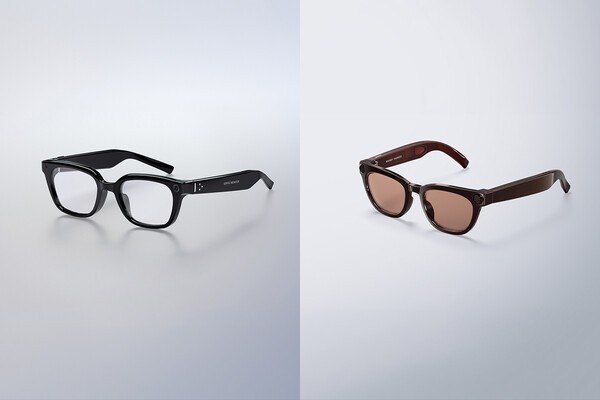
Samsung's Intelligent Eyewear designs created in collaboration with Gentle Monster (left) and Warby Parker. (Photo: Samsung Electronics)
The new devices feature Gemini Intelligence, jointly developed with Google, enabling contextual AI interactions across multiple applications. The system understands both on-screen content and conversations, allowing users to perform tasks such as searching for a restaurant, making a reservation and adding the appointment to their calendar in a single workflow. Samsung said the AI currently integrates with more than 40 applications, including food delivery, shopping and reservation services.
Samsung also introduced Now Nudge, an AI feature that proactively recommends next actions based on context. For example, it can suggest creating a calendar event when users make plans during a conversation or recommend saving a location after it is searched. On larger foldable displays, users can simultaneously view their conversation with the AI assistant and the progress of ongoing tasks.
Samsung is also expanding AI beyond smartphones through its Intelligent Eyewear platform. The smart glasses integrate cameras, microphones, speakers and sensors into the frame, allowing them to recognize the user's surroundings. They can translate foreign-language menus into spoken audio, capture meeting documents and whiteboards, and automatically organize the content in the Samsung Notes app.
The Intelligent Eyewear runs on the Android XR platform and is powered by Qualcomm's Snapdragon AR1 Gen 1 processor. Samsung said the device provides up to nine hours of battery life on a single charge. Eyewear brands Gentle Monster and Warby Parker collaborated on the industrial design, and Samsung has revealed four design variants to date.
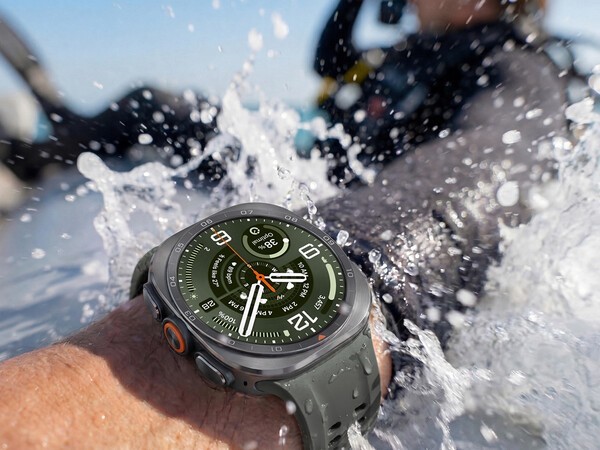
Galaxy Watch Ultra2. (Photo: Samsung Electronics)
Samsung also strengthened the health monitoring capabilities of its smartwatch lineup. The Galaxy Watch Ultra2 features an 800mAh battery—35% larger than its predecessor—and a display with peak brightness of up to 5,000 nits. It adds dedicated trail running and diving modes while upgrading durability with an IP69K rating for water and dust resistance.
The Galaxy Watch9 monitors heart rate, respiratory rate, skin temperature and blood oxygen saturation during sleep to detect changes in users' health conditions. It also provides a heart health score based on sleep quality, physical activity and body composition, along with personalized exercise and recovery guidance.
Samsung said each Galaxy device has a distinct role within its AI ecosystem: smartphones understand user behavior and digital content, smartwatches monitor physical health and AI glasses perceive the surrounding environment. By combining information gathered across all three devices, the company aims to deliver proactive AI experiences that recommend actions before users issue commands.
"As AI continues to evolve, mobile devices will become the products that understand users best and integrate most naturally into everyday life, serving as the closest point of interaction with consumers," said TM Roh, president and head of Samsung Electronics' Device eXperience (DX) Division. "The Galaxy Z series will further advance the mobile experience through highly refined foldable devices while delivering personalized AI services that usher in the next era of intelligence."
LG Electronics will halt production at its manufacturing plant in Huizhou, China, after October, bringing operations at the group's first manufacturing subsidiary in China to an end after 34 years.
According to industry sources on July 21, LG Electronics plans to cease operations on the production lines at LG Electronics Huizhou (LGEHZ) by the end of the year. The company has already informed local employees that manufacturing will stop after October.
The Huizhou facility has primarily produced speakers for LG Electronics' XBOOM audio brand. The company is understood to have decided to reorganize its manufacturing footprint as competition from Chinese manufacturers intensifies and its audio business shifts toward premium products.
LGEHZ was established in October 1993 as a joint venture among LG Electronics, LG Electronics China and TCL Group, becoming the LG Group's first manufacturing subsidiary in China. LG Electronics currently owns an 80% stake in the venture.
The Huizhou factory began operations in October 1994, producing home theater systems, Blu-ray DVD players, smart printers and beauty devices. More than 90% of its output was exported, primarily to North America, Latin America, Europe and Central Asia.
The plant has an annual audio production capacity of 2.6 million units and annual production value exceeding 2 billion yuan. Profitability has declined over the past three years, with net profit falling from 12.5 billion won in 2023 to 10.9 billion won in 2024 and 9.2 billion won in 2025.
"We plan to close the Huizhou plant this year and have already informed local employees that production will stop after October," a person involved in LG Electronics' China operations said.
The company has not yet finalized how it will handle the legal entity or the factory after production ends.
"Production at the Huizhou subsidiary is scheduled to stop by October this year," an LG Electronics spokesperson said. "We are reviewing various options for the future operation of the subsidiary and the factory."
Possible options include transferring production to LG Electronics' manufacturing base in Hai Phong, Vietnam, expanding contract manufacturing with Chinese partners, or liquidating the subsidiary.
LG Electronics previously liquidated its Kunshan manufacturing subsidiary in China in 2020, transferring automotive infotainment production to its Hai Phong plant. The Kunshan facility had produced automotive audio, video, navigation and telematics products.
LG Group operates the LG Hai Phong Campus in Vietnam, which houses manufacturing facilities for LG Electronics, LG Display and LG Innotek. Hai Phong has become one of the group's key overseas manufacturing hubs.
LG Electronics Vietnam Hai Phong (LGEVH) reported consolidated revenue of 5.97 trillion won in 2025, up 5.9% from 5.64 trillion won in 2024. Net profit increased 17.8% to 204.9 billion won from 173.9 billion won. LGEVH is the company's second-largest overseas manufacturing subsidiary by revenue, after its US subsidiary.
LG Electronics could also outsource production previously handled at Huizhou to Chinese manufacturers. The company already uses a joint development and manufacturing model for some entry-level refrigerators, washing machines and robot vacuum cleaners, with Chinese partners responsible for product development and manufacturing while LG Electronics oversees product planning and quality standards.
Depending on product positioning and target markets, the company could shift Huizhou production to external manufacturing partners.
Another possibility is the complete liquidation of the Huizhou subsidiary without relocating production. LG Electronics previously shut down and liquidated its Tianjin subsidiary, which manufactured kitchen appliance components, after the need to maintain local production diminished amid growing competition from lower-cost Chinese brands.
Industry sources said the closure reflects a manufacturing efficiency strategy rather than a retreat from the audio business.
LG Electronics has been expanding its premium audio lineup, particularly premium speakers and soundbars, while targeting annual audio business revenue in the trillions of won over the longer term. Market research firms forecast the global consumer audio market will grow from $58.1 billion in 2024 to $70.1 billion in 2029, driven in part by new product categories such as AI-powered speakers.

 Login