❌

Reading view

Flock Surveillance Cameras Are Actually Horrible for Fighting Crime, FBI Data Shows

Since the launch of Flock Safety in 2017, the ACLU estimates the company installed some 100,000 automatic license plate readers throughout the United States. The dragnet comes with plenty of downsides to privacy and civil liberties: it’s ripe for abuse by crooked cops, powered by sweatshop labor, and nearly impossible to escape once it designates you a target.

But police officials insist it’s worth the trade off — because at it least it helps them catch the bad guys, right? Unfortunately, the reality isn’t quite that peachy.

Atlanta, Georgia has experienced far and away the largest influx of ALRPs in the country, with over 5,000 various Flock cameras now blanketing the city. Yet as bombshell data released by the FBI shows, the city’s massive web of surveillance has had virtually zero impact on the Atlanta Police Department’s ability to solve crime, with some clearance rates for offenses like homicide even experiencing a decline over the past few years as the cameras have proliferated.

First reported by the Atlanta Community Press Collective, the FBI data is a damning refutation of Flock’s primary claim: that ALPRs are necessary to help officers keep the public safe.

According to the ACPC, the rates at which the APD resolves crimes like homicide, robbery, miscellaneous larceny, and shoplifting have actually decreased between 2021 and 2025, when the city’s ALPR build-out hit its full stride.

For homicide, the numbers are especially embarrassing, with the FBI reporting case closures at just 48 percent in 2025, down from 53.4 percent in 2021. Meanwhile, rape remained flat year over year, holding steady at a pitiful 37.7 percent closure rate from 2021 to 2025, and dipping down to just 21.2 percent at its lowest point in that four-year span.

Though the APD actually did show improvement on some crime categories as Flock’s cameras sprouted all over the city, the changes from 2021 to 2025 amount to little more than rounding errors.

For example, case closures on crimes like aggravated assault and motor vehicle theft ticked up by just 0.2 and 0.3 percent, respectively. One would think motor vehicle theft solve rates would be an easy win for a technology designed to track cars, specifically. Yet in 2025, the APD was solving just one in tencases of auto theft, even with thousands of Flock ALPRs at its disposal.

Len Phillips, head of the anti-ALPR community group DeFlock Atlanta told ACPC that the “public has been asked to accept a significant expansion of surveillance based on the promise that it would dramatically improve public safety.”

In reality, Phillips continues, that tradeoff between safety and civil liberties “was just a one-way transaction.”

More on Flock: In Light of Overwhelming Backlash, Flock Cancels Creepy Audio Surveillance Feature

The post Flock Surveillance Cameras Are Actually Horrible for Fighting Crime, FBI Data Shows appeared first on Futurism.

  •  

FTC Concerned About Meta Surveillance of Users of Erectile Dysfunction Apps

If you’re among the 2.6 million active users of the popular telehealth apps Hims and Hers to obtain medication for erectile dysfunction, hair loss, and a cavalcade of other intimate issues, there’s probably a very short list of people you want to know about it — and Mark Zuckerberg probably isn’t one of them.

On Wednesday, the US Federal Trade Commission filed a major lawsuit against Hims and Hers, over allegations the firm was sharing user’s health information with third party companies, Gizmodo reported. Chief among those third-parties apps was Zuckerberg’s Meta, as well as Snap, two social media companies with horrible track records on protecting sensitive information.

Though Hims and Hers advertises its app-based health services as “100 percent online, private, and secure,” the FTC suit alleges “those assurances were false or misleading.”

“Instead of honoring its privacy promises,” the filing says, “Hims opted to grow the company and increase its revenue streams… with advertising platforms such as Meta and Snap.”

The suit doesn’t blame Meta directly, but argues that Hims and Hers used two “automated tracking technologies offered by Meta” to surveil users’ actions on the telehealth app. “These two tools automatically tracked and disclosed certain Events [user actions] to Meta,” the lawsuit reads.

Hims sells all kinds of men’s health meds, but most people know it for one thing: erectile dysfunction pills. While any leak of patient data would be an outrage, the thought that Hims could be sharing this particular kind of medical information is especially horrifying.

In a statement, Hims and Hers argued that the FTC’s case “is not enforcement grounded in consumer protection,” but rather “an effort to generate headlines at our expense.”

The lawsuit comes on the back of a three-year investigation by the FTC, and is currently in the very early stages — meaning it could be years before a final verdict is reached.

More on Meta: Meta’s Attempted Crackdown on AI Glasses Perverts Is Already Failing

The post FTC Concerned About Meta Surveillance of Users of Erectile Dysfunction Apps appeared first on Futurism.

  •  

Apple’s rumored security camera: Privacy-focused HomeKit device expected as part of broader smart home push

Apple’s rumored security camera. (Image: Grok Imagine)
(Image: Grok Imagine)

Apple has not officially announced any first-party security camera, but multiple reports from analysts and journalists indicate the company is developing one (and possibly related products like a video doorbell) to compete more directly with Amazon’s Ring and Google’s Nest. The effort forms part of a wider smart-home hardware expansion that also includes a home hub and updated speakers.

Core Rumors and Sources

Analyst Ming-Chi Kuo reported in late 2024 that Apple was preparing a wireless smart home IP camera for mass production in 2026, with ambitions for millions of units annually and assembly by Goertek. The device is described as designed for tight wireless integration with other Apple products and expected to leverage Siri and Apple Intelligence.

Bloomberg News’ Mark Gurman has repeatedly covered Apple’s smart-home plans, stating the company is working on multiple types of cameras and home-security products. One reported design is a battery-powered camera lasting several months to a year on a charge. It would include facial recognition and infrared sensors to identify people in a room, supporting automation such as turning lights off when someone leaves or playing preferred music for a recognized family member. Users are expected to place cameras throughout the home for both security and presence-based automation.

A Face ID-equipped video doorbell has also been rumored; it could recognize residents and wirelessly unlock a compatible deadbolt. Reports suggest the doorbell may lag behind the primary security camera in development.

Internal code references to a device codenamed J229 (mentioned in late 2025 reporting) describe capabilities including image capture, alarm-sound detection, and multiple sensors (features obviously consistent with a security camera). Some coverage linked support for it to a spring 2026 software window, though timelines have since been described as more fluid.

Expected Features and Ecosystem Fit

Any Apple camera would almost certainly rely on HomeKit Secure Video, which already provides end-to-end encrypted streaming and recording to iCloud+ (with local analysis on a home hub such as a HomePod or Apple TV). Apple has recently expanded the platform: iOS 27 and related software add 4K support for compatible cameras, AI-generated text descriptions of footage, natural-language search across clips (e.g., “package delivery”), and grouping of noteworthy events across multiple cameras. These AI features reportedly require a higher-tier (2 TB) iCloud+ plan.

An official Apple camera would be expected to offer deeper, native integration than third-party options—potentially stronger on-device intelligence, seamless Siri/Apple Intelligence features, and privacy guarantees aligned with Apple’s usual approach (encrypted video that even Apple cannot access). Specifics on resolution, night vision, field of view, indoor vs. outdoor designs, or exact form factor remain unconfirmed.

Timing and Status

Early reports pointed toward 2026 availability, with some speculation around a spring window or a March 2026 “Apple Experience” event. More recent coverage (as of mid-2026) treats the latter half of 2026 or later as the more realistic window, noting that earlier expectations have slipped and that no official confirmation, pricing, detailed specs, or prototypes have been made public.

Apple already supports a limited selection of third-party HomeKit Secure Video cameras (from brands such as Eve, Aqara, Logitech, and others). A first-party device would give the company direct hardware control and a clearer path to showcase new Home app and Apple Intelligence capabilities.

MacDailyNews Take: Credible info from Kuo, Gurman, and others consistently points to Apple developing at least one battery-powered, privacy-oriented security camera with facial/presence sensing for automation, plus possible related products such as a Face ID doorbell. Everything remains unannounced and speculative on exact design, price, and launch date as of late July 2026. Further clarity will depend on official statements or stronger supply-chain evidence.


‎
Please help support MacDailyNews — and enjoy subscriber-only articles, comments, chat, and more — by subscribing to our Substack: macdailynews.substack.com. Thank you!

Support MacDailyNews at no extra cost to you by using this link to shop at Amazon.

The post Apple’s rumored security camera: Privacy-focused HomeKit device expected as part of broader smart home push appeared first on MacDailyNews.

  •  

DefCon security conference bans smart glasses with recording capabilities

It’s a sign of the times: Security conference DefCon has added smart glasses to its list of banned audio- or video-recording devices.

The organizers have said that, with no consistent way to understand whether smart glasses are recording or not, they have taken the step to ban them in their entirety on the grounds that they erode trust and invade people’s privacy.

Putting corrective lenses in the smart glasses will be no excuse: DefCon insists that visitors bring a pair of glasses without the smarts instead.

The smart glasses ban has been added to DefCon’s already strict rules on photography, which among other things ask visitors not to take group shots and to use “portrait” mode (or a low F-stop for those with old-fashioned cameras) to focus on the foreground, so that people in the background appear blurred.

The smart glasses market has gone up a notch lately. Google and Samsung have both announced Gemini powered eyewear running on Android. Apple is looking to launch its new generation of smart glasses next June, citing privacy concerns as the reason for the delay.

It is not only tech conferences that are getting jumpy about smart glasses. CISOs are beginning to get wary about their impact on organizations and whether their data is secure.

This article first appeared on CSO.

  •  

Wild Footage Shows Man Blocking Flock Camera With Comically Gigantic Protest Sign

There’s been plenty of buzz lately around vandalism of Flock Safety’s automatic license plate readers, which are AI-integrated surveillance cameras that index license plate data from passing vehicles indiscriminately and without a warrant.

Countless vigilantes have taken to the roadways armed with trash bags, spray paint, laser pointers, and power drills to render the surveillance poles useless, resulting in arrests and investigations by police.

But what if there was another way to block Flock cameras that didn’t involve damaging public property? Turns out they’ll come after you for that, too.

A 77-year old Florida man named Carl Gunn decided to take matters into his own hands and block a Flock camera in his neighborhood. His method is unorthodox: he doesn’t destroy anything, but simply uses a 12-foot pool skimmer with a sign taped to the end reading “DOWN WITH FLOCK CAMERAS.”

Footage of the one-man protest shows Gunn lounging in a camping chair with his comically long sign in one hand and an umbrella in the other. Speaking to weekly paper Creative Loafing Tampa Bay, the protestor justified his action saying the “Flock company, they’re doing this for profit.”

“They don’t own the air,” Gunn continued. “We didn’t give them permission to do it on us. If they want to do it for profit, I want my paycheck.”

The 77-year old has staged at least two protests so far, CL reports, both at different Flock cameras. Two St Petersburg squad cars rolled up on him during one protest, prompting a community member to stop and film the encounter.

“Yo, what’s your name? I’ll come bail you out!” shouts the passerby, a St Petersburg local named Tyler Knight. “You got the boys out protecting it [the ALPR].”

“F**k the Flock cameras, and f**k you for not looking out for us,” Knight hollers at the officers before driving off.

Though the video caption claims Gunn was arrested over the incident, no report with his name appears in the Pinellas County Clerk of the Circuit Court’s case record database.

Of course, any discussion of Flock overreach has to include the police officers themselves. While Flock may be a front-runner for most hated tech company of the 2020s, its dragnet would be impossible if it weren’t for a massive coalition of police departments and private landowners fueling the company’s rise.

Wherever Flock controversies bubble to the surface, police come out of the woodwork as the company’s most ardent defenders. And because police departments have complete access to the Flock network — which now spans nearly 100,000 cameras across the country — cops are also the most likely to abuse the company’s ALPRs.

In the state of Georgia alone, 17 officers have been caught using Flock in order to stalk and harass people. Further abuses have been recorded everywhere from big cities like Los Angeles and Milwaukee to small towns in South Carolina and Illinois.

Whether a 12-foot pole will be enough to stop those abuses nationwide is doubtful, but it sends a message that’s impossible to miss.

More on Flock: So Many People Are Smashing Flock’s Cameras That It’s Disguising Them Inside Other Objects

The post Wild Footage Shows Man Blocking Flock Camera With Comically Gigantic Protest Sign appeared first on Futurism.

  •  

Google's "privacy-preserving" age verification system is coming to the Play Store

Governments around the world are suddenly very keen on online age verification requirements. In some places, this takes the form of ID requirements to access adult content, but several US states have also focused on app stores. With these laws now going into effect, Google has announced an expansion of its beta Play Age Signals API, which it claims will allow developers to confirm user ages without impinging on privacy.

Google's system doesn't require an ID or selfie verification—it's connected to the company's existing Family Link app. The idea is that parents will set age ranges for their kids' managed accounts. For example, you might set a range like 16–17, allowing apps to tailor experiences and content for teenagers.

Google notes that the ranges are dynamic and may change as young users get older. So a kid who's 13 may be in the same app content bracket for a few years before hitting the next level. Parents have the option to set and share these ranges if they want that additional level of control over what their children can access in Google Play. However, it's not mandatory for child accounts—it's fully opt-in and can be turned off at any time.

Read full article

Comments

© Getty Images | Kirill Kudryavtsev

  •  

This New Meta “Advertisement” Is Absolutely Brutal

Last week, we came across a cleverly subversive advertisement for Meta’s controversial smart glasses, which overlaid socialite Kylie Jenner’s face with one of the terrifying bug-eyed monsters from John Carpenter’s “They Live” and a bold type caption that reads “We’re always watching” when viewed from a specific angle.

The billboard, created by activist group Everyone Hates Elon, called attention to how Meta’s camera-adorned and AI-enabled spectacles have quickly turned into a privacy-invading nightmare. The optics of the problem is so bad that Meta is now trying to ban “manfluencers” and juvenile pranksters who use the glasses to record members of the public without their consent.

The public backlash has become so strong, even those who bought a pair of the “pervert glasses” are choosing to leave them at home.

Now, the activist group has come up with its next — and even more brutal — stunt. A new “advertisement” adorning a bus station in London, not far from Meta’s King’s Cross office, shows late sex criminal Jeffrey Epstein wearing a pair of the specs while getting his picture taken for the New York sex offender registry.

“Glasses for people who don’t do consent,” the caption reads.

It’s a clear reference to the late criminal’s sex trafficking operation, which recruited dozens of girls, many underage. Grisly documents details how his victims were convinced to go to his beachfront mansion and even bring friends. According to some of their depositions, they were coerced into taking off their clothes without their consent.

Epstein has also been accused of secretly filming one of his victims. Witnesses also claim he kept “sex tapes” involving prominent people.

Email correspondences from 2014 also detail how the sex criminal directed his aide to install hidden video cameras across his home in Palm Beach, Florida, including one installed inside a Kleenex box.

While Epstein died in 2019, years before roughly two years before Meta launched the first generation of its smart glasses, the billboard sends a grim message.

Critics argue that glasses that can be used to film strangers without their consent shouldn’t be legal.

“If regulators actually did their damn jobs for once, glasses such as these would be illegal,” one Reddit user argued.

“Pervert glasses have no place in our society,” another wrote.

More on Meta’s glasses: Meta Desperately Trying to Ban Creeps Misusing Its AI “Pervert Glasses”

The post This New Meta “Advertisement” Is Absolutely Brutal appeared first on Futurism.

  •  

Samsung’s AI-powered glasses could be looking at your data

Now that Samsung has jumped into the crowded AI-powered glasses arena alongside Apple, Google, Meta, and others, CISOs and IT leaders are again having to think through whether it makes sense to establish enterprise restrictions on such devices, given the likely data leakage and privacy and compliance issues.

And even if those tech leaders decide that such policies might make sense, the logistical hurdles to universally enforcing them outside the office are all but insurmountable.

For example, it is up to individual wearers to choose their device’s settings, making it difficult for IT policies around data acquisition and usage to be enforced. Worse, AI devices have a history of ignoring guardrails. That means that a setting that limits how data is used may not necessarily be obeyed. 

One possible mitigating factor is that smart glasses typically have a light on the frame that activates when the device is recording, but there are also many easy ways for workers to defeat or cover up those lights to conceal their activities. 

Enforcement is virtually impossible

However, said independent technology analyst Carmi Levy, “although some organizations have tried to physically ban smart glasses from their in-person and virtual workplaces, the sad reality for corporate technological gatekeepers is there is no way to completely keep any device out of the workplace.”

There is nothing stopping employees from wearing eyewear of any type, smart or not, he noted, “and attempting to do so might put employers on the wrong side of a disability lawsuit launched by a worker who needs prescription smart glasses to accommodate vision issues.”

As well, Jitesh Ubrani, an IDC director focusing on worldwide device trackers, pointed out that the biggest challenge in creating rules around usage of smart glasses is that the data leakage problem with devices is both not new and certainly not limited to glasses. 

“The instinct to ban AI smart glasses outright is understandable, but it misses that the underlying risk isn’t new. A smartphone has been able to record a whiteboard, a screen, or a conversation for close to two decades,” he said. “What’s changed is the friction. Glasses make covert capture nearly effortless and far harder to notice because there’s no phone being visibly raised or pointed. That’s a real escalation in ease of misuse, but it’s a difference of degree rather than a fundamentally new capability.”

In fact, Ubrani argued, “where this gets hard for CISOs is enforcement. A ban on paper is easy to write. Enforcing it inside a corporate office is already difficult, since most current-generation devices, including Meta’s Ray-Bans, are visually indistinguishable from ordinary eyewear.”

And, he added, “enforcing it in a hybrid or work-from-home setting is close to impossible. IT has no practical way to confirm what someone is wearing on a home Zoom call, and even in-office detection options, like scanning for Bluetooth or BLE advertising signals tied to known manufacturer IDs, only catch devices that haven’t been reconfigured or that happen to be broadcasting at the time.”

Additional risk

Connected glasses have a history going back decades, but enterprises didn’t take them seriously until this year.

But Anshel Sag, principal analyst at Moor Insights & Strategy, characterized the problem as more psychological than technological. 

“People want to ban it because they don’t know how to handle it. But that just creates more problems than it solves. It’s a very kneejerk fear reaction,” Sag said. “We live in an era where cameras are everywhere.”

Meghan Hollis, a senior principal analyst for Gartner, agreed that the focus on smart glasses is misplaced, given that even headphones can today capture audio for translation and transcription. The change is not in the data capture, Hollis said, but the fact that it is adding video.

This creates additional risk, with the new capability brought into the corporate environment causing “a potential exposure for corporate intellectual property,” Hollis said.

One other often-overlooked issue is data sovereignty. Even if the glasses manufacturer agrees to store data only in specific countries, it could easily change that policy or simply switch third-party vendors. 

“There could be export control issues, possibly violating regulatory controls in transmitting information,” Hollis noted. 

However, Hollis said, threatening to punish workers if they are caught using unauthorized devices “is your last line of defense,” and that the best initial approach should not be enforcement, but education.

“You need to be educating your end-users, with constant reinforcement, telling them, ‘If you do this, here’s how you can harm the company and our clients/customers.’ Combine that with, ‘And if you do this, we will take action against you.’”

Tiered policies required

Hollis noted that the risk goes beyond an employee initially recording something they shouldn’t. Consider, for example, a technical meeting where an employee asks the rest of the attendees for permission to record the discussion. They agree and he starts to record. 

At the end of the meeting, he leaves to return to his office, fully intending to turn off the recording function when he gets there. But on the way, he has a brief hallway meeting with an SVP who tells him, without warning, “FYI, but the board just decided to greenlight our hostile takeover of Smith Corp. We’ll explore the specifics at a 10 a.m. tomorrow. Have your team there.” The executive then walks off.

With the recording still running, that ultra-sensitive data has just been transmitted to the cloud. 

IDC’s Ubrani pointed out that situations like this make smart glasses governance more challenging. “Enterprise IT and security leaders need to stop framing this as ‘ban versus allow,’ and instead build a tiered policy based on where the actual risk sits,” he said. “Boardrooms, R&D labs, and any space where trade secrets or regulated data are visible or discussed out loud deserve strict no-wearables rules, enforced the same way phone bans already are in those rooms.”

Open floor plans and general office space probably don’t need that level of restriction, he said, but meeting policies should require disclosure when a device capable of recording is present, similar to the way in which some companies already handle personal recording devices in sensitive briefings.

“Companies that try to write one blanket rule for every environment are going to find it’s either unenforceable or so restrictive it interferes with accessibility, since some employees rely on these devices as assistive technology,” he said.

However, Brian Jackson, a principal research director at Info-Tech Research Group, argued that enterprise CISOs and IT Directors need to take a far more strict position.

“Organizations should update their acceptable use policies for personal technology ASAP,” he said. “Look back about 15 years ago at how smartphones moved from consumer life into the workplace, and we may be at the beginning of a redefinition of BYOD here. But it needs to start with an extremely restrictive policy against the use of AI wearables and similar devices.”

He added, “organizations need to hold the line against making personal recordings in the workplace and maintain not only their compliance standards, but their workplace culture. This restriction cannot go as far as an outright ban; look at how Walt Disney World got caught up in a lawsuit after telling an employee she could not use Meta glasses. Still, this exception can be made narrow, and it should be made clear that other employees must be alerted when they are being recorded.”

This article originally appeared on CSOonline.

  •  

Activist charged with felony after giving border agent "duress code" that wiped his phone

In early 2025, Atlanta resident Samuel Tunick was on his way home following a trip abroad. After landing in the US, customs agents demanded access to his Pixel phone, which was running an alternative version of Android called GrapheneOS. Rather than hand over his data, Tunick used a clever feature of the software to delete everything. Now, he's facing federal charges.

The first hearing in this case happened last week, according to The Guardian, during which government attorneys and agents claimed that Tunick was subjected to a standard secondary interrogation at an international airport. During that encounter, agents were "looking for anything that’s prohibited." However, Tunick's legal team alleges he was targeted for his activism.

Tunick was involved with a group called Defend the Atlanta Forest, which opposed the construction of an enormous law enforcement training facility in the area often known as Cop City. What Tunick didn't know, according to his lawyers, was that he'd been placed on a watch list for his actions and that Customs and Border Protection had discussed over email plans to detain him upon his arrival back in the US for "suspected terrorism activities."

Read full article

Comments

© Ryan Whitwam

  •  

Meta Desperately Trying to Ban Creeps Misusing Its AI “Pervert Glasses”

Meta’s camera-equipped AI glasses have quickly turned into a massively controversial accessory.

They’ve been used by all kinds of charlatans and brutes to harass strangers, from pickup artist “manfluencers” filming themselves approaching strangers to juvenile pranksters recording members of the public without their consent.

Consequently, the backlash to Meta’s “pervert glasses” has reached a fever pitch, with owners choosing to leave them at home to avoid embarrassment.

Sensing a threat to its bottom line, Meta has slowly started treating the issue with some degree of seriousness. Now it’s vowing to crack down on creeps misusing its allegedly “privacy-first” glasses, as Business Insider reports: in an Instagram story, the platform’s head Adam Mosseri said the company would ban any user uploading videos showing them harassing others.

“If you’re posting content that is taking advantage of people and harassing them, like a lot of these pickup line kind of videos that we’ve heard of and seen, then we’re going to take the content down,” he said. “We don’t want people to be surreptitiously taking videos of other people and harassing them and then posting them on our platform. So we’re trying to fight that every way we can.”

According to BI, two large pickup artist accounts on Instagram have been deactivated. A spokesperson later confirmed that the accounts were banned for posting harassing content filmed with the glasses.

Take it all together, and it’s one of the clearest indications yet that Meta is struggling to control the narrative about how its flashy glasses are being used by the public. The eyewear’s concealed cameras, in particular, have sparked a thorny debate over privacy and consent. It remains trivially easy to record somebody in public with them without their knowledge.

On its website, Meta advises users to “turn off your glasses in sensitive spaces like the doctor’s office, locker room, public bathroom, school or place of worship.”

“Obey the law,” the website reads. “Don’t use your glasses to engage in harmful activities like harassment, infringing on privacy rights, or capturing sensitive information like pin codes.”

Yet Meta has yet to elaborate on how exactly it will address the issue of harassment beyond Mosseri’s promises to “take the content down.” The company didn’t respond to BI‘s inquiries on how the new policy will be enforced.

Chances are that the tech giant will be forced to continue defending its gadget. Last month, Wired also found that Meta had quietly infused unreleased facial recognition tech into the glasses, sparking a major controversy. While company executives vehemently denied the existence of a the feature, chief technology officer Andrew “Boz” Bosworth later discussed the feature at length during a subsequent interview.

In short, it’s no wonder Meta trying to regain the public’s confidence. Even some highly prominent names in the entertainment industry are now calling foul.

“You don’t know if someone’s wearing sunglasses, or if they’re wearing those f***ed-up f***ing…” singer Ella “Lorde” O’Connor told her audience during a concert earlier this month. “Can I just say, for the record, f*** the glasses! Don’t get the glasses — not sexy.”

More on the glasses: New “Advertisement” for Kylie Jenner’s Meta Perv Glasses Shows Something Extremely Funny If You Look at It From the Wrong Angle

The post Meta Desperately Trying to Ban Creeps Misusing Its AI “Pervert Glasses” appeared first on Futurism.

  •  

MIT Is Blanketing Its Entire Campus in AI-Powered Security Cameras

What happens when you deploy hundreds of high-tech surveillance cameras against a student population known for their hacking skills? We’re about to find out.

This week, the Massachusetts Institute of Technology’s student newspaper the Tech reported that the university is about to spend over $3 million installing over 500 AI-integrated surveillance cameras across the school’s campus.

As the paper explains, the cameras will likely be able to collect real-time facial data, as well as more info related to object classification. Basically,that means it’ll be able to automatically identify, catalogue, and track the movement of physical items. That means people, yes, but also personal belongings like backpacks, boxes, vehicles, bags, and more.

While the cameras will surely be hooked into the MIT police department’s already-existing CCTV feed, the footage collected will also be automatically monitored by AI-RGUS, a firm which develops 24/7 surveillance monitoring software, the Tech reports.

As MIT spokesperson Kimberly Allen explained to the Tech, data will be “retained up to 30 days,” though exceptions will be granted.

Defending the cameras, Allen noted they’re “part of regular efforts to promote campus security,” adding that the camera’s audio surveillance features will be disabled, though that’s more a matter of state law than of any kind of principle on MIT’s part.

It’s an alarming move, coming after MIT faculty have warned that campus police are preemptively punishing students for speeches and protests outside of the established disciplinary process.

And as critics pointed out on social media, the $300 million project comes just a month after MIT administrators shuttered two campus libraries and reduced staffing at others, citing a major budget deficit. Though the news was first reported in December of 2025, those libraries were given a closing date of June 2026 — making the timing of the costly new surveillance dragnet highly suspect.

“Look on the bright side,” joked Syracuse University public relations professor Joshua Foust on Bluesky, “at least they also closed down libraries to save money for the AI cameras.”

More on surveillance: Flock Is in Serious Trouble After Massive Backlash

The post MIT Is Blanketing Its Entire Campus in AI-Powered Security Cameras appeared first on Futurism.

  •  

US Accuses American of Allegedly Wiping His Phone Using a 'Duress' Password During Border Search

An anonymous reader quotes a report from TechCrunch: The U.S. Justice Department is prosecuting an American for allegedly providing U.S. border authorities with a passcode that wiped the contents of his phone, according to an indictment and media reports. This is thought to be the first known case in the United States where federal prosecutors have charged someone for the alleged destruction of data using a so-called "duress" password built into a phone's software. According to The Guardian, which covered the story earlier this week following the court's first hearing on Monday, Atlanta resident Samuel Tunick is fighting the charges. Tunick's attorneys said that it was unlawful for U.S. Customs and Border Protection to seize his phone as he arrived back in the U.S. last year, and that any evidence -- including the alleged wiping of his phone -- should be thrown out. The case centers on a feature included in GrapheneOS, a custom Android operating system that runs in place of the software on most modern Google Pixel devices. Tunick's attorneys confirmed GrapheneOS was running on his phone. The software feature allows the device owner to set a passcode that deliberately wipes the contents of that device if entered instead of the user's unlock passcode. Tunick's case also raises ongoing questions about what constitutional rights can be invoked at the border, which the U.S. government has long asserted is not U.S. soil until a person is authorized to enter. Bill Budington, a senior staff technologist at the Electronic Frontier Foundation, and Runa Sandvik, a digital security expert who works to protect at-risk people as the founder of security consultancy firm Granitt, told TechCrunch that they had not seen similar cases involving the use of duress passwords. "I have not seen this before, though I've discussed the potential scenario with activists and journalists over the years," said Sandvik. "I think this case serves as a reminder that authorities may argue you knowingly destroyed data, so it's better to not have that data on you when you cross certain borders." "With a little planning ahead of time, you can always download the data you need once you get to where you're going," said Sandvik.

Read more of this story at Slashdot.

  •  

Golden Gate Application Support Protection

Wojciech Reguła:

Looks like moving the user’s TCC db to /private/var/containers/Data/ProtectedSystem/[UUID]/Data/Library/Application Support/com.apple.TCC/ was not the only change in the whole privacy castle of macOS 27. (What btw was a great move as now attackers with full disk access permissions can’t modify your privacy settings)

macOS 27 quietly ships a new privacy mechanism I hadn’t seen documented anywhere: it extends the com.apple.macl protection that has always guarded sandboxed apps’ ~/Library/Containers/<bundle-id>/Data folders to a hand-picked set of non-sandboxed apps’ ~/Library/Application Support/<name> folders too. I noticed it by accident — Firefox’s profile folder was suddenly inaccessible from Terminal, while MacPass, a password manager sitting right next to it, was wide open. That asymmetry didn’t sit well with me, so I pulled the thread. It ends in a hardcoded app allowlist baked into /usr/libexec/sandboxd (thx @ciphwall for the hint), meant to be updated live via XProtect.

Previously:

  •  

So Many People Are Smashing Flock’s Cameras That It’s Disguising Them Inside Other Objects

On Wednesday, an a pro-privacy account called “Orwell Day” shared a video on X-formerly-Twitter of a man discovering a Flock license plate reader embedded inside an otherwise innocent roadside speedometer. Operated by the local Sheriff’s department, the device was cleverly hidden to be undetectable to approaching road and pedestrian traffic.

“What lurks on the back of it?” the man behind the camera asks as he approaches the device. “Look at that. Someone did some custom metal fabricating and decided to put a Flock camera, a mobile one, anywhere they want to put it, in the speedometer.”

They are hiding Flock cameras now, secret compartment found in speed radar box pic.twitter.com/4kkeRsKufi

— Orwell Day (@OrwellDay) July 22, 2026

That particular unit is operated by police in Volusia County, Florida, encompassing the suburbs north of Orlando. However, it’s not unthinkable that the practice might spread to other locales as the public backlash against ALPRs grows — and it’s growing fast.

So far, the privacy advocates behind the website DeFlock.org note that 53 US cities have ended their previous ALPR contracts with Flock. (Some municipalities are turning to alternative ALPR providers like Axon.)

In cities where local leaders aren’t ready to cut the cord, however, citizens are taking matters into their own hands, sawing down Flock towers, sabotaging their solar charging panels, or paint bombing the camera’s sensors.

While that kind of direct action has forced some municipalities to reconsider their Flock contracts, others are doubling down. Now, it seems some towns are getting crafty, secreting the now-infamous surveillance devices in roadside objects to throw saboteurs off their trail.

It’s not without precedent. In 2025, the Associated Press reported that US Border Patrol officers were hiding ALPRs and other surveillance devices inside traffic barrels, allowing them to monitor thousands of drivers throughout the US for “suspicious travel patterns.”

As the AP reported at the time, the program encompassed states like Arizona, Texas, and Michigan. In many cases, hidden cameras were discovered in locations that were hundreds of miles away from the nearest border.

At the moment, the full scope of covert ALPRs in the US remains to be uncovered. But with over 95,000 of the spy gadgets and counting deployed across the country, the number of hidden cameras is surely much higher than the public is currently aware.

More on Flock: LAPD Abandons Flock Contract After Making a Horrifying Discovery

The post So Many People Are Smashing Flock’s Cameras That It’s Disguising Them Inside Other Objects appeared first on Futurism.

  •  

ChatGPT Health Expands Apple Health Access

ChatGPT Health is returning with substantially wider access, giving more iPhone users the option to connect information from Apple Health directly to the AI assistant.

The expansion follows a limited test introduced in January. OpenAI is now gradually making the dedicated Health experience available to eligible ChatGPT Free, Go, Plus and Pro users in the United States who are at least 18 years old.

Despite the close Apple connection, this is not a feature created by Apple or built directly into the Health app. OpenAI operates the service through ChatGPT, while Apple Health serves as one of the sources users can voluntarily connect.

Once permission is granted, ChatGPT can examine selected health and fitness information stored on iPhone, including activity, sleep, workouts and other measurements collected by compatible apps and devices. Users can then ask questions about changes over time without manually exporting records or uploading screenshots during every conversation.

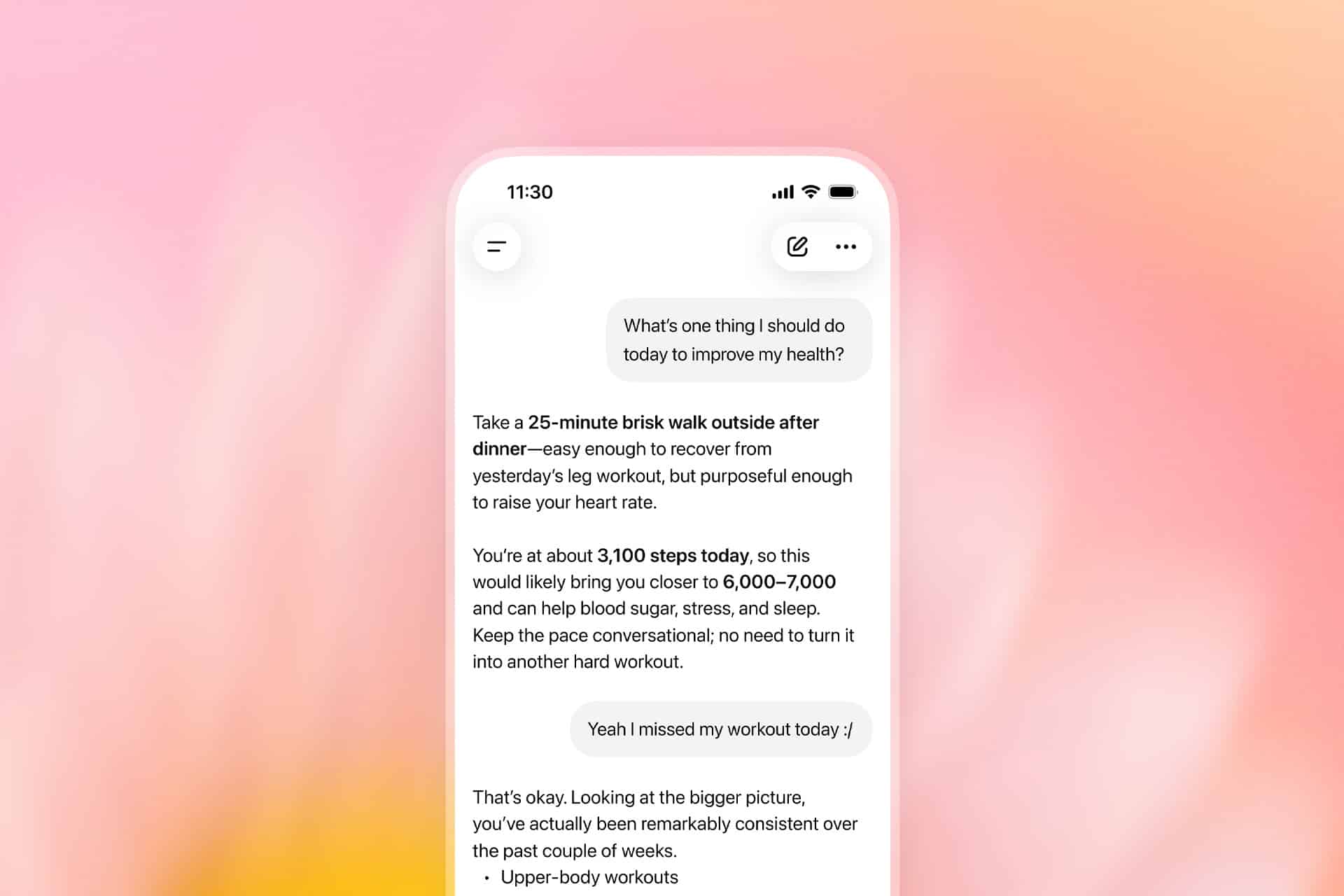
A smartphone screen displays a chat conversation about health, mentioning a 25-minute brisk walk and daily step goals, seamlessly integrated with Apple Health, against a softly blurred pink and yellow background.
Image Credit: OpenAI

ChatGPT Health Reaches More iPhone Users

ChatGPT Health originally appeared as a limited early-access experience for a small group of testers. The expanded rollout replaces that narrow availability with support for eligible adult users across the United States, although OpenAI says access may take several weeks to reach every account.

The feature works on the ChatGPT website and iOS app, but connecting Apple Health requires an iPhone. Users also need a recent version of the ChatGPT app before the Health option appears in the sidebar or More menu.

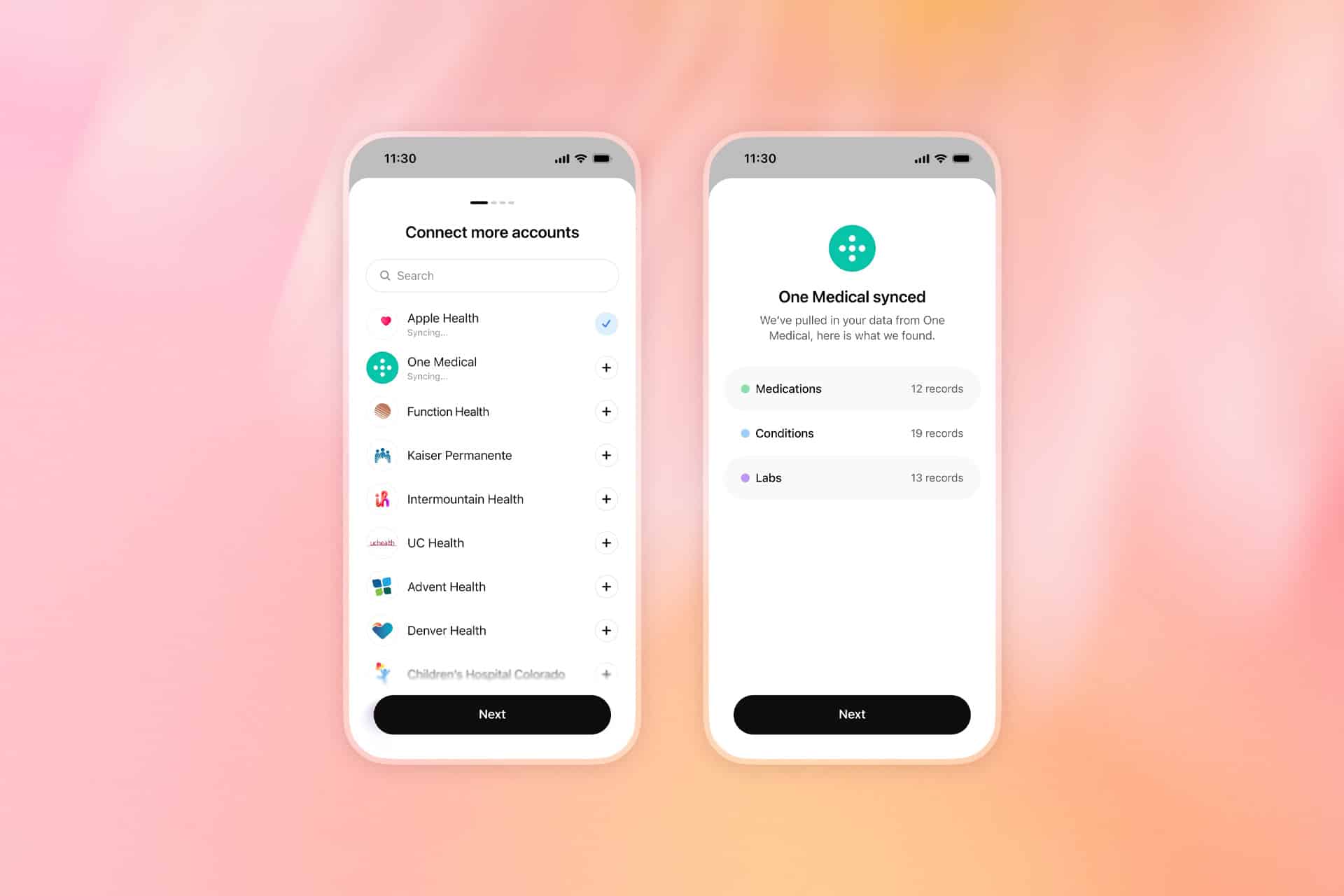
Apple Health is only one part of the system. ChatGPT can also connect to supported medical-record portals, One Medical and Function Health. Bringing those sources together allows the assistant to answer questions using a broader personal context than activity data alone.

A user could ask how sleep duration has changed across several weeks, whether workout frequency declined after a schedule change or how recent laboratory results compare with earlier tests. ChatGPT can also help organize questions before a medical appointment or summarize changes found across connected records.

Information from third-party fitness services can reach ChatGPT through Apple Health when those apps already share their data with the iPhone database. That may include measurements from platforms such as Garmin, Oura, Whoop, Strava and MyFitnessPal, depending on which categories each service makes available.

Not every proprietary score transfers. An app may calculate its own readiness, recovery or sleep score without writing that exact result into Apple Health. ChatGPT can only use the information made available through the connected source and approved by the user.

After synchronization, health information can inform responses throughout ChatGPT rather than remaining limited to conversations opened from the Health tab. The assistant normally asks for permission before using connected information, and users can also add “@Health” to a prompt when they specifically want a response based on their records.

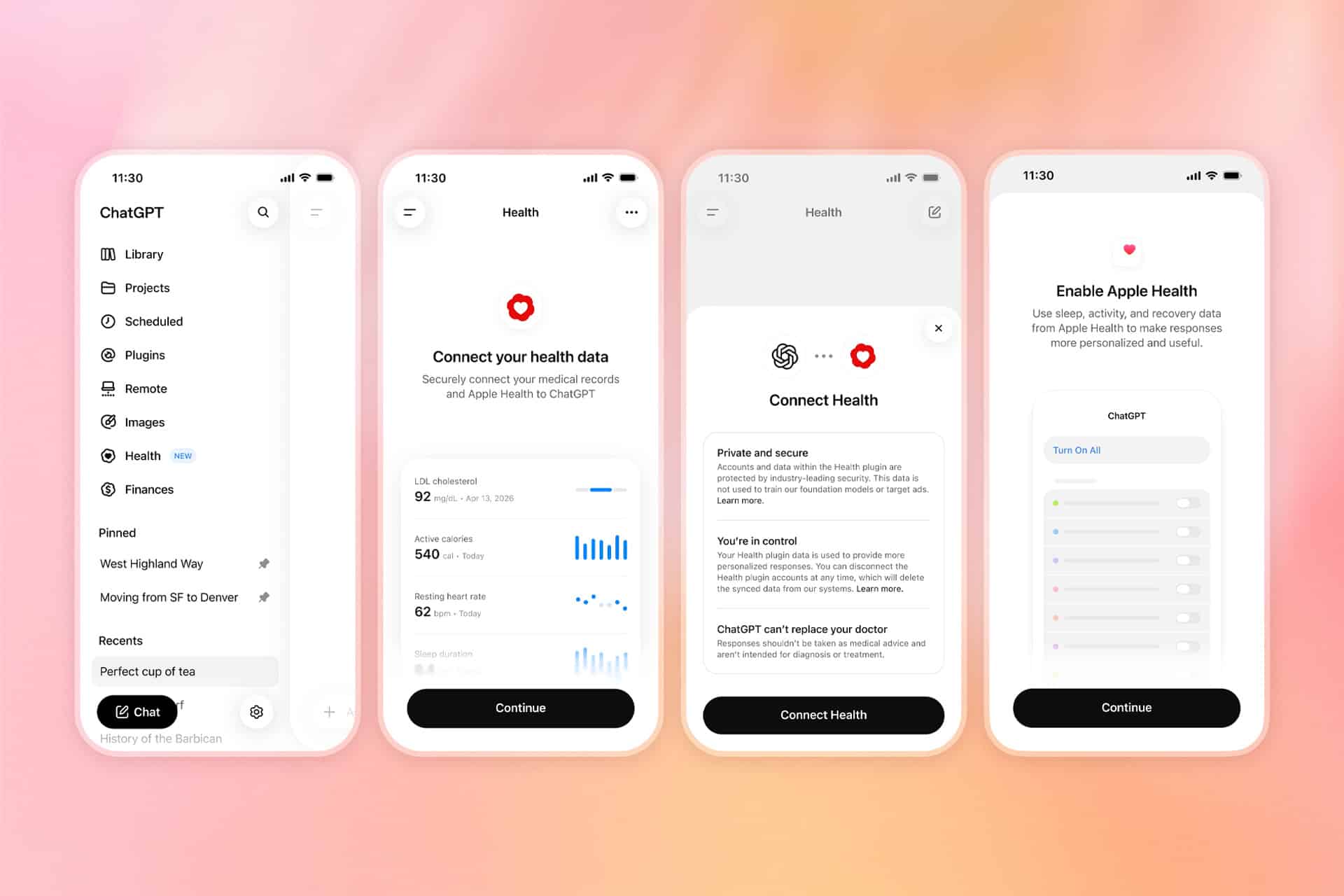
Four smartphone screens show the process of connecting health data to a Health app, displaying menus, health data graphs, privacy info, and Apple Health permissions. Background is a soft pink and orange gradient.
Image Credit: OpenAI

Apple Health Data Gains a Conversational Layer

The appeal of the integration comes from turning a large collection of measurements into questions expressed in ordinary language.

Apple Health can already organize trends, highlights, medications, laboratory results and activity records. ChatGPT adds a conversational layer capable of comparing those categories or explaining them in a more personalized format.

Someone preparing for an annual physical could ask for a summary of meaningful changes since the previous appointment. A runner might request a comparison between training volume, sleep and resting heart rate. Another user could ask which information deserves discussion with a clinician after receiving new laboratory results.

That does not make ChatGPT a doctor. OpenAI says the feature is intended to support medical care rather than diagnose conditions or recommend treatment. Urgent symptoms and emergencies still require professional assistance.

The distinction is especially important because health data can appear more conclusive than it is. A change in heart rate, sleep or activity may have several explanations that cannot be determined from an iPhone record alone. Wearables can identify patterns, but they do not automatically reveal the medical cause behind them.

ChatGPT may help users notice relationships and prepare better questions. It should not be treated as the final authority on whether a symptom is harmless, whether medication should change or whether professional care is unnecessary.

The service is also read-only. ChatGPT can examine approved Apple Health information but cannot alter the original records stored on iPhone. It cannot add a diagnosis, change a medication list or write new measurements back into the Health app.

Users retain control over which Apple Health categories are shared. Someone may allow access to steps, workouts and sleep while withholding reproductive health, medications or other sensitive information.

That selective approach may be more appropriate than approving every category simply because the option is available. A useful response does not always require a complete health history.

Two smartphone screens show a health app: the left screen lists health providers to connect, including Apple Health, while the right screen confirms "One Medical" synced, displaying counts of Medications, Conditions, and Labs. Both screens have a "Next" button.
Image Credit: OpenAI

Privacy Becomes the Central Decision

Connecting Apple Health to ChatGPT creates a different privacy relationship from using health features entirely within the Apple ecosystem.

Apple designs the Health app around on-device protections and user-controlled permissions. ChatGPT Health requires selected information to synchronize with OpenAI systems so the company can analyze it and generate personalized responses.

OpenAI says connected Apple Health data, medical records and conversations using that information are not used to train its foundation models or target advertising. The company also applies additional encryption and isolation protections to health information.

Users can disconnect Apple Health at any time. OpenAI says synchronized data from the disconnected source will be deleted from its systems within 30 days.

Previous conversations are handled separately. Information already included in ChatGPT conversation history remains until those chats are deleted, even after the Apple Health connection is removed.

Memory introduces another consideration. Conversations using Health can create memories when ChatGPT memory is enabled, although OpenAI says memories are not generated directly from synchronized health data. Temporary Chat or separate project memory can reduce how much personal context continues across future conversations.

The new Health experience should also not be confused with the existing ChatGPT integration inside Apple Intelligence. Siri and Writing Tools can use ChatGPT for certain requests without requiring the dedicated ChatGPT app or a connected account.

ChatGPT Health is a separate OpenAI service with its own account, permissions, privacy controls and health-data connections. Using ChatGPT through Siri does not automatically give OpenAI access to Apple Health.

That separation gives users a meaningful choice. They can continue keeping health information inside Apple apps, share only selected categories with ChatGPT or connect medical records for a more comprehensive view.

The expanded rollout makes one of the most personal databases on iPhone available to conversational AI. Its usefulness will depend not only on the quality of the answers, but also on whether users understand exactly which information they are sharing and where it goes after leaving the device.

The post ChatGPT Health Expands Apple Health Access appeared first on AppleMagazine.

  •  

Extensão do controlo de conteúdos de abuso sexual de crianças com “luz verde” do Conselho da União Europeia

A medida temporária tem como objetivo colmatar as lacunas existentes até que seja estebelecido um novo enquadramento jurídico de longo prazo para prevenir e combater o abuso sexual infantil online, avança o Conselho da UE, sendo aplicável até ao dia 3 de abril de 2028.

The post Extensão do controlo de conteúdos de abuso sexual de crianças com “luz verde” do Conselho da União Europeia appeared first on Tek Notícias.

  •  

Flock Is in Serious Trouble After Massive Backlash

Sometimes in business, the first to market isn’t ultimately the most successful.

That’s the reality for surveillance company Flock Safety, a now-infamous firm working to blanket the United States in automatic license plate readers known as ALPRs, which are basically AI-integrated cameras that interface to form wide-reaching webs of surveillance.

If you’ve heard of Flock, there’s a good chance it’s from one of the hundreds of decentralized local protests against the company’s devices currently raging across the country, or from a wave of negative press coverage.

According to data compiled by the anti-Flock site DeFlock.org, at least 53 municipalities have shredded their contracts with Flock over concerns that federal officials were accessing data collected by the company. Unfortunately for privacy activists and citizens concerned about police surveillance, that doesn’t necessarily mean ALPRs are going away — just that they’re increasingly being supplied by Flock’s competitor.

With Flock suffering some major brand damage as the face of ALPRs, the company Axon has emerged as a strong runner up. The publication Gadget Review observes that in cities like Denver, officials are ending controversial contracts with Flock in order to make room for Axon, which provides a remarkably similar surveillance architecture — just without the specter of federal overreach.

While Axon might lack the toxic name recognition that currently hampers Flock, the police tech company has plenty of controversy of its own.

Back in 2024, Axon was panned for the release of “Draft One,” a ChatGPT-integrated piece of software that transcribed law enforcement body cam audio into police reports. As critics noted at the time, the technology was widely prone to hallucinations, and large language models remain particularly susceptible to racial bias.

Prior to that, Axon faced significant backlash for its announcement that it would deploy drones armed with tasers into schools, as part of a hare-brained scheme to combat the school shooting epidemic which continues to plague the US. (They were also implicated in lighting a guy on fire.)

Overall, privacy advocates now face an added challenge: not just of slowing Flock’s advance, but in making the case that there are no good ALPRs, regardless of what company’s logo is slapped on the surveillance pole.

More on Flock: In Light of Overwhelming Backlash, Flock Cancels Creepy Audio Surveillance Feature

The post Flock Is in Serious Trouble After Massive Backlash appeared first on Futurism.

  •  

New “Advertisement” for Kylie Jenner’s Meta Perv Glasses Shows Something Extremely Funny If You Look at It From the Wrong Angle

Earlier this summer, socialite Kylie Jenner appeared in a series of ads promoting Meta’s controversial smart glasses.

The camera-adorned and AI-enabled spectacles, a collaboration with global eyewear juggernaut Ray-Ban, have been at the center of a discussion over personal privacy and surveillance so heated that many owners are now too afraid to be seen in public while wearing them.

Critics say they’re far too easily abused to prey on unsuspecting victims, even garnering them the pejorative nickname of “pervert glasses.” Wired also found in June that Meta silently added a facial recognition system to its glasses’ software — yet another privacy nightmare in the making — but hadn’t activated it.

Now, an inventive group of activists calling themselves Everyone Hates Elon took matters into their own hands by transforming a Meta AI glasses ad featuring Jenner into a cleverly subversive statement. Specifically, they seem to have added a lenticular overlay on top of a London bus stop ad that transforms her visage into a terrifying bug-eyed monster — but only when seen from a specific angle.

As a video that’s making its rounds on social media demonstrates, standing right in front of the ad shows Jenner’s face as the black-and-white demon, with a bold type caption that reads: “We’re always watching.”

Users were quick to point out that the addition was referencing John Carpenter’s 1988 dystopian sci-fi epic “They Live,” in which the protagonist finds a pair of sunglasses that reveal subliminal messages hidden all over the world, in billboards and other media. They also expose a race of bug-eyed aliens that masquerade as humans, much like Jenner in the tampered-with Meta ad.

“Meta has spent years tracking us online,” an Everyone Hates Elon spokesperson told online arts magazine Hyperallergic. “Now it wants to track us in the real world too.”

As its name suggests, Everyone Hates Elon was formed last year to voice opposition to Elon Musk for his disastrous attempts to gut US government budgets, as well as spouting far-right talking points and racist rhetoric. It has run guerrilla poster campaigns that call Musk a “bellend,” and parody Tesla’s latest vehicle as “the Swasticar,” which can go “from 0 to 1939 in 3 seconds.”

The group has also taken aim at Amazon founder Jeff Bezos and president Donald Trump’s extensive relationship with deceased sex criminal Jeffrey Epstein.

Meta’s glasses are a natural target for the activists’ latest campaign given how easily they’re exploited for highly questionable behavior.

“Meta and Ray-Ban’s new AI glasses can be used to secretly record women and young people for sexual reasons,” the spokesperson told Hyperallergic. “Simply put, that’s abuse.”

“Billionaires could fund cures for cancer — so why are they funding glasses for perverts instead?” the group asked rhetorically.

More on Meta’s glasses: The Backlash Is So Strong That People With “Pervert Glasses” Are Afraid to Use Them in Public

The post New “Advertisement” for Kylie Jenner’s Meta Perv Glasses Shows Something Extremely Funny If You Look at It From the Wrong Angle appeared first on Futurism.

  •  
❌