❌

Reading view

'Feynman and followers, you guys are off': Physicists disprove decades-old Richard Feynman theory on 'silly' sprinklers

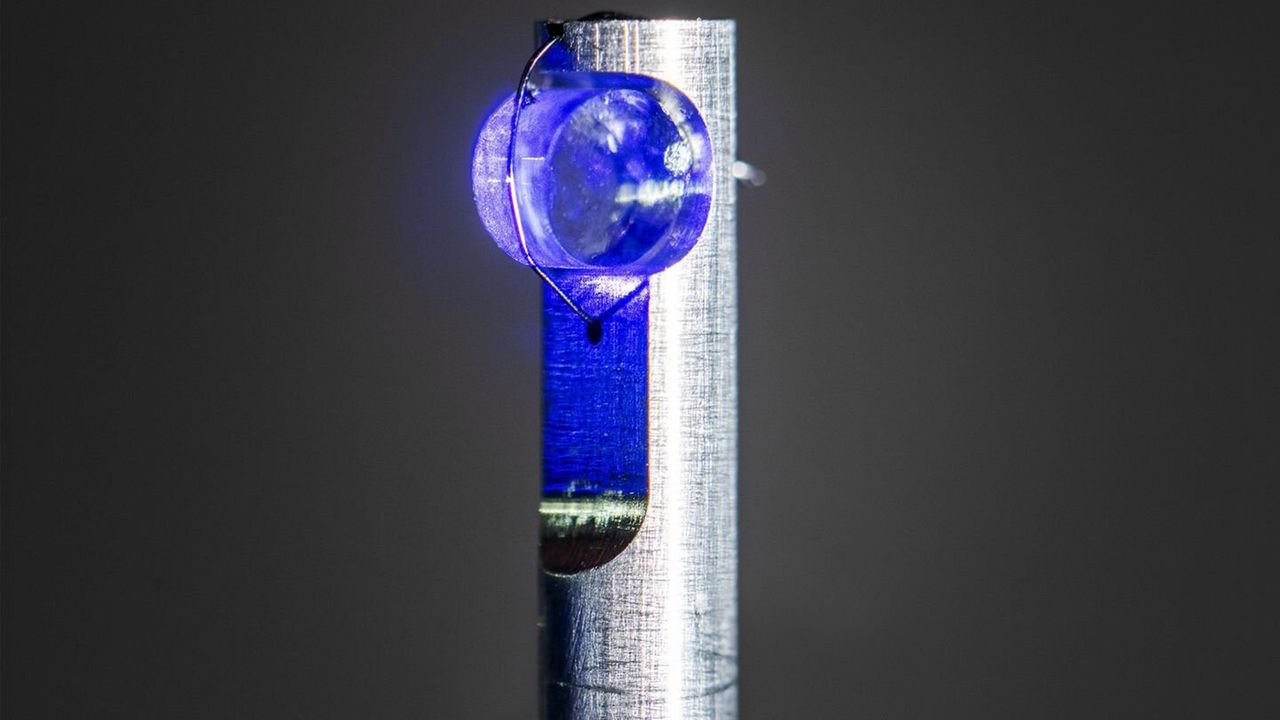
Richard Feynman was a serious physicist who loved to answer unserious questions. Can math tell you how to order the optimal lunch? Can a human track scents like a bloodhound can by smelling his own footprints? Now, researchers have picked up one of Feynman's most curious unanswered questions by looking at the physics of "silly" sprinklers.

A typical lawn sprinkler with an S-shaped nozzle spins in a given direction as it spews water from its two openings. But if you throw that sprinkler into a swimming pool and hook it up to a vacuum so it sucks water in instead of spraying it out, which way will it spin β€” the same direction as before, or the opposite?

Feynman posed that question as a Princeton graduate student in the 1940s. According to Feynman's telling, he rigged a glass sprinkler in his university's lab. It gave a brief "tremor," then barely moved even as he raised the pressure. He repeated the process until the glass shattered, leaving the answer ambiguous. Since then, decades of follow-up experiments have turned up every possible answer β€” the sprinkler spinning one way, spinning the other way, jittering back and forth, or not moving at all β€” depending on how carefully the tests were built.

In 2024, a team at New York University led by applied mathematician and experimental physicist Leif Ristroph took a first crack at the question, finding that the reverse sprinkler rotates opposite to a forward sprinkler. But that explanation was tested only on ordinary S-shaped sprinklers, and it hadn't yet been pitted directly against two other leading theories.

One, which traces back to Austrian physicist Ernst Mach, holds that the total angular momentum of the swirling water inside the sprinkler's arms must be balanced by an opposite spin of the sprinkler itself. The other, associated with Feynman himself, focuses on pressure and suction effects right at the outer nozzles.

So Ristroph's team asked, what if the sprinkler weren't shaped like a sprinkler at all? What if its arms spiraled, bent the wrong way or curled back on themselves?

In a new study published July 13 in the journal PNASs, the researchers built seven deliberately "silly" sprinklers with unusual arm geometries to pit the leading theories against each other. That includes one sprinkler with arms that spiraled several times to maximize the water's angular momentum, and another with a counter-bend at the nozzle.
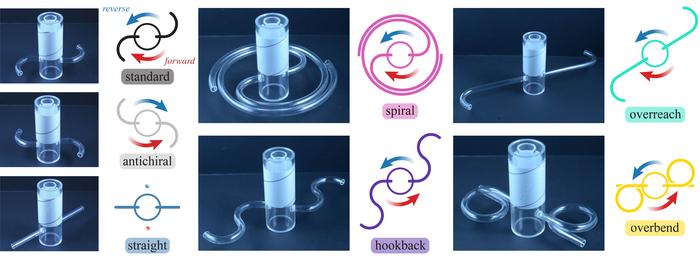
A diagram of a series of swirls and sprinkler shapes

The sprinkler designs studied, with the observed rotation direction in the forward (red arrow) and reverse (blue) modes. (Image credit: NYU's Applied Mathematics Laboratory)

In the process, they tore down both ideas. If Mach were right, the spiral design should have spun dramatically differently. If Feynman were right, reversing the nozzle bend should have flipped the sprinkler's direction. Neither happened.

"We were forced to say, 'Feynman and followers, you guys are off,'" Ristroph told Live Science.

The spiral-armed sprinkler, meant to test Mach's theory, was just as unyielding. Even though the fluid inside carried substantially more angular momentum, "the solid barely cared," Ristroph said.

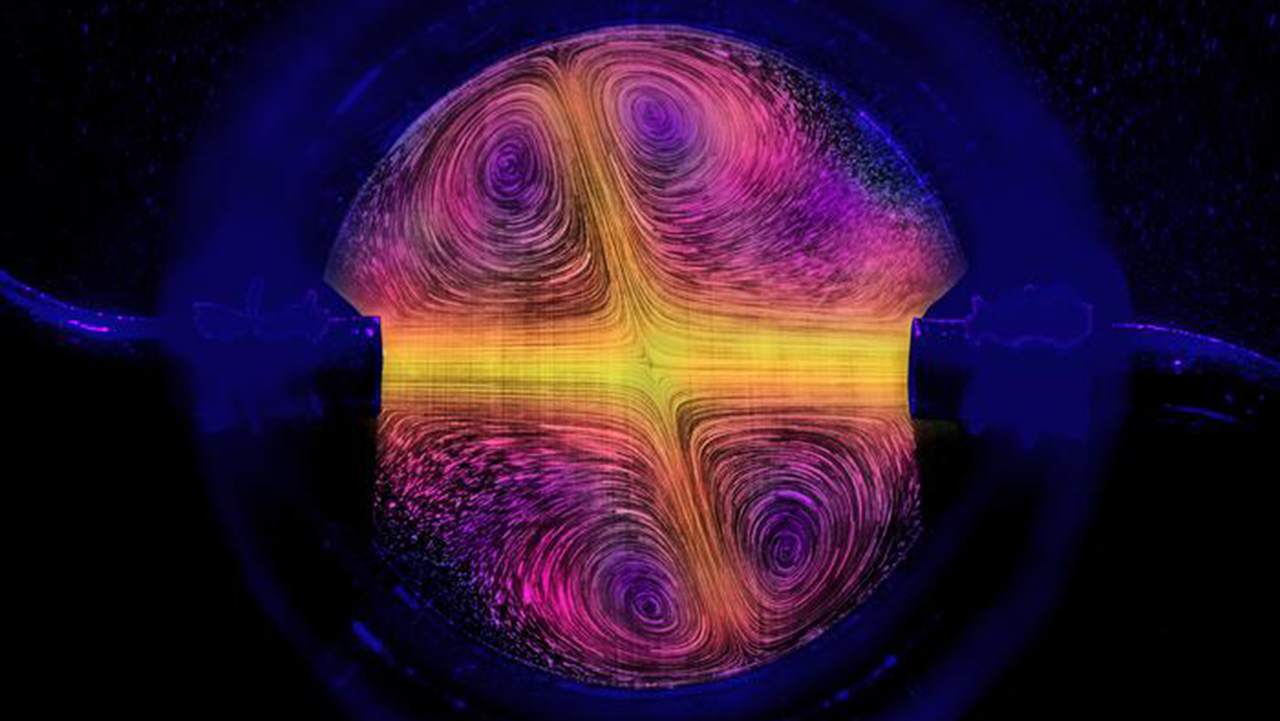
All three measurements across the seven designs pointed instead to the sprinkler's central hub, where the arms meet. There, incoming water collides and swirls, generating a flux of angular momentum inside the device that the solid structure pushes back against. The finding suggests that the reverse sprinkler is not much more than an inside-out version of a forward sprinkler governed by the same physics playing out at the opposite ends of the arms.

Ristroph emphasized that this result was made possible because of Jesse Smith, who just completed his physics doctorate at NYU while working on the project, along with a small team of Ristroph’s own students, and Ristroph's longtime collaborator Brennan Sprinkle, a computational fluid dynamics expert at the Colorado School of Mines whose surname is a coincidence.

Now, the team is building computer simulations to test whether the momentum-flux model holds up beyond the flow conditions already studied, and they hope to eventually derive it from fundamental fluid dynamics equations.

Ristroph said this "silly" problem does have real-world applications: Understanding how curved channels convert fluid flow into rotational force could inform the design of turbines and other devices that harvest energy from wind and water currents.

"If we can do something that would help with engineers designing devices to better make use of all the huge amounts of wind and water energy we have all around us," he said, "that would be, of course, a fantastic thing."

  •  

Are quasiparticles real?

Beyond familiar particles such as electrons and protons, scientists have discovered a zoo of "quasiparticles" with exotic names, such as magnons, angulons, dropletons and polaritons. But what are quasiparticles, exactly? And given the "quasi" in their name, are they considered real particles?

One way to understand quasiparticles is to explore what a particle is. The standard mental picture of a particle "is of a discrete object, like a ball," Douglas Natelson, a condensed matter physicist at Rice University in Houston, told Live Science. However, this classic image of particles changed with the advent of quantum physics, which revealed that the universe becomes fuzzy at its smallest levels. For example, in 1924, French physicist Louis de Broglie showed that particles such as electrons could also behave as waves β€ͺ—‬ a discovery that earned him a Nobel Prize.

Modern physics suggests that particles are excitations in fields that permeate the entire universe, a bit like a ripple in a pond, Ross McKenzie, a theoretical condensed matter physicist and professor emeritus at the University of Queensland in Australia, told Live Science. Each type of particle has its own corresponding field. For instance, photons of light are ripples of the electromagnetic field, McKenzie noted.

The quantum nature of particles means they can not only fly through an empty vacuum but also ripple through matter. For instance, photons can zip through transparent and translucent materials, and electrons can flow inside wires.

Sign up for our newsletter

Life's Little Mysteries logo with a question mark in a magnifying glass

(Image credit: Marilyn Perkins / Future)

Sign up for our weekly Life's Little Mysteries newsletter to get the latest mysteries before they appear online.

If you can picture a standard particle, such as an electron, as a ripple traveling within a material, you can also envision other kinds of excitations within matter. These other types of ripples are quasiparticles.

For example, think of "the wave" done at a sporting event. "You can watch it propagate around a football stadium; it has a location and a speed," Natelson said. "It only exists within the stadium, though, and it's made up of the collective response of all the interacting fans."

In much the same way, "quasiparticles can only exist within some medium or material, because they are built up from the response of that material's constituents or building blocks," Natelson said; in contrast, particles such as electrons and protons "can exist in free space."

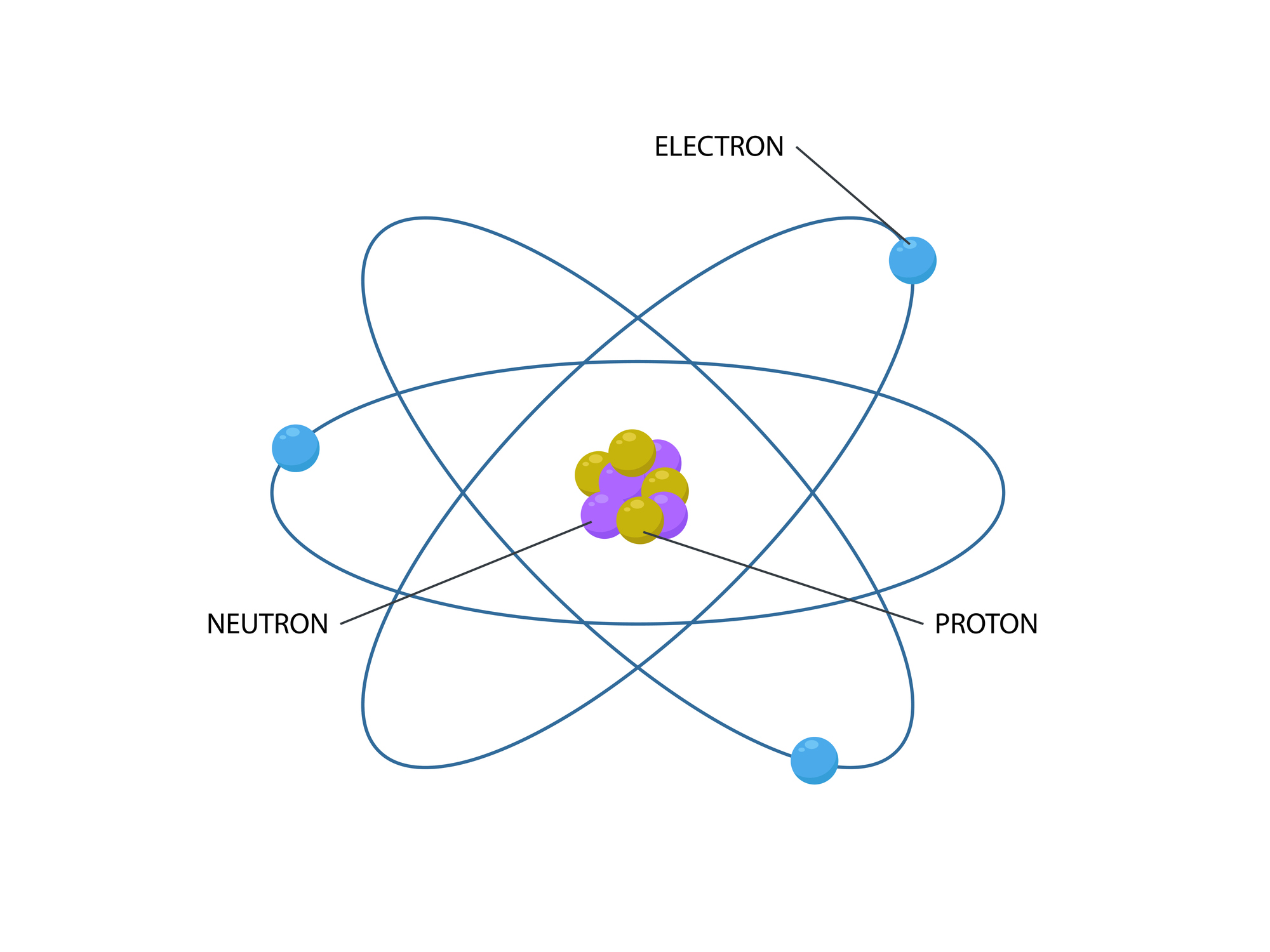
An illustration of an atom with a nucleus of protons and neutrons in the center and electrons orbiting around it

Electrons have a negative charge and orbit around the nucleus of an atom. (Image credit: agung fatria viaGetty Images)

In other words, quasiparticles can't exist in a vacuum and they can't exist on their own. They're reliant on particles acting together and being in a material where they can emerge, just as a wave carried out in a stadium can only exist when there is a group of people there who can perform it.

A philosophical question concerning quasiparticles is whether they are real, McKenzie noted. After all, "quasi" in Latin means "almost."

"Fundamental particles can exist in isolation in a vacuum, and quasiparticles need many interacting particles to exist," McKenzie said. "Still, I would say quasiparticles are, for all intents and purposes, just as real as particles, in how you can detect them and manipulate them."

A zoo of quasiparticles

The concept of quasiparticles originated with theoretical physicist Lev Landau in the 1950s, McKenzie said, and the idea ultimately helped Landau win the Nobel Prize in physics in 1962. Scientists have now proposed the existence of dozens of quasiparticle types, including the following:

  • The phonon, which is a quasiparticle of sound β€” it is the smallest packet of vibrational energy that makes up sound in matter, McKenzie said.
  • The electron hole, often simply called a hole, is the positively charged vacancy left behind once an electron has left its original place, McKenzie noted.
  • The electron quasiparticle, which essentially consists of an electron and its interactions with its surrounding environment. This combined package means the electron quasiparticle requires more force to move, so it effectively has more mass than a regular electron, McKenzie explained.
  • The exciton, a quasiparticle made of an electron and a hole orbiting each other.
  • The anyon, a kind of quasiparticle so far only seen in two-dimensional systems, which may carry only a fraction of an electric charge.

"How many kinds of quasiparticles are there?" McKenzie said. "Just like there are an infinite number of possible states of matter, I would say that, in principle, there are an infinite number of types of quasiparticles."

Scientists describe activity in material as quasiparticles "because it simplifies everything dramatically," McKenzie said. In the same vein, Natelson said that "very often the math behind physical phenomena in solids is described well by quasiparticles."

Quasiparticles are not simply useful for bookkeeping. For instance, researchers typically describe the behavior of electricity in electronic devices in forms of quasiparticles such as holes and excitons, Natelson said.

All in all, the answer to the question of whether quasiparticles are real is a matter of interpretation. If the question is whether or not a quasiparticle is an elementary particle such as an electron, the answer is no β€” they cannot exist on their own, and they depend on the materials in which they manifest.

However, if the question is whether or not quasiparticles are real phenomena, the answer is yes β€” they are things that scientists can measure that can behave like particles and effectively have many of the same properties that other particles do.

  •  

Fields Medal 2026 winners include mathematician Hong Wang β€” the third woman to ever win in the award's 90-year history

The 2026 Fields Medal, one of the world’s most prestigious mathematics prizes, has just been awarded to four pioneering young researchers β€” including mathematician Hong Wang, the third woman ever to win the prize in the 90 years since the award was established.

The Fields Medal is an award presented every four years to mathematicians under the age of 40 for their outstanding discoveries. The International Mathematical Union announced Thursday (July 23) that Wang, a professor at New York University, is among the four recipients of the 2026 medal for her work on a decades-old conjecture about how needles move in 3D spaces. .

The 2026 Fields Medal winners also include Yu Deng of the University of Chicago, who was recognized for connecting microscopic and macroscopic descriptions of gases; John Pardon of Stony Brook University, whose work solved major problems in topology and geometry; and Jacob Tsimerman of the University of Toronto, who developed powerful new techniques in algebraic geometry that have advanced progress on longstanding mathematical puzzles.

Wang joins an exceptionally small group of women to receive the Fields Medal. Iranian mathematician Maryam Mirzakhani was the first, in 2014, followed by Ukrainian mathematician Maryna Viazovska in 2022. No woman received the award at all in the nearly 80 years before Mirzakhani's win.

Four people stand on stage

The four 2026 Fields Medal honorees. From left to right: Yu Deng, John Pardon, Jacob Tsimerman, and Hong Wang. (Image credit: ERIN BLEWETT via Getty Images)

Wang was recognized for her work on the Kakeya conjecture, a problem that asks how little space is needed to rotate a needle so that it points in every possible direction in three dimensions. Mathematicians had chased a solution for roughly 50 years.

Working with collaborator Joshua Zahl, Wang showed that if you track every direction the needle could point as a bundle of thin tubes, there's a precise trade-off between how thin those tubes are and how much total space they must occupy. Solving the puzzle required tools from harmonic analysis, a field that studies how complex shapes and signals can be broken down into simpler pieces.

The proof wasn't a triumphant moment for Wang, at least not right away. She and Zahl spent months checking their 127-page proof before making it public β€” and even then, Wang worried that their argument might be unclear. The paper nonetheless earned comparisons to a "once-in-a-century" result and set off a string of honors culminating in the Fields Medal, according to Quanta Magazine.

The 2026 Fields Medals were presented during the International Congress of Mathematicians in Philadelphia. The first Fields Medal was awarded in 1936. So far, 65 men have received the award.

  •  

Science word of the day: Cryptology

Science word of the day: Cryptology

Pronunciation: Krip-TAH'-leh-jee

What it means: Cryptology is the study of secret codes β€ͺ—‬ both making them (cryptography) and breaking them (cryptanalysis). Once associated with spy networks' secret codes and ciphers, cryptology now often refers to the computer algorithms used to encrypt data to protect passwords and personal information from prying eyes.

How to use it in a sentence: Native American soldiers known as "code talkers" harnessed cryptology in World War II by developing codes and ciphers based on their Indigenous languages.

Can you crack our science word of the day puzzle, Chain Word?

  •  

Nobel Prize-winning physicist and team use Claude AI to solve decades-old math puzzle

Two physicists have used generative artificial intelligence (AI) to solve a stubborn mathematical problem in physics that had vexed researchers for more than a decade.

Their solution, described July 1 in the Journal of Statistical Mechanics: Theory and Experiment, came about when the physicists chose to revisit a problem they thought they had attempted to solve exhaustively within a topic they knew intimately. This concept, known as jamming, refers to the sudden transition from a fluid system to a rigid-but-disordered one.

The simplest way to understand this idea is to imagine a pool table covered with billiard balls. If you keep adding balls, eventually the table becomes so congested that there is no space for any more and each ball on the table is securely held in place by its neighbors. This is a disordered, completely frozen situation known as a jammed state.

The study authors —‬ β€ͺGiorgio Parisi, winner of the 2021 Nobel Prize in physics, and Francesco Zamponi, β€ͺboth physicists at the Sapienza University of Rome β€ͺ—‬ and collaborators had mathematically described jamming and offered numerical solutions in a 2014 paper. In the process, they noticed that two parameters β€” $a$ and $b$ β€” would mysteriously always add up to 1.

"The parameters $a$ and $b$ dictate exactly how the distribution of contact forces and small gaps [between balls] scales as the physical system hits that critical jamming point," Zamponi told Live Science in an email. "We were quite bothered by the fact that we had never been able to mathematically prove the relation $a+b=1$."

Moreover, separate work by Matthieu Wyart, a physicist at the Swiss Federal Technology Institute (EPFL), took a completely different approach but yielded the same relation. For Zamponi and colleagues, this suggested "entirely new physical concepts" were needed to link their and Wyart's work and simultaneously explain why $a+b=1$.

Fast-forward a decade, and no progress had been made in finding these new concepts nor a reason for why $a+b=1$. Stuck in a rut, Parisi had a thought: perhaps generative AI could offer a fresh perspective. For this, he turned to Anthropic's Claude. After Claude successfully reproduced the 2014 numerical result, Parisi prompted the AI to prove why $a+b=1$.

A close up of a phone with a white screen saying

The researchers prompted Claude 40 times in order to get a publishable solution to the jamming problem. (Image credit: NurPhoto via Getty Images)

"Giorgio initially sent me Claude's output while I was traveling, so I ended up reviewing it on an airplane," Zamponi recalled. "As I read through the LaTeX file Claude generated, it became immediately clear that the core idea was correct … That moment significantly shifted my perspective on what these models can achieve in theoretical physics."

Though the initial output contained some errors that required revision, the fundamental idea was correct. And in a total of just 40 prompts, the researchers had a verified publishable analytical solution. To their surprise, this solution was hidden directly within the equations themselves; they didn't need any external physical assumptions or deep connections between functions.

"It is entirely possible that a pure mathematician who works full time on such kind[s] of equations might have spotted the solution," Zamponi told Live Science. "But this is a particularly interesting point for us, as it highlights how Claude gave us instant access to a vast repository of mathematical training and formal skills that lay just outside our usual domain."

Whether Claude simply trawled the vast mathematical literature and used pattern matching to find a way to solve their problem or if it applied something akin to creativity is, for Zamponi, moot because they "could not see the path forward, and Claude did," he said. And although he admitted that interacting with AI forces him to reconsider his definitions of reasoning, intuition, and creativity, Zamponi will continue to collaborate with the technology to speed up mundane tasks and provide fresh perspectives on challenging problems.

Now, Zamponi is applying this collaborative approach to a problem involving the β€œrandom sequential addition of hard hyperspheres," he said. β€œIt is another excellent case study because, while the AI drastically accelerates writing and optimizing code, I have had to provide the vast majority of the conceptual ideas, which suggests that human guidance remains indispensable, at least in this case."

  •  

'Smaller than the tiniest scale in nature': Physicists made a black hole out of light and used it to test Stephen Hawking's elusive radiation theory

Physicists have coaxed a black hole's most famous glow out of a strand of optical fiber and, for the first time, watched that light react back on the simulated black hole that produced it.

The result gives researchers a rare, hands-on look at Hawking radiation β€ͺ—‬ the faint thermal emission that Stephen Hawking predicted should leak out of black holes β€ͺ—‬ and offers a first clue about the tiny push that could, in principle, make a real black hole slowly evaporate, the research team said in a new study.

Working with a tabletop experiment in optical fibers, the international team detected both the radiation and its long-sought "back reaction" β€” the way the radiation feeds energy back and reshapes the object that created it.

According to the new study, published July 1 in the journal Nature, the light behaved exactly as Hawking predicted it should: like the glow of a warm object, with a definite temperature and a spectrum that fades away steadily toward higher frequencies. It did so even in a regime where the usual textbook description of a black hole should break down.

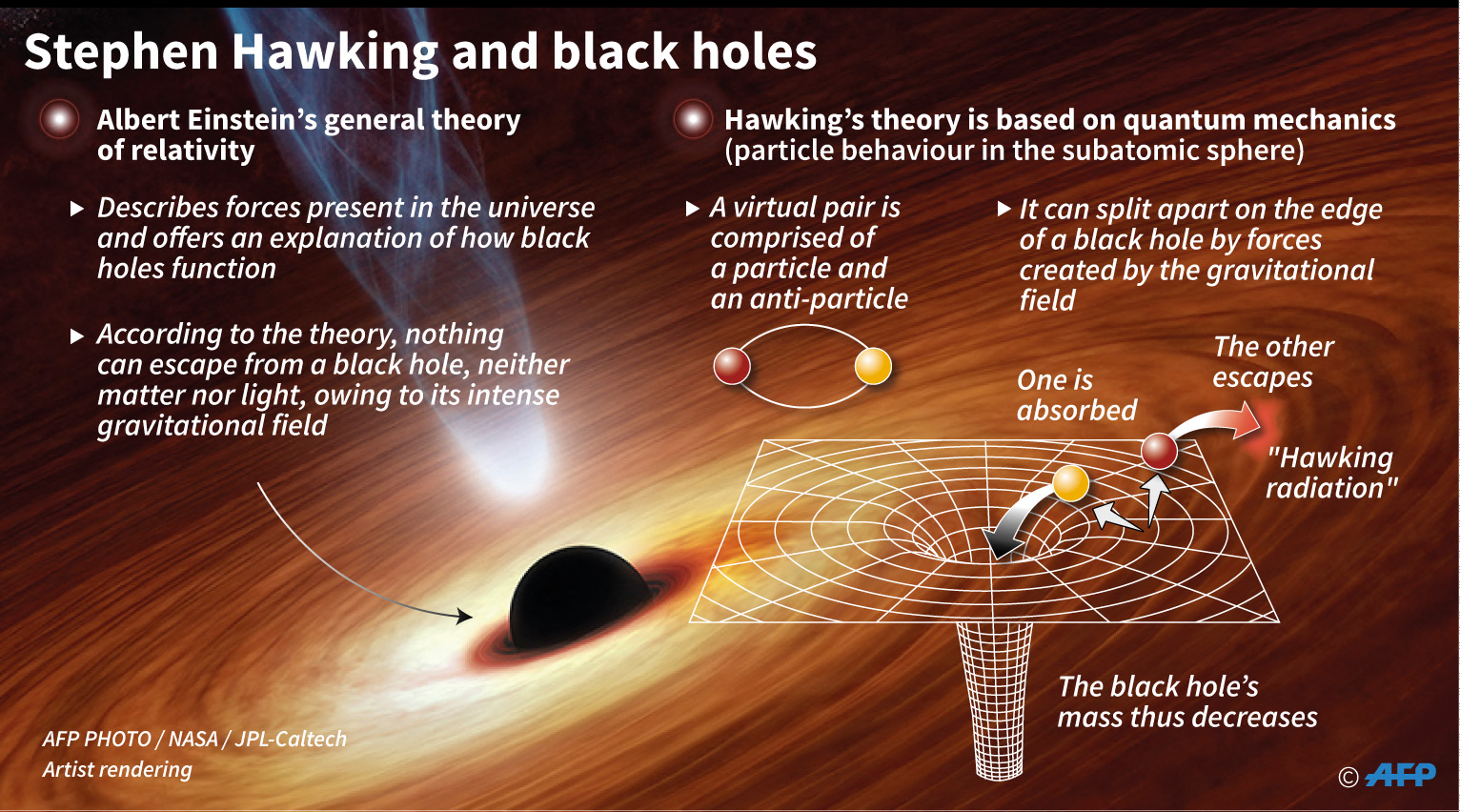
Illustration of two theories by Einstein and Hawking regarding black holes (Graphic by AFP)

An infographic explaining how Hawking radiation works, contrary to the predictions of general relativity. (Image credit: ALAIN BOMMENEL,VALENTINA BRESCHI,WILLIAM ICKES via Getty Images)

Where three great theories collide

Hawking radiation is famous because it sits at the crossroads of physics' biggest ideas.

"Jacob Bekenstein predicted that black holes have an entropy and a temperature, and Hawking calculated the thermal radiation of the black hole," study co-author Ulf Leonhardt, a physicist at the Weizmann Institute of Science in Israel, told Live Science via email. "In Hawking-Bekenstein radiation, quantum physics, general relativity and thermodynamics come together β€” subjects that are normally in conflict with each other."

The conflict runs deep: General relativity pictures space and time as smooth and continuous, while quantum mechanics describes a world of discrete, unpredictable jumps β€ͺ—‬ and no one has managed to fully reconcile the two.

That combination is exactly what makes Hawking radiation so hard to study. Astronomers have never seen Hawking radiation from a real black hole and probably never will; the glow is far too faint to pick out across the cosmos. So physicists have turned to laboratory stand-ins that obey the same equations, building black hole analogues out of flowing water, ultracold atoms and, as in this study, light.

A man in an electronic wheelchair stands in front of a projector screen with various space images on it

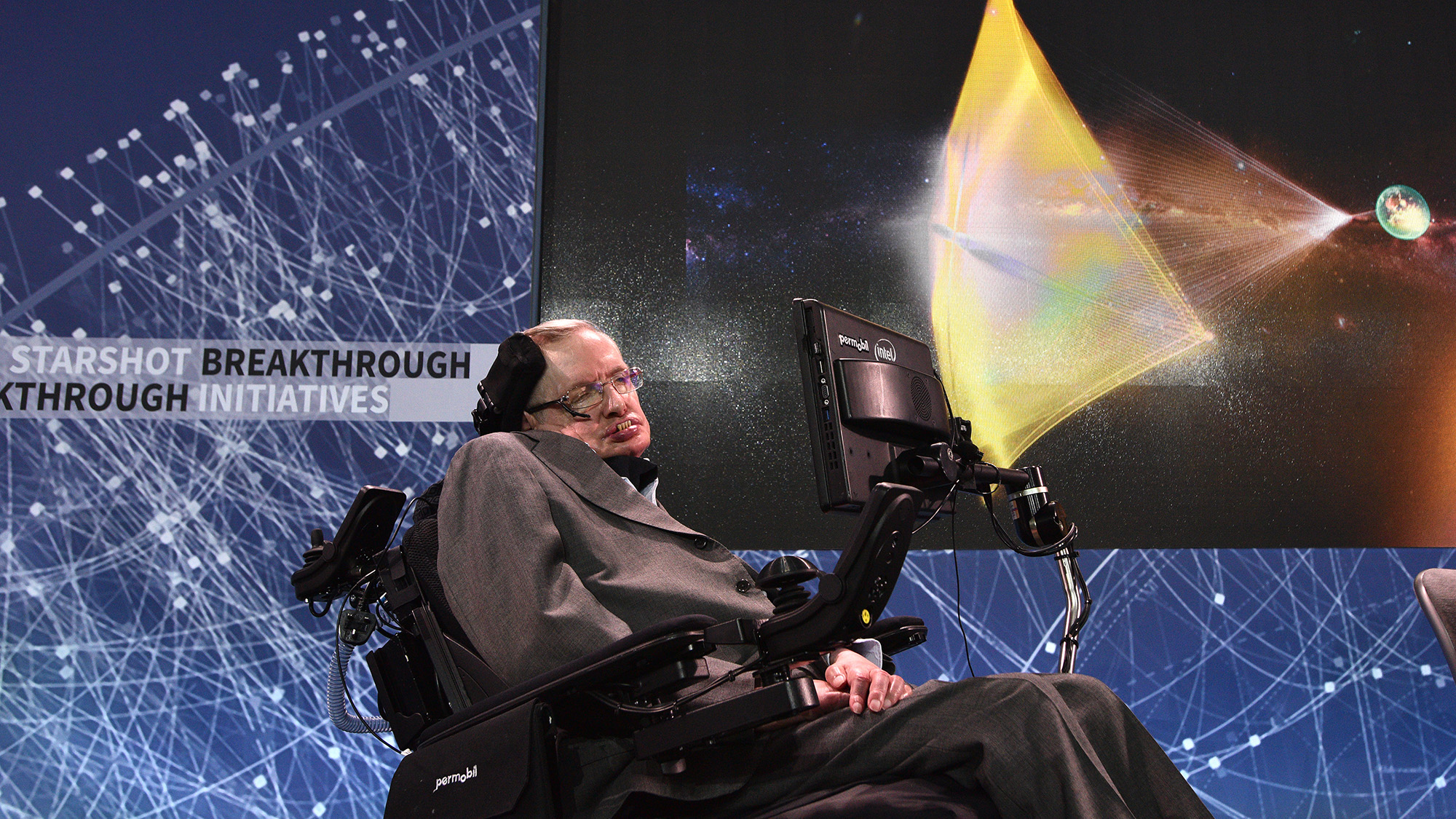
Physicist Stephen Hawking that black holes should be able to lose information through an elusive type of radiation. New research zooms in on the mechanism that makes it possible. (Image credit: Bryan Bedder / Stringer via Getty Images)

Building a black hole from light

The trick behind every black hole analogue is a moving medium. "Imagine a swimmer in the sea with a current faster than he can swim," Leonhardt explained. "He is swept away. This is what happens beyond the [event] horizon, and this is why normally nothing can escape the black hole."

A black hole's event horizon is the boundary where that current β€” space itself, in real life β€” starts moving faster than anything can travel. To recreate it, the team needed a material that appears to rush along at the speed of light. Their solution was elegant: use light to make the "material."

"In optics we need a material that appears to move at the speed of light," Leonhardt said. "For this we use light itself β€” in nonlinear optics, light acts like a material."

In practice, the researchers fired an intense, ultrashort "pump" pulse into a thin photonic-crystal fiber β€” a strand of glass threaded with a pattern of tiny air channels running along its length, which lets researchers fine-tune how light moves through it. As it traveled, the pulse slightly changed how the glass bent light, creating a moving speed bump that raced along with it. A second, much weaker "probe" pulse then ran into this moving front. Where the probe could no longer keep up, an artificial horizon formed β€” and the black hole analogue was born.

Catching the glow and its pushback

The payoff came in the ultraviolet. According to theory, Hawking radiation is created in pairs: One partner escapes, while the other, carrying "negative" energy, is the mirror image that would fall into a real black hole. In the fiber, that partner showed up as ultraviolet light.

"We counted photons in the ultraviolet that correspond to the Hawking partners beyond the horizon," Leonhardt explained. "They have a wavelength around 233 nanometers. This was our signal."

Just as important as seeing the glow was understanding how it was made. For years, researchers assumed the fiber built up its Hawking radiation through a cascade β€” a chain of separate steps in which the light is converted first into one intermediate form, and then another, each feeding the next before the radiation finally emerges. The team found that, instead, a single, direct interaction does the job, with the pump and probe light producing the Hawking pair in one clean step. It is a much simpler picture that the researchers said may carry over to other analogues and perhaps even to real black holes.

Because energy has to come from somewhere, making Hawking radiation should nudge the source that created it. For a real black hole, that nudge is how it loses mass and, over unimaginable timescales, evaporates entirely β€” the process Hawking described in his landmark 1974 paper. No experiment had ever captured that recoil.

Here, the team saw it. Producing the radiation shifted a small fraction of the pump pulse's own light to a slightly different color, leaving a telltale lopsided pattern in the spectrum. That asymmetry, absent in earlier experiments, is the fingerprint of the back reaction, or recoil β€” the black hole analogue quietly paying the energetic price for its own glow.

The road to a quantum experiment

The result also speaks to one of the thorniest puzzles in black hole physics: the trans-Planckian problem. Trace Hawking's radiation back to where it was born and the calculation runs into territory no physicist can vouch for β€” the Planck scale, the vanishingly small size at which space and time are thought to lose their familiar meaning and all known physics gives out. Hawking's prediction, in other words, appears to rest on a foundation that may not exist.

"Any light getting away from the horizon is stretched out enormously," Leonhardt said. "So it must come from waves smaller than the tiniest scale in nature, where the physics is unknown. Would that still give Hawking radiation? That was the question, and we have answered it in our experiment." Remarkably, the glow stayed perfectly thermal even in this extreme regime.

The team's next step is concrete. So far, they have used ordinary laser light, which reproduces the spectrum of Hawking radiation but not its deepest quantum weirdness. Next, the team plans to "go quantum," Leonhardt said. "We will explore how to get into the quantum regime and observe quantum features such as entanglement" β€” the ghostly link that should tie each escaping Hawking particle to its lost partner.

See how much you know about black holes with our black hole quiz!

  •  

Was Einstein wrong about anything?

Albert Einstein gave us the theory of relativity, explained the photoelectric effect and predicted the existence of gravitational waves. He revolutionized our understanding of space, time and gravity.

In fact, he is so famous for his brilliance that "Einstein" is synonymous with "genius." But being a genius doesn't mean you're infallible. So was Einstein wrong about anything?

"For sure, he was wrong about tons of things," NicolΓ‘s Yunes, a theoretical physicist at the University of Illinois Urbana-Champaign, told Live Science. "We remember him for the things he was right about, for the most part, because the things he was right about shocked the scientific world and eventually those ripples affected everyone on Earth."

Sign up for our newsletter

Life's Little Mysteries logo with a question mark in a magnifying glass

(Image credit: Marilyn Perkins / Future)

Sign up for our weekly Life's Little Mysteries newsletter to get the latest mysteries before they appear online.

For example, one of his most famous predictions was marred by a mathematical mistake. In 1916, Einstein correctly realized that the acceleration of matter could produce ripples in space-time that we now call gravitational waves. But when he and the physicist Nathan Rosen described these waves using mathematics, they ran into a problem: Any solution to the equations of general relativity that would allow for gravitational waves "blew up," Yunes said. "They had these singularities … these divergences. And solutions that diverge and explode like that, they can't be physical representations of reality."

As a result, Einstein changed his mind and decided that gravitational waves couldn't exist. He wrote up his results and submitted them to the journal Physical Review, which had recently begun sending papers to outside experts for peer review. An anonymous reviewer caught an error in Einstein's math, and when Einstein learned about it, he was so furious that he withdrew the paper and submitted it to a different journal.

But the reviewer had spotted a real error: Einstein's mathematical infinities were a coordinate artifact. Much like Earth's lines of longitude seem to converge to a "singularity" at the North Pole even though nothing unusual is happening there on the ground, Einstein's math could have been fixed by using a different set of coordinates.

Without Einstein's knowledge, the reviewer befriended and demonstrated the error to Einstein's assistant, who explained it to Einstein. Einstein corrected the error and republished the paper with the opposite conclusion, showing that gravitational waves do, in fact, exist.

An illustration of two dark spheres circling each other against a blue, grid-like surface.

Einstein originally thought that gravitational waves existed, then changed his mind when the math didn't work out. However, an anonymous peer reviewer named Howard Percy Robertson managed to secretly help Einstein fix his mathematical errors. (Image credit: MARK GARLICK/SCIENCE PHOTO LIBRARY via Getty Images)

Calculating "impossible infinities"

Remarkably, Einstein stumbled on the same error twice β€” at least, it seemed that way. When examining the mathematics around black holes, he once again calculated impossible infinities β€ͺ—‬ this time, at the edge of a black hole. And once again, he concluded that this must mean the object couldn't exist.

"Einstein remained skeptical of the existence of black holes," John D. Norton, a professor in the Department of History and Philosophy of Science at the University of Pittsburgh, told Live Science in an email. "He was resolute in his judgment that there would be a singularity in space-time already at the event horizon of a black hole, which is now merely regarded as marking the point of no return for those falling into a black hole."

But this time, Einstein was not convinced that he made a mistake. Norton argues this wasn't just stubbornness; it reflected a philosophical belief in how Einstein thought mathematics and physics should relate to each other.

"He was unmoved by alternative analyses that found his mathematical infinities to be merely artifacts of the particular mathematical methods he preferred," Norton said.

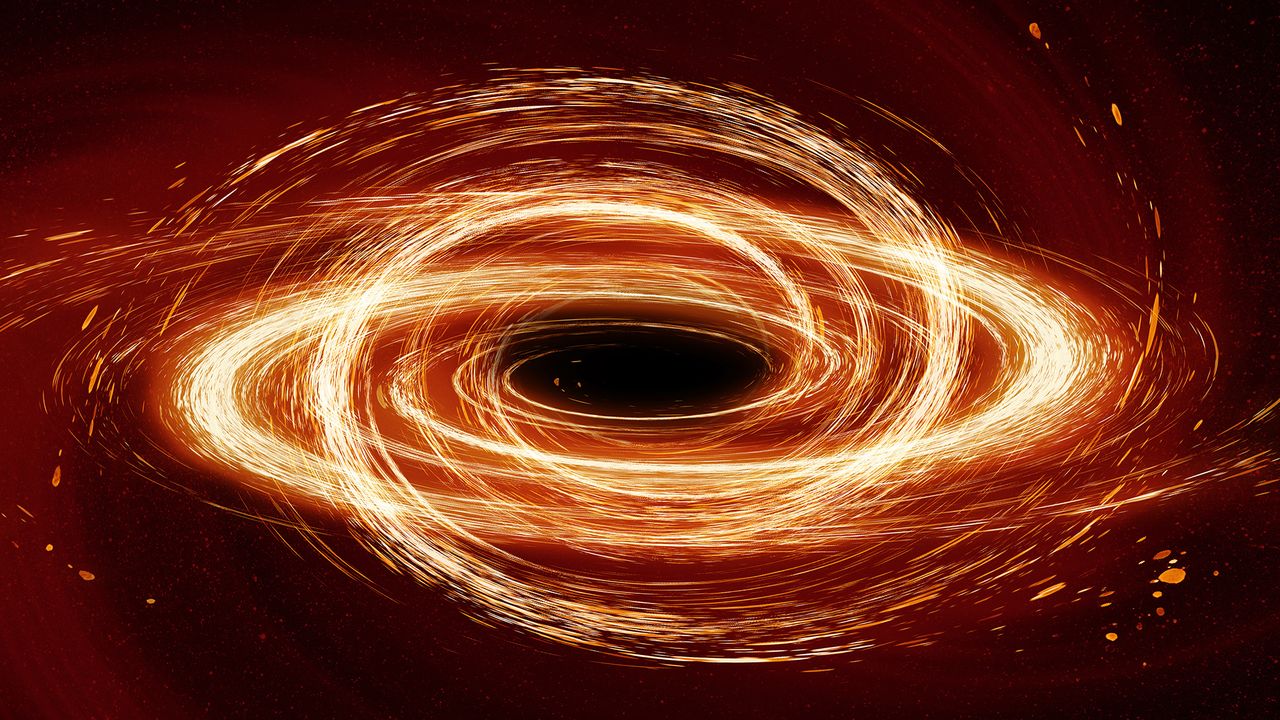
An illustration of a black sphere surrounded by glowing white gas in space

Einstein was skeptical of the existence of black holes (pictured here in a 3D render) because his math showed a breakdown in space-time at a black hole's edge. (Image credit: Cavan Images / Luca Pierro via Getty Images)

Einstein and quantum mechanics

Einstein's resistance to quantum mechanics is probably his most famous wrong turn. His central objection was to a phenomenon called quantum entanglement: the idea that two particles can be linked in such a way that measuring one instantly affects the other, no matter the distance between them. In a 1947 letter to his colleague Max Born, he wrote, "I cannot seriously believe in it because the theory cannot be reconciled with the idea that physics should represent a reality in time and space, free from spooky actions at a distance."

Einstein thought this instantaneous phenomenon seemed to violate special relativity, which says that nothing can travel faster than light. As a result, he believed quantum mechanics must be incomplete and that there was some deeper, unknown description of reality that would restore order.

"He died not liking quantum mechanics," Yunes said. It wasn't until 1964, almost a decade after Einstein's death, that John Bell proved entanglement was real.

"Today, a lot of the technology that we have relies on quantum mechanics, and so we know it's correct," Yunes said. "But it's still incompatible with general relativity, with [Einstein's] classical theory."

"It's possible that general relativity is wrong," Yunes said. "It's also possible that quantum mechanics is not the right description when you're talking about systems that are very strongly gravitating and you're looking at Planck-scale-type dynamics," which are incredibly small scales at which quantum effects dominate. For instance, the center of a black hole, which is both compressed to the quantum scale but also sits inside the most intense gravitational field in the universe, is a place where general relativity predicts a singularity that quantum mechanics has no way to describe.

But many of Einstein's mistakes still moved science forward. "General relativity is a good example," Norton said. "Einstein based it on the idea that he was generalizing the principle of relativity to acceleration and on what he soon called Mach's principle. Neither proved compatible with his final general theory of relativity."

Einstein's mistakes might come as a surprise to others, but they didn't to him. Once, when writing a book with his collaborator Leopold Infeld, Infeld told him he was taking special care with it because Einstein's name would appear on it. Einstein laughed and said, "There are incorrect papers under my name, too."

See how much you know about Albert Einstein with our Einstein quiz!

  •  

Science news this week: Time emerges inside a mini-universe, scientists thicken Arctic ice, and one of the oldest graves of a free Black person in the US found

This week's science news was filled with big discoveries from the world of the small, led by a physicist's creation of a mini-universe, which was designed so we can watch time emerge from within an isolated quantum system.

The experiment was performed using a Bose-Einstein condensate β€” a strange state of matter that consists of thousands of atoms blended into a single quantum object at near absolute zero (minus 273.15 degrees Celsius, or minus 459.67 degrees Fahrenheit). The system showed time speeding up, slowing down and even stopping, depending on what the system was doing.

Those weren't the only highbrow high jinks using a Bose-Einstein condensate we reported on this week. We also covered NASA's upgrade to its mini-fridge-sized laboratory on the International Space Station that will use the bizarre state of matter to probe the quantum world. Back on Earth, physicists also found that complex numbers aren't necessary for quantum mechanics to work and used quantum computers to create a rare material critical to nuclear fusion. And to stick with news from the small (and weird) things of the world, we also reported that scientists have created little diving suits to transform cockroaches into search-and-rescue cyborgs.

Arctic ice thickening shows promise

First experiment to thicken Arctic ice with seawater shows promise β€” but there's a big catch

A person walking through snow toward an air defence radar station in Cambridge Bay, Nunavut.

Researchers conducted the first real-life sea ice thickening experiments in Cambridge Bay, Nunavut. (Image credit: Arctic-Images/Getty Images)

The Arctic is the world's fastest-warming region, where sea ice is rapidly disappearing at a rate of 12.2% per decade.

The ice is crucial for maintaining stable sea levels and marine nutrient flows, and for reflecting solar radiation away from our planet, so its precipitous decline is deeply concerning. That's why one team of researchers turned to a surprisingly simple method to stem the ice loss: flooding ice sheets with seawater to thicken them.

The results, despite some major caveats, showed a lot of promise.

Discover more planet Earth news

β€”Extreme heat waves are making our cities buckle. Investing in urban nature is no longer optional.

β€”Colorful 'painting-like' ripples cover an ancient seafloor structure in the Bahamas β€” Earth from space

β€”'Uncharted territory': Record-high ocean temperatures confirmed for June as El NiΓ±o strengthens its grip

Life's Little Mysteries

Does fast charging damage your battery more than regular charging?

A close up of a phone showing 90% with a

Some types of batteries charge faster than others. (Image credit: Tfilm via Getty Images)

If you're as shamefully attached to your devices as I am, you may have wondered about the wildly differing times it can take for them to charge. So what's the science behind fast charging, and does it damage a device's battery more than regular charging does?

β€”If you enjoyed this, sign up for our Life's Little Mysteries newsletter

One of the oldest gravestones of a free Black person in the U.S. found

'One of the oldest gravestones of a free Black person in America' discovered in Boston

a grey gravestone in a barren landscape with a death's head decoration and inscription

The gravestone of "Boston," a formerly enslaved man who died in the 18th century in Boston, Massachusetts. (Image credit: Boston Parks and Recreation Department)

It was found amid photos of headstones during a restoration project at Boston's Granary Burying Ground β€” a gravestone with only one name, "Boston."

That's how a team of conservationists chanced upon the tombstone of Sebastian, a formerly enslaved man who died free in 1729 and chose the city's name as his own.

A search through the historical archives has produced a wealth of information about Boston's past, including his reputation as a hardworking handyman throughout the city, and his emancipation following the death of the man who held him in slavery.

"It's been there all along. We just had to go look and share the story," Michelle Wu, the mayor of Boston, said in a July 4 speech.

Discover more archaeology news

β€”100,000 years ago, one of the earliest Homo sapiens outside Africa was stabbed in the face, analysis finds

β€”6,000-year-old broken ribs discovered in Syria may be one of the oldest known cases of child abuse in the world

β€”Neanderthals and modern humans may have shared culture 59,000 years ago in Turkey, study finds

Also in science news this week

β€”New sodium metal battery design charges in just 4 minutes and retains its capacity for years

β€”Dirty 'button' unearthed by metal detectorist turns out to be a rare 900-year-old coin from Norway's last Viking king, Magnus Barefoot

β€”'Astronomers have to revise estimates': The Milky Way may be larger, heavier and more lopsided than we realized

β€”2,500-year-old tomb of a 'warrior prince' with chariot and helmet discovered on Italy's Adriatic coast

β€”Malaria had nearly been eliminated around a giant dam in the Amazon β€” but then it came roaring back. Experts just discovered why.

Science interview

'800 seconds for a sick visit': Some factors driving antibiotic resistance have nothing to do with biology, says medical sociologist Julia Szymczak

A person puts a stethoscope on a stuffed toy

Decisions around antibiotic prescribing aren't driven only by medical knowledge β€” emotions also play a role, a medical sociologist explains. (Image credit: Angel Santana via Getty Images)

Antibiotic resistance continues to pose a growing danger across the U.S., with more than 2.8 million antimicrobial-resistant infections occurring in the country each year. Last week, we brought you a report from Live Science health editor Nicoletta Lanese, who visited Japan to investigate how that country is curbing its overuse of antibiotics.

Now, in the second part of a feature series into the fight against this "silent pandemic," Nicoletta interviewed medical sociologist Julia Szymczak to dig into the social and emotional drivers of antibiotic overprescription.

Something for the weekend

If you're looking for things to keep you busy over the weekend, here's a selection from our best opinion pieces, interviews, diagnostic dilemmas and crosswords that we published this week.

β€”Superintelligent AI in space could explain the Fermi paradox [Opinion]

β€”'It's more than a hope; it's a guarantee': The Vera C. Rubin Observatory's 10-year movie of the universe is about to 'blow our minds,' chief scientist Tony Tyson says [Interview]

β€”Diagnostic dilemma: A woman heard voices for years β€” but not because of psychosis [Diagnostic Dilemma]

β€”Live Science crossword puzzle #51: Largest rodent on Earth β€” 4 down [Crossword]

Science photo of the week

Secretive Chinese probe snaps first photo of Earth's mysterious 'quasi-moon' β€” and it may pose a big problem

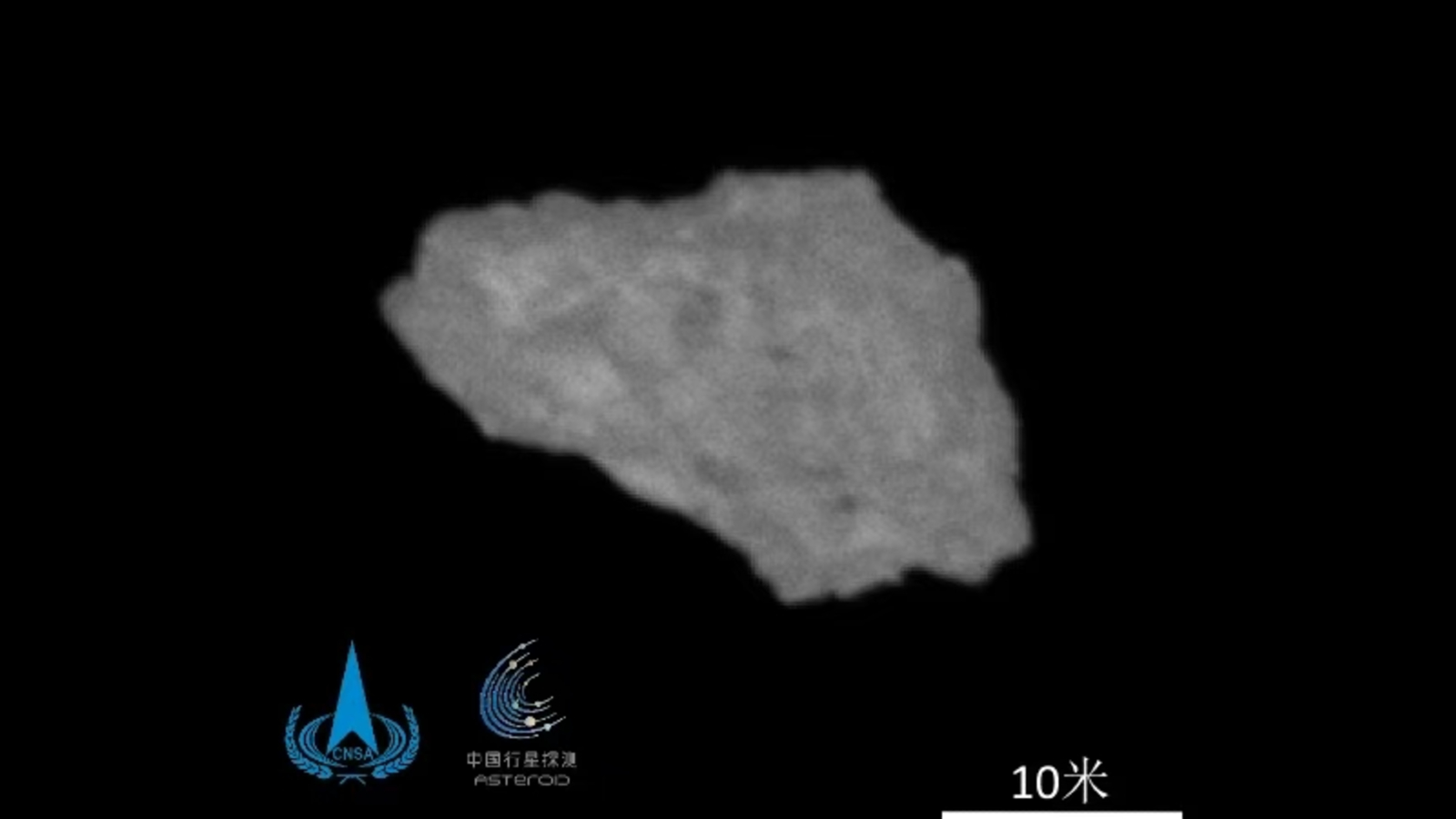
A blurry photo of a grey asteroid in the vacuum of space with Chinse logos superimposed on top

China's Tianwen-2 spacecraft captured this photo of the quasi-moon Kamo'oalewa (a.k.a. 2016 HO3) at a distance of around 12.5 miles (20 kilometers) from the near-Earth asteroid. (Image credit: CNSA)

It doesn't look like much, but this blurry, gray image is the first-ever close-up photo of one of Earth's temporary "quasi-moons" β€” a fast-spinning asteroid temporarily orbiting the sun in sync with our planet.

Of equal intrigue is the spacecraft that took the image: a secretive Chinese probe that is likely gearing up to land on the space rock and snag a sample β€ͺ—‬ although an unexpected hiccup will make that more difficult.

Follow Live Science on social media

Want more science news? Follow our Live Science WhatsApp Channel for the latest discoveries as they happen. It's the best way to get our expert reporting on the go, but if you don't use WhatsApp we're also on Facebook, X (formerly Twitter), Flipboard, Instagram, TikTok, Bluesky and LinkedIn.

  •  

NASA is creating a fifth state of matter on the ISS, thanks to an upgrade to a mini-fridge-sized quantum lab

A new upgrade to the International Space Station's (ISS) quantum laboratory is enabling NASA to probe the behavior of atoms further than ever before, the space agency has announced.

Combining the ISS's newly upgraded "Cold Atom Laboratory" with the near zero-gravity of low Earth orbit, scientists are attempting to understand the properties of so-called "ultracold" atoms in an environment impossible to replicate on Earth. The aim of the mission is to study how clouds of atoms behave at temperatures close to absolute zero (minus 459.67 degrees Fahrenheit or minus 273.15 degrees Celsius) β€” the coldest possible temperature in the universe, where atoms lose all their energy of motion.

"At the coldest temperatures, matter behaves drastically different from anything we have experienced," Jason Williams, project scientist for the Cold Atom Lab at NASA’s Jet Propulsion Laboratory in Southern California, which built the facility, said in a statement. "The wavelike nature of matter dominates, and ultracold matter can behave in ways that are not only unexpected, but that also enable extremely precise measurements of time, gravity, and motion. The lab has lots of tools β€” especially with this latest upgrade β€” to let us probe the nature of the universe."

Rule-breaking particles

Atoms and their subatomic particles are quantum mechanical objects whose behavior is fundamentally different from that of the large-scale world. For example, the laws of quantum mechanics predict that particles can be in more than one place at the same time (quantum superposition); can be mysteriously linked with each other over great distances (quantum entanglement); and move through spacetime as waves as well as moving like fixed, solid objects.

But observing these behaviors is notoriously difficult. Firstly, atoms are so tiny that if an atom were the size of a golf ball, then a human teeing one off would stand roughly as tall as the distance from Earth to the moon. Secondly, it’s impossible to isolate measurements of these behaviors for atoms in "normal" environments (like on Earth), as the desired quantum behavior is disturbed by energy from heat and gravity.

To overcome these challenges, the ISS's Cold Atom Laboratory β€” which is the size of a mini-fridge β€” uses lasers to cool gases of rubidium and potassium to just above absolute zero. At these temperatures, atoms form a state of matter known as a Bose-Einstein condensate, in which many atoms behave like a single wave of quantum matter.

Not only does this setup allow scientists to observe quantum behaviors on a much larger scale than that of single atoms, but the reduced gravity enables the condensate matter waves to expand and evolve undisturbed for much longer periods than would be possible on Earth.

This is the fourth major upgrade to NASA’s Cold Atom Laboratory since it arrived aboard the ISS in 2018. According to NASA, the significant improvements in this most recent upgrade include a redesigned magnetic trap to contain the cloud of atoms, improved atom sources, and better measurement capabilities.

Scientists launched these upgrades to the ISS in April 2026, and they have since been installed, switched on, and started making state-of-the-art measurements. As well as enabling novel tests of fundamental physics, measurements of these effects are critical in demonstrating future, space-based, highly precise quantum technologies related to positioning, navigation, timing, and gravity sensing. These technologies could one day enable astronauts to navigate on the moon without GPS and produce high-precision maps of Earth’s gravity.

"In the previous century, there was a quantum revolution that led to lasers, cellphones, and MRIs for medical imaging," Ethan Elliott, deputy project scientist at NASA’s Jet Propulsion Laboratory in California said in the statement. "We’re performing Quantum 2.0 – direct manipulation of large quantum states – and we hope for similar gains in quantum technology by advancing this science in orbit."

  •  

'Complex numbers are not needed for quantum mechanics': Physicists develop quantum model that uses only 'real' numbers for first time ever

For the first time, physicists have built a working version of quantum mechanics without complex numbers β€” numbers that have been considered essential to the theory for nearly a century.

Complex numbers combine a regular "real" number with an "imaginary" one β€” a multiple of the square root of -1, represented by the symbol i β€” into a single value, like 3 + 4i. The square root of -1 doesn't correspond to any quantity you could count or measure directly (you can't have negative one apple, for instance), which is why mathematicians call it imaginary.

Still, complex numbers have many useful applications. Engineers use them to describe alternating electrical current. Physicists use them to describe waves. And ever since quantum mechanics was first documented in the 1920s, complex numbers have been built directly into its equations. Quantum mechanics describes particles using something called a wave function, and that description relies on complex numbers.

In 2021, a team of physicists predicted that a version of quantum mechanics built with only real numbers would make incorrect predictions in certain experiments involving multiple particles. The following year, other researchers ran those experiments, and the results matched standard quantum mechanics, not the real-number version. Complex numbers seemed unavoidable.

But that 2021 result rested on one specific assumption: a particular mathematical rule for combining particles. That led physicists to ask a question: Are complex numbers actually necessary to describe reality at the quantum level, or are they just a convenience?

Now, in a new study published June 18 in the journal Physical Review Letters, researchers have found a way around the 2021 result.

"Complex numbers are not needed for quantum mechanics," study first author Pedro Barrios Hita, a theoretical physicist and doctoral student at the German Aerospace Center and Heinrich Heine University DΓΌsseldorf, told Live Science.

A different rule

The 2021 result relied on a specific mathematical rule called the tensor product, which combines two separate quantum systems into one. If you have two particles and you want to combine them into a single mathematical description, you can use the tensor product. It's a rule taught in every quantum mechanics textbook.

It works well for ordinary complex-number quantum mechanics, but past attempts to build a real-number version around that same rule ran into trouble. They couldn't reproduce the correlations seen in experiments involving three or more entangled particles.

In their new study, Barrios Hita and his colleagues found that the tensor product isn't the only option. They built quantum mechanics around a different rule based on an idea: An action taken on one part of a system shouldn't have any effect on a separate part of it.

3d rendered image of quantum entanglement.

Entanglement is just one aspect of quantum mechanics that seems to defy reality. Now, the math behind such phenomena can be expressed with only "real" numbers for the first time. (Image credit: koto_feja/Getty Images)

In ordinary quantum mechanics, multiplying a particle's state by i is undetectable on its own. But when two particles combine, that i can shuffle over and effectively attach itself to the other particle instead. Physicists call this phase kickback, and it's built automatically into the tensor product.

Barrios Hita's team had to recreate that shuffling using only real numbers. They attached a small "flag" to each particle to keep track of what the imaginary part used to store. Then, they treated certain flag combinations as physically identical, even though they looked different on paper. That grouping step allowed their real-number version to match every prediction of standard quantum mechanics, including the multiparticle cases that had tripped up earlier attempts.

At its core, the trick is simple. A complex number, like 3 + 4i, is really just a pair of ordinary real numbers (3 and 4) β€” the i is only a label marking which one is the imaginary part. "A complex number is nothing but two real numbers," Barrios Hita said. His team essentially built a bookkeeping system that tracks those two real numbers separately, instead of combining them into one complex number. It took a long time to figure out how to make that work consistently across multiple combined particles. But once they did, Barrios Hita said, the underlying structure turned out to be elegant.

The result puts quantum mechanics in the same boat as other physics theories that are often written using complex numbers purely for convenience, Barrios Hita said.

"There are many other theories, like, for example, electromagnetism," Barrios Hita added, "which has complex numbers at its core. So, these theories are formulated using complex numbers, but [they] are not fundamental. They're just helpful tools to help express equations."

The work doesn't change any experimental predictions or point to new quantum technology. It's also currently limited to systems with a finite number of quantum states. Extending it to infinite-dimensional systems, which show up in many real physics problems, is a natural next step, and other researchers are already looking into it. Barrios Hita is moving on to different research, on how quantum properties like entanglement can be used as a resource.

Still, the study settles a decades-long debate. Complex numbers make quantum mechanics easier to write down, but they aren't required to make it work.

  •  

'Time was speeding up, slowing down, or even stopping': Physicist demonstrates a key theory of time by building a 'mini-universe' in his lab

For the first time, a physicist has experimentally watched time emerge from within an isolated quantum system β€” by creating a β€œmini-universe.” This bizarre experiment raises an intriguing question: If the universe has nothing outside it, where does time come from?

In a new study published June 11 in the journal Physical Review Research, Giovanni Barontini, an experimental physicist at the University of Birmingham in the U.K., used a cloud of ultracold atoms to build his mini-universe. The system was so well isolated from its surroundings that, like the universe itself, it had nothing external to use as a clock. He split that system in two and ignored one half β€” what he called the "dark sector" β€” to show that time could arise entirely from within the system.

The result offers the first experimental look on why the universe has time at all. "When you put everything together, things really start to make sense," Barontini told Live Science. "How time inside the system was speeding up or slowing down, or even stopping β€” this was quite surprising, how well everything came together. Very neatly, in a way. Which is something that doesn't happen that often in experiments."

The work is an experimental verification of ideas that have been floating around in quantum cosmology and thermodynamics for decades. This is not a bombshell claim that time is an illusion, but it is the first time anyone has put those ideas to a direct, quantitative test in the lab.

A universe with nothing outside

Barontini set out to look at a problem that physicists have puzzled over for nearly 60 years. The Wheeler-DeWitt equation β€” a central equation in quantum gravity, the field that seeks to unify Einstein’s theory of gravity with quantum mechanics β€” describes the universe as a whole system with no external time parameter. There is no cosmic clock ticking away outside the universe. So where does our experience of time come from?

One influential idea, called relational time, says that time doesn't exist as a fundamental ingredient of reality. Instead, it emerges from relationships inside the universe, with one part of the system acting as a clock for another. But this idea had never been tested directly in the lab.

Barontini's inspiration came from watching his son play with building toys. "I thought that it's something very similar to what we do in our labs," he told Live Science. "We play with very expensive toys. We create our own small samples of reality."

In his lab, that sample is a Bose-Einstein condensate β€” a state of matter that forms only at near absolute zero. In a Bose-Einstein condensate, thousands of atoms slow to a near standstill and blur together into a single quantum object, behaving as one.

A man with glasses and a beard peers into an eye piece on a laser table with lenses and mirrors everywhere.

The University of Birmingham experiment to trap and cool rubidium atoms close to absolute zero β€” the first step in assembling the mini-universe. (Image credit: University of Birmingham)

The dark side of time

To mimic a universe with nothing outside it, Barontini placed the condensate in a trap and divided it down the middle with a thin sheet of laser light. He watched one half, the "bright sector," closely and deliberately ignored the other half, which he called the "dark sector."

The atoms in the bright sector sloshed back and forth in the trap, periodically spilling over the barrier and back again. Barontini called the moments when atoms flooded into the bright sector the "Big Bang" and the times when they drained out the "Big Crunch" (the nickname for one theory of how the universe will end, with the universe collapsing in on itself). Then, he tracked how entropy β€” a measure of disorder, or how spread out energy is within a system β€” was exchanged between the two halves as atoms crossed the barrier.

Instead of using laboratory time to order events, he built an "entropic time" β€” a clock defined entirely by how much entropy was flowing between the two halves of the system. If entropy was flowing, time was ticking. If no entropy was exchanged, time stopped. "The entropy exchange between the two systems could be transformed into an internal time variable," Barontini said.

Time speeds up, slows down and stops

What surprised Barontini most was how cleanly everything fit together. The internal, entropic time reliably ordered events in the bright sector. It matched the sequence seen in laboratory time, but it flowed at a different rate.

When entropy was flooding between the sectors, entropic time ran fast. When the exchange slowed, so did the clock. And when the two halves reached equilibrium (no more entropy flowing), the internal clock stopped altogether.

Both time and the arrow of time β€” maybe they just are born from ignorance.

Giovanni Barontini, experimental physicist at the University of Birmingham

"Time was speeding up or slowing down, or even stopping, depending on what the system was doing," Barontini said.

He then went a step further: Using this internal time, he derived a version of the SchrΓΆdinger equation and showed it accurately reproduced what he saw in the experiment. "This was quite surprising, how well everything came together," he said β€” "very neatly, in a way, which is something that doesn't happen that often in experiments."

Both time itself and the arrow of time β€” why time flows in one direction rather than the other β€” may arise from the same source: an observer giving up information. When Barontini chose not to look at the dark sector, he gave up knowledge of that half of the system. That act of ignorance, encoded in entropy, is what gave rise to time in the other half.

"Both time and the arrow of time β€” maybe they just are born from ignorance," Barontini said. "To have time and to observe, you have to give up some degrees of freedom."

Barontini sees this as just the beginning. The same cold-atom tool kit that generated a miniature Big Bang and Big Crunch in his trap could, in principle, be engineered to simulate far more exotic phenomena, such as black hole analogues, the conditions of the early universe, and what will happen at the moment of the Big Crunch itself.

"These are things we can do very simply, using the tools we already have to engineer our systems," he said.

The study is a proof of concept β€ͺ—‬ a first demonstration that controlled quantum systems can serve as a test bed for some unanswered questions in physics. For now, those questions remain open.

  •  

CERN shuts down Large Hadron Collider until 2030, upgrading the atom smasher to its most powerful form yet

The Large Hadron Collider (LHC), the world's largest and most powerful atom smasher, has entered a planned four-year shutdown that will upgrade it to its most capable form yet.

The particle accelerator was switched off Monday (June 29) and is scheduled to come back online in 2030 as the High-Luminosity Large Hadron Collider (HiLumi LHC), with improvements that will allow it to smash together roughly 10 times more particles than its original design. That data could help spark new discoveries in fundamental physics and shed light on the nature of dark matter, antimatter and the early universe.

"This is a very important moment," HiLumi LHC project chief Markus Zerlauth told Agence France-Presse. "From Monday, we will be entering a new phase."

Since its first successful proton collision in 2009, the LHC has allowed physicists to test theories about particle physics and the Standard Model of the subatomic world. It was essential to the discovery of the Higgs boson in 2012, which helped explain how tiny fundamental particles acquire mass. The collider covers a 17-mile (27 kilometers) loop at the border between France and Switzerland near Geneva.

The current shutdown is the third long-term, planned pause in the collider's operations. The first, a two-year shutdown beginning in 2013, consolidated connections between superconducting magnets and boosted the energy of the colliding proton beams. A second pause, from 2018 to 2022, involved a series of upgrades, replacements and preventive maintenance.

In the current period of dormancy, dubbed Long Shutdown 3 (LS3), specialists will install upgrades to boost the collider's luminosity by a factor of 10. That will increase the number of particle collisions, roughly tripling the number of times particles will smack into each other compared with the existing setup. Once the final version of the particle accelerator is online, it will run until the end of its operational lifespan in the 2040s and will be earmarked for replacement by a new, higher-energy particle accelerator in the years that follow.

"It really is an opportunity to explore the universe in a way we haven't done before," Mark Thomson, director general of CERN (the European Organization for Nuclear Research), where the LHC is housed, told New Scientist.

A large piece of construction machinery is seen next to a blue-lit tunnel.

Civil engineers work on upgrades to turn the Large Hadron Collider into the High Luminosity Large Hadron Collider, significantly increasing the facility’s rate of particle collisions. (Image credit: Samuel Joseph Hertzog, CERN)

That jump means that experiments will produce much more data, which will allow scientists to study known phenomena, such as the Higgs boson, in more detail and increase the odds of observing rare events. For example, the HiLumi LHC is expected to produce about 380 million Higgs bosons over its lifetime of a decade or so, compared with the 55 million it's made to date. The data could help scientists solve problems with the Standard Model, which currently doesn't incorporate dark matter or dark energy, the primary forms of mass and energy in the universe.

"The LS3 represents a huge and complex logistical and engineering undertaking," Jean-Philippe Tock, head of the LS3 coordination team, said in a statement. "In the LHC alone, 1.2 km [0.75 miles] of magnets and components will be removed and replaced with new equipment, and across the whole complex, dozens of projects are planned, involving thousands of engineers, physicists, technicians and support personnel."

While the LHC won't be smashing any particles together during the shutdown period, researchers will continue to analyze data already collected during experiments during the prior operational window.

Though the LHC's primary purpose is fundamental physics research, technologies used to upgrade the collider could find their way into everyday life. For example, some instruments and techniques originally developed at CERN are now being used in medical imaging, sensors and art restoration.

  •  

'A mixture from zero to infinity': Physicists split apart a photon β€” and ended up with an improbable swarm of particles

Physicists recently wondered what would happen if you tried to split a photon β€ͺ—‬ and they found some unexpected behavior that may transform the way we think about particles.

The experiment, in which researchers simulated a photon being sliced by a shutter under various conditions, showed that a severed photon can lead to a complex mixture of zero to infinitely-many photons β€” raising some big questions about the nature of particle interactions.

Photons are elementary packets of light, which means they are not made up of anything else. So what does it even mean to try splitting a photon? It may be possible thanks to wave-particle duality β€” a core principle of quantum mechanics, the bizarre physics of the very small.

According to wave-particle duality, a photon is not only a particle but also a wave. Using theoretical calculations, the researchers investigated what would happen if you sent this photon through a shutter and closed it while the photon was passing through, effectively cutting off the tail end of the photon wave.

"I think that most physicists would expect there to be a certain probability that you have zero photons and a certain probability that you have a single photon left after you have done this," Johannes Skaar, co-author of the new study and a professor of theoretical physics at the University of Oslo, told Live Science. "And that is approximately true, but it is not exactly true."

What are the chances?

This brings up another strange aspect of quantum mechanics: its probabilistic nature. Particles exist as a cloud of probabilities stretching to infinity. Until a particle is observed, its properties, such as its position or energy, are in a superposition of possible values; all we can know are the chances of finding it in a certain state.

Through their calculations, Skaar and his colleagues determined how cutting a photon affects these probabilities. In their study, recently accepted in the journal Physical Review Letters, they found that it would create a complex mixture of photon states, including one with an infinite number of photons.

Each of these states has a probability that depends on how quickly the shutter cuts the photon. The expected number of photons becomes infinite only if the shutter is closed infinitely quickly. For realistic shutter speeds, even a thousand photons would be extremely unlikely.

This may sound very strange, but the quantum physicists were unfazed. In fact, what surprised Skaar and his colleagues was what happens if you make measurements of the cut photon from different perspectives.

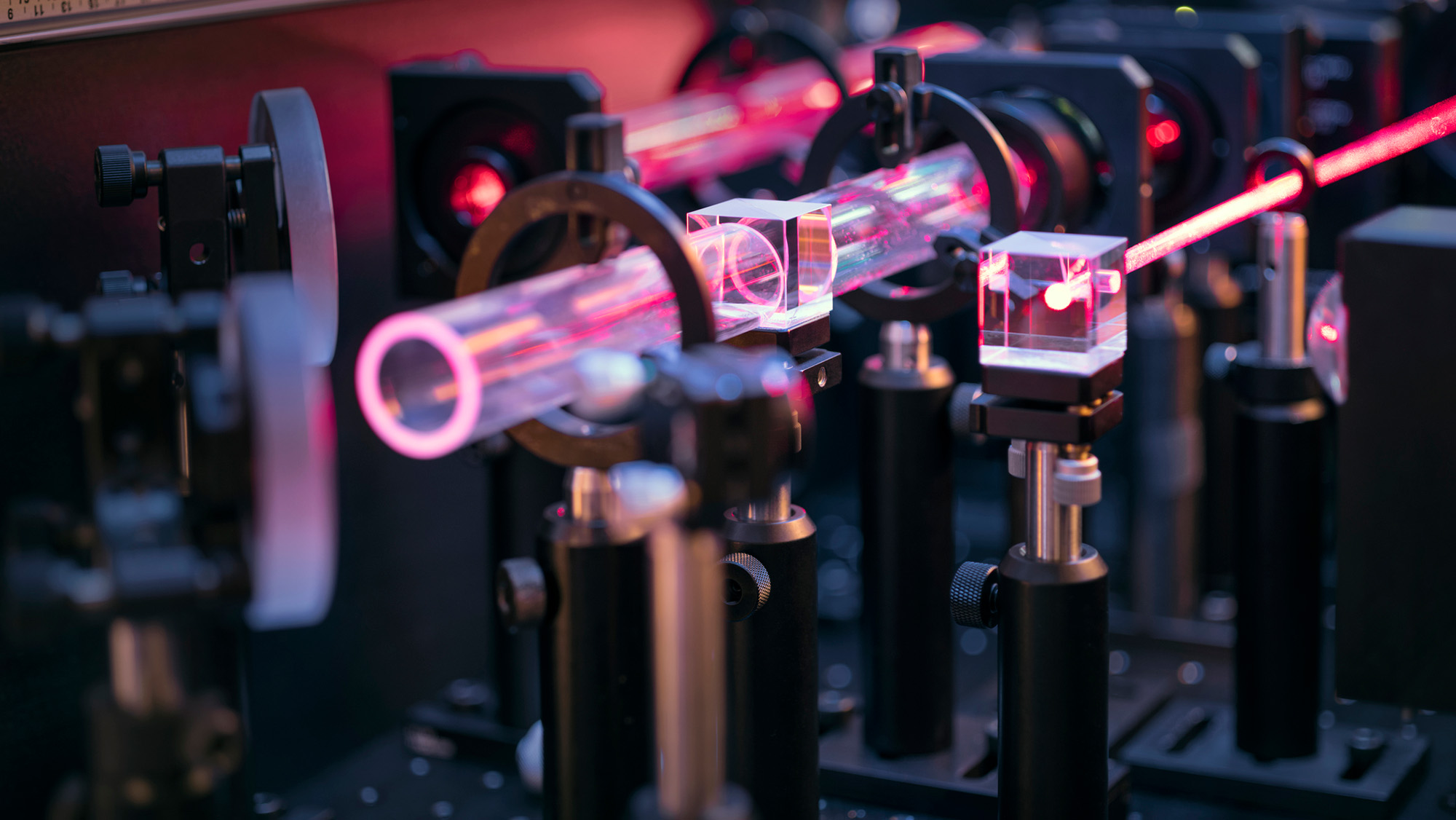
A close up of an optical table with various red lasers beamed across lenses and mirrors

A photo of an optical table with laser and beam-splitting cube, often used in photonics research. (Image credit: EschCollection via Getty Images)

"When you measure from one side of the shutter, then it will look like a single photon state," Skaar said. "Then, on the other side, it will look like a vacuum state β€” that means no photons. And that is very strange because the actual state globally is this mixture from zero to infinity."

Changing how we think about particles

The fact that these complex mixtures can be treated locally as very simple states raises fundamental questions about the nature of particles. Skaar said they are still reckoning with the full extent of these implications and they are now considering how this process could play out for other quantum particles, such as electrons.

They hope that by following this theoretical thread through, they may be able to develop a neater way of describing particle interactions. Currently, particles' infinite stretching means they have been interacting for an infinite amount of time. This then poses a problem for causality β€ͺ—‬ the order of cause and effect β€ͺ—‬ in particle interactions, the team said.

These new theoretical photons with a cutoff tail would not have this problem, meaning the causal link in an interaction would be clear, Skaar said. He admitted that there is much more work to be done to develop the theoretical description of this interaction. However, the new result is an important step toward describing particle interactions with a clear causal relationship, which Skaar described as the team's "ultimate goal."

  •  

The world's first nuclear clock just ticked on β€” and it could help detect a fifth fundamental force of physics

For decades, physicists have pursued a goal that sounds nearly impossible: to build a clock that keeps time using an atom's nucleus rather than the electrons orbiting it.

Now, researchers have demonstrated the first functioning nuclear clock β€ͺ—‬ an advancement that could eventually lead to more robust timekeeping devices and new ways to search for dark matter and physics beyond the Standard Model.

"Having worked in this field for more than 15 years, it is just beautiful, how a very 'wild' idea such as manipulating an atomic nucleus with a laser has turned into reality," Thorsten Schumm, a professor of quantum metrology at the Vienna University of Technology and a member of the research team, told Live Science via email.

How is a nuclear clock different from an atomic clock?

Today's most accurate clocks are optical atomic clocks, which measure the frequency of electrons jumping between different energy levels inside atoms. These clocks are so precise that they would lose less than a second over a 100 million years.

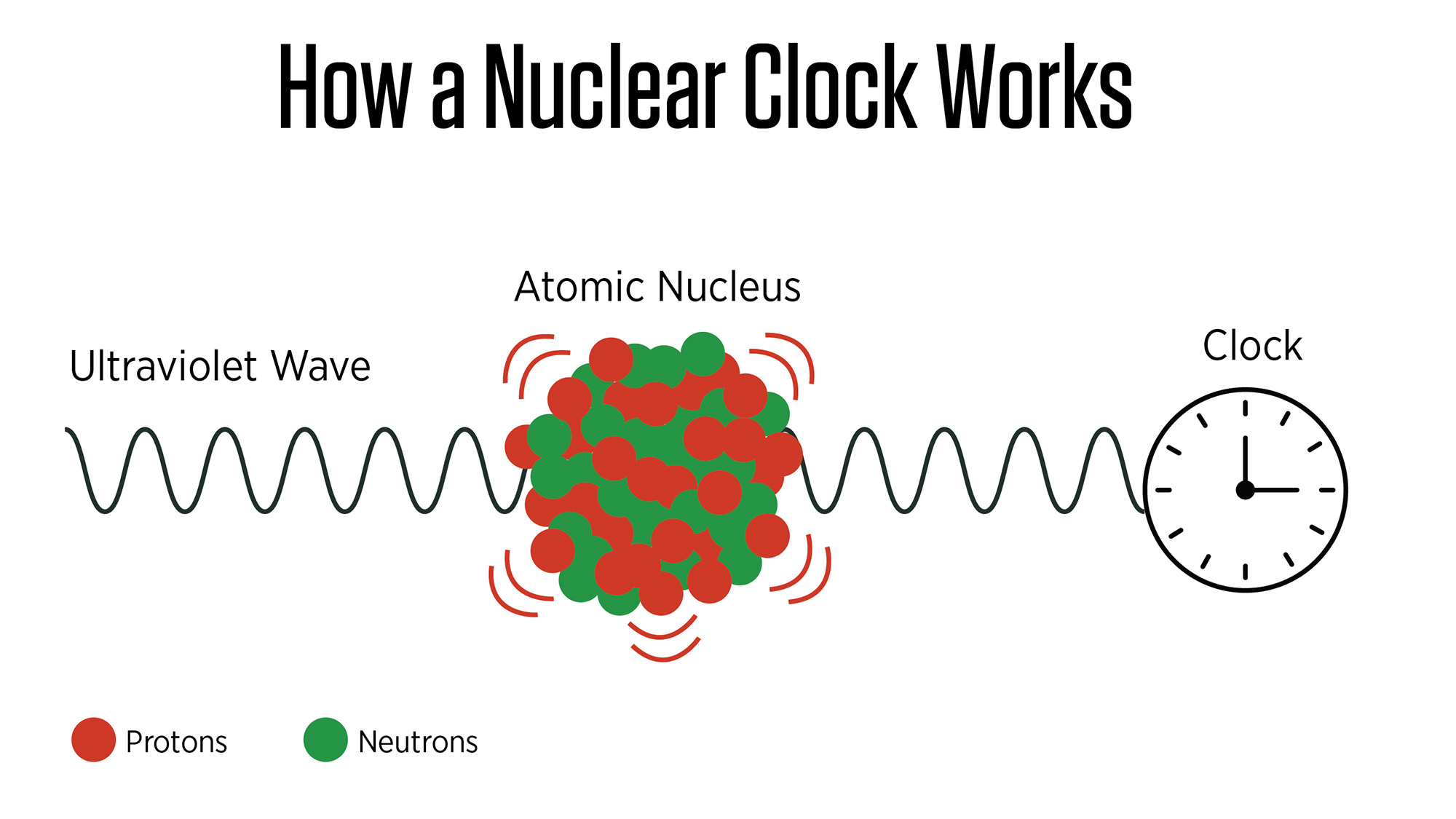
A nuclear clock works similarly, but it uses a transition within the nucleus itself, where the nucleus jumps between energy levels. Because the nucleus sits deep inside the atom, it's far less affected by external disturbances from things like electric or magnetic fields. According to Schumm, the nuclear transition can be 1,000 to 10,000 times less sensitive to environmental noise than atomic transitions are.

A diagram showing how a nuclear clock works

A diagram showing how a nuclear clock works. (Image credit: N. Hanacek/NIST)

"This means that it would be easier to stabilize a nuclear clock over long periods of time," Jacob Higgins, a postdoctoral researcher at Northwestern University who previously worked on thorium clock experiments at JILA in Colorado but was not affiliated with the study, told Live Science in an email. "The transition used for the nuclear clock experiment has a higher quality factor than optical atomic clock transitions, which means that in principle, it can be measured more precisely given the same amount of measurement time."

Together, those advantages could allow nuclear clocks to outperform even today's best atomic clocks according to Higgins.

Why thorium-229 is special

The nuclear clock relies on a rare isotope called thorium-229, whose nucleus contains an unusually low-energy excited state that can be manipulated with ultraviolet laser light.

For decades, scientists had suspected thorium had a low transition, but identifying and controlling it proved extremely challenging. Researchers spent years testing different thorium-containing materials, laser systems and detection methods before finally pinning down the transition.

"It was a long road," Higgins said.

One key advancement was the development of continuous-wave lasers that operate at the precise wavelength needed to excite the thorium nucleus. Before those lasers existed, researchers had to excite the nucleus and then wait several minutes for it to decay and emit a detectable signal. That process was too slow to build a practical clock.

"With the continuous lasers, we can measure the nucleus in absorption and get an immediate response, whether the laser is still at the right frequency (and if not, correct it back)," Schumm said. "Once we had that, it was 'just' implementing some electronics and atomization to have the clock stabilize itself to the nucleus."

Thanks to this set-up, the researchers kept the nuclear clock running continuously for 24 hours.

Unlike many optical atomic clocks, which require ultracold atoms to be suspended in a vacuum chamber, the thorium nuclei are embedded inside a crystal at room temperature.

Because the thorium transition remains stable inside a solid material, researchers may eventually be able to build compact clocks that are useful for navigation systems, telecommunication networks and data synchronization.

NASA's Deep Space Atomic Clock, seen here in an artist's illustration, will test out new technology to for deep-space navigation.

NASA's Deep Space Atomic Clock, seen here in an artist's illustration, was launched in June 2019 to use atomic clocks in space. (Image credit: NASA)

A tool for studying the universe

Some physicists are more excited about what nuclear clocks could reveal about fundamental physics, rather than the clocks' timekeeping abilities.

Atomic clocks primarily probe electromagnetic interactions involving electrons. Nuclear clocks, by contrast, are sensitive to the strong nuclear force, weak nuclear force and electromagnetism β€” three of the four fundamental forces of the universe, along with gravity. This can make them useful detectors of new physics, in a way.

"The nuclear clock is foremost a different clock, ticking on different fundamental physics mechanisms," Schumm said. "Essentially all modern theories beyond the standard model predict additional particles or 5th forces … which can be probed with the nuclear clock in some parameter regime."

Thorium-229 is particularly intriguing because the energy difference between its two nuclear states results from a delicate balance between electromagnetic and nuclear forces. Because those large contributions nearly cancel each other out, even tiny changes in the underlying forces could shift the clock's frequency.

"So small shifts in these forces β€” like if the nucleus were to couple to certain forms of dark matter or if there were an oscillation of a fundamental constant β€” will be amplified in our measurement," Higgins said.

Researchers, including Higgins, have already used early versions of the clock to place constraints on some dark matter models, and they expect its sensitivity to improve as the technology itself gets better.

Although the first functioning nuclear clock is a major achievement, these timekeepers remain in their infancy. Scientists still need to gain a better understanding of how the thorium transition responds to factors like temperature and magnetic fields while developing more powerful and stable laser systems.

"I think it will be many years before the thorium clock can compete with today's best optical atomic clocks," Higgins said, "but we will learn a lot of new science on the pathway to getting there."

  •  
❌