
❌

Reading view

ChatGPT Health Expands Apple Health Access

ChatGPT Health is returning with substantially wider access, giving more iPhone users the option to connect information from Apple Health directly to the AI assistant.

The expansion follows a limited test introduced in January. OpenAI is now gradually making the dedicated Health experience available to eligible ChatGPT Free, Go, Plus and Pro users in the United States who are at least 18 years old.

Despite the close Apple connection, this is not a feature created by Apple or built directly into the Health app. OpenAI operates the service through ChatGPT, while Apple Health serves as one of the sources users can voluntarily connect.

Once permission is granted, ChatGPT can examine selected health and fitness information stored on iPhone, including activity, sleep, workouts and other measurements collected by compatible apps and devices. Users can then ask questions about changes over time without manually exporting records or uploading screenshots during every conversation.
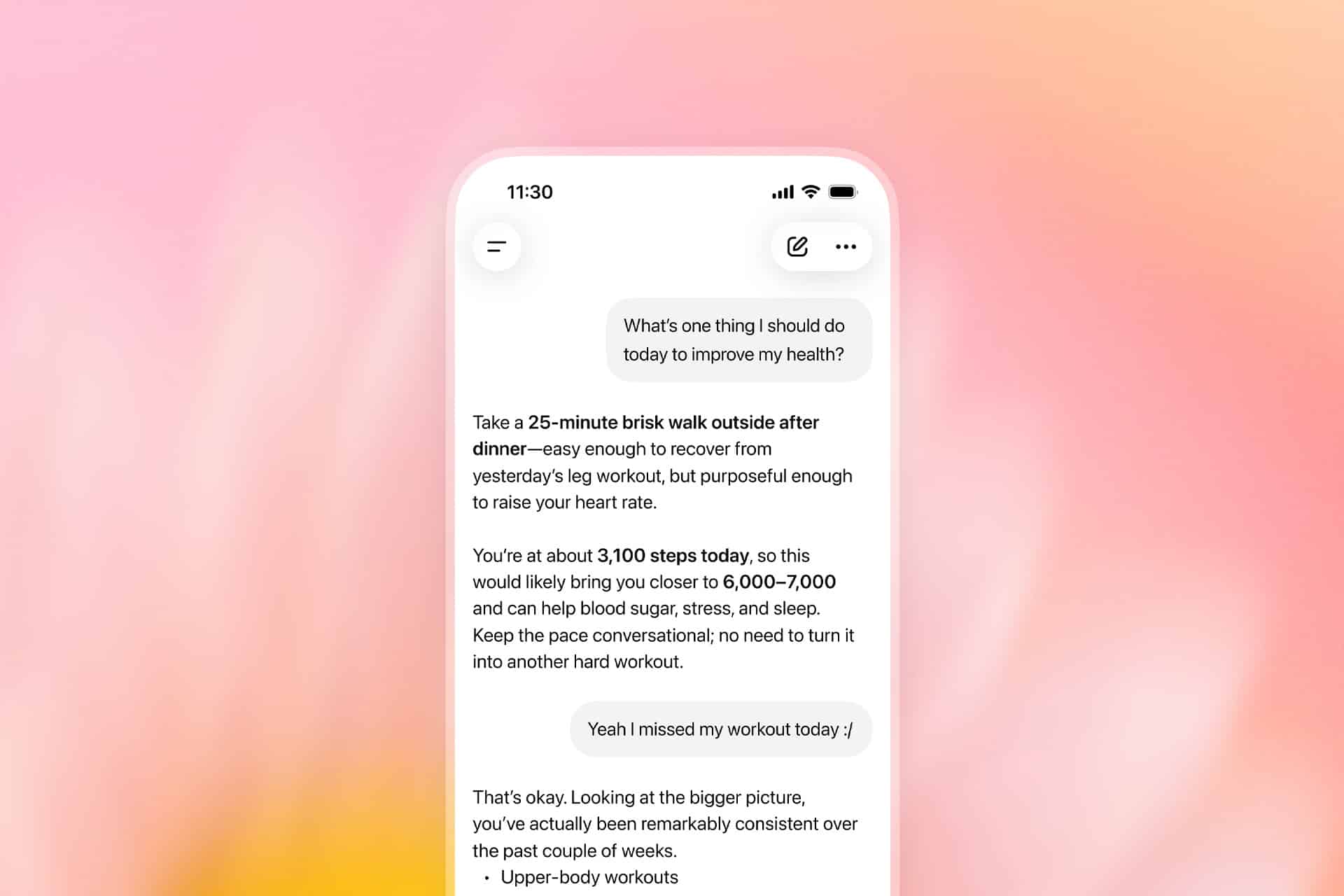
A smartphone screen displays a chat conversation about health, mentioning a 25-minute brisk walk and daily step goals, seamlessly integrated with Apple Health, against a softly blurred pink and yellow background.
Image Credit: OpenAI

ChatGPT Health Reaches More iPhone Users

ChatGPT Health originally appeared as a limited early-access experience for a small group of testers. The expanded rollout replaces that narrow availability with support for eligible adult users across the United States, although OpenAI says access may take several weeks to reach every account.

The feature works on the ChatGPT website and iOS app, but connecting Apple Health requires an iPhone. Users also need a recent version of the ChatGPT app before the Health option appears in the sidebar or More menu.

Apple Health is only one part of the system. ChatGPT can also connect to supported medical-record portals, One Medical and Function Health. Bringing those sources together allows the assistant to answer questions using a broader personal context than activity data alone.

A user could ask how sleep duration has changed across several weeks, whether workout frequency declined after a schedule change or how recent laboratory results compare with earlier tests. ChatGPT can also help organize questions before a medical appointment or summarize changes found across connected records.

Information from third-party fitness services can reach ChatGPT through Apple Health when those apps already share their data with the iPhone database. That may include measurements from platforms such as Garmin, Oura, Whoop, Strava and MyFitnessPal, depending on which categories each service makes available.

Not every proprietary score transfers. An app may calculate its own readiness, recovery or sleep score without writing that exact result into Apple Health. ChatGPT can only use the information made available through the connected source and approved by the user.

After synchronization, health information can inform responses throughout ChatGPT rather than remaining limited to conversations opened from the Health tab. The assistant normally asks for permission before using connected information, and users can also add β€œ@Health” to a prompt when they specifically want a response based on their records.
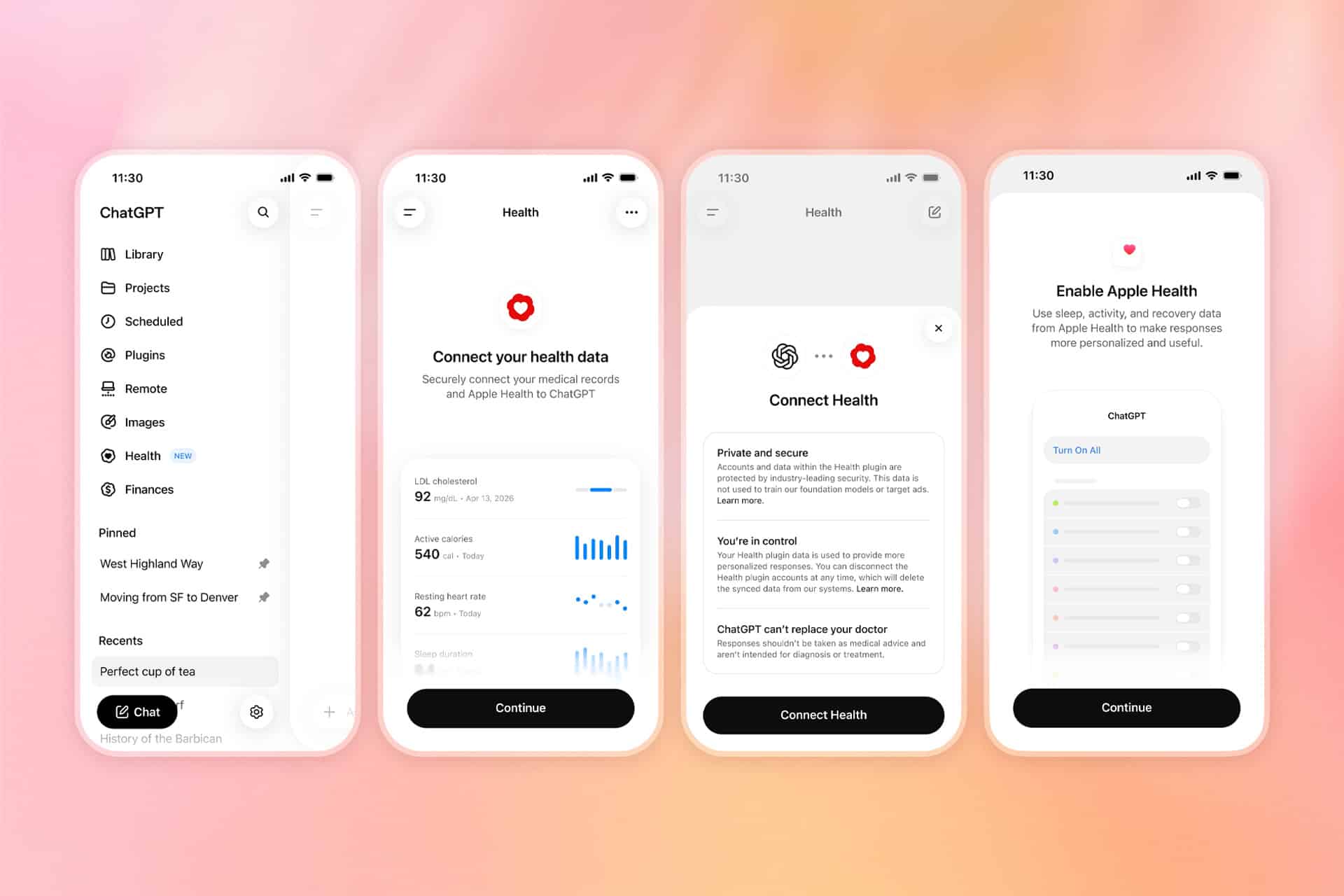
Four smartphone screens show the process of connecting health data to a Health app, displaying menus, health data graphs, privacy info, and Apple Health permissions. Background is a soft pink and orange gradient.
Image Credit: OpenAI

Apple Health Data Gains a Conversational Layer

The appeal of the integration comes from turning a large collection of measurements into questions expressed in ordinary language.

Apple Health can already organize trends, highlights, medications, laboratory results and activity records. ChatGPT adds a conversational layer capable of comparing those categories or explaining them in a more personalized format.

Someone preparing for an annual physical could ask for a summary of meaningful changes since the previous appointment. A runner might request a comparison between training volume, sleep and resting heart rate. Another user could ask which information deserves discussion with a clinician after receiving new laboratory results.

That does not make ChatGPT a doctor. OpenAI says the feature is intended to support medical care rather than diagnose conditions or recommend treatment. Urgent symptoms and emergencies still require professional assistance.

The distinction is especially important because health data can appear more conclusive than it is. A change in heart rate, sleep or activity may have several explanations that cannot be determined from an iPhone record alone. Wearables can identify patterns, but they do not automatically reveal the medical cause behind them.

ChatGPT may help users notice relationships and prepare better questions. It should not be treated as the final authority on whether a symptom is harmless, whether medication should change or whether professional care is unnecessary.

The service is also read-only. ChatGPT can examine approved Apple Health information but cannot alter the original records stored on iPhone. It cannot add a diagnosis, change a medication list or write new measurements back into the Health app.

Users retain control over which Apple Health categories are shared. Someone may allow access to steps, workouts and sleep while withholding reproductive health, medications or other sensitive information.

That selective approach may be more appropriate than approving every category simply because the option is available. A useful response does not always require a complete health history.
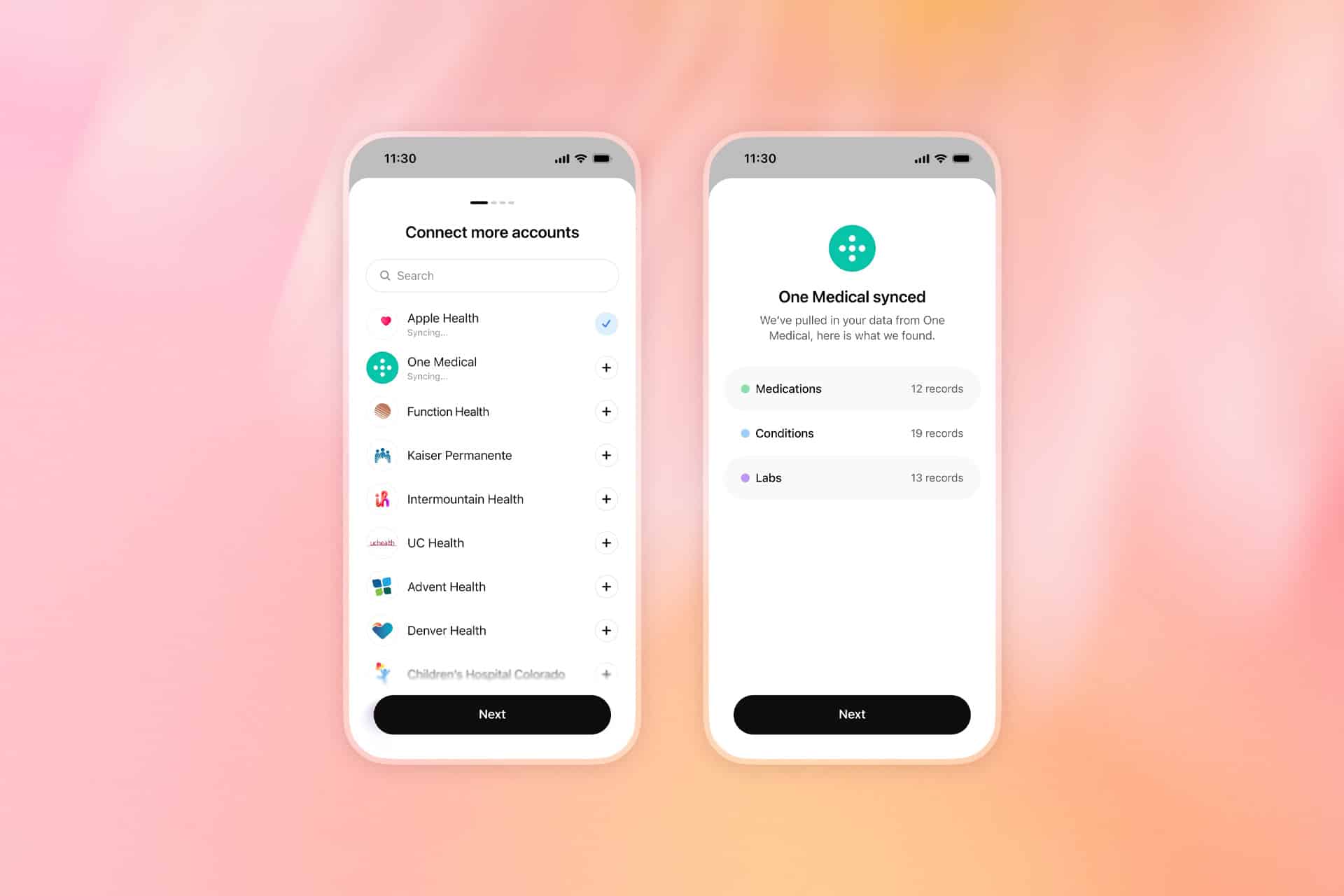
Two smartphone screens show a health app: the left screen lists health providers to connect, including Apple Health, while the right screen confirms "One Medical" synced, displaying counts of Medications, Conditions, and Labs. Both screens have a "Next" button.
Image Credit: OpenAI

Privacy Becomes the Central Decision

Connecting Apple Health to ChatGPT creates a different privacy relationship from using health features entirely within the Apple ecosystem.

Apple designs the Health app around on-device protections and user-controlled permissions. ChatGPT Health requires selected information to synchronize with OpenAI systems so the company can analyze it and generate personalized responses.

OpenAI says connected Apple Health data, medical records and conversations using that information are not used to train its foundation models or target advertising. The company also applies additional encryption and isolation protections to health information.

Users can disconnect Apple Health at any time. OpenAI says synchronized data from the disconnected source will be deleted from its systems within 30 days.

Previous conversations are handled separately. Information already included in ChatGPT conversation history remains until those chats are deleted, even after the Apple Health connection is removed.

Memory introduces another consideration. Conversations using Health can create memories when ChatGPT memory is enabled, although OpenAI says memories are not generated directly from synchronized health data. Temporary Chat or separate project memory can reduce how much personal context continues across future conversations.

The new Health experience should also not be confused with the existing ChatGPT integration inside Apple Intelligence. Siri and Writing Tools can use ChatGPT for certain requests without requiring the dedicated ChatGPT app or a connected account.

ChatGPT Health is a separate OpenAI service with its own account, permissions, privacy controls and health-data connections. Using ChatGPT through Siri does not automatically give OpenAI access to Apple Health.

That separation gives users a meaningful choice. They can continue keeping health information inside Apple apps, share only selected categories with ChatGPT or connect medical records for a more comprehensive view.

The expanded rollout makes one of the most personal databases on iPhone available to conversational AI. Its usefulness will depend not only on the quality of the answers, but also on whether users understand exactly which information they are sharing and where it goes after leaving the device.

The post ChatGPT Health Expands Apple Health Access appeared first on AppleMagazine.

  •  

Multi-Omic Insights Reveal Cardiometabolic and Depression Links

In a groundbreaking longitudinal study encompassing nearly half a million individuals, researchers have unveiled intricate patterns and biological underpinnings that link cardiometabolic diseases (CMDs) and depression. These two prevalent and often coexisting health conditions have long posed challenges due to their complex interaction and compounded risk on mortality. Now, through a multinational, multi-omic analytic approach, this study sheds new light on how these diseases develop, interlace over time, and ultimately impact life expectancy, offering hope for earlier detection and more precise interventions.

Cardiometabolic diseasesβ€”which include chronic conditions such as cardiovascular disease, type 2 diabetes, and metabolic syndromeβ€”are among the leading causes of death globally. Depression, meanwhile, remains a colossal mental health burden, often running parallel to various physical ailments. The coexistence, or multimorbidity, of CMDs and depression exacerbates health outcomes significantly, yet the trajectory of how one condition progresses to include the other and the biological mechanisms driving this interaction have remained elusive.

Leveraging data from the UK Biobank, the largest population-based health cohort, the study followed 467,592 participants initially free of both CMD diagnoses and depression. Over a 14.6-year period, the scientists meticulously chronicled disease transitions using advanced multistate models. These allowed them not only to identify disease onset patterns but also to map complex pathways outlining progression from health to single disease states and then to multimorbidity.

The findings revealed that within the follow-up window, more than 64,000 participants developed CMD alone, while approximately 17,500 were diagnosed with depression exclusively. Crucially, over 6,100 individuals progressed to multimorbidity, reflecting the convergence of these conditions in a significant subset of the population. Importantly, the risk of subsequently developing the alternate condition was substantially elevated for those already affected by either CMD or depression, underscoring the bidirectional relationship between physical and mental health.

Further delving into survival outcomes, the researchers observed that individuals with multimorbidity faced a 13 to 22 percent increase in mortality risk compared to those free of disease, accompanied by a marked reduction in life expectancy averaging between 3.6 to 3.8 years. Such stark contrasts reinforce the clinical urgency of understanding and managing the intersection of CMDs and depression rather than treating them in isolation.

However, a nuanced discovery emerged from the survival analysis: the mortality impact of coexisting CMD and depression appeared additive rather than synergistic. This suggests that while coexistence heightens risk, the two diseases may operate through largely independent pathways driving mortality, a revelation that could recalibrate how treatment priorities are structured.

To decipher biological signatures predictive of disease progression and multimorbidity, the study incorporated multi-omics platformsβ€”comprehensive analyses including proteomics, metabolomics, genomics, and methylomics. These high-dimensional tools allow scientists to detect subtle molecular changes reflecting pathophysiological shifts and prognostic biomarkers far earlier than clinical symptoms emerge.

Remarkably, proteomic models stood out in their predictive prowess. When applied to the 15-year risk horizon for CMD-depression transitions, these models achieved area-under-the-curve (AUC) values ranging between 0.70 and 0.91. This performance significantly eclipsed that of traditional clinical risk models, heralding a new dawn where molecular profiling could transform risk stratification and preventive strategies.

Distinct multi-omic signatures were identified at each disease transition pointβ€”whether from health to CMD alone, health to depression alone, or the combined pathway leading to multimorbidity. These signatures could reflect unique biological processes such as inflammatory cascades, metabolic dysregulation, neuroendocrine changes, or immune system perturbations, each contributing distinctively to disease progression.

The implications of these findings are far-reaching. With multimorbidity presenting as a growing global health challenge, understanding its trajectory and molecular footprints empowers clinicians and researchers to design targeted interventions that transcend symptom management. Early identification of individuals at highest risk via omic biomarkers could enable precision medicine approaches that pre-empt illness onset or halt progression.

Furthermore, by elucidating the distinct yet interconnected biological pathways linking CMDs and depression, this research challenges the traditionally siloed view of mental and physical health. It advocates for integrated care models that address the whole person rather than fragmented disease entities, a paradigm shift essential for improving patient outcomes in real-world settings.

The study also leverages rigorous multistate modeling, a sophisticated statistical technique allowing for dynamic representation of illness progression over time. This approach captures the complexity inherent in chronic disease trajectories, encompassing not only onset but transitions between disease states and eventual mortality. Such modeling enhances the granularity of epidemiological insights far beyond conventional methods.

As large-scale biobanks increasingly incorporate multi-omic data, the ability to unravel disease biology at unprecedented depth will only grow. The present study exemplifies how marrying big data with cutting-edge analytic frameworks can unveil novel insights into multimorbidity, transforming epidemiology into a powerful tool for precision health.

This research arrives at a critical juncture where global populations face rising burdens of chronic diseases intertwined with mental health challenges. Targeted, biologically informed strategies could ease the strain on healthcare systems and improve quality of life for millions living with overlapping disease burdens.

While promising, the findings also urge cautious optimism. The translation of molecular signatures into routine clinical tools requires further validation and contextualization across diverse ancestral and environmental backgrounds. However, these initial steps firmly establish a conceptual blueprint for future studies to build upon.

Taken together, this extensive investigation pioneers a new frontier in understanding the intertwined evolution of cardiometabolic diseases and depression. By uniting longitudinal clinical data with multi-omics analyses and sophisticated modeling, it heralds a transformative approach toward unraveling multimorbidity’s mysteries and paves the way for early, targeted prevention.

The convergence of CMDs and depression, previously viewed as a devastating clinical overlap, now emerges as a tractable problem awaiting targeted interventionβ€”fueling hope that integrated molecular insights will soon translate into lifesaving real-world applications. This revolutionary research sets the stage for a future where vulnerability to complex chronic disease is revealed well before symptoms arise, opening unprecedented avenues for personalized health preservation.

Subject of Research:
Multi-omic signatures and disease trajectories linking cardiometabolic diseases and depression

Article Title:
Multi-omic signatures and trajectories of cardiometabolic diseases and depression

Article References:

Yang, G., Jiang, X., Wang, J. et al. Multi-omic signatures and trajectories of cardiometabolic diseases and depression.
Nat. Mental Health (2026). https://doi.org/10.1038/s44220-026-00678-6

Image Credits: AI Generated

DOI:
https://doi.org/10.1038/s44220-026-00678-6

  •  
❌