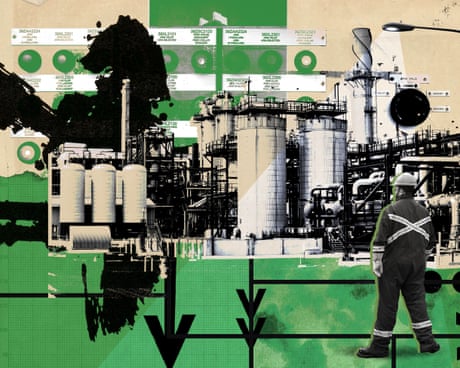
Labour MPs fear No 10 team lack up-to-date energy insight and don’t fully recognise voters’ climate concerns
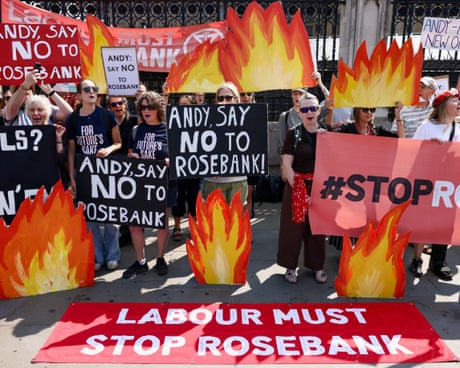
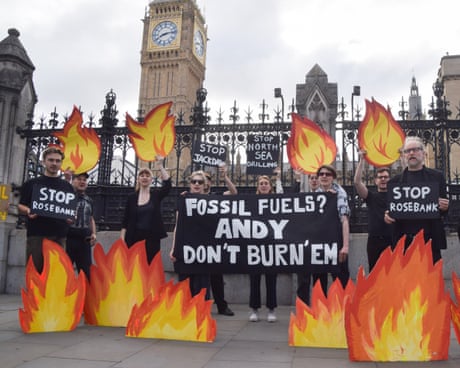
Andy Burnham was told he could face the first revolt of his premiership as Labour MPs and climate experts condemned his apparent support for renewed drilling for oil and gas.
As the UK suffers through drought, fires and heatwaves, the prime minister gave the strongest indication yet on Friday he was minded to allow new drilling. His comments came just hours before the UN secretary-general warned “every new fossil fuel project” made heatwaves more dangerous.
Don’t worry about the death toll and economic devastation. There’s money to be made!
As the United States launches a “heavy wave” of strikes against Iran, a conflict that turned from a limited incursion into an extremely expensive and painfully drawn-out war, some clear winners are starting to emerge — and we’re definitely not talking about the American people.
As the Wall Street Journal reports, British fossil fuel giant Shell is reaping enormous profits thanks to spiking oil prices triggered by the conflict in Iran. Its second-quarter adjusted earnings rose from just shy of $7 billion the previous quarter to a stunning $9.84 billion in the most recent one. That’s well above already-lofty expectations from analysts, who predicted earnings of $8.92 billion. It’s also double compared to the same period last year, indicating a major surge in profits, in large part due to the violence in Iran.
Shell isn’t alone in the oil industry. Both Chevron and ExxonMobil are expected to report “monster earnings,” as CNBC put it, later this week.
Beyond the oil and gas industry, major banks including JPMorgan are making record profits during the ongoing war thanks to heavy trading volumes as investors rush to dump volatile assets or buy the dip.
Then there’s the Department of Defense’s many contractors, which are also seeing strong growth in sales and profits. Three of the biggest defense contractors, Lockheed Martin, Boeing and Northrop Grumman, reported record sales backlogs boosted by the Iran war earlier this year, from anti-ballistic missile systems to Patriot drones and intercontinental ballistic missiles.
In short, it doesn’t take much reading between the lines to see who the real winners and losers of Trump’s prolonged war are. It’s a conflict lining the pockets of the military industrial complex and fossil fuel companies — the last thing a society suffering the effects of human-induced climate change and reeling from political instability needs.
PM tells reporters the government cannot ignore the energy resource ‘when people are struggling’
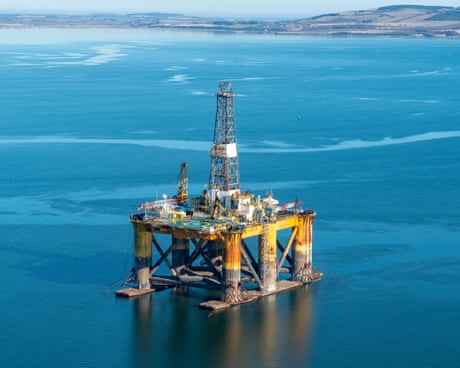
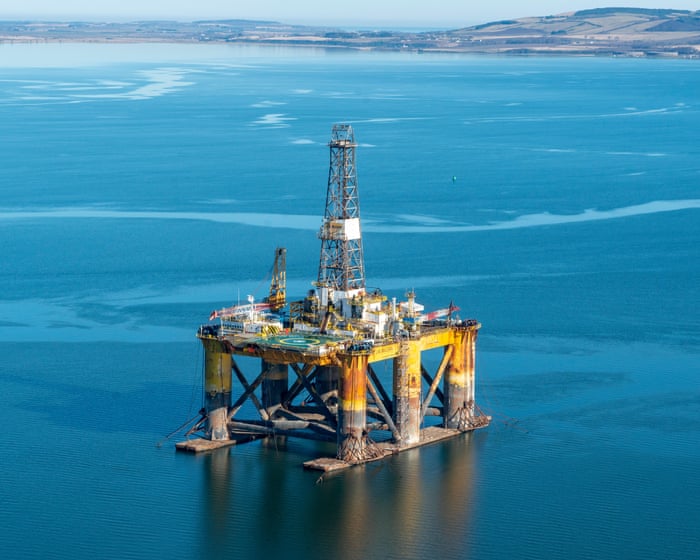
Andy Burnham has said he will take a “pragmatic” approach to oil and gas drilling in the North Sea, saying the government could not ignore the potential energy resources it holds.
The prime minister’s comments came in response to a question about his conversation with Donald Trump on his first day in No 10. Trump had said Burnham told him he would “open up” North Sea oil, something the UK summary of the call made no mention of.
Environmentalists renew calls for windfall tax to support households after Q2 earnings rise to almost $10bn
Shell has posted its second highest quarterly earnings on record as the energy market surge caused by the Middle East crisis helped to double its net profit to almost $10bn in the three months to June.
Europe’s biggest oil and gas company reported a quarterly profit of $9.8bn (£7.4bn), more than double the figure for the second quarter last year and the highest since its record-high earnings in the months after Russia’s invasion of Ukraine.
Leading Australian climate policy experts say a new oil refinery in Western Australia would be an investment in “dinosaur technology” that would require public subsidy and do little to solve the country’s fuel security.
Experts told Guardian Australia doing the feasibility study was not a bad idea, but would ultimately show the project would be uneconomic and would require government subsidies.
At Branxton community hall in the New South Wales Hunter Valley last week, local resident Janet Murray was given five minutes to speak about plans for the state’s biggest coalmine extension.
Before her were dozens of people, also there to share their views about whether the 19-year extension proposed by Hunter Valley Operations (HVO) should be allowed to proceed.
Exclusive: Blunder at Rosebank, UK’s biggest undeveloped oilfield, comes as government considers granting licence
Production at Britain’s biggest undeveloped oil and gasfield could be delayed for months after equipment from a rig was accidentally dropped in the North Sea, the Guardian can reveal.
The Trump administration is quietly considering a rule change that could make it easier for polluters to build facilities—including certain gas plants and diesel generators that power data centers—with little to no notice to the public.
On Wednesday, the Environmental Protection Agency held a public hearing on a proposed rule change that would hand the power to states to decide how the public participates in the permitting process for certain new sources of air pollution. The proposed rollback comes as data centers face greater pushbackacross the US, with many communities using the permitting process to try to slow down development. Any changes could have major consequences for how ordinary people are given notice about new or expanded polluting facilities coming into their neighborhoods.
“As someone actively working in communities with data centers, I know this to be fundamentally true: People want to have a say,” Vanessa Lynch, a Pennsylvania organizer with Moms Clean Air Force, said at the EPA hearing.
Selection of economist formerly at helm of green thinktank marks continuation of decarbonising Miliband era
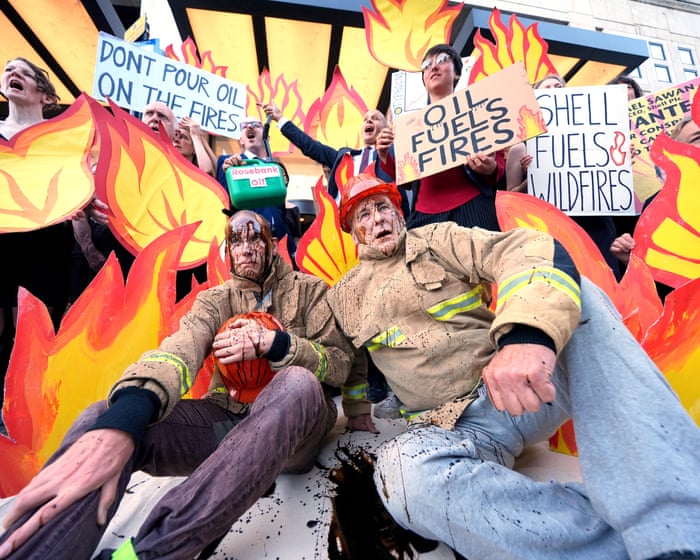
In her first 48 hours as energy secretary, Miatta Fahnbulleh was left in no doubt about the thorny policy decision at the top of her in-tray. Protesters from Fossil Free London met her outside her new offices dressed as firefighters holding placards reading: “We’re already putting out fires, don’t start new ones.”
The MP for Peckham – a radical economist who is outspoken about the climate crisis – is a surprising choice as secretary of state for energy and net zero for those who believe the speculation in Westminster that Andy Burnham wants to approve new oil and gas drilling in the North Sea.
Albanese government’s approval ofNorth West Shelf gas extension being challenged by the Australian Conservation Foundation and Friends of Australian Rock Art
The Albanese government’s decision to approve one of the world’s largest gas projects in Western Australia is being challenged in the federal court, setting up a significant test of how Australia’s environment law deals with the climate crisis.
The Australian Conservation Foundation (ACF) and Friends of Australian Rock Art (Fara) are this week running concurrent court challenges against the approval of the extension of Woodside’s major North West Shelf gas export project.
Campaigners hope move will force commercial banks to rethink holding assets linked to the fossil fuel
Climate campaigners have declared a victory after the Bank of England said it would no longer accept bonds linked to one of the most polluting industries on the planet for key loan arrangements.
The ban, which comes into force in October, marks a fresh crackdown on thermal coal, which is burned in power plants to create electricity, and has long been a target of green policy activists.
Party manifesto pledged to honour existing North Sea exploration licences but not issue new ones
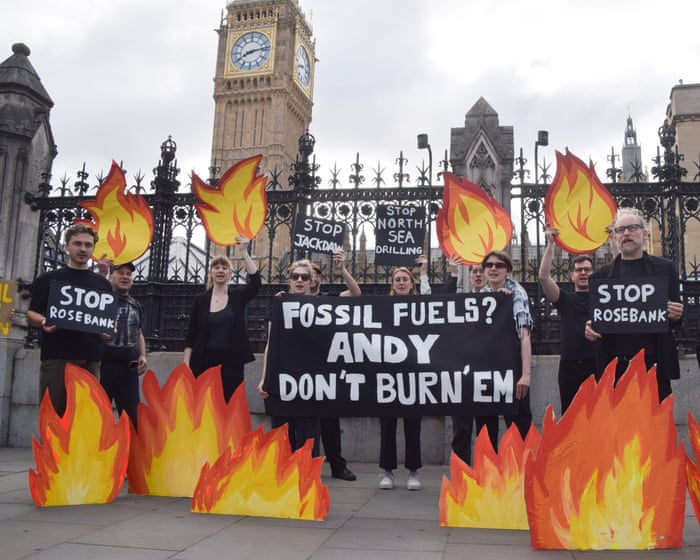
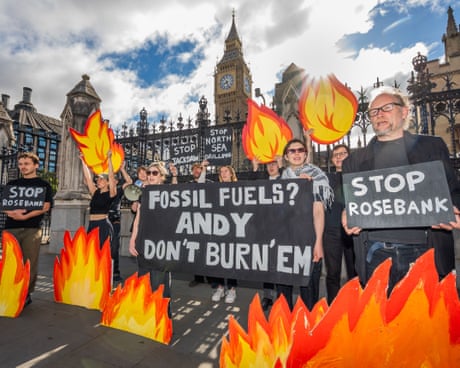
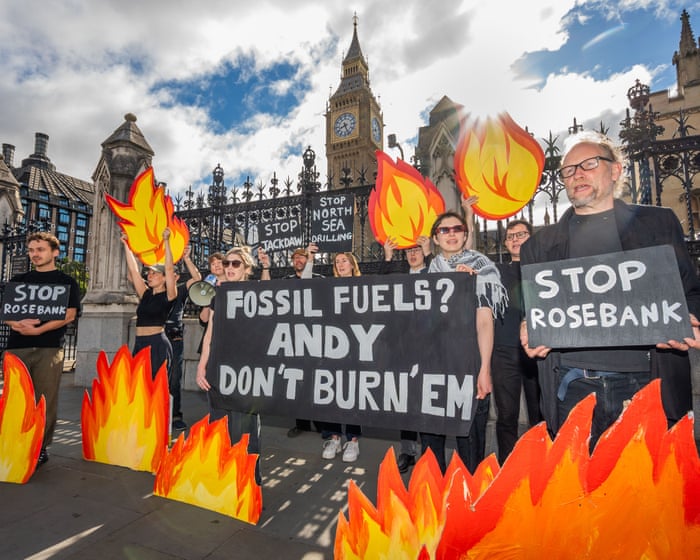
Andy Burnham risks his first confrontation with Labour MPs if he announces new oil and gas drilling licences when he becomes prime minister, insiders have warned.
Speculation is rife that Burnham will unveil fresh plans for drilling in the North Sea after he is installed in Downing Street.
The predicted £264bn cost by 2050 could be even higher, plus renewables avoid a far higher total of emissions than can be captured, writes Andrew Boswell, while Simon Oldridge calls out vested interests
Prof Myles Allen and colleagues, in their letter (12 July) on carbon capture and storage (CCS), propose licensing gasfields on condition that producers store an increasing proportion of “the carbon dioxide their products generate”. Their proposal only considers CO2. Methane is excluded by choice although it leaks throughout global fossil-fuel supply chains, including during extraction, processing, liquefaction and shipping.
A growing academic literature, supported by satellite observations of major methane plumes, shows that these emissions can be very substantial, and are the dominant near-term climate impact for gas supplied as liquefied natural gas.
Campaigners say field will bring minimal benefit for UK economy, as industry lobbies Burnham for go-ahead
More people can fit on to the top deck of a standard London bus than will be directly employed on the new Jackdaw gasfield in the North Sea, industry documents show.
“Burnham has been very quiet about the climate [crisis] so far,” says Chris Venables, an environmental campaigner and fellow at the Green Alliance thinktank. “I don’t think [it] is at the forefront of his mind, but that does not mean he will water down this agenda.”
Lobby appeals to prospective PM’s reindustrialisation agenda as it pushes for Rosebank and Jackdaw approval
The UK’s North Sea oil industry has made a last-ditch attempt to curry favour with the Labour government by appealing to Andy Burnham’s reindustrialisation agenda just days before he is expected to become Britain’s next prime minister.
Industry lobbyists have written to more than 400 Labour MPs to call on the government’s new leaders to allow more oil and gas drilling in UK waters to support homegrown energy and show “a commitment to UK manufacturing, industrial capability and the skilled workforce that has powered the nation for generations”.
Prof Myles Allen, Stephanie Loo and Toby Lockwood, and Olivia Powis, respond to an article by George Monbiot about ‘the great carbon capture con’
George Monbiot suggests that we can solve climate change without carbon capture and storage (The great carbon capture con: behold the wasted billions Burnham could claw back, 8 July). Physics says otherwise. The world is going to generate more carbon dioxide than we can safely dump into the atmosphere, and we can’t rely on our stressed biosphere and oceans to mop up the excess. Stopping global warming will therefore require capturing and durably disposing of carbon dioxide on a huge scale, which right now means injecting it back underground.
Where George does make a good point is in questioning whether carbon dioxide disposal should for ever be paid for using public money. Why should private companies be allowed to make large profits taking carbon out of the ground while the taxpayer foots the bill to put it back? The obvious solution: require those who extract fossil fuels to pay for the disposal of the carbon dioxide their products generate. If the fraction they store rises to 100% by mid-century, fossil fuel use would cause no further warming thereafter.
As the newly elected president, Abelardo de la Espriella, pledges to exploit oil reserves, environmentalists prepare to defend climate progress
It is hard for Yuvelis Morales Blanco to pinpoint when her activism started. Now 25, she recalls getting involved in land rights and environmental issues in Santander, northern Colombia, from a young age. Living near water, she says, has always shaped her connection to nature. “My parents are fishers on the Magdalena, Colombia’s most important river,” says Morales. “For us, the river isn’t just food – it embodies life, identity and culture.”
In April, she received the Goldman environmental prize for her leadership in Puerto Wilches, where she succeeded in halting oil extraction and fracking. Yet, it seems her struggle is only just beginning.
There are far better ways to tackle climate breakdown, but successive governments have chosen to listen to the fossil fuel companies instead
The new prime minister will be looking for money? Well, here’s £21.7bn lying on the ground. The government could cancel its deranged, disastrous carbon capture and storage (CCS) programme at no cost to public welfare: in fact, it would greatly reduce the harm we will suffer.

 Login