❌

Reading view

POSCO Future M to Mass Produce Hard Carbon Anode Material for Sodium-Ion Batteries From 2028
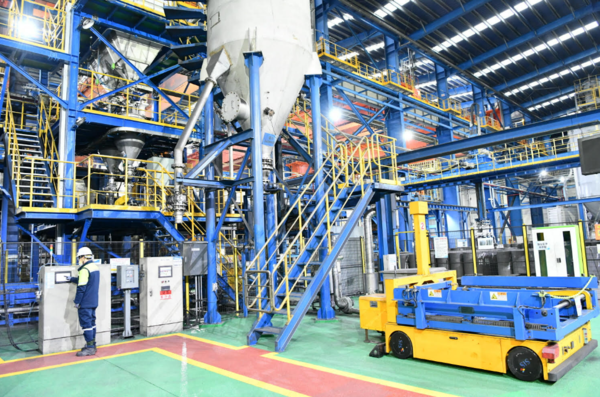
Production line at POSCO Future M's Pohang artificial graphite anode material plant.

POSCO Future M will begin mass producing hard carbon anode material, a core material for sodium-ion batteries, in 2028. It is the second company in South Korea, after Aekyung Chemical, to disclose plans for both the development and mass production of hard carbon anode material.

According to industry sources on July 24, POSCO Future M recently drew up its development plans for battery cathode and anode materials as well as its next-generation materials strategy. The development status and mass production plans for hard carbon anode material for sodium-ion batteries were included for the first time.

POSCO Future M plans to complete development of the hard carbon anode material by the third quarter of 2027 and begin mass production in 2028. It expects that rather than fully replacing lithium iron phosphate (LFP) batteries, sodium-ion batteries will broaden their range of use mainly in fields requiring low-temperature environments and long life. South Korean battery makers including LG Energy Solution and Samsung SDI are also developing sodium-ion batteries aimed at low-temperature, long-duration energy storage systems (ESS).

Sodium-ion batteries are next-generation batteries that use sodium (Na) instead of lithium (Li). Sodium is abundant on Earth, making raw material procurement easier than for lithium, with relatively smaller price fluctuations. The basic structure, consisting of a cathode, anode, electrolyte and separator, is the same as that of lithium-ion batteries, but the component materials differ. Cathode materials use sodium iron phosphate (NFPP) or nickel-iron-manganese (NFM), while hard carbon is mainly applied in place of graphite for the anode material. The electrolyte also uses sodium salts dissolved in an organic solvent.

The reason the anode material changes is the size of the sodium atom. Sodium atoms are about 2.5 times larger than lithium atoms and more than three times heavier. Ordinary graphite has narrow spacing between layers, making it difficult for the larger sodium ions to move in and out freely.

Hard carbon, by contrast, has a wide interlayer structure and fine pores inside that can stably store sodium ions. Its structural deformation is also relatively small even after repeated charging and discharging. Hard carbon costs more than three times as much as graphite, but a substantial portion of that cost burden can be offset because aluminum foil, priced at about one-third the cost of conventional copper foil, can be used as the current collector.

POSCO Future M plans to mass produce hard carbon using its existing anode material production lines. Existing equipment such as heat-treatment furnaces, reactors and slurry processes can be partially adapted, reducing the burden of new investment.

Market research firms forecast that global sodium-ion battery shipments will exceed 70 gigawatt-hours (GWh) in 2028. Producing 1 GWh of batteries requires about 1,500 tons of hard carbon anode material. On that basis, demand for hard carbon anode material in 2028 is estimated to exceed 100,000 tons. China has already taken the lead in the supply chain.

The companies currently mass producing hard carbon anode material are Chinese firms including BTR, Shanshan and Zhongke Electric. These companies are also among the global leaders in the graphite anode material market. China's hard carbon production capacity is estimated at 80,000 to 90,000 tons a year. In South Korea, Aekyung Chemical was the first to disclose plans for hard carbon mass production. It is building a pilot line with annual capacity of 1,300 tons, targeting completion within this year.

Besides hard carbon, POSCO Future M also unveiled a development roadmap for other next-generation battery materials, including LFP cathode material, lithium manganese-rich (LMR) cathode material and silicon anode material. It will convert part of its cathode production lines in Pohang for LFP use, produce prototypes this year and start mass production in the second half. In 2029, it will build an LFP cathode production system applying raw materials from within the group and its own processes. For anode materials, it will also expand its product lineup to include natural and artificial graphite and silicon anode materials to respond to changes in the electric vehicle and ESS markets.
  •  

Eco&Dream Begins Mass Shipments of NCM Precursors From Saemangeum

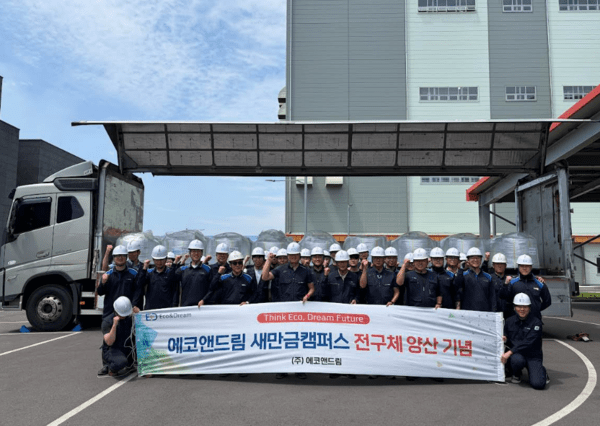
Eco&Dream employees pose for a commemorative photo to celebrate the start of mass shipments from the company's Saemangeum Campus.

Eco&Dream has begun mass shipments to customers of nickel-cobalt-manganese (NCM) precursors produced at its Saemangeum Campus, marking the full-scale launch of operations at its new manufacturing base.

The company said on July 24 that it has shipped NCM precursors manufactured at the Saemangeum Campus in line with customer orders. It has stabilized production processes and quality control systems at the facility.

Precursors are the key raw material used to produce cathode materials, which determine battery performance. Cathode materials account for about 40% of a battery's cost, while precursors represent roughly 70% of cathode material costs. Eco&Dream is also pursuing commercialization of new precursor products, developing customized NCM precursors with differentiated compositions, particle sizes, densities and surface characteristics tailored to electric vehicle (EV) platforms, battery cell designs and application-specific performance requirements.

Building on its existing and new products, the company is targeting the global EV and all-solid-state battery materials markets. It plans to strengthen its "Precursor Foundry" strategy by broadening its EV precursor portfolio while further advancing precursor design technologies for all-solid-state batteries. Eco&Dream also intends to pursue joint development projects and product evaluations with customers and expand its portfolio into next-generation materials, including solid electrolytes.

The company said it is also in discussions on EV localization projects in Europe, supply projects with battery makers in North America and global EV application projects.

"We have expanded our precursor production base to the Saemangeum Campus and begun full-scale operations at the new manufacturing base," an Eco&Dream official said. "We will respond reliably to customers' quality and supply requirements while further raising the utilization rate of the Saemangeum Campus."

  •  

Hanwha Ocean Signs Joint Design Agreement for US Strategic Sealift Vessel

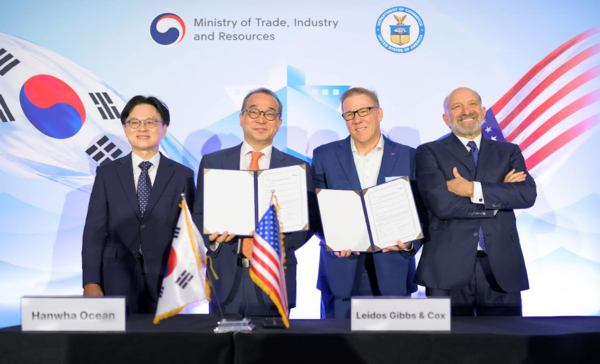
(From left) Kim Jung-kwan, Minister of Trade, Industry and Resources; Jeong In-seob, president and head of Management Support at Hanwha Ocean; Mike Rickels, vice president of Leidos Gibbs & Cox; and Howard Lutnick, US Secretary of Commerce.

Hanwha Ocean has signed a joint design agreement with a US naval architecture firm to develop the Fast Sealift vessel, expanding its collaboration with the US shipbuilding industry beyond ship construction to design, workforce development and supply chain initiatives.

The company announced on July 24 that it signed one professional services agreement for the joint design of a global strategic sealift vessel and two memoranda of understanding (MOUs) covering shipbuilding workforce development and supply chain cooperation during the opening ceremony of the Korea-US Shipbuilding Cooperation Center in Washington, D.C. on July 23.

Hanwha Ocean signed the professional services agreement with Leidos Gibbs & Cox, a US naval architecture company, to jointly design the strategic sealift vessel. The agreement expands the partnership beyond the memorandum of understanding signed in April, which focused on strengthening shipbuilding capabilities for the US Navy and allied naval forces, into the joint design phase.

A Fast Sealift vessel is a dual-use platform that operates as a commercial cargo ship during peacetime and can rapidly transport military equipment and supplies during emergencies.

The companies plan to combine Hanwha Ocean's naval shipbuilding expertise with the design capabilities of Leidos Gibbs & Cox to pursue opportunities in both the US and global naval vessel markets. Gibbs & Cox has designed more than 70% of the US Navy's surface combatants built since World War II.

Hanwha Ocean also signed an MOU with Hanwha Philly Shipyard and Delaware County Community College to cooperate on shipbuilding education and workforce development. Under the agreement, the partners will develop instructor training programs for US shipbuilding workers and help expand the pool of skilled labor.

"We will expand cooperation in the areas the United States needs most by leveraging our local production base and play a central role in the MASGA project," said Jeong In-seob, president and head of Management Support at Hanwha Ocean.

  •  

LIG D&A, Babcock Sign Strategic Cooperation Agreement at Farnborough Airshow 2026

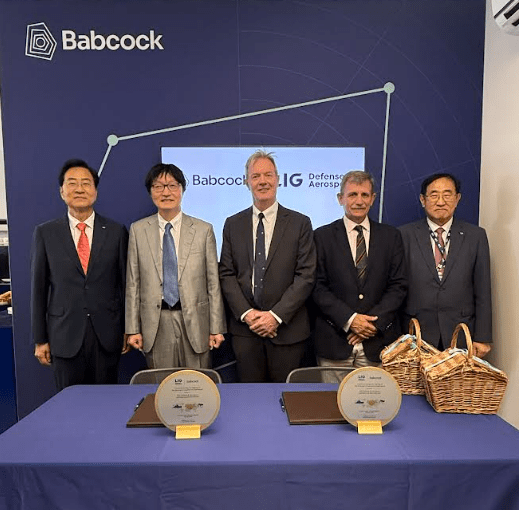
Officials from LIG D&A and Babcock pose for a commemorative photo after signing a strategic cooperation agreement. (Photo = LIG D&A)

LIG Defense & Aerospace (LIG D&A) is expanding cooperation with UK defense contractor Babcock International in next-generation defense sectors, including launch vehicles, precision-guided munitions (PGM), frigates, and unmanned systems.

LIG D&A announced on July 23, 2026, that it signed a Strategic Cooperation Agreement (SCA) with Babcock at the Farnborough International Airshow 2026 held in the United Kingdom.

Under the agreement, the two companies will integrate their global supply chains and pursue the joint development of an AH-140 (Arrowhead 140) frigate platform equipped with LIG D&A systems. The AH-140 is an export-oriented naval platform developed by Babcock based on the Royal Navy’s Type 31 frigate.

The companies will also jointly develop launch vehicles and PGMs while establishing a full life-cycle support system covering maintenance, repair, and overhaul (MRO) and capability upgrades. In addition, collaboration will expand into robotics and autonomous unmanned systems.

“This agreement will serve as an opportunity to secure new competitiveness in the global market,” said Lee Hyun-soo, head of LIG D&A’s Global Business Division. “We will continue to expand our partnership to provide integrated maritime defense solutions.”

  •  

LG Energy Solution, Chungbuk National University Partner to Foster Battery Talent

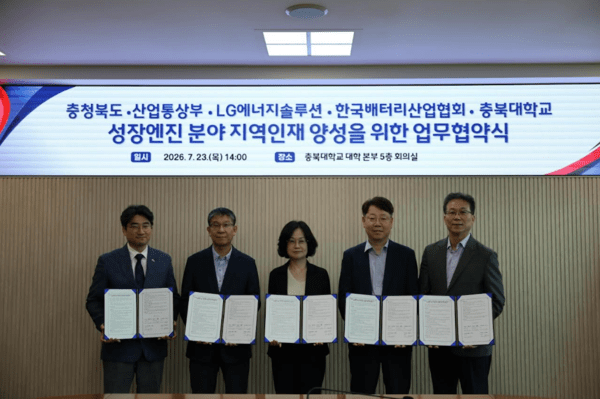
(From left) Cho Jung-ho, Vice President for Planning at Chungbuk National University; Kim Ki-soo, CHO and Executive Vice President of LG Energy Solution; Byun In-soon, Director General of the AI Science and Talent Bureau at North Chungcheong Province; Choi Woo-hyuk, Director General for Advanced Industry Policy at the Ministry of Trade, Industry and Energy; and Lee Hee-yeop, Executive Managing Director of the Korea Battery Industry Association. (Photo: LG Energy Solution)

LG Energy Solution (LGES) will collaborate with Chungbuk National University (CBNU), North Chungcheong Province, the Ministry of Trade, Industry and Energy (MOTIE), and the Korea Battery Industry Association (KBIA) to cultivate regional talent for the battery industry.

LGES said on July 23 that it signed a memorandum of understanding (MOU) with the four organizations at CBNU's main administration building under the Regional Talent Development for Growth Engine Industries initiative.

The agreement was established in line with the government's regional talent development policy for future growth industries, aiming to connect universities' education and research capabilities with the technology needs of industry. The participating organizations plan to develop curricula that reflect demand from the battery industry while strengthening industry-academia collaboration.

Under the agreement, the participants will jointly develop company-tailored educational programs and short-term training courses, while expanding contract-based enrollment programs and employment-linked education. LGES plans to strengthen regional manufacturing capabilities and workforce competitiveness centered on its Ochang Energy Plant in North Chungcheong Province.

"We will expand cooperation with the government, local authorities and universities to foster regional talent and build a stronger research and development (R&D) ecosystem," said Kim Ki-soo, Chief Human Resources Officer (CHO) and Executive Vice President of LGES.

  •  

Indonesia Nickel Investment Gains Momentum Despite Global Oversupply

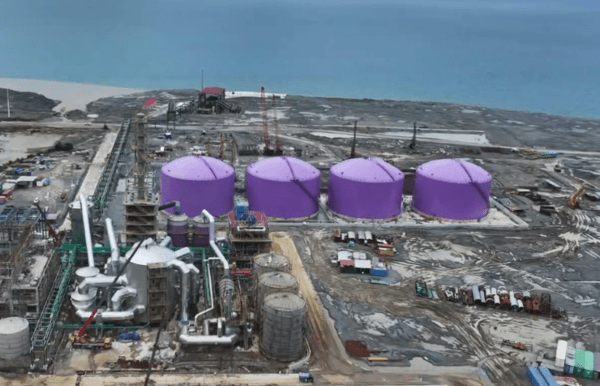
Construction site of the BNSI nickel smelter at the Indonesia Green Industrial Park (IGIP) in Sulawesi, where EcoPro Group is the largest shareholder. (Photo: EcoPro Group)

Investment in Indonesia’s nickel industry continues to accelerate despite a global oversupply of the battery material, as concerns over mineral security increasingly outweigh worries about excess supply. Companies including EcoPro BM are expanding investments to strengthen their access to critical raw materials amid tightening supply chain regulations.

The International Energy Agency (IEA), in its recently published Global Critical Minerals Outlook 2026, estimated that the global nickel market recorded an oversupply of approximately 200,000 metric tons in 2025. Continued investment in mining and smelting, particularly in Indonesia, has rapidly increased both mined and refined nickel production. The IEA expects supply growth to outpace demand for roughly the next decade, with significant new investment becoming necessary only after 2035.

Even so, companies continue to invest aggressively in securing nickel supply chains. EcoPro BM recently announced that 64% of the proceeds from its 1.2 trillion won rights offering will be used to acquire a stake in an Indonesian nickel smelter. The company believes that securing reliable access to nickel has become more important than the existence of surplus supply itself.

While stainless steel remains the largest consumer of nickel, demand growth is increasingly being driven by the battery industry. Nickel has emerged as a strategic mineral because it is a key material for high-energy-density batteries that extend electric vehicle (EV) driving range. Higher nickel content allows batteries to travel farther on a single charge, prompting South Korean battery makers to focus for years on developing high-nickel cathode materials.

Increasing nickel content also reduces reliance on cobalt, a material associated with greater supply chain risks. Ultra-high-nickel cathodes containing more than 95% nickel have been used in vehicles including Tesla’s Model Y Long Range. EcoPro BM is also focusing production at its Hungary plant, which began operations this year, on ternary cathode materials that use nickel as the primary raw material.

Most nickel feedstock is sourced from Indonesia, the world’s largest nickel producer. Backed by abundant reserves, Indonesia has become the center of global nickel supply by attracting investment in mines and smelters. According to the IEA, Indonesia accounts for about two-thirds of global nickel mine production and roughly half of global refined nickel output. Last year, Indonesia’s nickel mine production increased 9% while refined output rose 7%. In contrast, mine production in countries including Australia and New Caledonia declined by more than 10%. The IEA said the global nickel supply chain is becoming increasingly concentrated in Indonesia.

The challenge is that much of Indonesia’s nickel supply chain is controlled by Chinese companies. After the Indonesian government restricted exports of unprocessed nickel ore and encouraged domestic smelting investment, Chinese capital and technology flowed into the country. As a result, major nickel smelters and industrial parks are now largely operated by Chinese companies including CATL, CNGR Advanced Material, and GEM. The IEA projects that by 2035 Indonesia will account for more than 70% of global production of mixed hydroxide precipitate (MHP) and nickel matte, key feedstocks for battery-grade nickel sulfate, while China will produce 70% of global nickel sulfate.

The IEA identified mineral security as the primary reason companies continue investing despite oversupply. Global nickel demand is projected to increase 65%, from 3.532 million metric tons in 2025 to 5.832 million metric tons by 2040. As China expands export controls and nickel production becomes increasingly concentrated in Indonesia, securing stable access to raw materials is becoming a key competitive advantage.

Supply chain regulations, rather than concerns about future shortages, are also driving EcoPro and EcoPro BM’s investments in Indonesia. The United States is tightening restrictions on critical mineral supply chains involving prohibited foreign entities (PFE), particularly where Chinese participation exceeds 25%. EcoPro BM aims to use nickel produced at the BNSI smelter in Indonesia as feedstock that complies with PFE requirements. The investment is also viewed as positioning the company for Europe’s Critical Raw Materials Act (CRMA), which similarly encourages supply chain diversification.

EcoPro’s broader strategy is to establish vertical integration based on low-cost nickel. The company is building a value chain that links nickel produced in Indonesia to precursor materials, cathodes, and battery production in Europe. Cathode materials account for about 40% of battery manufacturing costs, while precursors represent roughly 70% of cathode production costs. Lower nickel procurement costs improve overall price competitiveness. EcoPro aims to build a cost structure capable of competing with lithium iron phosphate (LFP) batteries.

“Cathode material manufacturers also need to secure their own nickel supply chains to strengthen both cost competitiveness and competitiveness in winning new orders,” EcoPro BM Chief Executive Officer Kim Jang-woo said during a rights offering briefing on July 16.

Following its investment in the Indonesia Morowali Industrial Park (IMIP), EcoPro Group is also the largest shareholder in the BNSI nickel smelter at the Indonesia Green Industrial Park (IGIP). Over the past four years, the company has secured annual nickel supply rights for 29,000 metric tons through four smelters—Meiming, ESG, Green Eco Nickel, and QMB—located within IMIP. Once BNSI begins operations in the second quarter of next year, it will add another 36,000 metric tons annually, bringing EcoPro’s total secured nickel supply to 65,000 metric tons per year, enough to produce batteries for approximately 1.5 million EVs.

  •  

​LS Electric Posts Record Q2 Earnings as Order Backlog Reaches KRW 7 Trillion

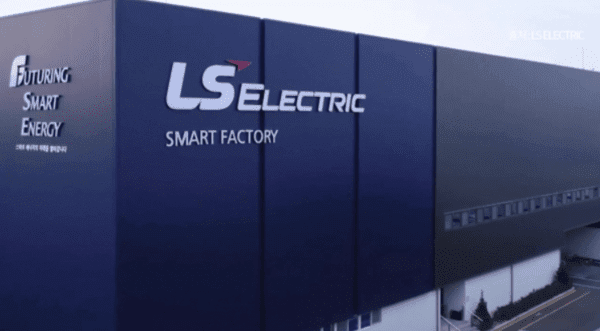
LS Electric Co. posted record quarterly revenue and operating profit for the second quarter of 2026.

​The company said in a regulatory filing on July 23 that it reported consolidated revenue of KRW 1.577 trillion and operating profit of KRW 178.5 billion for the second quarter. The figures increased 32.2% and 64.4%, respectively, from a year earlier.

​New orders totaled approximately KRW 2.1 trillion, while the company's order backlog rose by about KRW 1.4 trillion from the previous quarter to KRW 7 trillion.

​Growth was driven by its data center power distribution business and extra-high-voltage (EHV) transformer business. Demand for power distribution solutions increased as investments in artificial intelligence (AI) data centers and electric power grids accelerated. Shipments of EHV transformers also expanded, particularly in North America.

​Second-quarter revenue from EHV transformers climbed 91.2% from a year earlier. Revenue at subsidiary LS Power Solution increased 39%, while North American revenue reached approximately KRW 400 billion, marking a record high on a quarterly basis.

​LS Electric said it plans to expand investment in its manufacturing bases in Utah and Texas to increase local production capacity and further strengthen its presence in the North American market.

  •  

​EcoPro-Backed BNSI Nickel Smelter Receives Key Autoclave Reactor in Indonesia

An autoclave reactor arrives at the BNSI nickel smelter in Indonesia.

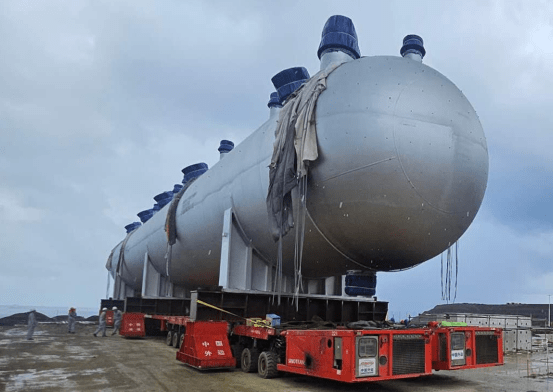
Indonesia's PT Blue Sparking Nickel Indonesia (BNSI) nickel smelter, in which EcoPro is the largest shareholder, has received a key processing unit, an autoclave reactor, as the project accelerates toward completion by the end of this year.

​EcoPro said on July 23 that BNSI held a ceremony to mark the arrival of the autoclave reactor at its nickel smelter in Sulawesi, Indonesia.

​The BNSI smelter will have an annual nickel production capacity of 90,000 metric tons. The project plans to install three autoclave reactors, each with a capacity of 30,000 tons, and two units have now been delivered. The remaining reactor is scheduled to arrive in September. After completing installation, the company aims to finish construction and begin trial production by the end of this year, with full commercial operations targeted for the second quarter of 2027.

​The autoclave is the core piece of equipment in the High-Pressure Acid Leach (HPAL) process, where nickel ore reacts with sulfuric acid under high temperature and pressure to extract nickel and cobalt. With the arrival of the reactors, the project has moved beyond the civil engineering and building phase into the installation of major production equipment.

​In line with the reactor delivery, the Indonesian government designated a 71.47-hectare area surrounding the smelter as a bonded zone. The designation is expected to improve operational efficiency by simplifying customs clearance and tax procedures for imported equipment, raw materials, and auxiliary supplies, while deferring or exempting value-added tax and import income tax.

​BNSI is a joint venture in which EcoPro holds a 39% stake. PT Vale Indonesia (PTVI) owns 30%, China's GEM Co., Ltd. holds 21%, and the remaining 10% is earmarked for strategic investors. Through BNSI, EcoPro will secure rights to procure 36,000 metric tons of nickel annually. Combined with volumes from its existing Indonesia Morowali Industrial Park (IMIP) project, the company will have access to a total of 65,000 metric tons of nickel per year.

​"HPAL autoclaves are the core equipment of the BNSI project," EcoPro Founder Lee Dong-chae said. "The BNSI project has moved beyond the planning stage and taken a major step toward full-scale construction and completion."

  •  

​LG Energy Solution Files Patent Lawsuit Against EVE Energy in U.S.

LG Energy Solution has filed a patent infringement lawsuit against Chinese battery maker EVE Energy in the United States.

​Tulip Innovation, LG Energy Solution's patent management company, announced on July 21 (local time) that LG Energy Solution had filed a complaint with the U.S. International Trade Commission (ITC) seeking an exclusion order against EVE Energy and U.S. importers, while also filing a patent infringement lawsuit in the U.S. District Court for the Eastern District of Texas.

​The litigation involves five patents, including four related to cylindrical batteries and one covering battery separators. The disputed portfolio includes patents related to tabless technology for cylindrical batteries.

​In addition to EVE Energy, LG Energy Solution has named U.S. customers that purchase EVE Energy's battery cells and sell power tools and other products in the U.S. market in its ITC complaint. If LG Energy Solution prevails before the ITC, the commission could issue an exclusion order barring imports of the accused products into the United States, as well as cease-and-desist orders restricting their sale and distribution in the country.

​LG Energy Solution began mass production of cylindrical lithium-ion batteries in 1998. The company holds an extensive portfolio of patents covering cylindrical battery formats, including 18650, 21700, and next-generation 46-series batteries.

  •  

​Hanwha Vision's 4 AI CCTV Models Obtain South Korea's NIS Security Certification

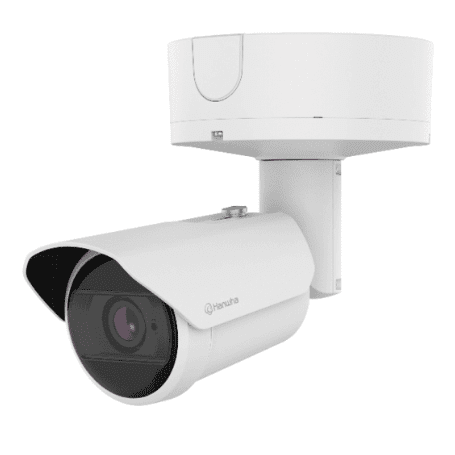
Hanwha Vision's flagship PNO-A9082RK AI CCTV camera model.

Hanwha Vision Co. has obtained South Korea's National Intelligence Service (NIS) security certification for four artificial intelligence (AI) CCTV models, securing a key qualification required to supply products to public-sector organizations and expanding its presence in the government video surveillance market.

​Hanwha Vision said on July 23 that four models in its flagship P Series AI 4K camera lineup received the NIS Security Function Verification Certificate last month. The certified products include Box, Dome, Bullet, and Vandal camera models.

​The Security Function Verification Certificate is a mandatory security qualification for products supplied to public institutions in South Korea. Products must meet NIS security standards covering data protection, software security, and access control.

​Hanwha Vision said it applied government-designated encryption technology throughout the image generation, transmission, and storage processes. The cameras also incorporate security features designed to prevent image tampering and respond to storage device theft.

​The company plans to launch 14 additional products in the second half of this year to expand its supply to the public-sector market.

​"Hanwha Vision will continue investing in AI CCTV product development and strengthening its security technology capabilities," a company representative said.

  •  

Government Approves Lotte, Hanwha and DL's Yeosu Petrochemical Restructuring

Yeochun NCC's Yeosu No. 2 complex. (Photo: Yeochun NCC)

South Korea has approved a major restructuring plan involving Lotte Chemical, Hanwha Solutions and DL Chemical, clearing the way for the integration of their petrochemical operations in Yeosu. The move marks the country's second government-approved restructuring of the domestic petrochemical industry, aimed at reducing oversupply and shifting production toward higher-value products.

On July 22, the Ministry of Trade, Industry and Resources approved the business restructuring plan jointly submitted by Lotte Chemical, Hanwha Solutions, DL Chemical and Yeochun NCC. The companies filed the application in March under the Corporate Vitality Improvement Act, which provides government support for corporate restructuring.

The plan calls for Lotte Chemical to spin off its Yeosu petrochemical complex before merging the new entity with Yeochun NCC, the naphtha cracking joint venture between Hanwha Solutions and DL Chemical. The resulting integrated company will be jointly operated by Lotte Chemical, Hanwha Solutions and DL Chemical.

As part of the restructuring, Yeochun NCC's No. 2 plant will be shut down, while No. 1 plant will be integrated with Lotte Chemical's Yeosu facility. The companies expect the move to reduce annual ethylene production capacity by approximately 1.4 million metric tons, helping alleviate oversupply in South Korea's petrochemical industry.

The integrated company also plans to consolidate the partners' competitive downstream businesses and shift its portfolio toward higher-value products, including low-density polyethylene (LDPE) for medical applications and polyolefin elastomers (POE) used in automobiles and power cables.

The approval follows the government's endorsement of the Daesan Industrial Complex restructuring in February, making it the second petrochemical restructuring project approved this year. The government said it will support the restructuring through financial assistance, tax incentives and regulatory approvals.

  •  

LS Marine Solution Completes Upgrade of GL2030 Cable-Laying Vessel

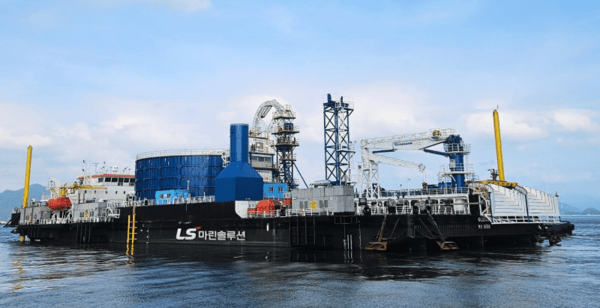
LS Marine Solution's submarine cable-laying vessel GL2030.

LS Marine Solution, a subsidiary of LS Cable & System, has completed a major upgrade of its cable-laying vessel GL2030, significantly increasing its cable carrying capacity to strengthen its competitiveness in large-scale offshore wind and high-voltage direct current (HVDC) transmission projects.

The company announced on July 22 that it has increased the vessel's submarine cable carrying capacity from 4,000 metric tons to 7,000 metric tons.

The upgrade enables the GL2030 to install submarine cables over distances exceeding 100 kilometers in a single continuous operation, reducing the number of voyages required for a project and lowering both construction time and costs.

LS Marine Solution expects demand for submarine power and telecommunications cable installation to increase as South Korea expands offshore wind generation, advances the West Coast HVDC transmission project and invests in new international submarine communications networks.

The company plans to deploy the GL2030 primarily for coastal projects while assigning its 13,000-ton next-generation cable-laying vessel, currently under construction, to long-distance and large-capacity projects, further expanding its offshore construction capabilities.

"We will expand our participation in domestic power grid projects, including the West Coast HVDC Energy Highway, while strengthening our presence in the US and European markets," an LS Marine Solution official said.

  •  

Yujin Technology Selected for Government AI Manufacturing Platform Project

Yujin Technology said on July 22 that it has been selected as the preferred bidder for the South Korean government's 2026 AI Transformation (AX) One-Stop Voucher Program, led by the Ministry of Science and ICT and the National IT Industry Promotion Agency (NIPA).

Yujin Technology will carry out the project through a consortium with Plan I and Gabia, developing a generative AI-based manufacturing platform for battery equipment.

The project will receive approximately 1.1 billion won in government funding during its first year. A second year of funding of a similar scale is expected following an evaluation of the first year's performance.

During the first phase, Yujin Technology plans to complete development of the AI platform and conduct proof-of-concept demonstrations. The second phase will focus on deployment in production environments and further enhancement of the platform's capabilities.

The company also plans to expand the platform beyond the battery industry into other manufacturing sectors, including semiconductors and precision machining.

"By establishing a generative AI-driven business innovation framework and a data-centric smart manufacturing system, we aim to improve both productivity and product quality," a Yujin Technology official said.

  •  

POSCO Group Opens Advanced Manufacturing Incubation Center in Pohang

The RIST Advanced Manufacturing Incubation Center in Pohang. (Photo: POSCO Group)

POSCO Group has opened an advanced manufacturing incubation center in Pohang, creating a new hub to support technology validation and commercialization for regional manufacturing startups.

The company announced on July 22 that it has opened the RIST Advanced Manufacturing Incubation Center at the Research Institute of Industrial Science & Technology (RIST). The facility was established jointly by POSCO Group, the Ministry of SMEs and Startups, North Gyeongsang Province and the City of Pohang.

The two-story facility has a total floor area of 4,074 square meters and can accommodate up to 10 companies.

The center is designed to support startups developing advanced materials and energy and environmental technologies. It is equipped with demonstration infrastructure, including cooling water, compressed air and industrial gases such as hydrogen, nitrogen and oxygen. RIST will provide testing and analysis services, reliability evaluation and process engineering support.

POSCO Group said it will leverage its venture investment, manufacturing and research capabilities to support resident companies throughout the commercialization process, including startup discovery, R&D, production scale-up, commercialization and market development. The Ministry of SMEs and Startups and North Gyeongsang Province will oversee operation of the center.

Four startups have already moved into the facility: Enforus, which develops high-temperature steam electrolysis technology for hydrogen production; Solarize, a manufacturer of photovoltaic inverters; Verycore Materials, which develops environmentally friendly coating materials; and EAFOS, which develops solvent extractants for battery manufacturing.

  •  

Hanjung NCS CEO Kim Sang-kyun Pledges Technology-Driven, Profit-Focused Management

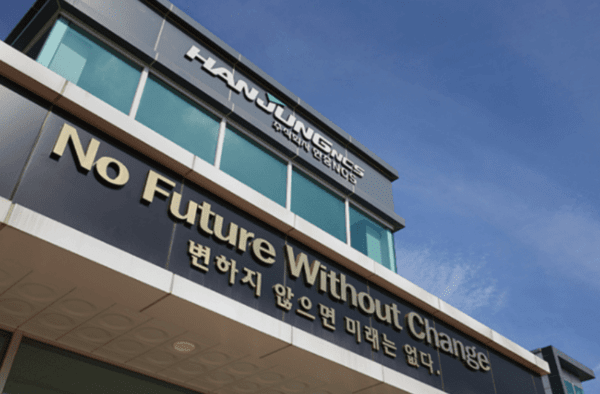
Kim Sang-kyun, chief executive officer of Hanjung NCS, has outlined his first management vision since taking office, pledging to strengthen the company's technology competitiveness and pursue profit-focused, accountable management.

Hanjung NCS announced on July 22 that Kim delivered a message to shareholders and employees outlining the company's mid- to long-term management strategy following its transition to a co-CEO structure on July 15.

Kim said the company will reinforce its existing businesses by leveraging its battery thermal management technologies while expanding new growth engines in energy storage systems (ESS), AI-based energy solutions and the North American market. He added that the company's North American expansion will be pursued with thorough preparation and disciplined risk management.

Kim also identified four core management principles: strengthening differentiated technological competitiveness, pursuing profitable growth, maintaining financial soundness and making decisions focused on enhancing shareholder value. The company said future investments and business expansion initiatives will be evaluated with profitability as the primary consideration.

"We will practice accountable management centered on technological competitiveness and profitability while enhancing corporate value," Kim said.

The company also noted that Kim recently purchased Hanjung NCS shares on the open market, underscoring his commitment to shareholder-aligned management.

  •  

LS Cable & System Wins Power Infrastructure Supply for Hyundai Motor's Battery Campus

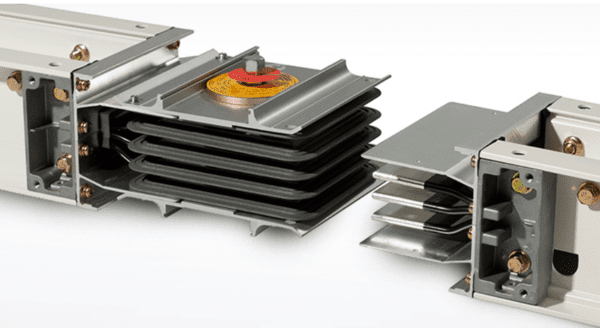
LS Cable & System's busduct product. (Photo: LS Cable & System)

Busduct installation at MAAC expands company's presence beyond AI data centers into EV battery manufacturing

LS Cable & System has supplied busduct power distribution systems to Hyundai Motor's battery manufacturing campus under construction in Anseong, expanding its power infrastructure business from AI data centers into the electric vehicle battery sector.

According to industry sources on July 22, LS Cable & System is responsible for the electrical infrastructure work at the Future Mobility Battery Anseong Campus (MAAC), which Hyundai Motor is building in the Fifth General Industrial Complex in Anseong, Gyeonggi Province. MAAC is Hyundai Motor's 1.2 trillion won battery research and pilot production facility. LS Cable & System has supplied power infrastructure, including busduct systems, to the site. Construction began in early 2025 and the project is understood to be more than 80% complete. The supply contract is estimated to be worth several hundred billion won.

This marks the first time that LS Cable & System's busduct supply for a Hyundai Motor battery facility has become publicly known. The company declined to comment on specific customers or supplied products. LS Cable & System already supplies enameled wire for traction motors used in Hyundai Motor and Kia electric vehicles, including the IONIQ 5 and EV6, making the latest project an expansion of its partnership in electric vehicle components.

Busduct is a high-capacity power distribution system consisting of copper or aluminum conductors enclosed within a prefabricated metal housing. Compared with conventional cable-based electrical installations, busduct systems are better suited for transmitting large electrical currents while reducing power losses and simplifying installation. Their use has expanded across power-intensive facilities such as semiconductor fabs, display plants, battery factories and AI data centers, although initial installation costs are generally higher than conventional cabling.

LS Cable & System and Taihan Cable & Solution are the leading domestic manufacturers of busduct systems. LS Cable & System developed South Korea's first busduct in 1984 and currently holds more than 50% of the domestic market. Its products have been installed at major industrial facilities, including Samsung Electronics' Pyeongtaek Campus and LG Display's Paju manufacturing complex.

The company manufactures a full lineup of busduct products ranging from low- to high-voltage systems and from small- to large-capacity configurations. Its products feature cold-resistant designs capable of operating at temperatures as low as minus 55 degrees Celsius as well as seismic resistance, allowing deployment in factories, high-rise buildings, wind power plants and ships.

Globally, LS Cable & System competes with companies including Schneider Electric, ABB, Eaton, Siemens and Mitsubishi Electric. The company has been expanding overseas orders by emphasizing shorter manufacturing and delivery times. While overseas competitors typically require more than a year—and sometimes as long as two years—from design through installation and commissioning, LS Cable & System says it can complete deliveries in approximately four to five months.

The company's fast delivery has proven particularly advantageous in the rapidly growing AI data center market, where minimizing construction schedules is critical. This year, LS Cable & System and its subsidiary Gaon Cable secured a series of busduct orders from global technology companies, including Amazon, Meta and Tesla. Their cumulative order backlog has exceeded 5 trillion won, including long-term supply agreements (LTAs). LS Cable & System expects revenue from its busduct business to more than double next year to approximately 2 trillion won.

Industry sources also said LS ELECTRIC is participating in the MAAC project. The company has previously supplied power equipment for Hyundai Motor's dedicated electric vehicle plant in Ulsan, Gwangju Global Motors (GGM), Hyundai Motor's Indonesia factory, Kia's Kazakhstan plant and Hyundai Mobis' motor and battery pack assembly lines. With Hyundai Motor planning to invest more than 9 trillion won in a future industrial cluster centered on AI, robotics and hydrogen energy in Saemangeum, industry observers expect additional opportunities for both LS ELECTRIC and LS Cable & System to supply power infrastructure.

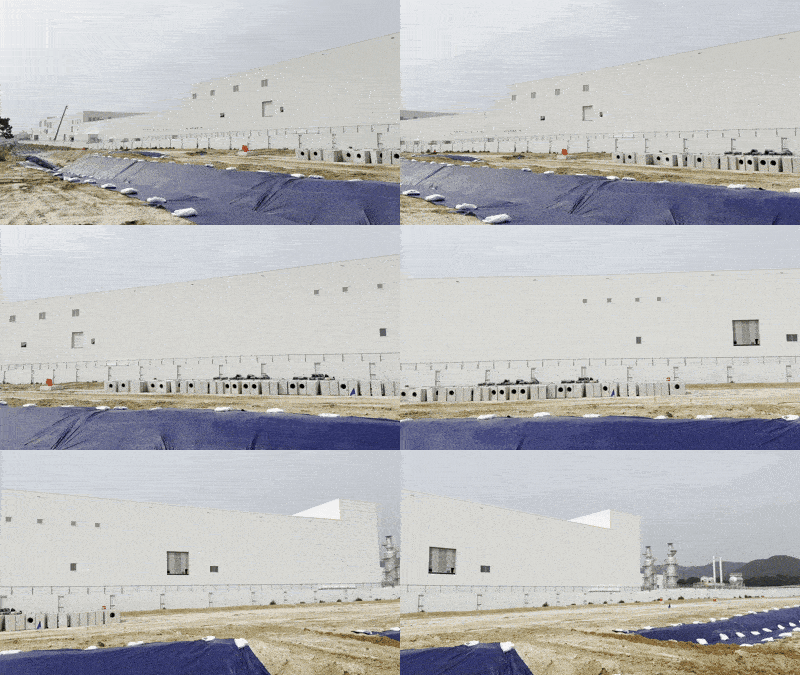
Hyundai Motor's Future Mobility Battery Anseong Campus (MAAC) construction site photographed on July 17. Most of the building construction has been completed, with work continuing on external infrastructure. (Photo: THE ELEC)

MAAC is being constructed by Hyundai Engineering, with building work now in its final stages and completion targeted within the year. Hyundai Motor has traditionally conducted advanced battery research covering materials, cells and design at its Namyang and Uiwang research centers. MAAC will expand those capabilities to include battery cell development suitable for commercial vehicles and validation for mass production. The campus will incorporate the full battery manufacturing process, including electrode production, cell assembly and formation, using equipment supplied primarily by South Korean battery equipment manufacturers.

  •  

Hanwha Aerospace Raises $500 Million in First Overseas Public Bond Offering

Hanwha Aerospace has completed a $500 million US dollar-denominated public bond offering, becoming the first South Korean defense and aerospace company to issue an overseas public bond.

The company announced on July 21 that it had finalized the issuance of $500 million in fixed-rate notes with a three-year maturity.

The bond offering attracted approximately $3.3 billion in orders from investors across Europe and Asia, representing demand of roughly seven times the issuance size.

In June 2026, S&P Global Ratings assigned Hanwha Aerospace a long-term issuer credit rating of A-, making it the first South Korean defense and aerospace company to receive an A-range long-term rating from the global credit rating agency.

Hanwha Aerospace said it plans to use the proceeds from the bond issuance for working capital and the repayment of existing debt.

The transaction was jointly arranged by Citigroup Global Markets, Crédit Agricole CIB, and UBS.

"We successfully completed our inaugural overseas public bond offering with strong interest from international investors," a Hanwha Aerospace official said. "Supported by a stable funding base, we will continue strengthening our competitiveness in global markets."

  •  

GI Tech Wins First Order for Solar Panel Recycling Equipment

GI Tech headquarters in Asan, South Chungcheong Province. (Photo: GI Tech)

GI Tech has secured its first order for automated equipment that separates glass from end-of-life solar panels, marking its expansion into photovoltaic recycling equipment following its battery and display equipment businesses.

The company announced on July 21 that it had won a contract to manufacture a double-glass module separation system used to recycle bifacial glass solar panels.

The order represents the first outcome of a memorandum of understanding signed in April 2026 between GI Tech and Wongwang S&T to jointly advance solar panel recycling equipment and pursue global commercialization.

The system removes the front glass from bifacial solar panels before automatically separating the glass from the photovoltaic cell sheet.

Bifacial glass modules encapsulate solar cells between two glass panels. During recycling, minimizing damage to the embedded solar cells and metallic materials while removing the glass is a key technical challenge.

GI Tech said it designed the separation process to preserve the value of recoverable metals such as silver and copper contained within discarded solar panels. The company is applying precision control technologies developed through its battery and display equipment businesses to recycling equipment.

Solar panels typically require replacement after 20 to 30 years of operation. South Korea currently operates an extended producer responsibility (EPR) system under which solar module manufacturers and importers are responsible for collecting and recycling end-of-life panels.

As aging photovoltaic installations increase, demand is expected to grow for automated equipment capable of dismantling discarded solar panels and separating recyclable materials.

"We will continue expanding our recycling equipment business by applying our precision control technologies to end-of-life solar panel recycling processes," a GI Tech official said.

  •  

LG Electronics to Shut Down Its First China Manufacturing Plant After 34 Years

LG Electronics will halt production at its manufacturing plant in Huizhou, China, after October, bringing operations at the group's first manufacturing subsidiary in China to an end after 34 years.

According to industry sources on July 21, LG Electronics plans to cease operations on the production lines at LG Electronics Huizhou (LGEHZ) by the end of the year. The company has already informed local employees that manufacturing will stop after October.

The Huizhou facility has primarily produced speakers for LG Electronics' XBOOM audio brand. The company is understood to have decided to reorganize its manufacturing footprint as competition from Chinese manufacturers intensifies and its audio business shifts toward premium products.

LGEHZ was established in October 1993 as a joint venture among LG Electronics, LG Electronics China and TCL Group, becoming the LG Group's first manufacturing subsidiary in China. LG Electronics currently owns an 80% stake in the venture.

The Huizhou factory began operations in October 1994, producing home theater systems, Blu-ray DVD players, smart printers and beauty devices. More than 90% of its output was exported, primarily to North America, Latin America, Europe and Central Asia.

The plant has an annual audio production capacity of 2.6 million units and annual production value exceeding 2 billion yuan. Profitability has declined over the past three years, with net profit falling from 12.5 billion won in 2023 to 10.9 billion won in 2024 and 9.2 billion won in 2025.

"We plan to close the Huizhou plant this year and have already informed local employees that production will stop after October," a person involved in LG Electronics' China operations said.

The company has not yet finalized how it will handle the legal entity or the factory after production ends.

"Production at the Huizhou subsidiary is scheduled to stop by October this year," an LG Electronics spokesperson said. "We are reviewing various options for the future operation of the subsidiary and the factory."

Possible options include transferring production to LG Electronics' manufacturing base in Hai Phong, Vietnam, expanding contract manufacturing with Chinese partners, or liquidating the subsidiary.

LG Electronics previously liquidated its Kunshan manufacturing subsidiary in China in 2020, transferring automotive infotainment production to its Hai Phong plant. The Kunshan facility had produced automotive audio, video, navigation and telematics products.

LG Group operates the LG Hai Phong Campus in Vietnam, which houses manufacturing facilities for LG Electronics, LG Display and LG Innotek. Hai Phong has become one of the group's key overseas manufacturing hubs.

LG Electronics Vietnam Hai Phong (LGEVH) reported consolidated revenue of 5.97 trillion won in 2025, up 5.9% from 5.64 trillion won in 2024. Net profit increased 17.8% to 204.9 billion won from 173.9 billion won. LGEVH is the company's second-largest overseas manufacturing subsidiary by revenue, after its US subsidiary.

LG Electronics could also outsource production previously handled at Huizhou to Chinese manufacturers. The company already uses a joint development and manufacturing model for some entry-level refrigerators, washing machines and robot vacuum cleaners, with Chinese partners responsible for product development and manufacturing while LG Electronics oversees product planning and quality standards.

Depending on product positioning and target markets, the company could shift Huizhou production to external manufacturing partners.

Another possibility is the complete liquidation of the Huizhou subsidiary without relocating production. LG Electronics previously shut down and liquidated its Tianjin subsidiary, which manufactured kitchen appliance components, after the need to maintain local production diminished amid growing competition from lower-cost Chinese brands.

Industry sources said the closure reflects a manufacturing efficiency strategy rather than a retreat from the audio business.

LG Electronics has been expanding its premium audio lineup, particularly premium speakers and soundbars, while targeting annual audio business revenue in the trillions of won over the longer term. Market research firms forecast the global consumer audio market will grow from $58.1 billion in 2024 to $70.1 billion in 2029, driven in part by new product categories such as AI-powered speakers.

  •  

Hanwha Launches Financing Program for Defense and Shipbuilding Suppliers

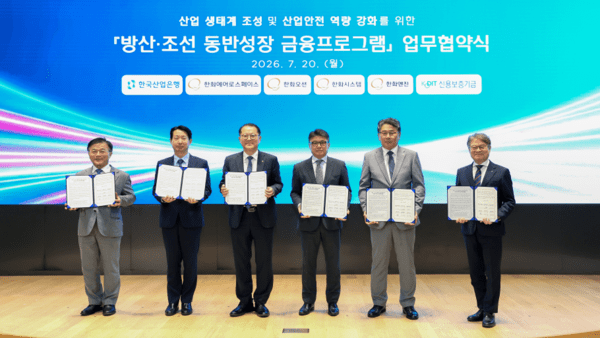
From left: Park Sang-jin, chairman of the Korea Development Bank; Moon Ji-hoon, executive vice president of Hanwha Aerospace; Kim Hee-cheul, chief executive officer of Hanwha Ocean; Kim Jong-seo, chief executive officer of Hanwha Engine; Kwak Jong-woo, executive vice president of Hanwha Systems; and Kang Seung-jun, chairman of the Korea Credit Guarantee Fund.

Hanwha has partnered with the Korea Development Bank (KDB) and the Korea Credit Guarantee Fund (KODIT) to provide financing support for facility investments by suppliers in the defense and shipbuilding industries.

The company announced on July 20 that it signed a memorandum of understanding on a shared-growth financing program with KDB and KODIT at KDB's headquarters in Yeouido, Seoul.

The program will support small and mid-sized suppliers of four Hanwha affiliates: Hanwha Aerospace, Hanwha Ocean, Hanwha Systems and Hanwha Engine.

Under the agreement, the Hanwha affiliates will contribute funds to KODIT and recommend eligible suppliers. KODIT will provide preferential credit guarantees to those companies, while KDB will extend facility investment loans backed by the guarantees.

The financing will enable participating suppliers to fund investments such as expanding production equipment and building new manufacturing facilities. Hanwha said it will identify suppliers requiring financial support and assist them throughout the financing process.

"We will identify suppliers that need facility investment and help them make full use of this financing program," said Kim Hee-cheul, chief executive officer of Hanwha Ocean.

  •  
❌