
❌

Reading view

3.5-Million-Year-Old Fossil from Japan Reveals Lost Lineage of Giant Salamanders
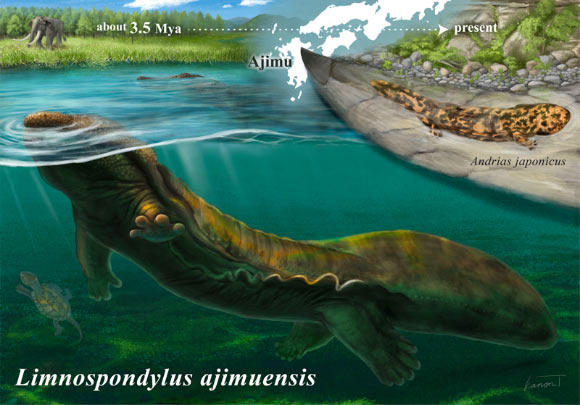
Life reconstruction of Limnospondylus ajimuensis. Image credit: Kanon Tanaka.

A new genus and species of cryptobranchid salamander that lived in lakes in Japan about 3.5 million years ago has been identified from three fossil vertebrae, filling a major gap in the fossil record of one of the world’s oldest amphibian lineages.

The post 3.5-Million-Year-Old Fossil from Japan Reveals Lost Lineage of Giant Salamanders appeared first on Sci.News: Breaking Science News.
  •  

Half-Ton Cattle Relatives Roamed Europe 4 Million Years Ago

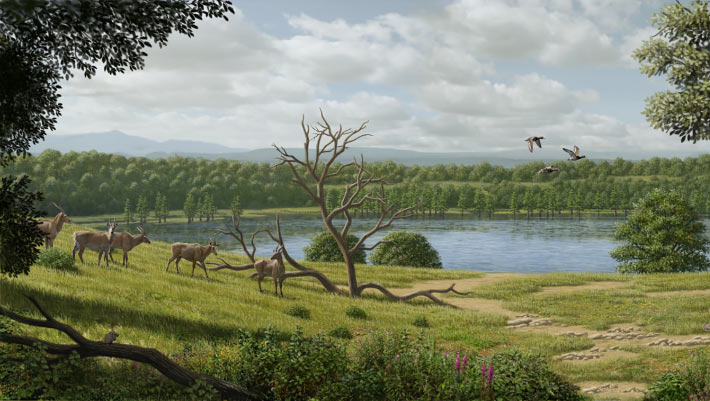
Paleoartistic reconstruction of the environment in the surrounding of Camp dels Ninots maar lake during the Early Pliocene. Image credit: Mauricio AntΓ³n.

Near-complete bovine skeletons unearthed the Early Pliocene site of Camp dels Ninots in northeastern Spain reveal that the ancestors of today’s buffalo and cattle were already growing to impressive sizes long before humans arrived on the continent.

The post Half-Ton Cattle Relatives Roamed Europe 4 Million Years Ago appeared first on Sci.News: Breaking Science News.

  •  

New Species of Fossil Axolotl Unearthed in Mexico

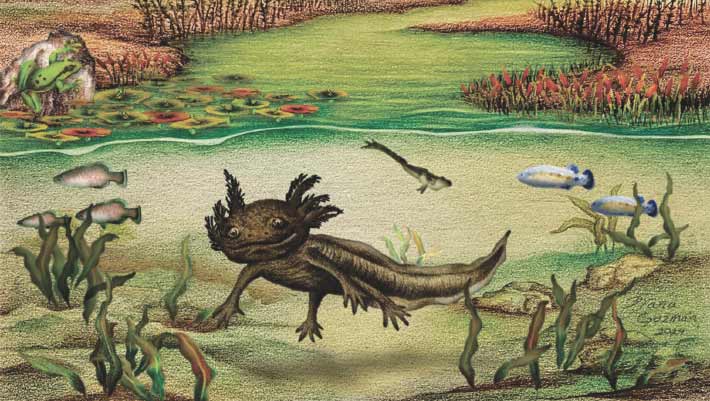
Reconstruction of the Santa MarΓ­a Amajac paleolake during the Late Pliocene; the paleobiodiveristy of the paleolake included microvertebrates such as the ambystomatid salamander Ambystoma quetzalcoatli, Paleocharacodon guzmanae and Goodea-like fishes, anurans and numerous species of terrestrial and aquatic plants such as Nymphaea sp., Scirpus sp., Typha sp. Image credit: Diana GuzmΓ‘n-Madrid.

Paleontologists have identified a new species of the axolotl genus Ambystoma from several fossilized specimens found deep in the rocky outcrops of the Mexican state of Hidalgo.

The post New Species of Fossil Axolotl Unearthed in Mexico appeared first on Sci.News: Breaking Science News.

  •  
❌