❌

Reading view

The Aquiry Civilization Inhabited the Southwestern Amazon with Millions of People for 1,500 Years and Collapsed at the Same Time as the Maya

An international team of researchers has documented through airborne laser scanning the existence of an extensive multicultural civilization that thrived in the Southwestern Amazon between 600 B.C. and 850 A.D., and that housed millions of people at its peak. The findings, published after meticulous fieldwork covering approximately 4,500 square kilometers, transform the current understanding of […]

  •  

Did Early Snakes Burrow, Swim or Crawl? 80‑Million‑Year‑Old Fossil Suggests: All Three

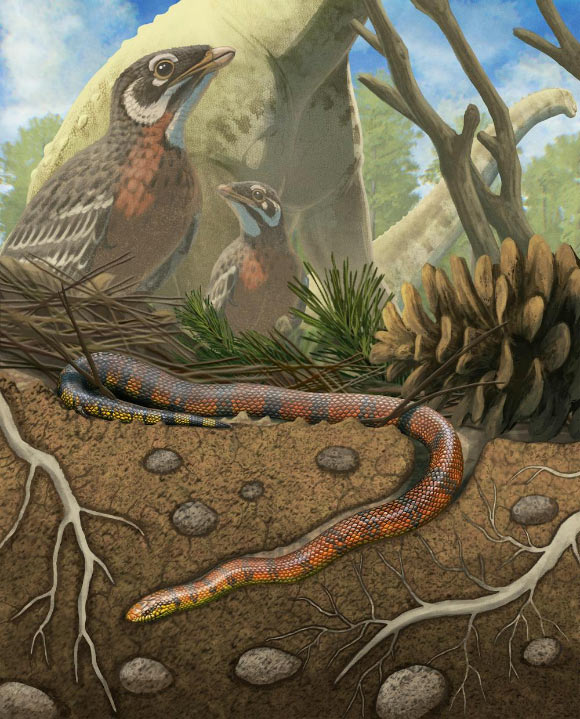
Life reconstruction of Tametara mirim. Image credit: Gabriel Ugueto.

Paleontologists have unearthed a remarkably preserved fossil snake in Brazil that is reshaping ideas about how the earliest snakes lived and complicating the long-running debate over whether their ancestors burrowed underground, swam in the sea or crawled the surface.

The post Did Early Snakes Burrow, Swim or Crawl? 80‑Million‑Year‑Old Fossil Suggests: All Three appeared first on Sci.News: Breaking Science News.

  •  

Tiny Triassic Reptile Sheds Light on Early Lizard Evolution

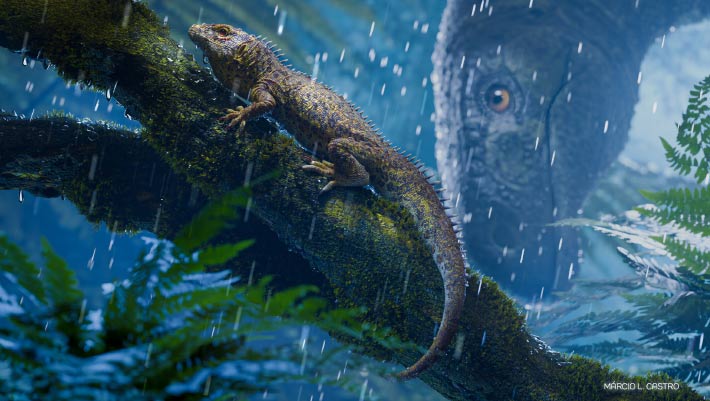
A landscape from the Late Triassic of southern Brazil showing Cargninia enigmatica being observed by the sauropodomorph dinosaur Macrocollum itaquii. Image credit: Marcio L. Castro.

Today, lepidosaurs -- the reptile group that includes lizards, snakes and New Zealand’s tuatara -- are among the most diverse vertebrates on Earth, but their earliest evolutionary history remains poorly understood.

The post Tiny Triassic Reptile Sheds Light on Early Lizard Evolution appeared first on Sci.News: Breaking Science News.

  •  

113-Million-Year-Old Pterosaur Fossil Reveals What Flying Reptiles Ate

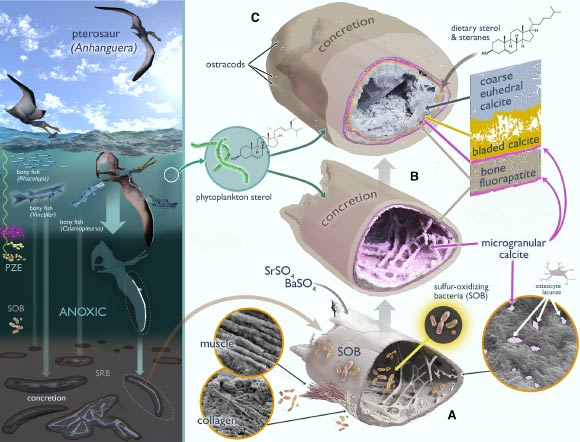
Grice et al. integrate organic geochemical analyses with high-resolution micro-mineral imaging of a three-dimensionally preserved Cretaceous pterosaur wing phalanx from Brazil to reveal steroid biomarkers and multi-stage mineralization pathways underlying its preservation. Image credit: Grice et al., doi: 10.1016/j.isci.2026.116199.

A 113-million-year-old pterosaur fossil from northeastern Brazil has yielded rare evidence of soft tissues, organic molecules and chemical traces of a diet heavy in fish and cephalopods such as squid or nautilus relatives.

The post 113-Million-Year-Old Pterosaur Fossil Reveals What Flying Reptiles Ate appeared first on Sci.News: Breaking Science News.

  •  
❌