Quantum materials could transform technologies ranging from powerful computers and highly secure communications to advanced energy systems, but one major obstacle has long stood in the way. Most quantum materials reveal their unusual properties only when chilled to temperatures near absolute zero. At room temperature, continual atomic vibrations caused by heat can overpower the fragile [...]
The promise of quantum computing is to solve complex problems faster and more energy-efficiently than today's supercomputers—from optimizing logistics to simulating molecules. This goal is coming within reach as the number of qubits—the computational units of quantum computing—increases.
A research team led by SKKU professor Hosung Seo of the Department of Quantum Information Engineering and the SKKU Advanced Institute of Nanotechnology, working with the University of Wisconsin–Madison and the University of Washington, has identified—for the first time—an atomic defect structure in the zinc oxide (ZnO) semiconductor with outstanding properties for use as a "spin qubit," a core building block of future quantum computers, quantum communications and quantum sensors.
ISTA physicists have confirmed a theory proposed 20 years ago that could advance quantum technology. A future quantum computer may need separate modules to behave as one machine, even when they are physically apart. That requires distributed entanglement, a quantum connection between distant components that has typically depended on active control and repeated measurements. Physicists [...]
Quantum technologies promise revolutionary advances in computing, sensing and information processing. However, controlling individual quantum bits (qubits) at the atomic scale remains a major challenge because conventional approaches rely on magnetic fields, which are difficult to confine to a single molecule.
A truly useful quantum computer must be able to run any algorithm, with the same versatility an ordinary laptop offers. Physicists have now shown a new way to give a quantum computer exactly that flexibility, harnessing the capabilities of exotic quantum particles called non-Abelian anyons.
Physicists have coaxed a black hole's most famous glow out of a strand of optical fiber and, for the first time, watched that light react back on the simulated black hole that produced it.
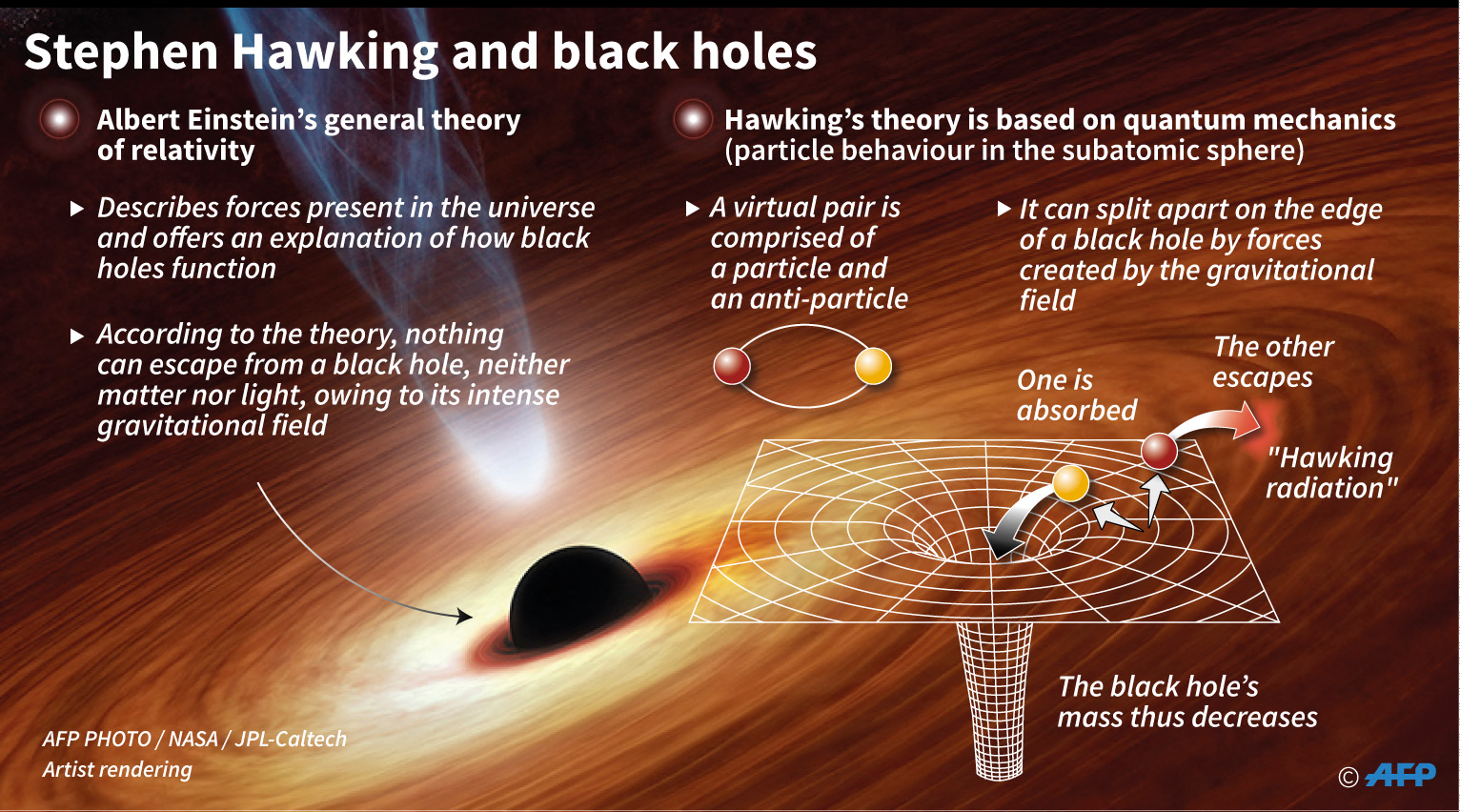
The result gives researchers a rare, hands-on look at Hawking radiation — the faint thermal emission that Stephen Hawking predicted should leak out of black holes — and offers a first clue about the tiny push that could, in principle, make a real black hole slowly evaporate, the research team said in a new study.
Working with a tabletop experiment in optical fibers, the international team detected both the radiation and its long-sought "back reaction" — the way the radiation feeds energy back and reshapes the object that created it.
According to the new study, published July 1 in thejournal Nature, the light behaved exactly as Hawking predicted it should: like the glow of a warm object, with a definite temperature and a spectrum that fades away steadily toward higher frequencies. It did so even in a regime where the usual textbook description of a black hole should break down.
An infographic explaining how Hawking radiation works, contrary to the predictions of general relativity. (Image credit: ALAIN BOMMENEL,VALENTINA BRESCHI,WILLIAM ICKES via Getty Images)
Where three great theories collide
Hawking radiation is famous because it sits at the crossroads of physics' biggest ideas.
"Jacob Bekenstein predicted that black holes have an entropy and a temperature, and Hawking calculated the thermal radiation of the black hole," study co-author Ulf Leonhardt, a physicist at the Weizmann Institute of Science in Israel, told Live Science via email. "In Hawking-Bekenstein radiation, quantum physics, general relativity and thermodynamics come together — subjects that are normally in conflict with each other."
The conflict runs deep: General relativity pictures space and time as smooth and continuous, while quantum mechanics describes a world of discrete, unpredictable jumps — and no one has managed to fully reconcile the two.
That combination is exactly what makes Hawking radiation so hard to study. Astronomers have never seen Hawking radiation from a real black hole and probably never will; the glow is far too faint to pick out across the cosmos. So physicists have turned to laboratory stand-ins that obey the same equations, building black hole analogues out of flowing water, ultracold atoms and, as in this study, light.
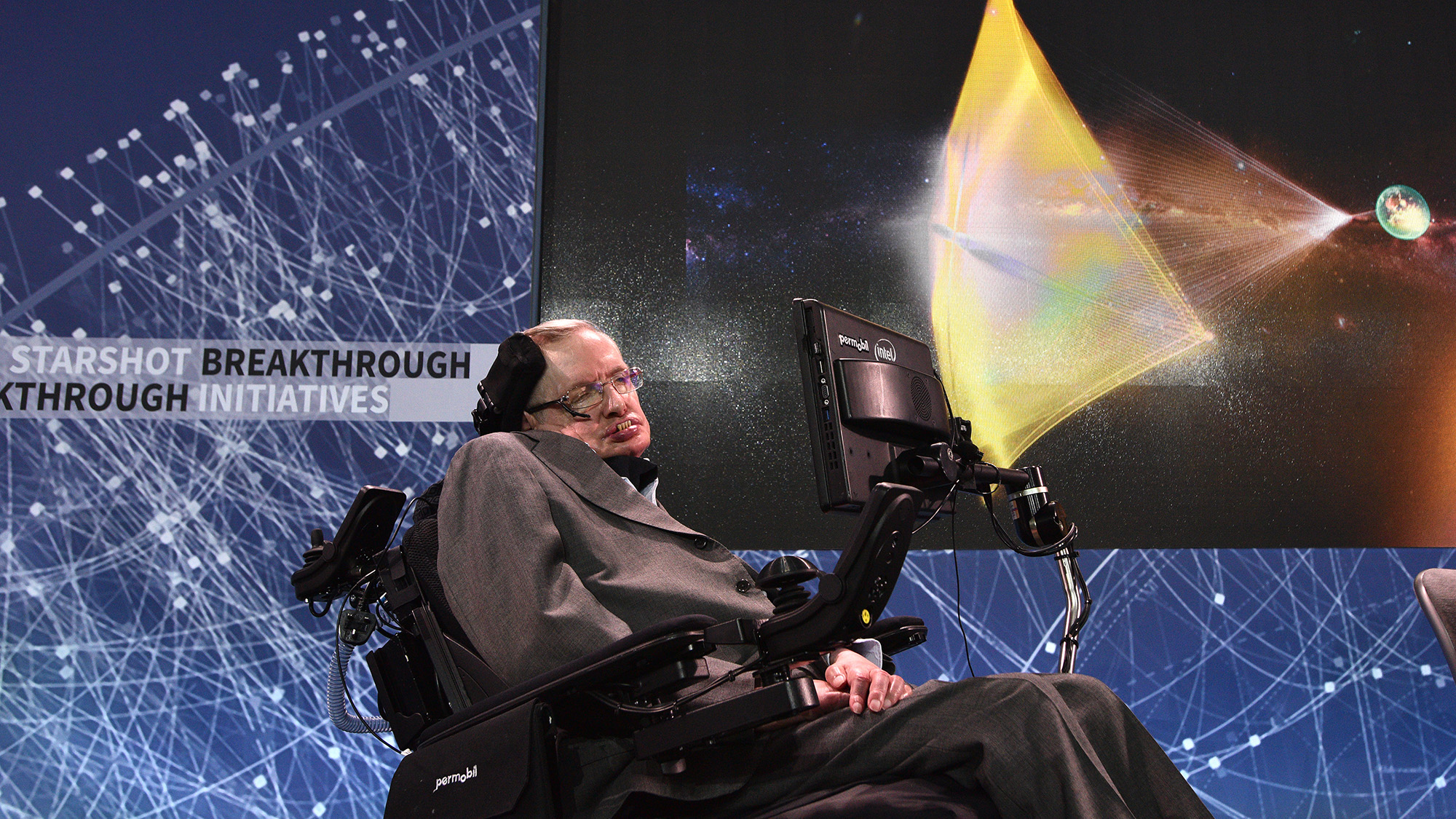
Physicist Stephen Hawking that black holes should be able to lose information through an elusive type of radiation. New research zooms in on the mechanism that makes it possible. (Image credit: Bryan Bedder / Stringer via Getty Images)
Building a black hole from light
The trick behind every black hole analogue is a moving medium. "Imagine a swimmer in the sea with a current faster than he can swim," Leonhardt explained. "He is swept away. This is what happens beyond the [event] horizon, and this is why normally nothing can escape the black hole."
A black hole's event horizon is the boundary where that current — space itself, in real life — starts moving faster than anything can travel. To recreate it, the team needed a material that appears to rush along at the speed of light. Their solution was elegant: use light to make the "material."
"In optics we need a material that appears to move at the speed of light," Leonhardt said. "For this we use light itself — in nonlinear optics, light acts like a material."
In practice, the researchers fired an intense, ultrashort "pump" pulse into a thin photonic-crystal fiber — a strand of glass threaded with a pattern of tiny air channels running along its length, which lets researchers fine-tune how light moves through it. As it traveled, the pulse slightly changed how the glass bent light, creating a moving speed bump that raced along with it. A second, much weaker "probe" pulse then ran into this moving front. Where the probe could no longer keep up, an artificial horizon formed — and the black hole analogue was born.
Catching the glow and its pushback
The payoff came in the ultraviolet. According to theory, Hawking radiation is created in pairs: One partner escapes, while the other, carrying "negative" energy, is the mirror image that would fall into a real black hole. In the fiber, that partner showed up as ultraviolet light.
"We counted photons in the ultraviolet that correspond to the Hawking partners beyond the horizon," Leonhardt explained. "They have a wavelength around 233 nanometers. This was our signal."
Just as important as seeing the glow was understanding how it was made. For years, researchers assumed the fiber built up its Hawking radiation through a cascade — a chain of separate steps in which the light is converted first into one intermediate form, and then another, each feeding the next before the radiation finally emerges. The team found that, instead, a single, direct interaction does the job, with the pump and probe light producing the Hawking pair in one clean step. It is a much simpler picture that the researchers said may carry over to other analogues and perhaps even to real black holes.
Because energy has to come from somewhere, making Hawking radiation should nudge the source that created it. For a real black hole, that nudge is how it loses mass and, over unimaginable timescales, evaporates entirely — the process Hawking described in his landmark 1974 paper. No experiment had ever captured that recoil.
Here, the team saw it. Producing the radiation shifted a small fraction of the pump pulse's own light to a slightly different color, leaving a telltale lopsided pattern in the spectrum. That asymmetry, absent in earlier experiments, is the fingerprint of the back reaction, or recoil — the black hole analogue quietly paying the energetic price for its own glow.
The result also speaks to one of the thorniest puzzles in black hole physics: the trans-Planckian problem. Trace Hawking's radiation back to where it was born and the calculation runs into territory no physicist can vouch for — the Planck scale, the vanishingly small size at which space and time are thought to lose their familiar meaning and all known physics gives out. Hawking's prediction, in other words, appears to rest on a foundation that may not exist.
"Any light getting away from the horizon is stretched out enormously," Leonhardt said. "So it must come from waves smaller than the tiniest scale in nature, where the physics is unknown. Would that still give Hawking radiation? That was the question, and we have answered it in our experiment." Remarkably, the glow stayed perfectly thermal even in this extreme regime.
The team's next step is concrete. So far, they have used ordinary laser light, which reproduces the spectrum of Hawking radiation but not its deepest quantum weirdness. Next, the team plans to "go quantum," Leonhardt said. "We will explore how to get into the quantum regime and observe quantum features such as entanglement" — the ghostly link that should tie each escaping Hawking particle to its lost partner.
See how much you know about black holes with our black hole quiz!
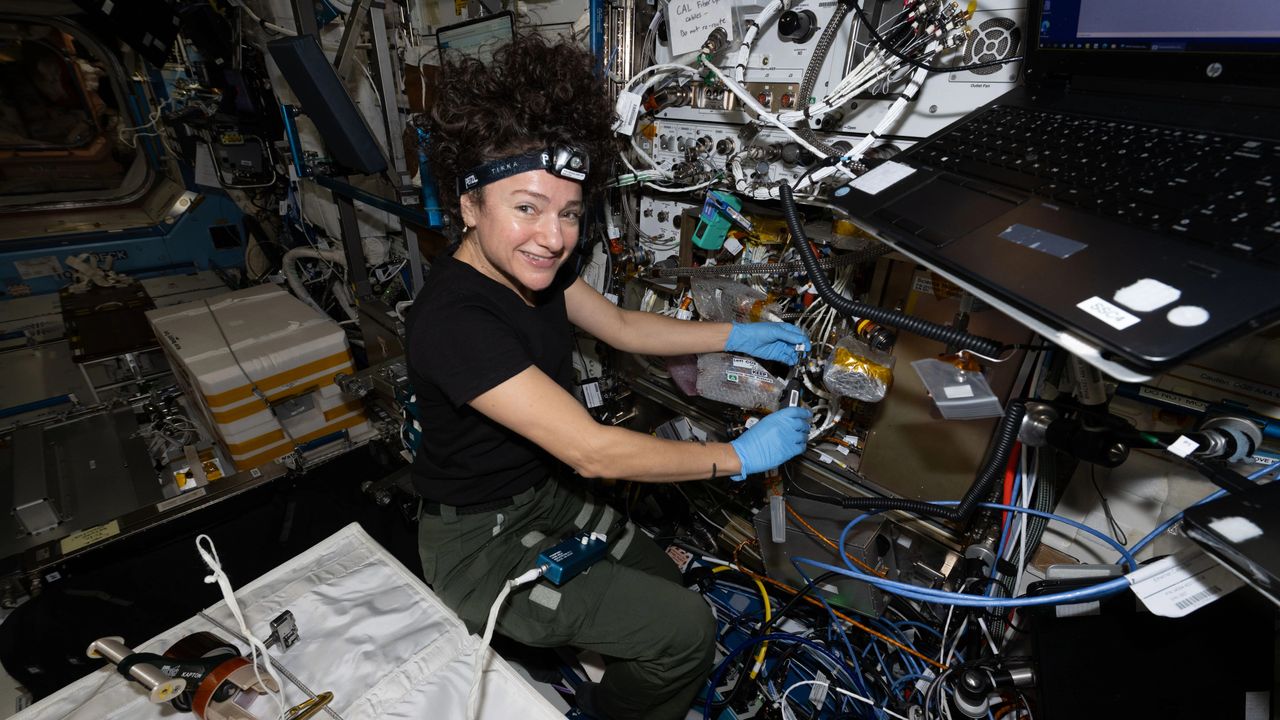
A new upgrade to the International Space Station's (ISS) quantum laboratory is enabling NASA to probe the behavior of atoms further than ever before, the space agency has announced.
Combining the ISS's newly upgraded "Cold Atom Laboratory" with the near zero-gravity of low Earth orbit, scientists are attempting to understand the properties of so-called "ultracold" atoms in an environment impossible to replicate on Earth. The aim of the mission is to study how clouds of atoms behave at temperatures close to absolute zero (minus 459.67 degrees Fahrenheit or minus 273.15 degrees Celsius) — the coldest possible temperature in the universe, where atoms lose all their energy of motion.
"At the coldest temperatures, matter behaves drastically different from anything we have experienced," Jason Williams, project scientist for the Cold Atom Lab at NASA’s Jet Propulsion Laboratory in Southern California, which built the facility, said in a statement. "The wavelike nature of matter dominates, and ultracold matter can behave in ways that are not only unexpected, but that also enable extremely precise measurements of time, gravity, and motion. The lab has lots of tools — especially with this latest upgrade — to let us probe the nature of the universe."
Rule-breaking particles
Atoms and their subatomic particles are quantum mechanical objects whose behavior is fundamentally different from that of the large-scale world. For example, the laws of quantum mechanics predict that particles can be in more than one place at the same time (quantum superposition); can be mysteriously linked with each other over great distances (quantum entanglement); and move through spacetime as waves as well as moving like fixed, solid objects.
But observing these behaviors is notoriously difficult. Firstly, atoms are so tiny that if an atom were the size of a golf ball, then a human teeing one off would stand roughly as tall as the distance from Earth to the moon. Secondly, it’s impossible to isolate measurements of these behaviors for atoms in "normal" environments (like on Earth), as the desired quantum behavior is disturbed by energy from heat and gravity.
To overcome these challenges, the ISS's Cold Atom Laboratory — which is the size of a mini-fridge — uses lasers to cool gases of rubidium and potassium to just above absolute zero. At these temperatures, atoms form a state of matter known as a Bose-Einstein condensate, in which many atoms behave like a single wave of quantum matter.
Not only does this setup allow scientists to observe quantum behaviors on a much larger scale than that of single atoms, but the reduced gravity enables the condensate matter waves to expand and evolve undisturbed for much longer periods than would be possible on Earth.
This is the fourth major upgrade to NASA’s Cold Atom Laboratory since it arrived aboard the ISS in 2018. According to NASA, the significant improvements in this most recent upgrade include a redesigned magnetic trap to contain the cloud of atoms, improved atom sources, and better measurement capabilities.
Scientists launched these upgrades to the ISS in April 2026, and they have since been installed, switched on, and started making state-of-the-art measurements. As well as enabling novel tests of fundamental physics, measurements of these effects are critical in demonstrating future, space-based, highly precise quantum technologies related to positioning, navigation, timing, and gravity sensing. These technologies could one day enable astronauts to navigate on the moon without GPS and produce high-precision maps of Earth’s gravity.
"In the previous century, there was a quantum revolution that led to lasers, cellphones, and MRIs for medical imaging," Ethan Elliott, deputy project scientist at NASA’s Jet Propulsion Laboratory in California said in the statement. "We’re performing Quantum 2.0 – direct manipulation of large quantum states – and we hope for similar gains in quantum technology by advancing this science in orbit."
The experiment centered on the Aharonov–Bohm effect, a strangequantum phenomenon where electrons respond to a magnetic field even when they never actually pass through it. First predicted back in 1959, this effect has been notoriously difficult to confirm because the changes it causes in electronwaves are incredibly subtle.
In 1980, physicist Michael Berry showed that classical systems could model the Aharonov–Bohm effect. In this analogy, a vortex at the center of a water tank replaces the solenoid that creates a magnetic field in the quantum experiment. Water waves take the place of electrons. When these waves travel around the vortex, rather than through it, they acquire a measurable distortion. This appears as a pitchfork-shaped pattern in the wave fronts, showing that the vortex changes the phase of the waves without direct contact. The OIST team extended the approach by testing a new scenario.
“With waves traveling the opposite direction, you see a mirror image pattern,” says Jonas Rønning, co- author and former postdoc in the OIST unit. “The question for us was, what happens if you send waves from both directions at the same time? We thought that the patterns might cancel each other out, or both pitchfork-like patterns would be visible, but our intuition was completely wrong.”
Two Waves Walk Into a Vortex
The researchers constructed a custom tank, created a vortex at its center, and sent waves from opposite sides to meet in the middle. They used a high-speed camera to observe how the waves interacted on the water’s surface.
Without a vortex, the peaks and troughs remain in place. When the vortex is there, the standing wave breaks down. The vortex shifts the phase of the waves as they travel around it, altering the standing-wave interference pattern and creating rotating nodal lines. These are lines of momentarily flat water that spiral outward and turn in the opposite direction of the vortex.
“This was something new and unexpected,” says Aditya Singh, a PhD student in the Nonlinear and Non-equilibrium Physics Unit and co-first author of the study. “That’s what makes this fluid analogue system so valuable. It reveals topological effects — wave behaviors that occur across the whole system — that can’t be seen in quantum experiments.”
At first, the team suspected their equipment was causing the rotating lines. However, the same pattern also appeared in their computer simulations.
“When we first saw these lines, we thought they were an experimental artifact,” Singh says. “But when we also saw them in our simulations, we dropped everything and quickly worked out the mathematics underlying how they arise.”
More Speed, More Lines
As the strength of the vortex increased, more rotating nodal lines appeared, always moving in the direction opposite to the vortex. The study showed that the number of lines is quantized, meaning it is fixed to whole-number values determined by the vortex’s circulation. In other words, the topology of the vortex determines how many rotating nodal lines appear. This effect was observed across the entire wave field, not just near the vortex core as earlier models suggested.
This finding differs from Berry’s original experiment, which observed changes only near the vortex. In this case, the researchers discovered a non-local effect, a pattern that covers the entire system and depends on the overall setup. Instead of being limited to the area near the vortex, the rotating nodal lines appeared throughout the whole standing-wave pattern.
Although the practical uses of these newly discovered nodal patterns are not yet clear, the study shows that simple classical systems can reveal behaviors that are challenging to observe in quantum experiments. By making these effects visible, the researchers plan to explore more complex wave systems that could offer new insights into superconductivity and other quantum phenomena.
“One direction is to make the system more complex by introducing multiple vortices and arranging them into a lattice,” senior author Mahesh Bandi says. “That setup would mirror conditions in some superconducting materials, with the water waves behaving like a supercurrent. We don’t yet know what we’ll see — and that’s exactly what makes it worth doing.”
Austin Burgess is a writer and researcher with a background in sales, marketing, and data analytics. He holds an MBA, a Bachelor of Science in Business Administration, and a data analytics certification. His work focuses on breaking scientific developments, with an emphasis on emerging biology, cognitive neuroscience, and archaeological discoveries.
Researchers investigate how quantum time flow can be stretched, blurred, or even reversed. What if the direction of time isn’t as fixed as it seems? While our everyday experience tells us that time moves relentlessly forward, the microscopic laws governing quantum systems are far less restrictive. In fact, many of the equations of quantum mechanics [...]
A quantum “mini universe” made from ultracold atoms revealed that time can emerge from entropy changes inside a system, offering experimental insight into one of physics’ deepest mysteries. A scientist at the University of Birmingham has created a “mini universe” that could help answer one of science’s most fundamental questions: What is time? In a [...]
Oxford physicists have created an unconventional class of quantum superpositions from highly nonclassical states. Researchers at the University of Oxford have created a new class of quantum superpositions, including Schrödinger’s cat-like states, using building blocks that are themselves strongly nonclassical. The advance could support future quantum computing architectures based on more complex systems than conventional [...]
The nature of time has long puzzled scientists, and now one researcher at the University of Birmingham has constructed a mini-universe in a laboratory to get to the bottom of this and other fundamental questions about gravity and quantum mechanics.
Revealed in a recent paper published in Physical Review Research, Professor Giovanni Barontini created a universe in a sealed quantum system to answer the lingering questions of “what is time?” with a laboratory model. His work creates an intriguing new testbed for exploring the nature of our universe from beginning to end, and all the phenomena in between.
Creating a Universe
Physicists have long puzzled over how a sequence of events could be understood in a universe without an external clock. The new work demonstrates how to move purely theoretical work into a practical laboratory environment, allowing exploration of deep questions about time and quantum physics.
In the new paper, Professor Barontini describes creating a miniature universe from 24,000 atoms held at just several degrees above absolute zero. Such temperatures are essential to many quantum explorations, including quantum computing technologies.
In this quantum system, the hermetically sealed cloud of ultracold atoms acts like a miniature universe. A thin barrier divides this tiny universe in half, while two lasers set to different frequencies bombarded it to create an observed bright region and an unobserved dark region.
For his research, Professor Barontini created simulations of a “miniature universe” from 24,000 atoms held at just several degrees above absolute zero (Image Credit: University of Birmingham).
Internal Time
Crucial to the experiment, Barontini did not measure time externally but instead waited for the internal relationship between the particles to generate time within this new universe. This idea comes from theoretical physics concepts such as the Wheeler-DeWitt equation, which posits that the universe exists in an ever-steady quantum state exhibiting both wave- and particle-like behavior, without an external time.
Barontini observed the bright side behaving similarly to our universe, albeit on “fast-forward,” repeating a cycle of Big Bangs and Big Crunches, continually expanding and collapsing back in on itself. Since the sequence of events could be reconstructed entirely within the quantum system without reference to a laboratory clock, this shows that time emerges from the system itself, created by the disorder of spreading atoms, rather than being an external function.
Investigating Quantum Time
Time moved forward in a single direction, with the increase or decrease in particles in the bright sector as they moved into the dark sector and back again, indicating an arrow of time. Yet, when the atomic distribution remained steady, Barontini observed a halt in time, leading him to describe what he witnessed as “entropic time.”
While this version of time corrects the order of events, it is not steady; it varies with the system’s entropy level. Notably, Schrödinger’s equation, the linchpin of quantum theory, still works in entropic time.
“In some theories of the universe, especially quantum gravity, time doesn’t appear as a built‑in feature,” Barontini said. “Yet in everyday life, time flows from past to future – why is this so, when most basic laws of physics work the same way forwards and backwards?”
“This study provides the first controlled experimental evidence that ‘time’ can be defined by changes within a system rather than as the external ‘ticking clock’ we think of as time,” Barontini concluded. “It offers new insight into the nature of time in quantum gravity that could be used to describe dynamics just as effectively as conventional time.”
Moving forward, such artificial universes could be used to probe the mysteries of our own universe, including its earliest moments, the emergence of time, and even black holes.
Ryan Whalen covers science and technology for The Debrief. He holds an MA in History and a Master of Library and Information Science with a certificate in Data Science. He can be contacted at ryan@thedebrief.org, and follow him on Twitter @mdntwvlf.
Physicists used quantum bits to achieve "perfect randomness" in a world-first experiment. The results of their research could strengthen cryptography and other security systems.
Swapping materials in its Majorana 2 chip boosted the effectiveness of quantum bits that rely on the math of topology to reduce errors, Microsoft says.
The introduction of quantum theory through the tree metaphor illustrates the observer effect emphasized in the double slit experiment. Wave-particle duality, de Broglie wavelength, and the role of observation in altering outcomes are key concepts. The deterministic pilot wave theory offers an alternative view, which includes the Creator of the universe.
Scientists have achieved a first in studying lanthanum superhydrides, a class of materials that could help unlock superconductivity at much higher temperatures. The dream of transmitting electricity without energy loss has driven decades of superconductivity research. Some of the most promising candidates yet are superhydrides, hydrogen-rich materials that, under immense pressures, have exhibited superconducting behavior [...]
In her YouTube video Bell’s Theorem Experiments on Entangled Photons, Dr. Fugate shows how polarization-entangled photons violate Bell’s inequality. In this Insight, I will use quantum information theory to explain why such entangled photon-polarization qubits violate the version of Bell’s inequality due to John Clauser, Michael Horne, Abner Shimony, and Richard Holt known as the...
Towards the end of the first lecture for the Qiskit Global Summer School 2025, Foundations of Quantum Mechanics, Olivia Lanes (Global Lead, Content and Education IBM) stated: Before we end, let’s now briefly talk about the birth of quantum information science, a pivotal shift that began in the 1990s. This is the era when researchers...

 Login

 Quantum materials could transform technologies ranging from powerful computers and highly secure communications to advanced energy systems, but one major obstacle has long stood in the way. Most quantum materials reveal their unusual properties only when chilled to temperatures near absolute zero. At room temperature, continual atomic vibrations caused by heat can overpower the fragile [...]