❌

Reading view

ARK Augmented Reality Could Build Apple’s Knowledge Layer

ARK augmented reality describes a form of spatial interaction in which artificial intelligence does more than place digital objects in the physical world. It uses knowledge from foundation models to understand unfamiliar scenes, generate useful information and adapt its response to the person, task and environment.

The concept comes from a 2023 research paper titled “ArK: Augmented Reality with Knowledge Interactive Emergent Ability.” Its authors proposed a system that transfers knowledge from large foundation models into new physical and virtual environments. Instead of training an AI agent separately for every room, object or activity, ArK uses existing knowledge memory to interpret what it sees and generate appropriate 2D or 3D content.

Traditional augmented reality places information over reality. ARK augmented reality tries to understand reality before deciding what should appear.

That distinction creates a compelling direction for Apple. Vision Pro already blends digital content with physical space. Apple Intelligence adds language, image understanding and personal context. Visual Intelligence lets users look at objects, text and scenes before asking for information. Siri AI adds a conversational layer. ARKit, RealityKit and visionOS provide the spatial foundation.

Apple now has many of the components required to build a knowledge layer over the physical world.

ARK Augmented Reality Goes Beyond Digital Overlays

Most familiar augmented reality experiences are relatively fixed. A furniture app places a digital sofa in a room. A navigation app displays arrows over a street. A museum app identifies an artwork. A repair app shows where a component belongs.

These experiences can be useful, but they usually depend on predefined content and rules. The system recognizes a known object or location, then presents prepared information.

ARK augmented reality proposes something more adaptive. A knowledge-enabled system could enter an unfamiliar environment, interpret what is present and generate assistance based on a broader understanding of objects, relationships and possible actions.

A user looking at a complicated electrical panel would not only see labels. The system could identify the panel type, explain the purpose of each section, compare the arrangement with standard configurations and warn the user not to touch dangerous components.

A student examining a machine could ask how it works and receive a spatial explanation attached to its real parts. A surgeon could review anatomical information positioned around a medical model. A technician could receive repair guidance even when the exact equipment had not been included in a previous training dataset.

The display becomes less like a floating screen and more like an informed interpretation of the environment.
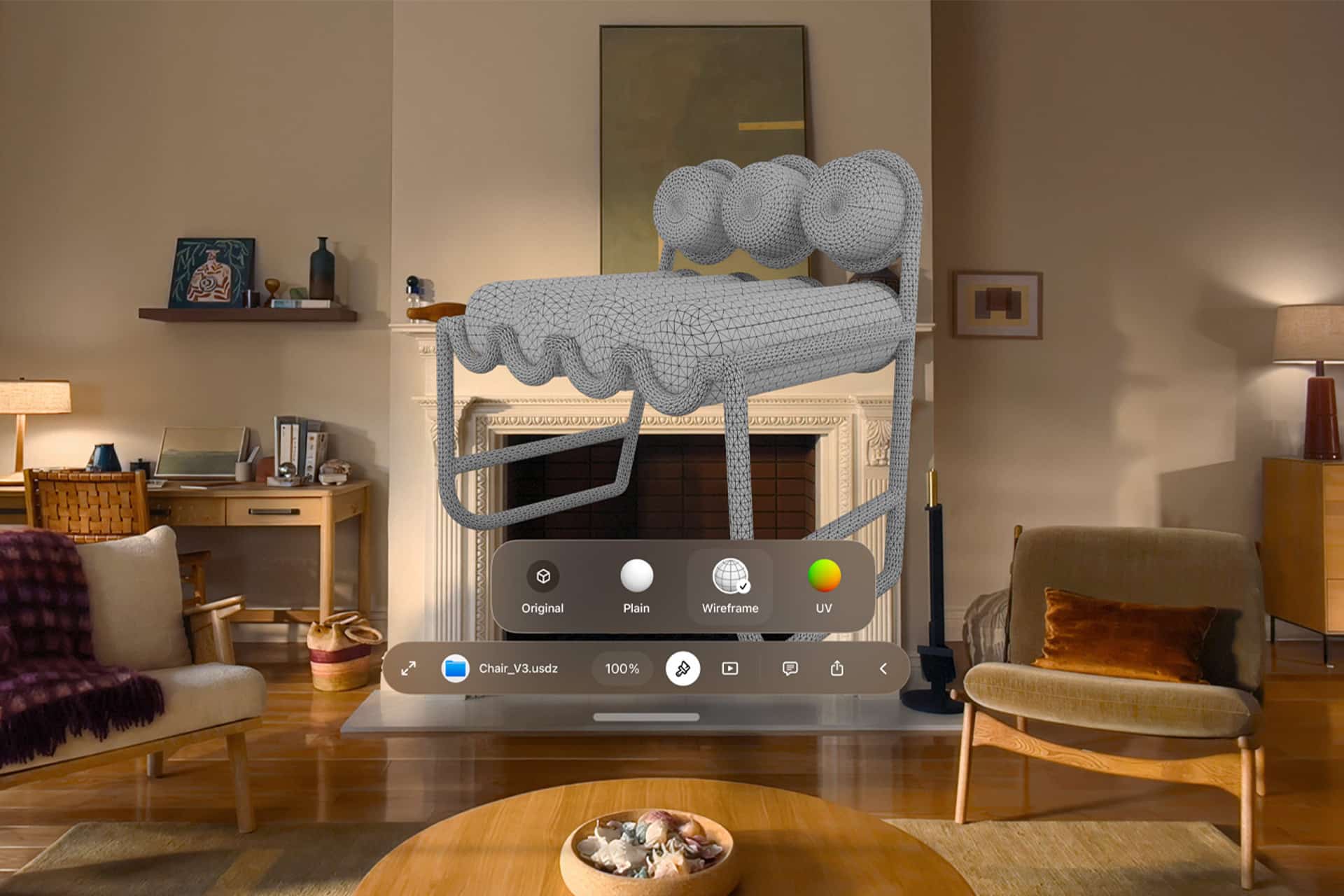
A cozy living room with a digital interface on Apple Vision Pro displaying a 3D wireframe chair design, superimposed in front of a fireplace and surrounded by modern furniture and warm lighting.
Image Credit: Apple Inc.

Why Apple Is Positioned to Build It

Apple’s advantage would not come from inventing every part of ARK augmented reality. It would come from combining hardware, software, artificial intelligence and personal context into one controlled ecosystem.

Vision Pro already understands rooms, surfaces, hands, eyes and objects well enough to place digital content convincingly in physical space. Its cameras and sensors continuously map the environment while visionOS manages windows, volumes and immersive experiences.

Apple Intelligence provides another layer. Foundation models can interpret language, summarize information, generate content and connect requests with app actions. Visual Intelligence can identify text, images and real-world objects. Siri AI can act as the conversational interface.

The Apple ecosystem also provides personal context that a generic AR platform may not have. Calendar knows the user’s schedule. Maps understands location. Photos contains visual history. Notes and Mail hold project information. Health contains personal trends. Home understands rooms, accessories and automations.

An Apple-built knowledge layer could combine the environment in front of the user with the information already available across trusted devices and apps.

A person preparing for a meeting could look at a conference room and see the agenda, participant names and relevant documents arranged around the table. A traveler could look across a train station and receive directions connected to the correct platform, departure time and digital ticket. A homeowner could examine a room and see live information from temperature, air-quality and energy sensors.

The physical environment becomes the interface.

Vision Pro Is the Laboratory

Vision Pro is the obvious development platform for this idea because it already offers the cameras, displays, sensors and processing required for advanced spatial understanding. Its size and price limit broad adoption, but those same characteristics allow Apple and developers to test experiences that would be harder to build first on lightweight glasses.

ARK augmented reality on Vision Pro could become especially useful in enterprise environments. Apple already promotes the headset for employee training, product design, field service, collaboration and specialized visualization.

A worker could enter an unfamiliar facility and receive contextual instructions attached to real equipment. An engineer could inspect a physical prototype while design changes, performance data and maintenance history appear around it. A new employee could learn a workflow through spatial guidance generated from company manuals and operational knowledge.

The system would not need to display every available fact. It would need to understand which information fits the current task.

That is where AI knowledge becomes more valuable than a traditional AR overlay. Too much information can be as disruptive as too little. A strong system should filter, prioritize and explain rather than cover the room with floating labels.

ARK augmented reality - A modern living room with visionOS virtual reality overlays displays an online store page for a red stool, alongside a 3D modeling preview of the stool positioned on the floor near a fireplace and sleek, modern chair.

The iPhone Could Bring ARK to More People

Vision Pro may be the development environment, but iPhone could provide the scale. The iPhone already combines cameras, LiDAR on Pro models, location, motion sensing, Visual Intelligence and Apple Intelligence.

An iPhone-based ARK experience would be less continuous because users would need to hold up the device. It could still deliver useful knowledge interaction without requiring a headset.

A user could point the camera at a plant and receive care guidance based on its species, visible condition, local weather and placement in the room. Someone assembling furniture could receive generated guidance positioned over the actual parts. A shopper could compare products by looking at them rather than manually searching for each model.

The difference from ordinary visual search would be interaction. The user could ask follow-up questions, change the goal and let the system update the visual guidance.

Future glasses could eventually make the experience persistent. The iPhone would help Apple develop the intelligence, privacy controls and app ecosystem before lightweight eyewear becomes ready.

A World That Explains Itself

The most ambitious version of ARK augmented reality is a world in which information is attached to objects, places and situations only when requested or needed.

A city could become understandable without searching through maps, review sites and separate transit apps. Buildings could reveal history. Streets could explain temporary closures. Restaurants could surface reservations, dietary options and accessibility details. Public transport could show the correct entrance and platform.

Inside a home, Apple’s knowledge layer could explain energy use, identify maintenance problems and guide repairs. In a classroom, physical models could become interactive lessons. In healthcare, patients could receive visual instructions for approved home procedures or medication devices.

The experience would depend on context rather than menus. The user looks, asks and receives information positioned where it belongs.

This is the transition from augmented reality as decoration to augmented reality as understanding.

Privacy Will Decide Whether It Works

A knowledge layer capable of understanding the physical world also creates serious privacy questions. The system may see homes, workplaces, documents, faces, screens and private conversations. The more context it receives, the more useful it becomes. The same access can also make it invasive.

Apple’s privacy architecture could become one of its strongest advantages. On-device processing would allow some scene understanding without sending continuous camera feeds to external servers. Private Cloud Compute could handle more complex requests while preserving stricter controls than an ordinary cloud AI service.

Apple would also need visible controls over what is analyzed, remembered and shared. A user should know when the system is interpreting the environment and whether information is temporary or retained. Workplaces and public spaces would need rules for recording, identification and sensitive data.

ARK augmented reality cannot become socially acceptable if people feel that nearby devices are constantly cataloging them.

The successful version would behave less like surveillance and more like intentional assistance. The user asks for understanding. The system processes only what is needed. The knowledge disappears when the task ends unless the user chooses to save it.
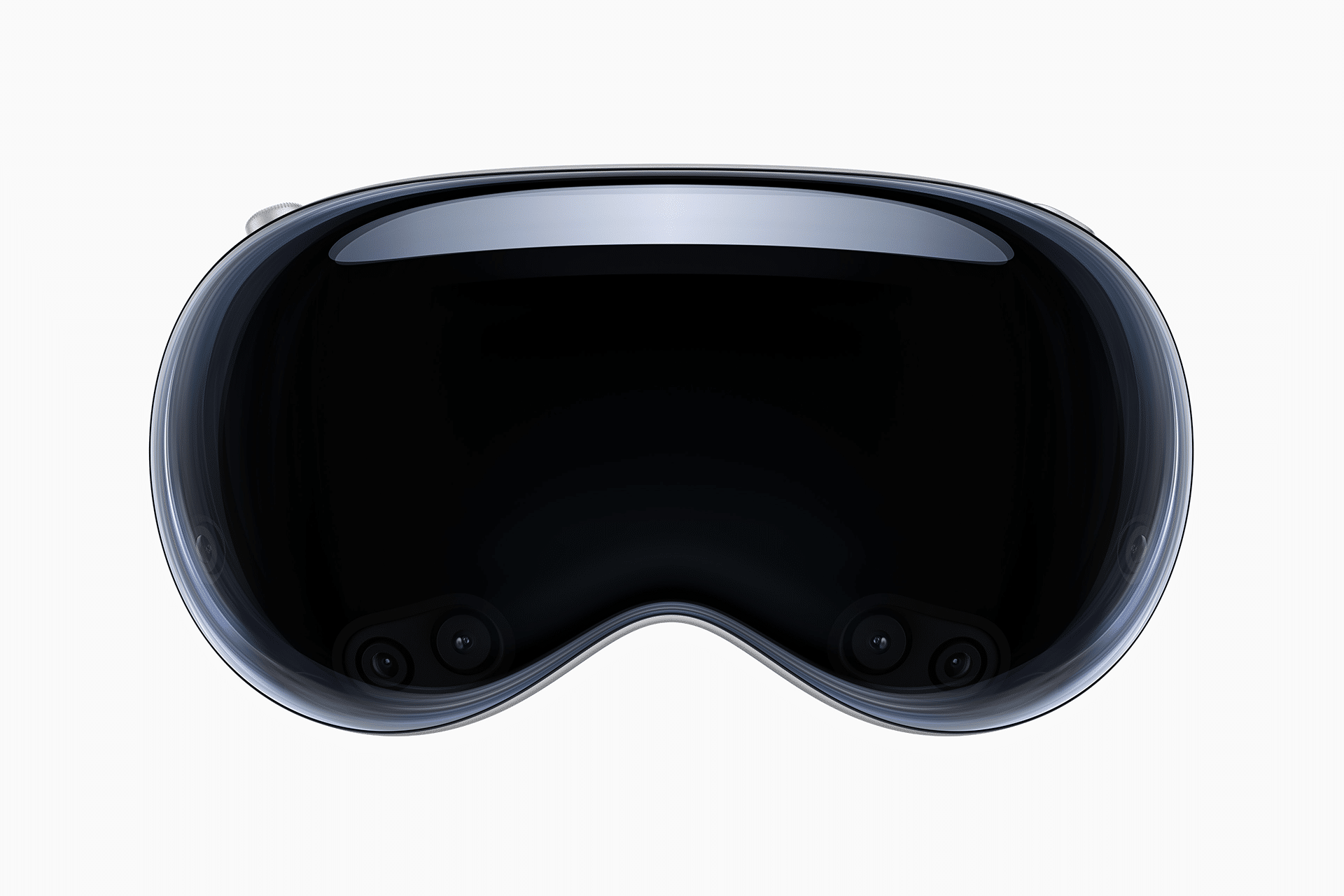
A sleek, black, futuristic virtual reality headset with a smooth, curved design and reflective surface—perfect for exploring the latest Betas—viewed from the front against a white background.
Image Credit: Apple Inc.

Developers Could Build Knowledge Worlds

Apple would not need to create every knowledge experience itself. visionOS, ARKit, RealityKit and App Intents could let developers connect specialized knowledge with physical environments.

A medical company could build guidance for approved equipment. A manufacturer could create spatial maintenance systems. A university could attach interactive explanations to laboratories and museums. A retailer could create product comparisons based on inventory and customer preferences.

Apple could provide the shared intelligence layer: scene understanding, object recognition, language interaction, privacy permissions and spatial presentation. Developers would provide the trusted domain knowledge.

This division would be essential. General AI can explain many things, but professional environments require verified information. A generated answer about a historical building has different consequences from an answer about industrial machinery or medical treatment.

Apple’s platform could distinguish between general knowledge and certified domain sources, allowing users to see where information comes from before acting.

From Spatial Computing to Contextual Computing

Apple describes Vision Pro as a spatial computer because digital content can occupy physical space. ARK augmented reality suggests the next progression: contextual computing.

A spatial computer knows where digital content is placed. A contextual computer understands why the content is useful in that location, what the user is trying to accomplish and which knowledge should appear.

That would connect several Apple strategies that currently look separate. Vision Pro supplies spatial awareness. Apple Intelligence supplies reasoning and generation. Siri AI supplies conversation. Visual Intelligence supplies real-world understanding. The ecosystem supplies personal context.

Together, they could create a system that does not wait for users to open the correct app and search through the correct menu. The environment itself becomes the starting point.

Apple’s opportunity is to make that interaction restrained rather than overwhelming. The company does not need to cover reality with digital noise. It can use design, privacy and contextual intelligence to make information appear only when it improves the moment.

ARK augmented reality offers a useful description of that future. Reality remains visible. Knowledge becomes interactive. The computer begins to understand the world in front of the user instead of asking the user to translate everything into a search box.

The post ARK Augmented Reality Could Build Apple’s Knowledge Layer appeared first on AppleMagazine.

  •  

A look at spatial intelligence and world models

It’s been several years since generative AI and large language models (LLMs) took the world by storm. LLMs surpassed earlier natural-language systems at generating text, while diffusion models enabled generating images, music, and videos.

These generative AI models work well in the digital world, but on their own, they have limited capabilities to comprehend the three-dimensional physical world and other spaces. This includes the objects occupying an area, how they relate to each other, tracking movement, and answering complex questions requiring an understanding of dimensions, distances, motion, and collisions.

Spatial intelligence is an AI capability that allows models to reason about three-dimensional space. These models can generate 3D scenes of the world and other spaces. This content can then be displayed through traditional renderers, game engines, or AR/VR systems that use spatial computing techniques. But it’s the spatial intelligence model’s ability to connect natural language with 3D models that has the most applications in robotics, manufacturing, construction, and other physical environments.   

Dr. Fei-Fei Li, often called the godmother of AI, published a manifesto on how spatial intelligence is AI’s next frontier, contrasting it with LLMs. “While current state-of-the-art AI can excel at reading, writing, research, and pattern recognition in data, these same models bear fundamental limitations when representing or interacting with the physical world,” wrote Dr. Li. “Our view of the world is holistic—not just what we’re looking at, but how everything relates spatially, what it means, and why it matters. Understanding this through imagination, reasoning, creation, and interaction—not just descriptions—is the power of spatial intelligence.”

The concept of spatial intelligence isn’t new and was described in Howard Gardner’s book, Frames of Mind, in 1983. Recent breakthroughs, including the launch of World Labs’ Marble and its $1 billion funding round, and competing approaches from Google’s Genie 3 and Nvidia Cosmos, should put spatial intelligence and world models on more R&D road maps.

What are spatial intelligence models?

It’s important to develop AI literacy and understand the terminology and concepts related to the physical world and 3D AI technologies: 

  • Spatial intelligence encompasses specialized approaches such as geospatial models for mapping the physical world and building information modeling (BIM) for modeling physical structures. It also extends to generative 3D, robotics, and physical reasoning applications.
  • World models are a class of neural network architectures and are currently a prominent approach to building spatial intelligence.
  • Digital twins are live, virtual replicas of physical assets that combine 3D models with real-time sensor data. Spatial intelligence, an emerging capability of digital twins, adds natural-language prompting, generative scenario exploration, and physics-aware reasoning.
  • Spatial computing refers to digital content anchored in and interacting with physical space, sensed and rendered in three dimensions and delivered through AR/VR and mixed-reality systems.

“Spatial intelligence models go beyond pixels to understand the 3D structure of the world—how objects are positioned, how they move, and how they interact,” says David Fattal, founder and CTO at Leia. “This enables applications like more realistic video generation, spatial computing interfaces, and AI systems that can reason about physical environments. As real-world 3D data becomes more available, these models will become foundational to the next generation of visual AI.”

Monitoring the built environment

To better understand spatial intelligence, let’s consider physical infrastructure such as bridges and buildings. The American Society of Civil Engineers estimates a $9.1 trillion investment is needed from 2024 through 2033 to achieve a state of good repair. When maintenance and monitoring lag, it can lead to major failures such as the 2022 collapse of the Fern Hollow Bridge in Pittsburgh.

Spatial intelligence and the development of digital twins may help identify issues earlier and prioritize where investments are needed. “Spatial intelligence models serve as the 4D digital blueprints for our built environment, allowing us to visualize and predict the complex interactions between aging assets and the shifting ground beneath them,” says Patrick Cozzi, chief platform officer at Bentley Systems. “By synthesizing disparate geospatial data into a living digital twin, these models provide the foresight necessary to mitigate the hidden risks of structural fatigue and subsurface instability.”

There’s a significant challenge in bridge health monitoring and transitioning from manual, infrequent structural inspections to leveraging sensors, digital twins, and spatial intelligence. Cozzi adds, “This integration of continuous field data moves beyond static documentation, empowering agencies to evolve from reactive repairs to proactive, resilient asset management that safeguards the long-term integrity of our most critical public systems.”

Avoiding collisions

Bridges are largely static, but the real world is increasingly being occupied by autonomous systems such as self-driving cars, robots, and drones. And where there are moving systems, there is a risk of collisions.

“Spatial intelligence models are AI systems that reason about the physical world by combining vision, sensor data, and contextual cues to understand space, motion, and object relationships,” says Sudeep George, CTO at iMerit. “The value of spatial intelligence models lies not just in perceiving an environment, but in enabling machines to act within it safely and in real time. That is especially important in robotics and autonomous systems, where decisions must be made in complex, multimodal, fast-changing settings.”

To see one example, this tutorial for simulating robotic environments combines Nvidia Isaac Sim, an open source robotics reference framework, with spatial intelligence in Marble from World Labs. 

Today’s collision detection systems, such as those used in autonomous vehicles, typically rely on modules for sensing, perception, planning, and control. Spatial intelligence models may offer improvements by assessing the collision risks of unidentified objects or by tracking objects that move out of sensor view. For example, Waymo’s World Model, built on Genie 3, is a simulator that generates complex weather conditions and other critical safety events.

For an out-of-this-world example, James Urquhart, field CTO and technology evangelist at Kamiwaza, has delivered several examples of spatial intelligence applications, including one for satellite collision detection and conflict analysis. Urquhart says, “Models that specialize in these types of data sets, as well as the physics and geography of the real world, enable faster and more accurate decision-making for tasks that depend on them.”

Applying spatial intelligence

Recent spatial intelligence announcements include creating 3D worlds from image or text prompts with Marble and simulating water physics, lighting, weather, and animal behavior with Genie 3. But difficulties remain in bringing spatial intelligence to physical-world use cases.

“Spatial intelligence and world models are laying the groundwork for future AI agents that will be able to interact in and with our physical world,” says Jason Corso, cofounder and chief scientist at Voxel51. “These models are significantly more challenging to develop and test, largely because the data underlying their development is complex, and it’s hard to handle all of the combinatorics involved in the physical world.”

In addition to learning the models and prototyping with them, development and data leaders need to review the data assets that will feed spatial intelligence models. “Spatial intelligence models translate location signals into a structured understanding of the real world, but they’re only as reliable as the data beneath them,” says Dan Adams, executive vice president and general manager of Enrich at Precisely. “The real unlock isn’t the model—it’s the reference layer with persistent identifiers, confidence metadata, and source lineage that lets AI reason about places, not just match strings.”

Even once applications are developed, there will be infrastructure challenges in deploying them at the edge. Ali Kayyam, principal research scientist at BrainChip, says, “The key to unlocking spatial intelligence at scale is having the low-power, event-driven hardware that can run it at the sensor in real time where it matters most.”

Where to get started

My suggestions for developers looking to get hands-on with spatial intelligence and world models:

  •  

You can save £100 on Samsung’s Galaxy XR headset if you act fast — and have a PayPal account

The Samsung Galaxy XR headset is now available for preorder ahead of its July 8 launch in the UK, and while you can’t pick it up at Amazon, that doesn’t mean you can't snag a Prime Day-like deal or two.

Best of all, you won’t need to be a Prime or other subscription service member; Samsung’s discounts are available to every shopper through its online store — you’ll just need to bundle a few things with your purchase, or sign up to PayPal (if you haven’t already) and check out using that as your payment method.

• Browse the full Amazon Prime Day sale

For that PayPal offer, you’ll get £100 off using the code PAYPALXR at Samsung's online store. That’s a serious saving off the £1,699 asking price, but you only have until July 7 to take advantage of this offer.

Plus, if you’re looking to upgrade your Samsung tech, or dive deeper into its ecosystem, it has deals that will save you 10% on Galaxy smartphones, a Galaxy Watch, and Galaxy Buds.

Today's best Samsung Galaxy XR deals

Code: PAYPALXR
If you buy the Samsung Galaxy XR headset using PayPal then you can save £100 with the code PAYPALXR. You only have until July 7 to use this deal, but if you’re strongly considering getting the Samsung Galaxy XR headset then it’s a hefty saving on the device for little to no effort (especially for folks with a PayPal account already).View Deal

Save 10% on Galaxy smartphones — August 4, 2026
Save 10% on Galaxy watches and buds — September 30, 2026
If you don’t want to simply buy a Galaxy XR headset, but also upgrade your whole Samsung setup, then this combo deal is for you, as you can save 10% on Galaxy gadgets. I currently use a Galaxy Watch 8 Classic, a pair of Galaxy Buds Pro 4, and a Galaxy S26 Ultra, and they are all superb, and this kind of discount only makes the tech even better.View Deal

Save 30% on a travel case & controllers — September 30, 2026
Lastly, much like the above tech offer you can also save big on an official travel case and Samsung controllers when they’re bought with the Galaxy XR headset.
The controllers will be required for some titles, though most games rely on hand tracking so I’m not convinced you need a pair straight away. A case, however, is a must-buy.
Whether it’s this one or an unofficial box, any VR headset is much easier to carry around with a case, and it helps keep the headset’s lenses from getting damaged by direct sunlight.
Besides a silicone facial interface (which this headset lacks), a case is the only accessory every VR headset user should own.View Deal

After spending a week with the Samsung Galaxy XR headset, Lance Ulanoff called it “an impressive multimodal AI spatial computer,” though Android XR and the overall experience didn’t hold a candle to visionOS and the Apple Vision Pro, especially the M5 version.

He also noted that, at launch, Gemini felt less deeply integrated as he had originally imagined, and the lack of precision with controls dulled the ‘wow’ factor.

At the same time, the Galaxy XR headset is half the price of the Vision Pro, so technical downgrades are to be expected, and as Google and Samsung iterate on the software, you could find the Samsung Galaxy XR headset seriously ups its game — especially as more apps get XR support.

It delivers some impressive OLED visuals despite costing less, and can integrate with the full G Suite of apps for some spatial productivity. So, if you want something that balances work and play, with great performance, at a more affordable price point, and don’t mind missing out on the Quest gaming library, you’ll struggle to find something better than Samsung’s XR machine.

More Prime Day deals in the UK

  •  

Holographic Breakthrough: This New Futuristic 3D Imaging System Overcomes a Longstanding Problem for Holographic Tech


A new 3D image projection system from researchers at the UCLA Samueli School of Engineering and the California NanoSystems Institute (CNSI) marks a major step toward overcoming a longstanding problem for holographic technology.

Professor Aydogan Ozcan led the work reported in a recent paper published in Light Science and Applications, which describes the team’s new snapshot 3D image projection system, solving one of the technology’s most daunting issues.

“These results establish the diffractive 3D display system as a compact and scalable framework for depth-resolved snapshot 3D image projection, with potential applications in holographic displays, AR/VR interfaces, and volumetric optical computing,” the authors write.

3D Image Challenges

While 3D films viewed wearing special glasses were popular a decade ago, this type of 3D image projection is something more akin to the holodeck on Star Trek, projecting sophisticated, real-time images. While advances have been made in bringing such technology to life, many obstacles remain to creating convincing three-dimensional projections.

The snapshot 3D image projection system described in the paper combines a digital encoder with a passive optical decoder and uses a deep learning algorithm that operates end-to-end to overcome one of holography’s greatest challenges. 

Interplane cross-talk is one of the main issues associated with 3D image projection. As 3D objects are sliced up and images projected at various depths, elements from one image can leak through to the image in front of it, destroying the illusion of a solid object existing in three-dimensional space. 

Improving Holographic Technology

In the new system, an image first enters the encoder, which uses a Fourier-based neural network to separate spatial and frequency features into a stack of images. It then analyzes the positions where the images will be projected to simultaneously generate a 3D visual. Then the images are decoded and projected onto structurally optimized surfaces, where the depth-dependent field programming occurs as the light propagates.

The deep learning algorithm, building on recent advances in combining machine learning and 3D projection, optically routes the image slice to its correct depth while adjusting for in-plane leakage.

Together, this system creates a compact, high-fidelity display in a single shot, combining closely spaced axial planes to create the illusion of a three-dimensional object from projected light. These improvements provide for a more natural depth perception and increase visual comfort for the viewer.

The Future of 3D Image Technology

Advancing 3D imaging technology is essential for a variety of emerging applications, including augmented reality, virtual reality, holography, and immersive visualization. The rapid degradation of image fidelity caused by light bleed has been one of the primary issues impeding progress in these fields.

So far, the researchers have demonstrated their multi-plane snapshot image projection with a model of volumetric scenes comprising 28 axial slices. They also constructed a simpler real-world prototype to validate the model, made of only two planes. Experiments with the prototype corroborated the model’s results, producing outputs that matched the simulated numbers and achieved a similar image quality. Additionally, when the team ran their prototype against a projection without a diffractive decoder, their device exhibited considerably superior performance.

Between the simulations and laboratory tests on a physical prototype, the team has demonstrated that their work is scalable yet compact, enabling a 3D display with high axial resolution. In their current form, the researchers see near-eye displays, microscopy, and volumetric optical computing as the primary use cases, but continued development could open possibilities for multi-perspective holography and energy-efficient 3D systems.

The paper, “Snapshot 3D Image Projection Using a Diffractive Decoder,” appeared in Light Science and Applications on June 10, 2026.

Ryan Whalen covers science and technology for The Debrief. He holds an MA in History and a Master of Library and Information Science with a certificate in Data Science. He can be contacted at ryan@thedebrief.org, and follow him on Twitter @mdntwvlf.

  •  

This Strange Crystal Bends Light Like Nothing Else in Nature

Guiding Light MoOCl2This record-breaking crystal can transform from mirror-like to glass-like, opening the door to tiny optical chips, AR displays, and smart contact lenses. Creating truly “invisible” wearable technology such as smart contact lenses and ultrathin augmented reality glasses will require a radical rethink of how optical devices are built. Instead of relying on conventional bulky components, [...]
  •  
❌