❌

Reading view

Apple Park: Designed to Isolate

Malcolm Crawford (Mastodon):

The open-plan floors make it hard to concentrate. The building is so large that getting from one meeting to the next eats real time out of the day. It’s common for people to run meetings with colleagues over Webex — colleagues on the same campus, sometimes no more than two hundred yards away.

Ironically, Apple Park replaced a campus that did far better on the same measure without ever trying to. Infinite Loop produced far more of the accidental, cross-team contact Apple Park was explicitly built to create. Working out why starts with what Infinite Loop got right by accident. It continues with what the research on office proximity says about why that kind of thing happens at all. And it ends with what Apple Park could become instead — including a version of the fix Apple already trusts enough to run for a hundred people a year.

[…]

There’s no obvious focal point for the whole site — most sections have their own sitting area and their own coffee bar, but nothing plays the role Caffè Macs and the IL1 coffee bar played together at Infinite Loop. Caffè Macs at Apple Park seats a thousand people and feels built for throughput, not conversation. Everything is organised per-segment rather than around a shared centre, which is convenient for the people in that segment and useless for the discovery-by-accident that made the old campus work.

[…]

By multiple accounts from people who were there during design and construction, the site was flagged as under-provisioned for meetings and conferences before it even opened.

Via Jason Anthony Guy:

Apple Park is a beautiful structure, but is not terribly conducive to focused or collaborative work. Even as an occasional visitor I found it overwhelming. Employees sit shoulder to shoulder, voices bounce off and bleed through glass walls, and privacy is a virtual impossibility. My friends and colleagues who worked there regularly found it difficult to be productive.

I worked in Infinite Loop (Building 3, 2nd floor) for thirteen years (right below Developer Publications, where Malcolm spent a good portion of his Apple career). I loved IL because its design made serendipitous encounters easy. Whether it was sitting outside Caffè Macs or in the IL 1 Atrium, I would inevitably bump into someone and have a conversation that furthered an in-flight project, sparked something new, or simply reinforced the social ties that bind colleagues.

It helped that at that time, Apple had perhaps 10,000 employees, most of whom were in or near IL. After iPhone came about and IL started getting locked down, much of the natural collaboration dissipated, disappearing behind badged doors and disclosures.

Ken McLeod:

IL provided a place to focus on your work[1], as well as seating spaces that are out of the flow of traffic where you can have an informal meeting[2]. At AP, every collaborative space is effectively in the middle of a hallway. That turns out to be enormously distracting, both to you and to those people trying to work in the glass bullpen right next to it.

[1] before all cubicles and offices became multi-person shared spaces

[2] before all those spaces were filled in with more offices

Helge Heß:

“The IL1 atrium really was the crossroads of the company in those days” I really don’t think that this is true literally by any means. Assuming “those days” overlap with the time I’ve been there (pre Park). The XFs in IL have been extremely scarce. IL was way too small and overloaded, I’d actually say it was very similar to Apple Park. No one really wanted to work there in those tiny offices with multiple people 🤷‍♀️

Steve Hayman:

I loved the IL1 atrium. I’d sit there and hope that someone like MMalc would wander by, and they often did. It was a real destination for field people who didn’t get to visit the mothership very often. I miss that. AP had nothing like it.

Eric Schwarz:

I think of my days in college—most dorms residence halls were not air conditioned, so at the end of August, you had to open your window (often to place a box fan) and door to create some airflow. People walking through the building would meet by chance. Newer buildings tended to be less lively and more like a hotel—all the doors closed and rarely much activity. Through renovations, most of the buildings have had air conditioning added, dropping those interactions over the years.

Previously:

Update (2026-07-22): Dr. Drang:

As you may know, the Lumon Industries building that Mark, Helly, Irving, and Dylan work in is a former Bell Labs facility in Holmdel, New Jersey. I first learned about the building several years ago, when I read Jon Gertner’s excellent history of The Labs, The Idea Factory. It’s a distinctive place designed by Eero Saarinen in the early 60s.

Bell Labs was known for the fruitful collaboration of its researchers, often started through chance meetings in the hallways of other Bell Labs facilities. The new Holmdel building was supposed to further that sort of teamwork, but things didn’t work out as planned.

macintog:

I worked in IL1 for over a decade. The day I saw the open-plan spaceship, I knew I would never set foot inside. There are more rewarding ways to work in a barn.

  •  

Apple Financial Statements: Products vs. Services

John Gruber (Mastodon, 2):

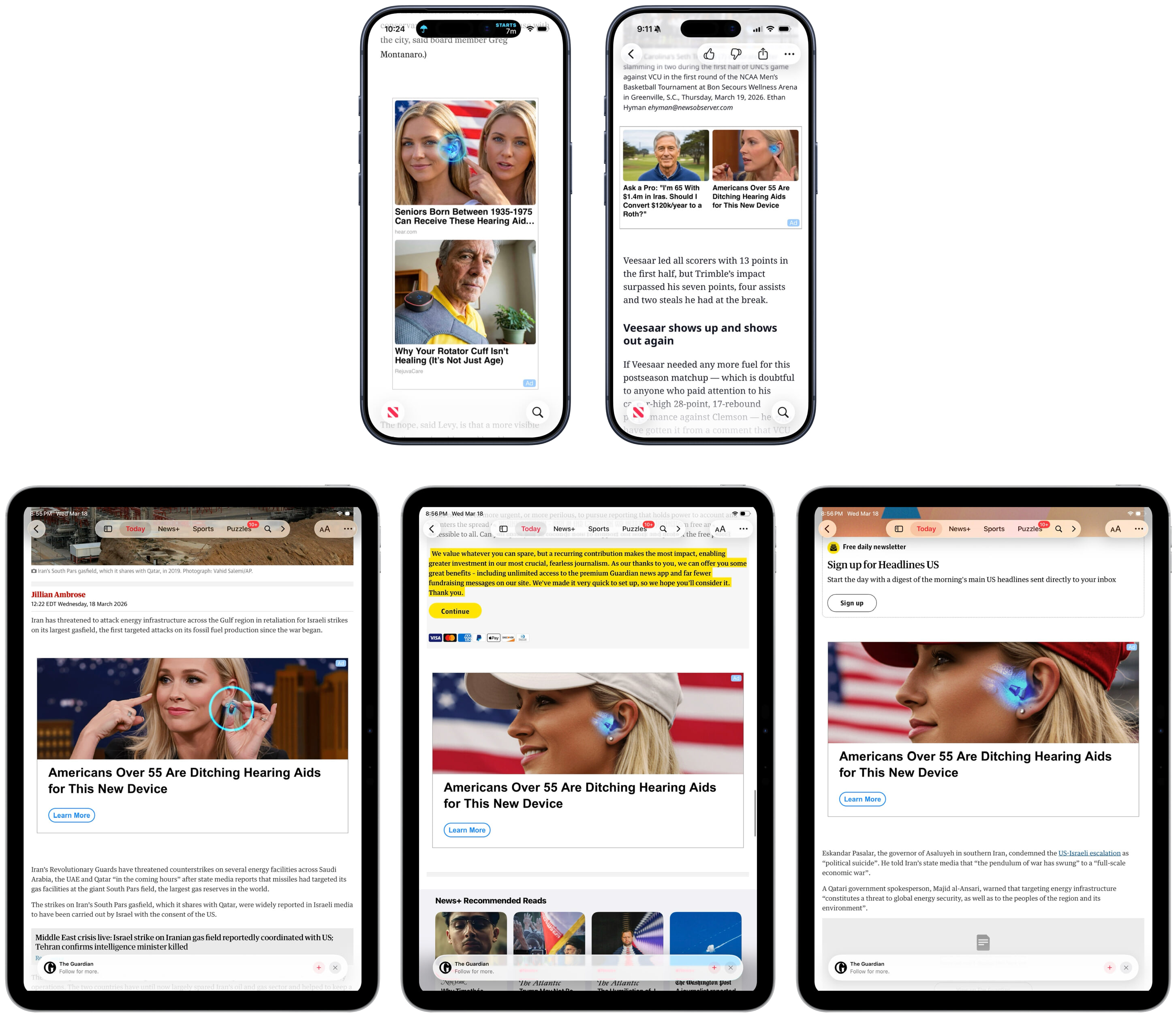
Some of [Cook’s letter] remains true, but has lost some truthiness — and truthiness matters. But some of it is no longer true, period. It’s no longer just “one small part” of Apple’s business that serves advertisers. Here in 2026, search results in the App Store not only show paid ads — frequently for casinos — but the search results are visually dominated by paid ads now that Apple has added a second ad to results. Apple News+ is a paid subscription that offers a genuinely great value for the number of paywalled publishers whose content it includes, but articles on the News app tend to include the weirdest AI-generated ads on the Internet. (How many young blond women am I supposed to believe need hearing aids?) And — at this writing, still “coming soon” — Apple is launching ads on Apple Maps. Apple Maps remains free of charge to use, so according to Tim Cook, we’re not the customer. We’re the product. Or, if you prefer, our frustration is the product.

[…]

The ratio of ads to organic results in App Store search — especially when measured in screen area — is clearly not aligned with Cook’s 2014 statement that “Our software and services are designed to make our devices better. Plain and simple.” Obviously not. App Store search today is designed primarily to generate more revenue for Apple. That’s not criminal, but it’s a change.

[…]

What gave Tim Cook’s privacy letter heft in 2014 wasn’t just the clarity of its plain language, but the fact that you didn’t have to take his word for it that the ads Apple showed you respected your privacy, because Apple didn’t show you ads in 2014. Apple today can’t say that.

[…]

John Ternus should return Apple’s privacy policy to its 2014 clarity. The trust Apple would earn from such a move would far out-value whatever revenue these ads pad to their already hefty and ever-increasing quarterly Services numbers.

I wish that were the case, but I fear this is kind of a Hotelling’s Law situation, where Apple can get most of the benefit by being just slightly better on this axis. Where else do its customers have to go?

Jeff Johnson (Mastodon):

In the second fiscal quarter of 2018, services generated $9 billion in revenue (net sales), whereas in Q2 2026, that amount had grown to $31 billion! In this blog post, I want to focus on understanding the relative financial importance of products and services for Apple.

[…]

In 2025, services were 42% of Apple gross margin. How does 26% of net sales become 42% of gross margin? The explanation is that services have a much lower cost of sales. The products gross margin was 37% of products net sales, while the services gross margin was an astonishing 75% of services net sales. In other words, Apple services are almost pure profit!

Does this 75% account for TV and movie production costs?

With persistent general inflation, consumers do not have unlimited money to spend on Apple products. At least in the near future, it’s reasonable to question how much further room is available for growth in profits from Apple products. To satisfy the demands of investors, Apple executives including CEO-elect John Ternus may be forced to rely even more than before on growth in services, which do not face as much pressure on cost of sales as hardware products.

Previously:

  •  

Apple Sues OpenAI Over Trade Secrets

Sarah Perez (PDF, Hacker News, MacRumors):

The iPhone maker alleges that this misconduct, which it says reveals a pattern of theft from OpenAI employees who previously worked at Apple, was directed by OpenAI’s senior leadership, including Chief Hardware Officer Tang Tan.

The lawsuit, which was filed in the U.S. District Court for the Northern District of California, accuses Tan of using Apple’s confidential project code names during OpenAI’s recruiting process, asking job candidates to bring in Apple hardware components to their interviews, coaching departing Apple employees on how to evade the company’s security procedures, and asking for details about the company’s unannounced products.

Apple’s allegations are detailed and shocking, and it sounds like they have a lot of evidence.

Chance Miller:

The lawsuit names Chang Liu and Tang Tan as two of the defendants. Tang Tan served as VP of product design at Apple, leading iPhone and Apple Watch product design. He departed the company in February 2024 to work with Jony Ive. Chang Liu, meanwhile, worked at Apple for eight years and was a senior system electrical engineer before departing to join OpenAI in January 2026.

Apple’s lawsuit also names OpenAI and io Products as defendants.

OpenAI’s hardware efforts are being led by Jony Ive, Apple’s former chief design officer.

[…]

Ive, Hankey, and Cannon are not personally mentioned anywhere in Apple’s initial filing today.

Emma Roth:

Here are the most surprising claims in Apple’s 41-page filing.

Marcus Mendes (MacRumors):

OpenAI’s Director of Strategic Communications, Drew Pusateri, took to X to comment on the company’s behalf.

In his post, he claims OpenAI has “no interest in other companies’ trade secrets,” adding that OpenAI remains “focused on building innovative technology that empowers people everywhere.”

This seems like a weak response, given that Apple says it reported its findings to OpenAI in February and never heard back. Presumably, they’ve already investigated but see the situation as serious enough that they need to say as little as possible.

It’s not clear to me the extent to which Apple believes the behavior was limited to the named defendants. It’s hard to believe that the rest of OpenAI’s leadership—including Altman and Ive—were unaware, given the scale of their recruiting from Apple. It’s equally hard to believe that they were aware and thought they could get away with it. I guess little from Altman would surprise me at this point. I’d like to believe that Ive wasn’t part of it, but then are we to believe that his former coworkers all kept him in the dark?

Nick Heer:

What is immediately notable about this whole thing is the myriad conflicts of interest. Apple, of course, has a current partnership with OpenAI to power Apple Intelligence features, something repeatedly mentioned on the previous version of its marketing webpage, and conspicuously absent on the current one.

But the history runs far deeper. Among the defendants in the suit is io Products — do not blame me for that capitalization choice — founded by Jony Ive and acquired by OpenAI last May. Total mentions of “Ive” in the body of this lawsuit? Zero. Also, one of the investors in Ive’s company was Emerson Collective, founded by Laurene Powell Jobs, and which now has equity in OpenAI. Neither Emerson nor Powell Jobs are defendants.

M.G. Siegler:

It all reads a bit as if Apple has been building up evidence of these allegations for some time and recently got their smoking gun. It’s not just nebulous “trade secrets” either, there are specific mentions down to “metal finishing techniques” that Apple apparently invented and protected.

It also comes a little less than a month after OpenAI was rumored to be threatening Apple with a lawsuit over the perceived failure of their deal to bake ChatGPT into the iPhone. As I wrote at the time, even just that threat was clearly not going to go over well in Cupertino.

John Gruber (Mastodon):

Footnote 13 on p. 15 states:

Apple and OpenAI have a commercial relationship involving the integration of OpenAI’s ChatGPT into Apple Intelligence. The companies have entered into a written agreement governing that integration. That agreement is not at issue here. OpenAI’s acts of trade secret misappropriation alleged herein do not arise from and have no connection to that agreement.

Be that as it may legally speaking, in practical terms it seems untenable for that Apple Intelligence partnership to continue after this.

Jason Snell:

All that bubbling-under-the-surface tension between Apple and OpenAI is now out in the open!

M.G. Siegler:

Namely, while Apple frames OpenAI – or at least its fledgling hardware division – as “rotten to its core” (interesting terminology!), they really only have a case against two and maybe three individuals. But they also clearly believe that if this case goes to trial, they will have a case against a lot more.

[…]

The parallels to the Anthony Levandowski situation after he left Google for Uber have been drawn.

[…]

It is interesting that Apple is not suing Yu-Ting “Alyssa” Peng, who is named in the suit as a co-conspirator with Liu while she was still employed at Apple, before she also subsequently went to work at OpenAI. Is it possible she’s cooperating or has cooperated with Apple in this investigation?

[…]

Even if these allegations are found to be untrue or embellished, can he reasonably stay at OpenAI now? And perhaps that’s the real outcome Apple is looking for here, as they clearly frame him as the ringleader of the 400-plus people who have come over to OpenAI from Apple.

Hartley Charlton:

OpenAI’s ambitions to build a hardware rival to the iPhone are already running into trouble because of Apple’s trade secret lawsuit, according to Bloomberg’s Mark Gurman, who argues the damage is showing up well before any court ruling.

[…]

The scale of the talent drain is a major part of why this matters to Apple. More than 400 former Apple employees now work at OpenAI, including former Apple design chief Jony Ive, and Gurman says the company poached so heavily from Apple’s iPhone product design group specifically that Apple had to rebuild parts of the team. Apple has responded with bigger retention bonuses and executives personally working to keep engineers from leaving.

Jeff Johnson:

OpenAI stole stuff? I can’t believe it! I thought they were done with stealing after they stole literally everything on the internet.

Colin Cornaby:

I’m sure there’s no problem with sending this company all your source code they pinky swear not to train on.

Steve Troughton-Smith:

I can’t believe this awful company solicited confidential information and stolen trade secrets, hiring from this other company while pretending to partner with them. ‘Rotten to the core’ indeed

😛

He’s referencing Apple doing this to Masimo. And, of course, Steve Jobs himself directed Apple to engage in illegal hiring practices.

Previously:

Update (2026-07-17): See also: Dithering.

Tim Hardwick (FT, Hacker News):

Apple has reportedly sent legal letters to dozens of former Apple employees now working at OpenAI, telling them to preserve potentially relevant documents and communications as it continues to pursue its trade secret lawsuit against the AI company.

Update (2026-08-06): Hartley Charlton (PDF):

OpenAI has asked a federal judge to dismiss Apple’s lawsuit accusing the AI company of stealing trade secrets, calling the allegations “meritless.”

Previously:

  •  

Apple Still Designated a Gatekeeper

Tim Hardwick:

Apple’s challenge against the EU’s designation of its App Stores and iOS platform as “gatekeepers” was dismissed by Europe’s top court on Wednesday, reports Reuters.

[…]

The company also disputed the classification of iMessage as a number-independent interpersonal communications service, or NIICS, which would subject the app to EU telecoms rules. But the General Court said Apple’s actions regarding the iMessage service are inadmissible.

William Gallagher:

Back in 2023, Apple acknowledged that it qualified under the then-new definition of being what the EU called a gatekeeper service. But key to that is the size of the operation, and since 2024, Apple has been claiming it runs five smaller App Stores rather than one large one.

[…]

“Irrespective of the devices in question,” ruled the judges, “those stores have the same purpose, namely to connect app developers with end users in order to facilitate the distribution of software applications.”

Steve Dent:

Apple disagreed with the decision but didn’t say yet if it would appeal. “We firmly believe the DMA’s mandate goes beyond what is lawful and proportionate, threatening to erode decades of privacy and security protections we’ve built and leaving our users vulnerable to new risks,” an Apple spokesperson said in a statement to multiple outlets. “We will continue advocating for the innovation and privacy our European customers deserve.”

Apple still has two cases pending with EU courts. The first is a challenge to the EU Commission’s decision last year forcing Apple to open iOS to third-party developers, and the second is an appeal against the €500 million fine imposed in April last year for anti-steering violations.

Previously:

  •  

Apple Silicon and AI

Jason Hiner (MacRumors):

In an exclusive conversation with The Deep View ahead of WWDC 2026 in June, Doug Brooks, senior product manager of Apple silicon, discussed how Apple’s long-term investments in neural processing, unified memory, power-efficient computing, and hardware-software integration have positioned its devices for the AI era.

He also explained why Macs have become a favorite platform among AI developers, why Mac minis and Mac Studios are emerging as the preferred AI agent machines, and how Apple sees the future of on-device AI across iPhone, iPad, and Mac.

[…]

“We build a chip knowing exactly what systems it’s going to go into. The chip can influence the system design, and the system design can influence the chip requirements. They’re married together very tightly. I’d actually go a step further and include software in that equation. As we enable new capabilities in the chip, we want to make sure those capabilities are exposed all the way through the software stack so developers can benefit and customers can benefit. Because if those transistors go unused, what’s the point? It’s not about adding something and hoping somebody finds a use for it. We want those capabilities available to solve real problems. I think that’s what allows us to build better systems and ultimately better products.”

It seems like a lot of it is just that developers like macOS.

Previously:

Update (2026-07-10): See also: Hacker News.

  •  

WhatCable 1.1.7

Darryl Morley:

WhatCable explains cable speed, charging limits, e-marker data, and connected devices in plain English. Name a cable and it tracks how the cable actually performs over time, so you can spot the one that has started misbehaving. No more guessing why a cable charges slow or refuses to drive your display.

Via Norbert M. Doerner:

It is open source, free, and definitely a tool to look into, if you have external drives on your Mac!

Previously:

Update (2026-07-10): Dan Moren:

For example, after looking at it, I realized that my backup drive was only connected via a USB2 cable. Fine in general for overnight backups, but when it reminded to me when I was troubleshooting some backup issues that maybe I should switch to a high speed cable that supports USB-3.

[…]

For a £9.99 one-time purchase, you can unlock WhatCable Pro, which works on up to two Macs, lets you assign names to cables so you can remember which one it is when you plug it in later, provides more in-depth diagnostics, offers live power metering to see how much juice is being delivered right now, and even more.

  •  

Hide My Email Moving to private.icloud.com Domain

Apple (MacRumors):

Later this summer, Apple will unify the email domains used by Sign in with Apple and iCloud+ Hide My Email under a single, shared domain: private.icloud.com.

New addresses generated for both features will be issued on the new domain.

[…]

Existing addresses on the legacy domains will continue to work and forward mail to users without interruption.

It’s unclear to me what the benefit of this is. Is there a reason to migrate legacy addresses?

Arseniy Shestakov (Hacker News):

This makes it much easier to ban all aliases without affecting non-relay mailboxes on iCloud mail.

This is certainly a big hit for iCloud privacy, since some plausible deniability together with Apple’s backing made banning iCloud aliases costly. But now a lot of services will just refuse to accept these emails, just like what happens with free temporary mailboxes.

John Gruber:

But my retort is that a service that won’t accept these email addresses is one that I probably don’t want to have anything to do with. The only reason not to accept private.icloud.com email addresses is if you want to do something invasive with users’ actual email addresses.

The main problem I have with Hide My Email is that some customers use it and then have no way to look up their purchase info via e-mail because they don’t know which address they used. Of course, I wouldn’t reject such addresses, but I wonder if services will start using the new domain to recognize that Hide My Email is being used and nudge the user to provide a different address.

Previously:

  •  

Chatrie v. United States

Amy Howe:

The Supreme Court on Monday ruled that when law enforcement officials used a “geofence warrant” – a warrant that instructed Google to provide location data for cellphone users who were near a particular place during a specific time period – to obtain evidence used to convict a Virginia man of a 2019 bank robbery, they conducted a “search” for purposes of the Fourth Amendment. By a vote of 6-3, the justices sent Okello Chatrie’s case back to the lower court for it to consider whether, as the Fourth Amendment requires, the search was “reasonable.”

Writing for the majority, Justice Elena Kagan emphasized that “[a]n individual has a reasonable expectation of privacy in records about his cell phone’s location, and police intrude on that constitutionally protected interest when they demand the information—even though for only a limited time, and from a third-party tech company.”

[…]

For purposes of whether the government conducted a search, Kagan said, it does not matter that law enforcement officials “access[ed] only a short amount of cell-phone location information.” […] Nor does it matter, Kagan continued, that Chatrie gave Google permission to collect and use the location data.

Previously:

  •  

Kids Online Safety Act

Amanda Silberling (May 2025):

The Kids Online Safety Act (KOSA) has been reintroduced into Congress. If passed into law, this bill could impose some of the most significant legislative changes that the internet has seen in the U.S. since the Children’s Online Privacy Protection Act (COPPA) of 1998.

As it currently stands, KOSA would be able to hold social media platforms legally accountable if it’s proven that these companies aren’t doing enough to protect minors from harm. The bill includes a long list of possible harms, such as eating disorders, sexual exploitation, substance abuse, and suicide. Though it overwhelmingly passed through the Senate last year, the bill was stifled in the House.

[…]

“Apple is pleased to offer our support for the Kids Online Safety Act (KOSA). Everyone has a part to play in keeping kids safe online, and we believe [this] legislation will have a meaningful impact on children’s online safety,” Timothy Powderly, Apple’s senior director of Government Affairs, said in a statement.

Nick Heer:

The App Store Accountability Act is based on model legislation written by the Digital Childhood Alliance. The lobbying group also publishes marketing pieces, including one (PDF) that calls Apple’s age verification frameworks “ineffective”. Specifically, it points to the lack of parental consent required “for kids to enter into complex contracts”, with “no way to verify that parental consent has been obtained”.

Maya Posch (via ednl):

Since the arrival of so-called ‘social media’ the central tenet of never giving out your personal information which was front and center during the 1990s and 2000s got quite literally flipped around. Suddenly we had massive corporations practically begging you to give every last scrap of your personal information, every intimate detail of your daily life and with it every last second of your attention span.

[…]

The upshot of this reversal is that instead of a mostly comfortable anonymous experience, suddenly every second that you’re awake has been turned into the equivalent of a schoolyard during recess, the watercooler banter at the office and similar social interactions.

[…]

This raises many questions, such as whether ‘social media’ and the FOMO it introduces is a legitimate addiction, and whether we shouldn’t make being online more anonymous rather than enforce a rather dystopian ‘real name’ policy onto the populace.

Joe Mullin (Hacker News):

Within the next week, Congress is preparing to vote on the KIDS Act, a sprawling package of legislation that seeks to control Americans’ web browsing and private messaging. The package includes a revised version of the Kids Online Safety Act, or KOSA, combined with a collection of other internet bills, study bills, reporting requirements, and new regulations. Instead of debating any of these proposals on their merits, lawmakers are attempting to move them all at once under an ultra-expedited process.

[…]

Buried inside the KIDS Act are provisions that will push online services to verify all users’ ages, require government-directed moderation policies for online speech, and even create new rules about private and encrypted communications. While supporters continue to claim this bill protects minors online, its requirements come at the expense of privacy, free expression, and the ability of people of all ages to use the internet without revealing sensitive data.

[…]

Several provisions of the bill create new rules around direct messages, disappearing or “ephemeral” messages, and AI chat services.

The bill includes language stating that certain KOSA requirements should not be construed to override strong encryption. But the protection is incomplete. The carve-out applies to certain features and messaging controls, but doesn’t apply to KOSA’s separate requirement that platforms “address” a list of harms to minors.

Previously:

  •  

Boom Mobile Restructuring

Our phones stopped working this morning, or perhaps last night, but everything looked fine on Boom’s Web site. I contacted their support, and as always they got back right away, but this time with bad news:

I’m deeply sorry to share that after careful consideration, we’ve made the very difficult decision to restructure through Chapter 11 bankruptcy. If this isn’t successful, then we will discontinue Boom! Mobile service. I know this is upsetting, and I want to personally thank you for trusting us. We’re committed to making your transition to another provider if you choose to do so.

So now I’m looking for another Verizon MVNO. The options and pricing seem to have changed a lot since the last time I was picking a plan. Some possibilities: US Mobile, Visible, RedPocket, Tello, Boost Mobile, and Total Wireless.

See also: Reddit.

Update (2026-06-29): I ended up going with US Mobile. I like that they offer smaller plans without unlimited data and that you can add extra lines sharing the same bucket of data for only $8. So far, so good. It was an easy switch—even for Visual Voicemail, which has given me trouble in the past. Their Web site works much better than Boom’s, which used to be good but had gotten unreliable in recent years.

Update (2026-07-17): Mike Rockwell switched to US Mobile, too.

  •  

SwiftData in appleOS 27

SwiftData updates:

Section your query results by creating your query with a macro that takes a sectionBy parameter, as listed on the Additional query macros page.

Use types that conform to Codable in a model, including types you don’t control directly, by using the codable option for Schema.Attribute.

Receive real-time updates to models that match specified fetch criteria by using the ResultsObserver type.

Observe remote model changes with the HistoryObserver type.

What’s new in SwiftData:

Discover the latest enhancements to SwiftData. We’ll show you how to persist custom and third-party types using Codable, and group fetched data into sections in your SwiftUI app. We’ll also explore how to observe data store changes anywhere else using ResultsObserver and HistoryObserver, giving you the flexibility to drive powerful state objects and react precisely to model updates.

Again, there seems to be nothing new in Core Data this year, nor any communication about it. There’s still no interoperability for object IDs. The SwiftData changes seem fine but don’t really address the new framework’s deficiencies relative to Core Data. It seems like there are still basic problems with threading. I just don’t understand how Apple is deciding what to prioritize with this framework.

With SwiftUI, the bones seem questionable, but at least we can see that Apple is full steam ahead, with substantial progress to address limitations and pain points. SwiftData seemed to have better bones and is much less ambitious. Getting it right seemed like just a matter of follow through. But, for some inexplicable reason, it seems to lack the resources and/or urgency to reach its potential. And even though SwiftUI is clearly the chosen one, AppKit remains in development. Meanwhile, Core Data seems to be abandoned, even though SwiftData feels more like a side quest than a genuine attempt to supplant it.

The implicit message, for those who have build the core of their app on top of Apple’s old persistence framework, seems to be that Apple is not looking out for their needs. Core Data will surely get maintenance to the extent that Apple’s own apps need it, but there’s no evidence of a future or even a migration plan. The answer, I guess, is third-party frameworks, but that’s not an easy migration, either, since none is even as close a match as SwiftData.

Add persistence with SwiftData:

Experience SwiftData in action as we add persistence to an existing app. We’ll show you how to define your data models and seamlessly integrate persistent data with SwiftUI. You’ll also learn foundational skills for managing your app’s state using this expressive, declarative API.

SwiftData Group Lab:

Join us online for a deep dive into WWDC26 with Apple engineers and designers to ask questions, get advice, and follow the discussion about the week’s biggest SwiftData announcements.

macOS Golden Gate 27 Beta Release Notes:

Fixed: You might experience a deadlock for @Query when saving a ModelContext on a background actor while scheduling new async tasks for a ModelActor.

Paul Hudson:

I am so pleased to say these words: IT IS A BIG YEAR FOR SWIFTDATA! 🎉

Mohammad Azam:

SwiftData predicates can now work directly with enum values, resulting in cleaner models and simpler query code.

[…]

In iOS 27, Apple introduced support for compound predicates through the Predicate(all:) and Predicate(any:) initializers, making it easier to build queries dynamically based on user input.

I’m not sure why that took so long.

The framework is gradually moving beyond simple demos and becoming easier to use in larger, more sophisticated projects.

[…]

iOS 27 is the first release where many of the framework’s early rough edges have started to disappear.

Matt Massicotte:

Results of my now-yearly check to see if SwiftData’s ModelActor continues to sometimes run code on the main thread: yes it does

Fatbobman:

Compared with @Query gaining support for section fetches, and ResultsObserver enabling observation of query result changes outside views, I am more interested in @Attribute(.codable). It provides a clearer storage intent and gives developers a way to avoid falling into the black box of composition.

Of course, @Attribute(.codable) is not a silver bullet. It is more like a clearly defined escape hatch SwiftData provides for opaque Codable types: suitable for storing external types that you cannot model yourself, but still genuinely need to persist. The cost is that this content cannot participate in SwiftData’s predicate, sort, or migration awareness. Precisely for this reason, its value lies not in being “more powerful,” but in being “more explicit.”

However, SwiftData still does not provide cloud syncing for public / shared data, nor have I seen a clearer signal of performance improvements. These issues will continue to limit its adoption. For many developers, SwiftData this year feels more like it is filling key gaps rather than making a leap significant enough to fundamentally change confidence in it.

Helge Heß:

Codable types in SwiftData seem pretty lame given that SQLite absolutely does have JSON support and does support queries on it?

But the funnier thing in the MKMapItem.Identifier example is that MKMapItem.Identifier is a RawRepresentable==String, so it could actually be stored as a String in the store.

Previously:

  •  

Maskking Ucee Max 60K Refillable Disposable Vape Review: A High-Capacity Vape with Smart Features and Refillable Convenience

The disposable vape market continues to evolve, with manufacturers introducing larger puff counts, smarter displays, and refillable designs that bridge the gap between traditional disposables and reusable pod systems. The Maskking Ucee Max 60K Refillable Disposable Vape is one of the latest examples of this trend, offering up to 60,000 puffs, a refillable e-liquid system, a rechargeable battery, and a dual mesh coil for consistent performance.

Designed for vapers who want extended usage without sacrificing convenience, the Ucee Max 60K combines premium features with a user-friendly design, making it a compelling choice in the ultra-high-capacity vape segment.

Modern Refillable Design

Unlike conventional disposable vapes that are discarded once the e-liquid is depleted, the Maskking Ucee Max 60K features a refillable e-liquid system that allows users to top up the device when needed.

This refillable design helps maximize the lifespan of the device while reducing unnecessary waste compared to fully disposable products. The transparent e-liquid reservoir also allows users to monitor the remaining e-liquid level, making refills more convenient and helping prevent dry hits.

The ergonomic construction ensures a comfortable grip, while the sleek body maintains the portability expected from a disposable-style vape.

Up to 60,000 Puffs

One of the headline features of the Ucee Max is its impressive 60,000-puff capacity.

While actual puff count varies depending on individual vaping habits, airflow settings, and usage style, the large-capacity design is intended to provide significantly longer use than traditional disposable devices, reducing the need for frequent replacements.

For heavy users, this extended lifespan offers greater convenience and value over time.

Dual Mesh Coil Technology

The Ucee Max 60K is equipped with a dual mesh coil, designed to improve vapor production and flavor consistency.

Compared with traditional single-coil systems, dual mesh technology offers several advantages:

  • Faster and more even heating
  • Enhanced flavor reproduction
  • Denser vapor production
  • Improved coil longevity
  • More consistent performance throughout the life of the device

This advanced atomization system helps maintain a satisfying vaping experience from the first refill to the last.

Rechargeable Battery for Extended Use

Powering the device is a high-capacity rechargeable battery, allowing users to recharge the vape multiple times instead of discarding it once the battery is depleted.

USB Type-C charging provides:

  • Faster charging speeds
  • Improved charging efficiency
  • Greater convenience for everyday use

The rechargeable battery complements the refillable design, ensuring users can continue using the device until the coil reaches the end of its service life.

Adjustable Airflow

The Maskking Ucee Max 60K includes an adjustable airflow control system, allowing users to customize their vaping experience.

Users can choose between:

  • A tighter mouth-to-lung (MTL) draw for a cigarette-like experience
  • A looser restricted direct-lung (RDL) draw with increased vapor production

This flexibility allows the device to accommodate a wider range of vaping preferences.

Smart Display for Real-Time Information

To improve usability, the Ucee Max features a smart display that provides real-time device information.

Depending on the version, the display can show:

  • Battery level
  • E-liquid status
  • Charging status
  • Device operating information

Having this information readily available helps users better manage charging and refilling, minimizing interruptions during daily use.

Wide Flavor Selection

Maskking offers the Ucee Max 60K in a variety of flavor options designed to appeal to different taste preferences.

Popular flavor categories include:

  • Fresh mint
  • Mixed berries
  • Tropical fruit blends
  • Watermelon varieties
  • Grape flavors
  • Citrus combinations
  • Beverage-inspired flavors
  • Dessert profiles

Flavor availability may vary depending on regional markets and local regulations.

Key Features

• Up to 60000 Puffs

• 10ml Capacity Refillable Pod

• 650mAh Rechargeable Battery

• 0.6ohm Dual Mesh Coil for Rich Flavor

• Dual Power Modes: NORMAL / BOOST

• Patented Rotating Seal Design for Leak Resistance

• Visible Pod Design

• At Least 3 Refills with Up to 30mL E-Liquid Usage

• Child Safety Lock for Enhanced Protection

• Ergonomic Design with Vivid Color Options

• USB Type-C Charging

Pros

  • Extremely high puff capacity
  • Refillable design extends product lifespan
  • Dual mesh coil delivers rich flavor and dense vapor
  • Rechargeable battery supports long-term use
  • Adjustable airflow accommodates different vaping styles
  • Smart display enhances user convenience
  • Transparent tank simplifies e-liquid monitoring
  • Portable and comfortable to use

Who Is It For?

The Maskking Ucee Max 60K is well suited for:

  • Experienced vapers seeking extended device longevity
  • Users who prefer refillable convenience over fully disposable products
  • Those looking for a high-capacity backup device
  • Vapers who enjoy adjustable airflow and customizable performance
  • Users who want to reduce the frequency of device replacement

Final Verdict

The Maskking Ucee Max 60K Refillable Disposable Vape represents the latest evolution of high-capacity vaping devices. By combining up to 60,000 puffs, a refillable e-liquid system, dual mesh coil technology, USB-C rechargeable battery, adjustable airflow, and a smart display, it offers a feature-rich experience that goes well beyond traditional disposable vapes.

As the vaping industry continues to shift toward longer-lasting and more sustainable device designs, products like the Ucee Max 60K demonstrate how refillable, rechargeable, and high-capacity technologies can coexist in a convenient all-in-one format. For adult vapers seeking durability, customization, and extended performance, the Maskking Ucee Max 60K is a strong contender in the growing ultra-capacity vape category.

The post Maskking Ucee Max 60K Refillable Disposable Vape Review: A High-Capacity Vape with Smart Features and Refillable Convenience appeared first on IGeeKphone China Phone, Tablet PC, VR, RC Drone News, Reviews.

  •  

Apple shares hit new all-time closing and intraday highs

Apple logo

In Nasdaq trading today, shares of Apple Inc. (AAPL) rose $0.48 to $333.74 to hit a new all-time closing high. Apple’s all-time intraday high was also set today at $334.98.

Apple’s 52-week low stands at $201.50.

Today’s trading volume for AAPL shares was 63,196,563 versus Apple’s average trading volume of 54,686,906 shares.

Apple’s PE Ratio currently stands at 40.40.

Apple currently has a market value of $4.902 trillion, making it the world’s second-most valuable company.

The top five U.S. publicly-traded companies, based on market value:

  1. NVIDIA (NVDA) – $4.912T
  2. Apple (AAPL) – $4.902T
  3. Alphabet (GOOGL) – $4.231T
  4. Microsoft (MSFT) – $2.925T
  5. Amazon (AMZN) – $2.659T

Selected companies’ current market values:

• Taiwan Semi (TSM): $2.252T
• Tesla (TSLA): $1.488T
• Meta Platforms (META): $1.695T
• Berkshire Hathaway (BRK-A): $1.087T
• Walmart (WMT): $906.425B
• Advanced Micro Devices (AMD): $909.696B
• Intel (INTC): $552.056B
• Cisco (CSCO): $473.938B
• Netflix (NFLX): $310.883B
• SoftBank (SFTBF): $220.206B
• IBM (IBM): $275.786B
• Dell (DELL): $254.787B
• Disney (DIS): $166.045B
• Sony (SONY): $122.428B
• Adobe (ADBE): $90.177B
• Spotify (SPOT): $98.65B
• Nokia (NOK): $69.447B
• Hewlett-Packard (HPQ): $20.961B
• SiriusXM (SIRI): $9.937B
• BlackBerry (BB): $6.06B
• Sonos (SONO): $1.727B
• Liquidmetal (LQMT): $0.181B
• RealNetworks (RNWK) was delisted from U.S. exchanges on December 21, 2022 and is no longer publicly traded.🍩

Apple all-time high (AAPL) via NASDAQ here.

MacDailyNews Take: To the moon, Alice. To the moon!


Please help support MacDailyNews — and enjoy subscriber-only articles, comments, chat, and more — by subscribing to our Substack: macdailynews.substack.com. Thank you!

Support MacDailyNews at no extra cost to you by using this link to shop at Amazon.

Like 🙂 or dislike 🙁 this post below!

The post Apple shares hit new all-time closing and intraday highs appeared first on MacDailyNews.

  •  

Apple reclaims title as World’s Most Valuable Company

Apple logo

Apple has once again become the world’s most valuable publicly traded company, surpassing Nvidia in a notable shift that reflects evolving investor priorities in the artificial intelligence era.

With a market capitalization of approximately $4.88 trillion, Apple edged past Nvidia, which stood at roughly $4.86 trillion following a 3.5% decline in its shares. This marks the first time Apple has reclaimed the top spot since April 2025, highlighting a broader rotation away from pure AI infrastructure plays toward companies with proven ecosystems and more durable revenue streams.

The move underscores growing confidence in Apple’s strategy. While the company was once viewed as lagging in the generative AI race due to more modest spending on foundational models, investors are now rewarding its focus on practical integration, services growth, and hardware upgrades. Apple’s upgraded Siri assistant, rolled out last month, aims to leverage the vast personal data within its privacy-focused iOS ecosystem to deliver more intelligent and personalized experiences.

“Apple is less exposed to the capital expenditure intensity plaguing some AI leaders and is better positioned to monetize AI through its services, ecosystem lock-in, and recurring hardware cycles,” analysts told Reuters. This re-rating emphasizes earnings stability over speculative upside.

The development arrives as CEO Tim Cook prepares to transition leadership to hardware expert John Ternus in September. It could frame Cook’s tenure positively, showcasing Apple’s ability to adapt and maintain dominance even as the tech landscape shifts.

Nvidia, which briefly became the first company to exceed $5 trillion in valuation last October, remains a powerhouse. Its GPUs continue to fuel the majority of the AI boom. However, today’s reversal signals that market leadership is fluid, with investors broadening their focus beyond chipmakers amid concerns over high AI spending levels.

Apple is not without challenges. Recent price hikes on products to counter rising costs could impact demand in price-sensitive markets. Still, its resilient Services segment and loyal user base provide a strong buffer.

What This Means Moving Forward

• For Investors: The race between Apple and Nvidia highlights the importance of diversified AI exposure — infrastructure (Nvidia) versus application and consumer integration (Apple).

• Market Implications: Expect continued volatility as sentiment swings between AI capex winners and consumer tech giants.

MacDailyNews Take: Apple’s return to the summit reaffirms its enduring strength in consumer technology. While Nvidia could reclaim the lead quickly if AI enthusiasm reignites, today’s milestone celebrates a company that has repeatedly proven its ability to innovate and lead through cycles. In the AI-driven future, Apple’s blend of hardware, software, and services may prove to be the most valuable combination of all.


‎
Please help support MacDailyNews — and enjoy subscriber-only articles, comments, chat, and more — by subscribing to our Substack: macdailynews.substack.com. Thank you!

Support MacDailyNews at no extra cost to you by using this link to shop at Amazon.

The post Apple reclaims title as World’s Most Valuable Company appeared first on MacDailyNews.

  •  

Apple closes unlocked iPhone loophole for T-Mobile and Verizon financing buyers

Available in five gorgeous colors — black, lavender, mist blue, sage, and white — iPhone 17 has a beautiful, more durable design.
Apple’s iPhone 17

Apple has quietly shut down a popular workaround that let customers finance new iPhones through T-Mobile or Verizon while still receiving fully unlocked devices.

For years, savvy buyers exploited a quirk in Apple’s sales process. They could stack generous carrier promotions — like massive trade-in credits or bill credits — on installment financing through Apple’s website or stores, and walk away with an iPhone that was carrier-unlocked from day one. This allowed them to use the phone on any network, switch carriers mid-contract, insert international eSIMs while traveling, or even resell the device at a premium before paying it off.

That loophole is now closed for T-Mobile and Verizon customers. Starting recently, any iPhone financed through these carriers’ installment plans will remain locked to the carrier until the balance is paid in full. This brings T-Mobile and Verizon in line with AT&T’s long-standing policy.

How the Loophole Worked

Carriers frequently offer deep discounts to attract customers, such as $1,100 off select iPhone models. Previously:

• AT&T-financed phones bought via Apple were locked.

• T-Mobile and Verizon versions were delivered unlocked, even when financed through their respective Equipment Installment Plans or Device Payment Programs.

Buyers took full advantage by financing through Apple’s site, claiming the carrier promo, and ending up with a flexible, unlocked flagship phone. Some used it to jump ship to cheaper MVNOs, while others flipped the devices for profit.

Apple made the change without fanfare or press release. It was first spotted by users on Reddit’s r/tmobile subreddit and confirmed via an updated FAQ on Apple’s iPhone purchase pages. The new language states clearly:

“If you choose to finance an iPhone through the AT&T Installment Plan, T-Mobile Equipment Installment Plan, or Verizon Device Payment Program, your iPhone will be locked to the carrier until paid in full.”

Why Apple Made the Change

Apple has offered no official explanation. However, the timing suggests it was responding to abuse of the system—particularly resale of subsidized but unlocked phones. The change also likely pleases carriers, who want to ensure customers remain committed during promotional periods and installment terms.

Note for current buyers: There may be a temporary mismatch. Some checkout flows still indicate T-Mobile and Verizon phones as unlocked. Always double-check the fine print before completing a purchase.

Workarounds That Still Work

The policy shift only affects carrier-financed devices. You can still get an unlocked iPhone immediately by:

• Buying it outright (no financing).

• Financing through Apple Card Monthly Installments — these remain unlocked from activation.

• Purchasing directly from third-party retailers or carriers with full upfront payment.

Once a carrier-financed phone is paid off, it will unlock automatically per standard carrier policy.

MacDailyNews Take: This update reflects Apple’s ongoing efforts to balance customer flexibility with carrier partnerships in a competitive wireless market. If you’re planning an upgrade soon, review your financing options carefully to avoid surprises.


‎
Please help support MacDailyNews — and enjoy subscriber-only articles, comments, chat, and more — by subscribing to our Substack: macdailynews.substack.com. Thank you!

Support MacDailyNews at no extra cost to you by using this link to shop at Amazon.

[Thanks to MacDailyNews Reader “Fred Mertz” for the heads up.]

The post Apple closes unlocked iPhone loophole for T-Mobile and Verizon financing buyers appeared first on MacDailyNews.

  •  

Apple shares hit new all-time closing and intraday highs

Stock chart

In Nasdaq trading today, shares of Apple Inc. (AAPL) rose $5.76 to $333.26 to hit a new all-time closing high. Apple’s all-time intraday high was also set today at $334.68.

Apple’s 52-week low stands at $201.50.

Today’s trading volume for AAPL shares was 59,624,981 versus Apple’s average trading volume of 54,664,537 shares.

Apple’s PE Ratio currently stands at 40.40.

Apple currently has a market value of $4.895 trillion, making it the world’s second-most valuable company.

The top five U.S. publicly-traded companies, based on market value:

  1. NVIDIA (NVDA) – $5.023TT
  2. Apple (AAPL) – $4.895T
  3. Alphabet (GOOGL) – $4.325T
  4. Microsoft (MSFT) – $2.980T
  5. Amazon (AMZN) – $2.688T

Selected companies’ current market values:

• Taiwan Semi (TSM): $2.109T
• Meta Platforms (META): $1.683T
• Tesla (TSLA): $1.469T
• Berkshire Hathaway (BRK-A): $1.055T
• Walmart (WMT): $913.508B
• Advanced Micro Devices (AMD): $816.833B
• Dell (DELL): $253.543B
• Intel (INTC): $487.421B
• Cisco (CSCO): $431.883B
• Netflix (NFLX): $313.073B
• SoftBank (SFTBF): $223.341B
• IBM (IBM): $206.051B
• Disney (DIS): $173.009B
• Sony (SONY): $124.819B
• Spotify (SPOT): $98.404B
• Adobe (ADBE): $93.544B
• Nokia (NOK): $57.897B
• Hewlett-Packard (HPQ): $22.077B
• SiriusXM (SIRI): $10.54B
• BlackBerry (BB): $5.357B
• Sonos (SONO): $1.679B
• Liquidmetal (LQMT): $0.135B
• RealNetworks (RNWK) was delisted from U.S. exchanges on December 21, 2022 and is no longer publicly traded.🍩

Apple all-time high (AAPL) via NASDAQ here.

MacDailyNews Take: Onward amd upward, Cupertino soldiers!


Please help support MacDailyNews — and enjoy subscriber-only articles, comments, chat, and more — by subscribing to our Substack: macdailynews.substack.com. Thank you!

Support MacDailyNews at no extra cost to you by using this link to shop at Amazon.

Like 🙂 or dislike 🙁 this post below!

The post Apple shares hit new all-time closing and intraday highs appeared first on MacDailyNews.

  •  

Apple shares hit new all-time closing and intraday highs

Apple logo

In Nasdaq trading today, shares of Apple Inc. (AAPL) rose $12.64 to $327.50 to hit a new all-time closing high. Apple’s all-time intraday high was also set today at $328.72.

Apple’s 52-week low stands at $201.50.

Today’s trading volume for AAPL shares was 58,741,821 versus Apple’s average trading volume of 54,375,570 shares.

Apple’s PE Ratio currently stands at 39.70.

Apple currently has a market value of $4.810 trillion, making it the world’s second-most valuable company.

The top five U.S. publicly-traded companies, based on market value:

  1. NVIDIA (NVDA) – $5.147T
  2. Apple (AAPL) – $4.810T
  3. Alphabet (GOOGL) – $4.526T
  4. Microsoft (MSFT) – $2.939T
  5. Amazon (AMZN) – $2.743T

Selected companies’ current market values:

• Taiwan Semi (TSM): $2.195T
• Meta Platforms (META): $1.667T
• Tesla (TSLA): $1.483T
• Berkshire Hathaway (BRK-A): $1.073T
• Walmart (WMT): $913.03B
• Advanced Micro Devices (AMD): $871.377B
• Intel (INTC): $518.281B
• Cisco (CSCO): $469.977B
• IBM (IBM): $273.502B
• Dell (DELL): $275.78B
• Netflix (NFLX): $310.925B
• SoftBank (SFTBF): $218.098B
• Disney (DIS): $166.688B
• Sony (SONY): $122.34B
• Spotify (SPOT): $99.839B
• Adobe (ADBE): $91.669B
• Nokia (NOK): $65.958B
• Hewlett-Packard (HPQ): $22.653B
• SiriusXM (SIRI): $10.487B
• BlackBerry (BB): $6.286B
• Sonos (SONO): ~$1.98B
• Liquidmetal (LQMT): ~$0.135B
• RealNetworks (RNWK) was delisted from U.S. exchanges on December 21, 2022 and is no longer publicly traded.🍩

Apple all-time high (AAPL) via NASDAQ here.

MacDailyNews Take: Gaudy (yet still woefully undervalued)! To the moon, Alice. To the moon!


Please help support MacDailyNews — and enjoy subscriber-only articles, comments, chat, and more — by subscribing to our Substack: macdailynews.substack.com. Thank you!

Support MacDailyNews at no extra cost to you by using this link to shop at Amazon.

Like 🙂 or dislike 🙁 this post below!

The post Apple shares hit new all-time closing and intraday highs appeared first on MacDailyNews.

  •  

OpenAI to join the smart speaker party: Following Amazon, Google, and Apple into the AI companion era

Apple's HomePod
Apple’s HomePod

OpenAI, the company behind ChatGPT, the AI for newbies who don’t know better alternatives exist, is stepping into consumer hardware with its first device: a movable, screen-free smart speaker designed as an always-on AI companion for the home. According to a Bloomberg News report, the product — still in development — aims to control smart-home devices, play media, answer questions, handle messages, and leverage ChatGPT’s capabilities.

This sounds innovative on paper, especially with the promise of a more “humanlike” AI presence. But let’s be clear: Amazon, Google, and Apple pioneered this category years ago. OpenAI isn’t breaking new ground here — it’s trying to catch up to a market these giants have dominated for nearly a decade.

In addition to midnight, HomePod mini is available in yellow, orange, blue, and white.
Apple’s HomePod mini

The Smart Speaker Revolution Started Long Before ChatGPT

Amazon lit the fuse in 2014 with the original Echo and Alexa. What began as a cylindrical speaker that could play music, set timers, and answer basic questions quickly evolved into a full ecosystem. Echo devices now control lights, thermostats, door locks, and more — exactly the smart-home hub role OpenAI envisions. Amazon iterated relentlessly with cheaper Dots, portable versions, and premium models, shipping hundreds of millions of units and embedding Alexa into countless third-party devices.

Google followed in 2016 with Google Home (later Nest Audio and similar), emphasizing superior search integration and natural language understanding powered by its vast data resources. These speakers became central to many households for information, entertainment, and automation. Apple entered the fray in 2018 with the HomePod, focusing on premium audio quality and tight integration with its ecosystem, later adding the more affordable HomePod mini.

By the time OpenAI is targeting a potential 2027 launch for its device, smart speakers will have been mainstream for over a dozen years. The core features OpenAI highlights — voice interaction, media playback, smart-home control, and AI assistance — are table stakes that consumers already expect.

What’s New (or Not So New) with OpenAI’s Approach?

The Bloomberg News description by Mark Gurman positions OpenAI’s speaker as a “new type of home computer for the AI era,” movable and screen-free for ambient use.

Earlier reports suggest possible camera integration for environmental awareness, object recognition, and even facial recognition for purchases — features that echo (pun intended) what existing devices already offer or are evolving toward. Many current smart speakers and displays already include cameras, microphones that listen continuously (with privacy toggles), and advanced AI for proactive suggestions.

OpenAI’s edge is presumably its cutting-edge language models, potentially enabling more conversational, context-aware interactions than today’s assistants. Yet even here, competitors aren’t standing still: Google has integrated Gemini, Amazon continues enhancing Alexa with generative AI, and Apple is finally significantly deepening Siri with on-device intelligence in its ecosystem.

Privacy Concerns Loom Large, Especially Versus Apple

One area where OpenAI’s entry raises fresh questions is privacy. An always-listening, camera-equipped AI companion that processes conversations, surroundings, and potentially personal interactions could amass intimate data about users’ daily lives. OpenAI has faced broader scrutiny over how it handles training data and user inputs with its models, and a device that lives in the home would amplify those risks — including potential data sharing, advertising uses, or breaches.

In contrast, Apple has long positioned itself as a privacy leader in the smart speaker space. HomePod devices prioritize on-device processing where possible, use randomized identifiers instead of linking data to user accounts, and offer straightforward controls to delete Siri history. Apple’s ecosystem design generally minimizes cloud transmission and avoids using customer data for ad targeting in the same way its competitors do. OpenAI, as a newer hardware player heavily reliant on cloud-based AI, will need to earn similar trust — something that could prove challenging given the always-on nature of the proposed companion.

Challenges Ahead for the Newcomer

OpenAI enters a crowded, mature market where hardware margins are thin, privacy concerns run high, and user loyalty to existing ecosystems (Amazon for shopping, Google for search, Apple for seamless device handoff) is strong. Building reliable hardware at scale, managing always-listening microphones and potential cameras responsibly, and competing on price (rumored $200–$300 range) won’t be trivial.

History shows that smart speakers succeeded because they solved simple, everyday problems affordably and reliably — not because they promised revolutionary AI companionship. OpenAI’s version may feel more “alive” thanks to advanced models, but it risks being perceived as a me-too product unless it delivers truly standout experiences that justify switching or adding yet another device to the home.
‎
MacDailyNews Take: In the smart speaker space, OpenAI following well-trodden footsteps laid by Amazon, Google, and Apple. The real test will be whether ChatGPT can make the familiar feel fresh enough to stand out — while addressing privacy headwinds that Apple has long navigated more cautiously.

Our prediction is that it won’t.

OpenAI has always been skeevy, from eschewing its open source roots to Sam Altman to desperately overpaying for a washed Jony Ive. Just plain skeevy.

If ever a Skynet would arise, we expect it would spring from the diseased loins of OpenAI. – MacDailyNews, July 13, 2026


‎
Please help support MacDailyNews — and enjoy subscriber-only articles, comments, chat, and more — by subscribing to our Substack: macdailynews.substack.com. Thank you!

Support MacDailyNews at no extra cost to you by using this link to shop at Amazon.

The post OpenAI to join the smart speaker party: Following Amazon, Google, and Apple into the AI companion era appeared first on MacDailyNews.

  •  

Apple shares hit new all-time closing and intraday highs

Apple logo

In Nasdaq trading today, shares of Apple Inc. (AAPL) rose $1.99 to $317.31 to hit a new all-time closing high. Apple’s all-time intraday high was also set today at $323.45.

Apple’s 52-week low stands at $201.50.

Today’s trading volume for AAPL shares was 41,376,714 versus Apple’s average trading volume of 54,682,654 shares.

Apple’s PE Ratio currently stands at 38.42.

Apple currently has a market value of $4.660 trillion, making it the world’s second-most valuable company.

The top five U.S. publicly-traded companies, based on market value:

  1. NVIDIA (NVDA) – $4.930T
  2. Apple (AAPL) – $4.660T
  3. Alphabet (GOOGL) – $4.302T
  4. Microsoft (MSFT) – $2.904T
  5. Amazon (AMZN) – $2.660T

Selected companies’ current market values:

• Taiwan Semi (TSM): $2.195T
• SpaceX (SPCX): $1.833T
• Tesla (TSLA): $1.483T
• Meta Platforms (META): $1.667T
• Berkshire Hathaway (BRK-A): $1.073T
• Walmart (WMT): $913.03B
• Advanced Micro Devices (AMD): $871.377B
• Intel (INTC): $518.281B
• Cisco (CSCO): $469.977B
• Netflix (NFLX): $310.925B
• IBM (IBM): $273.502B
• Dell (DELL): $275.78B
• SoftBank (SFTBF): $218.098B
• Disney (DIS): $166.688B
• Sony (SONY): $122.34B
• Spotify (SPOT): $99.839B
• Adobe (ADBE): $91.669B
• Nokia (NOK): $65.958B
• Hewlett-Packard (HPQ): $22.653B
• SiriusXM (SIRI): $10.487B
• BlackBerry (BB): $6.286B
• Sonos (SONO): ~$1.98B
• Liquidmetal (LQMT): ~$0.135B
• RealNetworks (RNWK) was delisted from U.S. exchanges on December 21, 2022 and is no longer publicly traded.🍩

Apple all-time high (AAPL) via NASDAQ here.

MacDailyNews Take: To the moon, Alice. To the moon!


Please help support MacDailyNews — and enjoy subscriber-only articles, comments, chat, and more — by subscribing to our Substack: macdailynews.substack.com. Thank you!

Support MacDailyNews at no extra cost to you by using this link to shop at Amazon.

Like 🙂 or dislike 🙁 this post below!

The post Apple shares hit new all-time closing and intraday highs appeared first on MacDailyNews.

  •  
❌