❌

Reading view

'A dangerous proposition': How AI is warping the social fabric and the ways we collectively imagine the future

Much of the discourse around artificial intelligence (AI) focuses on grand ideas such as the rise of a hypothetical artificial general intelligence (AGI) and superintelligence. Speculation swirls around the likelihood that the technology will thin out the job market, or even precipitate the death or evolution of human creativity. We haven't focused as much on the multitude of subtle yet hugely consequential ways in which AI is reshaping the social fabric of our society, and how we collectively imagine the future.

That's the argument sociologist and AI researcher Mona Sloane, an assistant professor of data science and media studies at the University of Virginia, puts at the center of her new book, "Predicted: How AI Is Restructuring Social Life" (University of California Press, 2026). Whether we consider email filtering, prediction markets or social media platforms, AI systems are embedded in the heart of how we interact with the digital world. Indeed, AI is so ubiquitously integrated into everyday interfaces that it's given rise to a new kind of "prediction logic" that makes assumptions about who we are and how we are likely to behave.

In this excerpt, Sloane compares the AI technology we use today with the oracles of ancient Greece, framing it as an omnipotent presence that has moved to organize society through the prism of prediction models. This in turn affects how we learn, live, love and even picture the future.

We live in a world of oracles. These oracles constantly feed us predictions that shape our social lives — how we socialize, love, work, gain access to resources. Like in ancient Greece, predictions occupy a prominent role in our society. We consider our oracles so mighty that their predictive power rules over the fate of whole economies and even geopolitical constellations. Where the oracle is, there is the center of the world.

But unlike in ancient Greece, our oracles aren't high priestesses delivering divine prophecies. They are artificial intelligence (AI) systems melted into the infrastructure of everyday life. Today, it is nearly impossible to evade the grasp of AI predictions. I voluntarily and involuntarily use AI on a constant basis: by using email providers that build on the predictive properties of AI for spam filters, by conducting online banking and getting enrolled into AI-automated fraud detection, or by using generative AI for supporting administrative chores. It has become part of how I experience the world.

It can be a relief when it helps me do things I dread or am bad at, such as produce a spreadsheet template I desperately need, help streamline language produced by different authors for a report, or generate a specific image for a presentation. Often, I must intently handhold the AI, checking and fixing its outputs. And sometimes, with deep frustration, I give up and start all over to complete my task manually.

The omnipresence of AI prediction can make it easy to think of these systems as inevitable, quasi-natural phenomena we are subject to, rather than a part of. But they are quantitative concepts that arise from social agreements about how we ought to capture and interpret the world around us.

"Quantitative concepts are not given by nature: they arise from our practice of applying numbers to natural phenomena," wrote Rudolf Carnap, a logician and professor of philosophy of science, in 1966. His point was that numbers can be useful, because they allow for information to travel more easily across contexts, as a sort of language. They also make mathematical predictions possible.

To him, this was first and foremost useful for engineering modern life: A quantitative language allows for the articulation of quantitative laws that, in turn, facilitate the routine generation of mathematicized predictions, particularly in the realm of physics. Being able to predict how energy, compounds, and materials will behave in certain configurations is the reason humans were able to build the conveniences of airplanes, cars, and telephones. For Carnap, predictions were simply instrumental in this way.

A white robot hand touches a digital screen

AI's ability to predict is changing how we think about the future. (Image credit: Yana Iskayeva via Getty Images)

Today, almost 60 years later, this pragmatic approach to mathematical prediction has been turned on its head by AI. Prediction is no longer just a handy tool in physics or engineering. The promises of AI's oracular power have turned prediction into a logic for structuring social life. This is a dangerous proposition. It implies that AI is always necessary or even inevitable and diverts attention from the social forces shaping ideas around this technology in the first place.

AI systems are not natural phenomena that happen to us. They are collective expressions of society. As such, they are not just a hype or a deception concocted and executed by global tech elites. They indicate a wider shift in how we imagine and enact society. Many critical discussions of AI characterize this phenomenon chiefly as heightened surveillance and capitalist extraction. But this is a myopic diagnosis. AI's most powerful effect is the subtle yet comprehensive recalibration toward prediction as a guiding principle for organizing society. In this book, I call this phenomenon the prediction paradigm.

AI is something that we do as part of going about our lives and participating in society — it is social infrastructure, affecting how we relate to one another and how we act in public and in private. Like all infrastructures, AI allows resources and ideas to flow in certain directions, but not others. AI uses data from our collective past to predict our individual future. And because AI deals in futures, it solidifies a linear time regime that hardens our social commitment to causality: The past always predicts the future. The problem of AI is not the rise of intelligent machines, but the extraordinary social significance ascribed to this linearity, fetishizing the future and leaving little room for deliberations about what (other) futures may be possible or we may want.

Reprinted from Predicted: How AI Is Restructuring Social LIfe by Mona Sloane, courtesy of the University of California Press. Copyright 2026.
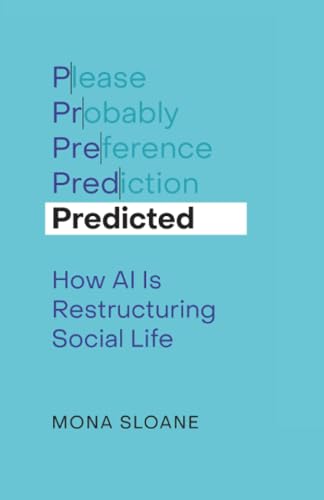
Predicted: How Ai Is Restructuring Social Life: 1 (co-Opting Ai)

University of California Press
Predicted: How Ai Is Restructuring Social Life: 1 (co-Opting Ai)

In Predicted, Mona Sloane offers a pragmatic framework for understanding these transformations around prediction, classification, and linearity, proposing that we think about AI as a social arrangement that we coproduce. Drawing on over a decade of empirical research and real-world examples, this book invites us to see AI for what it is: deeply social, deeply political, and open to change.


  •  

Apple Intelligence gains regulatory approval in China

With its new architecture and capabilities, the next generation of Apple Intelligence powers helpful features across the system, simplifying the things users do every day.

China’s cyberspace regulator has officially registered Apple’s on-device generative AI service, Apple Intelligence, for use in the country. This marks a significant step toward the long-awaited launch of the feature for Chinese consumers.

According to Reuters, “China’s cyberspace regulator said on Wednesday that Apple’s on-device generative AI service, Apple Intelligence, has been registered for use on iPhones in China, paving the way for the long-anticipated rollout of the service in the country.”

China mandates that companies register large language models and generative AI services with regulators before making them available to the public. This approval positions Apple to finally introduce its AI capabilities in one of its most important markets.

The service will integrate local AI expertise. Reuters reports, “Apple Intelligence will incorporate capabilities from AI models developed by Baidu and Alibaba, a source familiar with the matter said, speaking on condition of anonymity.”

Alibaba confirmed its involvement in a statement to Reuters: “Its Qwen model will be integrated into Apple Intelligence across Apple’s iPhone (iOS), iPad (iPadOS), Mac (macOS) and Vision Pro (visionOS) operating systems in China.”

A Baidu spokesperson also noted, “Apple is also working with Baidu to develop Apple Intelligence features for Chinese iPhone users.”

The regulator’s statement provided no specific launch date for Apple Intelligence in China.

This development comes at a crucial time for Apple in China, where the company reported a 24.4% year-on-year increase in shipments in the second quarter. The rollout of Apple Intelligence could further strengthen its competitive position in a market where consumers have eagerly awaited these AI features.

MacDailyNews Take: Clearly good news for Apple and should be for Apple’s – and Alibaba’s – stock prices, too.


‎
Please help support MacDailyNews — and enjoy subscriber-only articles, comments, chat, and more — by subscribing to our Substack: macdailynews.substack.com. Thank you!

Support MacDailyNews at no extra cost to you by using this link to shop at Amazon.

The post Apple Intelligence gains regulatory approval in China appeared first on MacDailyNews.

  •  

Privacy-focused Apple in talks with startup to run more powerful AI models directly on devices

Apple's all-new Siri AI. An even more capable AI assistant with expanded intelligence to be more helpful every day.
Apple’s all-new Siri AI. An even more capable AI assistant with expanded intelligence to be more helpful every day.

Apple is exploring new ways to keep AI processing on users’ devices, prioritizing speed, privacy, and reduced reliance on the cloud. The company is in early discussions with PrismML, a startup developing technology that dramatically compresses large AI models to fit and run efficiently on iPhones.

According to PrismML CEO Babak Hassibi, who spoke to CNBC, Apple and other companies have been evaluating the startup’s models, measuring their speed, energy efficiency, and performance on devices. “They’re really evaluating our technology right now,” Hassibi said of Apple. He described the discussions as very early but noted that “things are progressing nicely.”

Shrinking Massive Models for Everyday Devices

PrismML, a Khosla Ventures-backed spinout from the California Institute of Technology, recently released compressed versions of Alibaba’s open-source Qwen model. The company reduced the model from roughly 54 GB to less than 4 GB, enabling all 27 billion parameters to run on an iPhone 15 or newer.

The compression technique simplifies how internal information is stored—reducing values from 16 bits to just one or three possible values. PrismML claims the compressed models use 10 to 15 times less memory, generate responses six to eight times faster, and consume three to six times less energy than conventional versions.

Hassibi acknowledged a small performance trade-off: “PrismML’s models typically lose a few percentage points of overall performance, with factual recall weakening before skills such as reasoning, math and coding.” Despite this, the company is releasing two compressed versions for free, designed to run on iPhones, MacBooks, and Nvidia-powered PCs.

Boosting Siri and On-Device Capabilities

This development aligns closely with Apple’s ongoing efforts to enhance Siri. Just before PrismML’s release, Apple opened the public beta of iOS 27, introducing a major overhaul aimed at making Siri more competitive with offerings from xAI, OpenAI, and Anthropic — while emphasizing on-device processing for personal data.

Running more AI locally would bring several benefits:

• Reduced latency compared to cloud requests
• Lower cloud computing costs
• Support for features that work offline
• Stronger privacy protections, especially for sensitive health, medication, or personal information

Carolina Milanesi, president and principal analyst at Creative Strategies, told CNBC: “The more you can do on device, the better it is,” highlighting applications like computational photography, video generation, and health tools.

Analysts note Apple’s integrated hardware-software approach gives it an edge in optimizing these models. Horace Dediu of Asymco explained that Apple aims to keep most common Siri interactions on-device while routing only the most demanding tasks to the cloud. “They’re trying to figure out how big a model and how clever a model they can fit on the device,” he said.

Potential Industry Impact and Caveats

If PrismML’s technology proves effective at scale, it could influence memory requirements and datacenter demands. However, analysts caution that real-world performance — especially on lengthy prompts, multitasking, battery life, and millions of queries — remains to be fully validated.

Tarun Pathak of Counterpoint Research emphasized: “The ultimate test will be millions of queries, thousands of device combinations and robust testing at scale.” Phil Solis of IDC pointed to power consumption as a key open question for always-on or agent-like features.

Hassibi sees broader applications beyond phones, including robotics and autonomous systems where fast, local intelligence is critical: “It’s very important that the intelligence be local and that it can run fast.”

Pathak summed up the balanced future: “The combination of cloud and on-device AI can serve a more complete, efficient and privacy-centric AI experience. Complex tasks will be offloaded to the cloud, whereas sensitive, latency-critical and privacy-relevant tasks will be executed on-device.”

MacDailyNews Take: Apple’s interest in technologies like PrismML underscores its commitment to privacy as a core differentiator while pushing the boundaries of what smartphones can achieve with AI. As testing continues, this could mark a significant step toward more capable, personal, and private intelligent assistants.


‎
Please help support MacDailyNews — and enjoy subscriber-only articles, comments, chat, and more — by subscribing to our Substack: macdailynews.substack.com. Thank you!

Support MacDailyNews at no extra cost to you by using this link to shop at Amazon.

The post Privacy-focused Apple in talks with startup to run more powerful AI models directly on devices appeared first on MacDailyNews.

  •  

Apple emerges as the ultimate defensive play in an AI-driven market

Apple Park in Cupertino, California

While many Big Tech peers chase high-risk AI growth, Apple stands out for its stability and resilience. The company is projected to grow free cash flow in 2026 — a rarity among its counterparts — positioning its stock as a defensive haven traditionally reserved for consumer staples, utilities, and healthcare names.

Nate Wolf for Barron’s:
‎

“No one admits they like or want to buy more AAPL,” Mizuho Securities analyst Jordan Klein wrote Friday. “But I get why more folks [are] looking at AAPL as a hedge or long idea.”

“Analysts estimate Meta Platforms, Oracle, and Amazon will have negative free cash flow in 2026 because of their AI investments. Meanwhile, Apple is expected to produce $143 billion in free cash flow, up from $109 billion last year, per FactSet. Its capital expenditures will likely decline in 2026.

“[Apple] has definitely been out of favor, but carries a lot less direct near-term execution risk,” Klein wrote.”

But Apple is one of the few high-profile tech names that isn’t a primary consumer or supplier of AI compute, and that differentiation has value… If Apple’s share price is any indication, plenty of investors want to keep at least some money away from the AI trade.

‎
MacDailyNews Take: As we wrote back on February 18 when Apple shares closed at $264.11 ($50 per share ago):

Just wait until Apple begins to release Apple Intelligence features underpinned with — but privacy-protected from — Google Gemini and things like Siri begin to actually work as well as, or even better than, people expect them to work in 2026. The sky’s the limit for Apple stock!


‎
Please help support MacDailyNews — and enjoy subscriber-only articles, comments, chat, and more — by subscribing to our Substack: macdailynews.substack.com. Thank you!

Support MacDailyNews at no extra cost to you by using this link to shop at Amazon.

The post Apple emerges as the ultimate defensive play in an AI-driven market appeared first on MacDailyNews.

  •  

Apple eyes PrismML to run huge AI models directly on iPhone

neurons

Apple is in discussions with PrismML, a Khosla Ventures-backed startup that claims to have achieved a major breakthrough in running exceptionally large AI models directly on iPhones without relying on cloud servers, Aaron Tilley reports for The Information. The company says it has successfully compressed and executed a 27-billion-parameter model on the latest iPhone hardware, marking what it describes as the largest AI model ever run fully on-device.

PrismML, which emerged from stealth earlier this year as a Caltech spinout, specializes in extreme model compression techniques, particularly 1-bit and ternary weight architectures. These methods drastically reduce memory footprints while aiming to preserve performance. According to the startup, its technology allowed Alibaba’s open-source Qwen 3.6 (27B parameters) — which normally requires about 54 GB in standard precision — to shrink to under 4 GB. The compressed model reportedly ran with all parameters active simultaneously on an iPhone 17 Pro, enabling more complex on-device tasks like advanced reasoning and software development assistance.

This development aligns with Apple’s long-standing push to enhance Apple Intelligence with more powerful on-device capabilities. By keeping AI processing local, Apple can improve privacy, reduce latency, and lessen dependence on cloud infrastructure and external partners. Sources familiar with the matter indicate Apple has held talks with PrismML about potential integration of its compression technology to expand what future iPhones can handle natively.

The Technical Leap: 1-Bit Models and Intelligence Density

Traditional large language models use 16-bit floating-point precision, leading to massive memory requirements. PrismML’s approach uses 1-bit weights (essentially on/off states) and ternary variants (weights of -1, 0, or +1). The company’s flagship open-source “Bonsai” family includes:

• Bonsai 8B: An 8-billion-parameter model that fits in roughly 1 GB (versus ~16 GB for a typical 16-bit equivalent), while delivering competitive results on benchmarks like MMLU, GSM8K, and HumanEval.

• Smaller variants (4B and 1.7B) optimized for even greater efficiency.

PrismML claims these models offer up to 14× smaller memory use, 8× faster inference, and 5× better energy efficiency compared to full-precision counterparts, resulting in over 10× “intelligence density.” The startup has open-sourced its models under Apache 2.0 and released custom kernels for Apple’s Metal framework, making them compatible with iPhone and Mac hardware.

Co-founders, including Caltech professor Babak Hassibi and other PhDs, emphasize that the breakthrough stems from years of research into neural network compression. Investors include Khosla Ventures, Cerberus Capital, and Caltech itself, with the company raising $16.25 million in seed funding. Vinod Khosla has praised the work as a “mathematical breakthrough” that could shift AI from data-center dominance to efficient edge deployment.

Implications for Apple and the Industry

For Apple, adopting such technology could supercharge features in iOS and Apple Intelligence, enabling more sophisticated AI agents, real-time coding help, or advanced multimodal capabilities without constant server calls. It also addresses growing concerns around energy consumption and data privacy in AI.

PrismML positions its tech not just for consumer devices but for robotics, wearables, and industrial edge applications. By open-sourcing core models, the company hopes to accelerate adoption and invite community improvements.

While independent verification of all performance claims is still emerging, the reported iPhone demo and Apple’s interest signal strong validation. As the AI race intensifies, solutions that pack more intelligence into everyday devices — without ballooning costs or power draw — could prove transformative.

PrismML plans further releases and is expected to continue engaging with major device makers.

MacDailyNews Take: For Apple, which has invested heavily in on-device AI silicon like the Neural Engine, this could represent a key for the next-gen of truly personal, secure, and private artificial intelligence.


‎
Please help support MacDailyNews — and enjoy subscriber-only articles, comments, chat, and more — by subscribing to our Substack: macdailynews.substack.com. Thank you!

Support MacDailyNews at no extra cost to you by using this link to shop at Amazon.

The post Apple eyes PrismML to run huge AI models directly on iPhone appeared first on MacDailyNews.

  •  

Como gerar imagens usando o Creator Studio no Pages, Numbers e Keynote [iPhone, iPad e Mac]

O Apple Creator Studio desbloqueia vários recursos bacanas de aplicativos já conhecidos pelos usuários de dispositivos da Maçã.

Dentre os exemplos, estão os apps Pages, Numbers e Keynote. Com eles, assinantes do Creator Studio podem gerar imagens e adicioná-las aos seus documentos, planilhas e apresentações de slides.

Veja como fazer isso nos parágrafos a seguir! ✨

Como gerar imagens usando o Pages, Numbers ou Keynote pelo iPhone/iPad

  1. Com um dos apps abertos, abra o arquivo onde deseja anexar a imagem.
  2. Escolha o ícone roxo (na barra superior) e vá em “Gerar Imagem”.
  3. Selecione o estilo, a forma de visualização e a proporção desejadas.
  4. Descreva a imagem no campo da parte inferior da tela.

Após ela ser gerada, você pode fazer outras edições e salvá-la, por exemplo.

Como gerar imagens usando o Pages, Numbers ou Keynote pelo Mac

  1. Com o arquivo aberto, clique no ícone de explorar biblioteca (na barra superior) — ou, na barra de menus, vá até Inserir » Gerar Imagem.
  1. Em seguida, escolha “Gerar Imagem”.
  1. Siga os passos a seguir para gerar, aprimorar e anexar a imagem desejada.

  •  

Vídeo: veja a Siri AI em ação no macOS Golden Gate 27!

Depois de já termos publicado vários vídeos sobre as novidades do iOS 27, chegou a vez de começarmos a cobertura em vídeo do macOS Golden Gate 27 em nosso canal. E não tem jeito melhor de abrir essa série do que falando sobre a mudança mais aguardada do sistema: a Siri AI.

Neste primeiro vídeo, mostramos como funciona o novo app da Siri, os ajustes de voz disponíveis, as melhorias na busca do Spotlight, os recursos da Inteligência Visual a partir de screenshots e as ferramentas de escrita e revisão de texto integradas ao sistema.

Esse é só o primeiro de vários vídeos que estamos preparando sobre o macOS 27. Fique de olho no canal do MacMagazine para não perder os próximos! 😄


Apoio: UPDF

Este vídeo tem o apoio do UPDF, aplicativo equipado com inteligência artificial (IA) que já analisamos em detalhes aqui no site. Conheça mais esse belo editor de PDFs, obtenha-o com um desconto exclusivo e tenha acesso total ao UPDF Pro no Mac, no Windows, no iPad, no iOS e no Android pagando cerca de um quinto da suíte da Adobe!

  •  

Meta AI Updates Its Chatbot To Alert Parents About Teen Self-Harm

The social media giant Meta just added a major safety feature to its digital assistant. When younger users have conversations that involve thoughts of suicide or hurting themselves, the company will step in. Instead of just showing crisis hotlines on the screen, the system will now send a direct notification right to a linked parent […]

The post Meta AI Updates Its Chatbot To Alert Parents About Teen Self-Harm appeared first on The Mac Observer.

  •  

1Password Now Lets Claude Log In Without Seeing Your Passwords

If you want an artificial intelligence tool to book a flight or buy an audiobook, it usually needs to log into your personal accounts. Sharing your private login details directly with a chatbot feels risky, but a new software update changes that process entirely. The popular password manager 1Password just built a clever way for […]

The post 1Password Now Lets Claude Log In Without Seeing Your Passwords appeared first on The Mac Observer.

  •  

The EU Orders Google to Give Rival AI Apps Equal Android Access

The European Commission just told Google to stop giving its own artificial intelligence assistant special treatment on smartphones. Regulators declared that the company must give competing software the same system permissions currently used by Gemini. This order falls under the Digital Markets Act, forcing the tech giant to open up deep phone controls that were […]

The post The EU Orders Google to Give Rival AI Apps Equal Android Access appeared first on The Mac Observer.

  •  

OpenAI Is Selling $230 Codex Micro Hardware Product With Work Louder

OpenAI recently teamed up with Work Louder to release a physical tool for developers. Reports show OpenAI is selling $230 Codex Micro hardware product units on its website now. The keyboard brings your digital agent workspace straight to your desk. It helps users manage active chats and keep track of tasks through live lighting feedback. […]

The post OpenAI Is Selling $230 Codex Micro Hardware Product With Work Louder appeared first on The Mac Observer.

  •  

Suno App Now Lets You Generate AI Songs Directly in iMessage

If you have an iPhone, the AI music maker Suno just updated its software to make it much easier to share custom tracks with your friends. With a recent software update, Suno now lets iPhone users generate songs directly in iMessage without ever having to leave the chat window. You can easily turn your everyday […]

The post Suno App Now Lets You Generate AI Songs Directly in iMessage appeared first on The Mac Observer.

  •  

“The Lord of the Rings: The Hunt for Gollum” Will Use AI to De-Age Actors

“The Lord of the Rings: The Hunt for Gollum,” will de-age actors using AI, the actor and director Andy Serkis confirmed to Variety.

“There’s a little bit of de-aging for some of the characters and machine learning is part of the process,” Serkis, who is both directing the new film and reprising his famous role as Gollum, told Variety.

AI is an incredibly contentious topic in Hollywood. Some studios, like A24, have leaned into generative AI. Others in the industry, from actors to directors and writers, have lambasted the tech, with many fearing that AI will be used to replace industry jobs or simply result in lower-quality work. As the tension between the pro-AI and anti-AI — or perhaps AI-resigned — factions deepen, the industry and its leaders, Serkis included, are publicly grappling with the technology and what it means for a key creative industry.

In addition to Serkis, returning actors from past films include Elijah Wood as Frodo, Ian McKellen as Gandalf, and Lee Pace as Thranduil — all of whom are markedly older than when the original “Lord of the Rings” trilogy and the prequel franchise “The Hobbit” were filmed. Beyond de-aging, though, Serkis said that “at present,” there are no other plans to use AI in the making of the new movie.

“We’re not creating AI shots in our movie, every shot is created in a traditional way,” said Serkis. “One of the things actually that I really wanted to do with this film was to bring back all of the great filmmaking skills, from miniatures to prosthetics and marry them up, because that’s my taste.”

Serkis didn’t nix the idea of using AI altogether. He noted that Peter Jackson, who famously directed the previous live-action movies in the celebrated franchise, worked with the software engineer Stephen Regelous to develop the AI-powered special effects software known as MASSIVE back in the early 2000s.

“When you think about it, in the original ‘Lord of the Rings’ films, Peter created MASSIVE, which was a program which allowed thousands of orcs to all have their own individual mindset,” said Serkis. “So that is a brilliant example of an incredible use of AI.”

He added that AI can be a “valuable” creative tool “as long as it’s not exploitative and as long as it’s not harming anybody or defaming anybody or telling mistruths.”

“When it becomes exploitative and people are not remunerated for the work that they’ve done, or it’s used in nefarious, or mean-spirited or pornographic ways, then of course, that’s terrible and we’ve only brought it upon ourselves,” he added. “I’ve said this before and I mean it — we are the parents of AI, and we have to be good parents and teach AI well. And if we teach AI well, then it can help us across many industries.”

As The Tab noted, many Lord of the Rings fans responded positively, drawing a line between machine learning-infused virtual effects software and generative AI tools that churn out text, audio, and imagery.

“AI is perfect for de-aging,” wrote one commenter. “It should get a complete and utter free pass for that. Having an artist sit and de-age someone must be a horrific chore. Let them work on something fun instead.”

“Every single VFX tool these days uses AI for some part of the processing,” added another. “This isn’t generative AI.”

Other famous filmmakers’ AI stances, meanwhile, haven’t received the same warm reception from fans.

More on AI and movies: Film Community Aghast as Martin Scorsese Extolls AI Startup, Says He Now Uses AI for Storyboards

The post “The Lord of the Rings: The Hunt for Gollum” Will Use AI to De-Age Actors appeared first on Futurism.

  •  

Safari Notify Me Makes Online Shopping Easier

Safari Notify Me gives Apple’s browser a useful new role in online shopping: watching a product page after the shopper has closed it. Instead of repeatedly returning to check whether an item is available or whether its price has changed, users can ask Safari to monitor the page and send an alert when the requested update appears.

The feature arrives as online shopping becomes increasingly fragmented. Prices can change several times during a promotion, popular items disappear within minutes and retailers often require shoppers to join separate mailing lists for availability alerts. Dedicated tracking apps can help, but each adds another account, extension or subscription.

Safari Notify Me places the monitoring tool inside the browser already being used to view the product. It is simple enough for occasional purchases while potentially useful for expensive electronics, limited releases, event registrations and products that move in and out of stock.

Safari Notify Me Watches the Page for You

Safari Notify Me is designed to monitor changes on a specific webpage. The user identifies what should be watched, such as a lower price, a product returning to stock or registration becoming available. Safari then checks the page and sends a notification after detecting the relevant change.

Apple has presented price changes and product restocks as central examples, though the feature is not restricted to shopping. It may also help with reservations, ticket availability, enrollment openings or other pages where one detail changes over time.

For shopping, the advantage is immediate. A customer can leave the product page without relying on memory, leaving dozens of tabs open or refreshing the site throughout the day.

The browser becomes temporarily responsible for the follow-up.

This differs from a retailer’s own email alert. Store notifications usually depend on the business offering the feature, and they may focus only on inventory. Safari can monitor the page according to the user’s request, potentially covering price and availability without requiring another marketing subscription.

Safari Notify Me - Close-up of a Mac computer screen showing the dock with app icons. The cursor hovers over the macOS Tahoe Launchpad icon, displaying a popup label that says "Launchpad.” Other visible icons include Safari, Chrome, and Calculator.
Image Credit: Pond5

How Safari Price Alerts Help

Online prices are rarely as stable as the label suggests. Retailers adjust discounts, respond to competitors, launch short promotions and change prices according to stock levels.

A shopper interested in a Mac accessory, appliance or expensive display may not want to purchase immediately at the listed price. Checking the page every day is inefficient, while joining a store mailing list can produce far more promotional email than useful information.

Safari price alerts create a quieter alternative. The user can identify the product and wait for the browser to report a meaningful change.

The feature does not replace price history. Safari may detect that the amount has dropped, but that does not necessarily prove the new price is the lowest offered during the year. Dedicated price-tracking services may still provide charts, comparisons and retailer-specific history.

Safari Notify Me is better understood as a page-change assistant. It tells the shopper that something requested has happened. The decision to purchase remains with the user.

Restock Alerts May Be Even More Useful

Restock monitoring may become the feature’s strongest shopping use. Limited products can return without warning and sell out before a retailer’s email reaches every subscriber.

This often happens with game consoles, graphics hardware, collectibles, seasonal products, concert merchandise and popular configurations of newly released devices. Size and color variations can also return separately, making a general product alert less useful.

Safari restock alerts can focus on the page the user is already viewing. A notification provides a reason to return without requiring the tab to remain open.

The browser cannot reserve the item or guarantee that inventory will remain available. A notification may also arrive after other buyers have begun ordering. Safari removes the repeated checking, but it does not control the retailer’s inventory system.

That limitation is reasonable. Notify Me helps users notice the opportunity; it does not turn Safari into an automated purchasing bot.

Using Safari Notify Me

The feature is intended to require little setup. Users begin on the relevant product or registration page and tell Safari which change they want it to watch.

To create a Safari Notify Me alert:

Open the webpage in Safari > Select Notify Me > Describe the price, availability or page change to monitor > Allow Safari notifications when requested

The exact options shown may depend on the device, webpage and software version. Apple is introducing the feature with its new operating-system releases, and availability may vary by language or region.

A useful request should be specific. Asking Safari to report when the item returns to stock is more actionable than asking for any page change. For price monitoring, the user may request a reduction or watch for a particular target when the page supports enough information.

Once the alert is active, there is no need to keep the product page open. Safari sends a notification after detecting the requested update, allowing the user to return directly to the page.

A Better Use for Apple Intelligence

Safari Notify Me is a practical example of Apple Intelligence operating as an assistant rather than a writing tool. It interprets what the user wants, watches for a future condition and reports back when that condition appears.

The feature does not need to generate a long answer or place a chatbot beside every shopping page. Its value comes from removing a repetitive task.

That restrained approach fits Safari. The browser already manages passwords, private browsing, tab organization, Reader and tracking protections. Monitoring a page extends that utility without turning Safari into a retailer or shopping marketplace.

It may also reduce the need for third-party extensions among casual users. Someone who occasionally watches one product does not necessarily need a dedicated deal platform with wish lists, affiliate links and account registration.

Specialized services will remain useful for serious bargain hunting. Safari covers the simpler request: tell me when this exact page changes in the way I care about.

A glowing, abstract metallic shape with six curved, interconnected loops forms a symmetrical pattern against a black background, illuminated with blue and white light—evoking the futuristic vibe of WWDC26 developer betas.
Image Credit: Apple Inc.

Notifications Need Restraint

Any feature built around alerts can become noisy when used too freely. Monitoring every product considered during casual browsing could fill Notification Center with price changes and restocks that no longer feel relevant.

Safari Notify Me works better when reserved for purchases with genuine intent. A few focused alerts are easier to understand and act upon than dozens of loosely defined page watches.

Users should also remove alerts after buying the item or losing interest. A notification for a product purchased weeks earlier adds clutter without saving time.

Safari notifications can be managed through the device’s normal notification settings. Disabling all Safari alerts may also silence other useful browser notifications, so reviewing individual watches inside Safari is preferable when available.

Price Is Not the Only Shopping Decision

A lower price can encourage a quick purchase, but shoppers should still review the seller, return policy, warranty and delivery estimate. Notify Me reports a page change; it does not evaluate whether the store is reliable or whether the offer has hidden conditions.

A product may return through a third-party marketplace seller at a higher price. A discount may apply only after a membership, coupon or trade-in. Limited inventory can also create pressure to buy before reading the terms.

Safari’s privacy protections and fraud warnings remain relevant, but users should confirm that the page belongs to the intended retailer before entering payment information.

The alert is a starting signal, not an endorsement.

Safari Becomes More Useful After the Tab Closes

Browsers traditionally stop being helpful once users leave a page. Safari Notify Me changes that relationship by allowing selected pages to remain useful without remaining visible.

For shoppers, that means fewer repeated searches, fewer forgotten products and less dependence on promotional email. Price and restock alerts can operate quietly until there is a reason to return.

The feature will not replace advanced shopping trackers, and it cannot guarantee inventory. Its appeal is that most users do not need those larger systems for every purchase.

Sometimes the entire shopping problem is waiting for one price to fall or one button to change from unavailable to buy. Safari Notify Me allows the browser to handle that wait.

The post Safari Notify Me Makes Online Shopping Easier appeared first on AppleMagazine.

  •  
❌