❌

Reading view

'A dangerous proposition': How AI is warping the social fabric and the ways we collectively imagine the future

Much of the discourse around artificial intelligence (AI) focuses on grand ideas such as the rise of a hypothetical artificial general intelligence (AGI) and superintelligence. Speculation swirls around the likelihood that the technology will thin out the job market, or even precipitate the death or evolution of human creativity. We haven't focused as much on the multitude of subtle yet hugely consequential ways in which AI is reshaping the social fabric of our society, and how we collectively imagine the future.

That's the argument sociologist and AI researcher Mona Sloane, an assistant professor of data science and media studies at the University of Virginia, puts at the center of her new book, "Predicted: How AI Is Restructuring Social Life" (University of California Press, 2026). Whether we consider email filtering, prediction markets or social media platforms, AI systems are embedded in the heart of how we interact with the digital world. Indeed, AI is so ubiquitously integrated into everyday interfaces that it's given rise to a new kind of "prediction logic" that makes assumptions about who we are and how we are likely to behave.

In this excerpt, Sloane compares the AI technology we use today with the oracles of ancient Greece, framing it as an omnipotent presence that has moved to organize society through the prism of prediction models. This in turn affects how we learn, live, love and even picture the future.

We live in a world of oracles. These oracles constantly feed us predictions that shape our social lives — how we socialize, love, work, gain access to resources. Like in ancient Greece, predictions occupy a prominent role in our society. We consider our oracles so mighty that their predictive power rules over the fate of whole economies and even geopolitical constellations. Where the oracle is, there is the center of the world.

But unlike in ancient Greece, our oracles aren't high priestesses delivering divine prophecies. They are artificial intelligence (AI) systems melted into the infrastructure of everyday life. Today, it is nearly impossible to evade the grasp of AI predictions. I voluntarily and involuntarily use AI on a constant basis: by using email providers that build on the predictive properties of AI for spam filters, by conducting online banking and getting enrolled into AI-automated fraud detection, or by using generative AI for supporting administrative chores. It has become part of how I experience the world.

It can be a relief when it helps me do things I dread or am bad at, such as produce a spreadsheet template I desperately need, help streamline language produced by different authors for a report, or generate a specific image for a presentation. Often, I must intently handhold the AI, checking and fixing its outputs. And sometimes, with deep frustration, I give up and start all over to complete my task manually.

The omnipresence of AI prediction can make it easy to think of these systems as inevitable, quasi-natural phenomena we are subject to, rather than a part of. But they are quantitative concepts that arise from social agreements about how we ought to capture and interpret the world around us.

"Quantitative concepts are not given by nature: they arise from our practice of applying numbers to natural phenomena," wrote Rudolf Carnap, a logician and professor of philosophy of science, in 1966. His point was that numbers can be useful, because they allow for information to travel more easily across contexts, as a sort of language. They also make mathematical predictions possible.

To him, this was first and foremost useful for engineering modern life: A quantitative language allows for the articulation of quantitative laws that, in turn, facilitate the routine generation of mathematicized predictions, particularly in the realm of physics. Being able to predict how energy, compounds, and materials will behave in certain configurations is the reason humans were able to build the conveniences of airplanes, cars, and telephones. For Carnap, predictions were simply instrumental in this way.

A white robot hand touches a digital screen

AI's ability to predict is changing how we think about the future. (Image credit: Yana Iskayeva via Getty Images)

Today, almost 60 years later, this pragmatic approach to mathematical prediction has been turned on its head by AI. Prediction is no longer just a handy tool in physics or engineering. The promises of AI's oracular power have turned prediction into a logic for structuring social life. This is a dangerous proposition. It implies that AI is always necessary or even inevitable and diverts attention from the social forces shaping ideas around this technology in the first place.

AI systems are not natural phenomena that happen to us. They are collective expressions of society. As such, they are not just a hype or a deception concocted and executed by global tech elites. They indicate a wider shift in how we imagine and enact society. Many critical discussions of AI characterize this phenomenon chiefly as heightened surveillance and capitalist extraction. But this is a myopic diagnosis. AI's most powerful effect is the subtle yet comprehensive recalibration toward prediction as a guiding principle for organizing society. In this book, I call this phenomenon the prediction paradigm.

AI is something that we do as part of going about our lives and participating in society — it is social infrastructure, affecting how we relate to one another and how we act in public and in private. Like all infrastructures, AI allows resources and ideas to flow in certain directions, but not others. AI uses data from our collective past to predict our individual future. And because AI deals in futures, it solidifies a linear time regime that hardens our social commitment to causality: The past always predicts the future. The problem of AI is not the rise of intelligent machines, but the extraordinary social significance ascribed to this linearity, fetishizing the future and leaving little room for deliberations about what (other) futures may be possible or we may want.

Reprinted from Predicted: How AI Is Restructuring Social LIfe by Mona Sloane, courtesy of the University of California Press. Copyright 2026.
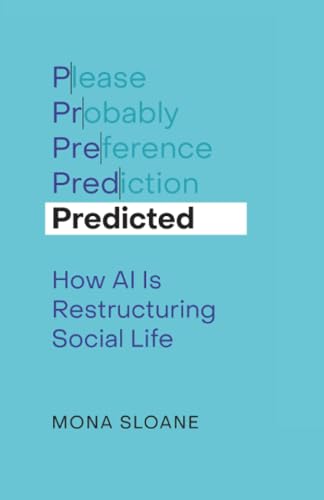
Predicted: How Ai Is Restructuring Social Life: 1 (co-Opting Ai)

University of California Press
Predicted: How Ai Is Restructuring Social Life: 1 (co-Opting Ai)

In Predicted, Mona Sloane offers a pragmatic framework for understanding these transformations around prediction, classification, and linearity, proposing that we think about AI as a social arrangement that we coproduce. Drawing on over a decade of empirical research and real-world examples, this book invites us to see AI for what it is: deeply social, deeply political, and open to change.

  •  

Meta AI Updates Its Chatbot To Alert Parents About Teen Self-Harm

The social media giant Meta just added a major safety feature to its digital assistant. When younger users have conversations that involve thoughts of suicide or hurting themselves, the company will step in. Instead of just showing crisis hotlines on the screen, the system will now send a direct notification right to a linked parent […]

The post Meta AI Updates Its Chatbot To Alert Parents About Teen Self-Harm appeared first on The Mac Observer.

  •  

1Password Now Lets Claude Log In Without Seeing Your Passwords

If you want an artificial intelligence tool to book a flight or buy an audiobook, it usually needs to log into your personal accounts. Sharing your private login details directly with a chatbot feels risky, but a new software update changes that process entirely. The popular password manager 1Password just built a clever way for […]

The post 1Password Now Lets Claude Log In Without Seeing Your Passwords appeared first on The Mac Observer.

  •  

The EU Orders Google to Give Rival AI Apps Equal Android Access

The European Commission just told Google to stop giving its own artificial intelligence assistant special treatment on smartphones. Regulators declared that the company must give competing software the same system permissions currently used by Gemini. This order falls under the Digital Markets Act, forcing the tech giant to open up deep phone controls that were […]

The post The EU Orders Google to Give Rival AI Apps Equal Android Access appeared first on The Mac Observer.

  •  

OpenAI Is Selling $230 Codex Micro Hardware Product With Work Louder

OpenAI recently teamed up with Work Louder to release a physical tool for developers. Reports show OpenAI is selling $230 Codex Micro hardware product units on its website now. The keyboard brings your digital agent workspace straight to your desk. It helps users manage active chats and keep track of tasks through live lighting feedback. […]

The post OpenAI Is Selling $230 Codex Micro Hardware Product With Work Louder appeared first on The Mac Observer.

  •  

Suno App Now Lets You Generate AI Songs Directly in iMessage

If you have an iPhone, the AI music maker Suno just updated its software to make it much easier to share custom tracks with your friends. With a recent software update, Suno now lets iPhone users generate songs directly in iMessage without ever having to leave the chat window. You can easily turn your everyday […]

The post Suno App Now Lets You Generate AI Songs Directly in iMessage appeared first on The Mac Observer.

  •  

“The Lord of the Rings: The Hunt for Gollum” Will Use AI to De-Age Actors

“The Lord of the Rings: The Hunt for Gollum,” will de-age actors using AI, the actor and director Andy Serkis confirmed to Variety.

“There’s a little bit of de-aging for some of the characters and machine learning is part of the process,” Serkis, who is both directing the new film and reprising his famous role as Gollum, told Variety.

AI is an incredibly contentious topic in Hollywood. Some studios, like A24, have leaned into generative AI. Others in the industry, from actors to directors and writers, have lambasted the tech, with many fearing that AI will be used to replace industry jobs or simply result in lower-quality work. As the tension between the pro-AI and anti-AI — or perhaps AI-resigned — factions deepen, the industry and its leaders, Serkis included, are publicly grappling with the technology and what it means for a key creative industry.

In addition to Serkis, returning actors from past films include Elijah Wood as Frodo, Ian McKellen as Gandalf, and Lee Pace as Thranduil — all of whom are markedly older than when the original “Lord of the Rings” trilogy and the prequel franchise “The Hobbit” were filmed. Beyond de-aging, though, Serkis said that “at present,” there are no other plans to use AI in the making of the new movie.

“We’re not creating AI shots in our movie, every shot is created in a traditional way,” said Serkis. “One of the things actually that I really wanted to do with this film was to bring back all of the great filmmaking skills, from miniatures to prosthetics and marry them up, because that’s my taste.”

Serkis didn’t nix the idea of using AI altogether. He noted that Peter Jackson, who famously directed the previous live-action movies in the celebrated franchise, worked with the software engineer Stephen Regelous to develop the AI-powered special effects software known as MASSIVE back in the early 2000s.

“When you think about it, in the original ‘Lord of the Rings’ films, Peter created MASSIVE, which was a program which allowed thousands of orcs to all have their own individual mindset,” said Serkis. “So that is a brilliant example of an incredible use of AI.”

He added that AI can be a “valuable” creative tool “as long as it’s not exploitative and as long as it’s not harming anybody or defaming anybody or telling mistruths.”

“When it becomes exploitative and people are not remunerated for the work that they’ve done, or it’s used in nefarious, or mean-spirited or pornographic ways, then of course, that’s terrible and we’ve only brought it upon ourselves,” he added. “I’ve said this before and I mean it — we are the parents of AI, and we have to be good parents and teach AI well. And if we teach AI well, then it can help us across many industries.”

As The Tab noted, many Lord of the Rings fans responded positively, drawing a line between machine learning-infused virtual effects software and generative AI tools that churn out text, audio, and imagery.

“AI is perfect for de-aging,” wrote one commenter. “It should get a complete and utter free pass for that. Having an artist sit and de-age someone must be a horrific chore. Let them work on something fun instead.”

“Every single VFX tool these days uses AI for some part of the processing,” added another. “This isn’t generative AI.”

Other famous filmmakers’ AI stances, meanwhile, haven’t received the same warm reception from fans.

More on AI and movies: Film Community Aghast as Martin Scorsese Extolls AI Startup, Says He Now Uses AI for Storyboards

The post “The Lord of the Rings: The Hunt for Gollum” Will Use AI to De-Age Actors appeared first on Futurism.

  •  

Top Meta Exec Describes Controversial Facial Recognition Feature in Detail After the Company Claimed It Didn’t Exist

Meta executives claimed that a controversial facial recognition feature didn’t “exist.” Fast forward a few weeks later, and they’re describing the feature in public — and in detail.

In June, a Wired investigation revealed that Meta had quietly infused unreleased facial recognition tech into its “AI Glasses,” the tech giant’s chatbot and camera-equipped smart glasses. While the feature, dubbed NameTag, was inaccessible to consumers, it was designed to register faces encountered by Meta glasses wearers “into unique biometric signatures, commonly known as faceprints, and check each one against faceprints stored on the user’s phone,” according to the magazine.

It’s safe to say that Meta executives were furious after Wired published its investigation. After all, the company has a long track record of data privacy violations. The revelation that its “pervert glasses,” as some have taken to calling Meta’s controversial smart glasses, could soon be using facial recognition tech — not unlike the eyewear being used by Immigration and Customs Enforcement (ICE) agents — fueled an existing PR disaster.

Andy Stone, the tech giant’s spokesperson and VP of communications, declared on X that Wired’s reporting was “intellectually dishonest” and “advocacy-driven click bait.” What’s more, according to Stone, NameTag was fully nonexistent.

“Here’s a thing: Wired reports Meta didn’t answer several questions about how this will work,” Stone added in a follow-up post. “How could we? The feature doesn’t exist!”

In response to Stone, another Meta executive, chief technology officer Andrew “Boz” Bosworth, jumped in.

“Incredibly misleading from Wired,” he wrote. “Absolutely dishonest.”

Yet despite company leaders reassuring us that the feature doesn’t exist, Bosworth discussed it in detail during an interview with The Atlantic CEO and podcaster Nick Thompson. Bosworth’s comments in the interview, which was published last week, seemingly contradicted his fellow executives, revealing that the feature did indeed exist.

NameTag, Bosworth told Thompson, would be “encrypted locally to your device,” and would catalog people who smart glasses wearers “met in person, with your glasses on, who introduced themselves, or you said, ‘okay, this is David, remember this person.'”

This information is “only available to you, when you are wearing your glasses,” Bosworth added. He emphasized that the data captured by NameTag wouldn’t be stored in a centralized database.

“This is a person you’ve met before. Here’s their name. They’re right in front of you. That’s… what we call a NameTags feature,” said Bosworth. “I think people get confused because they hear face recognition and they think, ‘oh, there’s a central face database that everyone’s being scanned constantly into.’ It’s not that.”

In addition to supporting blind or low-vision smart glasses wearers, said Bosworth, NameTag could solve what Meta calls “the cocktail party problem,” saving wearers from any awkwardness that may arise when encountering people at parties who they’re sure they’ve met before, but can’t quite place.

“It’s a very universally human problem,” Bosworth said. “Nearly every human I talk to, no matter what their status of their vision or their memory, understands that this is a problem that would help them feel more comfortable in social situations if they had it.”

To be clear, Wired never suggested that the facial recognition feature it uncovered was being used to build a “central face database” by way of Meta’s smart glasses. Indeed, in line with what Bosworth said in the podcast appearance, Wired reported that “code discreetly added to Meta’s AI app over multiple updates this year shows that the feature, internally called ‘NameTag,’ identifies people captured by the glasses’ camera and, when activated, alerts the wearer when it recognizes someone.” The story also repeatedly noted that the feature was unreleased and inaccessible to glasses wearers.

When journalists and others called out the contradiction between Meta’s past and recent statements, Stone — the comms executive who said that Wired couldn’t answer questions about the feature because it “doesn’t exist” — jumped back in the comments section.

“We have said for months we’re exploring such features, even as nothing has shipped to consumers,” the spokesperson said in response to a post by The Intercept journalist Sam Biddle. “No secret there despite the conspiratorial thinking.”

There’s a big difference between a feature not existing and a feature that exists — if still unfinished — and has yet to be released. Meta appears to be arguing that if a feature remains inaccessible to consumers, it’s technically nonexistent, even if the company has gone as far as to issue multiple updates inserting code for the feature into products that are already in consumers’ hands. (Meta quietly deleted the NameTag code after its existence was made public.)

During the podcast interview, Bosworth took care to emphasize that Meta is considering the privacy implications of a facial recognition-powered feature like NameTag. He noted that it’s likely illegal in states like Illinois and Texas, and that it “has to be done in a way that people feel comfortable.”

Meanwhile, Meta continues to fight an ongoing consumer harm lawsuit, prompted by an investigation by a pair of Swedish newspapers. The publications found that Meta collected recordings by smart glasses wearers and passed them along to human data labelers, despite promising consumers that their recordings would be stored only on their devices.

“Designed for privacy,” reads a webpage for Meta’s smart glasses, “controlled by you.”

More on Meta’s smart glasses: Meta Furious Over Bombshell Smart Glasses Revelation

The post Top Meta Exec Describes Controversial Facial Recognition Feature in Detail After the Company Claimed It Didn’t Exist appeared first on Futurism.

  •  

Data Centers Are Making Electricity Brutally Expensive for the Public

Despite a financial situation more reminiscent of a Ponzi scheme than a technological revolution, the data center boom is continuing at a rapid pace, bringing novel kinds of biological contamination, ear-splitting noise, and unprecedented levels of pollution to communities across the US.

Those environmental burdens also come with a financial one: skyrocketing demand for electricity, which is increasing the cost of utilities for renters and homeowners alike.

According to a report by Monitoring Analytics, an independent monitor for the largest transmission company in the US, PJM, data center demand is expected to drive over $23 billion in customer price increases by 2028. That eye-watering figure, first spotted by Fortune, is a direct result of the country’s old and confusing electrical infrastructure, which ultimately leaves regular people, not the tech industry, holding the bag.

Whether they’re data centers, factories, or other large facilities, Fortune points out that local regulators and transmission companies like PJM have a hard time figuring out who’s responsible for rising energy demand. While a small power line from a data center campus to a nearby substation is easily billed to the data center, figuring out who to invoice gets harder further on down the line, particularly with shared infrastructure like the substation itself, or the long-distance transmission lines connecting to it.

Though utility companies can and do charge data centers for the electricity they use, Fortune observes that the facilities undergirding the AI boom can “fine tune” their electricity use minute-by-minute, gaining an edge that the average consumer could only dream of.

Because many utility companies charge based on a system of “peak demand” — a measure of a customer’s energy usage at the exact moment the collective grid hits peak demand — data centers have gotten into the habit of scaling down right when the grid measures highest demand. That’s not because they’re actually trying to use less power, but because that narrow window is what determines how high their bill will be. In reality, their overall usage remains the same.

This is more or less the scenario that played out in a Bitcoin mining operation in Texas, where the company Riot Platforms agreed to cut its power use on hot summer days, only to ramp back up massively at night. In exchange, the company negotiated for a lower flat electricity rate overall, and even snagged some state subsidies meant to encourage responsible energy use.

Load-shifting like this can genuinely help the grid, but it also means companies with the ability to game the system get rewarded with subsides that an average household will never get. And because companies are merely changing when they suck their juice — not how — subsidized load-shifting ends up being a poor strategy for reducing electrical use overall.

And while data centers are just the most contemporary example of this practice, the shrewd manipulation of US energy markets by for-profit corporations dates back decades. That may not be comforting news for citizens scrambling to hold data center firms accountable in the here-and-now, but it should at least give them an idea of where to start looking for inspiration.

More on data centers: New York Becomes First State to Ban AI Data Centers

The post Data Centers Are Making Electricity Brutally Expensive for the Public appeared first on Futurism.

  •  

Meta Patents Technology to Detect Your Mood by Constantly Analyzing Your Tone of Voice

Meta patented AI tech that constantly analyzes your voice and surroundings in order to detect your emotional state. Finally, exactly what we were all asking for: Meta being granted constant access to our offline lives.

As first caught by Patentlyze, a patent published on July 2 describes a system that records all the user’s “audible communications” and combines it with “contextual factors” like “time of day, location, user activity, or digital interaction.” Audio may be “transcribed, and an emotional-state machine learning model may interpret verbal and nonverbal cues to determine emotional indicators.”

In other words, the system listens to you and everything you do, combines it with other data, and feeds it all to a mood-predicting AI.

“The system increases the precision and reliability of emotional inference by aligning multimodal sensor inputs on synchronized timelines, which creates a novel data structure that supports richer emotional analysis,” reads the patent. “These combined features deliver a technical improvement in automated audio interpretation, enabling continuous emotional monitoring on everyday devices.”

According to the patent, the goal of this extraordinarily intrusive system would be to better tailor users’ workouts to their emotional state, as “personal trainers cannot provide the level of precision in guidance, such as correcting a pose and/or body movement,” as well as Meta’s imagined device could.

It’s not surprising to see Meta pitch this kind of surveillance technology as a fitness device. Health-tracking wearables have become wildly popular, despite the extraordinary amount of physical data about individual consumers they collect and store.

The key difference in Meta’s case, is that rather than crunch biological metrics, it’s an AI-powered fly-on-the-wall attempting to measure a person’s emotional state by listening in on the world around them, and possibly then connecting that information to all other available data.

“The AI assistant may listen to a user(s) at predefined times to hear various types of communication, such as sighs, laughter, and/or the tone(s) of a voice(s),” reads the patent. “The AI assistant may use these inputs to quantify the user’s emotional state or generate other insights about the user.”

The patent also discusses connecting audio inputs to information like when a user takes their medicine, proposing that “the AI assistant may take multiple inputs in addition to audio inputs (e.g., of a user’s voice) to provide a summary of emotional trends based on various inputs (e.g., a happier emotional state associated with a particular time of day or at a time when medication is taken, etc.)”

It’s worth noting that fellow tech giant Amazon tried and failed to market a similar system. In 2020, the company launched the Halo Band, a fitness band with a built-in microphone that was designed to listen in on users and conduct what Amazon described as a “tone of voice analysis.” Following public backlash in 2021, Amazon nuked the microphones when it launched a next-generation version of the band. It discontinued the product line altogether in 2023.

Whether we’ll ever see Meta attempt to launch a similar mood-tracking device is unclear. In a statement to 404 Media, a Meta spokesperson said that “like other companies, patents at Meta are often filed to disclose concepts that may or may not be implemented, and a granted patent does not guarantee that Meta has pursued or will pursue the technology described.”

The existence of the patent, though, shows that such a device is certainly on Meta’s mind — and is yet another Meta-made product that stands to strengthen the bridge between our online and offline worlds.

More on Meta products: The Backlash Is So Strong That People With “Pervert Glasses” Are Afraid to Use Them in Public

The post Meta Patents Technology to Detect Your Mood by Constantly Analyzing Your Tone of Voice appeared first on Futurism.

  •  

Scientists Discover AI Models May Not Think Like the Brain After All

AI Robot Thinking Artificial IntelligenceA reverse prediction test suggests that supposedly brainlike AI models may rely on visual strategies the primate brain does not use. Artificial intelligence can sometimes predict how the brain responds when people recognize objects. But that resemblance may hide an important weakness: the internal workings of today’s vision models do not necessarily match the processes [...]
  •  
❌