❌

Reading view

New metal alloys that beat 1,832°F heat could help jet engines and nuclear reactors
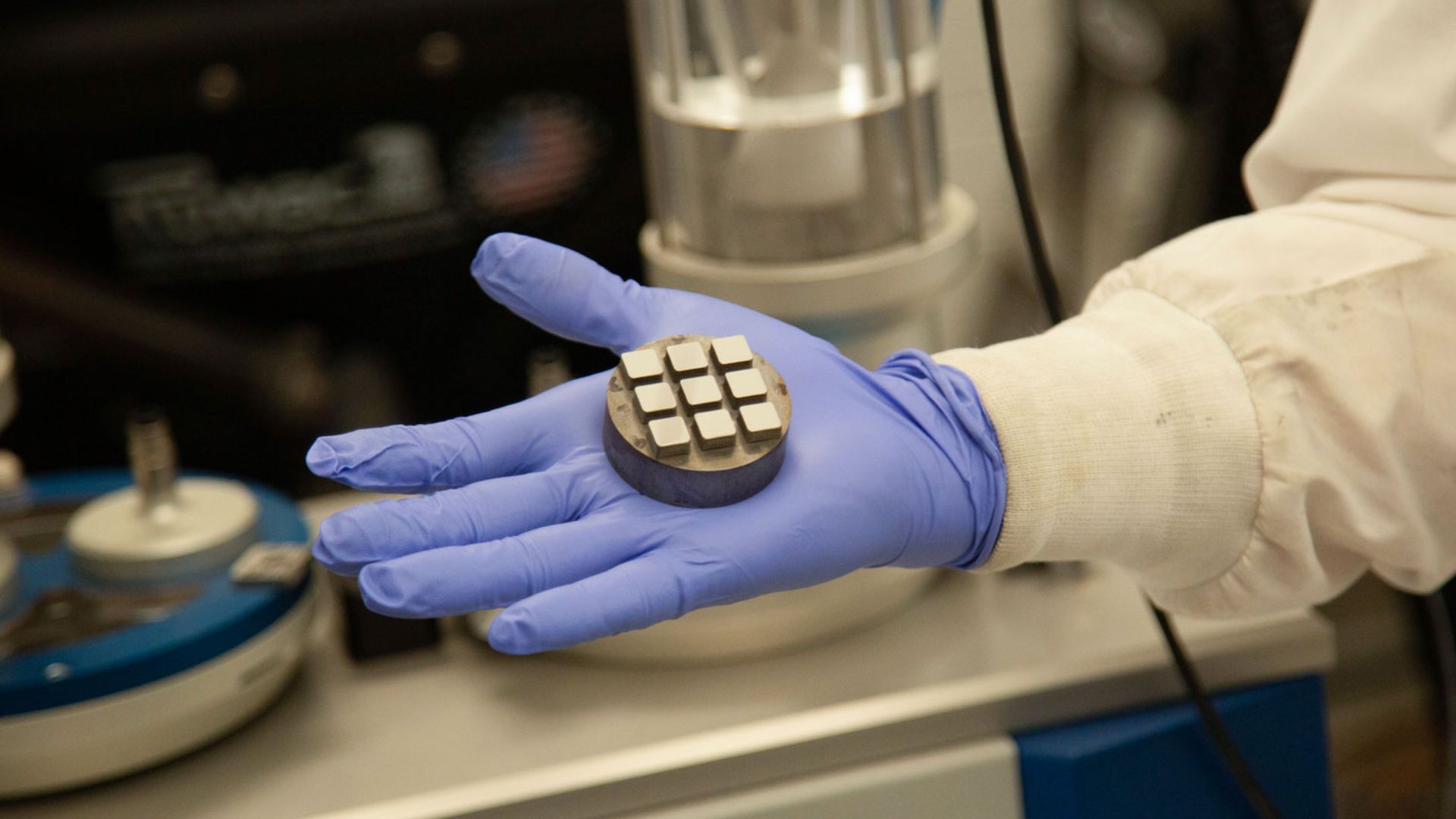
Researchers at the University of Toronto Engineering have developed six new metal alloys using an artificial intelligence-driven discovery platform that could improve the durability of parts used in jet engines, nuclear power plants, and other extreme environments. The findings show that the AI-assisted system identified promising alloys within just a few weeks, significantly speeding up the search for high-performance materials.

These new alloys also work well with 3D metal printing, enabling the production be complex parts that are hard or impossible to produce with traditional methods.

AI speeds up alloy discovery

Led by Yu Zou, Canada Research Chair in Materials and Manufacturing for Extreme Environments, the team worked with Jason Hattrick-Simpers to build a system that uses computer modeling, machine learning, and robots to help with manufacturing.

Their method, called active learning, acts like a self-driving laboratory. Rather than testing thousands of metal combinations by hand, the system picks the best options, makes them, tests how they perform, and uses those results to guide the next experiments.

“There’s enormous demand for materials that can stand up to huge swings of temperature and pressure, such as what you would find inside a jet engine or in the steam generators inside nuclear power plants, anywhere conventional steel just can’t survive,” said Yu Zou, who led the project.

“We also need materials that can be printed layer by layer, enabling us to make components that can’t be created by traditional manufacturing processes. For example, to make a material that is both lightweight and strong, you can vary the composition: a hard, tough alloy on the outside to something softer and lighter on the inside.”

The project was partly supported by the University of Toronto’s Acceleration Consortium, a group that uses AI and automation to accelerate the discovery of new materials.

Active learning cuts the need for massive datasets

Most AI systems need a large amount of experimental data to make accurate predictions. This becomes a problem when researchers look at materials that have not been tested yet.

“One problem you often run into when trying to use AI to design materials is that most machine learning models require lots of data about material properties to learn from,” revealed Ajay Talbot, a Ph.D. student in Zou’s lab and lead author of the study.

“But if you’re working in part of the design space that hasn’t been explored yet, that data doesn’t exist, so you’re kind of flying blind.”

“The way we get around that challenge is to use data-lean models that essentially feel their own way along. Our active learning model strategically selects a few samples to manufacture and test, and the data from those experiments is fed back into the model to inform where we go next. It really speeds things up.”

<a href=”https://www.youtube.com/watch?v=RFYJV7WvtOM“>https://www.youtube.com/watch?v=RFYJV7WvtOM</a>

New alloys outperform industry benchmark

To demonstrate the system, the researchers focused on compositionally complex alloys made from nickel, cobalt, and chromium. Within weeks, the automated platform identified six new alloy formulations with strong performance.

“One of the properties we were targeting was puncture resistance at temperatures of up to 1,112°F (600°C), which is what you’d find in the front section of a jet engine,” Talbot said.

“The industry standard in this space is nickel-based alloys such as Inconel 625. But we found one made of 12 percent nickel, 62 percent cobalt, and 26 percent chrome that was great for retaining hardness at extremely high temperatures. Even with just three components, our alloy outperformed Inconel 625, an alloy of more than 10 different elements, by 4.5 percent in our lab tests.”

The team also developed another alloy designed for hotter sections of jet engines, where temperatures can reach 1,832°F (1,000°C).

“One of the things that happens in an environment like that is the formation of oxide scale, which essentially means that your material is just getting burned away,” Talbot explained.

“We found a material made of 36 percent nickel, 14 percent cobalt, and 50 percent chrome that was extremely good for oxidation resistance at these high temperatures: It even outperforms Inconel 625 by 85 percent. We’re eventually aiming to ramp up to even higher temperatures, up to 2,192°F (1,200°C).”

Researchers plan to expand to more complex materials

The researchers say the current alloys represent an early demonstration of what the AI-driven discovery platform can achieve.

“This nickel-cobalt-chrome system has just three elements in it. In the grand scheme of things, it’s a relatively simple system,” he added.

“But it’s great for showing that this whole closed-loop discovery platform really works. What we want to do next is ramp up the complexity a bit more to make even crazier stuff, with maybe up to 10 or 12 different elements.”

“As you add more components, you can get different strengthening mechanisms, different kinds of useful properties. There’s a lot more out there just waiting to be discovered.”

The study was published in the journal npj Advanced Manufacturing.

  •  

New Winged Robot Can Fly and Swim Like a Puffin

Scientists hoped for years to make a machine that could emulate the movements of diving birds, such as puffins, and offer an affordable, unobtrusive way to monitor fragile marine ecosystems. A team of researchers at M.I.T. has been able to create such a waterproof winged robot, according to a study published July 9 in the journal Science.
  •  

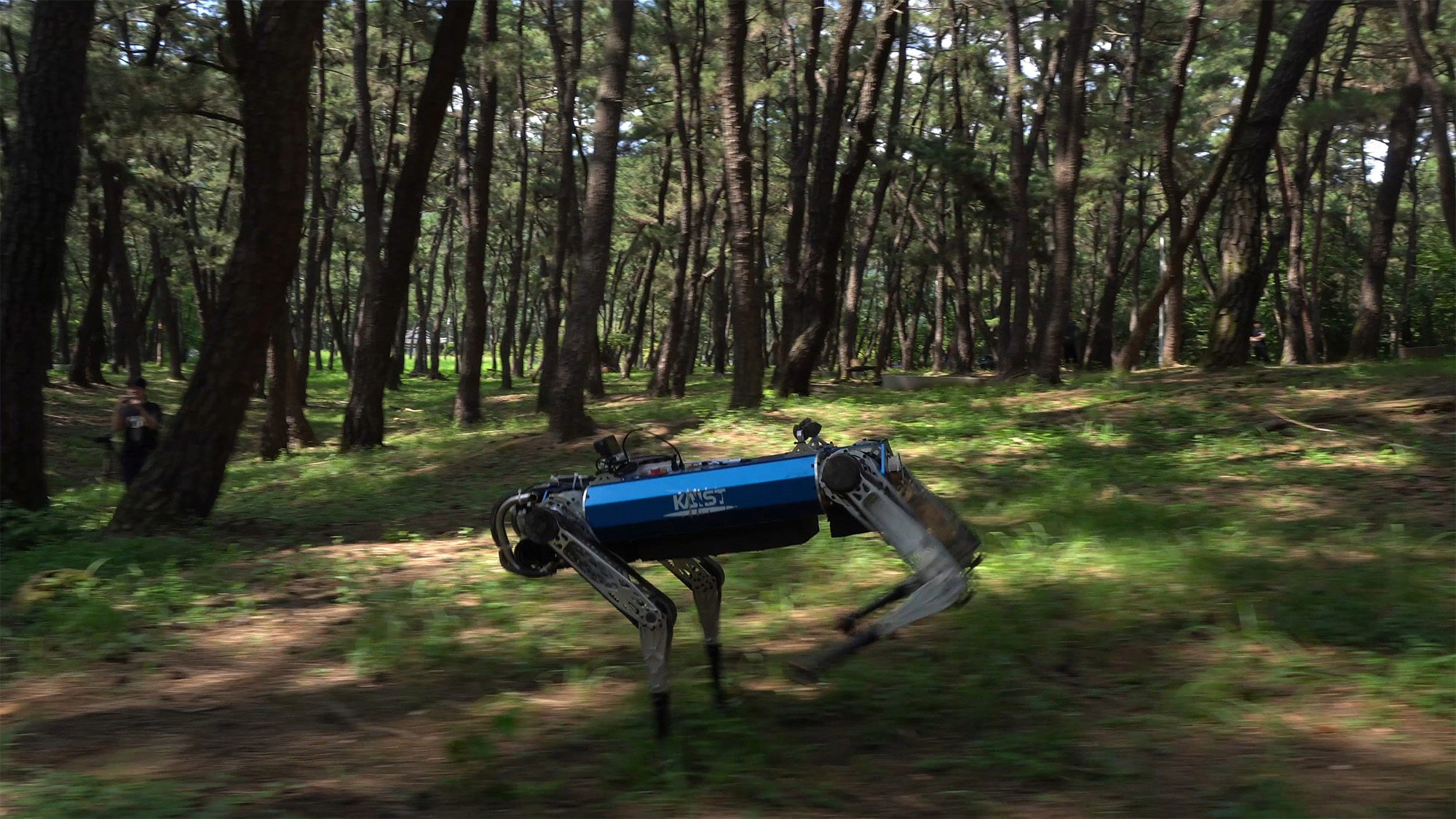
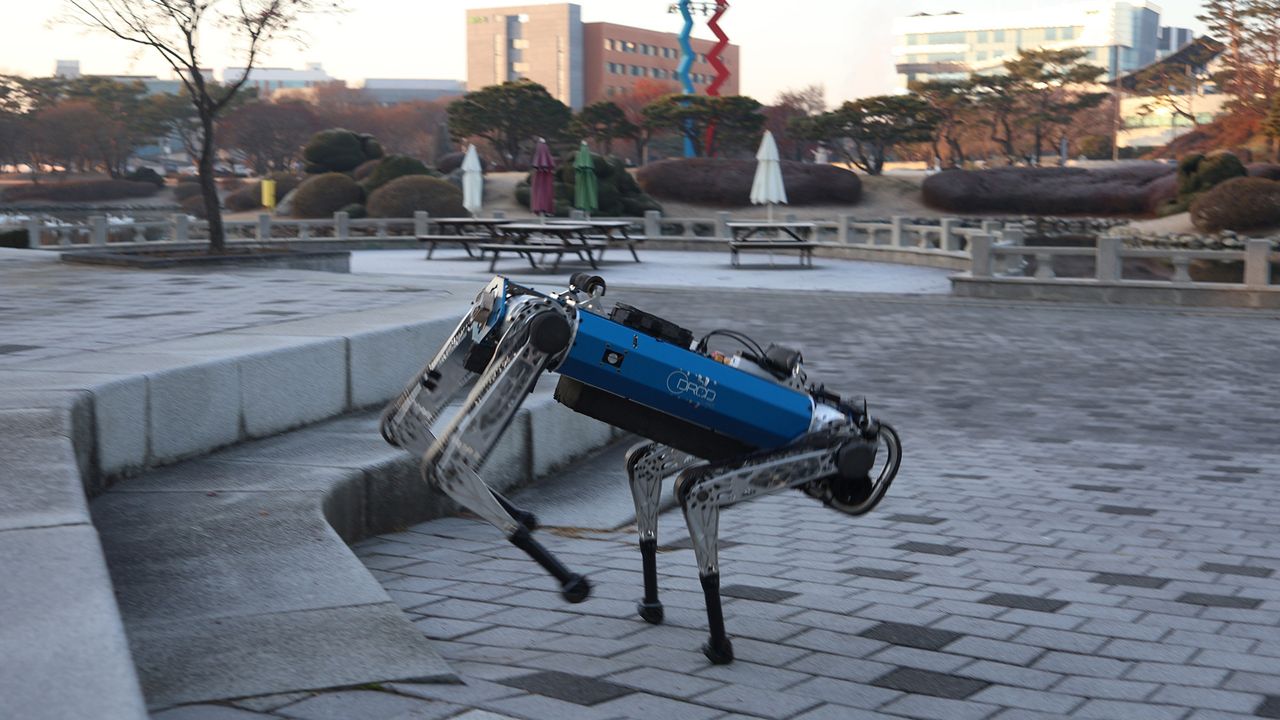
Robot dog can climb stairs, navigate a forest and bound over logs thanks to new, rapid AI training technique

A four-legged robot has learned to change the way it runs while navigating forests, staircases and obstacle courses. — seamlessly switching between a steady trot and a faster bounding gait without instructions from a human operator.

The 100-pound (45 kilograms) robot, called KAIST HOUND, uses cameras and lidar to scan the ground ahead, then selects an appropriate gait and adjusts its movements in real time. In outdoor tests, it crossed a 0.7-mile (1.1- kilometers) university campus route and a 0.2-mile (0.3 km) forest trail strewn with roots, logs and slippery leaves.

The researchers described the robotic framework on July 15 in the journal Science Robotics.

Changing gait

Animals naturally change their gait depending on their speed and surroundings. A dog might trot carefully across uneven ground, for example, before bounding over a fallen branch. Reproducing this adaptability in robots is tricky because different movements are often controlled by separate, highly specialized coding systems, and transitions between them can cause a lag that drives the robot to stumble.

To overcome this issue, researchers developed a special training framework called action pretrained transformer–based reinforcement learning (APT-RL). This is an artificial intelligence (AI) training system that first studies many examples of actions, uses a transformer to understand patterns across those actions, and then improves through rewards and penalties.

The training began with a simple, two-dimensional computer model of the robot. Using trajectory optimization — a technique that calculates physically workable movements for the robot — the team generated 180,000 short trotting and bounding sequences, including the joint forces the robot's legs need to perform. The dataset represented about 15.5 hours of movement but took only around eight minutes to produce.

During reinforcement learning — a machine learning technique where AI learns to make the best decisions by engaging with a particular environment through trial and error — an AI system then learned how to select and modify those skills while negotiating simulated stairs, stepping stones, hurdles, gaps and rough ground.

In digital simulations, the robot dog was not limited to copying its prerecorded movements. It could also make corrections for three-dimensional terrain and unexpected situations, such as jumping over a log — a behavior that wasn't included in the original, flat-ground training data.

A four-legged robot dog with a blue torso runs through a forested landscape.

The KAIST HOUND quadrupedal robot navigates a forested terrain (Image credit: Jun-Gill Kang, Jaehyun Park)

Finally, the researchers configured the system to include the robot's depth camera and lidar scanner in the simulation.

In one indoor test, HOUND bounded across an obstacle 2 feet (60 centimeters) high while briefly achieving 9.5 mph (15 km/h). It also jumped down a three-step staircase. The robot generally chose trotting at lower speeds on irregular ground, while bounding became more common at higher speeds or when it encountered larger steps, hurdles or gaps. The AI system that could select either gait performed more consistently across the different simulated environments than the version restricted to trotting or bounding alone.

The researchers suggest the technology could eventually help robots navigate disaster zones or other places inaccessible for wheeled machines. However, the current framework only allows two gait choices and mainly handles forward movement. Rapid turning, sideways motion and other behaviors like crawling remain future goals for the research team.

  •  

Icarus Robotics taps KULR to provide batteries for Space Station robots

NAPA, Calif. – Icarus Robotics, the New York startup developing dexterous mobile robots for space missions, selected KULR Technology Group to provide batteries for Joy, a free-flying platform destined for […]

The post Icarus Robotics taps KULR to provide batteries for Space Station robots appeared first on SpaceNews.

  •  

Startup Upset After Journalist Points Out How Creepy Its Humanoid Robots’s Hands Are

The VP of a humanoid robotics company was in for a surprise after finding that a Wired article pointed out something extremely unsettling about the company’s robot fingers.

Last week, Wired published a piece on Norwegian-American startup 1X and its Neo humanoid robot with an otherwise uncontroversial thesis: Though the marketing around Neo is decidedly carnal, its hands are impressive, matching and in some ways exceeding the dexterity of a human’s.

During the latter half of the article, Wired‘s Boone Ashworth noted a distinctly sensual pattern emerging in the company’s marketing materials: “smooth jazz plays in the background of a soft, warmly lit video. The robo digits curl around a wine glass, turn off a light, unzip a jacket, and gently fondle some grapes.”

“Not to kink shame, but this is a strange strategy for selling a robot that can also become a portal for human operators to peer into and interact with the things in your home,” Ashworth wrote, referring to the fact that the Neo will have remote human operators to start.

As reviews go, it’s far from the harshest critique of a robot ever written — and we should know — but 1X vice president of product and design Dar Sleeper still took Ashworth’s comments personally. Responding to the piece on X-formerly-Twitter, Sleeper lashed out at the author, using him as an example to lecture other tech journalists on what not to do.

“I gave Wired the exclusive on our hands launch, and they wrote a really weird article about how we are sexualizing robotics,” Sleeper wrote, displaying a remarkable amount of entitlement right out of the gate. “I felt pretty betrayed because that’s not what they told me they were writing about not is that what I’ve ever been about… but I’ve come to find a lot of dishonesty and malice in the journalism community so I wasn’t surprised.”

Continuing, Sleeper says he sent the following email to the Wired writer: “It was nice talking to you, but I wanted to let you know that I didn’t enjoy your article at all.”

I would like to note that I believe both Financial Times, Forbes & Bloomberg to be incredible institutions. You guys are killing it and I respect your ability to always innovate when things are changing.

— dar (@radbackwards) July 11, 2026

“I understand the need to be inflammatory because that seems to be the only thing that gets clicks these days but that doesn’t mean you shouldn’t recognize when something special is in front of you,” Sleeper carried on. “I trusted our PR team in saying we should offer you the exclusive on what is one of the most important technological developments in the history of Mankind and I deeply regret it.”

“Good luck with the rest of your writing career,” he added.

Clearly, 1X had something very different in mind with being featured in Wired, a highly reputable tech publication with decades of history. Sleeper’s comments highlight how the company was hoping to control the narrative.

If anything, the executive’s protest suggests that the “sexualization” of humanoid robots is an ongoing source of frustration for the company.

“This post makes it sound like the entire article is about the robot trying to make love to you,” tech journalist Joshua Topolsky tweeted, referring to Sleeper’s comments. “In fact, it’s roughly two paragraphs commenting on the marketing of the robot and the privacy issues of the Neo’s human control mode, where a person is remotely operating the bot, potentially inside your house and potentially in very private moments.”

“I appreciate that the founder embraces journalism and expected a certain framing, but this post kind of exaggerates a rather positive and mild take on his product into something it’s not,” Topolsky added. “If you want journalists to engage with your work, you must expect them to see things you might have missed. This seems to be one of those cases.”

More on robotics: Korean Workers Vote to Go On Strike, Fearing Robots Could Replace Them

The post Startup Upset After Journalist Points Out How Creepy Its Humanoid Robots’s Hands Are appeared first on Futurism.

  •  

MIT Engineers Unleash New ‘Aerial-Aquatic’ Robot That Can Swim Underwater and Fly Like a Bird

Engineers have developed a new robot that can swim underwater, then rise to the surface and take flight, in an aerial-aquatic feat that mimics some of nature’s most formidable fliers and swimmers.

Developed by researchers at the Massachusetts Institute of Technology (MIT) and the Swiss Federal Institute of Technology Lausanne (EPFL), the new robot’s capabilities could help launch a new generation of aerial-aquatic exploration vehicles.

Dubbed the “Flapping-Wing Aerial-Aquatic Vehicle” (FAAV), this lightweight robotic platform weighs less than 300 grams and can transition seamlessly between water and air with its very flexible flapping wings. Now, the team’s findings, published in the journal Science, could help scientists better understand how diving birds, which include puffins, petrels, loons, and gulls, are so adept at navigating two vastly different environments.

Such capabilities, the team says, could also pave the way toward advanced drones in the coming years that could transform ocean research.

Inspired by Diving Birds

Departing from conventional modern designs employed for aircraft or underwater vehicles, the team based their design on diving birds, which evolved to fly over water, then plunge beneath the waves to hunt for food, before surfacing and resuming flight.

aerial-aquatic robot
MIT’s new aerial aquatic robot seen launching from water into the air (Image Credit: Raphael Zufferey/MIT)

One problem when it comes to replicating these abilities in robots involves the density of water, which is around 1,000 times denser than air. Because of this, the engineering team had to carefully balance the flexibility of the robotic wings in their design, along with flapping frequency, tail angle, and other factors that allowed the robot to move efficiently through both environments without requiring propellers or separate propulsion systems.

Finding the Sweet Spot for Transmedium Travel

Experiments were undertaken by the team in the lab and in Switzerland’s Lake Geneva, and helped the team determine that the robot achieved best performance with medium-sized wings that flap at approximately five times per second. Under such conditions, the robot was able to swim one meter per second, then by pitching upward at a 70-degree angle, it could break through the surface, and continue this same movement to propel itself through the air.

Although the robot still has some limitations compared to the avian examples that inspired it, interestingly, it does appear to have one advantage: unlike diving birds, which paddle using their feet to achieve aquatic launches into the air, the new robot has no such requirement, and can transition from water to air relying only on its wings and adjustable tail.

Future Drones with “Aerial-Aquatic” Abilities

In the future, drones equipped with such capabilities could be leveraged to monitor marine ecosystems in a variety of ways. The team also says it could help to observe environmental concerns, such as water near glaciers or offshore infrastructure, or even collect data from hazardous locations that are either too difficult or simply too costly for ships to reach.

“Our dream vision is for oceanographers, marine biologists, and members of coastal communities to launch this robot from a boat, or from shore, and it would fly close to the area of interest, such as an iceberg or a port facility, or over a pod of whales,” according to Raphael Zufferey, assistant professor of mechanical engineering at MIT.

“It would dive into the water to take a measurement or collect a sample, and fly back to deliver the data at a fraction of the cost of traditional methods. Then it could go back out to dive for more,” Zufferey recently told MIT News.

Drawing from movements in nature influenced by evolution, the researchers hope their bird-inspired design may eventually help scientists by introducing cost-effective, but formidable new tools to help obtain information from some of the most challenging environments, all with help from robots that can do what only nature’s diving birds could once achieve.

The achievement is detailed in a new paper, “Leaping out of the water: aerial-aquatic locomotion with flapping wings,” which appeared in the journal Science.

Micah Hanks is the Editor-in-Chief and Co-Founder of The Debrief. A longtime reporter on science, defense, and technology with a focus on space and astronomy, he can be reached at micah@thedebrief.org. Follow him on X @MicahHanks, and at micahhanks.com.

  •  

This Color-Changing Material Could Give Robots a New Way to Detect Touch

Engineers at Queen Mary University of London have created a tactile sensor, described in a study published in Science Advances, that allows robots to detect touch using a simple camera.  

The sensor converts mechanical forces into visible color patterns, reducing the need for dense arrays of embedded sensors. Giacomo Sasso, a postdoctoral researcher at Queen Mary’s School of Engineering and Materials Science, led the team that developed this new sensor. Rather than relying on embedded electronic sensors, they created a soft material that changes color when pressed or bent.

This effect, known as structural color, is the same reason butterfly wings look iridescent without pigment. Pressure causes microscopic structures within the material to shift, altering how light reflects and creating a real-time visual indicator of force.

Touch Without the Computation

Most vision-based tactile sensors can map contact and force in detail, but only at the cost of heavy computation that slows them down. Simpler systems are faster, but sacrifice detail. The new material developed by Sasso’s team sidesteps this problem by building the sensing function into the material itself. With just a standard USB camera, researchers can track color changes on the surface and immediately infer pressure, strain, and contact shape without complex data reconstruction.

“You won’t guess how much information is generated when your finger presses a light switch. A human hand contains more than 10,000 mechanoreceptors to do the job, yet touch sensing remains one of the major challenges in robotics,” Sasso said. “We were happy to capture the finger ridges, as no existing technology can reproduce such sensor density at [a] comparable scale and simplicity. The key idea behind this project was to think outside the box: instead of embedding dense and overengineered sensor arrays, sensing is moved into the material itself, where mechanical cues are directly transformed into colour fields and captured using a simple low-cost USB camera.”

Professor James Busfield, one of the paper’s co-authors, described the advantage more simply: “What is particularly powerful is that the information is already in the light signal. You are no longer reconstructing touch – you are observing it directly.”

From Precision Manufacturing to the Operating Room

Reducing the computational demands of touch sensing opens up new possibilities. A robotic gripper made with this material could handle tiny parts more gently, since changes in force are immediately detectable. Prosthetic limbs equipped with similar sensors could also provide users with more detailed tactile feedback.

The researchers also see potential applications in surgery, where detecting subtle pressure differences could help clinicians interpret tissue properties.

A Decade of Groundwork Behind One Material

Professor Federico Carpi from the University of Florence and Professor James Busfield from Queen Mary worked together on this project, merging years of separate work on stretchable sensors and polymer behavior into one material system. This allowed the team to use a mechanochromic material as the sensor itself, not just as a base for electronics.

Many approaches to robotic touch have relied on increasingly complex sensor arrays, wiring, and computing systems. Rather than adding more electronics, Sasso’s team’s approach allows the material itself to encode touch into visible color. It remains unclear whether this color-based method can be scaled for use in commercial robotic hands, but this work suggests that the future of robotic touch might rely as much on smart materials as on advanced electronics.

Austin Burgess is a writer and researcher with a background in sales, marketing, and data analytics. He holds an MBA, a Bachelor of Science in Business Administration, and a data analytics certification. His work focuses on breaking scientific developments, with an emphasis on emerging biology, cognitive neuroscience, and archaeological discoveries.

  •  

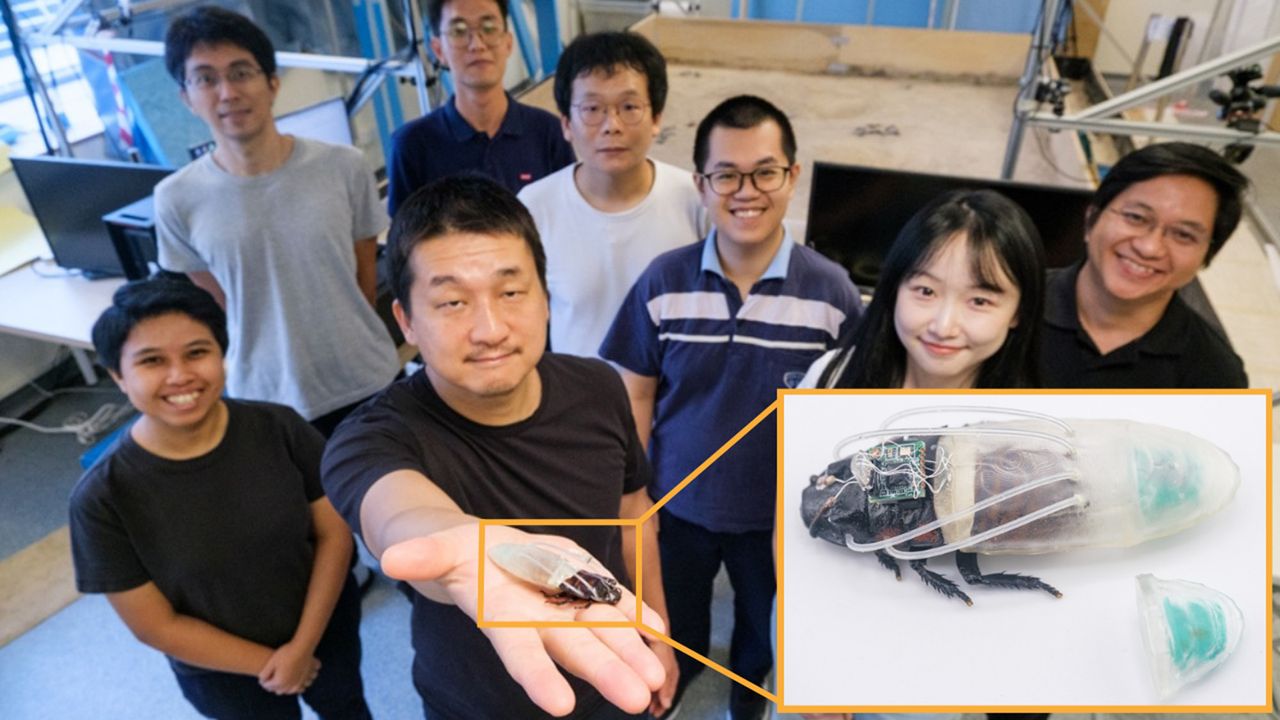
Scientists build tiny 'diving suit' for cockroaches, turning them into search-and-rescue cyborgs

Engineers have designed a waterproof "diving suit" for cyborg cockroaches that enables the hybrid insects to survive and roam underwater for up to three hours. This function expands the capabilities of cyborg insects and could one day be deployed in disaster zones, according to the team.

A built-in oxygen generator and silicone tubes deliver the gas directly to a cockroach's breathing holes, known as spiracles. The design is adapted for use in low-oxygen conditions as well as submerged environments, the researchers said in a new study published June 29 in the journal Nature Communications.

"Our approach combines a soft waterproof shell with a simple yet reliable chemical oxygen generator," study co-author Shinjiro Umezu, a professor in the School of Creative Science and Engineering at Waseda University in Japan, said in a statement. "This allows the insect to retain its natural mobility while being protected from an environment that it cannot normally survive in."

Cyborg insects are living insects that have been fitted with electronic controllers that guide their movements. Researchers have previously used them in search-and-rescue operations to access and investigate hard-to-reach areas; for example, they were used in rescue efforts after the devastating magnitude 7.7 earthquake in Myanmar in March 2025 that killed at least 3,700 people and injured 4,800 more. The advantage of cyborg insects over tiny robots is that the former employ insects' muscles to move, whereas the latter rely on high-power batteries that consume energy and can run out of steam.

The cyborg insects deployed in Myanmar were developed in the laboratory of Hirotaka Sato, senior author of the new study and a professor in the School of Mechanical and Aerospace Engineering at Singapore's Nanyang Technological University.

Sato has spent more than a decade pioneering cyborg insect technology. He and colleagues hope the new diving suit will extend cyborg insects' operational range to include flooded and partially submerged areas in disaster zones.

The suit consists of a flexible shell, four silicone tubes that attach to the spiracles and a transparent, 3D-printed oxygen tank. To make the tank produce oxygen, the researchers sprinkled manganese dioxide onto a highly absorbent sponge inside the tank. They then injected a small amount of diluted hydrogen peroxide, which breaks down slowly in the presence of manganese dioxide to produce oxygen. Finally, the team sealed the tank with ultraviolet adhesive to prevent leaks.

"The key engineering challenge was to build a system that was small, light and flexible enough for the insect to wear, while still producing enough oxygen for long-duration underwater movement," Umezu said.

The silicone tubes send oxygen straight into the thoracic spiracles, while the abdominal spiracles, which are lower down the insects' bodies, take in the oxygen contained in the suit.

"Our new insect diving suit works like the oxygen tank used by human divers," Sato said in the statement. The silicone tubes can be attached and removed without pain or harm to the insect, the researchers added.

The researchers tested the suit on a cyborg Madagascar hissing cockroach (Gromphadorhina portentosa), which they placed in a water tank and later sent into a plastic tube that simulated submerged and low-oxygen environments.

The suit enabled the cockroaches to roam underwater for up to three hours, raising the prospect that cyborg insects, including locusts and beetles, could one day be used to inspect flooded pipes, drains, tunnels and other hard-to-access places.

Next steps include improving the diving suit to potentially include sensors and a navigation system; and testing the design in simulated disaster environments, according to the statement.

  •  

Scientists Create Bio-Inspired Robots to Hack the Hovering Powers of This Exceptional Species to Build Better UAVs

An innovative new approach to building safer, more efficient small unmanned aerial vehicles is taking a cue from nature.

Anticipating worsening turbulence due to environmental concerns in the coming years, engineers studying the unmatched hovering ability of kestrels hope to reverse engineer the secrets of their exceptional flight capabilities to help assemble better future drones.

Smaller drones, known as sUAVs, have a range of different applications that include delivery services, photography, and more. However, wind conditions can often cause turbulence that either grounds them temporarily or, when caught off guard, can lead to their destruction.

Now, a team of researchers has published their findings in the Journal of the Royal Society Interface, which details an ongoing collaboration between RMIT University and the University of Bristol that seeks to overcome such issues by building drones that operate more like some of nature’s best flyers.

Specifically, the nankeen kestrel is an avian species whose amazing prowess while flying during adverse conditions still confounds researchers. To unravel the secrets of their flight, the researchers used motion capture technologies made possible in RMIT’s special Industrial Wind Tunnel facility, one of the largest such facilities anywhere on the Australian continent.

“Birds don’t rely on a single response to wind gusts,” according to RMIT researcher Matt Penn. “They constantly adjust their wings and tails to stay balanced, while the natural flexibility of their feathers and joints helps absorb sudden changes in airflow.”

“They can also sense disruptions very quickly, which allows them to respond almost instantly and maintain control,” added Penn, one of the team members who co-led the studies into how birds can cope with turbulence.

According to Penn and his colleagues, these birds possess a range of unique strategies that help them overcome the dangers of turbulence, which help them navigate under conditions that would cause most sUAVs to come tumbling from the sky.

To attempt to understand what makes kestrels such adept fliers, the team created a robotic replica to mimic some of their key flight movements and characteristics, which allowed the team to unravel some of the secrets to how these incredible birds perform.

“By creating a robot replica, we were able to measure how specific movements were contributing to steadiness in flight,” said Dr Mario Martinez Groves-Raines, a researcher now with the Royal Veterinary College in London, adding that precision measurements of kestrel flight that normally could not be achieved in nature were possible using the team’s robotic version.

“We uncovered several unique techniques behind the kestrel’s impressive stability,” Groves-Raines said. “Many of these techniques have the potential to improve [the] manoeuvrability of small aircraft, which encounter similar challenges to kestrels.”

“This research shows what’s possible when engineers look to nature for solutions,” added RMIT senior researcher Associate Professor Abdulghani Mohamed.

“Our findings open new pathways for designing aircraft that can better handle turbulence.”

Going forward, the researchers say they hope to apply their findings toward the construction of novel sUAVs, which can help future drones operate safely and more efficiently, much like their agile avian forebears.

Ultimately, similar engineering in the coming years may have applications that extend well beyond just drone flight, and could also help to ensure safe operations for much larger aircraft.

The team reported their findings in a pair of new studies, ‘Bridging the Gap: A Review of Gust Mitigation in Birds and Small UAVs’, and ‘Stability and control benefits of coupled wing and tail morphing in kestrel wind-hovering flight explored using a robot replica’, both of which were published in the Journal of The Royal Society Interface.

Micah Hanks is the Editor-in-Chief and Co-Founder of The Debrief. A longtime reporter on science, defense, and technology with a focus on space and astronomy, he can be reached at micah@thedebrief.org. Follow him on X @MicahHanks, and at micahhanks.com.

  •  

Friendly social robots may help ease a child's anxiety at the doctor's office

When 3-year-old Cameron arrived at the UC Davis MIND Institute for a recent medical appointment, she was in for a surprise: cuddly, social AI robots visiting from Japan were in the waiting room. "We both melted when we saw them," said Cameron's mom, Caroline Nguyen. "They're so adorable, and the little sounds they make—I mean, she took to them right away."

  •  

Chinese humanoids take on penalty challenge as Messi, Ronaldo light up FIFA World Cup

As the World Cup fever grows around stars like Messi and Ronaldo, Shanghai hosts a unique penalty shootout featuring humanoid robots.

At MWC Shanghai 2026, humanoid robots are stepping up to the spot in the Humanoid Robot Football Penalties Challenge, testing the limits of robotics,
AI, machine vision, and real-time motion control.

According to Chinese media outlets, the event showcases how embodied AI performs under pressure, highlighting next-generation autonomous technology through football-inspired challenges.

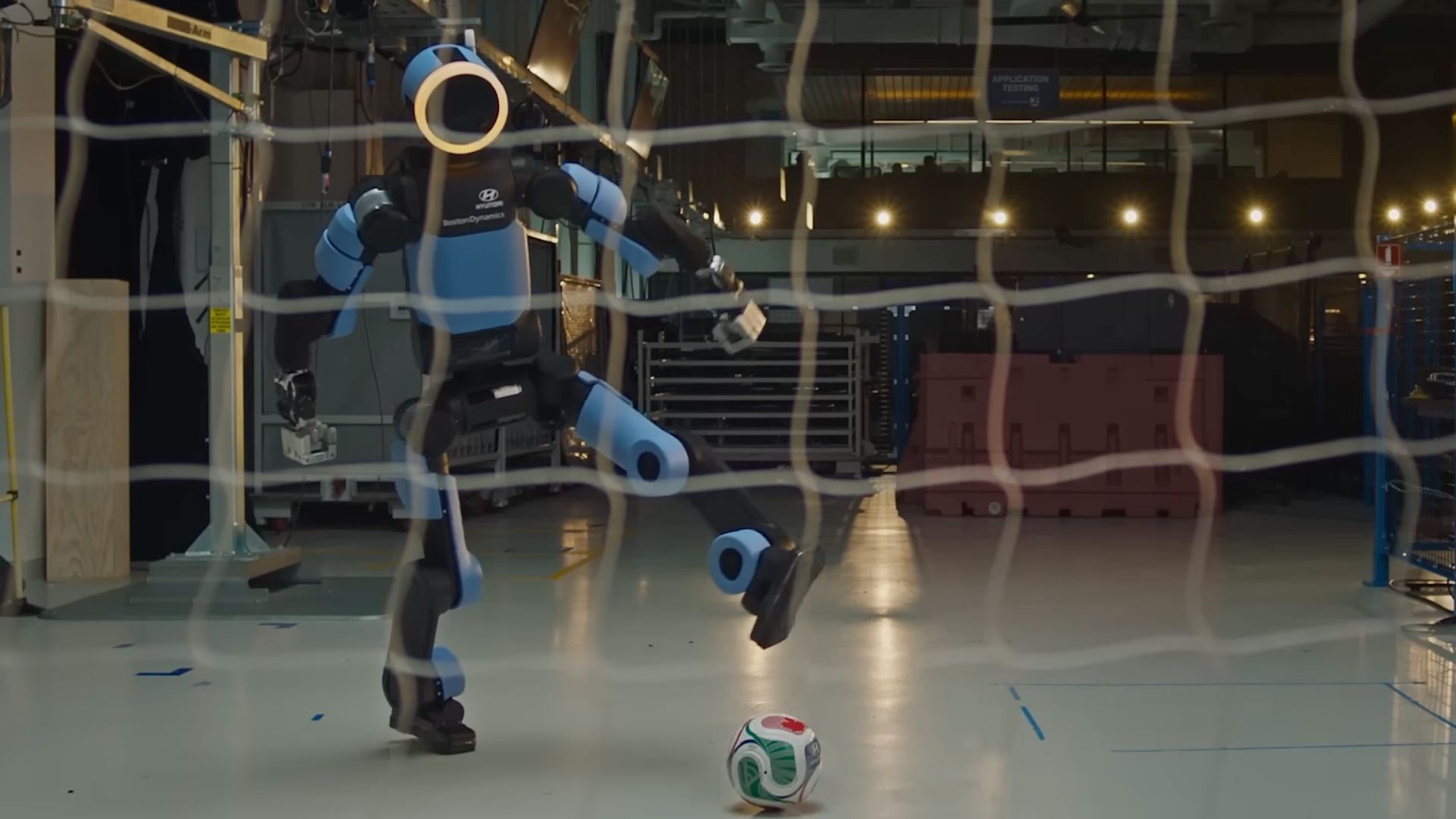
Ahead of the 2026 FIFA World Cup, Hyundai Motor recently launched a football-themed campaign featuring Boston Dynamics’ Atlas humanoid robot.

Humanoid football test

On its opening day at MWC Shanghai 2026 on June 24, the spotlight quickly shifted from keynote speeches to a live demonstration of embodied AI in action: the Humanoid Robot Football Penalties Challenge.

Held within the Mobile AI Innovation Frontiers Zone at the Shanghai New International Expo Centre, the event is designed as a controlled stress test for real-time autonomous decision-making, where humanoid robots must read the goal, judge angles, and execute penalty kicks without pre-programmed sequences, external control, or resets, reported CGTN.

While official details of the participating humanoid robots remain limited, videos circulating online suggest models from Booster Robotics and Unitree Robotics taking part in the challenge.

In the penalties challenge itself, participating humanoids are evaluated on perception accuracy, balance control, motion planning, and adaptive response under game-like pressure. Each robot must independently interpret ball position and goalkeeper movement before committing to a strike, making split-second corrections based on sensor feedback.

The format escalates through semi-finals and a final scheduled for June 25, intensifying constraints to simulate high-pressure competitive conditions. By turning a universally understood sports moment—the penalty kick—into a robotics benchmark, the showcase highlights how far embodied AI has progressed toward coordinated, human-like physical intelligence in unpredictable environments.

Atlas soccer showcase

In a recent football demonstration by Boston Dynamics, an Atlas robot is shown standing before a large display screen, closely tracking player movements, body positioning, and in-game reactions across football footage. After each clip ends, Atlas moves into a practice zone where it immediately attempts to reproduce the actions it has just observed, effectively linking visual perception with physical execution in real time.

The footage highlights a series of football-inspired motions. In one sequence, the robot shifts its weight, swings a leg forward, and smoothly guides a ball across the floor with controlled contact. It then progresses through rapid training drills focused on balance, coordination, and timing. As the session continues, Atlas’s movements appear increasingly fluid, suggesting the system is being evaluated not only for strength but also for agility, reflex response, and adaptive motor control.

Some of the most notable moments show Atlas imitating human emotional reactions. After completing a drill, it raises its arms in celebration, mirroring a footballer’s goal celebration. In another instance, it drops to one knee and pauses, recreating an injury response seen in match footage it had just observed.

Hyundai Motor Company, parent of Boston Dynamics, described the demonstration as Atlas’s first exposure to football under its “School of Football” initiative. The company has also indicated potential plans to showcase Atlas and the quadruped robot Spot at the FIFA World Cup, though their exact roles remain undisclosed.

💾

Humanoid robots participate in a penalty shootout at MWC Shanghai 2026, testing embodied AI, vision and real-time control under pressure.
  •  

China’s new robot dog tackles -22°F cold, crosses river and rugged terrain in demo

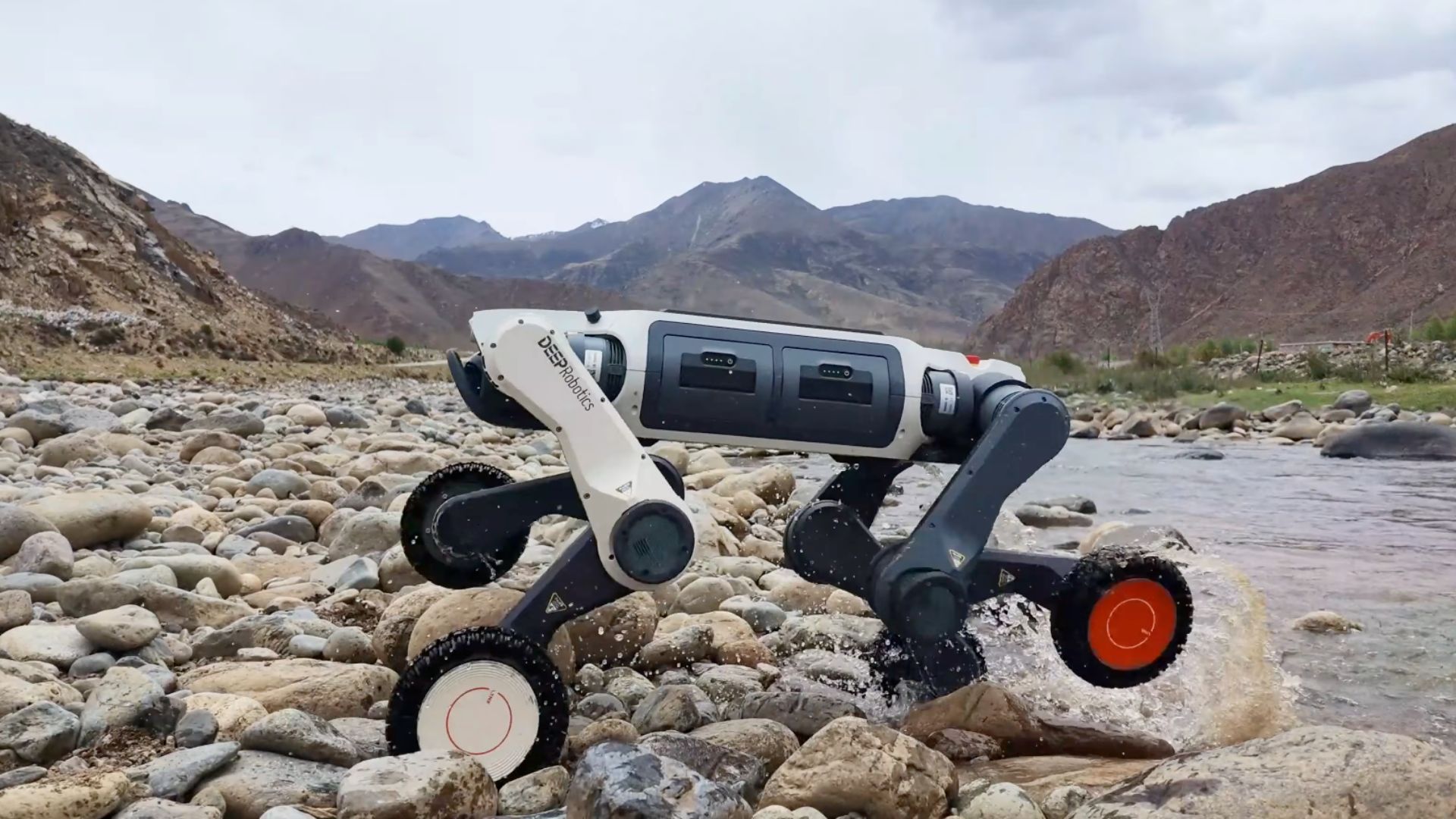
DEEP Robotics has demonstrated its new wheeled-legged robot in action, designed to handle challenging industrial operations across complex terrain.

M20S introduces significant improvements over M20 in payload capacity, mobility, durability, and endurance, positioning it as a new benchmark for industry-grade wheeled-legged robots.

Built for all-terrain performance, the Lynx M20S is designed to support a wide range of inspection, logistics, and field operations where reliability and adaptability are critical.

Recently, Deep Robotics unveiled new footage of its DR02 humanoid traversing rough terrain, climbing stairs, and carrying equipment, which is built for industrial and hazardous-environment operations.

Mastering rough terrain

LYNX M20 is a wheeled-legged robot designed for industrial operations in challenging terrain and hazardous environments. The company describes it as the world’s first wheeled-legged robot built specifically for demanding field applications, including power inspection, emergency response, logistics, and scientific exploration.

In this newly released demonstration video, DEEP showcases the capabilities of its Lynx M20S wheeled-legged robot in some of the world’s most demanding environments. The footage follows the robot traversing rugged mountain terrain, crossing icy rivers up to 31.5 inches (80 centimeters) deep, and operating in temperatures as low as -22°F (-30°C).

The Lynx M20S is also shown climbing steep 45-degree slopes and navigating rocky, uneven landscapes that would challenge conventional mobile robots. At elevations reaching nearly 17,000 feet (5,177 meters), the robot maintains stability and mobility while carrying out its mission in harsh outdoor conditions. The video highlights the platform’s combination of wheeled speed and legged agility, enabling it to tackle obstacles, extreme weather, and difficult terrain.

According to DEEP, the Lynx M20S, designed for industrial inspections, emergency response, and field operations, demonstrates how advanced robotic mobility can extend autonomous operations into environments that are often inaccessible or hazardous for human workers.

Next-gen field robot

M20S, weighing 77 pounds (35 kilograms), combines the speed of wheeled mobility with the adaptability of legged locomotion. It can navigate narrow spaces with as little as 50 cm of clearance, climb stairs up to 25 cm high, overcome obstacles up to 80 cm high, and handle slopes up to 45 degrees. The platform is designed to operate across rugged mountain trails, muddy wetlands, tunnels, pipelines, and disaster-stricken areas.

The M20 can carry a payload of 33 pounds (15 kilograms) and support a maximum load of 110 pounds (50 kilograms). It offers up to three hours of operation or 9 miles (15 kilometers) of travel on a single charge when unloaded, while carrying a 33-pound (15-kilogram) payload reduces endurance to 2.5 hours and 7.4 miles (12 kilometers). The robot can reach a laboratory-tested top speed of 5 m/s and an operating speed of 2 m/s.

For perception and navigation, the robot is equipped with dual 96-line LiDAR sensors providing a 360-degree by 90-degree field of view, along with wide-angle cameras and omnidirectional obstacle avoidance capabilities. Built for harsh environments, the platform carries an IP66 protection rating and can operate in temperatures ranging from -4°F (-20°C) to 131°F (55°C). Additional features include hot-swappable batteries, bidirectional lighting, OTA updates, and modular expansion options.

To improve operational endurance, DEEP increased the Lynx M20S’s single-charge runtime by 17 percent to 67 percent and added dual hot-swappable batteries. The upgrades help offset the high power demands of wheeled-legged locomotion and support longer, uninterrupted missions.

💾

DEEP Robotics demostrates Lynx M20S, an all-terrain wheeled-legged robot built for demanding industrial and field operations.
  •  

A Plastic Motor Just Defied a Century of Engineering Assumptions

Electricity Sparks Outside Concept ArtElectrostatic forces enable low-voltage actuation without relying on rare earth materials. Nearly every electric motor in modern life, from the fan on your desk to the motor in an electric vehicle, relies on magnetism. For more than a century, magnetic fields have dominated motor design because electrostatic forces were considered too weak for practical machines. [...]
  •  

Robots will replace 700K delivery workers, warns head of e-commerce giant

China’s e-commerce giant JD.com is preparing for a future where packages are delivered by robots instead of people. The company’s founder and chairman, Richard Liu, expects robots will “sooner or later” take over deliveries from the company’s roughly 700,000 couriers.

“It will definitely be robots delivering packages. But I really don’t want our 700,000 brothers to go without food and without jobs,” Liu said at the Asia-Pacific Economic Cooperation CEO Forum, according to the Financial Times.

He did not provide a more specific timeframe for the change. As part of the transition, Liu said JD.com has entered into agreements with about 120 schools to retrain couriers for new professions, including the repair and maintenance of robots.

The number of gig workers in China — including delivery drivers, chauffeurs, and factory workers on temporary contracts — is expected to reach about 320 million this year, according to Chinese researchers. At the same time, the youth unemployment rate stands at over 16%.

  •  

SIGINT: New RF platform achieves 85% real-time signal accuracy under one watt

Australia-based technology company BrainChip has launched a new hardware platform designed to classify radio frequency (RF) signals in real time while operating on less than a watt of power, targeting defense and intelligence applications that require processing at the edge.

Called the Akida Communication Reference Platform, the system is built around the company’s Akida AKD1500 neuromorphic processor and is intended for defense contractors, government agencies, software-defined radio vendors and edge AI developers.

The platform performs RF signal classification directly on-device, eliminating the need for cloud connectivity or large computing hardware. BrainChip said the system is designed for environments where power availability, thermal constraints and size limitations make conventional GPU- or FPGA-based solutions difficult to deploy.

Potential applications include handheld signal intelligence systems, unmanned aerial vehicles, satellite communications terminals and other portable defense technologies.

AI tackles RF threats

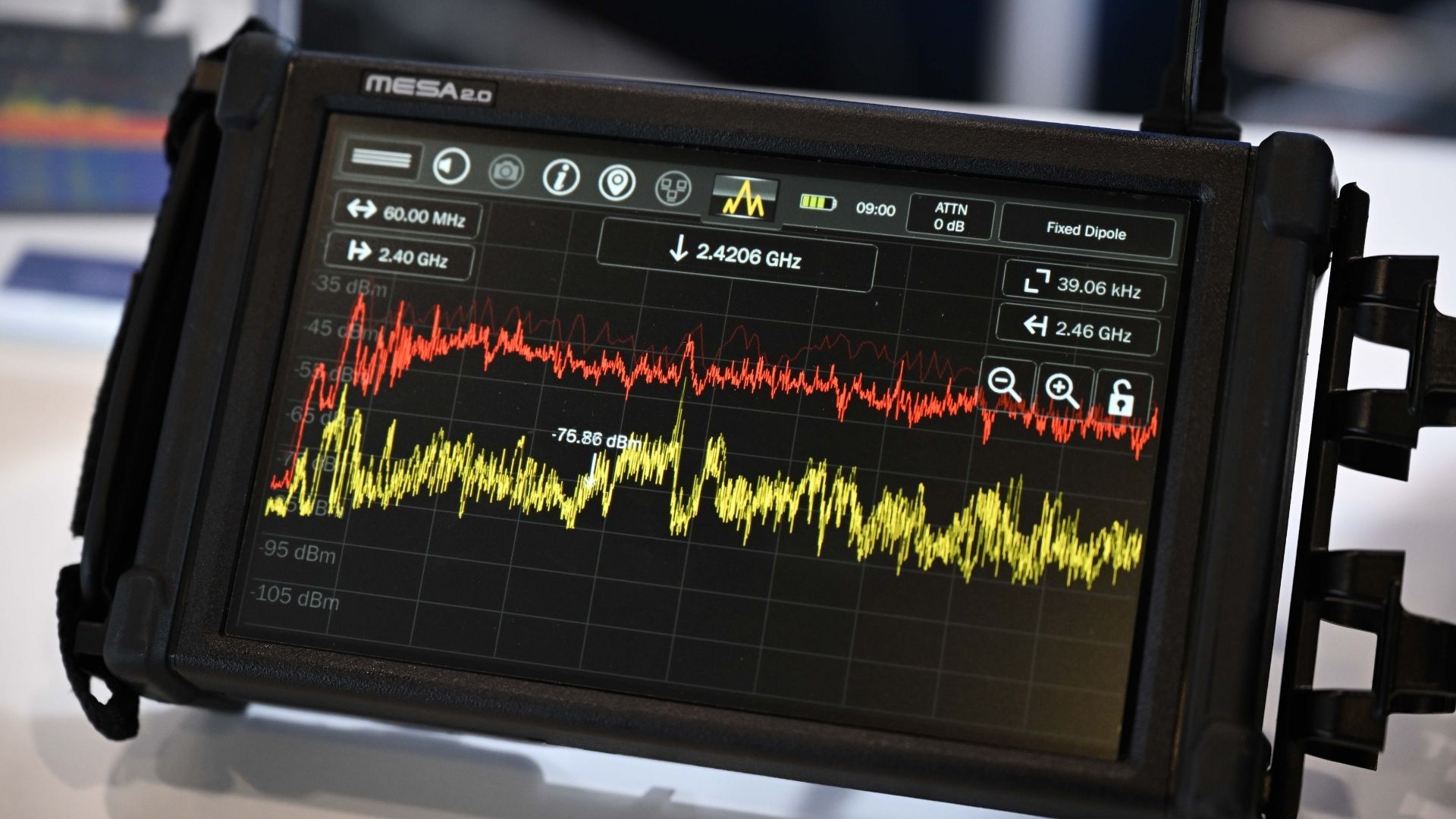
According to BrainChip, the platform can identify more than 20 signal modulation types in real time while maintaining greater than 85% accuracy at a signal-to-noise ratio of 30 decibels.

Traditional digital signal processing systems typically rely on rule-based approaches that can struggle to identify new or intentionally modified signals. BrainChip says its neuromorphic AI approach allows the system to capture unknown waveforms and use them for future model retraining, enabling adaptation to emerging wireless threats.

The company argues that this flexibility addresses a key limitation of existing RF classification systems, which often require significant computational resources and can be difficult to update for changing operational conditions.

The platform is also designed to support battery-powered deployments where continuous operation is required without access to external infrastructure.

“BrainChip’s Akida Communication Reference Platform proves that real-time signal intelligence can be condensed into a portable battery powered solution to extend the range of deployment options,” said Sean Hehir, BrainChip’s CEO.

Built for edge deployment

The platform is available for evaluation and partner integration as a reference design kit. It supports integration with software-defined radio front ends such as the USRP B205mini and EPIQ Sidekiq.

A host system, including devices like the Raspberry Pi 5, can be used to manage data flow and application development. BrainChip said engineering teams can use the platform to prototype intelligence, surveillance and reconnaissance capabilities, as well as broader signal intelligence applications.

The launch expands the company’s portfolio of edge AI reference platforms beyond radar and sensor-fusion systems. BrainChip says the new offering demonstrates how neuromorphic computing can be applied to RF processing workloads that traditionally require larger and more power-hungry hardware.

The release comes as defense agencies and communications providers increasingly explore AI-powered spectrum monitoring tools capable of operating in remote and contested environments. By reducing power consumption and hardware requirements, such systems could enable RF awareness capabilities in smaller platforms that previously lacked sufficient computing resources.

As military and commercial users continue pushing AI capabilities closer to sensors and data sources, low-power processors capable of running advanced inference at the edge are becoming increasingly important for real-time decision-making in disconnected environments.

  •  
❌