❌

Reading view

ARK Augmented Reality Could Build Apple’s Knowledge Layer

ARK augmented reality describes a form of spatial interaction in which artificial intelligence does more than place digital objects in the physical world. It uses knowledge from foundation models to understand unfamiliar scenes, generate useful information and adapt its response to the person, task and environment.

The concept comes from a 2023 research paper titled “ArK: Augmented Reality with Knowledge Interactive Emergent Ability.” Its authors proposed a system that transfers knowledge from large foundation models into new physical and virtual environments. Instead of training an AI agent separately for every room, object or activity, ArK uses existing knowledge memory to interpret what it sees and generate appropriate 2D or 3D content.

Traditional augmented reality places information over reality. ARK augmented reality tries to understand reality before deciding what should appear.

That distinction creates a compelling direction for Apple. Vision Pro already blends digital content with physical space. Apple Intelligence adds language, image understanding and personal context. Visual Intelligence lets users look at objects, text and scenes before asking for information. Siri AI adds a conversational layer. ARKit, RealityKit and visionOS provide the spatial foundation.

Apple now has many of the components required to build a knowledge layer over the physical world.

ARK Augmented Reality Goes Beyond Digital Overlays

Most familiar augmented reality experiences are relatively fixed. A furniture app places a digital sofa in a room. A navigation app displays arrows over a street. A museum app identifies an artwork. A repair app shows where a component belongs.

These experiences can be useful, but they usually depend on predefined content and rules. The system recognizes a known object or location, then presents prepared information.

ARK augmented reality proposes something more adaptive. A knowledge-enabled system could enter an unfamiliar environment, interpret what is present and generate assistance based on a broader understanding of objects, relationships and possible actions.

A user looking at a complicated electrical panel would not only see labels. The system could identify the panel type, explain the purpose of each section, compare the arrangement with standard configurations and warn the user not to touch dangerous components.

A student examining a machine could ask how it works and receive a spatial explanation attached to its real parts. A surgeon could review anatomical information positioned around a medical model. A technician could receive repair guidance even when the exact equipment had not been included in a previous training dataset.

The display becomes less like a floating screen and more like an informed interpretation of the environment.
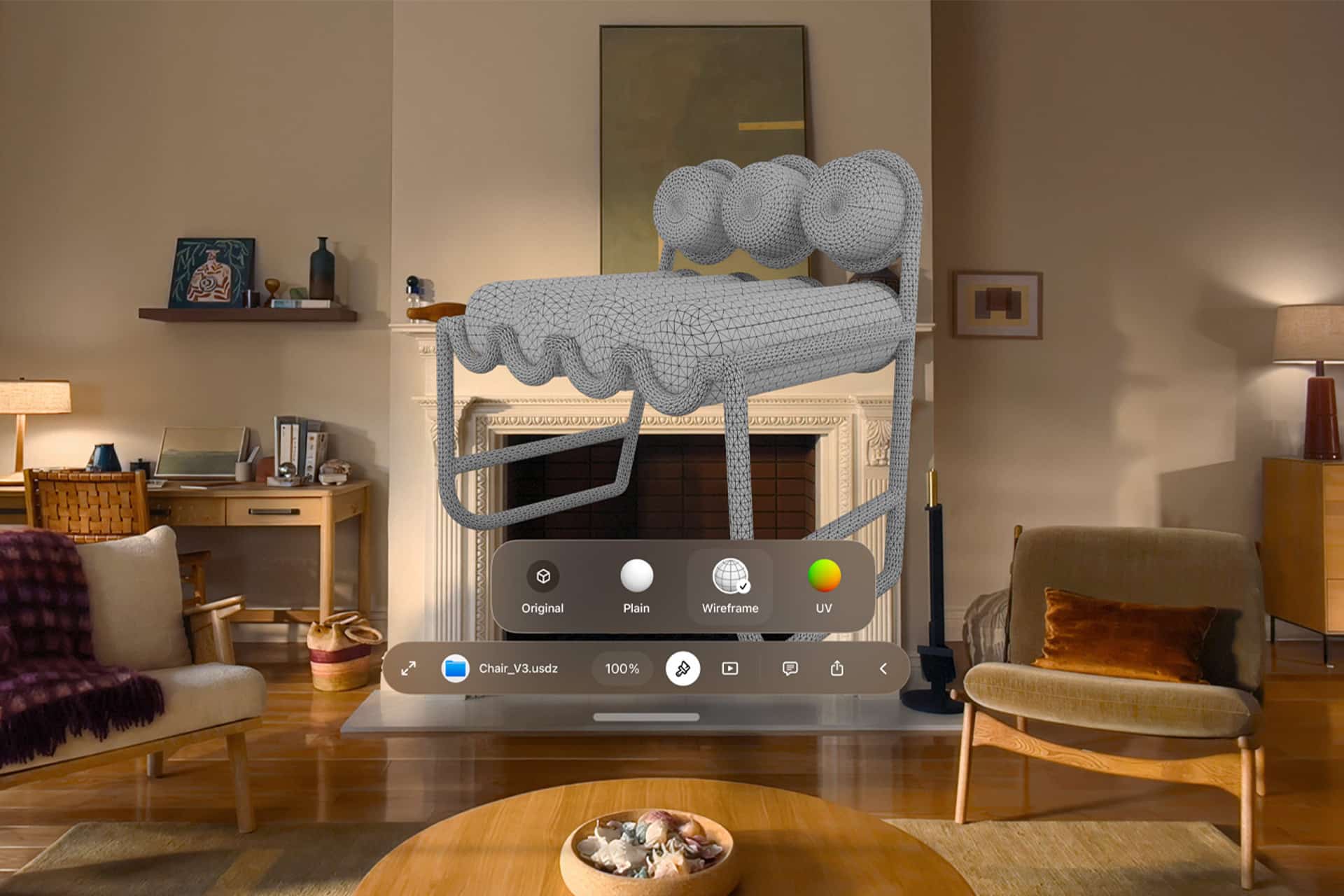
A cozy living room with a digital interface on Apple Vision Pro displaying a 3D wireframe chair design, superimposed in front of a fireplace and surrounded by modern furniture and warm lighting.
Image Credit: Apple Inc.

Why Apple Is Positioned to Build It

Apple’s advantage would not come from inventing every part of ARK augmented reality. It would come from combining hardware, software, artificial intelligence and personal context into one controlled ecosystem.

Vision Pro already understands rooms, surfaces, hands, eyes and objects well enough to place digital content convincingly in physical space. Its cameras and sensors continuously map the environment while visionOS manages windows, volumes and immersive experiences.

Apple Intelligence provides another layer. Foundation models can interpret language, summarize information, generate content and connect requests with app actions. Visual Intelligence can identify text, images and real-world objects. Siri AI can act as the conversational interface.

The Apple ecosystem also provides personal context that a generic AR platform may not have. Calendar knows the user’s schedule. Maps understands location. Photos contains visual history. Notes and Mail hold project information. Health contains personal trends. Home understands rooms, accessories and automations.

An Apple-built knowledge layer could combine the environment in front of the user with the information already available across trusted devices and apps.

A person preparing for a meeting could look at a conference room and see the agenda, participant names and relevant documents arranged around the table. A traveler could look across a train station and receive directions connected to the correct platform, departure time and digital ticket. A homeowner could examine a room and see live information from temperature, air-quality and energy sensors.

The physical environment becomes the interface.

Vision Pro Is the Laboratory

Vision Pro is the obvious development platform for this idea because it already offers the cameras, displays, sensors and processing required for advanced spatial understanding. Its size and price limit broad adoption, but those same characteristics allow Apple and developers to test experiences that would be harder to build first on lightweight glasses.

ARK augmented reality on Vision Pro could become especially useful in enterprise environments. Apple already promotes the headset for employee training, product design, field service, collaboration and specialized visualization.

A worker could enter an unfamiliar facility and receive contextual instructions attached to real equipment. An engineer could inspect a physical prototype while design changes, performance data and maintenance history appear around it. A new employee could learn a workflow through spatial guidance generated from company manuals and operational knowledge.

The system would not need to display every available fact. It would need to understand which information fits the current task.

That is where AI knowledge becomes more valuable than a traditional AR overlay. Too much information can be as disruptive as too little. A strong system should filter, prioritize and explain rather than cover the room with floating labels.

ARK augmented reality - A modern living room with visionOS virtual reality overlays displays an online store page for a red stool, alongside a 3D modeling preview of the stool positioned on the floor near a fireplace and sleek, modern chair.

The iPhone Could Bring ARK to More People

Vision Pro may be the development environment, but iPhone could provide the scale. The iPhone already combines cameras, LiDAR on Pro models, location, motion sensing, Visual Intelligence and Apple Intelligence.

An iPhone-based ARK experience would be less continuous because users would need to hold up the device. It could still deliver useful knowledge interaction without requiring a headset.

A user could point the camera at a plant and receive care guidance based on its species, visible condition, local weather and placement in the room. Someone assembling furniture could receive generated guidance positioned over the actual parts. A shopper could compare products by looking at them rather than manually searching for each model.

The difference from ordinary visual search would be interaction. The user could ask follow-up questions, change the goal and let the system update the visual guidance.

Future glasses could eventually make the experience persistent. The iPhone would help Apple develop the intelligence, privacy controls and app ecosystem before lightweight eyewear becomes ready.

A World That Explains Itself

The most ambitious version of ARK augmented reality is a world in which information is attached to objects, places and situations only when requested or needed.

A city could become understandable without searching through maps, review sites and separate transit apps. Buildings could reveal history. Streets could explain temporary closures. Restaurants could surface reservations, dietary options and accessibility details. Public transport could show the correct entrance and platform.

Inside a home, Apple’s knowledge layer could explain energy use, identify maintenance problems and guide repairs. In a classroom, physical models could become interactive lessons. In healthcare, patients could receive visual instructions for approved home procedures or medication devices.

The experience would depend on context rather than menus. The user looks, asks and receives information positioned where it belongs.

This is the transition from augmented reality as decoration to augmented reality as understanding.

Privacy Will Decide Whether It Works

A knowledge layer capable of understanding the physical world also creates serious privacy questions. The system may see homes, workplaces, documents, faces, screens and private conversations. The more context it receives, the more useful it becomes. The same access can also make it invasive.

Apple’s privacy architecture could become one of its strongest advantages. On-device processing would allow some scene understanding without sending continuous camera feeds to external servers. Private Cloud Compute could handle more complex requests while preserving stricter controls than an ordinary cloud AI service.

Apple would also need visible controls over what is analyzed, remembered and shared. A user should know when the system is interpreting the environment and whether information is temporary or retained. Workplaces and public spaces would need rules for recording, identification and sensitive data.

ARK augmented reality cannot become socially acceptable if people feel that nearby devices are constantly cataloging them.

The successful version would behave less like surveillance and more like intentional assistance. The user asks for understanding. The system processes only what is needed. The knowledge disappears when the task ends unless the user chooses to save it.
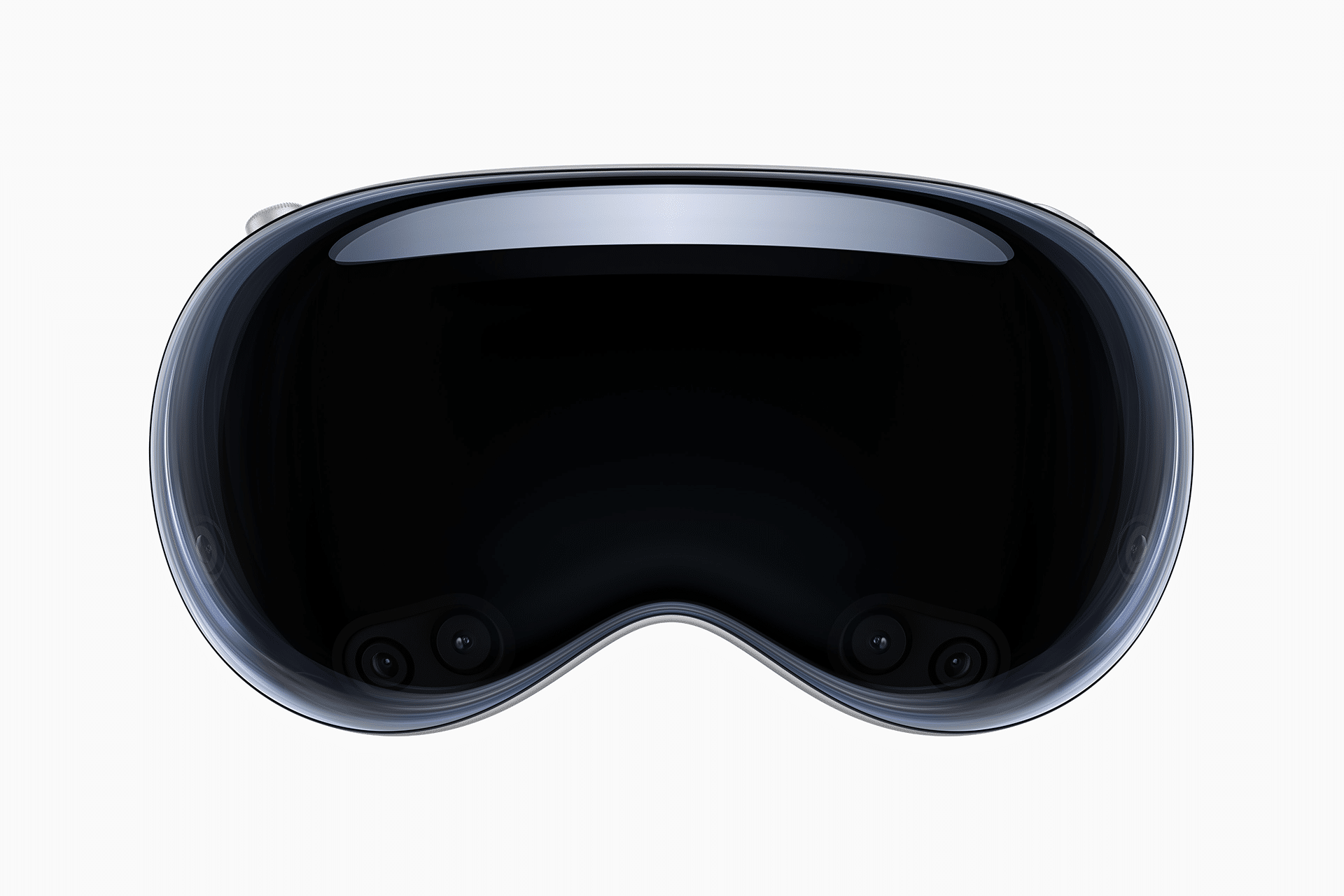
A sleek, black, futuristic virtual reality headset with a smooth, curved design and reflective surface—perfect for exploring the latest Betas—viewed from the front against a white background.
Image Credit: Apple Inc.

Developers Could Build Knowledge Worlds

Apple would not need to create every knowledge experience itself. visionOS, ARKit, RealityKit and App Intents could let developers connect specialized knowledge with physical environments.

A medical company could build guidance for approved equipment. A manufacturer could create spatial maintenance systems. A university could attach interactive explanations to laboratories and museums. A retailer could create product comparisons based on inventory and customer preferences.

Apple could provide the shared intelligence layer: scene understanding, object recognition, language interaction, privacy permissions and spatial presentation. Developers would provide the trusted domain knowledge.

This division would be essential. General AI can explain many things, but professional environments require verified information. A generated answer about a historical building has different consequences from an answer about industrial machinery or medical treatment.

Apple’s platform could distinguish between general knowledge and certified domain sources, allowing users to see where information comes from before acting.

From Spatial Computing to Contextual Computing

Apple describes Vision Pro as a spatial computer because digital content can occupy physical space. ARK augmented reality suggests the next progression: contextual computing.

A spatial computer knows where digital content is placed. A contextual computer understands why the content is useful in that location, what the user is trying to accomplish and which knowledge should appear.

That would connect several Apple strategies that currently look separate. Vision Pro supplies spatial awareness. Apple Intelligence supplies reasoning and generation. Siri AI supplies conversation. Visual Intelligence supplies real-world understanding. The ecosystem supplies personal context.

Together, they could create a system that does not wait for users to open the correct app and search through the correct menu. The environment itself becomes the starting point.

Apple’s opportunity is to make that interaction restrained rather than overwhelming. The company does not need to cover reality with digital noise. It can use design, privacy and contextual intelligence to make information appear only when it improves the moment.

ARK augmented reality offers a useful description of that future. Reality remains visible. Knowledge becomes interactive. The computer begins to understand the world in front of the user instead of asking the user to translate everything into a search box.

The post ARK Augmented Reality Could Build Apple’s Knowledge Layer appeared first on AppleMagazine.

  •  

Safari’s New MCP Server Is Great for Agents

Saron Yitbarek, writing on the WebKit blog:

In Safari Technology Preview 247, we’re introducing the Safari MCP server — a Model Context Protocol server for web developers that makes your web development and debugging workflow faster and more powerful. We know agents are increasingly integral to the coding process and the Safari MCP server gives your agent the ability to know how your code actually renders in the browser by connecting it to a Safari browser window.

Any MCP-compatible client can connect to the Safari MCP server. By connecting your agent to a Safari browser window, your agent can emulate what your users experience, giving it the information it needs to debug more autonomously, like access to the DOM, network requests, screenshots, and console output.

Importantly:

The Safari MCP server runs entirely on your local machine and makes no network calls of its own. It also does not have access to your personal information in Safari (e.g. AutoFill or other browser activity). When it captures page content, screenshots, or console logs, that data goes directly to the agent you’re running — not to Apple. What happens to that data from there depends on the agent and model you’re using. As with any agent you give access to your browser, only use ones you trust.

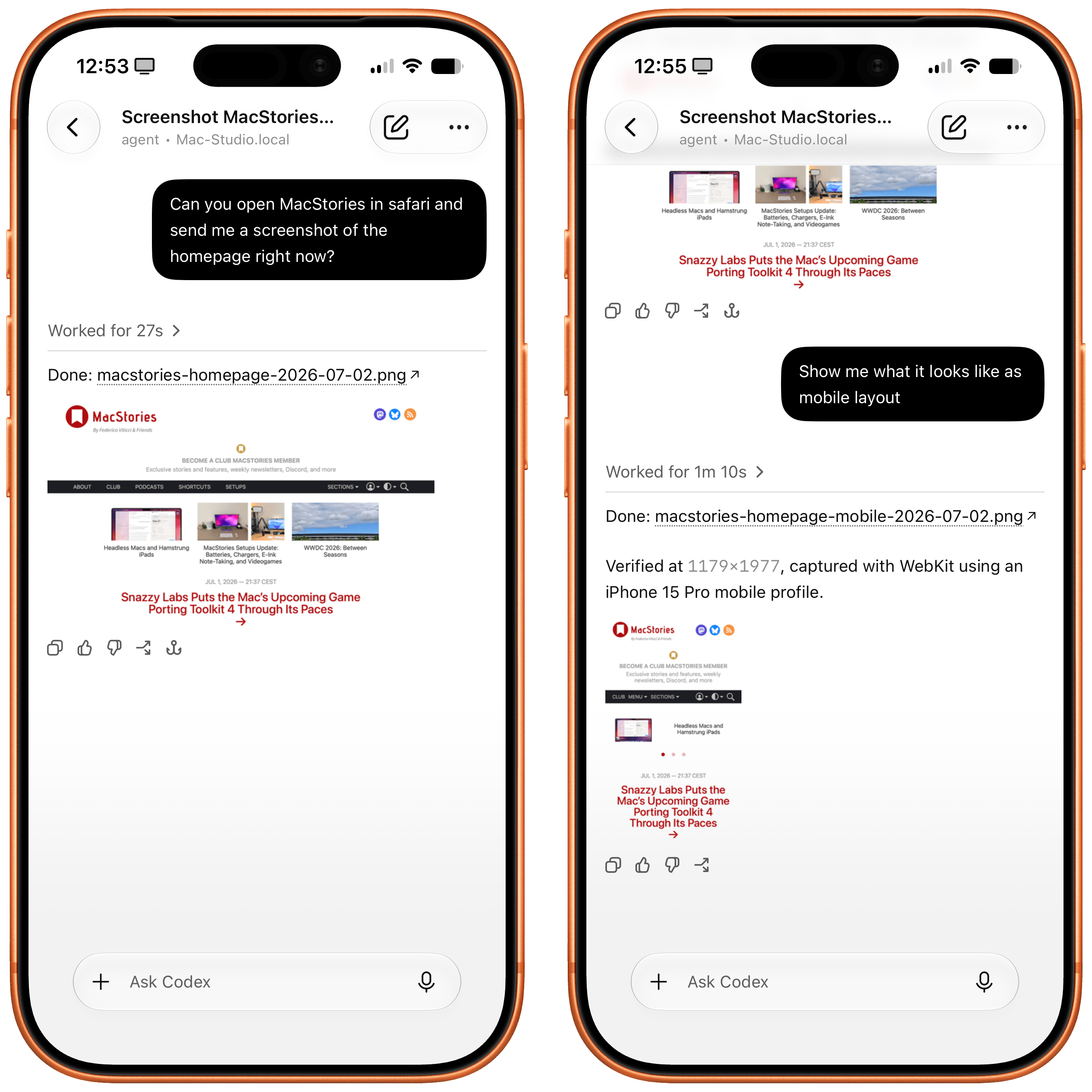
For the past few months, I’ve been using Google Chrome on my MacBook Pro and Mac Studio not because I like the browser (in fact, I really dislike Chrome’s text rendering and UI), but simply because it was the best option for agents. In Codex specifically, between Playwright, Chrome Dev Tools, and OpenAI’s own Chrome extension, I could kick off research tasks (such as vacation planning and booking a hotel) that involved a browser directly from my iPhone, letting Codex drive the research on my remote Mac.

Safari in Codex.

Safari in Codex.

Now, thanks to Safari’s new MCP server, I no longer have to use Chrome on desktop and can return to a unified browser setup across all my devices. Even better: it actually looks like Apple shipped the most ergonomic browser MCP for agents to date. The MCP server has dedicated tools for page extraction (including getting webpages as Markdown, based on WebKit’s own conversion pipeline), evaluating JavaScript, DOM interactions (clicking, scrolling, resizing the viewport for mobile screens, etc.), taking screenshots, and more. I set this up immediately in Codex, and I also asked Codex about comparing Safari’s MCP to its own Chrome extension and the older Playwright. The verdict: although Chrome has a richer API with Chrome Dev Tools when it comes to network requests, Codex actually preferred Apple’s leaner, more direct approach for letting an agent drive and debug a browser.

I’m really happy to see folks at Apple embrace agentic tools: between the new MCP capabilities of Xcode and now this, it looks like Apple’s software (on the Mac, of course) is becoming more and more approachable by people who are working in new ways thanks to agents. Whether you’re a web developer or tinkerer, I highly recommend checking out what Apple has released in Safari Technology Preview. More of this, please.

  •  

Move over, GPS: Navigation satellites in low-Earth orbit are making a comeback

New navigation satellites in low-Earth orbit could provide 100 times stronger signal strength compared to GPS and other global navigation satellite systems operating from higher orbital altitudes—enabling greater location accuracy within dense cities, under thick foliage, and even inside buildings. Such signals would also likely prove more resilient to interference at a time when commercial flights, maritime shipping, and even various smartphone apps face increasingly widespread disruption from GPS jamming.

That vision may start to take shape when the first six production satellites of California-based Xona Space Systems are scheduled to launch in October 2026, with early service starting in 2027. Once the full constellation of 258 Pulsar satellites has been launched in the following years, Xona claims that customers will be able to accurately pinpoint their locations anywhere on Earth to within several centimeters.

“That added power means that we can get into that indoor environment that GPS can't get to today,” Adrien Perkins, co-founder and VP of engineering at Xona Space Systems, told Ars. “Our higher power allows you to get into those jamming environments a lot further than you would with GPS by itself.”

Read full article

Comments

© Xona Space Systems

  •  

Sheetz is quitting VMware, migrating 11,000 virtual machines

Sheetz, a US convenience store chain, is moving its 838 locations off VMware.

Sheetz has used VMware virtualization across two Dell R440/R450-series servers at each of its locations since 2019. Now it’s migrating 12 to 14 virtual machines (VMs) in each of its stores from VMware vSphere to StorMagic’s SvHCI, “with an additional two VMs to be replaced over the coming months to transition from Windows 10 to Windows 11,” Scott Robertson, infrastructure team manager at Sheetz, told Ars Technica via email. Ultimately, Sheetz will move about 11,000 VMs from Broadcom's virtualization platform. Sheetz is still running the original Dell server hardware.

So far, Sheetz has finished migrating more than 600 stores, averaging 200 per month, according to a company announcement today. Sheetz should be finished with the migration in four months, the announcement said.

Read full article

Comments

© Sheetz

  •  

Windows 0-day drops the same day Microsoft releases record number of patches

Right on the heels of Microsoft releasing a record number of security patches, a researcher has published exploit code that can enable low-privilege Windows accounts to make sensitive changes to administrator accounts.

The exploit, which multiple researchers say works, is sending Microsoft scrambling, yet again, to patch a zero-day released by an anonymous researcher who has complained about the software maker’s handling of their bug reports. To date, the pseudonymous NightmareEclypse has published nine such exploits, including Tuesday’s HiveLegacy. The researcher said the proof-of-concept code included in the report was stripped down to prevent attackers from using it maliciously.

A “pretty powerful primitive”

HiveLegacy is an elevation-of-privilege exploit that targets a vulnerability residing in the Windows User Profile Service. It allows users (and with more work likely processes) with limited system rights to compromise an admin user's account by modifying its classes registry hive, a resource that ensures the correct application opens when certain types of files are clicked on in Windows Explorer.

Read full article

Comments

© Getty Images

  •  

FCC to repeal 39% TV ownership cap in boost for Trump-friendly news orgs

The Federal Communications Commission will vote to repeal the National Television Ownership Rule that is supposed to prevent a single broadcast station owner from reaching more than 39 percent of all TV households in the US. The proposed change sets up a likely court battle over the FCC claim that it has authority to repeal a limit set by Congress.

FCC Chairman Brendan Carr has already treated the rule as more of a suggestion. In March, the Carr FCC granted a waiver allowing Nexstar Media Group to buy Tegna in a deal that let it reach over half of TV households. The Carr FCC argued that Congress gave it authority to modify or waive the rule.

Carr now plans to repeal the 39 percent limit and replace it with a "case-by-case review" of each proposed merger, the chairman announced today in an op-ed published on Breitbart. The change would make it easier for the FCC to pick and choose which station groups get to surpass the limit. Under Carr, this would likely benefit news companies that provide favorable coverage for President Trump.

Read full article

Comments

© Getty Images | Heather Diehl

  •  

Microsoft’s Secure Boot has been broken for a decade and no one noticed until now

An industry-wide standard Microsoft invented to protect Windows, and later Linux, devices from firmware infections has been trivial to bypass for 13 of its 14 years of existence. The discovery was made by researchers at security firm ESET after identifying 11 firmware images, at least one from 2013, that were known to be defective but remained signed by the software company anyway.

The images are known as shims, which were invented to extend Secure Boot to Linux devices and utility software. Using a technique simple enough to be performed by novice hackers, these old, forgotten shims can be used to completely circumvent the protection, which is embedded into the UEFI (Unified Extensible Firmware Interface) of the device's motherboard. The gaffe is the result of the failure by Microsoft, which oversees the signing of shims, to revoke the publicly available images once vulnerabilities were found in them.

Threat extends to Windows and Linux users

The threat extends to Windows and Linux users alike, since the shim can be installed on devices running both operating systems. From there, an attacker can subvert the mandated chain of digitally signed firmware to install malicious firmware that loads early in the boot process and persists after either the OS is reinstalled or a hard drive is replaced.

Read full article

Comments

© Getty Images

  •  

The US government warns that Russia state hackers are coming after your router

The federal government is warning users of home and small office routers to secure their devices as Russia state hackers continue to mass-compromise them for use in obscuring nefarious actions against sensitive organizations in the public and private sectors.

Both the Russian and Chinese governments have been compromising routers for years, sometimes in prolonged tugs-of-war to wrest control of devices the other has already commandeered. The US government has occasionally issued covert commands and taken other steps to disinfect routers. Google and other companies have also worked to disrupt the massive botnets that control compromised routers in lockstep. The actions to date are little more than whack-a-mole exercises as the operators simply replace their botnets with new ones.

Proxy networks: The go-to tool

“Russian Federal Security Service (FSB) Center 16 cyber actors continue to exploit poorly configured and vulnerable networking devices worldwide, opportunistically compromising multiple critical infrastructure sector networks,” the Cybersecurity and Infrastructure Security Agency said Monday. The hacking groups are tracked under various names, including Berserk Bear, Energetic Bear, Crouching Yeti, Dragonfly, Ghost Blizzard, and Static Tundra. The advisory was co-issued by governments from around the world, including Australia, Denmark, New Zealand, and the UK.

Read full article

Comments

© Getty Images | BernardaSv

  •  

Now, defenders are embracing the prompt injection, too

Prompt injections, the malicious commands attackers embed into content to entice large language models to follow them, have been attackers’ go-to tool for turning AI platforms against their users. A well-phrased command sneaked into an email or calendar invitation is often all it takes to cause the LLM to exfiltrate sensitive data or follow other harmful actions.

Now, defenders are embracing the prompt injection, too.

A strong, sharp effect

Researchers from Tracebit on Monday said they found that placing prompt injections alongside passwords, cryptographic keys, and other secrets stored on Amazon Web Services was often all that was needed to shut down attacks from AI hacking agents. The prompts direct the attacking LLM to perform an action forbidden by its guardrails, the safety barriers AI developers erect to prevent it from taking harmful actions. The LLM responds by shutting down.

Read full article

Comments

© Getty Images

  •  

MIT Engineers Unleash New ‘Aerial-Aquatic’ Robot That Can Swim Underwater and Fly Like a Bird

Engineers have developed a new robot that can swim underwater, then rise to the surface and take flight, in an aerial-aquatic feat that mimics some of nature’s most formidable fliers and swimmers.

Developed by researchers at the Massachusetts Institute of Technology (MIT) and the Swiss Federal Institute of Technology Lausanne (EPFL), the new robot’s capabilities could help launch a new generation of aerial-aquatic exploration vehicles.

Dubbed the “Flapping-Wing Aerial-Aquatic Vehicle” (FAAV), this lightweight robotic platform weighs less than 300 grams and can transition seamlessly between water and air with its very flexible flapping wings. Now, the team’s findings, published in the journal Science, could help scientists better understand how diving birds, which include puffins, petrels, loons, and gulls, are so adept at navigating two vastly different environments.

Such capabilities, the team says, could also pave the way toward advanced drones in the coming years that could transform ocean research.

Inspired by Diving Birds

Departing from conventional modern designs employed for aircraft or underwater vehicles, the team based their design on diving birds, which evolved to fly over water, then plunge beneath the waves to hunt for food, before surfacing and resuming flight.

aerial-aquatic robot
MIT’s new aerial aquatic robot seen launching from water into the air (Image Credit: Raphael Zufferey/MIT)

One problem when it comes to replicating these abilities in robots involves the density of water, which is around 1,000 times denser than air. Because of this, the engineering team had to carefully balance the flexibility of the robotic wings in their design, along with flapping frequency, tail angle, and other factors that allowed the robot to move efficiently through both environments without requiring propellers or separate propulsion systems.

Finding the Sweet Spot for Transmedium Travel

Experiments were undertaken by the team in the lab and in Switzerland’s Lake Geneva, and helped the team determine that the robot achieved best performance with medium-sized wings that flap at approximately five times per second. Under such conditions, the robot was able to swim one meter per second, then by pitching upward at a 70-degree angle, it could break through the surface, and continue this same movement to propel itself through the air.

Although the robot still has some limitations compared to the avian examples that inspired it, interestingly, it does appear to have one advantage: unlike diving birds, which paddle using their feet to achieve aquatic launches into the air, the new robot has no such requirement, and can transition from water to air relying only on its wings and adjustable tail.

Future Drones with “Aerial-Aquatic” Abilities

In the future, drones equipped with such capabilities could be leveraged to monitor marine ecosystems in a variety of ways. The team also says it could help to observe environmental concerns, such as water near glaciers or offshore infrastructure, or even collect data from hazardous locations that are either too difficult or simply too costly for ships to reach.

“Our dream vision is for oceanographers, marine biologists, and members of coastal communities to launch this robot from a boat, or from shore, and it would fly close to the area of interest, such as an iceberg or a port facility, or over a pod of whales,” according to Raphael Zufferey, assistant professor of mechanical engineering at MIT.

“It would dive into the water to take a measurement or collect a sample, and fly back to deliver the data at a fraction of the cost of traditional methods. Then it could go back out to dive for more,” Zufferey recently told MIT News.

Drawing from movements in nature influenced by evolution, the researchers hope their bird-inspired design may eventually help scientists by introducing cost-effective, but formidable new tools to help obtain information from some of the most challenging environments, all with help from robots that can do what only nature’s diving birds could once achieve.

The achievement is detailed in a new paper, “Leaping out of the water: aerial-aquatic locomotion with flapping wings,” which appeared in the journal Science.

Micah Hanks is the Editor-in-Chief and Co-Founder of The Debrief. A longtime reporter on science, defense, and technology with a focus on space and astronomy, he can be reached at micah@thedebrief.org. Follow him on X @MicahHanks, and at micahhanks.com.

  •  

Patch for Windows Defender 0-day could allow attackers to fill hard disk

A patch Microsoft released on Wednesday to fix a zero-day vulnerability in its Defender security engine may cause Windows machines to write files large enough to completely consume available disk space, the researcher who discovered the flaw said.

RoguePlanet, tracked as CVE-2026-50656, came to public notice in June when NightmareEclipse, the pseudonymous name used by a researcher, disclosed it along with code for exploiting it. The vulnerability allows remote attackers to gain administrative control of Windows 10 and Windows 11 machines, even when real-time protection has been disabled. Over the past few months, the anonymous researcher has published a handful of other zero-days that have sent Microsoft scrambling to develop patches.

Writing files of unlimited size

Microsoft said Wednesday that it patched RoguePlanet with an update to the Microsoft Malware Protection Engine, which is used by the Defender antivirus app. The fix will automatically be downloaded and installed without users having to take any action. Wednesday’s update also includes “defense-in-depth updates to help improve security-related features.”

Read full article

Comments

© Photo Illustration by Igor Golovniov/SOPA Images/LightRocket via Getty Images

  •  

Allstate accuses Broadcom of auditing it because it quit VMware, CA

Allstate Insurance Company has accused Broadcom of haphazardly issuing audits against it because the insurance firm decided not to renew its contracts with VMware and CA Technologies.

The allegations were made in relation to a lawsuit that VMware filed against Allstate in December 2025, according to The Register. In the complaint, Broadcom alleges that Allstate failed to comply with license audits, which Broadcom claims its contract with Allstate requires.

In a June 12 filing, Allstate suggested that Broadcom issued the audits in response to Allstate deciding to end business with its companies. Allstate's statement reads:

Read full article

Comments

© Samuel Boivin/NurPhoto via Getty Images

  •  

“A Potential Minefield” in Earth’s Orbit Has Scientists Sounding the Alarm Over Hidden Objects Threatening Critical Satellites

For many years, scientists have been tracking even the tiniest fragments of space debris orbiting our planet to keep tabs on whether these small leftovers from decades of spaceflight might become a problem, whether for astronauts or for populations here on Earth.

Now, in new research, scientists say they have uncovered dozens of previously undetected fragments of space debris orbiting high above Earth, revealing a hidden population of tiny objects that some liken to a “potential minefield” in space that could pose a growing hazard to some of the world’s most important satellites.

The findings, published in the Journal of the Astronautical Sciences, were carried out by an international team led by researchers at the University of Warwick, who found 25 faint objects in geosynchronous orbit—roughly 36,000 kilometers (22,400 miles) above Earth’s equator.

Close to 80 percent of these newly detected objects had been absent from catalogs available to the public that track such debris, meaning that there could be even more unrecognized leftovers from past space missions circling the Earth than experts realize.

A Problem in Geosynchronous Orbit

Home to a steadily growing number of satellites that we rely on daily for activities here on Earth, geosynchronous orbit is where satellites that govern communication systems, television broadcasting, weather forecasting, and environmental monitoring all reside.

Objects at this altitude remain synchronized with our planet’s rotation, which means that they inhabit what is considered some of the most valuable real estate in space around the Earth.

“Pieces of space junk can be moving very quickly relative to one another, as much as several kilometers every second,” says Dr. James Blake of the University of Warwick’s Centre for Space Domain Awareness, who served as the new study’s lead author. “The energies involved are really high, and even small debris can cause a lot of damage to very expensive satellites, so small things really matter.”

Archival Imagery Reveals New Concerns

Blake and his colleagues didn’t have to collect new observations to make these discoveries: they were able to discover evidence of undocumented orbital debris simply by looking at archival images obtained by the 2.54-meter Isaac Newton Telescope in the Canary Islands.

Offering a new perspective on these archival photos, the team employed a new image processing technique known as “blind stacking,” along with advanced image-processing algorithms, to detect fragments in orbit as small as five centimeters. The detections were significant, as they are now counted among the faintest examples of debris ever observed in geosynchronous orbit.

Naturally, a question arises: how many more examples of tiny debris might be lurking up there?

Tiny Tumbling Troublemakers in Space

Additional analysis of the brightness of these objects revealed another concerning reality: based on variances in the light they reflect, it was evident that many of these objects are tumbling as they make their way through space.

The team’s findings offer a wakeup call in terms of just how much undetected debris may be drifting—or even tumbling—through geosynchronous orbit. However, there is also a positive side to the situation: the team’s discoveries also showcase our growing ability to make such detections if we know how to look for such minuscule objects.

Still, the findings underscore the challenges presented by monitoring orbital debris in a space above the Earth where such materials could potentially linger for centuries, since atmospheric drag in this region of orbit is essentially nonexistent.

“The debris in the neighborhood of the geostationary belt is a potential minefield,” said co-author Dr. Stuart Eves of SJE Space Ltd. “No one in their right mind would enter a terrestrial minefield without a mine detector. Similarly, no one in their right mind should launch a satellite to GEO without an adequate debris survey.”

A Call for International Collaboration

With the project’s reach beyond Europe to include collaboration with researchers in Australia and Japan, the team says that international cooperation will be necessary to track potentially dangerous orbital debris—especially as more and more satellites are being placed in orbit above the Earth.

Increasingly sensitive surveys will be essential for understanding and mitigating the risks posed by even the smallest fragments of space junk, the team says.

“There are a finite number of orbital slots in the GEO belt,” Blake adds, “so it’s important that we know how much debris is out there, how it behaves, what risks are posed to the active satellites we rely on. Surveys for faint debris help us build a clearer picture.”

The team’s findings were detailed in a new study, “DebrisWatch II: Digging Deeper for Geosynchronous Debris,” which appeared in The Journal of the Astronautical Sciences.

Micah Hanks is the Editor-in-Chief and Co-Founder of The Debrief. A longtime reporter on science, defense, and technology with a focus on space and astronomy, he can be reached at micah@thedebrief.org. Follow him on X @MicahHanks, and at micahhanks.com.

  •  
❌