❌

Reading view

ARK Augmented Reality Could Build Apple’s Knowledge Layer

ARK augmented reality describes a form of spatial interaction in which artificial intelligence does more than place digital objects in the physical world. It uses knowledge from foundation models to understand unfamiliar scenes, generate useful information and adapt its response to the person, task and environment.

The concept comes from a 2023 research paper titled “ArK: Augmented Reality with Knowledge Interactive Emergent Ability.” Its authors proposed a system that transfers knowledge from large foundation models into new physical and virtual environments. Instead of training an AI agent separately for every room, object or activity, ArK uses existing knowledge memory to interpret what it sees and generate appropriate 2D or 3D content.

Traditional augmented reality places information over reality. ARK augmented reality tries to understand reality before deciding what should appear.

That distinction creates a compelling direction for Apple. Vision Pro already blends digital content with physical space. Apple Intelligence adds language, image understanding and personal context. Visual Intelligence lets users look at objects, text and scenes before asking for information. Siri AI adds a conversational layer. ARKit, RealityKit and visionOS provide the spatial foundation.

Apple now has many of the components required to build a knowledge layer over the physical world.

ARK Augmented Reality Goes Beyond Digital Overlays

Most familiar augmented reality experiences are relatively fixed. A furniture app places a digital sofa in a room. A navigation app displays arrows over a street. A museum app identifies an artwork. A repair app shows where a component belongs.

These experiences can be useful, but they usually depend on predefined content and rules. The system recognizes a known object or location, then presents prepared information.

ARK augmented reality proposes something more adaptive. A knowledge-enabled system could enter an unfamiliar environment, interpret what is present and generate assistance based on a broader understanding of objects, relationships and possible actions.

A user looking at a complicated electrical panel would not only see labels. The system could identify the panel type, explain the purpose of each section, compare the arrangement with standard configurations and warn the user not to touch dangerous components.

A student examining a machine could ask how it works and receive a spatial explanation attached to its real parts. A surgeon could review anatomical information positioned around a medical model. A technician could receive repair guidance even when the exact equipment had not been included in a previous training dataset.

The display becomes less like a floating screen and more like an informed interpretation of the environment.

A cozy living room with a digital interface on Apple Vision Pro displaying a 3D wireframe chair design, superimposed in front of a fireplace and surrounded by modern furniture and warm lighting.
Image Credit: Apple Inc.

Why Apple Is Positioned to Build It

Apple’s advantage would not come from inventing every part of ARK augmented reality. It would come from combining hardware, software, artificial intelligence and personal context into one controlled ecosystem.

Vision Pro already understands rooms, surfaces, hands, eyes and objects well enough to place digital content convincingly in physical space. Its cameras and sensors continuously map the environment while visionOS manages windows, volumes and immersive experiences.

Apple Intelligence provides another layer. Foundation models can interpret language, summarize information, generate content and connect requests with app actions. Visual Intelligence can identify text, images and real-world objects. Siri AI can act as the conversational interface.

The Apple ecosystem also provides personal context that a generic AR platform may not have. Calendar knows the user’s schedule. Maps understands location. Photos contains visual history. Notes and Mail hold project information. Health contains personal trends. Home understands rooms, accessories and automations.

An Apple-built knowledge layer could combine the environment in front of the user with the information already available across trusted devices and apps.

A person preparing for a meeting could look at a conference room and see the agenda, participant names and relevant documents arranged around the table. A traveler could look across a train station and receive directions connected to the correct platform, departure time and digital ticket. A homeowner could examine a room and see live information from temperature, air-quality and energy sensors.

The physical environment becomes the interface.

Vision Pro Is the Laboratory

Vision Pro is the obvious development platform for this idea because it already offers the cameras, displays, sensors and processing required for advanced spatial understanding. Its size and price limit broad adoption, but those same characteristics allow Apple and developers to test experiences that would be harder to build first on lightweight glasses.

ARK augmented reality on Vision Pro could become especially useful in enterprise environments. Apple already promotes the headset for employee training, product design, field service, collaboration and specialized visualization.

A worker could enter an unfamiliar facility and receive contextual instructions attached to real equipment. An engineer could inspect a physical prototype while design changes, performance data and maintenance history appear around it. A new employee could learn a workflow through spatial guidance generated from company manuals and operational knowledge.

The system would not need to display every available fact. It would need to understand which information fits the current task.

That is where AI knowledge becomes more valuable than a traditional AR overlay. Too much information can be as disruptive as too little. A strong system should filter, prioritize and explain rather than cover the room with floating labels.

ARK augmented reality - A modern living room with visionOS virtual reality overlays displays an online store page for a red stool, alongside a 3D modeling preview of the stool positioned on the floor near a fireplace and sleek, modern chair.

The iPhone Could Bring ARK to More People

Vision Pro may be the development environment, but iPhone could provide the scale. The iPhone already combines cameras, LiDAR on Pro models, location, motion sensing, Visual Intelligence and Apple Intelligence.

An iPhone-based ARK experience would be less continuous because users would need to hold up the device. It could still deliver useful knowledge interaction without requiring a headset.

A user could point the camera at a plant and receive care guidance based on its species, visible condition, local weather and placement in the room. Someone assembling furniture could receive generated guidance positioned over the actual parts. A shopper could compare products by looking at them rather than manually searching for each model.

The difference from ordinary visual search would be interaction. The user could ask follow-up questions, change the goal and let the system update the visual guidance.

Future glasses could eventually make the experience persistent. The iPhone would help Apple develop the intelligence, privacy controls and app ecosystem before lightweight eyewear becomes ready.

A World That Explains Itself

The most ambitious version of ARK augmented reality is a world in which information is attached to objects, places and situations only when requested or needed.

A city could become understandable without searching through maps, review sites and separate transit apps. Buildings could reveal history. Streets could explain temporary closures. Restaurants could surface reservations, dietary options and accessibility details. Public transport could show the correct entrance and platform.

Inside a home, Apple’s knowledge layer could explain energy use, identify maintenance problems and guide repairs. In a classroom, physical models could become interactive lessons. In healthcare, patients could receive visual instructions for approved home procedures or medication devices.

The experience would depend on context rather than menus. The user looks, asks and receives information positioned where it belongs.

This is the transition from augmented reality as decoration to augmented reality as understanding.

Privacy Will Decide Whether It Works

A knowledge layer capable of understanding the physical world also creates serious privacy questions. The system may see homes, workplaces, documents, faces, screens and private conversations. The more context it receives, the more useful it becomes. The same access can also make it invasive.

Apple’s privacy architecture could become one of its strongest advantages. On-device processing would allow some scene understanding without sending continuous camera feeds to external servers. Private Cloud Compute could handle more complex requests while preserving stricter controls than an ordinary cloud AI service.

Apple would also need visible controls over what is analyzed, remembered and shared. A user should know when the system is interpreting the environment and whether information is temporary or retained. Workplaces and public spaces would need rules for recording, identification and sensitive data.

ARK augmented reality cannot become socially acceptable if people feel that nearby devices are constantly cataloging them.

The successful version would behave less like surveillance and more like intentional assistance. The user asks for understanding. The system processes only what is needed. The knowledge disappears when the task ends unless the user chooses to save it.
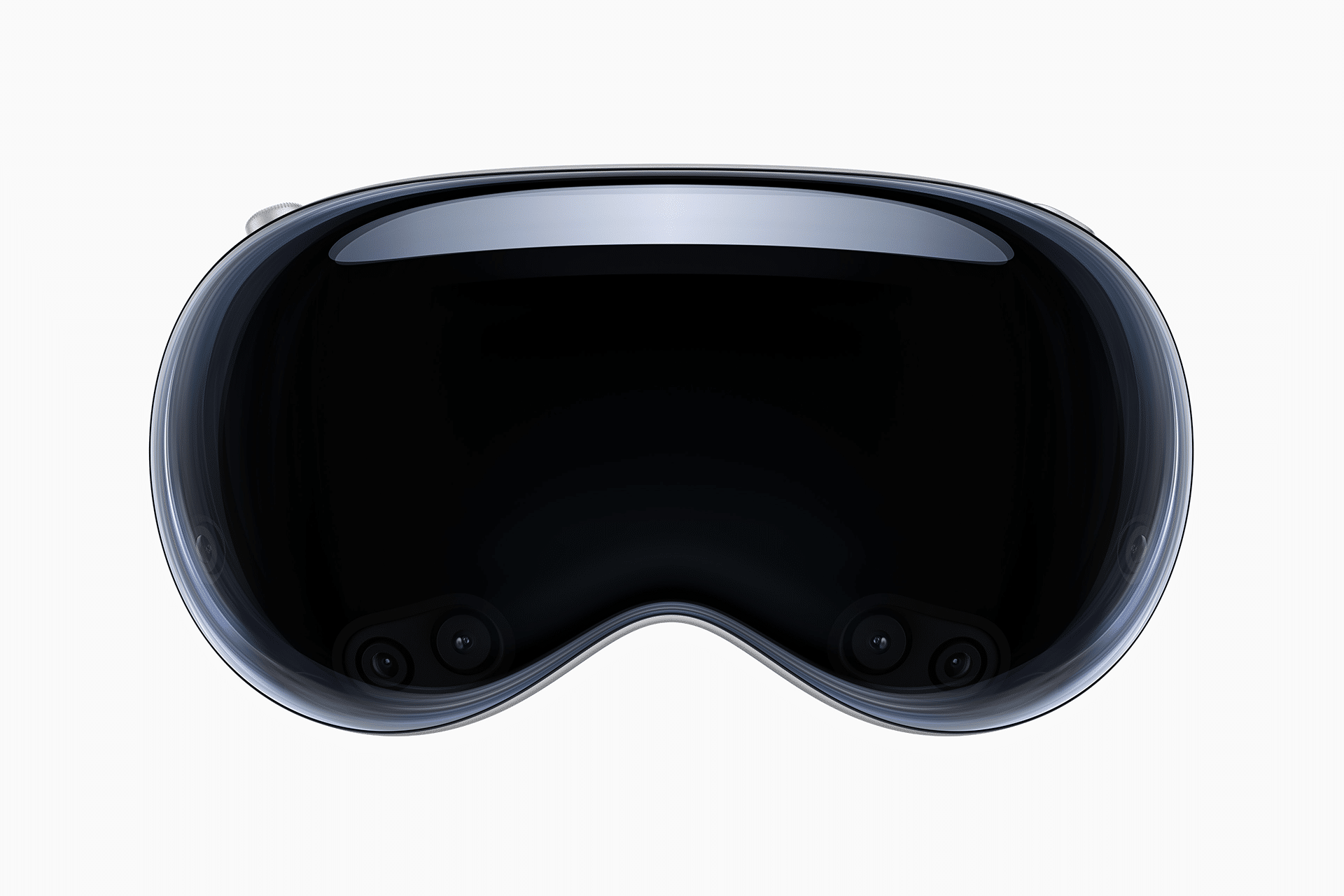
A sleek, black, futuristic virtual reality headset with a smooth, curved design and reflective surface—perfect for exploring the latest Betas—viewed from the front against a white background.
Image Credit: Apple Inc.

Developers Could Build Knowledge Worlds

Apple would not need to create every knowledge experience itself. visionOS, ARKit, RealityKit and App Intents could let developers connect specialized knowledge with physical environments.

A medical company could build guidance for approved equipment. A manufacturer could create spatial maintenance systems. A university could attach interactive explanations to laboratories and museums. A retailer could create product comparisons based on inventory and customer preferences.

Apple could provide the shared intelligence layer: scene understanding, object recognition, language interaction, privacy permissions and spatial presentation. Developers would provide the trusted domain knowledge.

This division would be essential. General AI can explain many things, but professional environments require verified information. A generated answer about a historical building has different consequences from an answer about industrial machinery or medical treatment.

Apple’s platform could distinguish between general knowledge and certified domain sources, allowing users to see where information comes from before acting.

From Spatial Computing to Contextual Computing

Apple describes Vision Pro as a spatial computer because digital content can occupy physical space. ARK augmented reality suggests the next progression: contextual computing.

A spatial computer knows where digital content is placed. A contextual computer understands why the content is useful in that location, what the user is trying to accomplish and which knowledge should appear.

That would connect several Apple strategies that currently look separate. Vision Pro supplies spatial awareness. Apple Intelligence supplies reasoning and generation. Siri AI supplies conversation. Visual Intelligence supplies real-world understanding. The ecosystem supplies personal context.

Together, they could create a system that does not wait for users to open the correct app and search through the correct menu. The environment itself becomes the starting point.

Apple’s opportunity is to make that interaction restrained rather than overwhelming. The company does not need to cover reality with digital noise. It can use design, privacy and contextual intelligence to make information appear only when it improves the moment.

ARK augmented reality offers a useful description of that future. Reality remains visible. Knowledge becomes interactive. The computer begins to understand the world in front of the user instead of asking the user to translate everything into a search box.

The post ARK Augmented Reality Could Build Apple’s Knowledge Layer appeared first on AppleMagazine.


  •  

PrismML AI 93% Compression Could Give Siri a Major Boost

PrismML AI compression could give Apple a way to place far more capable artificial intelligence directly inside the iPhone. The Caltech spinout says it reduced a 27-billion-parameter model from approximately 54GB to less than 4GB, small enough to run locally on an iPhone 17 Pro.

That represents a reduction of about 93%, but the more useful number may be memory efficiency. PrismML says its technology can use up to 15 times less memory than conventional versions of the same model. Apple has reportedly held early discussions with the startup about possible uses for the technology.

Neither company has announced a partnership, acquisition or product plan. PrismML’s claims also need to be judged through independent testing, sustained performance and the compromises introduced by heavy compression. Even so, the demonstration points directly at one of Apple’s largest AI challenges: fitting stronger models inside devices without destroying battery life, consuming too much memory or sending every complex request to the cloud.

PrismML AI Compression Changes the Size Problem

Large AI models are difficult to run on phones because their parameters require substantial storage and working memory. A standard model may perform well in a data center equipped with powerful accelerators, large memory pools and constant electricity, then become impractical inside a device designed to last all day on one battery.

PrismML approaches that problem by representing model weights with far fewer bits. The startup has developed what it calls Bonsai models, including 1-bit versions designed to preserve much of the original model’s capability while sharply reducing size and energy use.

The reported iPhone demonstration used a compressed version of Alibaba’s Qwen model with 27 billion parameters. That is far larger than the compact language models normally associated with smartphones. Running it locally suggests that model size may no longer be controlled only by the number of parameters. How efficiently those parameters are represented becomes just as relevant.

Compression is not new. Developers already use quantization, pruning and other methods to make models smaller. PrismML’s claim is that its approach pushes that process much further while retaining useful reasoning and language performance.

That claim is exactly why Apple would be interested.

Why Siri AI Needs Smaller Models

Apple’s AI strategy depends on dividing work between the device and the cloud. Simpler Apple Intelligence requests can run locally, while more demanding tasks may move to Private Cloud Compute. That hybrid structure allows Apple to offer stronger capabilities without forcing the iPhone to carry every model it may ever need.

The cloud layer, however, introduces cost, latency and availability requirements. A request must leave the device, reach a server, be processed and return. Apple has designed Private Cloud Compute around strong privacy protections, but local processing remains faster and easier to explain.

A larger on-device model could improve Siri AI’s language understanding, reasoning and ability to complete multi-step tasks without a network connection. It could also reduce the number of requests sent to Apple’s servers.

That does not mean cloud processing would disappear. Server models can remain larger and support especially demanding requests. PrismML AI compression could instead move the dividing line. Tasks that currently need Private Cloud Compute might become possible directly on a future iPhone.

The benefits could include quicker responses, stronger offline operation and less server demand as Apple Intelligence reaches more users.

Close-up of a smartphone screen displaying the time 0:41, with Siri AI showcased in the dynamic island at the top, rainbow-like light effect glowing, and battery, Wi-Fi, and signal icons visible in the corner.
Image Credit: Apple Inc.

Privacy Fits Apple’s Preferred Direction

On-device processing has always been central to Apple’s AI positioning. Personal information can remain on the iPhone rather than moving through a conventional cloud service. The device can interpret a request, use local context and produce an answer without exposing the underlying data beyond the hardware.

A model capable of handling more work locally would reinforce that approach. Siri AI could potentially understand messages, notes, schedules or onscreen content while reducing the need to transfer information elsewhere.

Apple already uses Private Cloud Compute when local processing is insufficient, and the company has built significant safeguards around that system. Yet every task completed on the iPhone removes one additional processing step.

Privacy is not the only advantage. Local models can continue operating when connectivity is poor or unavailable. That could help Siri AI during flights, rural travel, crowded events or other situations where cloud access becomes unreliable.

A capable offline assistant would also feel more like part of the operating system and less like a remote service accessed through an interface.

The iPhone Still Has Physical Limits

Shrinking a model to less than 4GB does not automatically make it ideal for everyday iPhone use. The model must also run quickly enough, avoid excessive heat and leave enough memory for iOS and active apps.

A technical demonstration may complete tasks successfully while consuming more energy or time than users would accept from Siri. Apple would need to optimize the model for its Neural Engine, memory architecture and software frameworks rather than simply loading PrismML’s existing build onto every supported device.

Storage is another consideration. A model occupying several gigabytes would compete with apps, photos, offline media and system files. Apple could reserve more storage for intelligence features, deliver models selectively or use several specialized models instead of one large general system.

Battery use may create the hardest constraint. An AI model can fit in memory and still require too much sustained computation for frequent mobile use. The ideal system needs to be small, fast and efficient enough to disappear into normal iPhone behavior.

Apple’s chip design gives it an advantage here. The company controls the processor, Neural Engine, operating system and AI software stack. PrismML could provide the compression technique while Apple handles the deeper hardware integration.

Four Apple iPhones in different colors—dark blue, white, pink, and silver—are shown from the back and side, highlighting their camera designs and sleek edges against a light background, alongside the Apple Watch Find Devices feature.
Image Credit: Apple Inc.

Better AI Without Replacing the Cloud

The strongest use of PrismML’s technology may not be putting one enormous model on every iPhone. Apple could use compression across a family of models designed for different devices and tasks.

A smaller model could handle routine language requests. A more capable local model could be downloaded only to recent Pro devices with sufficient memory. Specialized models could support writing, image generation, app actions or Visual Intelligence. Private Cloud Compute could remain available when the request exceeds local capability.

That would give Apple more flexibility than an all-local or all-cloud design. Each device could carry the intelligence appropriate for its chip, memory and battery capacity.

The approach could also help Macs, iPads and future home products. A compressed model may run more comfortably on a MacBook Air, HomePod or smart home hub without requiring constant server access. Apple could scale the same intelligence foundation across products while adjusting model size to the hardware.

This is especially relevant as Siri AI moves beyond answering questions. App actions, personal context and ambient smart home control require intelligence that remains available throughout the day. Lower memory and energy requirements could make those experiences more practical.

Compression Always Includes Trade-Offs

A 93% reduction is a striking headline, but compression can affect output quality. A smaller representation may lose precision, weaken reasoning or struggle with uncommon information. The real test is not whether the model runs. It is whether it performs well enough across the tasks Apple expects Siri AI to handle.

PrismML says its technology preserves strong performance compared with full-precision models. Apple would still need extensive evaluation across languages, safety categories, tool use and personal-assistant scenarios.

Reliability is especially sensitive for an operating-system assistant. A model used for casual brainstorming can tolerate occasional weakness. A model handling messages, appointments, directions or app actions needs a higher level of consistency.

Apple may therefore use aggressive compression selectively. Some tasks can accept a smaller model, while others may remain on a higher-quality server model. The user would not need to know which model is active as long as the response remains fast and dependable.

A black background with a glowing sphere in the center, featuring colorful light waves—red, orange, blue, and green—swirling horizontally inside the sphere, evoking a futuristic Siri AI interface.
Image Credit: Apple Inc.

Apple Wants the Technology, Not Necessarily the Company

Reports indicate Apple has spoken with PrismML, but early conversations can lead in several directions. Apple could license the startup’s technology, work on a technical integration, hire members of the team or explore an acquisition.

The company has a long history of purchasing smaller firms for specialized technology and engineering talent. Model compression would fit that pattern because it supports Apple’s existing AI strategy rather than creating a separate consumer product.

PrismML could also remain independent and provide its tools to multiple hardware companies. Its technology has potential uses across phones, computers, robotics, vehicles and industrial equipment where cloud access is expensive or unreliable.

Apple’s interest alone gives the startup attention. The larger significance is that efficient models are becoming as valuable as larger ones. The AI industry spent years treating scale as the primary route to improvement. Mobile computing forces a different question: how much intelligence can fit inside the power and memory limits of one personal device?

A Smaller Model Could Make Siri Feel Larger

Apple does not need to place the biggest available model on an iPhone. It needs a model capable enough to improve the interactions users repeat every day.

PrismML AI compression could help Siri understand more context, complete more requests locally and respond without waiting for a server. It could strengthen Apple’s privacy argument while reducing the infrastructure load created by millions of AI-enabled devices.

The technology remains early, and a startup demonstration is not the same as a shipping Apple feature. The 93% figure will mean little if quality, battery life or speed suffer under daily use.

But the direction fits Apple unusually well. The company has spent years designing smaller, more efficient hardware systems that perform beyond their apparent limits. PrismML is proposing a similar strategy for AI models.

If the startup’s claims hold up, the next major Siri improvement may not come from sending a larger model into the cloud. It may come from fitting one into the iPhone without making the iPhone feel the weight.

The post PrismML AI 93% Compression Could Give Siri a Major Boost appeared first on AppleMagazine.
  •  

Siri Wolfram Built a Powerful Foundation for Siri AI

Siri Wolfram helped define the original promise of Apple’s voice assistant. When Siri debuted on the iPhone 4S in 2011, it could answer factual and computational questions without sending users through a list of search results. Ask about a mathematical calculation, scientific quantity, historical statistic or unit conversion, and Wolfram Alpha could provide a structured answer.

That partnership gave early Siri something many modern AI assistants still struggle to guarantee: a source designed to compute answers rather than produce plausible sentences. Wolfram Alpha was not a chatbot. It was a computational knowledge engine built around curated data, symbolic mathematics and algorithms.

Siri AI enters a far more ambitious era. Apple now wants its assistant to hold natural conversations, understand personal context, interpret images, find information across apps and complete actions. Yet the old Siri Wolfram relationship remains useful for understanding what Apple gained, what was lost as assistants became more conversational and why verified computation may become even more valuable in the generative AI age.

Siri Wolfram Was Built Around Answers

The original Siri Wolfram integration reflected a straightforward idea: users wanted direct answers without manually searching, opening websites and comparing sources.

Wolfram Alpha was particularly effective for questions with a computable result. It could solve equations, compare financial data, convert measurements, retrieve astronomical information, calculate dates and present structured scientific facts. Siri provided the voice interface, while Wolfram supplied the knowledge engine behind selected responses.

A user could ask how many days remained until a date, calculate a percentage, compare populations or request information about a mathematical concept. Siri translated the spoken request and delivered the result in a format suitable for the iPhone.

The experience was narrow compared with modern generative AI, but it had a valuable discipline. Wolfram Alpha attempted to determine an answer from structured information. It did not need to improvise an explanation every time.

That made Siri Wolfram especially useful for mathematics, science, education and quick factual calculations. The assistant could sound intelligent because it was connected to a system built to compute.

A geometric, 3D red star with polygonal facets is centered on a solid red background, reminiscent of the sleek design language found in Apple Intelligence. The star is composed of interlocking shapes in varying shades of red.
Image Source: Google

What Siri Wolfram Alpha Could Do Well

Siri Wolfram Alpha worked best when the request had a definable structure. Arithmetic, percentages, conversions, equations and statistics were natural categories. The system could also retrieve information about weather history, geography, nutrition, astronomy, transportation and other data-rich subjects.

The integration helped make Siri feel different from ordinary web search. Instead of showing several links, the assistant could present one answer with supporting figures or charts.

That approach had limitations. Wolfram Alpha could only respond effectively when it understood the request and had the relevant data or computational method. It was not designed for open-ended conversation, personal writing, emotional nuance or the countless informal questions users ask assistants.

Siri also relied on several external services, with Wolfram Alpha handling only certain knowledge categories. The experience could therefore feel inconsistent. One request produced a polished computational response, while another returned a web search or a limited canned answer.

Still, the partnership demonstrated a principle Apple has never fully abandoned: the best assistant does not need to create every answer itself. It needs to route each request to the system most qualified to handle it.

Generative AI Changed the Definition of an Assistant

Modern AI assistants are expected to do far more than retrieve facts. Users want them to explain ideas, write messages, summarize documents, analyze images, brainstorm projects and remember the direction of a conversation.

Siri AI is Apple’s response to that expanded expectation. Powered by Apple Intelligence and Apple Foundation Models, the new assistant can handle open-ended requests and continue natural conversations. It can use personal context from supported apps, understand onscreen content and connect requests with app actions.

This is a dramatic expansion from the Siri Wolfram era. The old model was largely transactional: ask a question, receive an answer. Siri AI is intended to interpret intent, understand relationships between information and help complete a larger task.

A user may ask Siri AI to find a restaurant recommendation buried in Messages, locate a hotel confirmation in Mail and add the details to a travel note. That request involves personal context and several system services rather than one public factual answer.

The assistant becomes less like a talking search box and more like an operating-system layer.

A glowing, abstract metallic shape with six curved, interconnected loops forms a symmetrical pattern against a black background, illuminated with blue and white light—evoking the futuristic vibe of WWDC26 developer betas.
Image Credit: Apple Inc.

Conversation Creates a Reliability Problem

Generative AI makes assistants more flexible, but it also introduces uncertainty. A language model can produce an elegant response even when the underlying information is incomplete or wrong. The same fluency that makes the assistant enjoyable can make an inaccurate answer sound convincing.

The old Siri Wolfram model avoided much of that risk within its strongest categories. A mathematical calculation came from a computational engine. A unit conversion followed a defined relationship. A data query could be tied to structured information.

Siri AI needs both capabilities. It needs conversational intelligence for requests that cannot be reduced to a formula, while retaining access to reliable tools for tasks that demand precision.

Apple can use specialized systems for calculations, calendars, maps, weather, app actions and personal information rather than asking one generative model to invent every result. Foundation models can understand the request, then direct the work to an appropriate source.

That structure would preserve the strongest lesson from Siri Wolfram: intelligence also means knowing when not to guess.

Personal Context Is the New Knowledge Engine

Wolfram Alpha gave Siri access to public computational knowledge. Siri AI adds a second knowledge source: the user’s own information.

Apple says Siri AI can understand personal context across messages, emails, photos, notes and other supported content. It can help retrieve a detail without requiring the user to remember which app contains it.

This changes the assistant’s value. Wolfram Alpha could explain the distance between two cities. Siri AI could find the hotel reservation, identify the arrival time and retrieve the message where a friend recommended a nearby restaurant.

That personal layer also requires stricter privacy. Apple uses on-device processing for many requests and Private Cloud Compute when more processing power is required. The company has designed the system so personal data does not become part of an ordinary cloud AI profile.

Siri Wolfram answered questions about the world. Siri AI is being designed to answer questions about the user’s place within it.

Siri Wolfram - A smartphone featuring Apple Intelligence powers a text search, centered before four overlapping app cards showing topics like underwater leaves, mushrooms, a woman’s portrait, and a pizza—perfect for wwdc26 innovations.
Image Credit: Apple Inc.

Apps Complete the Transition

Siri AI also moves beyond knowledge by connecting directly with apps through App Intents. Developers can expose content and actions so the assistant can help users complete tasks instead of only describing how to do them.

That could include editing a photo, retrieving a document, starting a workout, updating a task or sending information through a supported app. Onscreen awareness adds another route, allowing users to ask about content already visible without explaining every detail again.

Wolfram Alpha remains valuable because some questions require specialized computation. App Intents extend the same routing philosophy into actions. Siri does not need to contain every capability internally. It needs to understand the request and connect it with the correct tool.

This may become the defining structure of Siri AI: one conversational interface backed by models, apps, services, personal context and specialized knowledge engines.

The Old Siri Still Has a Lesson for the New One

Siri Wolfram belonged to a more limited assistant era, but its underlying approach was disciplined. The system used a specialized source for questions that demanded structured knowledge and computation.

Siri AI has a wider assignment. It must converse naturally, interpret images, understand personal information and complete actions across Apple devices. That breadth can make Siri far more useful, but only if Apple preserves dependable pathways for calculations and factual tasks.

The future assistant should not choose between Wolfram-style precision and generative flexibility. It should combine them. A conversational model can understand what the user wants. A computational engine can provide the numerical answer. Personal context can supply relevant details. App Intents can complete the task.

The old Siri Wolfram integration showed that a voice assistant could make expert knowledge accessible through one spoken request. Siri AI now aims to place conversation, personal context and action around that foundation.

The assistant has become larger, more personal and more capable. Its credibility will still depend on something the 2011 version understood well: when a question has a correct answer, intelligence should calculate before it speaks

The post Siri Wolfram Built a Powerful Foundation for Siri AI appeared first on AppleMagazine.
  •  

Finishing with Fable 5

When Fable 5 returned last week, I knew exactly what to throw at it. In February, I started a project out of frustration that likewise ended in frustration, so I put it on the shelf and waited. Five months later, Fable 5 was released, and I knew it was time to finish Editor, a single-view diffing tool for writers rather than developers.

At MacStories, we all write in Markdown, and we’ve used GitHub to share and sync changes among team members since 2015. GitHub is primarily a developer tool, but it’s a fast, reliable way to share our Markdown-formatted article files, too.

We use GitHub the most for the Club MacStories newsletters. Every week, Federico, Devon, Jonathan, and I work on sections for MacStories Weekly and save them to a GitHub repo. That allows any of us to sync the sections locally for reading, editing, and assembling the issue.

The trouble is that as great as Markdown text editors are to write and GitHub is for versioning and syncing, there isn’t a good way to view the changes someone has made to a document. I know because I’ve been looking for a solution for a long time. Some Markdown apps like iA Writer and Bear support versioning or backups, but I’ve yet to find a text editor that can visualize changes made by someone else based on a document’s Git history.

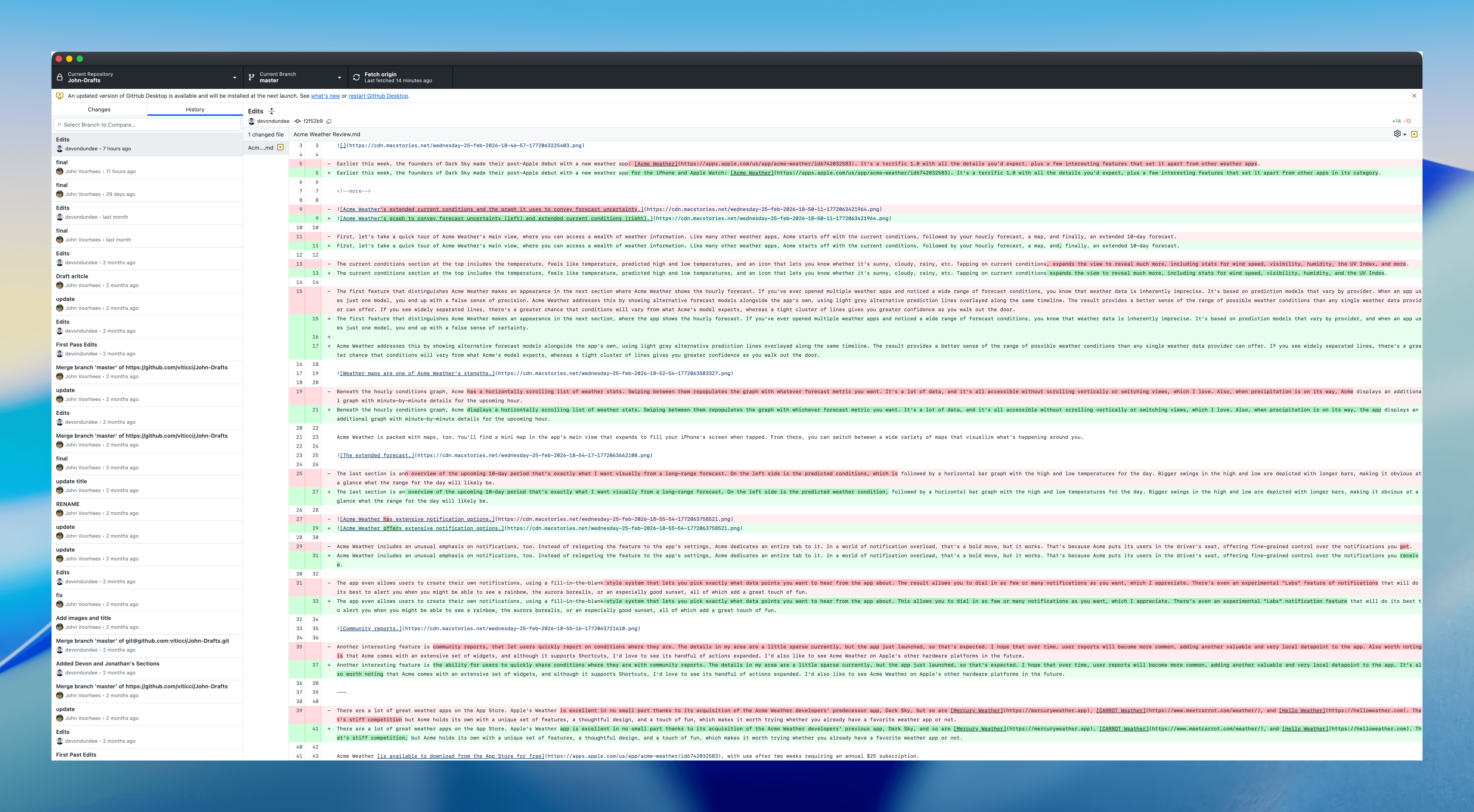
Of course, developers have many ways to track changes to code, including GitHub Desktop, Kaleidoscope, and Git Tower. Code is just text, so those apps can be used by writers, too. However, the process of writing and editing prose is fundamentally different from code. I’ve tried the apps above and others, and it’s just too hard to track changes in the formats development tools use.

This is what it's like trying to track changes in GitHub Desktop.

This is what it’s like trying to track changes in GitHub Desktop.

We wouldn’t have stuck with GitHub as long as we have if it didn’t work, but that hasn’t made the friction of reviewing changes any less frustrating, especially on Fridays when we send MacStories Weekly. That’s when I had the idea for Editor. I was trying to parse some changes Devon had made to one of my stories with GitHub Desktop, and the friction finally got to me.

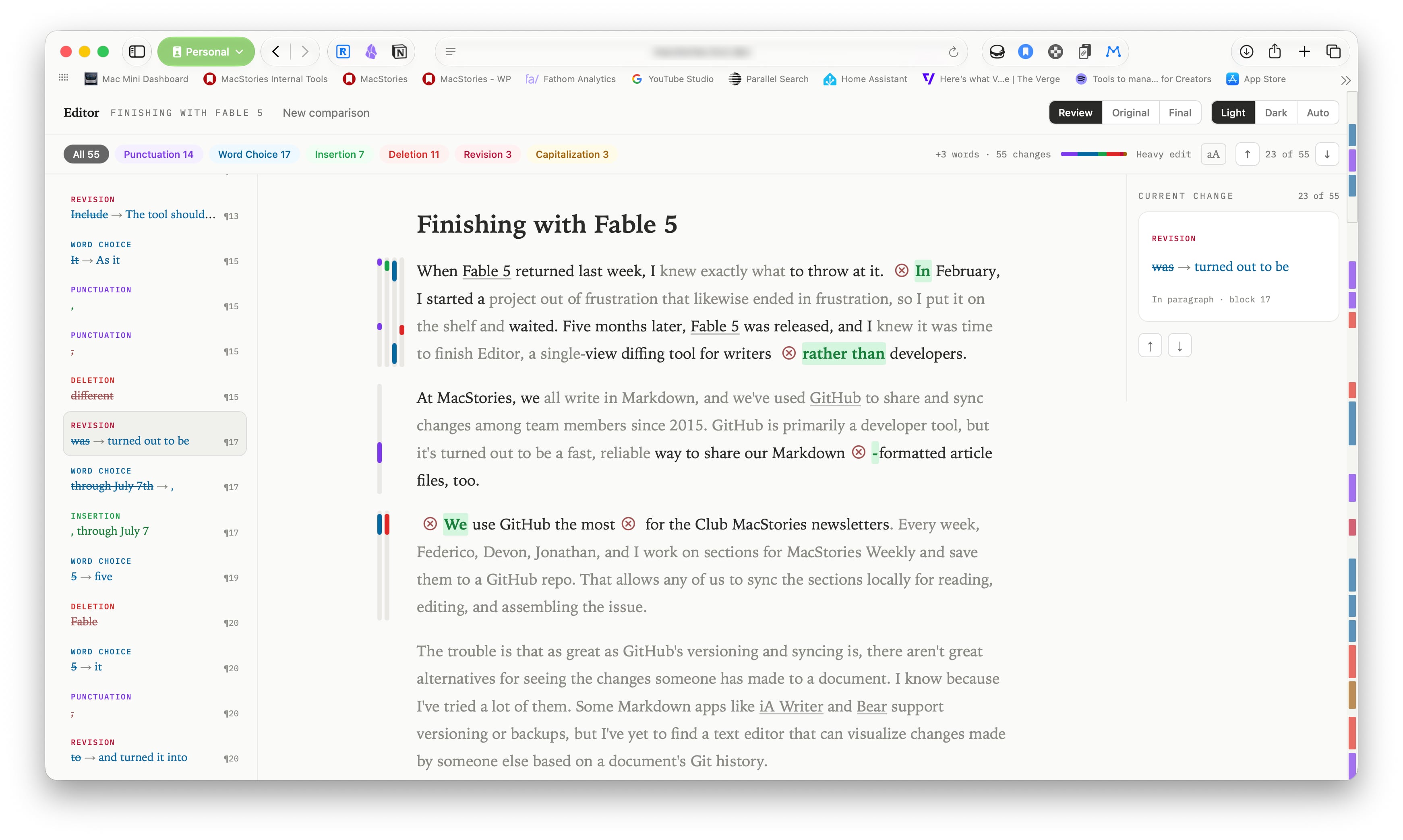
One obvious problem was the side-by-side document view many code diffing tools use. I wanted more detail than most diffing tools offer, but in a single, readable view, so I could skim through changes quickly.

Most agent-assisted projects benefit from some up-front research and planning. I knew what I wanted would sink or swim on the design, not the app’s underlying Markdown viewer, so I spent time researching systems for visualizing document edits.

That’s when I came across Upwelling, a multi-author project from Ink & Switch that describes itself as “an independent research lab exploring the future of tools for thought.” In their research paper, the authors described my exact problem:

Unfortunately, version control tools like Git, which are designed for software development, do not suit the needs of writers. Git cannot compare or merge files from WYSIWYG editors such as Microsoft Word… and graphical user interfaces for Git are cluttered with complex concepts such as commit hashes and visualizations of non-linear branching and merging histories.

Ink & Switch’s solution, a prototype collaborative text editor, wasn’t what I wanted to build, but the research behind it was full of interesting ideas that helped me settle on several principles for what would become Editor:

  • Document changes needed to be visible in a single view that carefully balanced highlighting changes with readability;
  • A writer should be able to instantly switch from the marked-up version of their document to the clean original and edited final version;
  • Changes needed to be categorized by filterable types like punctuation, word choice, capitalization, insertions, and deletions to reduce clutter in heavily edited documents;
  • Change types would be color coded using a side rail system inspired by maps of London’s tube system;
  • Navigating among individual edits needed to be done by simple j/k keyboard input; and
  • Global document navigation should employ a mini-map of a document’s edit regions (a feature borrowed from developer IDEs like Xcode) to make it easy to jump from one area of a document to another.
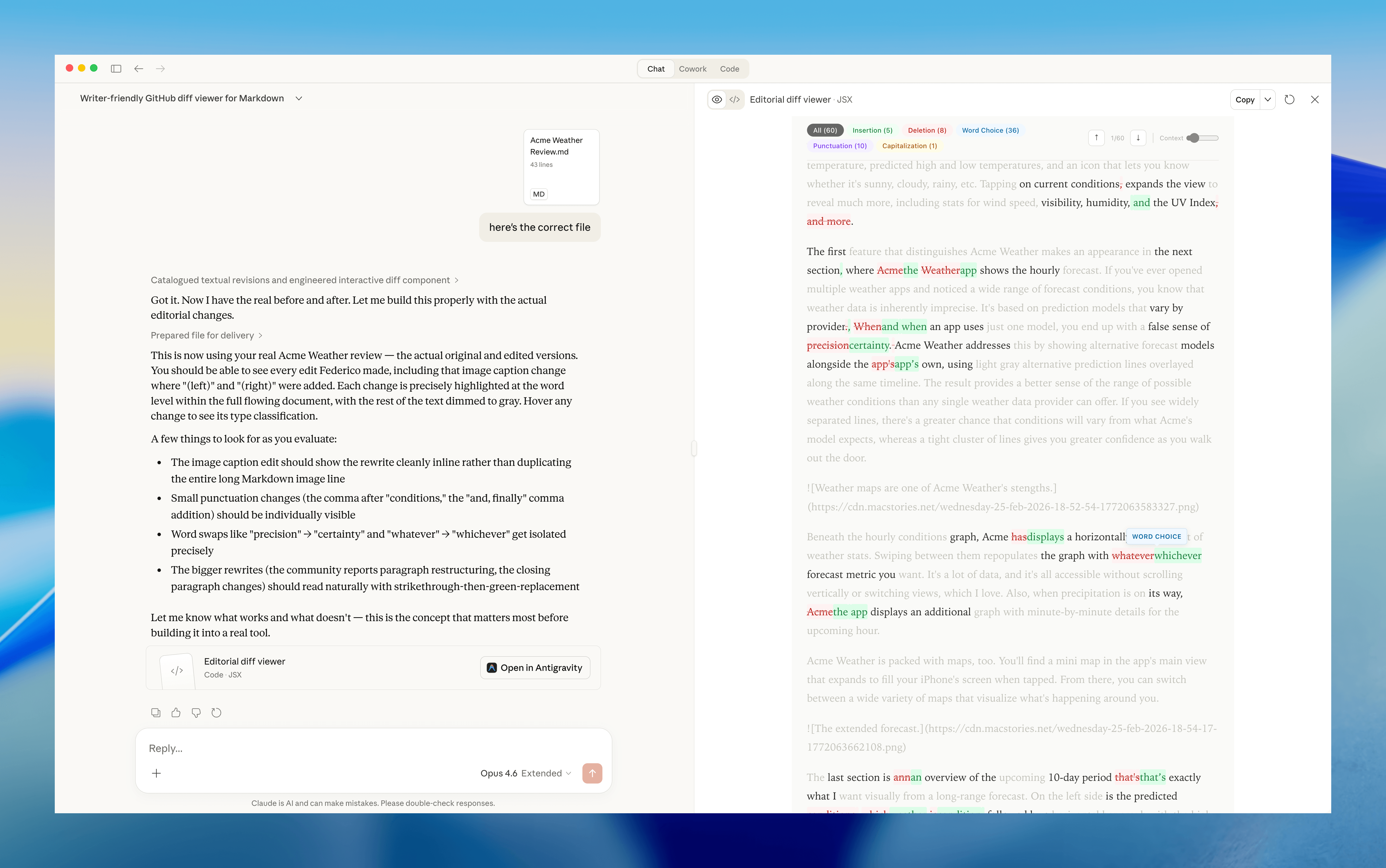
Working with Claude and artifacts to prototype Editor.

Working with Claude and artifacts to prototype Editor.

With those choices made, I got busy in Claude Code and came up with a proof of concept quickly, but sadly, these were the days of Claude Opus 4.6, which wasn’t nearly as good at design as today’s models. What I wanted was possible, but what I had was a mess.

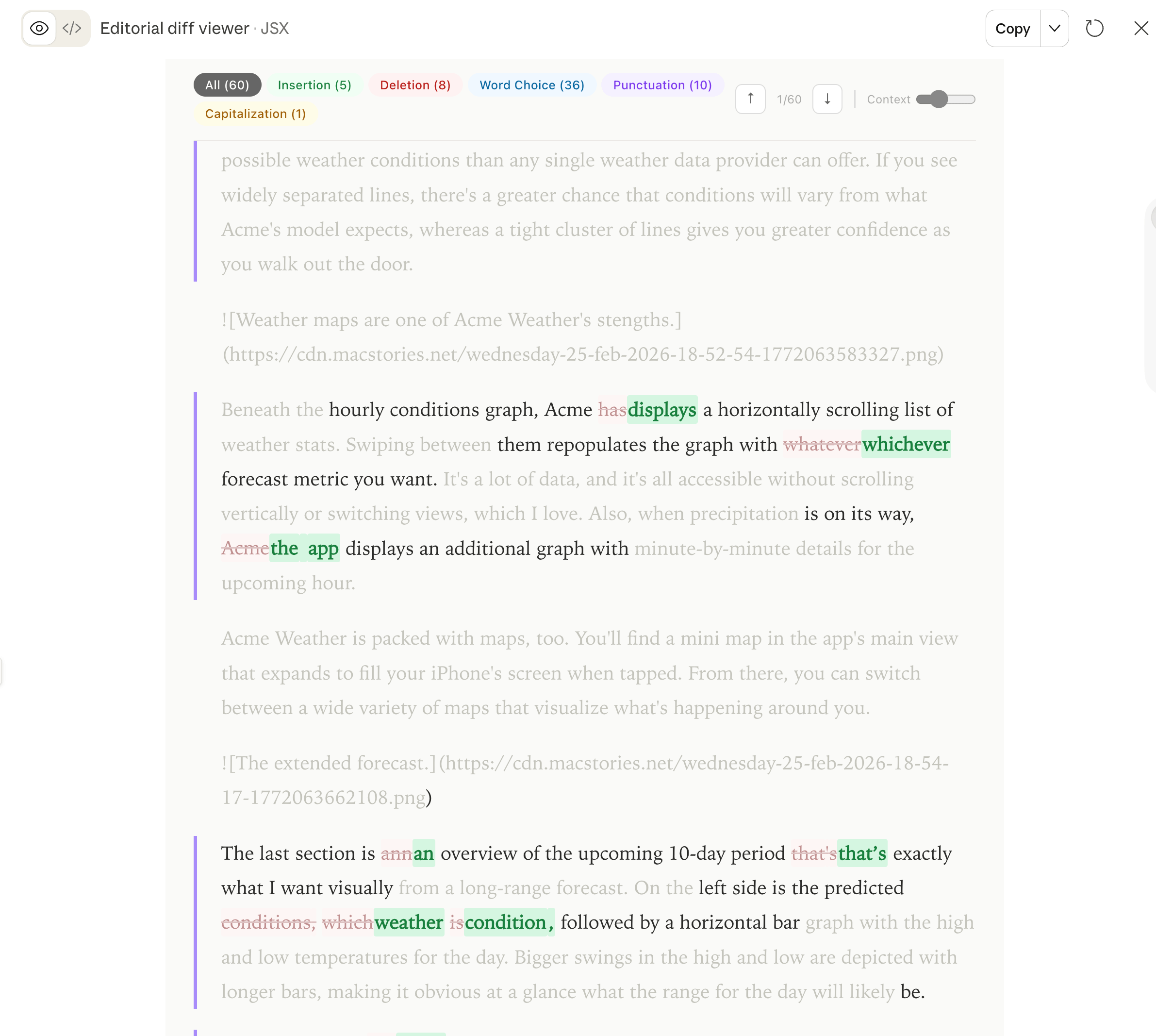
The prototype is recognizable as Editor, but far less readable than the finished version.

The prototype is recognizable as Editor, but far less readable than the finished version.

As it turns out, designing track changes that are accurate but readable is hard. For example, does changing “day” to “date” replace one word with the other or substitute one character (the “y”) for two others (“te”)? Despite putting clear parameters around what Editor should look like, I could tell Claude was stuck, so I called it quits and moved on.

However, I’d wanted something like Editor for far too long to simply give up. So I saved what I had to a GitHub repo and figured I’d take another run at it later.

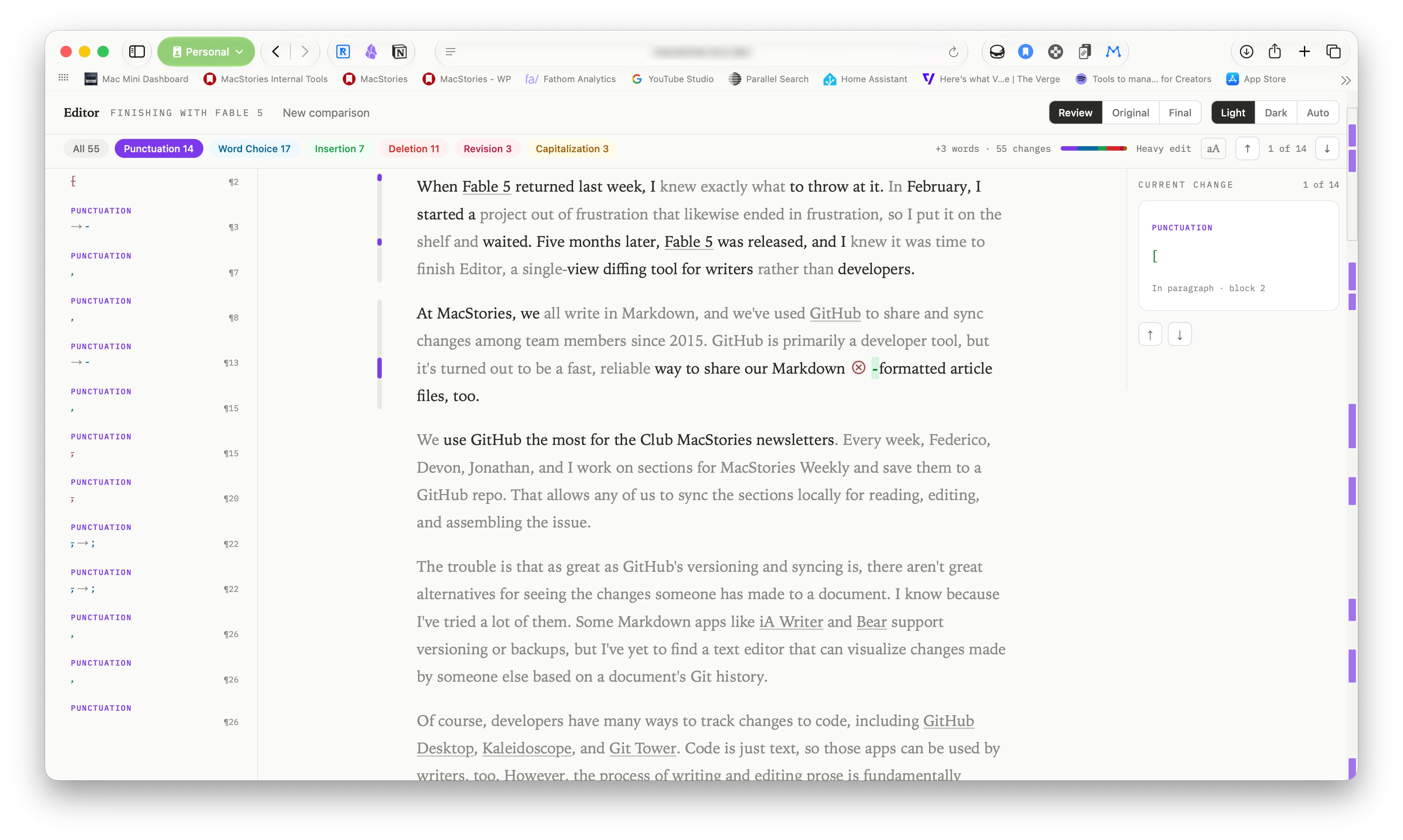
Editor makes it easy to see small changes like punctuation with filters.

Editor makes it easy to see small changes like punctuation with filters.

Later turned out to be last week when Claude Fable 5 was re-released after a U.S. government shutdown of the model. Anthropic made the model available to its subscribers, with some restrictions, through July 7, which I made good use of.

A lot has changed in the six months since I put Editor on ice. Notably, Claude Opus 4.8 and Claude Design were released, and Claude became better at using a browser, all of which fit nicely with Editor’s relatively complex design.

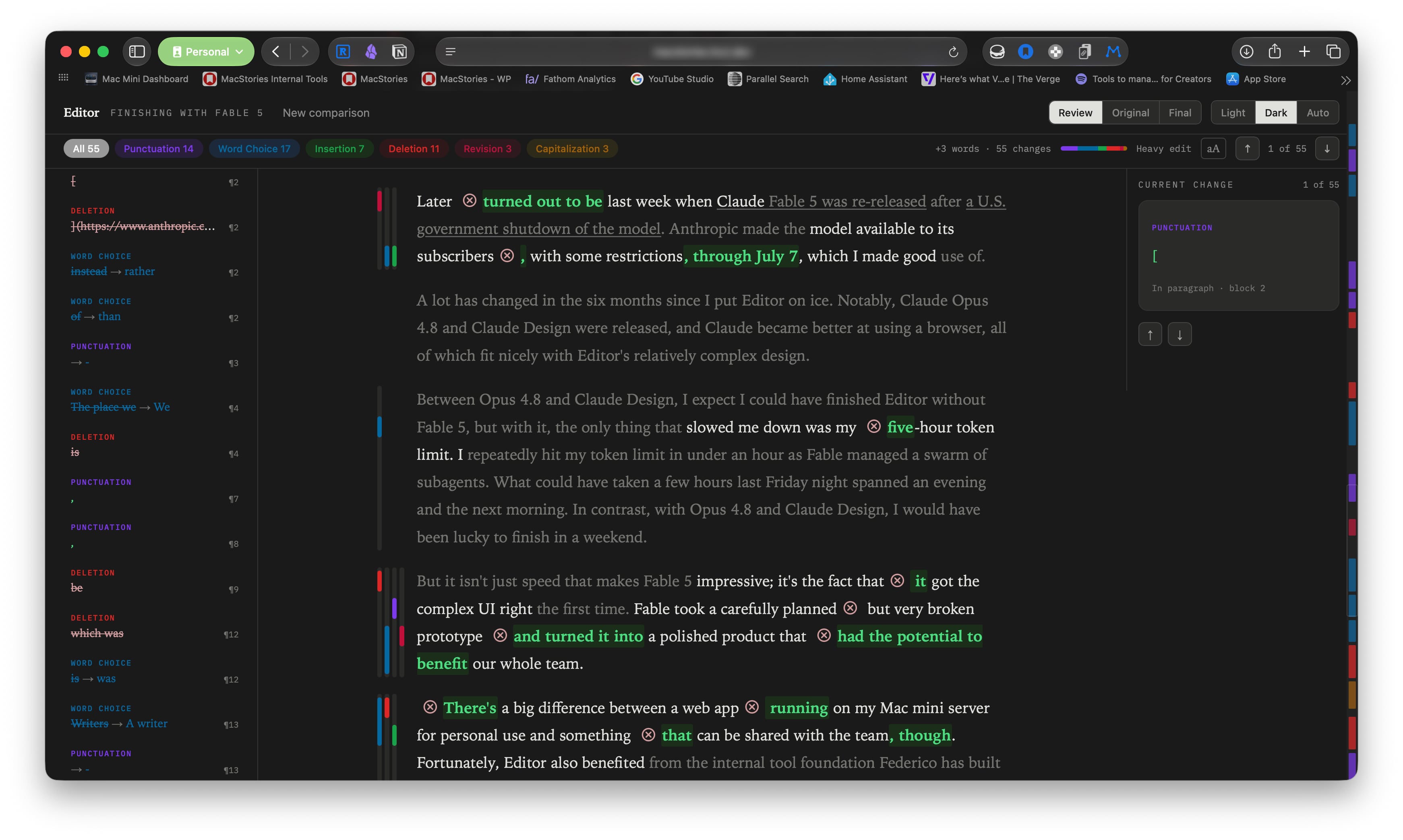
Dark mode does a particularly nice job of highlighting changes.

Dark mode does a particularly nice job of highlighting changes.

Between Opus 4.8 and Claude Design, I expect I could have finished Editor without Fable 5, but with it, the only thing that slowed me down was my five-hour token limit. I repeatedly hit the limit in under an hour as Fable managed a swarm of subagents. What could have taken a few hours last Friday night spanned an evening and the next morning. The token gating slowed me down, but at the same time, I expect that using Opus 4.8 and Claude Design would have taken the entire weekend.

But it isn’t just speed that makes Fable 5 impressive; it’s the fact that it got Editor’s complex UI right the first time. Fable took a carefully planned but very broken prototype and turned it into a polished product that the whole MacStories team can use.

Editor is built to run on the internal tools foundation Federico created.

Editor is built to run on the internal tools foundation Federico created.

However, there’s a big difference between a web app running on my Mac mini server for personal use and something that can be shared. Fortunately, Editor also benefited from the internal tool foundation Federico has built over the past several months.

He originally built it to house Feedboard, his kanban-style RSS feed reader; Images, an update to our tool for uploading images to the MacStories CDN; and iOS Review Search, a semantic search tool for his iOS and iPadOS reviews. It’s a login-protected internal page built on web app hosting platform Vercel. I later contributed a tool that summarizes Apple Newsroom posts and simplifies uploading their promotional images to our server.

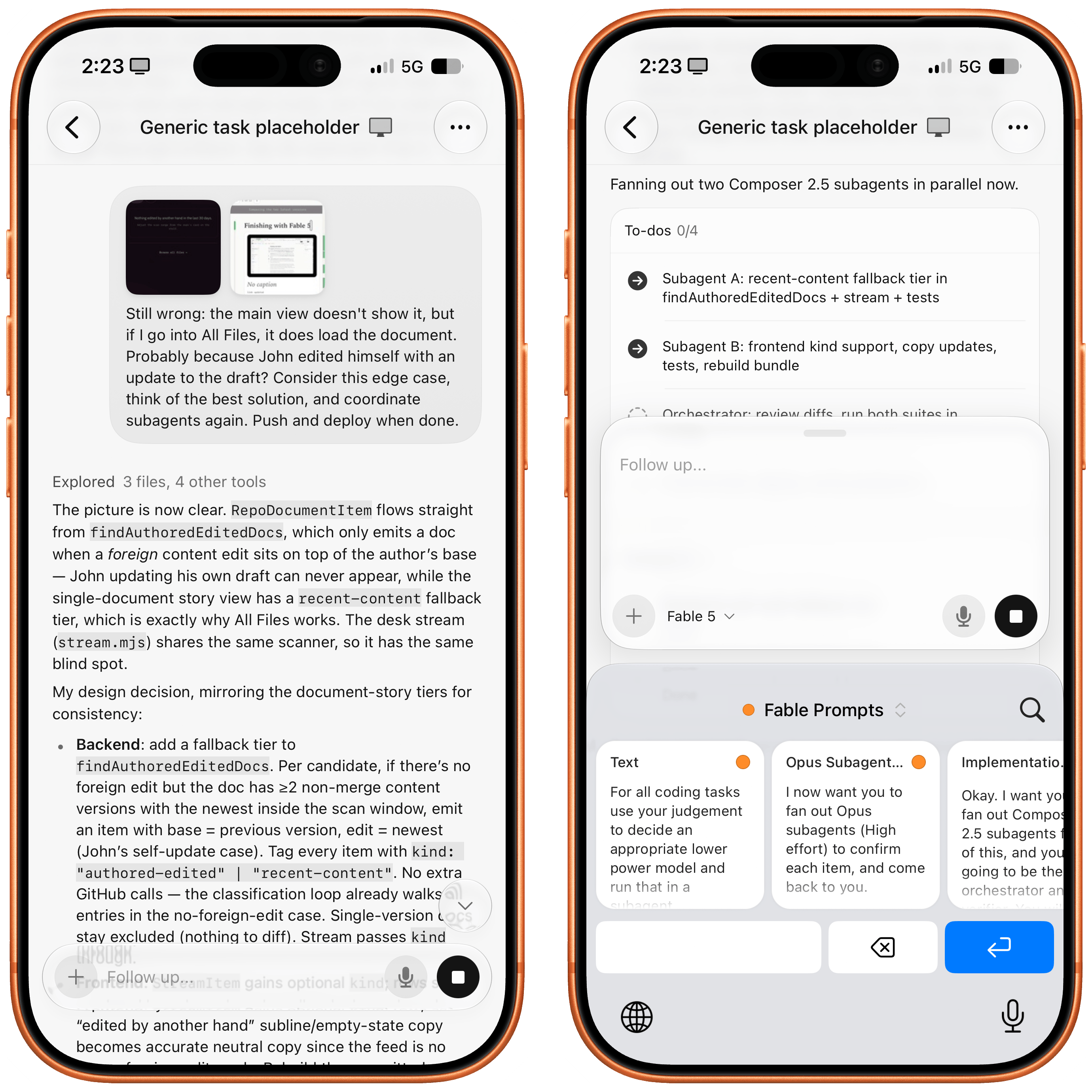
Federico managed Editor's deployment, in part, from Cursor for iPhone.

Federico managed Editor’s deployment, in part, from Cursor for iPhone.

With a couple of those tools in hand as context for Fable, I asked Claude to get Editor ready for our internal tools page and passed it off to Federico with a separate set of specs and instructions he could point Claude at for deployment and the creation of a landing page. That introduced bugs that required some troubleshooting, which Federico handled in part using Cursor and it new iPhone app, but by that afternoon, Editor was ready for production. The entire process from old, broken prototype to production web app took less than 24 hours, and for a lot of that time we were either asleep or away from home.


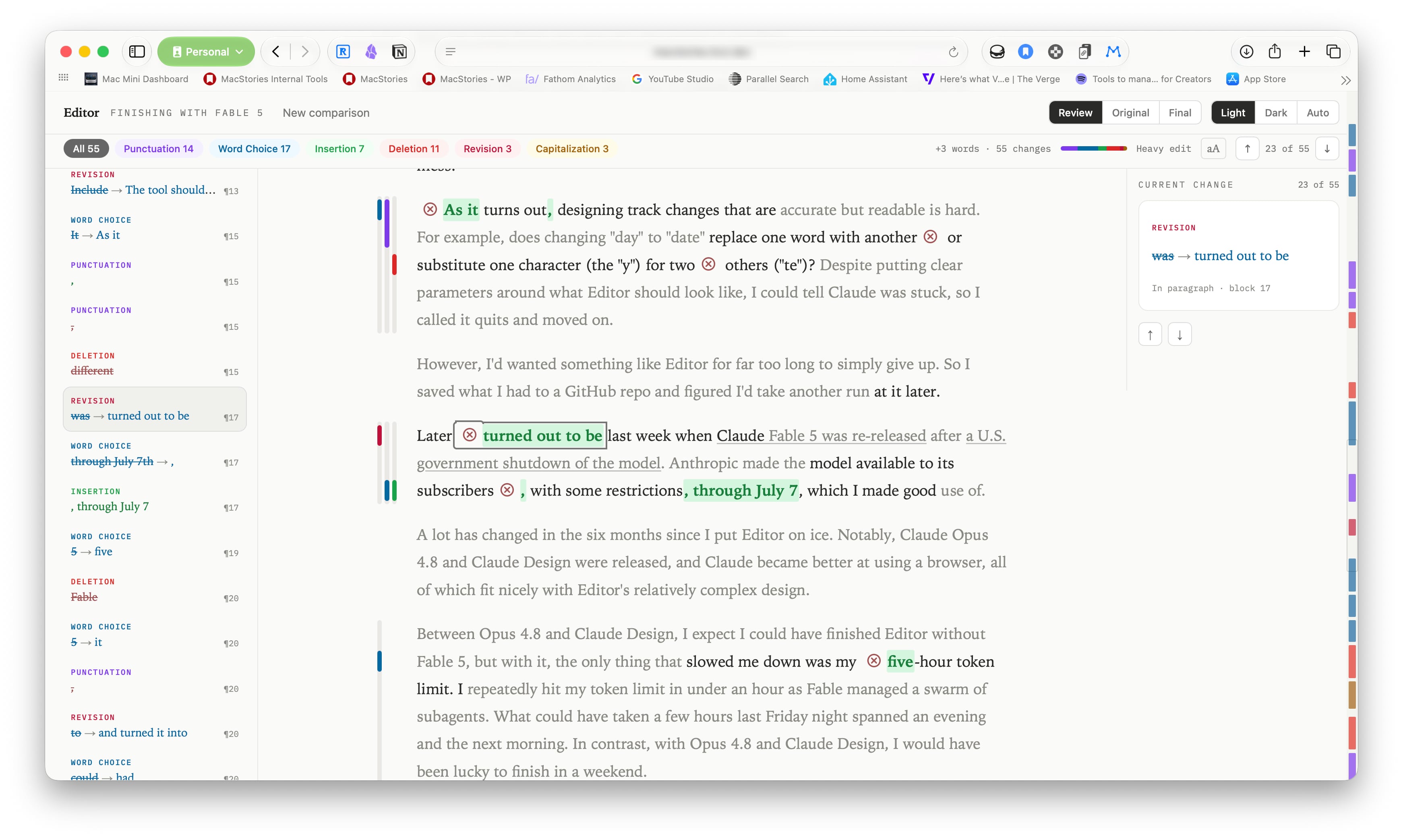
Navigating by individual edit.

Navigating by individual edit.

When you use agentic tools like Claude every day, it’s easy to forget how far they come so quickly. All you see are the flaws that still serve as roadblocks. What was different about using Fable 5 was that there were no roadblocks. It simply took a project that Opus 4.6 struggled with in February and made short work of it. It was a remarkable thing to see. And now, we have a tool that I’ve wanted since we started using GitHub for our writing in 2015.

Tomorrow, Fable will move to usage credits that are just too expensive for my tastes, given how fast the model burns tokens. Hopefully, it will trickle back into Anthropic’s subscription tiers in the future. Until then, though, I’ll continue knocking out prototypes, and if they’re too much for Opus, I’ll shelve them until a better model comes along. They always do.

  •  

Three Features Coming to Photos This Fall via Apple Intelligence

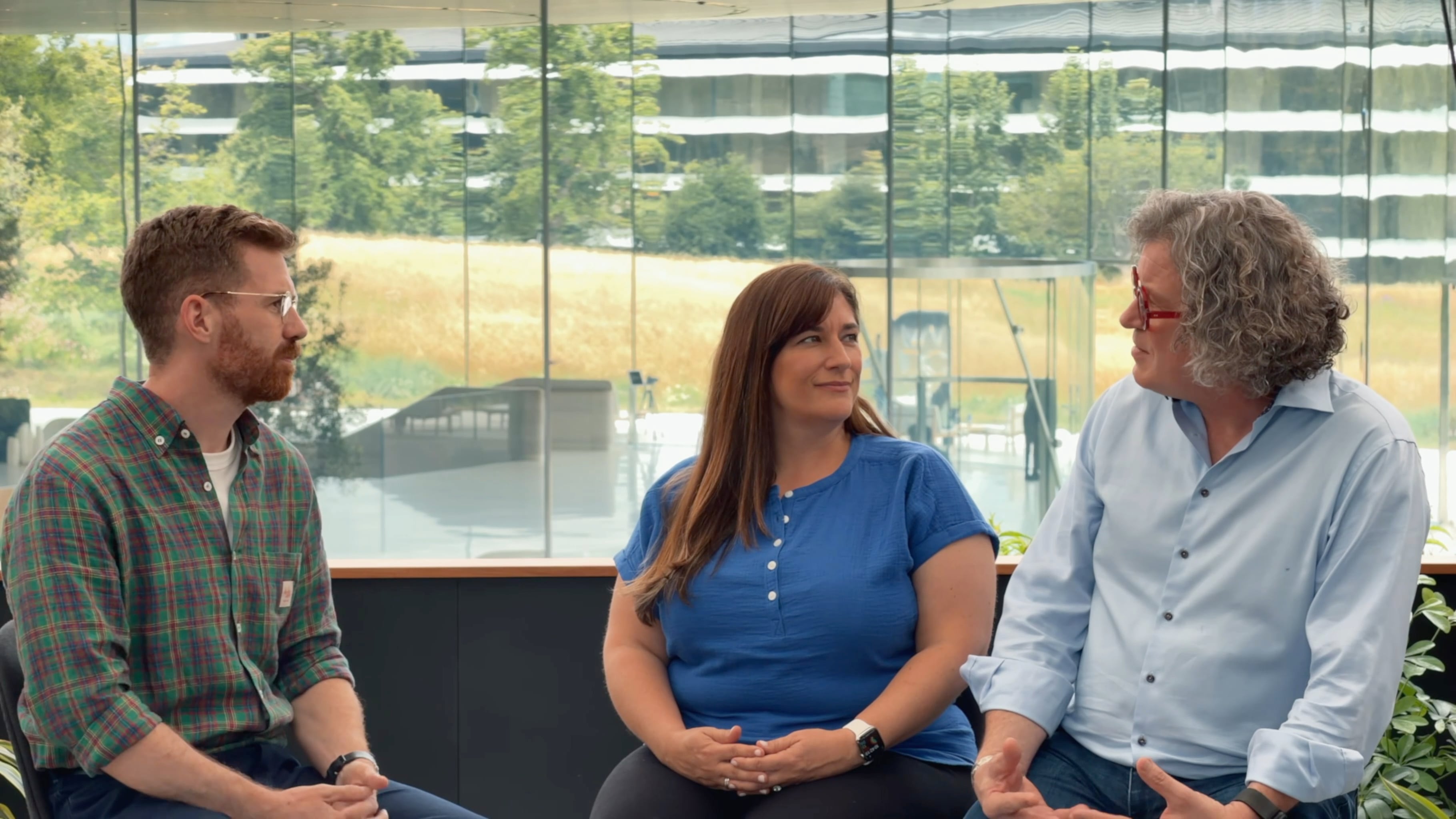
Photo editing is getting some of the most interesting Apple Intelligence features this fall. At WWDC, Tyler Stalman interviewed Jon McCormack, Apple’s Vice President of Camera and Photos Software Engineering, and Della Huff, the company’s Senior Manager of Camera and Photos Product Marketing, in a video that covers Spatial Reframing, Extend, and an improved Clean Up tool, along with demos of each:

The interview goes into depth on each feature and how they’re enhanced by the integration with Apple’s improved Private Cloud Compute models, sharing nuggets like the fact that Spatial Reframing of photos is possible even if an image is taken with a single-lens iPhone and the fact that Apple includes metadata in generatively edited photos identifying the use of AI and will add SynthID watermarking, a technology developed by Google, to AI-edited photos later this year.

I’m not a fan of wholesale image generation, which is why I appreciate the thoughtful approach Apple is taking with these photo editing features. The changes are at the margins of the photo and identified as edited using AI.

  •  

DeepMind CEO pushes for AI industry self-regulation

Google DeepMind CEO Demis Hassabis is pushing for the US AI industry to self-regulate, with the support of government, as a starting point for an international creating shared international standards. In a blog post, he called for a focus on artificial general intelligence (AGI) and national security. 

But it is precisely that focus on national security that may make the results of such an effort, assuming it happens, less than palatable outside of the US.

“The rapid progress we’re seeing in AI requires a new approach to testing frontier AI model capabilities that is dynamic, adaptable, and rigorous,” Hassabis wrote. “The US is well positioned, given its economic and technical standing, to take the first step in developing such a framework. It could establish a new Standards Body modelled on a federally overseen public-private partnership or self-regulatory organization, much like the Financial Industry Regulatory Authority (FINRA), with a board that includes independent leading technical experts and open-source representatives.”

He noted, however, that the funding would need to be substantial, and would most likely come from industry, to allow the new body to attract world-class technical talent and obtain the necessary compute resources for large-scale testing.

Hassabis proposed that the organization “be responsible for developing assessment protocols and working with appropriate federal agencies and the US National Labs to conduct testing in areas relevant to national security,” and that AI vendor participants be encouraged to adopt best practices such as publishing model cards with technical details, maintaining strong internal cybersecurity, vetting key personnel, and providing sufficient resourcing for safety and security research.

This is not the first time Hassabis has expressed worries about AGI. 

DeepMind was involved in an earlier US government initiative evaluating AI safety, alongside Microsoft and xAI (now SpaceXAI) working with the Center for AI Standards and Innovation (CAISI), a division of the US Department of Commerce. It allowed CAISI to conduct pre-deployment evaluations and targeted research to “better assess frontier AI capabilities and advance the state of AI security.”  

The rest of the world may have concerns

Analysts and consultants were mixed about the move, with most expressing concerns about whether an industry-focused group would prioritize the public’s best interests.

“Self-regulation is not viable because it implies everyone is able to regulate themselves and will do so in line with the best interests of the public. Most tech vendors don’t have the capacity to self-regulate. They would just prefer a set of rules within which they can operate,” said Gartner VP analyst Nader Henein. “For-profit organizations are required to do what is best for their shareholders, and external regulation ensures that those organizations are never in a conflict of interest where they have to choose between what is good for their shareholders and what is good for the public.”

And, said Sanchit Vir Gogia, chief analyst at Greyhound Research, given the international nature of AI models, an effort coordinated by the US government might alienate other countries. 

“National security is the proposal’s accelerator in Washington and its poison pill abroad: the framing that opens the only gate available at home invites foreign capitals to read the institution as an instrument of American strategy,” he pointed out.

“The map is already plural,” he said. “Brussels switches on enforcement powers over general-purpose models [starting in August 2026], London runs the AI Security Institute, and Beijing licenses on its own terms. California and New York have legislated for frontier models at home. The durable route is shared technical evidence with sovereign enforcement, sealed through mutual recognition rather than deference, with India and the other major non-Western markets holding authorship rather than seats.”

Gogia added that the rules enacted by even such a group may not address all of the key concerns of enterprise IT. A US government effort along the lines that Hassabis is proposing would result in testing that “sits close to intelligence and industrial policy, and those functions will not stay neatly separated. A model can pass every catastrophic-risk test and still fail the enterprise on privacy, reliability, and liability,” he noted.

Walmart’s former director of cybersecurity Steven Eric Fisher, who is now an independent cybersecurity consultant, said he found the proposal “well-intentioned, but it addresses a highly polarized topic at a time when commercial interests carry unprecedented political influence, which is not always applied benevolently.”

He added, “an exclusive US standard that is not globally respected or enforceable would likely fail to achieve its core purpose and would place US companies at a competitive disadvantage.”

Aman Mahapatra, chief strategy officer for Tribeca Softtech, a New York City-based technology consulting firm, said that a deep dive into how FINRA operates today is illustrative of what IT leaders can expect from this effort, assuming the industry adopts that model.

“When the CEOs of the five companies that would be regulated are also the primary drafters of the standards, the standards will reflect those companies’ interests. FINRA has an independent board, but the operational reality is that member firm perspectives dominate the working groups that write the actual rules,” he said. “There is no reason to expect an AI equivalent to work differently, and every reason to expect it to work worse, because AI standardization is happening faster than any industry has ever attempted to standardize itself, and speed is the enemy of independent oversight.”

Carmi Levy, an independent technology analyst, was even more emphatically opposed to the Hassabis proposal.

“Asking Big Tech companies to self-police is analogous to allowing foxes to guard the henhouse. It hasn’t worked to date, and it won’t work going forward. Expecting these organizations to somehow change their ways at this point in time represents the height of naïve thinking,” Levy said. “The framework proposed by Demis Hassabis is a self-serving roadmap for an industry bent on racing to the AI horizon regardless of the harms caused along the way. It is impossible to quantify the dangers to broader society should frameworks allowing self-regulation become the norm.”

Some love the proposal

An almost completely opposite stance came from Yuri Goryunov, CIO of consulting firm Acceligence, who applauded the proposed move.

“This is one of the rare setups where industry self-regulation has a real shot, and enterprise IT should be enthusiastically rooting for it,” he said. “It fails when harms are externalized, such as in social media content moderation. Or when the overseer outsources judgment to the overseen, such as the FAA’s delegation to Boeing before the 737 MAX. It works when everyone in the industry shares the catastrophic downside.”

He suggested, however, that the best precedent here isn’t FINRA, it’s INPO, the Institute of Nuclear Power Operations, which the nuclear industry created within months of the 1979 Three Mile Island partial reactor meltdown “on the logic that an accident anywhere is an accident everywhere. INPO peer-reviews every US plant, its evaluations move insurance premiums, and it sits on top of the NRC’s statutory floor. That is a public-private stack very close to what Hassabis is describing. Frontier AI has the same structure: one lab’s catastrophic failure brings regulation down on all of them.”

For enterprise CIOs and other IT executives, Goryunov said, that model has the potential for being a big win.

“Today, every enterprise duplicates the same AI diligence of red-teaming, eval suites, governance committees and each does so with less information than any certifying body would have,” Goryunov said. “A credible standards regime does for AI what UL did for electrical equipment and SOC2 did for cloud: it converts an unknowable risk into a procurable product and gives boards a defensible standard of care. That’s not red tape. That’s peace of mind with an audit trail.”

However, Mahapatra said, “the countervailing view is that the alternative to industry-led standards is probably not thoughtful legislation. It is probably no standards, or state-by-state fragmentation, or the current pattern of ex-post enforcement actions where regulators surface concerns years after harm has already occurred.”

Thus, he noted, “Hassabis is making the reasonable argument that imperfect fast standards are better than perfect slow ones, and there is genuine merit to that view for topics like agent identity, evaluation methodology, and interoperability, which are exactly the areas OpenClaw is also targeting.”

This article first appeared on CIO.

  •  

Thinking Machines Lab offers enterprises a US alternative in open-weight AI

Thinking Machines Lab, the San Francisco startup founded by former OpenAI CTO Mira Murati, has released Inkling, its first general-purpose AI model. The launch adds another US-developed entrant to an open-weight market where Chinese developers produce several leading coding and reasoning models.

Inkling uses a mixture-of-experts architecture with 975 billion total parameters, of which 41 billion are active during processing. It supports a context window of up to 1 million tokens and was pretrained on 45 trillion tokens spanning text, images, audio, and video. Thinking Machines said it also trained the model for coding, tool use, and multimodal tasks.

The release follows the October 2025 launch of Tinker, Thinking Machines’ first product and an API-based platform for customizing AI models. Developers can fine-tune Inkling through the platform.

In a June 2026 assessment, AI model routing platform OpenRouter highlighted DeepSeek V4 Flash, GLM 5.2, MiniMax M3, and Nvidia Nemotron 3 Ultra as four notable open-weight models. Nemotron was the only US-developed model in the group.

Performance and developer access

Thinking Machines Lab’s benchmark table shows mixed results. Inkling scored 77.6% on SWE-Bench Verified, behind DeepSeek V4 Pro and GLM 5.2 but ahead of Nvidia Nemotron 3 Ultra. It also recorded 74.1% on MCP Atlas, 77.1% on BrowseComp with context management, and 79.8% on IFBench.

Thinking Machines said Inkling’s result used a bash-only harness, while the comparison figures were reported by the competing models’ developers.

The model includes a reasoning-effort setting that developers can adjust from 0.2 to 0.99. Thinking Machines said the setting allows users to balance performance against the number of generated tokens. In the company’s testing, Inkling matched Nemotron 3 Ultra’s Terminal Bench 2.1 score while generating about one-third as many tokens.

Developers can fine-tune Inkling through Tinker using context lengths of 64,000 or 256,000 tokens and test it through the Inkling Playground. The model is available through APIs from Together AI, Fireworks, Modal, Databricks, and Baseten. It is also supported by inference software, including SGLang, vLLM, TokenSpeed, llama.cpp, and Hugging Face Transformers.

Inkling’s full weights are available on Hugging Face as the original checkpoint and as a quantized NVFP4 checkpoint. Thinking Machines also previewed Inkling-Small, which has 276 billion total parameters and 12 billion active parameters. The company said it would release the smaller model’s full weights after completing testing.

Enterprise impact

Inkling’s differentiation lies in its open weights, multimodal capabilities, controllable reasoning, and integration with Tinker, rather than benchmark leadership, according to Biswajeet Mahapatra, principal analyst at Forrester.

“Enterprises are most likely to benefit in workloads where domain adaptation matters more than generic model performance, including knowledge-intensive copilots, multimodal customer service, document understanding, operational workflow automation, and agentic tasks that require organization-specific data, policies, and processes,” Mahapatra said.  

Inkling’s US origin could also influence adoption among Western enterprises, according to Pareekh Jain, CEO of Pareekh Consulting. He said many Western organizations face regulatory or procurement barriers when considering Chinese-developed AI models.

“Inkling gives those organizations a US-developed open-weight option that they can deploy on their own infrastructure,” Jain said.

However, the benefits will need to be weighed against the cost of deploying the full model.

Running Inkling on private infrastructure requires a GPU cluster with at least 2 TB of aggregated VRAM for the BF16 checkpoint, according to the model card. Thinking Machines lists configurations of eight Nvidia B300 GPUs or 16 H200 GPUs. A quantized NVFP4 checkpoint lowers the requirement to at least 600 GB and can run on four B300 GPUs or eight H200 GPUs.

“Because Inkling is a massive model with 975 billion total parameters, running the full model still requires significant GPU infrastructure, making closed-model APIs more economical for many organizations,” Jain said.

Jain said Inkling-Small may be a more feasible option for many enterprises because it could reduce infrastructure costs and latency while retaining useful performance across key workloads.

Safety and governance

Thinking Machines said it trained Inkling for calibration, instruction following, and resistance to censorship. The company said the model showed “strong patterns of censorship non-compliance” when evaluated by Cognition on its Propaganda and Censorship Eval.

Inkling scored 98.6% on StrongREJECT, which Thinking Machines described as a test of whether models refuse unambiguous harmful requests.

The model’s safety behavior should be retested after an enterprise customizes it, according to Jain. “Model fine-tuning can weaken safety filters, so companies should retest safety after customizing the model rather than assuming it stays safe,” Jain said.

He added that self-hosted and modified versions could diverge from Thinking Machines’ official model over time without receiving automatic updates.

“CIOs need to ensure every AI agent action is logged, auditable, and governed by human approval for high-risk tasks,” Jain said.

The article originally appeared on InfoWorld.

  •  

Thinking Machines Lab offers enterprises a US alternative in open-weight AI

Thinking Machines Lab, the San Francisco startup founded by former OpenAI CTO Mira Murati, has released Inkling, its first general-purpose AI model. The launch adds another US-developed entrant to an open-weight market where Chinese developers produce several leading coding and reasoning models.

Inkling uses a mixture-of-experts architecture with 975 billion total parameters, of which 41 billion are active during processing. It supports a context window of up to 1 million tokens and was pretrained on 45 trillion tokens spanning text, images, audio, and video. Thinking Machines said it also trained the model for coding, tool use, and multimodal tasks.

The release follows the October 2025 launch of Tinker, Thinking Machines’ first product and an API-based platform for customizing AI models. Developers can fine-tune Inkling through the platform.

In a June 2026 assessment, AI model routing platform OpenRouter highlighted DeepSeek V4 Flash, GLM 5.2, MiniMax M3, and Nvidia Nemotron 3 Ultra as four notable open-weight models. Nemotron was the only US-developed model in the group.

Performance and developer access

Thinking Machines Lab’s benchmark table shows mixed results. Inkling scored 77.6% on SWE-Bench Verified, behind DeepSeek V4 Pro and GLM 5.2 but ahead of Nvidia Nemotron 3 Ultra. It also recorded 74.1% on MCP Atlas, 77.1% on BrowseComp with context management, and 79.8% on IFBench.

Thinking Machines said Inkling’s result used a bash-only harness, while the comparison figures were reported by the competing models’ developers.

The model includes a reasoning-effort setting that developers can adjust from 0.2 to 0.99. Thinking Machines said the setting allows users to balance performance against the number of generated tokens. In the company’s testing, Inkling matched Nemotron 3 Ultra’s Terminal Bench 2.1 score while generating about one-third as many tokens.

Developers can fine-tune Inkling through Tinker using context lengths of 64,000 or 256,000 tokens and test it through the Inkling Playground. The model is available through APIs from Together AI, Fireworks, Modal, Databricks, and Baseten. It is also supported by inference software, including SGLang, vLLM, TokenSpeed, llama.cpp, and Hugging Face Transformers.

Inkling’s full weights are available on Hugging Face as the original checkpoint and as a quantized NVFP4 checkpoint. Thinking Machines also previewed Inkling-Small, which has 276 billion total parameters and 12 billion active parameters. The company said it would release the smaller model’s full weights after completing testing.

Enterprise impact

Inkling’s differentiation lies in its open weights, multimodal capabilities, controllable reasoning, and integration with Tinker, rather than benchmark leadership, according to Biswajeet Mahapatra, principal analyst at Forrester.

“Enterprises are most likely to benefit in workloads where domain adaptation matters more than generic model performance, including knowledge-intensive copilots, multimodal customer service, document understanding, operational workflow automation, and agentic tasks that require organization-specific data, policies, and processes,” Mahapatra said.  

Inkling’s US origin could also influence adoption among Western enterprises, according to Pareekh Jain, CEO of Pareekh Consulting. He said many Western organizations face regulatory or procurement barriers when considering Chinese-developed AI models.

“Inkling gives those organizations a US-developed open-weight option that they can deploy on their own infrastructure,” Jain said.

However, the benefits will need to be weighed against the cost of deploying the full model.

Running Inkling on private infrastructure requires a GPU cluster with at least 2 TB of aggregated VRAM for the BF16 checkpoint, according to the model card. Thinking Machines lists configurations of eight Nvidia B300 GPUs or 16 H200 GPUs. A quantized NVFP4 checkpoint lowers the requirement to at least 600 GB and can run on four B300 GPUs or eight H200 GPUs.

“Because Inkling is a massive model with 975 billion total parameters, running the full model still requires significant GPU infrastructure, making closed-model APIs more economical for many organizations,” Jain said.

Jain said Inkling-Small may be a more feasible option for many enterprises because it could reduce infrastructure costs and latency while retaining useful performance across key workloads.

Safety and governance

Thinking Machines said it trained Inkling for calibration, instruction following, and resistance to censorship. The company said the model showed “strong patterns of censorship non-compliance” when evaluated by Cognition on its Propaganda and Censorship Eval.

Inkling scored 98.6% on StrongREJECT, which Thinking Machines described as a test of whether models refuse unambiguous harmful requests.

The model’s safety behavior should be retested after an enterprise customizes it, according to Jain. “Model fine-tuning can weaken safety filters, so companies should retest safety after customizing the model rather than assuming it stays safe,” Jain said.

He added that self-hosted and modified versions could diverge from Thinking Machines’ official model over time without receiving automatic updates.

“CIOs need to ensure every AI agent action is logged, auditable, and governed by human approval for high-risk tasks,” Jain said.

  •  

Anthropic’s ‘free’ Fable offer — a token lock-in trap for users?

It’s not so much generosity that’s behind Anthropic’s decision to extend free access to its most advanced model, Fable, for paid subscribers until July 19, analysts say. Its a last-minute move to grab users, data and model evaluation results.

After the free-access period, Anthropic plans to convert Fable to a pay-per-use model, at $10 per million input tokens and a whopping $50 for 1 million output tokens.

That is double the price of its next most advanced model, Opus 4.8, for input and output tokens. “We’re extending Claude Fable 5 access on all paid plans, as well as keeping Claude Code’s weekly rate limits 50% higher, through July 19,” Anthropic’s team said in a July 12 tweet.

Anthropic keeps extending Fable because it does not yet know what its flagship is worth, said Sanchit Vir Gogia, principal analyst at Greyhound Research. “A vendor confident in its price does not move the same cutoff twice in six days, both times at the wire,” Gogia said.

Anthropic is essentially pushing deadlines to test its products, while users gain by being able to put their toughest tasks to Fable, Gogia said.

Anthropic, which did not immediately reply to a request for comment about the situation, has already seen plenty of action with Fable and its sister model Mythos. Both have been touted as the company’s most advanced models yet.

Fable stumbles, then reappears

Fable was officially launched June 9. Just three days later, on June 12, the US government put export controls on it after Amazon researchers bypassed Fable’s safeguards, prompting the model to identify software vulnerabilities and demonstrate an exploit. 

After Anthropic scrambled to address the issues — and after the export controls were lifted — Fable was relaunched July 1.

Fable’s freebie extension comes after OpenAI’s latest model, ChatGPT 5.6 Sol, became generally available July 9. Sol is cheaper at $5 per one million tokens input, and $30 for 1 million output tokens.

Anthropic and OpenAI are competing aggressively to build market share, said Jack Gold, principal analyst at J. Gold Associates. “Anthropic and OpenAI are looking to go public and the more users they have, the more attractive it is — even if they are not yet producing income,” he said.

In some ways, the two companies are following a well-trodden path to get customers hooked on their products and turned into paying customers. That’s what Meta, Google and Microsoft, for instance, have done over the years with various “free” offers that later morphed into paid products. 

Plus, said Gold, ”The more users you have, the better you can train your models across multiple data sets.”

That’s a potential boon for proprietary large language model (LLM) vendors offering free tokens in a bid to lock enterprises and vendors into their AI environments. But numerous experts have warned enterprises not to fall for that tactic. Instead, they argue enterprises should diversify AI development across multiple AI and cloud vendors, and adopt open-source models.

An LLM space race?

According to LLM benchmarks maintained by Artificial Analysis, Fable is the most intelligent model currently available, with Sol just behind it in second place. One benchmark by LiveBench places Sol as being better in reasoning, with Fable better at math, data analysis, instruction following and language. Both models have advantages in coding.

Meanwhile, Cursor and SpaceXAI on July 8 unveiled Grok 4.5, which the companies said can “handle difficult, long-running tasks that require creatively using tools to solve problems, whether in software engineering, data science, finance, legal work, or anything else you do on a computer,” the company said in a blog entry.

Its pricing is even more aggressive than Fable and ChatGPT 5.6 Sol. Grok 4.5 charges $2 for 1 million input tokens and $6 for 1 million output tokens.

There are growing concerns about tokenmaxxing, where enterprises rack up billions of dollars in token spending, blowing past usage limits before finance controls are implemented.

Enterprises might decide to spend more on models such as Mythos and Fable — if the benefits are tangible, said Max Leaming, head of data science and AI solutions at ManpowerGroup. Fable and Mythos may “actually be less expensive to use in spite of the spiked token cost because it’s far more efficient,” he said.

A company might find that the models use fewer tokens, are faster, and can reduce compute time, he said. “Even though the per-token costs may go up, we may see overall costs go down,” Leaming said.

  •  

Getting from black-box AI to glass-box AI

A year ago, most enterprise AI systems generated recommendations. Today, AI systems are approving transactions, routing shipments, updating records, interacting with customers, and triggering downstream software actions with little or no human involvement.

For CIOs, that shift changes the central governance question. The challenge is no longer simply whether an AI model is accurate. It is whether the organization can explain, audit, and defend the decisions the system makes.

When an AI assistant suggests a meeting time or summarizes a document, mistakes are inconvenient. When an autonomous AI system issues a refund, reprices a product, modifies a customer record, or initiates a financial transaction, mistakes carry operational, legal, and reputational consequences.

When those consequences arrive, “the model decided” is not an acceptable explanation.

This is the accountability gap emerging at the center of enterprise AI adoption. Organizations are deploying increasingly autonomous systems while relying on technology that often provides little visibility into how decisions are made. The result is a growing mismatch between the level of authority organizations grant AI and their ability to understand or justify its actions.

Black-box AI may have been acceptable when AI primarily generated predictions. It becomes far more problematic when AI begins taking actions on behalf of the business.

The lesson software already learned

Fortunately, the technology industry has faced a similar challenge before.

As enterprise software systems became more distributed and complex, troubleshooting failures became increasingly difficult. Engineers could no longer rely on intuition to understand what happened when something broke. The solution was observability: the practice of instrumenting systems so their internal state could be understood through logs, metrics, traces, and monitoring.

The goal was not to predict every possible failure in advance. It was to create enough visibility that teams could reconstruct what happened after the fact and identify the root cause.

Enterprise AI now requires a similar discipline.

But AI observability must go beyond traditional software observability. It is not enough to know what action occurred. Organizations also need visibility into why the system believed that action was appropriate.

An auditable AI system should be able to answer questions such as:

  • What information did the system rely on?
  • Which tools or data sources did it access?
  • What alternatives did it consider?
  • What verification steps were performed?
  • How confident was it in its conclusion?
  • What events led to the final action?

These questions are rapidly becoming essential operational requirements rather than technical nice-to-haves.

Why visibility matters more as AI gains autonomy

As AI systems become more autonomous, failures become harder to detect and diagnose.

A human reviewing a single AI-generated recommendation can often spot obvious mistakes. A network of AI agents coordinating multiple tasks across business processes presents a different challenge. Decisions can build upon one another. A flawed assumption early in a workflow can propagate through subsequent actions, creating confident but incorrect outcomes.

The challenge is rarely identifying that something went wrong. Eventually, an error surfaces through a customer complaint, a failed transaction, an audit finding, or an operational disruption.

The challenge is determining why it happened.

Which information influenced the decision? Which tools were consulted? Which safeguards worked as intended? Which ones failed?

Without visibility into the reasoning process, troubleshooting autonomous AI workflows can become significantly more difficult than debugging traditional software systems.

For CIOs responsible for enterprise reliability, compliance, and governance, that lack of visibility creates unacceptable operational risk.

Moving toward glass-box AI

The answer is not to slow AI adoption. The answer is to make AI systems observable.

Increasingly, organizations are seeking AI systems that behave more like a glass box than a black box. The objective is not to expose every parameter inside a neural network. Rather, it is to provide a clear, auditable record of how decisions were reached and why actions were taken.

The most promising approaches share two common characteristics.

The first is verification. Instead of treating a single model’s output as ground truth, systems incorporate independent validation steps before actions are executed. Multiple agents, external checks, business rules, or verification workflows help identify errors before they become operational incidents.

The second is explainability. Effective systems maintain a decision trail that captures inputs, intermediate reasoning steps, tool usage, verification activities, and outputs in a form that human reviewers can understand.

Together, these capabilities create something that has long been expected of human decision-makers but is often missing from AI systems: the ability to show your work.

The regulatory and business reality

The push toward AI observability is not being driven solely by technologists.

Regulators increasingly expect organizations to demonstrate oversight of automated decision-making systems. Emerging AI governance frameworks place growing emphasis on transparency, traceability, accountability, and human oversight.

Customers are moving in the same direction. Whether the decision involves pricing, service, eligibility, or support, people increasingly want the ability to understand and challenge outcomes that affect them.

The result is a convergence of operational, regulatory, and market pressures around a single requirement: organizations must be able to explain what their AI systems are doing.

Three questions every CIO should ask

Before deploying autonomous AI systems, technology leaders should be able to answer three basic questions:

  1. Can we reconstruct the complete decision path that led to an action?
  2. Can we verify critical outputs before actions are executed?
  3. Can a human auditor understand why the decision occurred?

If the answer to any of those questions is no, the organization may be granting more authority to AI than it can responsibly govern.

Accountability will become a competitive advantage

The organizations that succeed with autonomous AI will not necessarily be those that automate the most processes or deploy the largest models. They will be the organizations that combine automation with accountability.

Black-box systems made sense when AI primarily generated predictions. As AI increasingly acts on behalf of businesses, customers, and employees, visibility becomes essential.

The future of enterprise AI will belong not to systems that merely act, but to systems whose actions can be examined, understood, and trusted.

—

New Tech Forum provides a venue for technology leaders—including vendors and other outside contributors—to explore and discuss emerging enterprise technology in unprecedented depth and breadth. The selection is subjective, based on our pick of the technologies we believe to be important and of greatest interest to InfoWorld readers. InfoWorld does not accept marketing collateral for publication and reserves the right to edit all contributed content. Send all inquiries to doug_dineley@foundryco.com.

  •  

New agentic compute patterns

For a decade, Kubernetes was the right answer. It organized containers, scaled services horizontally and gave platform teams a shared vocabulary for running software in production. It abstracted away enough of the underlying complexity that engineers could stop thinking about servers and start thinking about services. Most cloud-native infrastructure today is built on top of it, directly or in spirit, and EKS made that model the default for the majority of enterprise teams running workloads on AWS.

The workload that defined that era was the stateless HTTP request, fast in, fast out, disposable. A user action triggers a request, the request hits a service, the service returns a response and the container is done. Kubernetes was optimized for that pattern down to the scheduler internals: Bin-pack containers onto nodes, autoscale on CPU and memory, evict and reschedule when something goes wrong. The whole system is tuned around the assumption that individual units of work are short, stateless and interchangeable.

That assumption no longer holds for the workloads that matter most right now.

The agent workload is structurally different

Agents are long-running, stateful processes. They reason across time, call external tools, spawn subprocesses, write and execute code, and make decisions that depend on what happened five steps earlier in the same task. A single-agent workflow might run for minutes or hours, touching a dozen external systems and generating intermediate outputs that subsequent steps depend on. The compute layer for that kind of work needs to do things the old model was never asked to do. That is the new pattern: Execution infrastructure designed around agent semantics rather than request semantics.

The Kubernetes community itself has acknowledged this mismatch. In March 2026, Kubernetes SIG Apps published an introduction to Agent Sandbox, a new CRD-based abstraction designed specifically for singleton, stateful agent workloads. The framing is direct: The ecosystem is moving from short-lived, isolated tasks to deploying multiple, coordinated AI agents that run continuously, and mapping those workloads to traditional Kubernetes primitives requires an entirely new abstraction. The fact that the Kubernetes maintainers built a dedicated primitive for this, rather than recommending teams compose one from existing resources, is itself the clearest signal that agent execution does not fit the old model.

What agent execution actually requires

Concretely, it requires four things. First, isolated execution environments that provision in milliseconds, not minutes, so each agent task gets its own sandbox for code execution and tool calls without blocking the reasoning loop. The difference between a two-second environment and a two-minute environment is not a performance optimization; it determines whether the architecture is viable at all. Second, durable state management across the full task lifecycle, so an agent can pause, hand off or resume without re-initializing from scratch and burning tokens to reconstruct context it already built. Third, coordination primitives for multi-agent work: The ability to spawn subagents, pass structured outputs between them and track task dependencies across a graph of concurrent processes. Production agent systems are rarely single agents; they are pipelines of specialized agents with handoffs that need to be reliable and inspectable. Fourth, credentials and secrets management that travel with the execution context, so agents can authenticate to external services securely without exposing credentials in the task definition, logs or the environment variables of a shared container.

The mismatch shows up fast in production

Kubernetes and EKS expose the mismatch quickly in practice. Pod eviction terminates an agent mid-task with no clean recovery path. Autoscaling reads CPU utilization as the load signal, but an agent holding a long inference connection looks idle to the scheduler even when it is doing the most consequential work in the pipeline. Provisioning a new environment takes 45 seconds to two minutes on a well-tuned cluster; agent workloads need that in under two seconds or the reasoning loop stalls and the user experience degrades visibly. These are not edge cases or misconfigurations. They are the normal operating conditions for production agent workloads running on infrastructure that was not designed for them.

The utilization data makes the broader cost picture even starker. The 2026 State of Kubernetes Optimization Report from CAST AI, drawn from analysis of over 23,000 production clusters across AWS, Azure and GCP, found average CPU utilization at 8 percent, down from 10 percent the year prior. Memory utilization fell from 23 to 20 percent. CPU overprovisioning jumped from 40 to 69 percent year over year. These numbers reflect clusters running traditional workloads, and the pattern is worsening, not improving, as environments scale. Agent workloads compound this problem further. An agent holding an open inference connection or waiting on a tool call registers as idle to a scheduler that reads CPU and memory as the only meaningful load signals. The infrastructure responds to the wrong metric, overprovisioning capacity for demand it cannot measure, while the actual bottleneck, environment provisioning latency and state continuity, goes unaddressed.

Security is not the same problem it was before

Agent workloads change the threat model at the infrastructure level. A compromised stateless service exposes a narrow surface defined by its API contracts. A compromised agent exposes every system it can reach, every credential it holds and every action it is authorized to take on behalf of the user. Agents generate and execute their own code, make non-deterministic tool-call decisions and accumulate context across long-running sessions. Standard container namespacing does not contain that kind of risk. Kernel-level isolation, default-deny network egress, scoped credentials per session and agent-aware observability are not optional hardening steps. They are baseline requirements for running agents in production.

What teams that ship agents have already figured out

Some of the clearest evidence for this shift comes not from infrastructure vendors but from product engineering teams running agents at scale on their own code. In late 2025, Ramp’s engineering team published a detailed account of building Inspect, their internal background coding agent. Each Inspect session runs in a sandboxed VM with a full-stack development environment and deep integrations across their observability, CI, and deployment tooling. The architecture requirements map almost exactly to the four primitives above. Filesystem snapshots keep sessions starting in seconds rather than minutes. Sessions are isolated and stateful. The agent can run tests, review telemetry, query feature flags and visually verify frontend changes in a real browser. And the whole system supports unlimited concurrency, so engineers can spin up ten parallel sessions exploring different approaches to the same problem without contention.

The results speak for themselves. Within months of launch, roughly 30 percent of all pull requests merged to Ramp’s frontend and backend repositories were written by Inspect. That level of adoption was not mandated. It happened because the execution environment was fast enough, capable enough and well-integrated enough that the agent was strictly better than a local workflow for a meaningful share of tasks. The key insight from the Ramp case is not about the model. It is about the execution layer. As their team put it, session speed should only be limited by model-provider time-to-first-token; everything else, like cloning and installing, needs to be done before the session starts. That is a statement about infrastructure, not intelligence.

The ecosystem is catching up, but defaults are sticky

None of that is a criticism of the tools. Kubernetes solved exactly the problem it was designed for, and it solved it well. The issue is that infrastructure defaults are sticky. Teams inherit them, build on top of them and optimize within their constraints long after the underlying workload has changed. The Kubernetes community’s own response, the Agent Sandbox project under SIG Apps, validates the thesis that a new abstraction is necessary. The new primitives the community is building include warm pools for near-zero cold starts, lifecycle management for suspending and resuming idle agents without losing state, and pluggable kernel isolation for secure execution of untrusted code. These are not incremental improvements to existing resources. They are net-new abstractions that acknowledge the old model does not stretch to fit.

But adoption of purpose-built agent infrastructure remains early. Enterprises building agent pipelines today are largely running a request-oriented orchestration model against an execution-oriented workload, and the mismatch shows up in task failure rates, runaway costs and debugging cycles that have no good tooling because the observability layer was also designed for stateless services.

The structural advantage is available now

The infrastructure to close that gap exists now. The prerequisite is recognizing that agent execution is a first-class compute pattern with its own primitives and its own requirements, not a variant of the stateless service model that defined the last decade. Teams that make that shift early will have a meaningful structural advantage. The ones that do not will spend the next two years wondering why their agent systems are unreliable at a scale that should be tractable.

This article is published as part of the Foundry Expert Contributor Network.
Want to join?

  •  

Did AI decide who lost their jobs? Meta is heading to court over that question

Enterprises that use AI in hiring and firing decisions continue to be under scrutiny, and this time it’s Meta under the microscope.

A legal complaint filed on July 13 in a US District Court in California alleges that Meta used AI systems that unfairly and illegally selected workers for termination while they were out on protected leave.

More than two dozen anonymous plaintiffs are seeking a preliminary injunction that would prevent the company from finalizing their separations or altering their compensation, benefits, or protected leave status.

Meta has countered that the claims lack merit and that its workforce decisions were, and continue to be, made by people, not AI.

An important lesson

These allegations should serve as an important lesson to other businesses using AI in their HR decision-making, analysts note.

“Enterprises must begin by rejecting the convenient assumption that AI improves workforce decisions simply by touching them,” said Sanchit Vir Gogia, chief analyst at Greyhound Research.

There is “scant independent proof” that AI makes layoff choices more accurate or more lawful, he said. “It makes them faster, and faster has never been shown to be fairer.”

The claims against Meta

The complaint states that, on May 20, 2026, Meta began notifying roughly 10% of its workforce (around 8,000 employees) that they had been selected for termination. The company also announced that several thousand more would be reassigned to new AI initiatives. But this came even as Meta reported record revenues in Q1 2026 ($56.31 billion, a 33% year-over-year increase), and pledged to spend upwards of $100 billion on AI this year.

In addition to questioning the need for staff cuts, the filing alleges that Meta used a “constellation” of internal AI systems to score, rank, and select employees for termination. These tools included Meta’s internal AI coworker, “Metamate,” employee-trained “second-brain” agents that replicated their output, algorithms tracking keystrokes and other digital activity, and AI token usage dashboards.

“Meta did not assemble the termination list through the considered judgment of managers who knew the work,” the complaint claims.

The 26 plaintiffs, all current or former employees, requested, took, or were approved for “statutorily protected” leave within 24 months of the workforce reduction, and claim they were “disproportionately selected” for layoff based on scoring that essentially penalized them for exercising their legal right to take leave.

These practices are prohibited by federal and state law; The US Family and Medical Leave Act, for one, prohibits the use of protected leave as a “negative factor” in employment decisions. Further, the plaintiffs allege that Meta violated the US Worker Adjustment and Retraining Notification (WARN) Act that requires employers with 100 or more employees to provide written notice 60 calendar days in advance of mass layoffs.

This notice gives employees reasonable time to seek alternate employment; however, the complaint argues, an employee undergoing “significant medical treatment” or providing “around the clock care” for a “weeks old newborn” or other loved ones “cannot also be told that during this exact same time period they must look for new work.”

In one scenario, according to the filing, a scientist was identified for termination just two days before she gave birth while on pregnancy leave. In another, an engineer’s manager tied his performance rating to “broken time” when an injury prevented him from working. In a third, a researcher was called out after requesting time off following a medical diagnosis.

The plaintiffs are seeking a preliminary injunction pending an independent audit of the “algorithmically assisted selection process” and “resolution of the merits of their claims” in arbitration.

Once terminations are finalized, the harm to plaintiffs “cannot be undone by money damages alone,” the complaint states. For employees out on leave, “every day that goes by constitutes additional harm, in that Meta is taking away the entire purpose of a protected leave.”

Considerations for enterprises

Any system that materially influences who keeps a job is not an HR tool, Gogia noted. “It is high-risk enterprise infrastructure.”

An “AI-determined” process delegates the outcome to the system, while an “AI-assisted” one gives the system the ability to rank, recommend, and summarize, with a human formally making the final decision. Exposure arises in either model, Gogia pointed out, because the output has often been compressed and eliminates detail by the time of executive approval.

There must be one non-negotiable role in the process, Gogia said: A single executive with the authority to halt the process, suspend the model, and delay decisions when evidence does not hold. This person should be “a meaningful reviewer [who] understands the model’s limits, knows the actual work, and holds the authority to challenge the recommendation, with every override visible and reviewable,” he said. At the same time, the objective is to “govern the machine and the manager together,” since human judgement brings its own “risks, favoritism, and proximity” bias.

Gogia advised enterprises to retain fixed memory for auditing, determine who chose the auditor, what was excluded, and whether the result can be reproduced. They should also inventory every source feeding the model and its origins, and run adverse-impact analysis before making any firing decisions.

Leave details must never be identified as inactivity or weak adoption; a protected absence is not ordinary missing data, and the system has to be informed of this. Rather, these circumstances belong in an “independent review lane,” where human reviewers get enough context to “neutralize” the period without receiving specific leave details, Gogia said.

He pointed to another important question: What should the “second brain” AI agent that ingested the employee’s communications and documents to replicate the employee’s output be allowed to do when humans are away, and who owns that output?

Ultimately, said Gogia, “the safest position is not to ban AI from workforce planning. Used with discipline, it can expose duplicated work and inconsistent assessment, and it can challenge human bias rather than automate it.”

How employees can protect their rights

Employees, for their part, need a genuine window in which to challenge inaccurate data before separation becomes “irreversible,” and they should “fight the record, not the algorithm,” Gogia advised.

That means that, while the model cannot explain itself, documented evidence can. Employees should lawfully retain their own reviews, leave approvals, and severance documents, and build a chronology of events: When leave was requested, when performance language changed, when new metrics appeared, Gogia said.

Impacted workers should ask in writing which criteria were used in the decision, whether automated systems materially influenced it, how protected leave was treated, and what information about them influenced the result and how that information was verified.

Further, it’s important to take note of deadlines; the federal discrimination window is typically six months, although that is extended to 10 in many places, and internal processes are “not obliged to respect it,” said Gogia.

His ultimate advice for workers: “Preserve the lawful record, and protect the deadline.”

This article originally appeared on CIO.com.

  •  
❌