Microsoft sees itself as cheaper and more effective at bundling the full stack
The company is clearly pushing its own internal models
Claude also slated for being slower and less accurate
Microsoft is reportedly teaching sales workers how to compare the company's AI offerings to rival companies like OpenAI and Anthropic.
Per Bloombergreporting, the company's sales staff are being told to emphasize benefits like efficiency and cost advantages when using Microsoft's offerings, which offer a much fuller picture than just the models and tools, extending to compute and other workflow tools.
"Everyone else is selling parts – we’re selling the full end-to-end system," EVP Jay Parikh reportedly told workers. "That’s the story that we all need to get out there and tell in FY27."
Microsoft sales teams up the ante against OpenAI, Anthropic
Clearly, the company wants customers to see the combination of its own models and third-party models, cloud infrastructure, applications and security as better value compared with having to piece these elements together separately.
Copilot EVP Jacob Andreou also reportedly compared Copilot to Claude, accusing Claude of being slower, less accurate and missing certain security integrations.
The sales push comes at a time of change for the company, which has started to push more of its own internal models across different apps and workflows to replace OpenAI and Anthropic models. It's also a marked shift from the company's earlier AI strategy, which leaned heavily on its multibillion-dollar partnership with OpenAI.
Company CEO Satya Nadella also pointed at a major customer, Unilever, which recently switched form an unnamed frontier model to one of Microsoft's own cheaper models to make significant savings.
In April, the company announced that its AI business is now worth around $37 billion annually, marking a 123% year-over-year increase.
Report finds 38% of employees consider themselves self-taught in AI, just 23% have received formal training
Nearly half believe it's the employer's responsibility to provide upskilling opportunities
88% of workers are Level 1-2 on the readiness scale, only 12% are Level 3-4
New research from TrustedTech has warned of an "AI underclass," whereby uneven access to AI training and support could end up creating a two-tier workforce.
The data claims around three in four (74%) UK decision-makers feel confident using AI at work, and yet only 44% of junior workers feel the same way.
The report also reveals that formal AI training is pretty uneven, with around two in five (38%) employees describing themselves as self-taught in AI.
Insufficient AI training is creating an emerging divide
Additionally, fewer than one-quarter (23%) say they've received AI training from their employer, with 41% criticizing their workplace for not providing enough safety and security training. But despite widespread self-learning, nearly half (47%) believe it's the employer's responsibility to support training and upskilling efforts.
"Employees are being told AI will transform the way they work, yet many have received little training on how to use it effectively, securely or confidently," TrustedTech Chief Visionary Officer Julian Hamood warned.
"The people who are most confident with AI will continue to build skills and productivity, while others risk being left behind through no fault of their own."
All of this is set against a backdrop of rising AI investments and ongoing deployments. Separate Notion data found that 60% of AI decision-makers believe their organization is ready to deploy next-generation agentic AI, but only 36% of employees would agree.
According to Notion's reporting, 88% of workers are at Levels 1 and 2 of AI readiness, seeing the tech as a brainstorming tool or an assistant, leaving only 12% at Levels 3 (team mate) and 4 (system workflows).
One of the biggest differentiators setting advanced organizations apart, Notion says, is effective governance and oversight, which aligns with TrustedTech's findings that workers lack sufficient guidance.
"The leaders pulling ahead are the ones doing it thoughtfully: integrating AI into how work runs, building trust across teams, and measuring real business impact," EMEA GM Andrew McCarthy wrote.
OpenAI's debut of the new GPT-5.6 model prompted the usual ritual of benchmark charts and arguments over whether it is really smarter than the last version, but CEO Sam Altman asked for a little more this time. He publicly asked to see what people actually built with it.
i'd love to see interesting things people have built with 5.6 sol.i will send the person who made the coolest thing a special gift from the openai archives.July 12, 2026
That led to a much more interesting showcase. Developers responded with all kinds of ideas, pilot projects, and even complete services. It makes sense, since OpenAI claims GPT-5.6 is better at coding and more reliable for long tasks. Seeing them turn into real software says much more than a release blog ever could. Here are five that stood out among the deluge.
ChatGPT coworker
A new way to interface with AI pic.twitter.com/7ip7JPijLOJuly 12, 2026
The demo from Kitsune Agent Lab almost makes the chat window feel old-fashioned. The AI agent is given a goal and gets on with the job, moving between different tools, making decisions, and keeping track of what it has already done.
The interesting part is how motivated the AI agent appears to keep going and how good it is at remembering what it's done before. Developers have been asking for something like this for a while. AI is far more useful when it can finish the work instead of simply suggesting how you might do it yourself.
Financial chatter
Hi @sama I built a gameboy emulator for NYC that streams real-time city data (subways, weather, ferries, etc) all layered on a 3d map of NYC! All data exists in a spatial intelligence layer that agents can use to experience your fav places in the city!Should I do SF next? pic.twitter.com/uo0niBRvR5July 13, 2026
One of the most charming projects makes New York City look like it belonged inside an original Game Boy. It comes complete with chunky pixel graphics but runs on a live digital map of New York that pulls in real-time information, including subway trains, weather conditions, and ferry movements. Instead of wandering through a fictional RPG world, you're exploring a tiny, pixelated version of the city.
A project like this requires far more than generating a few lines of code. It brings together live data feeds, mapping, interface design, and plenty of problem-solving into something that feels polished rather than experimental. It's one reason developers are feeling excited about GPT-5.6
Wardrobe AI
i gave 5.6 sol access to my camera roll and had it extract pictures of every piece of clothing i own from my photosthen, told it to find new outfits for me and render them on me with gpt-image!its kinda cool to see your entire wardrobe in a collection like this https://t.co/pkLTjtn7xL pic.twitter.com/SV796uScrBJuly 13, 2026
This project uses GPT-5.6 to create a polished AI wardrobe assistant that organizes clothing, suggests outfits, and presents everything through an interface that feels more like a premium consumer app than an experimental AI demo.
It's an impressively complete experience. The application gives users a visual, interactive way to browse their clothes and receive recommendations based on what they already own. The demo also highlights GPT-5.6's strength in developers building entire applications instead of isolated features. It brings together interface design, image generation, organization, and intelligent recommendations that would normally require stitching together several complex systems. GPT-5.6 appears to handle much of that heavy lifting.
Pokémon Go, but for neighborhood cats
I made a mobile game https://t.co/J1xWyutGk4 🐱July 13, 2026
One developer made a whole real-world-based game called CatchCat. It's like a digital expansion to a scavenger hunt for cats. Point your phone at a real cat, let the app verify the sighting with its camera, and turn that encounter into a collectible digital cat card with its own personality, rarity, and place in your growing album. It is essentially a creature-collecting game in which the creatures are the neighborhood cats you meet.
Players can build collections, explore community sightings, compete with friends, and gradually fill a living scrapbook of feline encounters, all wrapped in a polished interface that would not look out of place on the App Store or Google Play. Building something like CatchCat means juggling computer vision, mobile development, backend services, and game design.
Tasteful travel
Built Atlas Mode for Pearl, an interactive globe that integrates data on the world’s best places + your taste profile to discover and book restaurants, hotels, bars, wineries, and flights. Used 5.6 Sol Ultra + GPT Voice 2.1 pic.twitter.com/b4LlPC7BZRJuly 13, 2026
One of the most ambitious projects, Atlas Mode for Pearl, is an interactive globe that turns travel planning into something closer to exploring a living map. Instead of typing destination names into a search box, users can spin the globe, discover places visually, and receive recommendations for restaurants, hotels, and more matched to their personal tastes.
It has an impressive number of moving parts running behind the scenes. The app combines geographic data with an individual taste profile, then layers AI recommendations directly onto an interactive globe. It even has an audio aspect thanks to GPT Voice 2.1. You can talk through vacation ideas instead of endlessly tweaking search filters.
That is a recurring theme among the projects developers rushed to show Sam Altman. The AI is no longer the product itself. Increasingly, it is the engine quietly powering products that people might actually want to use.
The AI buildout is well and truly underway with OpenAI CEO Sam Altman leading the charge, having made various deals with companies including Oracle and Nvidia to guarantee the infrastructure needed to train future AI models is installed. But as this ensues, the spotlight has been thrown on how much energy these models will need.
Eating machines
Altman was speaking during an AI summit in India earlier this year when making the remarks to The Indian Express.
Quote of the day
This article is part of TechRadar Pro's QOTD project to provide an insight into the minds of the brightest and most recognized figures in the technology industry today and in years gone by. Read the full series here.
The OpenAI chief was being questioned about the substantial amount of energy that AI has already been consuming – and will be projected to continue consuming – for both training and inference. Bringing these models online, after all, and keeping them running require a huge amount of resources, not only in terms of the energy to power the data centers, but the water for cooling, and the components and resources in building the hardware.
Altman's defence hinged on the idea that people, too, require plenty of energy in order to reach utility — while AI can be trained much quicker. This view, in essence, frames machine intelligence as a like-for-like competitor with human intelligence.
Energy efficiency
Altman argued that humans are deeply inefficient, and that you should compare the total energy spent to create a human expert versus a machine expert. There's also an argument that energy efficiency of AI could improve over time.
But detractors were scathing in their criticism of this entire point of view – saying this framing doesn't take into account the fact that the human brain operates on roughly 20 watts of power. This isn't to mention the ethically gray and dehumanizing nature of the remarks.
OpenAI is building an AI-powered smart speaker nobody wants. That is, if you believe the Bloomberg report from Mark Gurman and you've read his description of said rumored device.
According to the report:
"OpenAI believes the product’s defining feature will be its personality and ability to connect on a humanlike level with users. The speaker incorporates mechanical elements that can move on their own, creating a sense that it is alive and not just an object responding to commands. The machine also will draw on personal information such as emails to better understand its owner."
The news sources, it appears, come from an insider who decided to spill all the juicy details mere hours after Apple dropped a blockbuster trade-secrets lawsuit on OpenAI's head. OpenAI claims it's done nothing of the sort, and recent reports say that Apple's claim that the AI giant has not even responded to Apple's earliest concerns was based on it potentially incorrectly identifying the former Apple employees who left to join OpenAI (allegedly with Apple trade secrets in tow).
Apple's concerns here are twofold: First, these former employees had access to many of Apple's secretive product development details and may even have asked recruits to share fresh details when they approached them to interview for jobs at OpenAI. The other concern is that Apple is already far behind in the AI race, and if Apple's plans for Siri, AI, and a potential robotic desktop home assistant were also leaked, it could harm its ability to catch up in multiple market sectors.
This latest news, which may or may not be accurate, should put Apple's fears to rest.
OpenAI is apparently not building something that could ably compete with any of Apple's key hardware or future hardware initiatives.
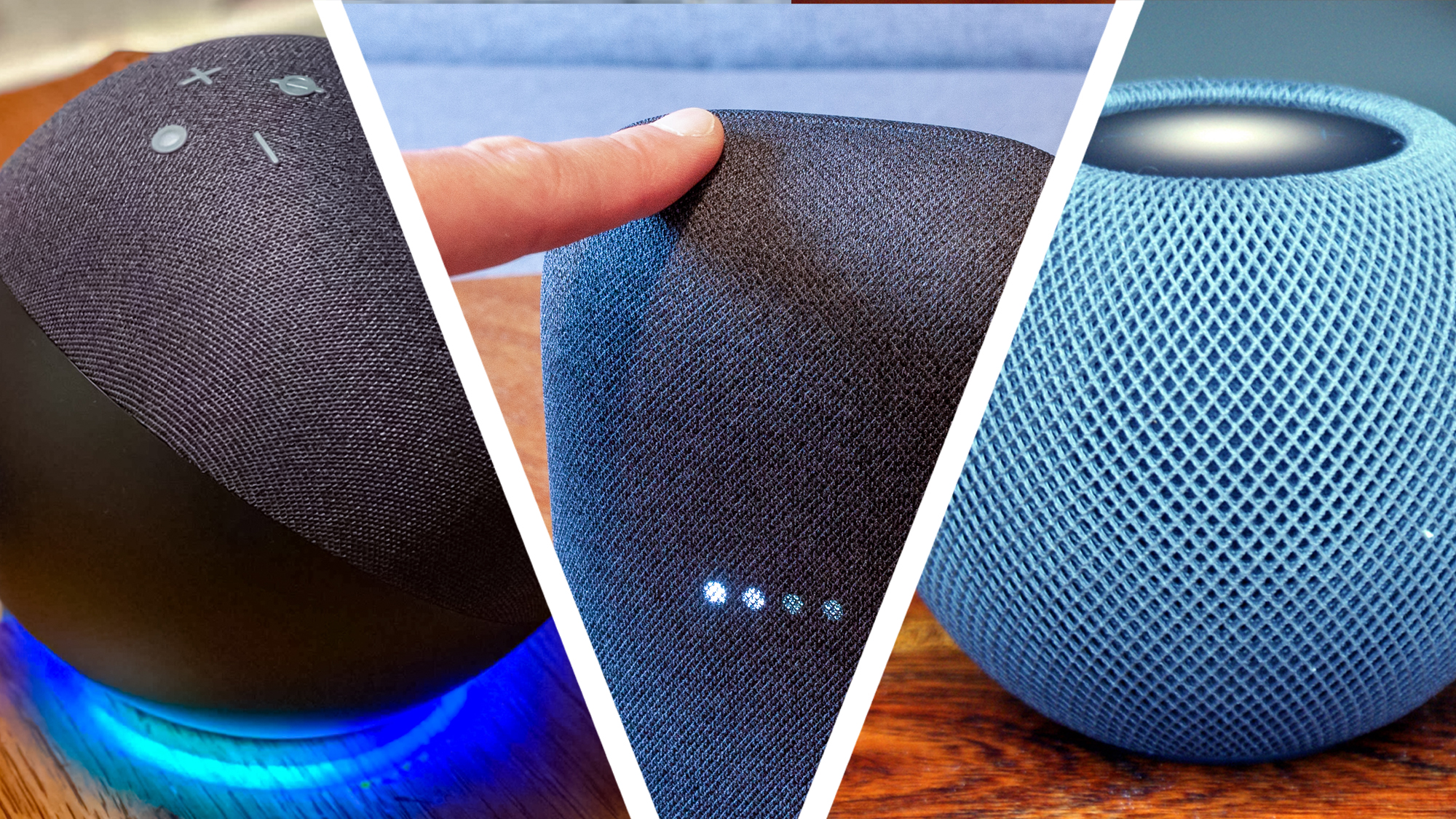
First of all, there's the smart-speaker-ness of the whole rumored OpenAI concept. There are already too many smart speakers on the market, many of them with their own smart assistants. Amazon, for instance, is smack in the middle of trying to convince millions of customers that not only do they need Echo devices throughout the home, but they need the AI-powered Alexa+ to guide them through their smart home experiences and, to some extent, their lives.
Apple has its own HomePod, Siri-infused speakers, which may get considerably more powerful with the Gemini foundation model-backed version arriving this Fall.
Put another way, smart speakers are a known quantity in the home consumer electronics space, and I think what most tech companies are realizing is that people like and use them, but mostly in limited ways: they want music, occasional answers to simple questions, and voice control of their smart home devices. That's it.
Why does my speaker think it's alive?
(Image credit: Future)
OpenAI appears to be prepared to offer something different: a personality-filled speaker that can watch you, move to engage, seem alive, and generally make you feel uncomfortable.
Obviously, that would not be the objective, but it could be the result. Who needs a speaker that quietly watches you as you walk from your kitchen to the den, waiting and hoping for you to say, "hey ChatGPT, what's up with the Strait of Hormuz today?"
In my home, we have a Psync smart security webcam with one oddball feature: it has a motorized body that can turn almost 360 degrees on its base and lift its thin, rectangular face and camera to keep track of people and alert me to intruders. However, most of the time, it's just watching us move around the house, and I can tell you that my family hates it. Sometimes I come home and find its face forced down so it can't pop up and track anything.
Now, imagine a larger and far smarter OpenAI AI smart speaker in your home, watching, waiting, chiming in when you don't want it to, and generally making people feel uncomfortable.
This will not be the breakout hardware hit OpenAI is hoping for.
Look, I was under the impression that OpenAI (really Jony Ive and Sam Altman) were working on an AI wearable. I didn't love that idea either, but it was a lot less creepy than this.
So, Apple, chill out. OpenAI's plans are no threat to you, even if they do allegedly have a bunch of insidery Apple information.
AI hallucination can be weaponized, new report warns
HalluSquatting is short for “adversarial hallucination squatting”
GitHub Copilot, Gemini CLI, and OpenClaw are all affected
Your favorite AI service could be subverted to deploy code that turns your phone or PC into a botnet, according to researchers at Intuit, Technion, and Tel Aviv University.
The technique has been given the name HalluSquatting, a portmanteau of adversarial hallucination squatting, and is similar to typosquatting in that it relies on a mistake in order to distribute malicious code. While typosquatting might occur with the incorrect input of a website URL, HalluSquatting pivots on an LLM being unable to identify a resource or repository with 100% accuracy.
Relying on an LLM’s tendency to hallucinate repository resource identifiers, this weakness could be scaled up to conduct massive ransomware campaigns, botnets, and more.
Push-me-pull-you
Previous LLM-based malware operations have relied on pull-based attacks. In this scenario, a prompt designed to jailbreak or otherwise subvert the AI is (for example) placed on a website and the LLM encouraged to gather the information, thereby reducing its internal security.
What the researchers have shared in their paper, is that pull techniques are being combined with push attacks, which are traditionally executed as code injection.
The paper’s introduction summary states: “By preemptively registering hallucinated resources—a technique we call adversarial hallucination squatting (HalluSquatting)—we demonstrate remote tool execution and remote code execution at scale across a range of popular agentic LLM applications, which could be exploited to the establishment of a botnet.”
Once an attacker has identified the resource likely to be misnamed by an LLM, and squatted on it (to embed adversarial prompts), the work is done. All that remains is for a user to trigger the resource, the AI chatbot or agent to initiate the response, and the squatted resource will be accessed.
Promptware attack
Following this, the adversarial content held within the squatted resource is activated, triggering the tool invocation stage. This is the promptware attack, where attacker-controlled instructions are executed, with results potentially including turning the device you’re using into a botnet zombie.
LLMs such as the Cursor, Cursor CLI, Windsurf, GitHub Copilot, Cline coding assistants have been used in the testing of this avenue of attack along with Gemini CLI, and the OpenClaw, ZeroClaw, and NanoClaw AI assistants. The researchers successfully achieved remote tool execution (essentially remotely accessing and controlling the LLMs) and remote code execution (RCE, where malicious code is executed remotely).
Some mitigation is available, including LLM developers blocking fetch operations in favor of a search tool, and resource owners enforcing strict naming, perhaps in favor of globally unique resource names. However, these are will require collaboration by disparate parties, and may take a while to implement.
The risk of LLM-based malware is increasing, and some has already been spotted in the wild. Of these, the JADEPUFFER attack is perhaps the most notable, as it isn’t simply AI-based malware – it is a full ransomware attack run entirely by an LLM.
It claims to be able to reduce AI generated codebases by up to 65% in size
They aim to "refactor vibecoded codebases back to maintainability"
Vibecoding has a lot to answer for, not least some excessively large codebases. A new team of software engineers are collaborating to reduce the size of these cumbersome projects… with a $10,000 per week bill.
Slopfix is the name of the team (comprising a trio: Maciej, Kuba, and Krzysztof), but its aim is efficiency and functionality, rather than code golf, where code is reduced to the shortest possible length.
However, while this might seem like a noble task and a service worth paying for, Slopfix isn’t taking a stand against the use of AI. In fact, it is employing AI tools to detect the AI flab in your codebases.
Use an AI to catch an AI
Challenges around vibecoded projects have increased in recent months, as the limitations of the technology become apparent.
While using an AI to program based on your prompts and requirements is straightforward, agents habitually begin to lose context and logic once the project reaches a certain size or age. Once that happens, you’re looking at duplication, features breaking, and of course, the dreaded hallucination.
Slopfix is targeting companies that have adopted vibecoding, built huge codebases, and found that they’re running into issues. To find the problematic AI code, however, Slopfix is employing AI.
They state that a full “screen by screen, endpoint by endpoint” evaluation of the vibecoded app is made, which aims to find the duplicated functions, broken logic, and other issues. There’s also the promise of a two-week warranty for anything they break.
All of this is aided by Claude Code “on a very short leash” which Slopfix uses find problems. They clearly state that “the agent doesn’t get a vote.” Instead, they’re relying on their experience as developers to improve your code.
$10,000 seem a bit steep?
While the price might seem high, $10,000 for one successful week’s work for three seasoned developers shouldn’t really be a budget breaker.
The fee covers successful work only, and as the Slopfix website states, payment is in proportion to how much of the reduction target the team hits, with $10,000 being the price for hitting the target – it’s not the default fee.
However, there is a lot of preparation involved, and the analysis of your codebase is conducted free of charge. If they can't fix your project's issues, they'll let you know and refuse the contract.
As software consultancies go, Slopfix is an unusual case. But as the problems with vibecoded projects begin to become apparent, competing consultancies may begin offering similar services.
The White House is worried about AI's cybersecurity implications
Meta urged to submit frontier AI models for review before release
OpenAI and other major developers have already signed up to do this
The White House is reportedly urging Meta to voluntarily submit its most advanced AI models to the government for security reviews before they get released publicly, per New York Timesreporting.
Doing so would allow US policymakers to assess model capabilities, security risks and vulnerabilities, with the administration likely focusing on military implications like cyber warfare and attacks on critical national infrastructure.
According to the report, Meta is one of the few major AI developers that has not yet agreed to participate in the voluntary review program.
Meta pressed to submit AI models to US government for review
Companies like OpenAI, Anthropic, Google, Microsoft and xAI have already entered similar arrangements with the US government, and Meta could be next to sign up.
"We share the administration's goal of advancing U.S. leadership on robust and secure frontier AI," a company spokesperson said (via Reuters).
"While we are working through the details, we hope to sign the agreement soon."
The news follows the signing of an executive order to establish a framework for the government evaluation of advanced AI models before public deployment.
"Advanced AI capabilities make our Nation stronger, but also introduce new national security considerations that require coordinated action," the order reads.
The Five Eyes intelligence alliance (US, UK, Canada, Australia and New Zealand) also recently declared that AI systems are now more capable than ever at launching highly sophisticated cyber attacks. "Frontier Al models are anticipated to exceed current industry expectations," the alliance wrote.
If Meta signs up to participate, it means that virtually all major US frontier AI developers will be voluntarily submitting models for review prior to public release.
US government ordered Anthropic to pull frontier models for foreign nationals
Legal AI startup claims it had contractual access to those models
Anthropic doesn't agree with the White House – but complies
Legal AI startup Legion LegalTech Corp has filed a lawsuit challenging a June 12 government order that forced Anthropic to restrict access to its most advanced AI models, Fable 5 and Mythos 5, for foreign citizens (via Reuters).
According to the complain, the Bureau of Industry and Security (BIS) gave Anthropic around 90 minutes to comply with the order, or face civil and criminal penalties.
All foreign nationals, including those living inside and outside of the US, and even Anthropic's own employees, are said to be affected by the order.
Government order to ban Anthropic models internationally legally challenged
Legion LegalTech Corp acknowledges that the order was triggered because of concerns that users could jailbreak models into reviewing software code and identifying vulnerabilities, but the startup argues this is a common capability of all frontier models and doesn't just affect Anthropic's models.
The company says it had contractual access to Anthropic's Fable 5 model, and was actively integrating it into its products that draft and manage cases. Because the company employs Canadian developers working remotely from Canada, it lost access to the model once restrictions took effect.
"Anthropic took no independent action to restrict Legion’s access; it complied with the government’s command under threat of enforcement consequences," the lawsuit reads.
The lawsuit argues that no current export control classifications cover access to cloud-hosted AI models. It also references an independent reviewer, who sees the government's action as disproportionate and "way out of line."
Anthropic announced the frontier models on June 9. By June 12, it had released a statement in response to the government directive, criticizing the government for "not provid[ing] specific details of its national security concern."
"We are complying with the government’s legal directive and are removing access to Fable 5 and Mythos 5 for all users."
Apple avoids setting off your iPhone when its execs say “Hey Siri” at events
One enterprising engineer decided to find out why
By analyzing the keynote’s audio, they solved an intriguing mystery
Siri has just been given the brain transplant it's needed for years, but it's always been good at detecting the words "Hey Siri" — so much so that accidental summonings have been a common problem. But an audio engineer has just explained how Apple cleverly avoided Siri popping up on your phone during its recent WWDC 2026 keynote.
As revealed by Techexplain on Substack, it all comes down to the audio frequencies embedded in Apple’s keynote video. Once Apple’s audio engineers made a few subtle tweaks, the company’s presenters could say “Hey Siri” as much as they liked without risking millions of phones going off around the world.
To find out what was going on, Techexplain downloaded the audio and video from the WWDC event. They fed that into a spectrogram analyzer, which is an app that can visualize audio frequencies as colored graphs and bands. When the WWDC video was examined, it revealed that a few frequency bands in the 3kHz to 6kHz range had been removed from the audio.
And this is the key to the video not invoking Siri. Without those four frequency bands, the Siri assistant lurking on your device did not hear the phrase “Hey Siri” — even though Apple’s presenters said it repeatedly throughout the show.
Wait, how exactly does this work?
(Image credit: Apple)
Apple’s solution might sound odd. After all, doesn’t Siri listen out for the trigger words being spoken? If those words were present in Apple’s video, shouldn’t Siri have been activated?
Well, not quite. Your iPhone contains an “always-on processor” chip whose job is to constantly sample background audio, which is then fed into a neural network. The audio is converted into a spectrogram and the neural network analyzes it to look for a specific frequency pattern — in this case, the sibilant sound that occurs when you say “Siri.” And yep, you guessed it, those sibilant sounds mostly exist in the 3kHz to 6kHz range.
In other words, what Siri is actually listening out for is a frequency rather than the words being spoken. It means that if Apple’s engineers remove the 3kHz to 6kHz bands from the WWDC keynote, Siri won’t “hear” its name being spoken — even if that’s exactly what the presenters are doing.
It’s a clever trick that helps ensure Apple’s presenters can speak naturally without the need to avoid saying “Siri.” At the same time, it avoids setting off millions of iPhones and annoying their owners when “Hey Siri” is uttered. It’s an ingenious solution that solves a thorny problem in a satisfyingly elegant way — and we wouldn’t expect anything less from Apple.
University researchers and NHS staff developed an AI forecasting tool that predicts resignations and explains workforce factors behind possible departures.

 Login