❌

Reading view

ARK Augmented Reality Could Build Apple’s Knowledge Layer

ARK augmented reality describes a form of spatial interaction in which artificial intelligence does more than place digital objects in the physical world. It uses knowledge from foundation models to understand unfamiliar scenes, generate useful information and adapt its response to the person, task and environment.

The concept comes from a 2023 research paper titled “ArK: Augmented Reality with Knowledge Interactive Emergent Ability.” Its authors proposed a system that transfers knowledge from large foundation models into new physical and virtual environments. Instead of training an AI agent separately for every room, object or activity, ArK uses existing knowledge memory to interpret what it sees and generate appropriate 2D or 3D content.

Traditional augmented reality places information over reality. ARK augmented reality tries to understand reality before deciding what should appear.

That distinction creates a compelling direction for Apple. Vision Pro already blends digital content with physical space. Apple Intelligence adds language, image understanding and personal context. Visual Intelligence lets users look at objects, text and scenes before asking for information. Siri AI adds a conversational layer. ARKit, RealityKit and visionOS provide the spatial foundation.

Apple now has many of the components required to build a knowledge layer over the physical world.

ARK Augmented Reality Goes Beyond Digital Overlays

Most familiar augmented reality experiences are relatively fixed. A furniture app places a digital sofa in a room. A navigation app displays arrows over a street. A museum app identifies an artwork. A repair app shows where a component belongs.

These experiences can be useful, but they usually depend on predefined content and rules. The system recognizes a known object or location, then presents prepared information.

ARK augmented reality proposes something more adaptive. A knowledge-enabled system could enter an unfamiliar environment, interpret what is present and generate assistance based on a broader understanding of objects, relationships and possible actions.

A user looking at a complicated electrical panel would not only see labels. The system could identify the panel type, explain the purpose of each section, compare the arrangement with standard configurations and warn the user not to touch dangerous components.

A student examining a machine could ask how it works and receive a spatial explanation attached to its real parts. A surgeon could review anatomical information positioned around a medical model. A technician could receive repair guidance even when the exact equipment had not been included in a previous training dataset.

The display becomes less like a floating screen and more like an informed interpretation of the environment.
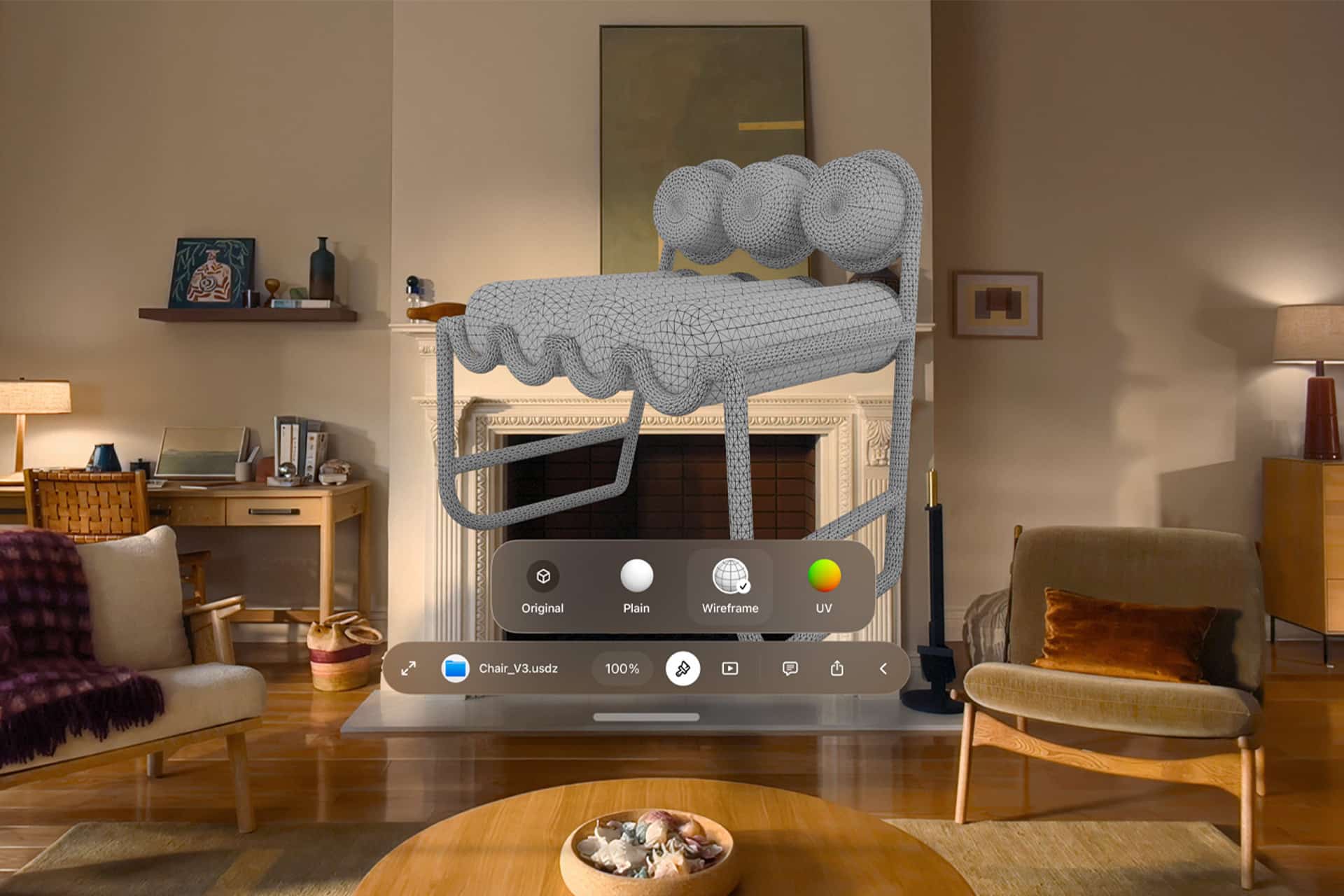
A cozy living room with a digital interface on Apple Vision Pro displaying a 3D wireframe chair design, superimposed in front of a fireplace and surrounded by modern furniture and warm lighting.
Image Credit: Apple Inc.

Why Apple Is Positioned to Build It

Apple’s advantage would not come from inventing every part of ARK augmented reality. It would come from combining hardware, software, artificial intelligence and personal context into one controlled ecosystem.

Vision Pro already understands rooms, surfaces, hands, eyes and objects well enough to place digital content convincingly in physical space. Its cameras and sensors continuously map the environment while visionOS manages windows, volumes and immersive experiences.

Apple Intelligence provides another layer. Foundation models can interpret language, summarize information, generate content and connect requests with app actions. Visual Intelligence can identify text, images and real-world objects. Siri AI can act as the conversational interface.

The Apple ecosystem also provides personal context that a generic AR platform may not have. Calendar knows the user’s schedule. Maps understands location. Photos contains visual history. Notes and Mail hold project information. Health contains personal trends. Home understands rooms, accessories and automations.

An Apple-built knowledge layer could combine the environment in front of the user with the information already available across trusted devices and apps.

A person preparing for a meeting could look at a conference room and see the agenda, participant names and relevant documents arranged around the table. A traveler could look across a train station and receive directions connected to the correct platform, departure time and digital ticket. A homeowner could examine a room and see live information from temperature, air-quality and energy sensors.

The physical environment becomes the interface.

Vision Pro Is the Laboratory

Vision Pro is the obvious development platform for this idea because it already offers the cameras, displays, sensors and processing required for advanced spatial understanding. Its size and price limit broad adoption, but those same characteristics allow Apple and developers to test experiences that would be harder to build first on lightweight glasses.

ARK augmented reality on Vision Pro could become especially useful in enterprise environments. Apple already promotes the headset for employee training, product design, field service, collaboration and specialized visualization.

A worker could enter an unfamiliar facility and receive contextual instructions attached to real equipment. An engineer could inspect a physical prototype while design changes, performance data and maintenance history appear around it. A new employee could learn a workflow through spatial guidance generated from company manuals and operational knowledge.

The system would not need to display every available fact. It would need to understand which information fits the current task.

That is where AI knowledge becomes more valuable than a traditional AR overlay. Too much information can be as disruptive as too little. A strong system should filter, prioritize and explain rather than cover the room with floating labels.

ARK augmented reality - A modern living room with visionOS virtual reality overlays displays an online store page for a red stool, alongside a 3D modeling preview of the stool positioned on the floor near a fireplace and sleek, modern chair.

The iPhone Could Bring ARK to More People

Vision Pro may be the development environment, but iPhone could provide the scale. The iPhone already combines cameras, LiDAR on Pro models, location, motion sensing, Visual Intelligence and Apple Intelligence.

An iPhone-based ARK experience would be less continuous because users would need to hold up the device. It could still deliver useful knowledge interaction without requiring a headset.

A user could point the camera at a plant and receive care guidance based on its species, visible condition, local weather and placement in the room. Someone assembling furniture could receive generated guidance positioned over the actual parts. A shopper could compare products by looking at them rather than manually searching for each model.

The difference from ordinary visual search would be interaction. The user could ask follow-up questions, change the goal and let the system update the visual guidance.

Future glasses could eventually make the experience persistent. The iPhone would help Apple develop the intelligence, privacy controls and app ecosystem before lightweight eyewear becomes ready.

A World That Explains Itself

The most ambitious version of ARK augmented reality is a world in which information is attached to objects, places and situations only when requested or needed.

A city could become understandable without searching through maps, review sites and separate transit apps. Buildings could reveal history. Streets could explain temporary closures. Restaurants could surface reservations, dietary options and accessibility details. Public transport could show the correct entrance and platform.

Inside a home, Apple’s knowledge layer could explain energy use, identify maintenance problems and guide repairs. In a classroom, physical models could become interactive lessons. In healthcare, patients could receive visual instructions for approved home procedures or medication devices.

The experience would depend on context rather than menus. The user looks, asks and receives information positioned where it belongs.

This is the transition from augmented reality as decoration to augmented reality as understanding.

Privacy Will Decide Whether It Works

A knowledge layer capable of understanding the physical world also creates serious privacy questions. The system may see homes, workplaces, documents, faces, screens and private conversations. The more context it receives, the more useful it becomes. The same access can also make it invasive.

Apple’s privacy architecture could become one of its strongest advantages. On-device processing would allow some scene understanding without sending continuous camera feeds to external servers. Private Cloud Compute could handle more complex requests while preserving stricter controls than an ordinary cloud AI service.

Apple would also need visible controls over what is analyzed, remembered and shared. A user should know when the system is interpreting the environment and whether information is temporary or retained. Workplaces and public spaces would need rules for recording, identification and sensitive data.

ARK augmented reality cannot become socially acceptable if people feel that nearby devices are constantly cataloging them.

The successful version would behave less like surveillance and more like intentional assistance. The user asks for understanding. The system processes only what is needed. The knowledge disappears when the task ends unless the user chooses to save it.
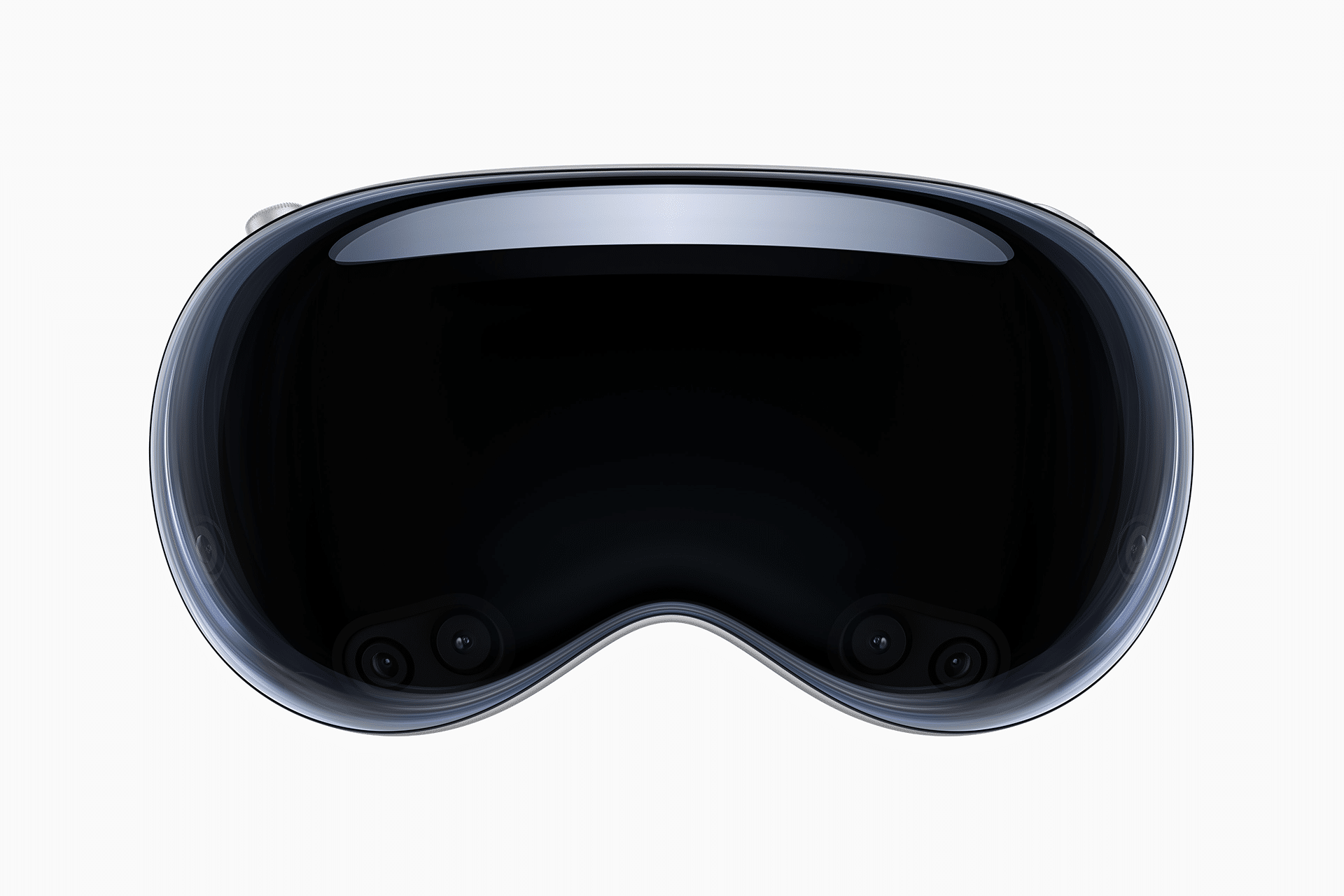
A sleek, black, futuristic virtual reality headset with a smooth, curved design and reflective surface—perfect for exploring the latest Betas—viewed from the front against a white background.
Image Credit: Apple Inc.

Developers Could Build Knowledge Worlds

Apple would not need to create every knowledge experience itself. visionOS, ARKit, RealityKit and App Intents could let developers connect specialized knowledge with physical environments.

A medical company could build guidance for approved equipment. A manufacturer could create spatial maintenance systems. A university could attach interactive explanations to laboratories and museums. A retailer could create product comparisons based on inventory and customer preferences.

Apple could provide the shared intelligence layer: scene understanding, object recognition, language interaction, privacy permissions and spatial presentation. Developers would provide the trusted domain knowledge.

This division would be essential. General AI can explain many things, but professional environments require verified information. A generated answer about a historical building has different consequences from an answer about industrial machinery or medical treatment.

Apple’s platform could distinguish between general knowledge and certified domain sources, allowing users to see where information comes from before acting.

From Spatial Computing to Contextual Computing

Apple describes Vision Pro as a spatial computer because digital content can occupy physical space. ARK augmented reality suggests the next progression: contextual computing.

A spatial computer knows where digital content is placed. A contextual computer understands why the content is useful in that location, what the user is trying to accomplish and which knowledge should appear.

That would connect several Apple strategies that currently look separate. Vision Pro supplies spatial awareness. Apple Intelligence supplies reasoning and generation. Siri AI supplies conversation. Visual Intelligence supplies real-world understanding. The ecosystem supplies personal context.

Together, they could create a system that does not wait for users to open the correct app and search through the correct menu. The environment itself becomes the starting point.

Apple’s opportunity is to make that interaction restrained rather than overwhelming. The company does not need to cover reality with digital noise. It can use design, privacy and contextual intelligence to make information appear only when it improves the moment.

ARK augmented reality offers a useful description of that future. Reality remains visible. Knowledge becomes interactive. The computer begins to understand the world in front of the user instead of asking the user to translate everything into a search box.

The post ARK Augmented Reality Could Build Apple’s Knowledge Layer appeared first on AppleMagazine.
  •  

White Spot on iPad Screen: What to Do

A white spot on iPad screen can appear as a bright patch that remains visible while browsing, watching videos or using apps. It may be small and easy to ignore at first, then become distracting whenever the screen shows a white, gray or lightly colored background.

The spot may come from a temporary software problem, but a fixed bright area is more commonly connected to the display hardware. Pressure inside the iPad, a damaged backlight layer, display separation or an impact can create uneven illumination that no setting can remove.

Before arranging a repair, a few simple checks can reveal whether the spot belongs to the image being displayed or to the physical screen itself.

What Causes a White Spot on iPad Screen?

A white spot on iPad screen is often described as a bright spot, pressure mark or backlight patch. On iPads with LCD displays, light passes through several internal layers before reaching the glass. When one of those layers becomes damaged, separated or compressed, light can concentrate in one area.

The mark may be more visible against pale backgrounds and almost disappear when the screen displays black or dark content. This is different from a dead pixel, which usually appears as a tiny fixed dot rather than a larger cloudy patch.

Pressure is one possible cause. Carrying an iPad in an overloaded bag, placing heavy objects on it or using a tight case can place stress on the display. A drop may also disturb the internal screen layers without cracking the front glass.

Battery swelling can create similar pressure from inside the device. If the screen is lifting from the frame, the iPad feels unusually warm or the body appears bent, stop using it and seek service. A swollen battery should not be pressed back into place or handled as an ordinary screen defect.

The problem can also appear after a display replacement involving a poorly fitted or lower-quality part. Apple notes that nongenuine displays may produce inconsistent brightness, color or touch behavior.

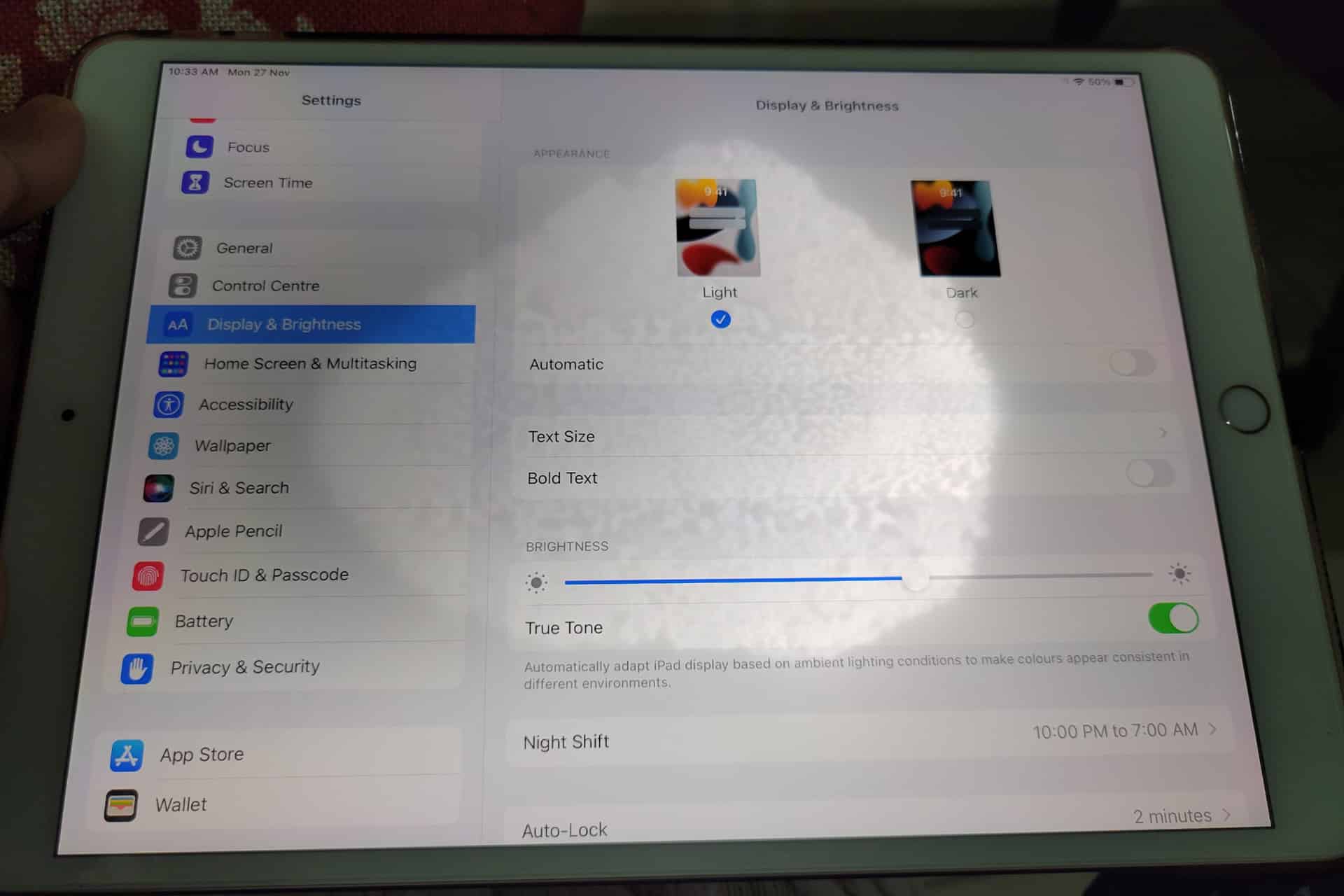
White spot on iPad screen - An iPad displays its "Display & Brightness" settings, showing options for Light and Dark modes, brightness adjustment, True Tone, Night Shift scheduling, and other appearance settings—features that can help users address common issues like an iPad screen problem or an uneven iPad backlight. A hand holds the device.
Image Credit:

Check Whether the Spot Is Really on the Display

Begin by opening several different apps. Look at the spot over a white webpage, a gray Settings screen, a dark photo and a full-screen video. A hardware-related mark normally stays in the same physical location regardless of what appears underneath it.

Rotate the iPad. If the content changes orientation but the bright patch remains in the same part of the glass, the display is the likely cause.

Taking a screenshot provides another useful test. A physical screen defect will not normally become part of the screenshot file.

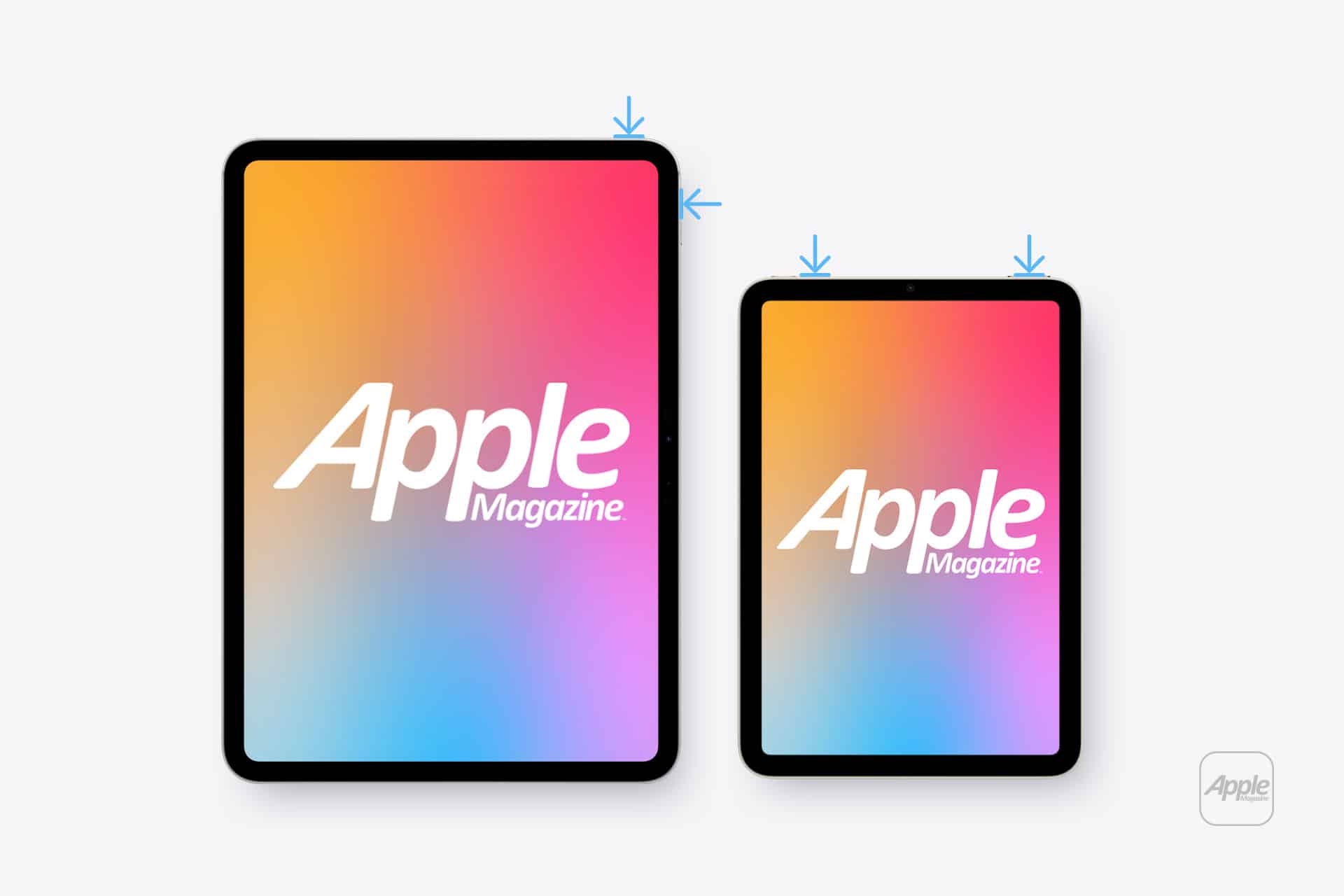
To take a screenshot on an iPad without a Home button:

Top button + either volume button

To take a screenshot on an iPad with a Home button:

Top button + Home button

Open the screenshot on another device or send it to a trusted computer. If the white spot does not appear there, the image generated by iPadOS is normal and the problem is probably inside the display assembly.

If the mark appears in the screenshot, it may belong to an app, image, accessibility setting or software effect rather than the panel.

Restart Before Assuming Hardware Failure

A restart is worth trying because it clears temporary display and system behavior without affecting personal files. It is unlikely to repair physical backlight damage, but it can eliminate a short-lived graphical problem.

To restart an iPad without a Home button:

Press and hold the top button and either volume button > Drag the power slider > Wait approximately 30 seconds > Hold the top button until the Apple logo appears

To restart an iPad with a Home button:

Press and hold the top button > Drag the power slider > Wait approximately 30 seconds > Hold the top button until the Apple logo appears

After restarting, return to the same pale background and check the area again. A spot that remains fixed is unlikely to be caused by a temporary iPadOS issue.

Two tablets displaying a colorful Apple Magazine cover are shown side by side. Blue arrows point to the corners of the tablet on the right, highlighting its narrower bezels compared to the left; it resembles an iPad Screenshot in vibrant detail.
Image Credit: AppleMagazine

Brightness Can Make the Problem More Visible

Lowering brightness may make a bright patch less distracting, but it does not repair the underlying display. The same applies to Dark Mode, Night Shift and Reduce White Point. These settings can change how noticeable the mark becomes without removing it.

To adjust screen brightness:

Settings > Display & Brightness > Brightness

Test the iPad at several brightness levels. A backlight-related spot may become easier to see as brightness increases. Photographing the screen against a plain background at medium and high brightness can also help document the defect before requesting service.

Avoid pressing or rubbing the affected area. Pressure may temporarily change the appearance, but it can damage the display further. Internet advice suggesting that users massage bright spots out of a panel should be ignored.

Check the Case and Screen Protector

Remove any rigid case that appears unusually tight or has been damaged. A poorly fitted case can place uneven pressure around the frame, particularly if the iPad has been dropped while inside it.

A screen protector normally cannot create a true illuminated patch beneath the display. It can, however, produce bubbles, trapped moisture or reflective marks that resemble a screen defect. Examine the iPad with the display turned off. If the mark is visible on the surface even when the screen is black, the protector or glass may be involved.

Do not remove a properly installed protector solely as an experiment unless the mark clearly appears close to its surface. A bright patch visible only while the display is illuminated usually comes from deeper inside the screen.

When the iPad Needs Repair

A persistent white spot generally requires display service when it remains after restarting and does not appear in screenshots. There is no iPadOS setting that can realign a damaged diffuser, remove internal pressure or repair separated display layers.

Back up the iPad before service so photos, documents and app data remain protected.

To create an iCloud backup:

Settings > your name > iCloud > iCloud Backup > Back Up Now

Apple can inspect the device and determine whether the defect qualifies for warranty coverage, AppleCare service or paid repair. Coverage depends on the device, purchase date, condition and whether the problem resulted from accidental damage.

To check coverage:

Settings > General > AppleCare & Warranty

Apple or an Apple Authorized Service Provider may replace the display assembly or the iPad, depending on the model and available service process. The final repair estimate normally requires inspection.

A white cloud icon centered on a blue gradient background symbolizes iCloud Drive offline, with a small Apple logo and the word "Apple" in the lower right corner.
Image Credit: AppleMagazine

Do Not Ignore Physical Changes

A stable white spot that has not changed for months may remain only a visual annoyance. A spot that is expanding, accompanied by screen lifting or followed by unusual heat needs faster attention.

Stop using the device if the display separates from the enclosure, the iPad becomes visibly swollen or pressure marks spread across the panel. Do not puncture the device, force the display closed or continue charging it unattended.

For an ordinary fixed bright patch, the practical path is simpler: confirm it does not appear in screenshots, restart the iPad, remove any case applying pressure and arrange display service if the mark remains.

A white spot on iPad screen rarely affects the information stored on the device, but it can indicate physical damage that software cannot correct. A brief check can rule out the easy causes. After that, repair is usually more effective than repeatedly changing display settings and hoping the light disappears.

The post White Spot on iPad Screen: What to Do appeared first on AppleMagazine.
  •  

Natural Compound Found in Cheese and Mushrooms May Help Boost Vaccine Responses

Vaccination Female Doctor Holding Vaccine SyringeResearchers have found that the natural compound spermidine can help improve vaccine responses in older adults by reducing molecular markers of immune system aging. A vaccine shot can look the same from one arm to the next, but the immune system beneath the skin may not respond with the same force. In older adults, that [...]
  •  

Engineer identifies and explains every '90s computer seen in Jurassic Park

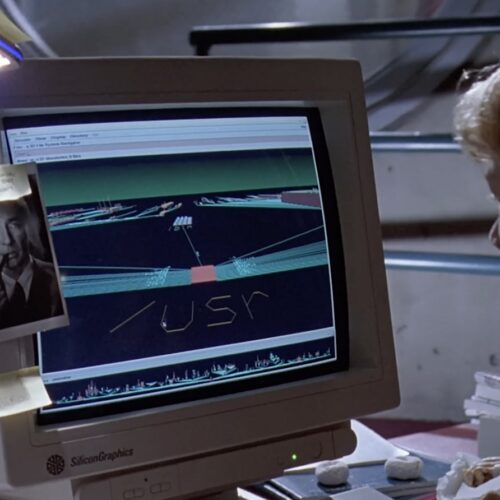
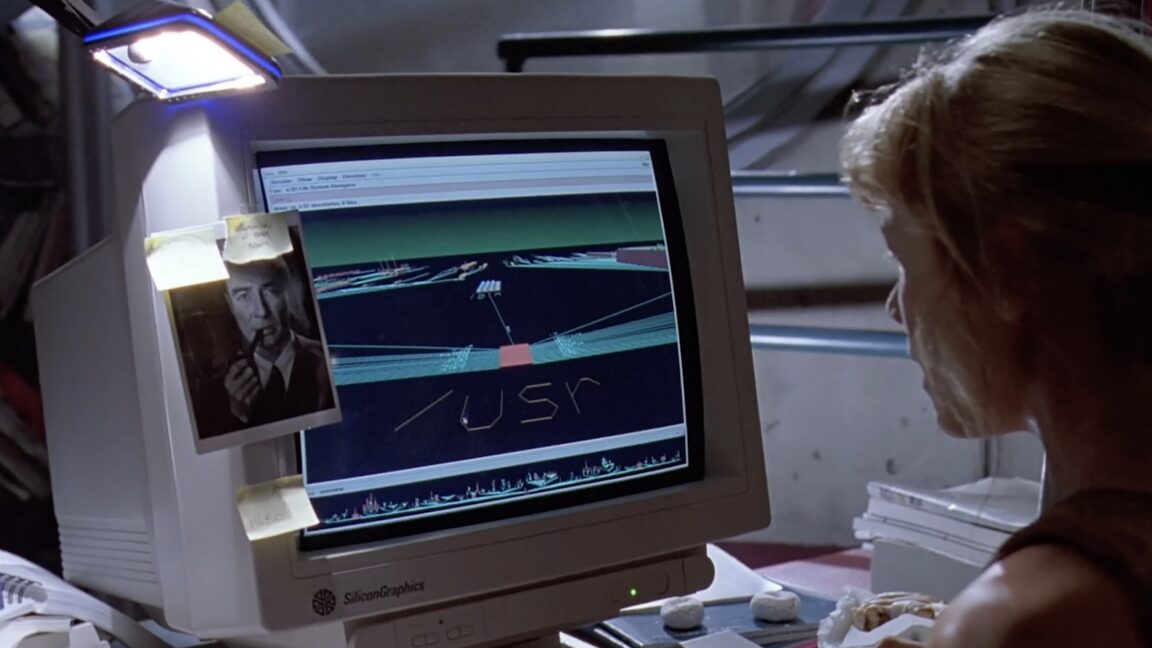
Jurassic Park, while beloved as a film, has been the subject of snarky memes for the infamous line in which one of the characters declares, "This is a Unix system, I know this!" while using a computer with an unusual 3D file manager interface.

Despite the memes, the film's production team was meticulous in accurately sourcing the right PCs (and adjacent details) for the sets—not too much of a surprise, given writer Michael Crichton's background with computing and his obsessive attention to detail in the book the film is based on.

Read full article

Comments

© Universal Pictures

  •  

Pluto’s Moon Charon May Still Be Slowing Its Spin, Study Suggests

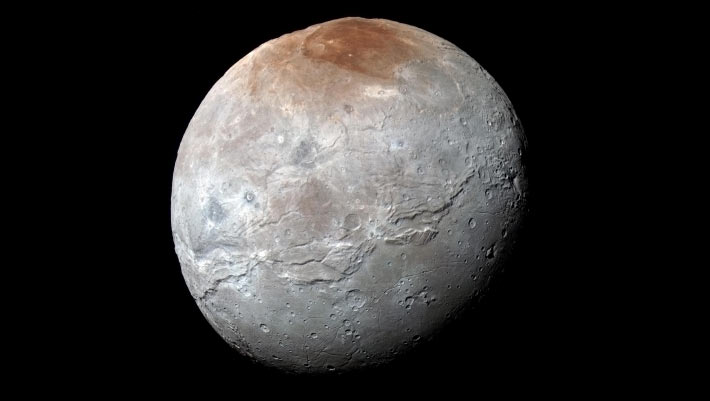
This impressive view of Charon was captured on July 14, 2015. Charon’s color palette is not as diverse as Pluto’s; most striking is the reddish north (top) polar region, informally named Mordor Macula. Image credit: NASA / Johns Hopkins University Applied Physics Laboratory / Southwest Research Institute.

New research indicates that Pluto’s largest moon, Charon, may continue to lose rotational energy despite the pair’s long-standing tidal lock, offering scientists a rare glimpse into the hidden interiors of distant icy worlds.

The post Pluto’s Moon Charon May Still Be Slowing Its Spin, Study Suggests appeared first on Sci.News: Breaking Science News.

  •  

Tianwen-2 arrives at target asteroid Kamoʻoalewa

Nearly 400 days and a billion kilometers after leaving Earth, China’s Tianwen-2 spacecraft has arrived at its target: the near-Earth asteroid 469219 Kamoʻoalewa, also known as 2016 HO3. And the mission’s first photo of the rock has already had scientific impact, reopening an ongoing investigation over whether Kamoʻoalewa began as a chunk of the Moon.Continue reading "Tianwen-2 arrives at target asteroid Kamoʻoalewa"

The post Tianwen-2 arrives at target asteroid Kamoʻoalewa appeared first on Astronomy Magazine.

  •  

Glaciers spotted flowing across the Himalayas from space | Space photo of the day for July 15, 2026

The Himalaya mountains from space.

Glaciers flow across the Himalaya, as seen from the International Space Station. (Image credit: NASA/Jessica Meir)

Towering glaciers flow down the Himalayas' northern slopes like icy giants cascading onto China's Tibetan Plateau.

What is it?

Back in May, from aboard the International Space Station 259 miles (417 kilometers) above Earth, NASA astronaut Jessica Meir peered out the station's windows with her camera and captured a breathtaking sight.

In that fleeting moment from space, she captured the northern slopes of the Himalaya mountains stretching into China. And atop the mountains, slow-moving rivers of glacial ice carve their way downhill.

This view shows the enormity of this mountain range, which separates Nepal from China's Tibetan Plateau. The Himalayas have the highest mountains in the world, including Mount Everest, with over 110 mountain peaks surpassing 24,000 feet (7,300 meters) of elevation above sea level. Ranging across five countries (Nepal, India, China, Bhutan and Pakistan) the mountain range is about 1,500 miles (2,400 kilometers) wide.

Why is it incredible?

With the range being so incredibly expansive, this view from space offers a unique vantage point from which we can see a large swath of the mountains in motion. Even in a helicopter, you would get a fairly localized view of individual mountains in the Himalayas. This view provides a striking scene that you cannot see from the surface of our planet.

This view is also a reminder of how important space is in our evolving understanding of climate change. As our planet continues to change and sea levels rise with warming temperatures, we can see glacial movement from space. This is an important resource to researchers fighting to better understand climate change so we can better fight it. With access to information about glaciers and how they melt, move and flow across the world, we can be better prepared to protect our planet and its inhabitants.

  •  

Honeycomb structures spotted on Mars | Space photo of the day for July 14, 2026

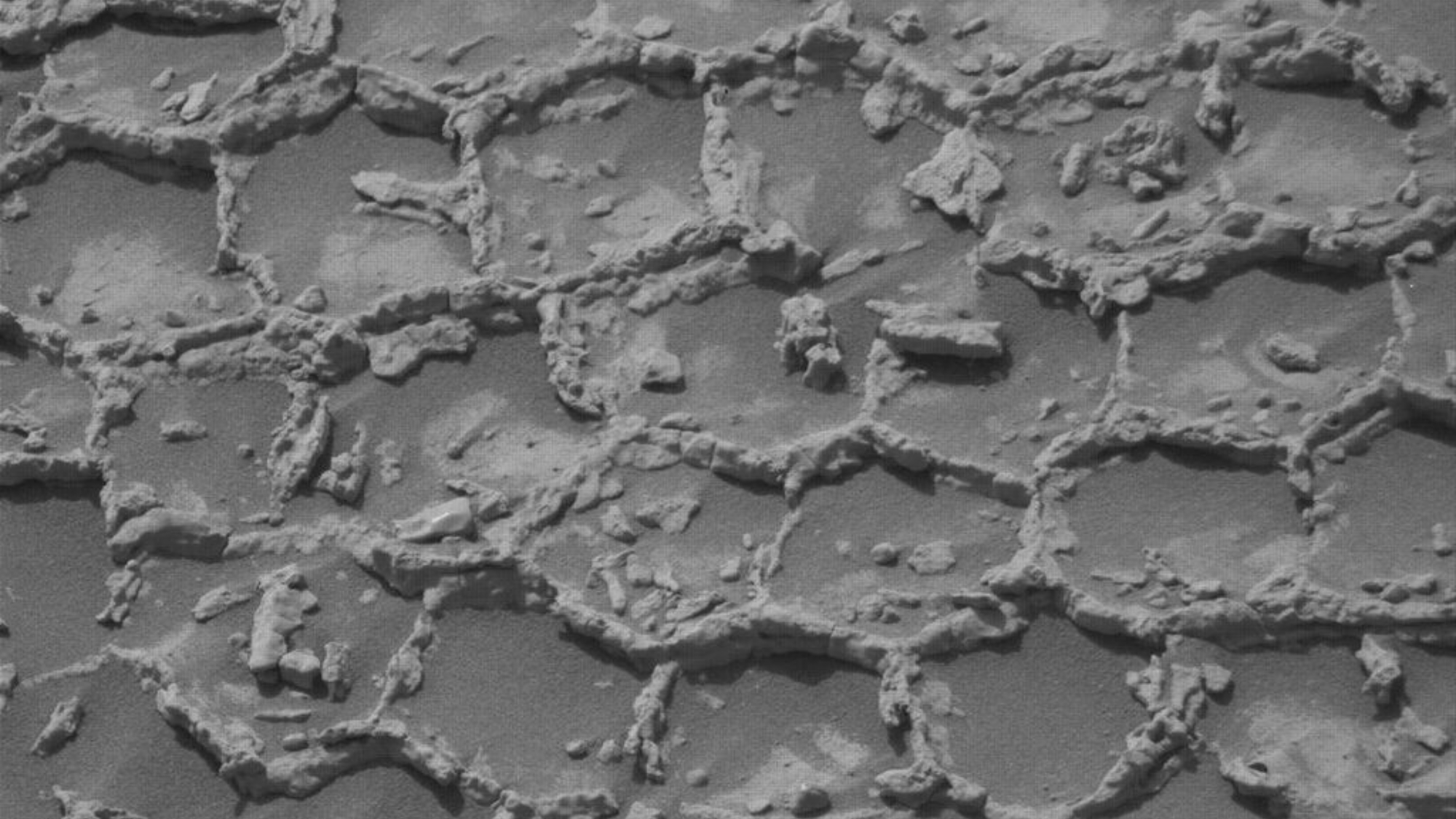
Gray honeycomb material on the Martian surface.

NASA's Mars rover Curiosity spotted these "honeycomb" structures on Mars. (Image credit: NASA/JPL-Caltech/MSSS)

NASA's Curiosity rover has spotted a strange honeycomb texture on the surface of Mars. But what is it?

What is it?

Almost 14 years since landing on the Red Planet, Curiosity is still hard at work exploring. And in new observations, Curiosity has revealed an image that is certainly ... peculiar.

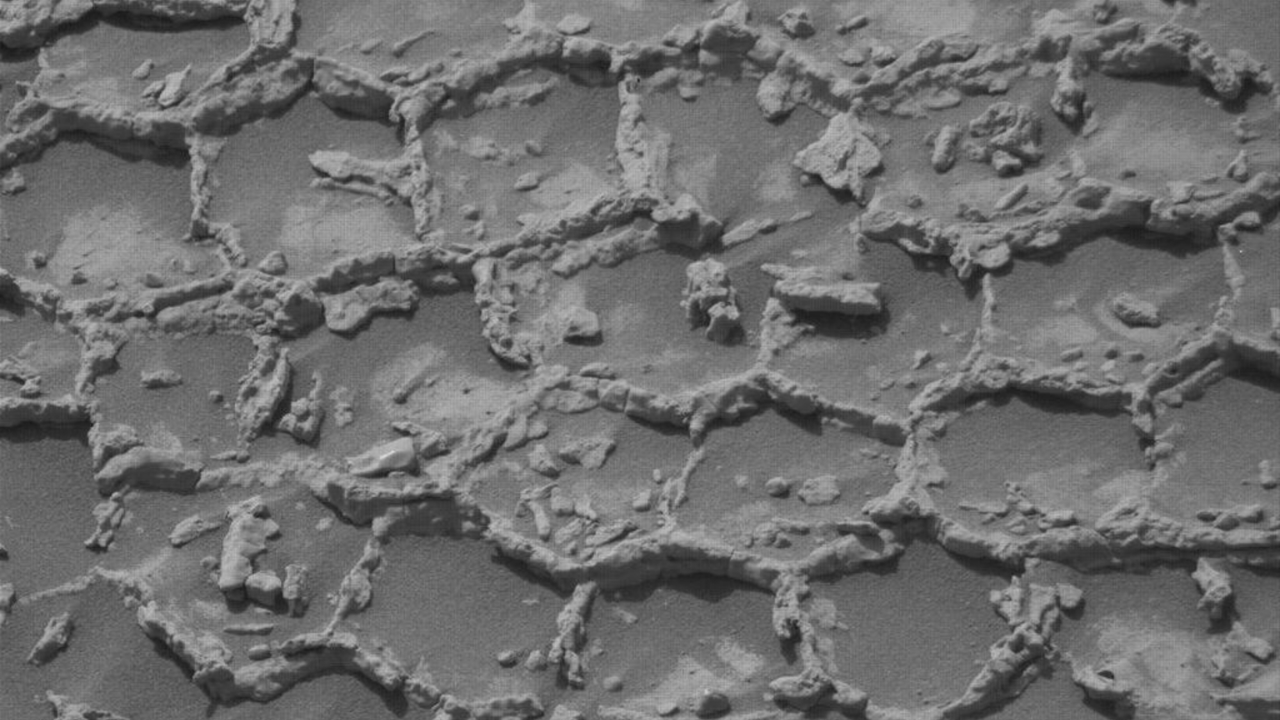
Curiosity went to get a closer look at an area first observed from Mars orbit, and found what appears to be a honeycomb structure in on the planet's surface. Polygonal shapes, nearly identical to one another, make up a pattern almost like a Martian wallpaper or carpet.

But what is it? Why does it look like that? What is a honeycomb doing on Mars?

Why is it incredible?

This is one of many mysteries we have yet to solve on Mars. While the team saw this area first from orbit around the planet, when the rover arrived and saw this structure they were surprised, they shared in a blog post.

In addition to the honeycomb texture, the area was littered with dark rocks and strewn around. But even these pebbles lack explanation. Did they "float" down from higher rock levels, did they launch out of Gale crater during some ancient collision or could they possibly even be meteorites from outside of Mars that ended up strewn across the surface? Researchers think any one of these explanations could be possible.

Previous, similar dark stones have been found on Mars with minerals like nickel that are common in meteorites and uncommon in Mars rocks. But are these similar? Perhaps part of a similar collision event? We don't yet know.

As researchers find new mysteries on Mars, they also continue to find new ways to investigate the unknown. With further study, they will explore both these strange honeycombs and the dark rocks scattered amongst them.

  •  

Feynman’s Famous Physics Problem of a Sprinkler Running in Reverse has a Surprising New Solution

For decades, physicists have debated Richard Feynman’s famous Sprinkler Problem—the question of how a reverse sprinkler would behave—and now researchers may have finally found the answer.

Made famous in Feynman’s 1985 memoir, Surely You’re Joking, Mr. Feynman!, the problem concerns the spin direction of a sprinkler-like device inside a pool that draws water inward instead of spreading it out. The researchers revealed their experimental results, based on tests with a variety of custom sprinklers, in a recent paper published in the Proceedings of the National Academy of Sciences, adding new life to the long-standing physics debate.

Feynman Experiments

“This work provides the experimental answer for Feynman’s Sprinkler Problem by showing, across several sprinkler types, how the angular momentum of water flows drives sprinklers’ rotation,” said senior author Leif Ristroph, an associate professor at New York University’s Courant Institute School of Mathematics, Computing, and Data Science.

The significance of the work extends well beyond an esoteric question about a hypothetical device, providing new insights into the physics of fluid dynamics. Feynman famously attempted to investigate the problem experimentally during the 1940s, though his apparatus reportedly failed dramatically before producing a definitive result. During his lifetime, Feynman discouraged naming the problem after himself, noting that it built upon ideas first explored by physicist Ernst Mach in the 1880s.

“Our findings provide a firmer understanding of how components respond to fluid flows—knowledge that can guide future engineering and technological advances for devices, such as turbines, that convert these flows into energy,” said co-author Brennan Sprinkle, an assistant professor at Colorado School of Mines.

Feynman Sprinkler
A visualization of Feynman’s reverse sprinkler, using particles and with false color (Image Credit: NYU’s Applied Mathematics Laboratory)

Exploring Feynman

This isn’t the team’s first work on Feynman’s Sprinkler Problem, as it builds on what they reported in an earlier 2024 paper. Unlike Feynman himself, the researchers managed to make their reverse sprinkler rotate, leading to intriguing new physics discoveries. In that work, they discovered that a reverse sprinkler would operate much like a conventional one, though at about 50 times the slower rate.

While traditional sprinklers act like a rocket of water, the Feynman sprinkler is comparable to an inside-out rocket, shooting towards the junction of the arms at the device’s center. Inside that central chamber, the team discovered something interesting: the water jets do not collide head-on, which produces the sprinkler’s reverse rotation, in what the researchers dubbed the momentum flux theory.

That 2024 study was limited to traditional sprinklers with S-shaped arms, leaving the researchers to ponder how alternate shapes would impact the water flow. After fabricating their own series of sprinkler designs, the researchers tested water flow in both forward and reverse directions, measuring torque, flow rate, and rotational motion.

Testing Theories

One of the theories they tested was Ernest Mach’s 1883 theory that the fluid and sprinkler would swirl in opposite directions, but they found it did not align with the reverse rotations and torques observed in their experiments. They also tested a theory originally attributed to Feynman and later refined by others, which suggested that water flow at the outer edges of the sprinkler arms drove rotation; however, the team’s observations showed this is not the case.

Their observations supported the team’s existing momentum flux theory in both the forward and reverse directions, across all sprinkler shapes. According to their work, the shape of the sprinkler arms controls the flow of the water jet.

“By showing that momentum flux is the answer to Feynman’s Sprinkler Problem,” Ristroph concluded, “our findings address a long-standing open problem in flow physics and provide useful knowledge about how these devices work and their effectiveness.

The paper, “Geometry Controls Momentum Flux in the Sprinkler Problem,” appeared in the Proceedings of the National Academy of Sciences on July 13, 2026.

Ryan Whalen covers science and technology for The Debrief. He holds an MA in History and a Master of Library and Information Science with a certificate in Data Science. He can be contacted at ryan@thedebrief.org, and follow him on Twitter @mdntwvlf.

  •  

Moon landings could destroy evidence of life's origins

Landing spacecraft on the moon could contaminate ancient clues about how life may have originated on Earth, a new study finds.

As NASA continues on with its plan of sending astronauts back to the moon with the Artemis program, researchers are exploring what possible unintended consequences may arise from humans visiting the lunar surface. For instance, Artemis IV will land astronauts near the moon's south pole and the agency has future plans for building a longer-term moon base on the lunar surface, which would require many more trips. And indeed, a new study has found the exhaust from spacecraft involved with these landings could expel enough methane to contaminate the moon's surface — possibly destroying molecules that could help to explain how life may have originated on Earth.

"We are trying to protect science and our investment in space," senior study author Silvio Sinibaldi, the planetary protection officer at the European Space Agency, said in a statement. "Our activity can actually hinder scientific exploration."

While experts have had concerns for some time about how rocket launches on Earth pollute our planet and atmosphere, scientists have only really considered this issue with our own planet. This is especially because we haven't been to the moon's surface in over 50 years; concerns of accidental effects of a lunar landing simply haven't been top-of-mind. That's what makes this new study so important. It points to a potential issue that could mean that future moon landings might actually be detrimental to science.

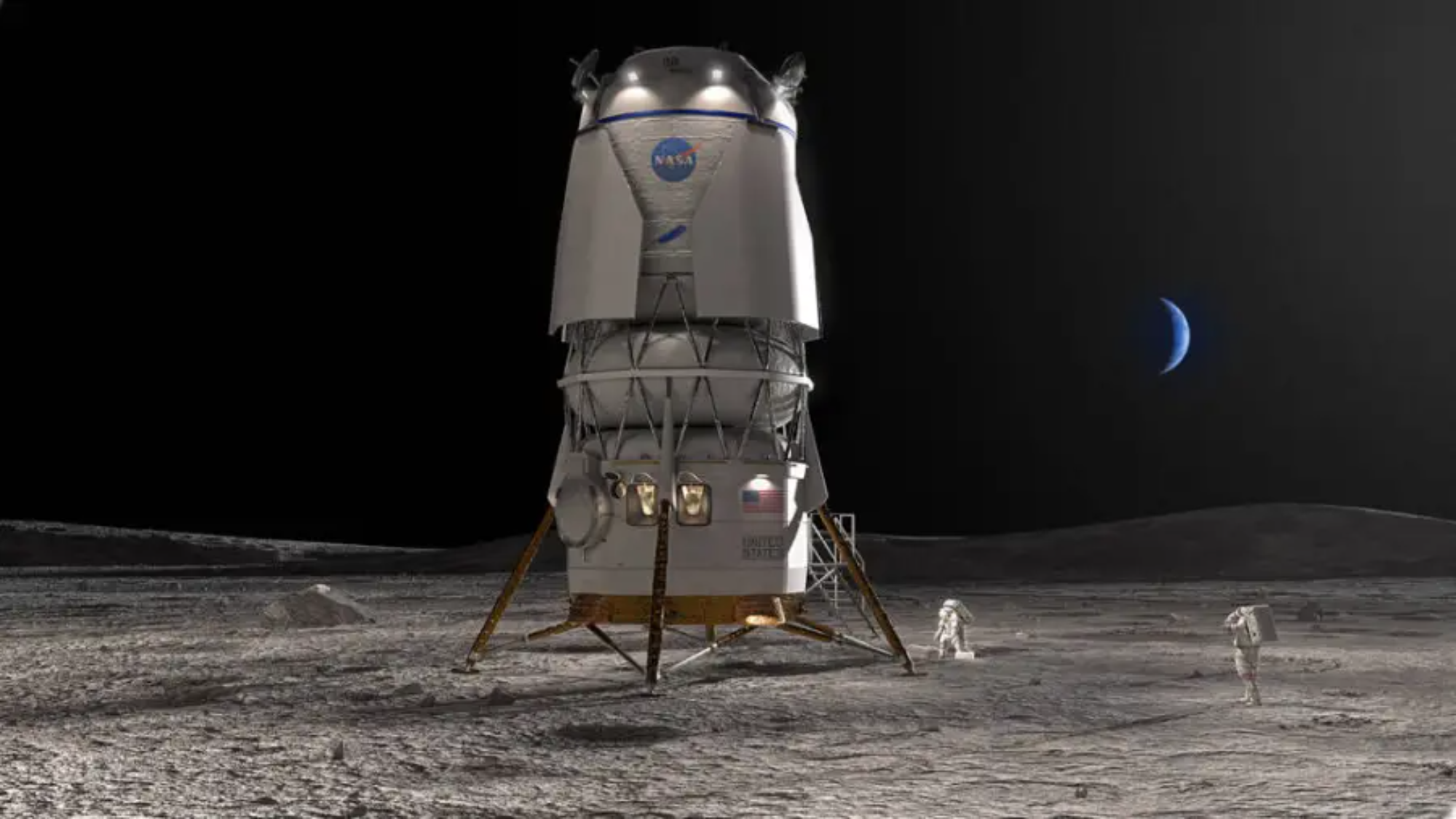
An artist's concept showing Blue Origin's lunar lander on the moon.

An artist's concept of Blue Origin's lunar lander. Lunar landings could pose a serious issue for science on the moon if methane contaminates ancient polar ices, a new study has found. (Image credit: Blue Origin)

Life's clues on the moon?

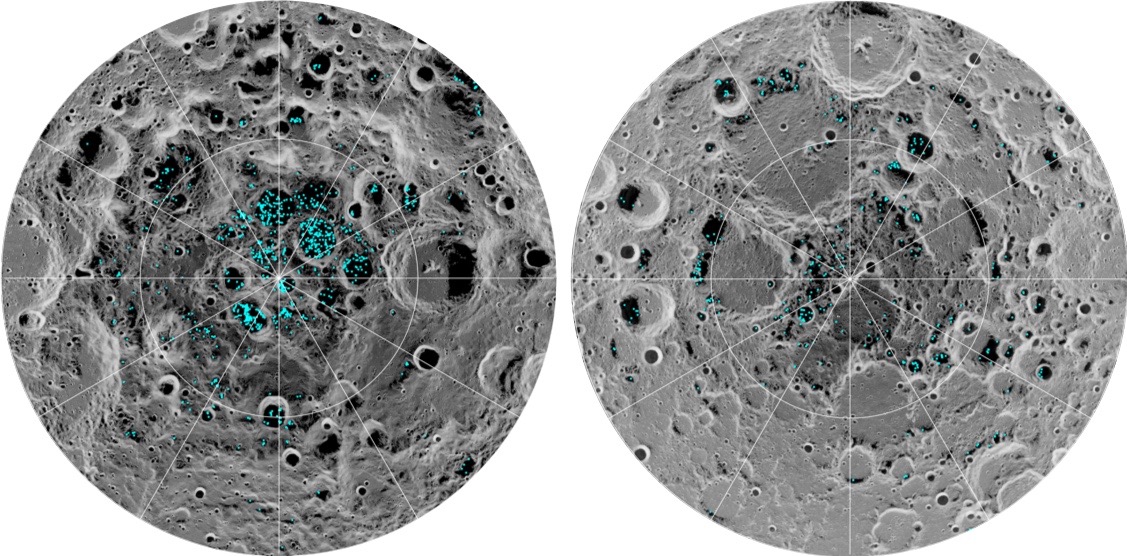
So why do we think the signs of life could be hiding on the moon? It's actually hiding in ice. Dark craters near the moon's poles, which exist in perpetual shadow, hold ancient ice. This ice is thought to contain material from asteroids and comets that smashed into the moon billions of years ago. Trapped in lunar ice to this day, these bits of ancient collisions could include what the researchers describe as "prebiotic organic molecules," or molecules that could have preceded life on Earth.

It's thought that these molecules from asteroid and comet visitors could have sparked life on Earth, and by studying those possibly trapped on the moon, researchers could be looking at the molecules that ended up combining and creating life as we know it.

The molecular history of life on Earth is pretty much nonexistent on our own planet, as it was largely destroyed by the billions of years of changes we've experienced. But the moon has remained mostly unchanged, so these wells of ice are a uniquely-preserved sampling of pre-life molecules.

"We know we have organic molecules in the solar system — in asteroids, for example," Sinibaldi said. "But how they came to perform specific functions like they do in biological matter is a gap we need to fill."

This ice exists in a somewhat fragile ecosystem, so left alone in darkness, this ice isn't going anywhere anytime soon. But with Artemis, NASA is planning on sending crewed landers to the moon's south pole. That might pose a problem. With computer models in this new study, researchers have shown that the methane exhaust from these landers could very quickly and permanently contaminate this ancient ice, destroying the molecular evidence sealed within.

Inside the simulations

This image shows the distribution of surface ice at the moon’s south pole (left) and north pole (right). Blue represents ice locations, and the gray scale corresponds to surface temperature.

This image shows the distribution of surface ice at the moon’s south pole (left) and north pole (right). Blue represents ice locations, and the gray scale corresponds to surface temperature, with darker gray representing colder areas and lighter shades indicating warmer ones. (Image credit: NASA)

In those computer models, the researchers simulated how methane, the main organic component expelled by planned lunar landers, would spread across the moon's surface after a landing at the south pole. While the simulations included the effects of solar wind and radiation, the moon's lack of an atmosphere caused the methane to spread incredibly quickly, reaching the moon's north pole in under two lunar days.

Within one lunar week (which is roughly seven months on Earth), over half the methane was trapped at the moon's cold polar areas, with a whopping 42% of the substance trapped at the south pole compared to 12% at the north pole. This methane could collect in the same cold pockets where ice and ancient molecules have been collected for billions of years, possibly contaminating this finite, scientific evidence.

"Their trajectories are basically ballistic," lead author Francisca Paiva, a physicist at Instituto Superior Técnico in Portugal, said in the statement. "They just hop around from one point to another."

In better news, there may be a way to circumvent some of this methane disturbance. For instance, the study suggests it's possible that by choosing colder landing sites, scientists can avoid having the methane travel as quickly or as far. Additional simulations are needed to better understand how exhaust compounds travel on the moon, however, as well as the risks that this poses for scientific investigations and if there are other materials lunar trips will involve that could contaminate the environment. Above all, the new study's team emphasizes that as we push toward future lunar exploration, it is key to balance our dreams of settling the moon with preserving its priceless history.

"We have laws regulating contamination of Earth environments like Antarctica and national parks," Paiva said. "I think the moon is an environment as valuable as those."

This work was described in a study published last year in the journal the American Geophysical Union.

  •  

Beans and Broccoli Linked to Lower Heart Risk in Young Adults

Sotos-Prieto et al show that modifying dietary habits can have a significant impact on health outcomes. Image credit: Silvia Rita.

A new analysis of data from the Western Australian-based Raine Study suggests that two humble vegetable groups -- legumes and cruciferous vegetables -- may play an outsize role in protecting young adults from early cardiometabolic risk, though the benefits appear to diverge sharply between men and women.

The post Beans and Broccoli Linked to Lower Heart Risk in Young Adults appeared first on Sci.News: Breaking Science News.

  •  

How many asteroids can we detect before they hit Earth?

When you think of an asteroid impact, you’re probably imagining something like the cataclysmic event that nearly wiped out the dinosaurs. In an astonishingly rare event, a rock the size of the island of Manhattan could come hurtling from deep space towards Earth and destroy the world.

On the contrary, asteroids are generally leftover debris from the primordial solar system that didn’t become part of a larger body, like a planet or moon, and they’re not particularly rare. Scientists estimate that there are about 1 billion asteroids and comets classified as near-Earth objects, or NEOs. NEOs are generally much smaller than the asteroid that killed the dinosaurs. They range from weakly held-together piles of rubble 200 meters (700 feet) across, to the minuscule 2024 BX1, approximately 44 centimeters (17 inches) across. 

For several decades, astronomical surveys of the sky have looked for these asteroids. NASA’s Center for Near-Earth Object Studies (CNEOS) Fireball and Bolide Database has records of over 1,000 incidents of objects colliding with our planet since the mid-1990s. Among these is a set of 11 objects that scientists detected before they hit Earth, known as imminent impactors. Finding imminent impactors allows scientists unique opportunities to study the smallest building blocks of the solar system, enabling them to learn more about asteroid composition, structure, and history.

A team of scientists recently conducted a study on how the newly built Vera Rubin Observatory could detect more imminent impactors before they strike Earth. They examined the CNEOS Fireball and Bolide Database impact records spanning February 1, 1994, to January 1, 2026, for records of the asteroids’ coordinates, velocities, and the energy they released at the time of collision. 

They found that 343 NEOs met this criterion, including 5 known imminent impactors. Using these recorded data, they reconstructed the objects’ pre-impact characteristics. The team predicted the asteroids’ orbital paths from the recorded coordinates and velocity. Assuming the objects were spherical, they estimated the size from velocity and impact energy. From this information about the asteroids’ state before impact, the team could then simulate whether the Rubin Observatory would have detected them. 

When small asteroids hit Earth, they mostly burn up in the atmosphere, producing a bright flash that is relatively easy to spot compared to when they are in space. The Rubin Observatory can see objects up to 10 billion times dimmer than the brightest star in the night sky, Sirius. To predict if the Rubin Observatory can detect dim NEOs, the team used the solar system simulator SORCHA. SORCHA takes an observatory’s specifications and the physical properties of the NEOs and uses these to determine whether the observatory could detect them. It also estimates the measured sizes and speeds of the NEOs, and predicts when the observatory would have seen them. 

At the Rubin Observatory, an imminent impactor is considered discovered if it’s observed at least 3 separate times over 15 days before hitting Earth. So this team applied this same criterion to their simulation. They found that of their 343 impactors, SORCHA estimated that the Rubin Observatory would have discovered 14 of them before impact. 

They also found that SORCHA predicted 4 additional impactors that could have been observed at least once, potentially allowing scientists to search other telescope data for evidence of their existence in pre-collision images. Based on these results, the team estimated that the Rubin Observatory could find 4% of all objects longer than 1 meter (3 feet) before they hit Earth. This percentage of discovery translates to 1 to 2 imminent impactors detected every year, at least double their current discovery rate.

The ability to more consistently find imminent impactors would allow researchers to study the smallest pieces of the solar system in detail and to draw general conclusions about the properties of objects that could potentially collide with Earth. This would also allow scientists to more accurately calculate the orbits of imminent impactors, determine where more meteorites land to recover them, and keep tabs on the extremely rare but more hazardous large impactors for planetary defense initiatives. So, humanity can learn more about the ancient solar system, and hopefully avoid going the way of the dinosaurs while doing so!

The post How many asteroids can we detect before they hit Earth? appeared first on Sciworthy.

  •  
❌