
❌

Reading view

Farmers in a national park are turning down lights at night to help wildlife – it could be good for crops too
Some farms are looking at how best to use their lights at night. MillaF/Shutterstock

Growing evidence suggests that excessive outdoor lighting at night may be harming wildlife.

For generations, rural communities worked to the rhythms of daylight and darkness. Today, the amount of harsh light switched on at nightime is having profound consequences for many living things.

Agricultural properties are often remote and vulnerable to equipment or livestock theft. In response, many landowners have now installed security floodlights, powerful halogen beams, and unshielded external LEDs to illuminate yards overnight.

The North York Moors National Park, an international dark sky reserve in the north of England, has been working with farmers to reduce the impact of artificial light on the natural environment.

The initiative is about ensuring that lighting is used in the right place, at the right time, and at the appropriate intensity. This might involve installing downward-facing fixtures, reducing glare through shielding, or switching to warmer-coloured lighting that is less disruptive to wildlife.

The best places to start trying to reduce bright nighttime lights are those rich in wildlife, and farms in the park are often in the darkest areas.

Since 2021, the national park has worked with more than twenty farms in key dark sky locations, with many more projects in development.

Carefully designed lighting systems can use shielded or motion-activated lighting, which reduce impact on wildlife.

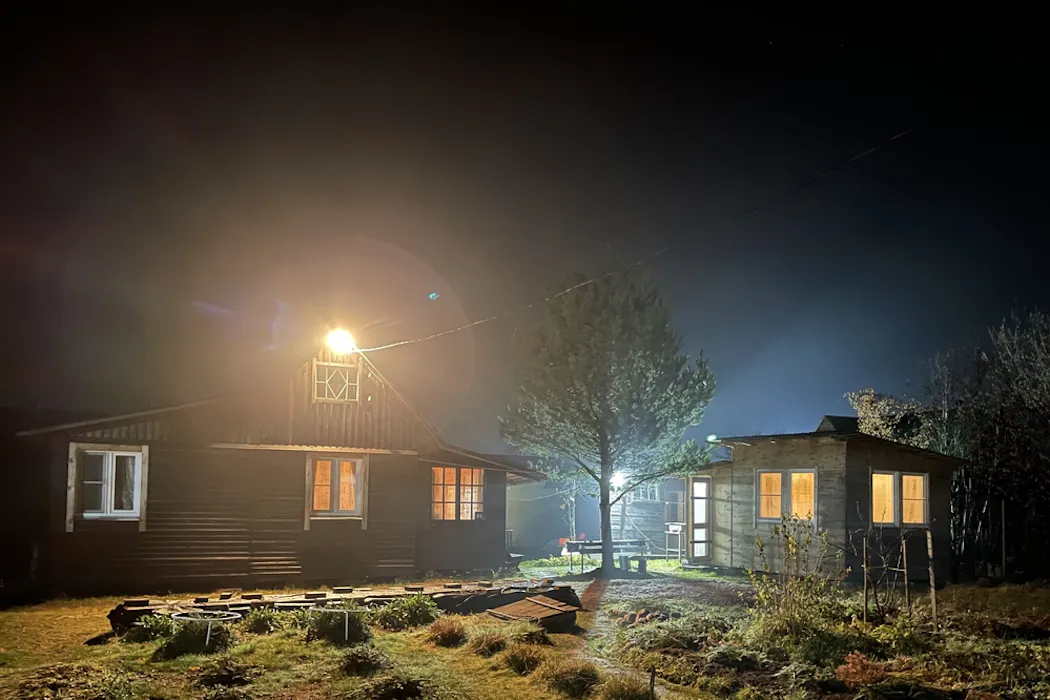
Two agricultural buildings, on left more light is showing.
Before and after a North Yorkshire property worked with the national park’s advice on lighting. North York Moors National Park, CC BY

How does it affect the environment?

Over-illumination disrupts complex regional ecosystems, extending daylight artificially and changing the behaviour of animals that depend on natural darkness. Research suggests that light pollution caused by humans, harms ecosystems because of the critical role light has on the timing of biological systems, which artificial light disrupts.


Read more: Why walking in a national park in the dark prompts people to turn off lights at home


The damage extends from the soil upward. Scientific research indicates that pressures on ecosystems due to habitat loss, pesticides, invasive species and light pollution could create a devastating decline in the insect population, with a knock-on effect on the food chain.

Benefits for farms?

There’s also evidence that suggests that changing lighting could help farms. This light disruption affects crucial agricultural allies. Moths, which serve as vital nocturnal pollinators, are heavily affected, alongside bats facing shrinking feeding grounds. Bats can help farmers control insect pests.

Artificial light exposure also alters vital plant cycles, for instance, and light at night can affect plant growth.

Small changes, such as switching to down-facing lights, can lead to significant environmental improvements.

Changing lighting around farms could also open up new tourism opportunities. Farms that also operate as B&Bs, for instance, can flag to tourists that they are part of a dark skies friendly community programme. This is an accreditation scheme for businesses that improve their lighting systems in accordance with international dark sky standards.

While UK national park authorities have powers to enforce planning restrictions on lighting, in places outside national parks, the UK lacks a comprehensive national regulatory framework to govern rural skyscapes.

The lesson in North Yorkshire and beyond is not that farms should switch off their lights. It is that lighting can be used responsibly to contribute to the stewardship of one of the countryside’s most valuable resources: the natural night sky.

The Conversation

The authors do not work for, consult, own shares in or receive funding from any company or organisation that would benefit from this article, and have disclosed no relevant affiliations beyond their academic appointment.

  •  

‘AI needs to be disarmed’: Pope Leo sees threat to humanity in technological arms race

In the first landmark publication of his papacy, Pope Leo XIV has addressed recent advances in artificial intelligence by focusing on the threat it poses to workers, social justice and “the dignity of persons”.

Presenting his first papal encyclical, “Magnifica Humanitas” (“Magnificent Humanity”), at the Vatican on May 25, Leo declared: “Artificial intelligence needs to be disarmed.”

In the document – comprising around 42,300 words in its English translation – the pope writes: “To disarm does not mean rejecting technology, but preventing it from dominating humanity.”

Encyclicals are exceptionally important papal documents that respond to the most pressing social issues of the time. Typically written as letters to all bishops and archbishops, they have become a crucial vehicle for disseminating the theology and political commitments of the Roman Catholic Church across the world.

Pope Leo XIV signing his first encyclical on May 15 2026. Video: Vatican News.

Leo chose to sign his first encyclical on May 15 2026, the exact anniversary of Pope Leo XIII’s “Rerum novarum” (“Of new things”). This famous encyclical, which responded to the technological advances of the industrial revolution, became the foundational document of all modern Catholic social teaching.

Indeed, the current pope probably chose the name Leo because of Leo XIII’s renowned commitment to social justice.

Just as “Rerum novarum” responded to the industrial revolution by emphasising workers’ rights and the dignity of human labour, so too Leo XIV has responded to the explosion of AI technology by emphasising the importance of human over machine intelligence.

In 1891, Leo XIII wrote: “Wage-earners … should be specially cared for and protected by the government.”

Leo XIV now makes similar appeals to world governments about AI: “It is necessary to establish adequate regulatory tools capable of upholding justice and curbing the distorting effects of technological power.”

Pope Leo XIII
Pope Leo XIII. Wikimedia

The current pope follows a long tradition of Catholic engagement with new tech – from concerns about the impact of the printing press in the 15th century to the rise of the internet over 500 years later.

Leo XIV’s presentation was preceded by a short film which juxtaposed images of previous popes with major technological innovations. Radio towers gave way to images of broadband centres; early computers to a sea of people holding up their smartphones in St Peter’s Square, Vatican City.

Perhaps the crucial theme of this video was the connection between technology and war. Pictures of second world war aircraft were intercut with the dropping of the atomic bomb, soon followed by images of the 9/11 attacks.

In the encyclical, Leo warns: “The growing ease with which autonomous weapons systems can be deployed makes war more ‘feasible’ and less subject to human control.”

Call for disarmament

Leo XIV isn’t the first pope to address the potential threat posed by AI technology. In January 2025, his predecessor Francis signed off the doctrinal note “Antiqua et nova” (“Ancient and new”) – which called for AI technology “to include the least of our brothers and sisters, the vulnerable and those most in need”.

Leo’s new call for the disarmament of AI is not a demand to discontinue its development, but to regulate AI robustly so it only serves the common good.

In this, the pope drew an analogy with the nuclear disarmament movement, suggesting that both nuclear and AI technologies should only be developed for the good of humanity, and never used as weapons.

Video: Vatican News.

Those invited to offer their thoughts on Leo’s encyclical included Christopher Olah, the Canadian billionaire and co-founder of AI firm Anthropic. The appearance of Olah marks the first time a speaker entirely outside clerical or theological circles has been included in such a presentation.

Anthropic is currently locked in a legal dispute with the US government regarding the military application of its AI systems. Leo’s encyclical underlines his concerns about the escalation of war around the world, stating: “It is important to reaffirm that the ‘just war’ theory, which has all too often been used to justify any kind of war, is now outdated.”

Olah echoed Leo’s demands for greater social justice around the use of AI, stating: “His Holiness’s call for disarmament is profoundly timely.”

He called for people working outside computer science to contribute to AI governance and ethics – people “beyond the incentives” of financial markets “who can see what we, from the inside, cannot”.

Leo answered Olah by saying: “In the name of the Church, I accept your invitation to walk together, to listen and to speak – and together, to find the way for humanity in this time of artificial intelligence.”

The Conversation

James Lorenz does not work for, consult, own shares in or receive funding from any company or organisation that would benefit from this article, and has disclosed no relevant affiliations beyond their academic appointment.

  •  
❌