
❌

Reading view

Fossils from Chinese Cave Fill Crucial Gap in History of Gigantopithecus blacki

An artist’s impression of a group of Gigantopithecus blacki within a forest in southern China. Image credit: Garcia / Joannes-Boyau, Southern Cross University.

Deep inside a limestone cave in southern China, paleontologists have uncovered an assemblage of thirteen fossilized teeth belonging to Gigantopithecus blacki, the largest primate species ever known to have lived.

The post Fossils from Chinese Cave Fill Crucial Gap in History of Gigantopithecus blacki appeared first on Sci.News: Breaking Science News.
  •  

Study: Cave Lions were Distinct Species that Occasionally Bred with Ancestors of Today’s Lions

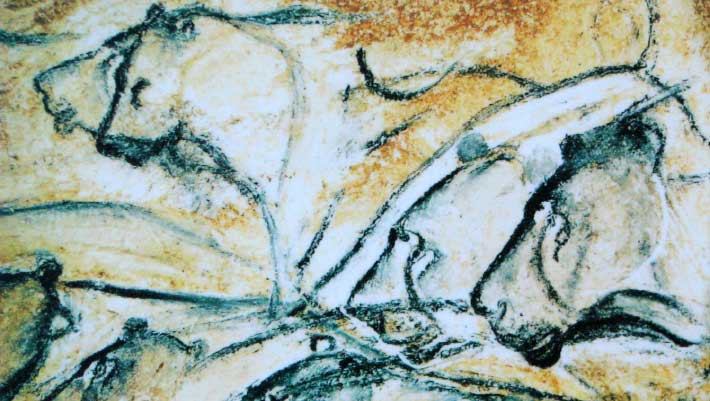
Cave lions painted in the Chauvet Cave, France.

The extinct Eurasian cave lion (Panthera spelaea) and today’s African and Asian lions (Panthera leo) belong to separate evolutionary lineages that diverged roughly 1.7 million years ago -- far earlier than previously thought, according to an analysis of 12 cave lion genomes spanning more than 100,000 years.

The post Study: Cave Lions were Distinct Species that Occasionally Bred with Ancestors of Today’s Lions appeared first on Sci.News: Breaking Science News.

  •  

New Species of Fossil Axolotl Unearthed in Mexico

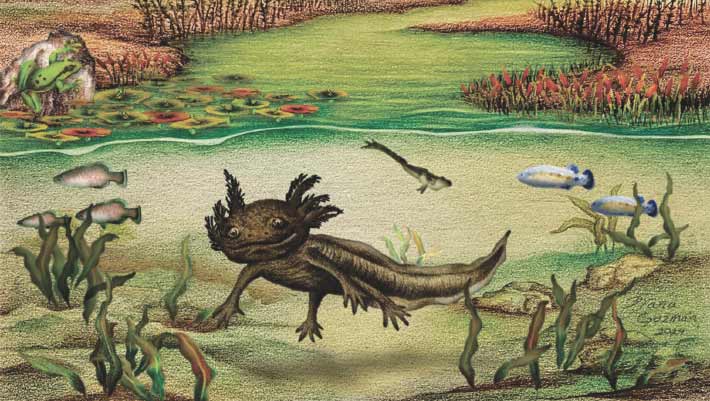
Reconstruction of the Santa MarΓ­a Amajac paleolake during the Late Pliocene; the paleobiodiveristy of the paleolake included microvertebrates such as the ambystomatid salamander Ambystoma quetzalcoatli, Paleocharacodon guzmanae and Goodea-like fishes, anurans and numerous species of terrestrial and aquatic plants such as Nymphaea sp., Scirpus sp., Typha sp. Image credit: Diana GuzmΓ‘n-Madrid.

Paleontologists have identified a new species of the axolotl genus Ambystoma from several fossilized specimens found deep in the rocky outcrops of the Mexican state of Hidalgo.

The post New Species of Fossil Axolotl Unearthed in Mexico appeared first on Sci.News: Breaking Science News.

  •  
❌