
 Login

ESA chief calls for greater European space autonomy as trust in US partnership erodes
The head of the European Space Agency has issued a wakeup call to decision makers amid partners cancelling missions and geopolitical changes affecting the space sector, calling for Europeans to be pilots rather than passengers.
In a LinkedIn post published last month, European Space Agency (ESA) Director General Josef Aschbacher stated that recent decisions taken by the United States to pause the lunar Gateway station and cancel the Mars Sample Return mission campaign — both major projects with deep ESA commitments — have revealed how dependent the agency is on outside actions.
"Europe has become too exposed to decisions beyond its control," Aschbacher wrote, before laying out the challenge the continent faces. "The choice before Europe is clear: Do we pilot, or are we merely passengers?"
The situation for ESA and its 23 member states is complex, requiring Europe to both develop agency and autonomy while balancing this with fruitful collaboration, Aschbacher noted.
"The current environment demands both diversified international partnerships and strengthened autonomous capabilities," he wrote. "Only under these conditions can Europe decide when to act independently and when to cooperate globally, protecting our investments and our industrial base amid geopolitical uncertainty."
With trust in the U.S. as a reliable partner taking a hit, collaboration with other space actors such as Japan, South Korea and Australia could grow, while Europe also pursues its own capabilities.
Human spaceflight is one area Aschbacher is keen to push Europe forward, describing it as a necessity rather than a luxury, and one needed to secure ESA's freedom to unlock the "scientific, economic, strategic and geopolitical benefits of space and to inspire a new generation to shape Europe's future."
The question is not new — it has long been debated by European policy makers and the space sector — but recent events and Aschbacher's comments have brought the issue to the fore. And there is clear support and grounds for greater European autonomy in space.
"The disruption brought by the Trump administration has made this question more pressing," said Marco Aliberti, associate manager and lead on international engagement at the European Space Policy Institute (ESPI) in Vienna, an independent think tank that advises European space policymakers. "There is a realization in Europe that so far we have not been pursuing autonomy."
Europe, Aliberti argued, has built genuine technical capacity, including the ability to build and operate world-class space systems, but, at the same time, has consistently failed to secure the political autonomy to decide how and with whom those capabilities are deployed.
"Participation without agency is yet another form of dependency dressed up as ambition," he said. In other words, Europe has built the capacity to execute in space, but not the autonomy to decide its own agenda.
Aliberti pointed out that this is not the first time Europe has needed to move to acquire greater autonomy. The birth of Europe's Ariane rocket in the 1970s was a response to an asymmetric relationship. The United States refused to launch the Franco-German Symphonie communications satellite unless Europe agreed to forgo commercial use, with the aim of protecting American dominance in commercial communications. European governments concluded they had no choice but to build their own launch capability.
Aliberti went on to point out that history could, potentially, repeat itself, this time in the lunar realm, as a European partner dependent on U.S. transportation could face unacceptable conditions. "The U.S. may tell us: I will continue bringing you to the lunar surface, provided that you do not engage in commercial activity," he said. "We do not see the risks that being a passenger entails."
And investment in space can bring huge payoffs. For example, NASA's Commercial Orbital Transportation Services contracts in the 2000s gave early funding to SpaceX, enabling the development of the company's workhorse Falcon 9 rocket, and ultimately, the rise of its Starlink broadband megaconstellation.
"It was the billions that NASA gave to SpaceX that enabled the birth and growth of SpaceX," Aliberti stated. "Let's not neglect the impact that space exploration investment has across other parts of the ecosystem."
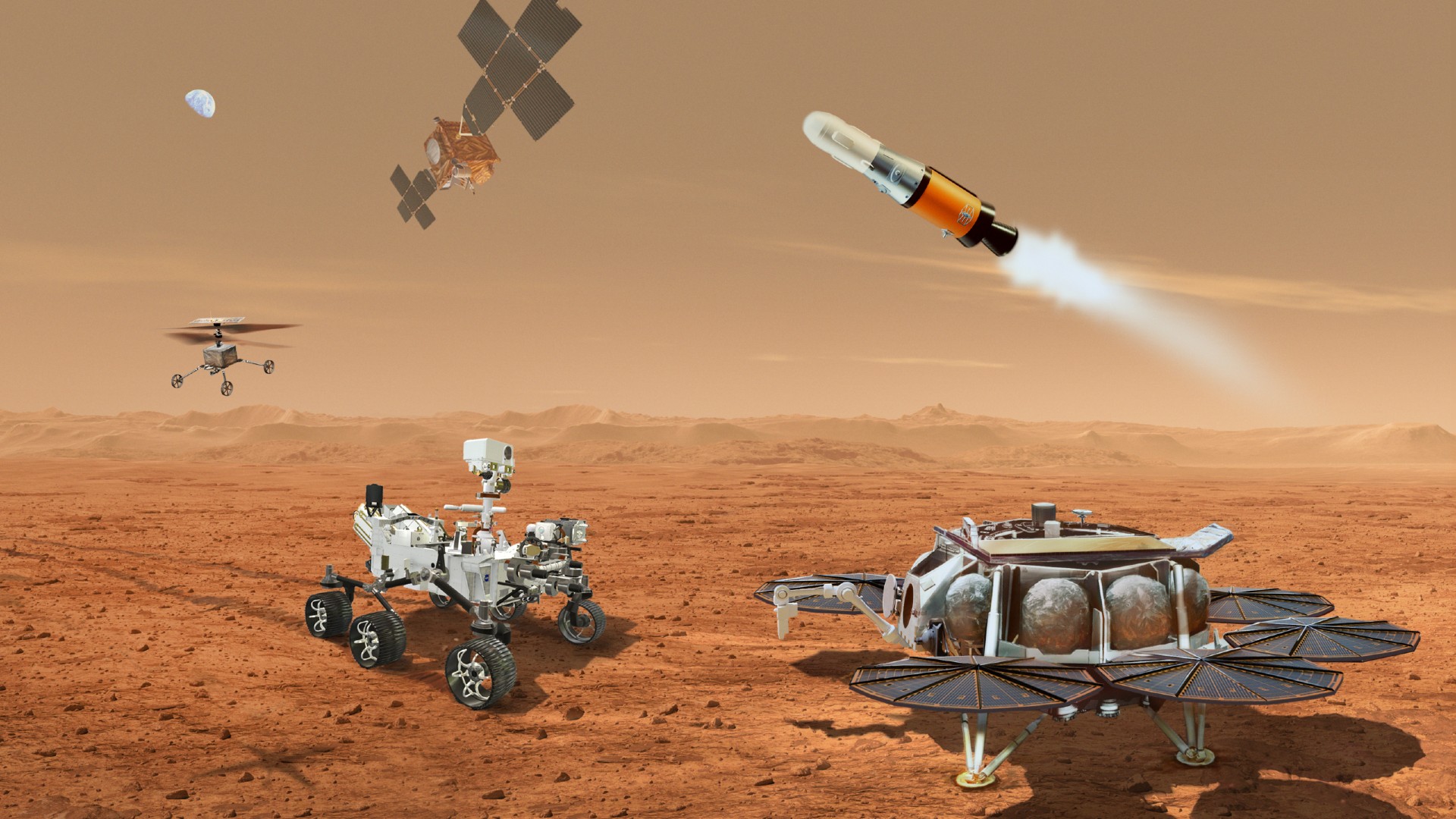
ESA's DG has signaled the need for action and its urgency, although he admitted it will take years to build autonomous capability. "If not now, then when? If not ESA, then who?" Aschbacher asked.
What comes next is unclear. Institutionally, Aschbacher sees opportunities in a convergence of key meetings and milestones, including an ESA Council in mid-June, a ministerial focused specifically on exploration scheduled for December, and the crucial once-every-three-years ESA Ministerial Council in 2028. At the same time, the European Union, with a growing interest in space separate to ESA, is drafting its Multiannual Financial Framework for 2028-2034.
Aliberti warned that, if ESA cannot act promptly, its member states could move to act alone to address shorter-term needs. He cited the recent development of the French government reaching an agreement to send a pair of its astronauts on missions with U.S. space station firm Vast.
As confidence in the partnership with the U.S. government erodes, individual European nations may look to explore bilateral arrangements with commercial American providers, meaning less interest in investing into joint European efforts. The window for collective European action is open, but perhaps not for long.
"If we take decisions by the Ministerial Council in 2028, we will be able to play a role and be pilots in 10 years," Aliberti says. "If not, it may become too late."


